

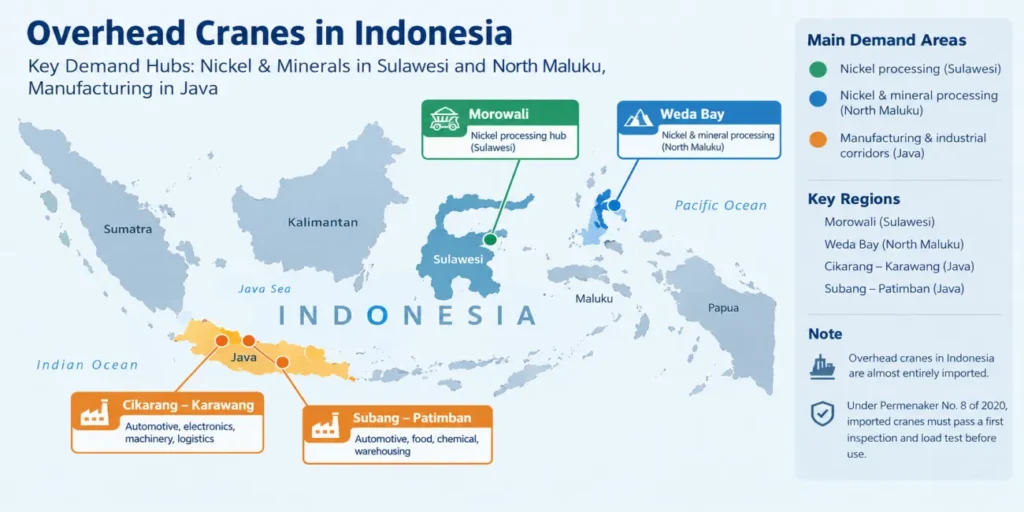
Overhead cranes in Indonesia are almost entirely imported, and demand is pulled by two engines: nickel and mineral processing plants in Sulawesi and North Maluku, and factories and warehouses along Java's industrial corridors. Buyers in both places face the same gate. Under Permenaker No. 8 of 2020, the Ministry of Manpower's regulation on lifting equipment, an imported crane must pass a first inspection and load test before it can be used.
Most quotes compare capacity, span and price. The Indonesian side of the job (inspection documents, operator licences, import duty, humidity, and local-content rules on mining projects) tends to surface after the purchase order, which is where schedules slip and budgets stretch.
This guide covers where the demand actually sits, what an imported crane must clear, how to specify it for Indonesian sites, and what to ask a supplier before you sign.
Оглавление
Quick reference: overhead cranes in Indonesia by application
| Приложение | Typical crane | Capacity (reference) | Duty class, ISO 4301 (reference) | Confirm first |
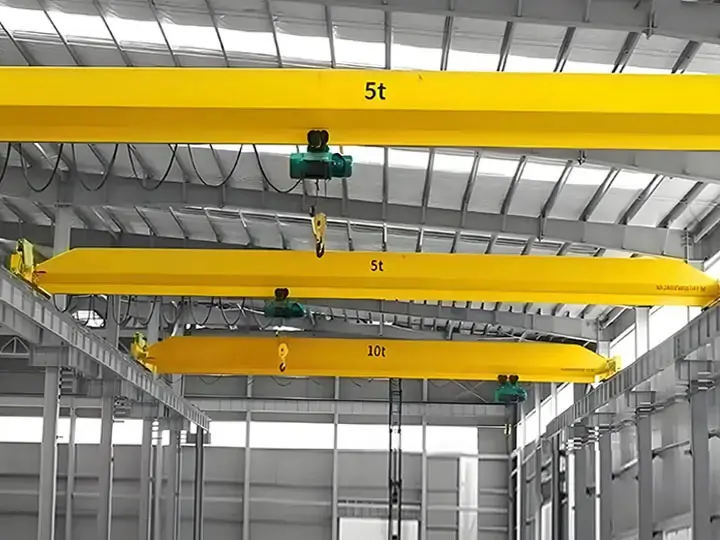
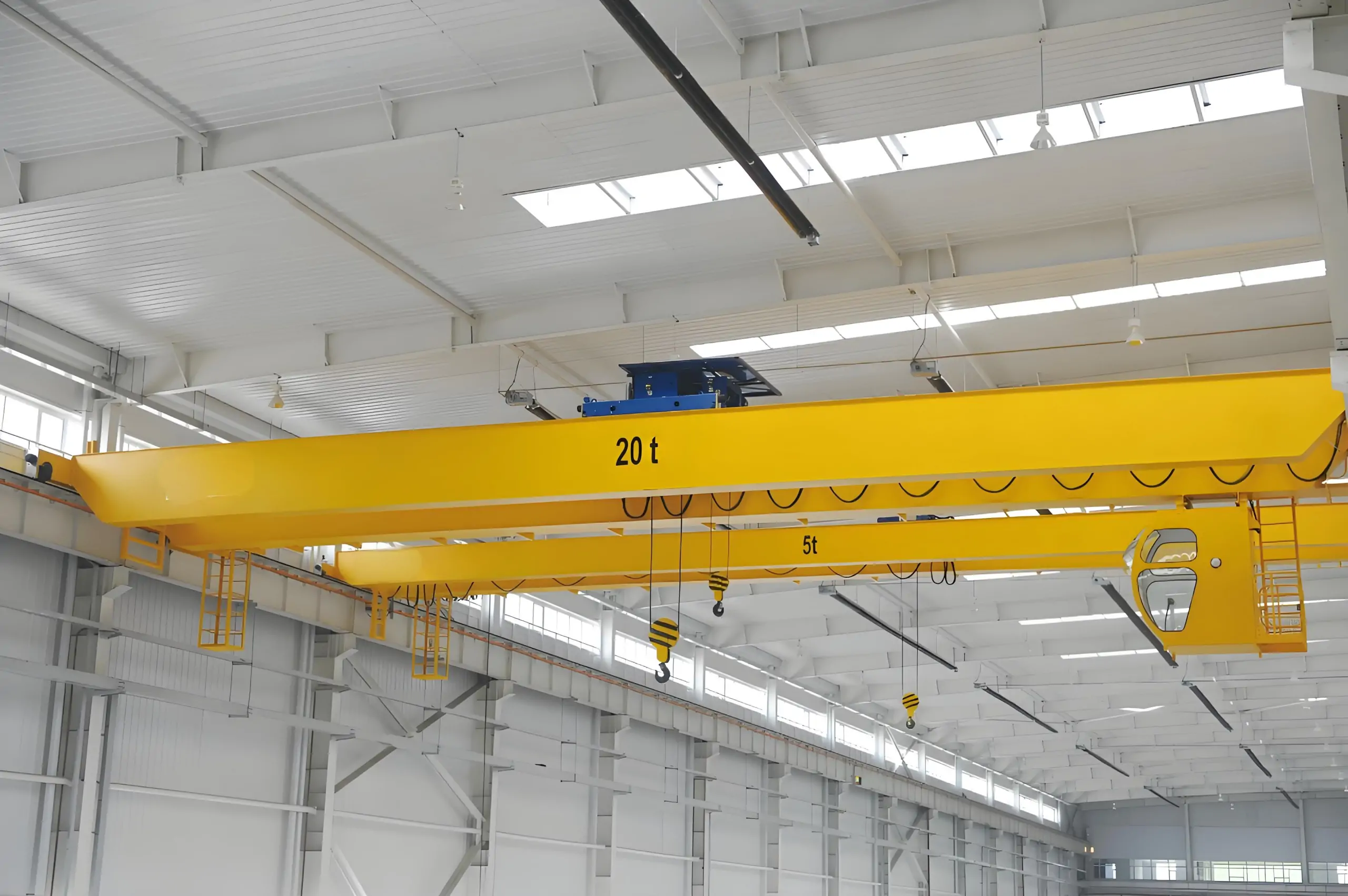
| Machine shops, fabrication | Single girder EOT crane, electric hoist | 2–20 t | A3–A5 | Runway length, headroom, hook approach |
| Automotive and component plants (Java) | European-style single girder, variable-speed drives | 2–16 t | А4–А5 | Positioning precision, duty for repeated cycles |
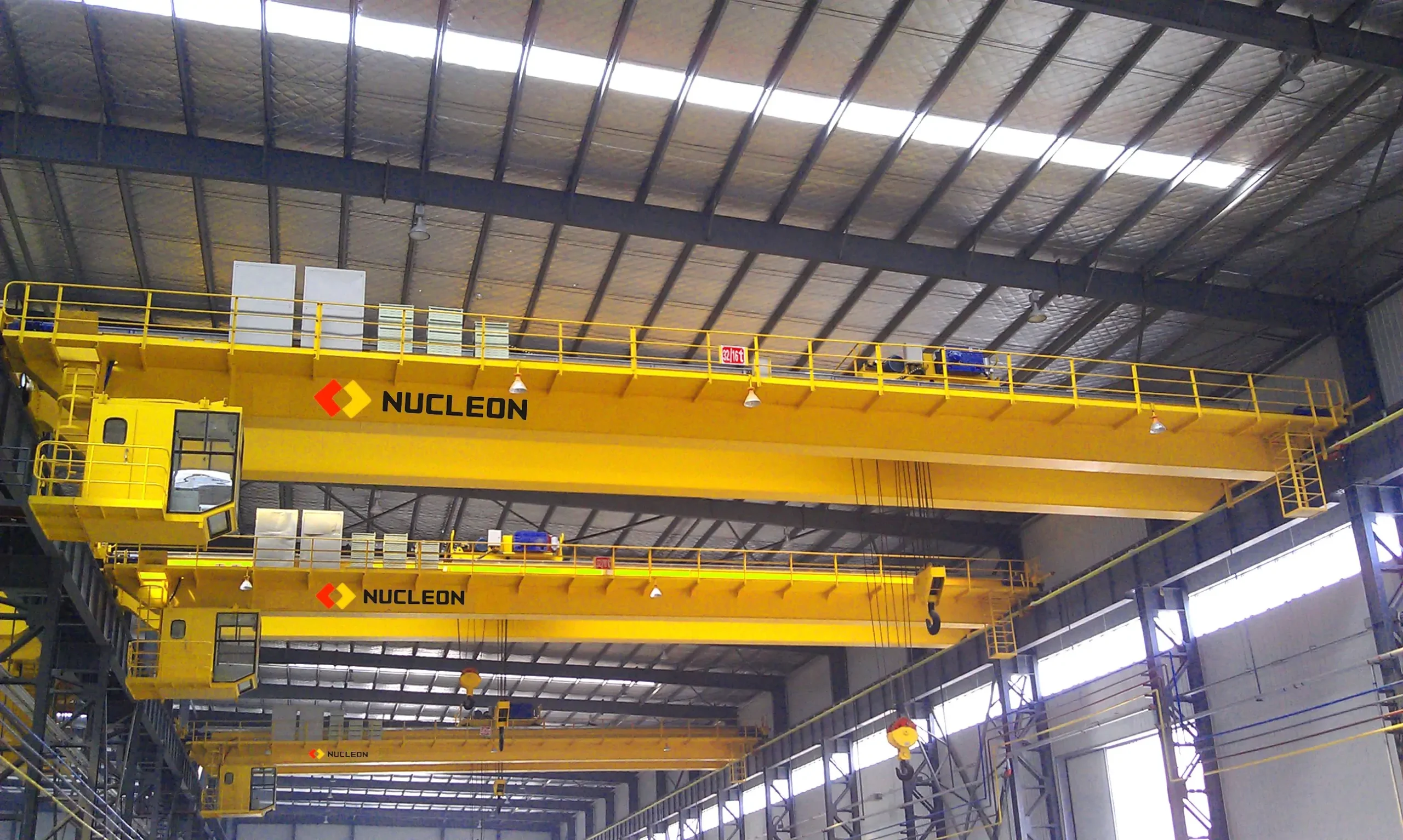
| Steel and metal processing | Single or double girder, remote or cab control | 10–30 t | A5–A6 | Spreader or magnet, corrosion protection |
| Maintenance workshops at mines and smelters | Single girder, light to medium duty | 5–20 t | A3–A5 | Dust and humidity protection, heaviest component |
| Furnace and ladle bays | Special metallurgical or ladle crane | Project-specific | А6–А7 | Specialist design; confirm the supplier has direct experience |
| Warehouses and logistics | Single girder, low headroom | 1–10 t | A3–A4 | Building clearance |
| Outdoor yards (stock, precast, timber) | Козловой кран, not an overhead crane | Project-specific | A4–A6 | Rain protection, rail foundation, wind design |
Capacity and duty ranges are typical reference bands, not model commitments. Contact us to confirm parameters for a specific model.
For most Indonesian workshops and warehouses, a 5–10 t single girder crane at A3–A4 covers the need; steel plants and smelter halls justify double girder designs at A5–A6 or higher. Furnace and ladle handling needs a purpose-built metallurgical crane, not a general-purpose crane with extra paint.
Price reference: equipment-only market reference for a 10 t single girder overhead crane runs roughly $3,890–$12,000, and a 20 t unit $7,100–$18,300. The pricing section explains what those figures leave out.
Получить коммерческое предложениеWhere Demand for Overhead Cranes in Indonesia Comes From
Indonesia imports almost all of its cranes, and China leads
China supplies about 72% of Indonesia's imports in HS 842619, the customs heading for bridge, gantry and transporter cranes, and import value grew roughly 27% a year from 2020 to 2024. The figures come from ITC Trade Map data compiled in a 2025 market review by a Chinese crane maker, which also puts the 2024 imports at about USD 138 million and the trade deficit at about USD 135 million, so domestic production is thin.
Two cautions. This is a supplier's compilation, and HS 842619 excludes fixed-support overhead cranes, which have their own code (HS 842611), so the true overhead crane market is probably larger. Treat the numbers as direction, not precision.
The reasons for Chinese dominance are practical: a full product range, faster quotes and short sea routes. Japanese, German and Korean brands mostly compete in high-specification and automated projects. The consequence for a buyer is that Chinese quotes will look alike on price and capacity. What separates them is document quality, installation support and how well the crane is specified for Indonesian conditions.
Mining demand sits in plants and workshops, not at the pit
Mining drives overhead crane demand through the buildings around the mine, not the pit itself. Overhead cranes need a runway structure and a roof, so they live in smelters, processing plants, maintenance workshops and warehouses; pit-side lifting is done with mobile and crawler cranes.
Indonesia counts 55 RKEF smelters, 10 HPAL plants, 10 nickel matte producers and six integrated stainless steel smelters, according to the Jakarta Post. On 8 October 2026 President Prabowo launched four commercial facilities and marked construction starts for seven more at the Indonesia Weda Bay Industrial Park in North Maluku, 11 projects worth about US$10.2 billion, which the Oregon Group reports are Chinese-backed. Each plant needs cranes for maintenance bays, workshops, warehouses, material yards and utility buildings.
Mine output itself is being trimmed. The mineral and coal director general projected about 720 million tonnes of coal for 2026 against 817 million in 2025 (Indonesia Business Post), and officials were reported in January to be considering a nickel ore target of 250–260 million tonnes, down from about 379 million (S&P Global). Yet nickel output was still forecast to rise 11.9% to 2.9 Mt in 2026 as funded smelter capacity comes online (GlobalData via Mining Technology).
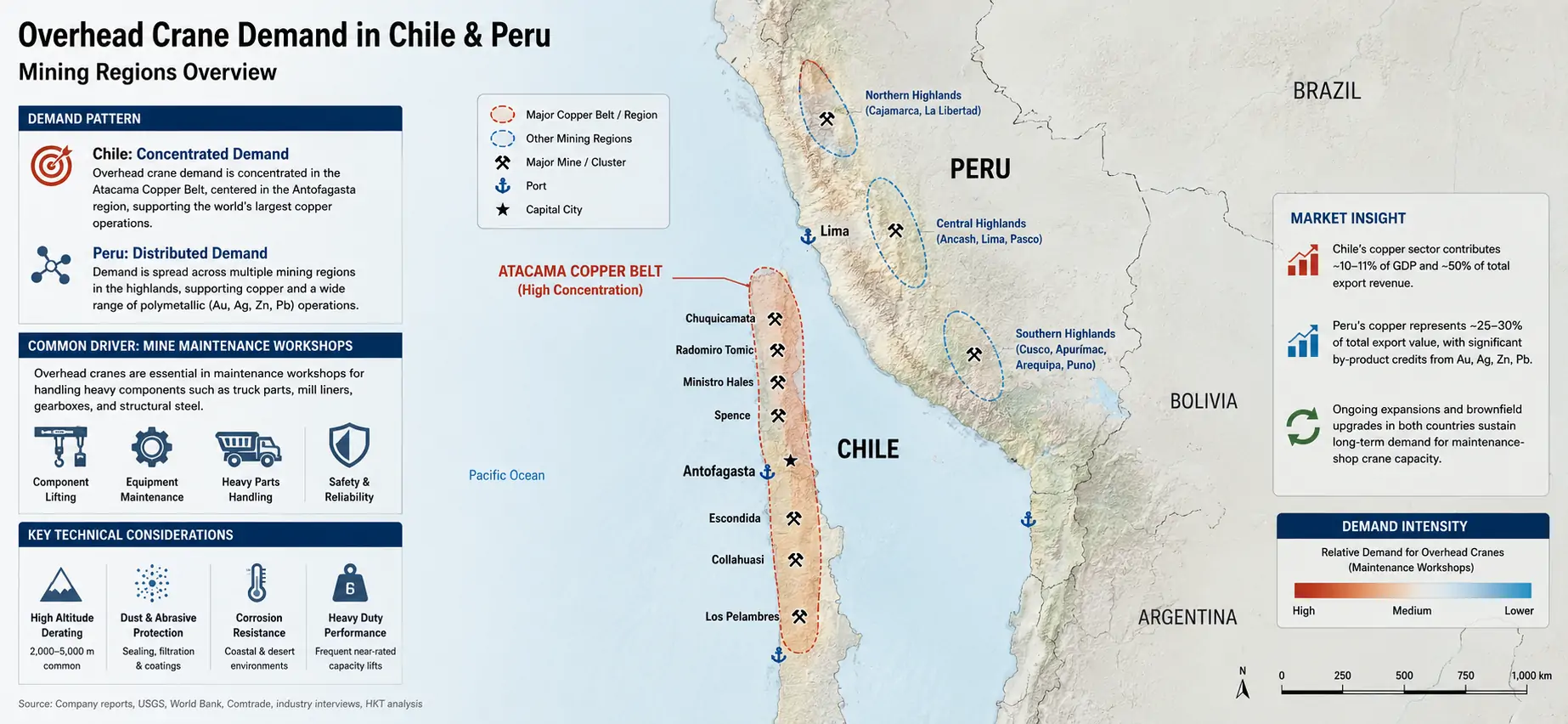
Our reading: quota cuts slow mine-side purchasing, while plants under construction or commissioning keep buying cranes. Mining work plans (RKAB) are now approved annually, according to a logistics provider's summary of Energy Ministry Regulation 17/2025, so expect purchase timing to follow approval windows. For the same mining-driven pattern in South America, see overhead cranes in Peru and Chile.
Java's factories and warehouses set the specification benchmark
Java's industrial corridors generate steady demand for light-to-medium duty cranes. CBRE Indonesia says land in the Cikarang–Karawang corridor east of Jakarta is now extremely limited, with expansion moving toward Subang and Patimban in West Java, a cluster targeting manufacturing and automotive occupiers (IDNFinancials). Recent absorption in Cikarang–Karawang has come mostly from data centres, logistics warehouses and manufacturers that need skilled labour.
West Java steel and wire plants also show what buyers specify when uptime matters. In February 2026 Konecranes booked nine overhead cranes for PT Tata Metal Lestari in West Java, from 10 t to 30 t, all with remote monitoring (Конекранес). Its late-2024 order for PT Beka Wire in Subang called for hot-dip galvanized girders and C5-coated hoist components on runways nearly 200 m long (Dry Bulk Magazine).
A Chinese bid in the same plant is compared against those features. Price corrosion protection and condition monitoring as visible options, so the buyer compares like with like instead of discovering the gap after delivery. Useful starting points: Однобалочные мостовые краны и двухбалочные мостовые краны.
A demand risk to watch: nickel oversupply
Nickel fell to a 2026 low of US$15,510 a tonne on 2 October, and the government is considering a moratorium or restrictions on new smelters that make semi-processed nickel, according to the Jakarta Post. No final policy has been announced.
Our reading: demand for cranes on new greenfield smelter lines may be uneven, while demand tied to maintenance, upgrades and downstream processing (batteries, aluminium, stainless) is steadier. Weda Bay's latest launches are mostly downstream, which fits that picture. Qualify greenfield smelter leads early and keep the maintenance and downstream pipeline warm.
Compliance: What an Imported Overhead Crane Must Clear Before It Works
Permenaker 8/2020 requires a first inspection and load test for every imported crane
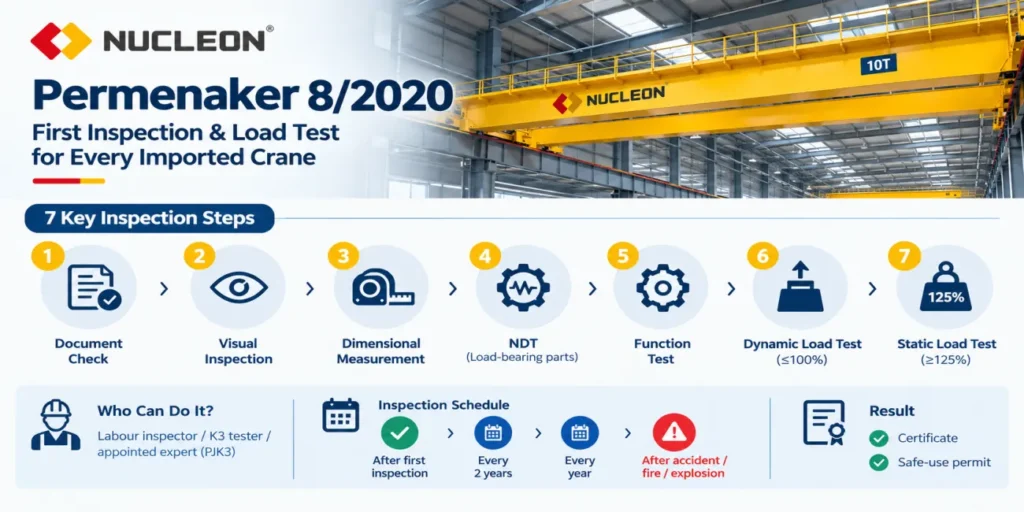
An imported overhead crane must pass a first inspection and test under Permenaker 8/2020 before it can be used. Article 175 applies the first inspection to manufacture, installation, repair or modification, and to equipment that is new, imported or rented. For girder cranes the test is:
- Document check
- Visual inspection
- Dimensional measurement
- Non-destructive testing of load-bearing parts
- Function test
- Dynamic load test, applied in steps up to 100% of rated load
- Static load test at 125% of rated load or more for girder cranes (110% for most other lifting equipment)
The work must be done by a labour inspectorate specialist, a competent K3 tester or an appointed K3 expert (Article 173), typically through a licensed K3 service company (PJK3). After the first inspection, periodic inspection and testing falls due no later than two years later and then every year; a special inspection follows any accident, fire or explosion (Articles 176–177). Passing leads to a certificate and a safe-use permit. The full text is available in Permenaker 8/2020 (Indonesian).
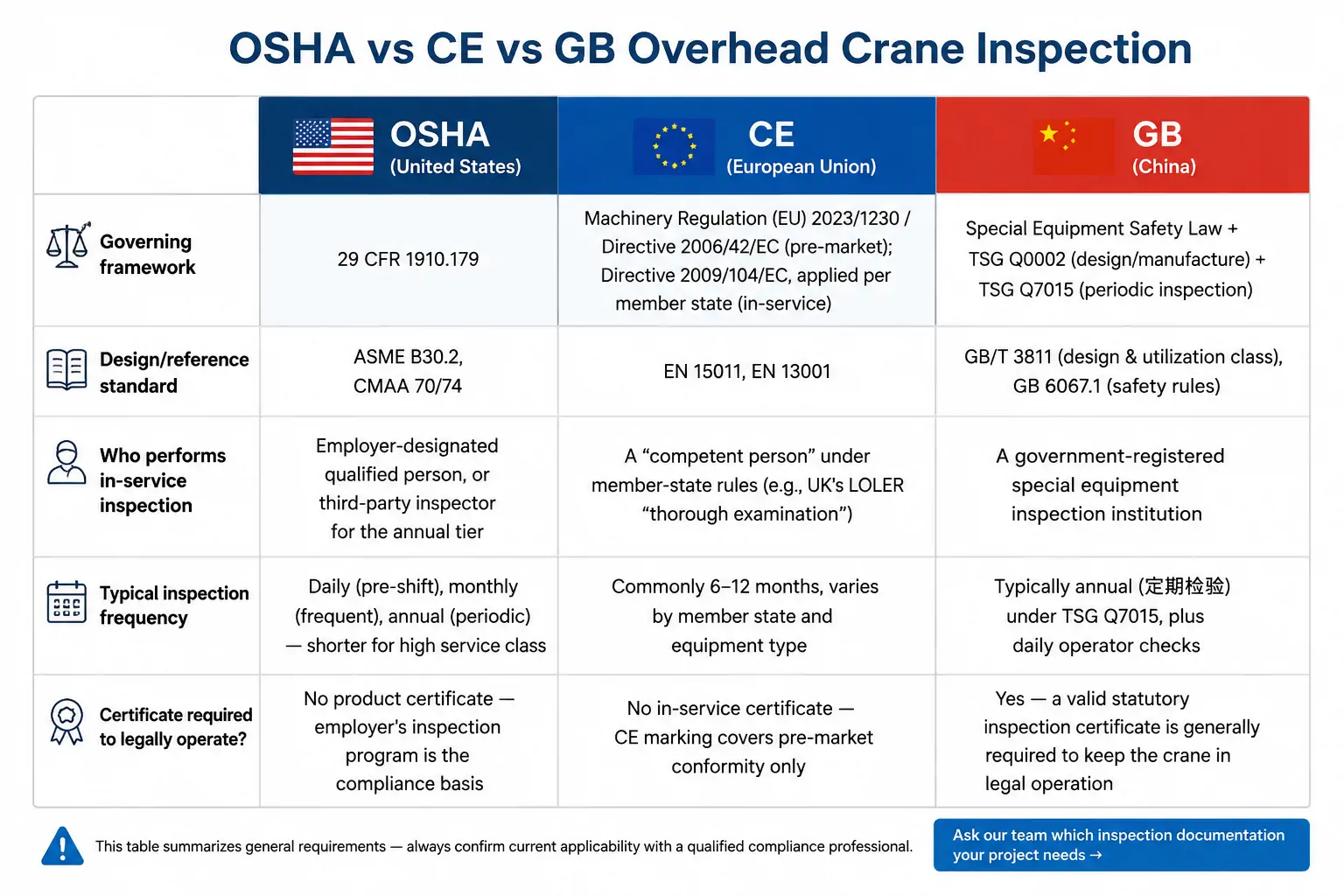
Our reading: the first inspection starts with a document check, so what the factory hands over matters as much as the steel. Ask your inspection body early which drawings, calculations, certificates and test records it needs, and make the supplier ship them with the crane. Our OSHA vs CE compliance checklist shows how to organise a technical file that inspectors and buyers can follow.
Design and documentation requirements start at the factory
The regulation sets design and equipment rules, so a quote should be checked against them before an order is signed. The table lists the items most relevant to a bridge crane.
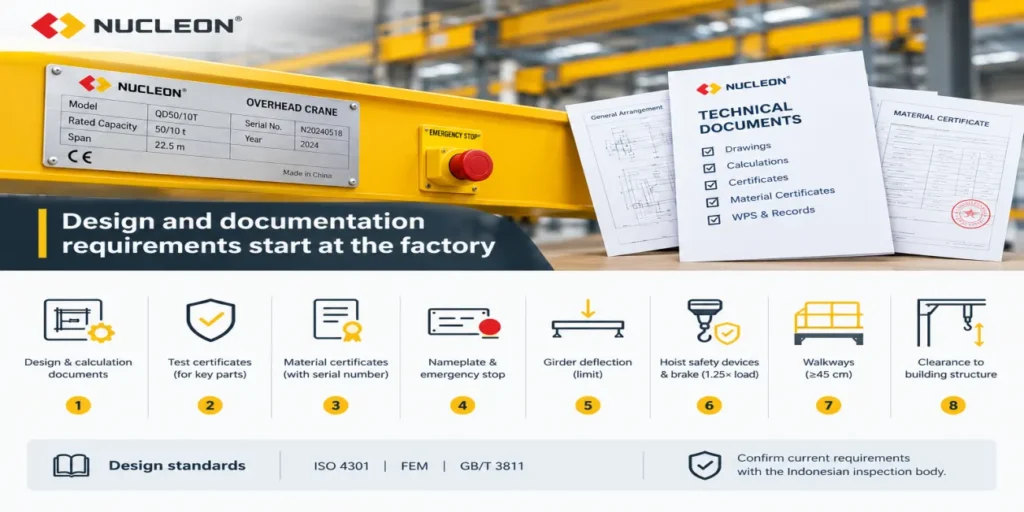
| Requirement | Article | What to ask the supplier |
| Design drawings, strength calculation, welding procedure specifications and qualification records for welded load-bearing parts | 5 | Copies in English, ready for the inspector |
| Test marks or certificates for girders, hooks, wire ropes and chains | 7 | Material certificates tied to this crane's serial number |
| Nameplate with maker, year, model, serial number and capacity; red emergency stop | 16–17 | Nameplate drawing and wording |
| Girder deflection at maximum load no more than 1/888 of span (single girder) or 1/600 (double girder), as published | 29 | Calculated deflection at mid-span |
| Electric hoisting: automatic brake, upper and overload limiting devices, brake holding at least 1.25× rated load | 40 | Brake torque and limiter data |
| Double girder: walkways at least 45 cm wide with guardrail and toeboard | 44 | Walkway layout |
| Clear space between crane and building structure | 48 | Building clearance drawing |
An inspector measures deflection and tests the brakes during the load test, so a mismatch found on site costs weeks, not hours. We read the 2020 published text; confirm current requirements and any amendments with an Indonesian inspection body. Design standards still matter: ask the supplier to state ISO 4301, FEM or GB/T 3811 and how load tests are documented.
Operator class and licence decide who can run the crane
Crane capacity sets the operator class: Class III up to 25 t, Class II above 25 t up to 100 t, and Class I above 100 t (Article 165). Operator K3 licences last five years, and employers may not use unlicensed operators (Articles 162 and 171).
The practical effect shows at the boundary. A plant whose heaviest lift is 26 t and that buys a 25 t crane is also buying a staffing problem, while a 32 t crane brings Class II licensing into the project plan. Ask the customer how many licensed operators they have before settling capacity, and offer operator training in the commissioning scope.
Installation, maintenance and repair must be done by technicians holding a K3 licence (Articles 141 and 144). Ask early who the licensed technician on site will be, because a foreign supervising engineer may not satisfy that alone.
Import duty, permits and local content
Duty is modest for China-origin cranes, but the paperwork is not. A tariff aggregator (Treayo) lists Indonesia's MFN duty on HS 8426.11, overhead travelling cranes on fixed support, at 5%, with a 0% preferential rate for China-origin goods under ACFTA or RCEP with a Form E certificate of origin. VAT and other import taxes are charged on top. Aggregators lag official schedules, so confirm your HS code and the current rates with a customs broker before fixing a landed price.
Three more checks:
- Import approvals. Trade Ministry Regulations 16/2025 and 22/2025, effective 30 August 2025, tightened import approvals for certain industrial goods (DFDL summary). Whether your crane's HS code needs one is a question for the customs broker.
- Used cranes. Used machinery is a restricted category with extra conditions, so new equipment is the simpler route.
- Local content (TKDN). According to logistics provider PT Transcon Indonesia, Ministry of Industry Regulation 35/2025, effective 12 December 2025, requires mining procurement to meet at least 25% local content, and equipment without TKDN documentation can be disqualified (TCI summary). State-owned and government-funded tenders may also carry local-content preferences.
These are secondary summaries, not the regulations themselves. The end user's procurement team will tell you whether TKDN applies to their purchase.
Planning an Indonesian project? Send us the capacity, span, lifting height, building drawings and site voltage, and our engineers will come back with a reference configuration.
Получить коммерческое предложениеSpecifying Overhead Cranes for Indonesian Sites
Humidity, coastal air, rain and ground conditions
An Indonesian site needs a written specification for corrosion, electrical protection and foundations, not the supplier's defaults. The climate is hot and humid, plants near ports see salt air, and outdoor runways take heavy rain. Konecranes' Beka Wire order used hot-dip galvanizing and C5-coated hoist components, C5 being the high-corrosivity category in ISO 12944. A published Chinese export case for an Indonesian timber mill added rain covers on the trolley and chlorinated-rubber paint.
How to specify it:
- State the paint system and coating thickness, or galvanizing for girders in coastal plants.
- Ask for enclosure ratings on motors, brakes and control panels; IP55 or higher is typical for outdoor electrical enclosures.
- Add anti-condensation heaters for panels that sit idle in humid halls.
- For outdoor runways, plan for the wind rule in Article 49: operation must stop when wind exceeds 38 km/h.
- Indonesia is seismically active. Ask the building engineer whether seismic loads apply to the runway and building, and whether crane stops and rail clamps need upgrading.
- Outdoor gantry rails need a properly designed foundation, particularly on reclaimed or soft ground.
- Hot, dusty or explosive areas in mineral processing may need higher protection ratings or explosion-proof equipment; see our guide to when you need an explosion-proof overhead crane.
The trade-off is a higher upfront price. It is usually cheaper than repainting a girder in a live plant and the downtime that comes with it. Confirm the site voltage, frequency and phase from the electrical drawings. The Indonesian export cases published by Chinese makers show 380 V, 50 Hz, three-phase, but plants differ.
Match capacity and duty class to the real lifting cycle, not the nameplate
Duty class under ISO 4301-1 follows the load spectrum and number of cycles, not rated load alone. Published export cases for Indonesian sites show a 5 t single girder crane at A5 and a 32 t billet-handling gantry at A6. A crane lifting a few times a day in a maintenance bay can sit at A3–A4; one cycling coils, bars or billets through two or three shifts usually starts at A5–A6.
Under-specifying duty class is the usual way a cheap crane becomes an expensive one: wheels, gearboxes and hoist ropes wear out years early. See how duty class works, and the component guides on crane gearbox selection, wire rope versus chain hoists и main girder materials and structure. The parts of an overhead crane guide covers terminology. Capacity also interacts with the 25 t operator class threshold above, so settle the heaviest real lift first.
Delivering to island sites
Sites in Sulawesi and North Maluku may need transshipment, barge or trucking after the main port, so delivery terms matter as much as the crane. Decide early whether the main girder ships in a container, on a flat rack or as break-bulk, because that sets port handling, inland trucking and whether a site crane is needed to unload. Ask the supplier for shipping dimensions and weights of every component with the quote, and agree who provides lifting equipment on site for installation.
Pricing and Supplier Evaluation
Equipment prices are a starting point; landed cost is the real comparison
Market reference prices for single girder overhead cranes start near $3,890 for 10 t, but the number that matters is the delivered, inspected and commissioned cost. The ranges below come from published Chinese manufacturer price lists and cover the crane only.
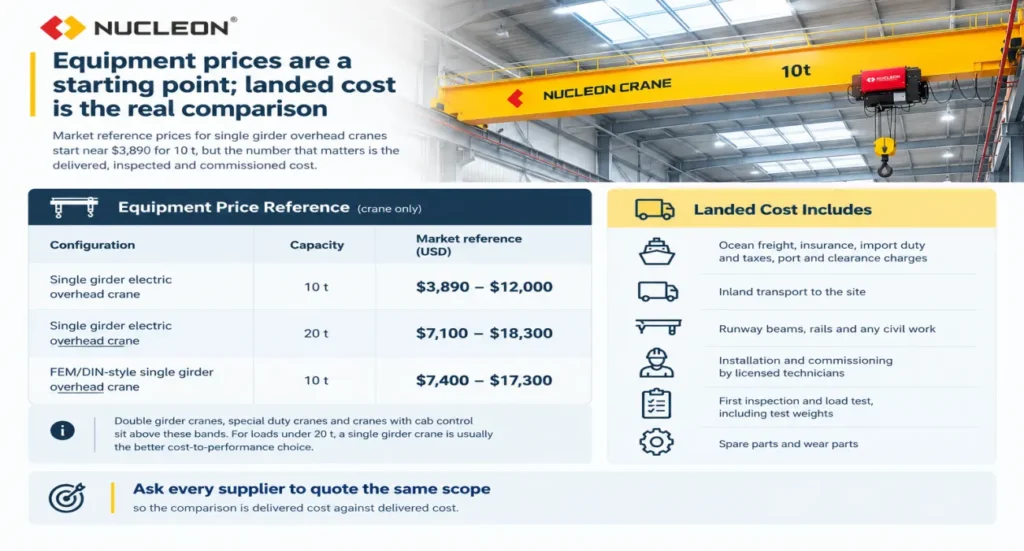
| Конфигурация | Вместимость | Market reference (equipment only) |
| Single girder electric overhead crane | 10 t | $3,890–$12,000 |
| Single girder electric overhead crane | 20 t | $7,100–$18,300 |
| FEM/DIN-style single girder overhead crane | 10 t | $7,400–$17,300 |
Double girder cranes, special duty cranes and cranes with cab control sit above these bands. For loads under 20 t in a standard workshop, a single girder crane is usually the better cost-to-performance choice.
The spread within each row comes from span, lifting height, duty class, hoist type and component brands. What the figures leave out is where Indonesian projects differ:
- Ocean freight, insurance, import duty and taxes, port and clearance charges
- Inland transport to the site
- Runway beams, rails and any civil work
- Installation and commissioning by licensed technicians
- First inspection and load test, including test weights
- Spare parts and wear parts
Ask every supplier to quote the same scope, so the comparison is delivered cost against delivered cost. Our overhead crane price guide explains how each cost driver moves the quote, and warehouse crane solutions for SMEs shows how to match a lighter crane to the building.
A supplier checklist that follows Indonesian rules
The best supplier is the one that hands over what the Indonesian inspection will ask for. Request these before the purchase order:
- Design drawings and strength calculation for the crane
- Material certificates for girders, hooks, ropes or chains
- Welding procedure specifications and qualification records
- Nameplate data matching the documents' serial number
- Factory test and inspection record
- Operation and maintenance manuals; Article 5 requires maintenance to follow the manufacturer's manual
- Recommended spare parts list, with wear parts stocked and a stated response time
- A named engineer for installation supervision and the load test, plus the licensed local technician
- TKDN documentation, if the end user is a mining company
- Commercial terms: Incoterm, what duties and taxes are included, and quote validity
Our reading: items 1–4 cost the supplier little to produce at manufacture and a lot to reconstruct after shipment. A supplier that cannot produce them on request is the one most likely to stall your first inspection.
What to send when requesting a quote
A complete enquiry saves a week of back-and-forth and lets us propose a configuration, a clear inclusion list and the documents your inspection body will ask for. Send:
- Capacity, span, lifting height and duty pattern (shifts, lifts per hour)
- Site voltage, frequency and phase
- Indoor or outdoor use, and nearby coastline or chemical exposure
- Building or runway drawings, or photos
- Destination site and nearest port
- Which inspection documents you want prepared for your PJK3, and which standard it requires
- Whether you need installation supervision
Nucleon Crane also exhibited at Mining Indonesia 2026 in Jakarta in September; see the exhibition news for the products shown. For the same market-guide format in Southeast Asia, see overhead cranes in Vietnam.
Заключение
Overhead cranes in Indonesia are an import-led market, and the winning bid is the one that arrives with the paperwork, the right corrosion protection and a clear delivered price. Demand is real in nickel and downstream processing plants and in Java's factories and warehouses, even while 2026 mining quotas tighten and the nickel price stays weak.
Three actions: confirm capacity and duty class from the real lifting cycle, ask for the document set before the PO, and quote on delivered scope so suppliers compare fairly. If you are planning overhead cranes in Indonesia and want a reference configuration, send us your building drawings, capacity, span, lifting height and supply voltage.

Специалист по оборудованию
Успешный менеджер по работе с кранами с обширным опытом в управлении крупномасштабными проектами и операционным контролем. Подтвержденный опыт увеличения доходов и обеспечения соблюдения требований безопасности.
Часто задаваемые вопросы
Q1: Do overhead cranes need inspection in Indonesia before use?
Yes. Under Permenaker 8/2020, imported cranes need a first inspection and load test before use. For girder cranes the static test is at least 125% of rated load, and the dynamic test goes up to 100%. Periodic inspection follows within two years of the first, then annually, carried out by a K3 inspector, tester or expert.
Q2: What operator licence does a 30-ton overhead crane need in Indonesia?
A Class II licensed operator. Article 165 of Permenaker 8/2020 assigns Class III operators up to 25 t, Class II above 25 t up to 100 t, and Class I above 100 t. The K3 licence is valid for five years, and employers may not use unlicensed operators, so plan training time before commissioning.
Q3: What is the import duty on overhead cranes in Indonesia?
Duty is about 5% MFN on HS 8426.11, per one tariff aggregator. China-origin goods may enter at 0% under ACFTA or RCEP with a Form E. VAT and other import taxes are extra. Aggregators lag official schedules, so confirm your HS code, rates and any import approval with a customs broker before fixing a landed price.
Q4: How much does an overhead crane cost for an Indonesian project?
Equipment-only market reference prices start around $3,890–$12,000 for a 10 t single girder crane and $7,100–$18,300 for 20 t. Delivered cost is higher once freight, import duty and taxes, installation, first inspection and load testing are added. Quote suppliers on the same delivered scope; contact us for a project quotation.
Q5: What voltage do overhead cranes use in Indonesia?
Three-phase 380 V at 50 Hz is common, but confirm at your site. Published export cases for Indonesian plants list 380 V, 50 Hz, three-phase, yet older or specialised plants may differ. Take voltage, frequency and phase from the electrical drawings and state them on the purchase order, so the motors and control panels match from day one.

 English
 العربية
 Español
 Français
 Português
 Русский