

Chain hoist capacity is the maximum load a hoist is rated to lift, stamped on its body in tons or kilograms. It ranges from 1/4 ton for workshop tasks to 20 ton for heavy industry, but the right size also depends on duty class, load type, headroom and the structure it hangs from.
Most buyers still order on that one number. They ask for a 5-ton hoist, get a quote for a 5-ton hoist, and consider the job done. That is one of the most common purchasing mistakes, because tonnage is only one dimension of the specification. A 2-ton hoist used for occasional maintenance and a 2-ton hoist lifting all through a production shift are very different applications, even though the nameplate reads the same.
This guide shows how to read a rating, what each size class is used for, and how to specify one. The quick table below gives a starting point; the rest explains why that starting point is not the whole answer.
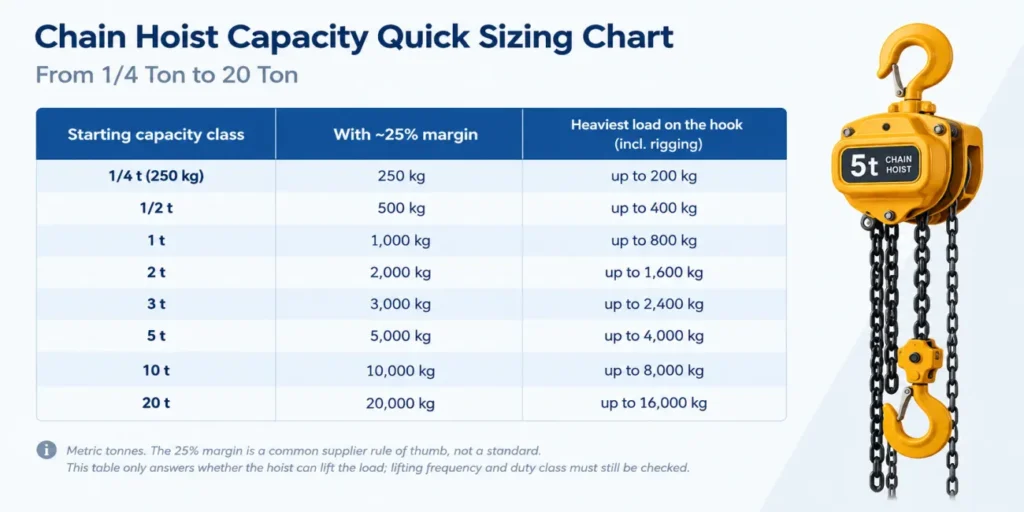
| Heaviest load on the hook (incl. rigging) | With ~25% margin | Starting capacity class |
| up to 200 kg | 250 kg | 1/4 t (250 kg) |
| up to 400 kg | 500 kg | 1/2 t |
| up to 800 kg | 1,000 kg | 1 t |
| up to 1,600 kg | 2,000 kg | 2 t |
| up to 2,400 kg | 3,000 kg | 3 t |
| up to 4,000 kg | 5,000 kg | 5 t |
| up to 8,000 kg | 10,000 kg | 10 t |
| up to 16,000 kg | 20,000 kg | 20 t |
Metric tonnes. The 25% margin is a common supplier rule of thumb, not a standard. This table only answers whether the hoist can lift the load; lifting frequency and duty class must still be checked.
Оглавление
What Chain Hoist Capacity Means: Rated Load vs Working Load
Rated capacity (also called rated load or working load limit, WLL) is the heaviest load a hoist may lift in service under the manufacturer's stated conditions, as classified under ASME B30.16 и EN 14492-2.
Rated capacity is a ceiling, not a working target
A chain hoist's rated capacity is the most it may lift, not the load it should lift every day. It must never be exceeded: US construction rules require the manufacturer's safe working load to be marked on an overhead hoist and not exceeded, and US shipyard rules say the same for chain falls.
Staying inside the limit is not the same as running at it. Each lift near the rating uses up some of the life of the load chain, gearing and brake, and buyer guidance says never to plan on running a hoist at 100 percent of rating every day. So a 1-ton chain hoist should not automatically be chosen for a 1-ton load. Extra margin is needed when lifting is frequent, loads are shocked, the pull is inclined, or the weight is uncertain. There is no single percentage that applies to every hoist, so select by the manufacturer's rating, the real duty and the applicable standard.
Ton, tonne and kilogram: read the label before you compare quotes
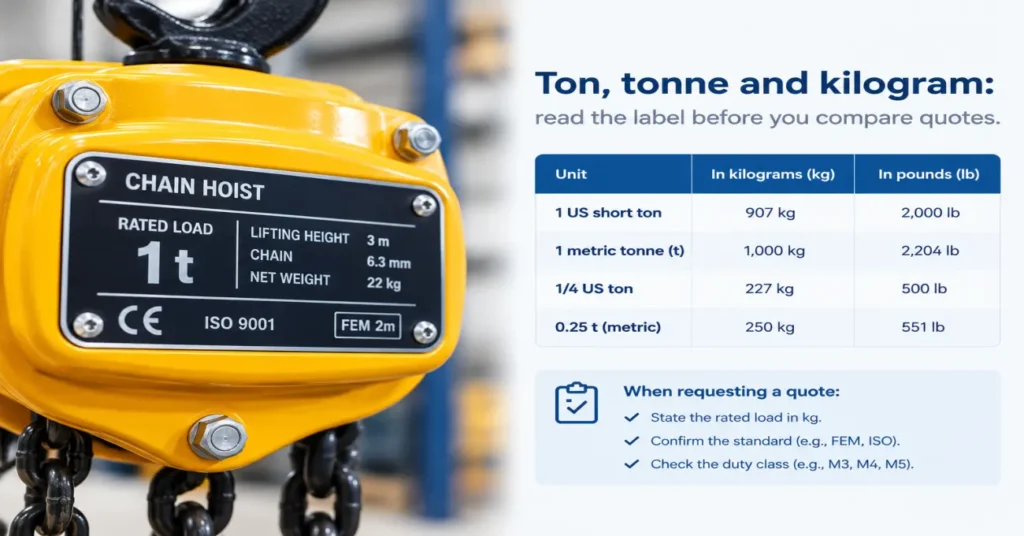
A "1 ton" hoist is not the same size everywhere: a US short ton is 907 kg, a metric tonne is 1,000 kg. The metric unit is about 10% larger. It also shows at the small end: a US "1/4 ton" hoist is 500 lb (227 kg), while a metric 0.25 t hoist is 250 kg.
Chinese and European catalogs are normally metric, and European manufacturers state capacity directly in kilograms. Ask every quote to state the rated load in kilograms, the standard it is built to, and the duty class. Then the comparison is like for like.
What counts toward the load on the hook
The load on the hook is the product weight plus everything hanging with it, and only a vertical lift uses the full rating. Slings, shackles, spreader bars and hook blocks all count. Movement adds to the static weight: sudden starts, or a slack chain snatching tight, can momentarily load the hoist well above the product weight.
Angle matters too. Chain hoists are designed for a straight, in-line lift, and side pulling loads them differently. If the job is really pulling or tensioning at an angle, that is lever hoist work, or it needs engineering review.
Chain Hoist Capacity Chart: Sizes from 1/4 Ton to 20 Ton
Chain hoist capacity chart at a glance
Chain hoist sizes step up from 1/4 ton to 20 ton, and each step changes chain size, headroom and how the load is reeved.
| Class | If "ton" = US short ton | If "t" = metric tonne | Typical use tier |
| 1/4 | 500 lb / 227 kg | 250 kg / 551 lb | Light assembly, HVAC |
| 1/2 | 1,000 lb / 454 kg | 500 kg / 1,102 lb | Workshop, small fabrication |
| 1 | 2,000 lb / 907 kg | 1,000 kg / 2,205 lb | General manufacturing, maintenance |
| 2 | 4,000 lb / 1,814 kg | 2,000 kg / 4,409 lb | Industrial maintenance |
| 3 | 6,000 lb / 2,722 kg | 3,000 kg / 6,614 lb | Heavy fabrication |
| 5 | 10,000 lb / 4,536 kg | 5,000 kg / 11,023 lb | Plant and shipyard maintenance |
| 10 | 20,000 lb / 9,072 kg | 10,000 kg / 22,046 lb | Heavy industry, power plants |
| 20 | 40,000 lb / 18,144 kg | 20,000 kg / 44,092 lb | Presses, large castings, shipyards |
Use tiers are typical reference values; confirm for the specific model with the manufacturer. Intermediate sizes such as 3/4 ton and 1-1/2 ton also exist.
For most workshop and maintenance lifts, a 1–2 ton hoist covers the widest range; above 5 ton, specify it as engineered equipment.
Catalog ranges depend on the hoist type and brand. One European manufacturer lists electric chain hoists from 125 kg to 20,000 kg, hand chain hoists from 250 kg up to 50,000 kg, and lever hoists from 250 kg to 9,000 kg. Chain hoist ranges vary between manufacturers, so always check the exact model.
1/4 to 2 ton: workshop, assembly and maintenance
Hoists from 1/4 to 2 ton cover most workshop, assembly and machine-maintenance lifts. A 1/4 ton chain hoist suits light components, tooling and HVAC equipment, but it is a poor fit if routine loads sit close to the rating. Stepping up one class costs little compared with replacing a worn-out unit. The 1-ton chain hoist is the most versatile size because parts, service knowledge and accessories are easy to find. At 2 ton, the chain and body are larger, so check headroom and beam capacity before ordering.
This is also where small electric hoists make sense. Single-phase electric hoists are typically in the 1/4 to 2 ton range and are used in workshops, garages and light manufacturing, while most industrial sites use three-phase power. Electric units cost more than manual ones of the same capacity, so the extra cost only pays back when lifting is frequent.
3 to 5 ton: heavy fabrication and plant maintenance
From 3 ton upward, buyers usually move to multi-fall chain arrangements or electric drive, trading lifting speed for capacity. With more load falls, the load is split across more chain strands, so each strand and the drive see less force. The cost is speed: with the same motor and gearing, hook speed drops in proportion to the number of falls. A 5 ton chain hoist will lift more slowly than a 1-ton unit of the same design, so ask for the lifting speed at rated load, not just the capacity.
Manual hoists at this size also need much more hand-chain travel per unit of lift, which is why electric drive becomes the practical default. Around 5 ton is also where many chain hoist ranges end, which leads to the next size class.
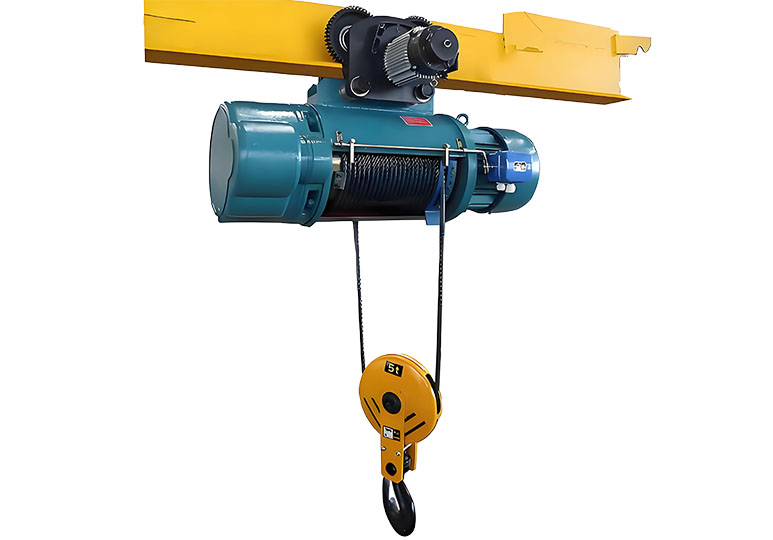
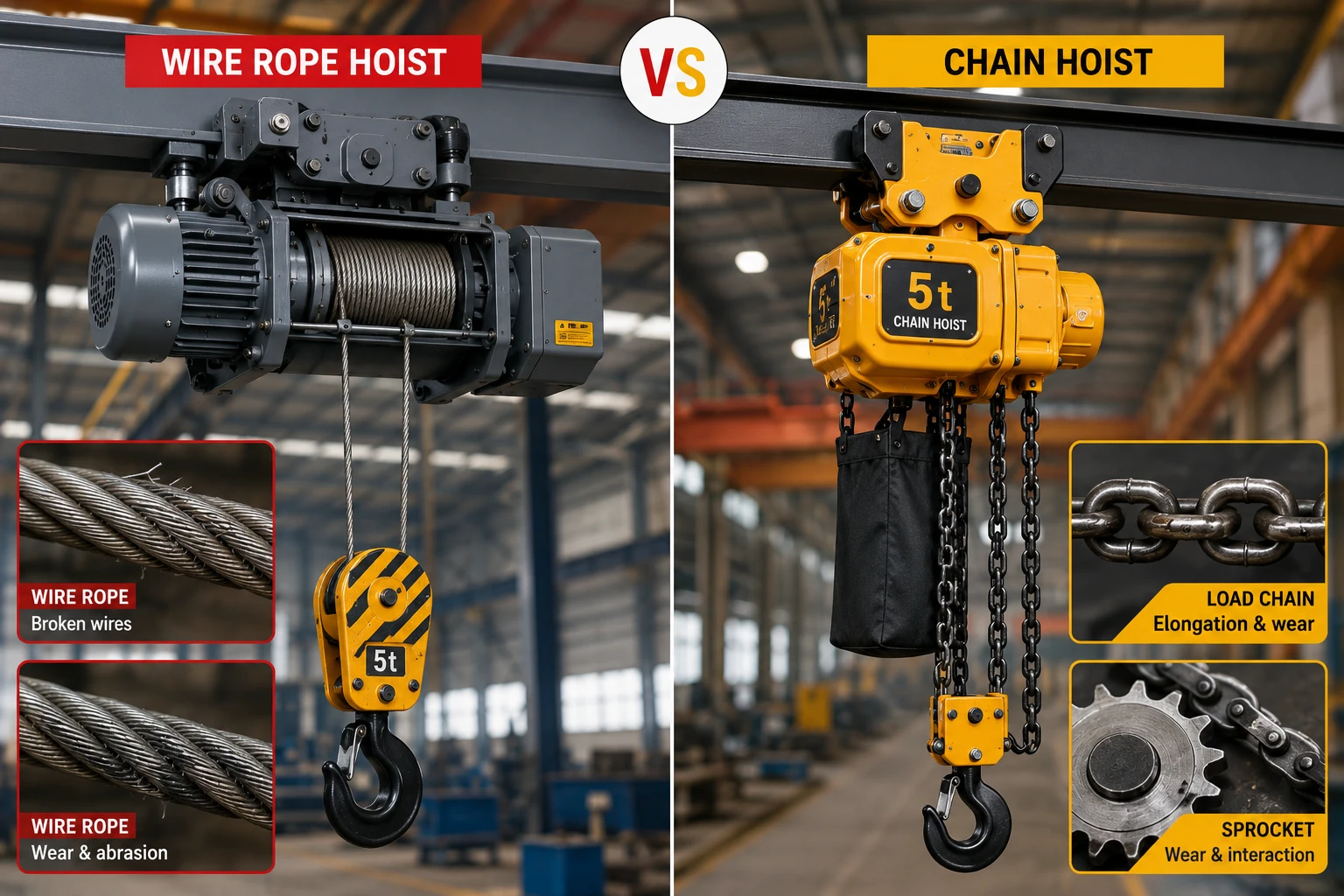
10 to 20 ton: where chain hoists end and wire rope hoists begin
At 10 to 20 ton, the hoist is only one part of the system, and the supporting structure often decides what you can install. A 10 ton chain hoist or 20 ton chain hoist is not a scaled-up 1-ton unit: body size, chain arrangement, headroom and installation conditions all change noticeably, and the speed is normally slower. Some manufacturers do build chain hoists up to 20 ton; one European range splits its documentation into a 125 kg to 5 ton group and a 7.5 to 20 ton group, which signals different construction at the upper end.
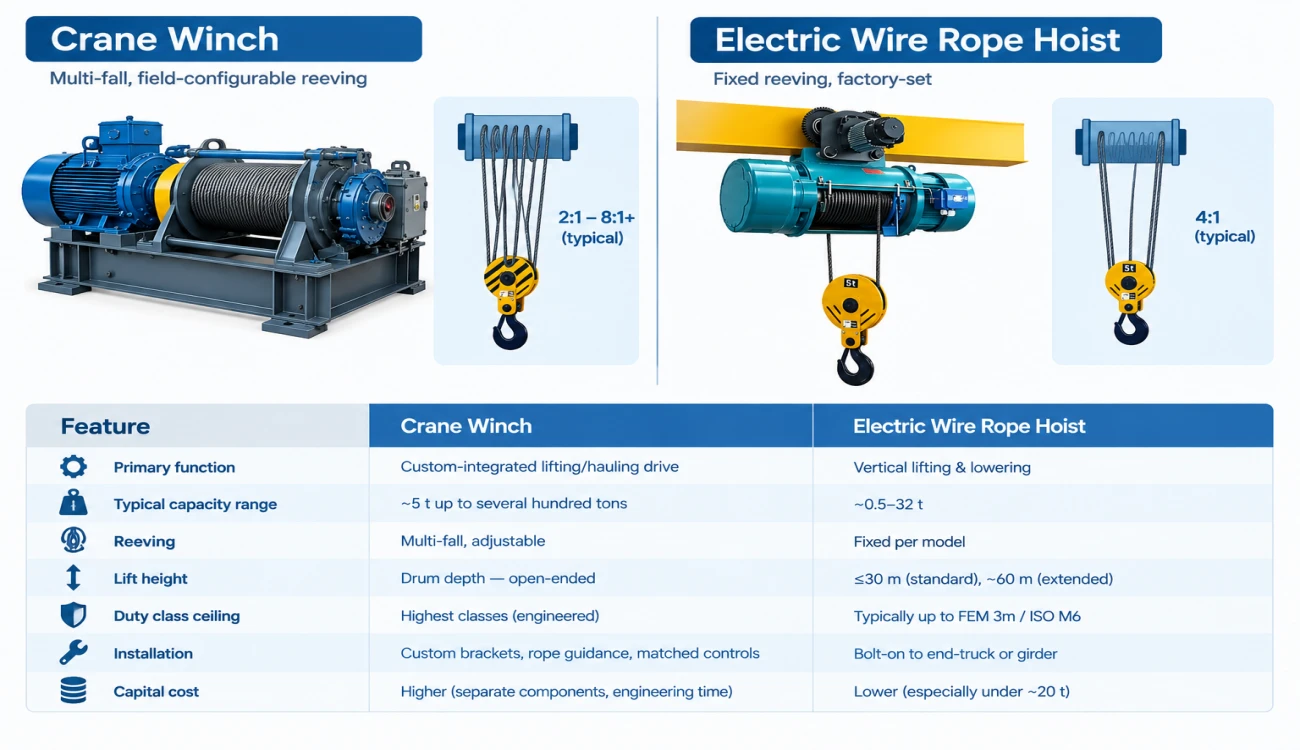
For most builders, and for Nucleon, chain hoists stop at about 5 ton, and heavier lifting moves to wire rope hoists. Nucleon's Европейский электрический грузоподъемник NR is listed at 1 to 20 ton, and the 10-тонный электрический цепной таль covers the 10 ton class specifically. We compare the two hoist types in wire rope hoist vs chain hoist.
Beam, trolley, hook block and a documented lifting plan all need engineering review at this size. Before first use, a new or altered hoist is normally load tested. Under ASME B30.16, the test load is between 100% and 125% of the rated load.
How to Choose the Right Chain Hoist Capacity
Size from the heaviest load plus rigging, then add margin
Start with the heaviest realistic lift including rigging, add roughly 25%, and choose the next standard capacity up.
Here is an illustrative calculation, not a customer case. Say the heaviest part is 1,600 kg and the sling and shackle weigh 60 kg, so the load on the hook is 1,660 kg. With a 25% margin that becomes about 2,075 kg. A 2-ton (2,000 kg) hoist is about 4% short, so the choices are a 3-ton hoist or lightening the lift. Rounding down defeats the purpose of the margin, which covers chain wear and dynamic loads.
For a manual hand chain hoist, one major manufacturer's basic rule is that the rated capacity should at least equal the heaviest load and should not exceed the rating of the pad eye, monorail or other structure holding it. The 25% figure is a rule of thumb, not a code requirement. For an occasional lift near the rating in a controlled setting, a qualified engineer may accept less.
Match the hoist type to the capacity
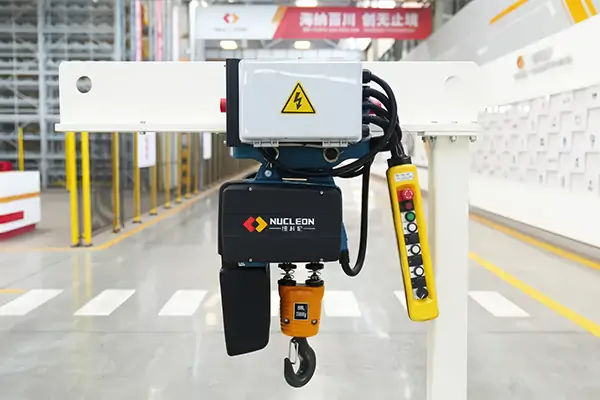
Hand chain hoists, lever hoists and electric chain hoists overlap in capacity but suit different lifting frequencies. Manual hand chain hoists cost the least and suit temporary or infrequent use, low capacities, short lifts and sites without power. Electric hoists suit heavier duty cycles, higher capacities and longer lifts. Lever hoists are the tool for pulling, tensioning and angled work.
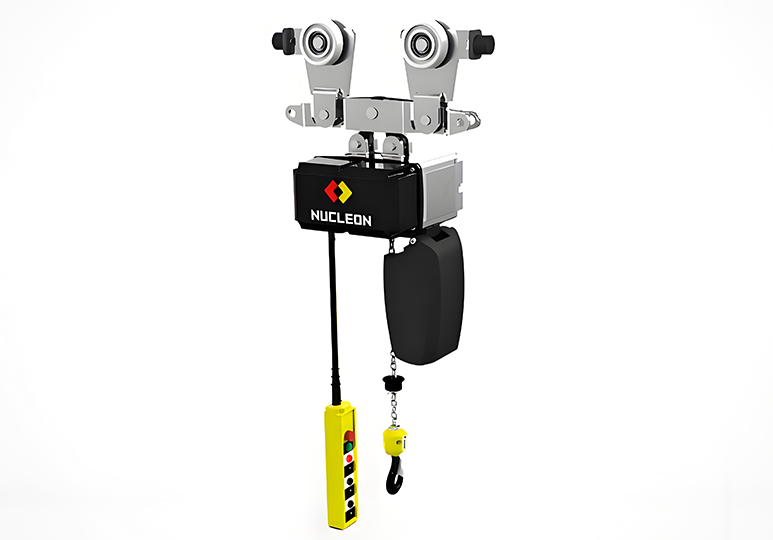
Nucleon's current chain hoist range, as listed on our product pages, is:
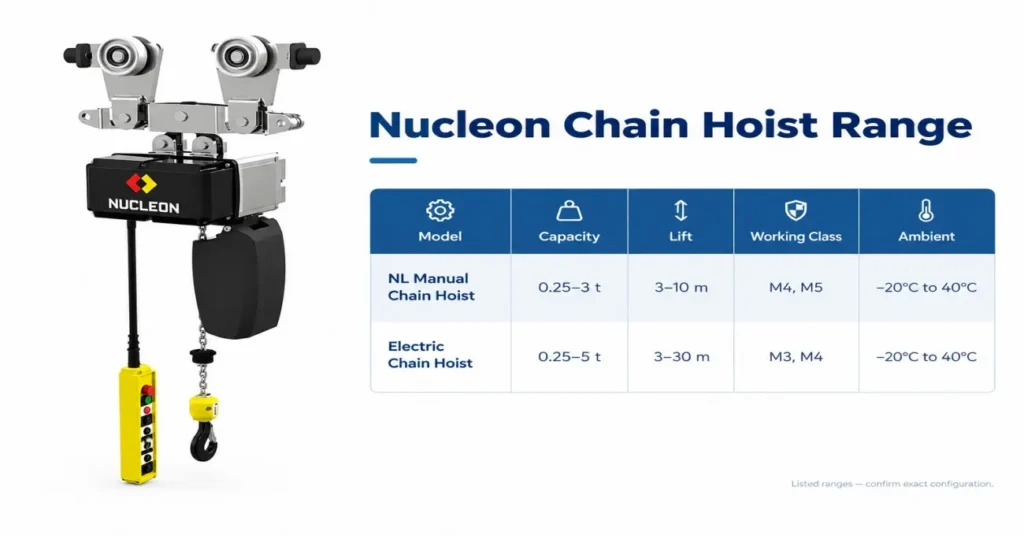
| Модель | Вместимость | Высота подъема | Рабочий класс | Температура окружающей среды |
| Ручная цепная таль NL | 0.25–3 ton | 3–10 m | М4, М5 | −20 °C to 40 °C |
| Электрическая таль | 0.25–5 ton | 3–30 m | М3, М4 | −20 °C to 40 °C |
Listed ranges; contact us to confirm the exact configuration for your project.
Capacity vs duty class: choosing a heavy duty chain hoist
Capacity determines whether the hoist can lift the load; duty and configuration determine whether it can do the job reliably and economically. Duty class combines how often the hoist runs, how heavy the loads are relative to its rating, and how long it is expected to last. It is defined by standards such as ISO 4301 and FEM 9.511, and by ASME's HST series in the US.
| Usage pattern | Typical duty class (reference) |
| Occasional maintenance, few lifts a day, mostly below rating | FEM 1Bm / ISO M3 / ASME H2 |
| General shop, mixed loads | Around FEM 1Am / ISO M4 / ASME H3 |
| Repeated production lifting, often near rated load | FEM 2m / ISO M5 or above / ASME H4 |
Class equivalences are approximate; confirm the class on the nameplate and quotation.
The limits are concrete. ASME H2, for example, allows a total running time of no more than 12.5% of the work period. Electric hoists add another factor: the duty classes assume an average load, and the manufacturer's guidance for electric and pneumatic hoists is to determine the mean effective load and apply a factor of 0.65, with detail in ASME HST-1. In practice, if your average lift is much heavier than that, you need a higher duty class, not just a bigger hoist.
This is why the working class on a datasheet matters as much as the tonnage. Our electric chain hoist is listed at M3–M4, which suits light to standard duty. For repeated production lifting near rated load, a wire rope hoist in a higher class is the better fit; our NR European Electric Hoist, for example, is listed at M4–M7. A heavy duty chain hoist is the one whose duty class matches your load pattern, so if you lift more than a few times an hour, ask for the class in writing before comparing prices.
Headroom, reach and lifting speed
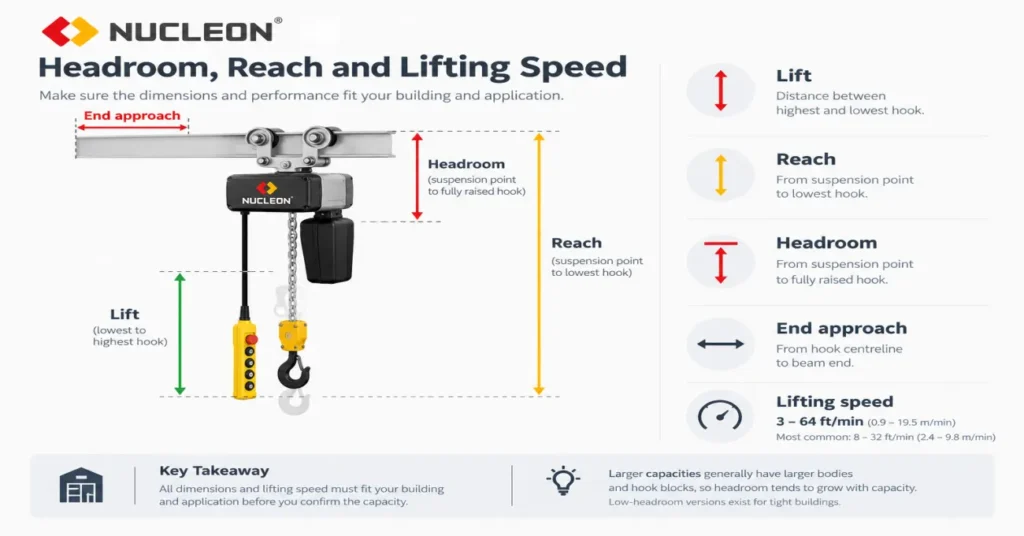
Headroom, lift and reach are related dimensions, and all three must fit the building before you fix the capacity. The lift is the distance the hook travels between its lowest and highest positions. Reach is the vertical distance from the suspension point down to the lowest hook position. Headroom is the distance from the suspension point to the fully raised hook. Larger capacities generally have larger bodies and hook blocks, so headroom tends to grow with capacity; low-headroom versions exist for tight buildings.
Also check the end approach, the distance from the hook centreline to the end of the beam. It decides whether the hoist can be centred over the load, which avoids side pulling. Lifting speed varies widely too: one manufacturer's powered hoists range from about 3 to 64 feet per minute, with the most common speeds between 8 and 32 (roughly 2.4 to 9.8 m/min).
Common Chain Hoist Capacity Mistakes and Hidden Costs
The cheapest hoist at the right tonnage is not always the cheapest
A low quote for the right tonnage can hide a hoist whose lifting speed, duty class or chain length does not fit the job. The usual gaps are these:
- Chain length: a chain drop too short for your lift height, with no spare or chain container included.
- Lifting speed: so slow that operators work around it.
- Duty class: rated for occasional use but placed in a production shift.
- Chain grade and standard: an unstated grade, where a standard such as EN 818-7 for load chain is the expected reference for industrial hoists.
- Environment: one European hoist lists an operating window of −20 °C to +40 °C, 85% humidity and IP55. Temperature extremes, outdoor use, marine or corrosive sites need special versions.
Replacing an under-specified hoist later usually costs more than specifying it correctly at the start: you pay for the second unit, the downtime, the installation and the removal of the first. In high-frequency use, a low-spec hoist can also mean more inspection, faster chain and brake wear, more spare parts and earlier replacement. Compare quotes on rated load in kg, lift height, lifting speed, duty class, chain grade and included accessories, not on the headline price.
Forgetting the supporting structure and acceptance test
A hoist rated for the load is useless if the beam, trolley or anchor point is not rated for hoist plus load. US construction rules require the supporting structure to have a safe working load equal to the hoist's, and US shipyard rules require the beam and gear to be strong enough for the load plus gear. Those are US examples, but the logic is universal: add the weight of the hoist, trolley, load and rigging, and confirm the structure carries that total. If the beam rating cannot be documented, have an engineer assess it before installing.
Ask the supplier for the test certificate and the standard the hoist was built to. Local rules on inspection and testing vary by country.
What to send with your RFQ
A complete RFQ states the heaviest load, lifting frequency, lift height and power supply, not just the tonnage. Send:
- heaviest load in kg, including rigging, and the typical load
- lifts per hour or per shift, and the number of shifts (duty class)
- lift height, available headroom and required lifting speed
- suspension type: fixed top hook, or trolley (plain, geared or motorised) and beam flange width
- environment: dust, humidity, corrosion or temperature extremes
- voltage, phase and frequency for electric models
- control method: standard pendant, variable-speed drive or radio remote
- required standards or certifications, such as CE
With those details, our engineers can confirm capacity and duty class in one reply. Send them through our contact page.
Заключение
Chain hoist capacity is a ceiling, not a working load, and the right size comes from the heaviest realistic lift including rigging, plus margin, plus the duty class that matches how often you lift. Capacity determines whether the hoist can lift the load; duty and configuration determine whether it can do the job reliably and economically. Read the unit on every quote, since a US ton and a metric tonne differ by about 10%.
Three actions: weigh your heaviest lift with its rigging, count your lifts per shift, and check the beam rating and headroom before you order. If you want a second opinion on chain hoist capacity for a specific job, our engineering team will review your load, duty and site details. Send us your RFQ details, browse our chain hoist range, or read wire rope hoist vs chain hoist if you are still choosing between hoist types.

Специалист по оборудованию
Успешный менеджер по работе с кранами с обширным опытом в управлении крупномасштабными проектами и операционным контролем. Подтвержденный опыт увеличения доходов и обеспечения соблюдения требований безопасности.
Часто задаваемые вопросы
Q1: What is the maximum capacity of a chain hoist?
It depends on the manufacturer. One European brand lists electric chain hoists up to 20,000 kg and hand chain hoists up to 50,000 kg. Nucleon's listed chain hoist range runs to 5 ton for electric and 3 ton for manual, with wire rope hoists covering heavier loads. Confirm the exact limit for the model you plan to buy.
Q2: Is a 1-ton chain hoist the same as 1,000 kg?
Not always. A US short ton is 907 kg, while a metric tonne is 1,000 kg, about 10% more. Hoists sold as "1 t" in metric catalogs are rated at 1,000 kg. Ask the supplier to state the rated load in kilograms on the quotation so that offers can be compared on the same basis.
Q3: Can I lift the rated load every day?
Not routinely. The rating is the maximum, and daily lifting at that limit wears chain, gears and brake faster. Occasional lifts at the rating are acceptable if the hoist is in good order. For frequent lifts, pick a higher capacity or a higher duty class, and confirm with the manufacturer what the duty class allows.
Q4: What affects the price of a chain hoist besides capacity?
Capacity is only one driver. Electric drive costs more than manual, and duty class, lifting speed, chain length, trolley type, control method and environment protection all move the price. Two quotes at the same tonnage are only comparable if they match on all of these. Send us your RFQ details for a written quote.
Q5: Can a chain hoist pull a load at an angle?
Generally not. Chain hoists are designed for a straight vertical lift, and side pulling loads them differently. For angled pulling or tensioning, use a lever hoist designed for that duty, or have the setup reviewed by an engineer. Do not assume the full rated capacity applies at an angle.

 English
  العربية
  Español
  Français
  Português
  Русский