

мостовой кран for automobile industry use moves dies, coils, body panels, engines and sub-assemblies between storage, press lines, welding cells and final assembly — usually under a repetitive, multi-shift duty cycle rather than occasional lifts. Sizing one correctly means matching crane type, capacity, duty class and hook coverage to the actual production rhythm, not just the heaviest single load on the line.
Procurement teams sourcing a crane for a stamping plant, body shop or assembly line often start with a single number — "we need a 20-ton crane" — and stop there. That number answers only whether the crane can lift the load once. It says nothing about whether the crane can do it safely and economically for the next ten years of two- or three-shift production, or whether it will actually reach the die storage rack, press bolster or assembly fixture it needs to reach.
This guide walks through where overhead cranes are used across automotive manufacturing, which crane types fit which process, and the parameters — capacity, duty class, environment, speed, hook approach and building clearance — that determine whether a quote is actually specified correctly or just tonnage-matched.
Оглавление
Automotive Applications for Overhead Cranes
Automotive plants use overhead cranes across five recurring process areas, and each one puts a different kind of stress on the crane — which is why "one crane spec for the whole automotive industry" doesn't hold up.
Stamping and Press Shop: Die and Coil Handling
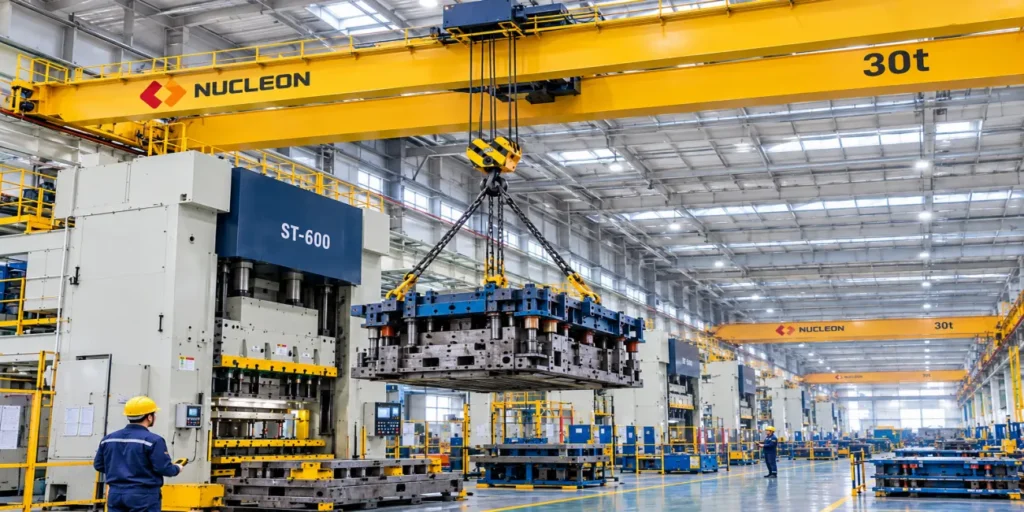
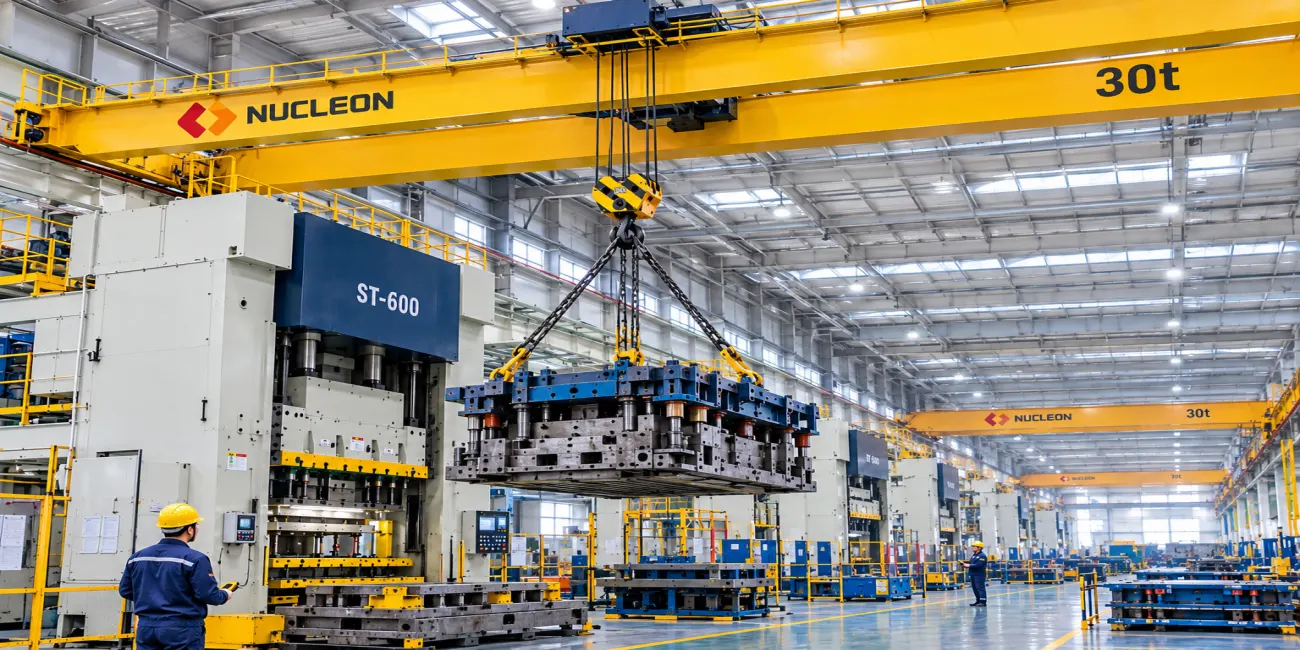
Die and coil handling cranes carry the two heaviest, most frequently moved loads in a stamping plant — steel coils into the blanking line and stamping dies into the press. Steel coils are unreeled and blanked before being pressed through a sequence of three to five stamping operations, with press forces on body panels typically in the range of roughly 1,000–25,000 kN depending on the part and press. Dies then move from die storage to the press bolster and back, and on modern lines this die change can happen several times per shift rather than once every few days.
That change frequency is the point buyers most often underweight: a crane rated for the die weight but sized as if it changes dies twice a week will wear out its brakes, gearbox and wire rope far faster than expected once it's running semi-automated die changes on a compressed production schedule. Die handling is also where semi-automated die-gripper attachments are common — the crane operator alone (instead of an operator plus a two-person rigging crew) picks the die up via lifting pins at all four corners, which changes both the required precision and the duty cycle assumptions for the crane.
Body-in-White / Welding: Component and Sub-Assembly Handling
Body-in-white (BIW) and welding areas move stamped panels, spot-welded sub-assemblies and body shells between stations, usually as light-to-medium loads handled at high frequency. Unlike the press shop, the challenge here is rarely raw tonnage — it's cycle time and positioning accuracy. A body panel or sub-assembly has to land within tight tolerance on a welding fixture dozens of times an hour, so smooth acceleration/deceleration and reduced load sway matter as much as rated capacity.
Paint Shop: Explosion-Proof Cranes
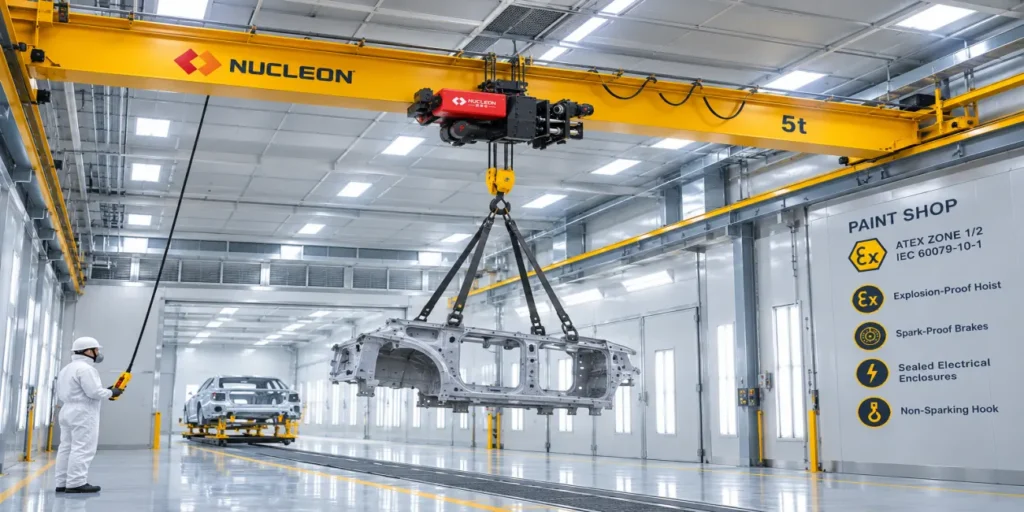
Paint shops and primer areas contain solvent vapors that create a potentially explosive atmosphere, which rules out a standard overhead crane regardless of how well it matches the load. Where a plant's paint booth or primer application zone is classified as an explosive atmosphere zone under a standard such as IEC 60079-10-1, the crane, hoist, pendant control and runway conductors all need explosion-protection features — spark-proof brakes, sealed electrical enclosures and non-sparking hook hardware — rather than just a higher-spec version of the same standard crane used elsewhere in the plant. Loads in this area are usually light (fixtures, small assemblies, paint-line components) compared to the press shop, so buyers sometimes assume the crane spec is simple; in practice, the environment — not the tonnage — is what drives the selection here, and it's a separate decision from capacity or duty class.
Final Assembly: Engine, Powertrain and Body Marriage
Final assembly cranes handle engines, transmissions, powertrain modules and — on some lines — the body-to-chassis "marriage" lift, where precision and controlled lowering speed matter more than maximum lifting speed. These are typically moderate-capacity loads (engines and transmissions rarely exceed a few tons) but the tolerance for error is small: a powertrain module has to align with mounting points without operator guesswork, which is why assembly-line cranes lean more heavily on variable-speed control than press-shop cranes do.
Maintenance, Tooling Storage and Spare Parts
Maintenance bays and die/tooling storage areas need cranes for turning dies for servicing, changing rolls, and general equipment upkeep — occasional-use loads that don't need the same duty class as the production line feeding them. It's a common design mistake to size every crane on the plant to match the busiest line's duty class; a maintenance crane handling the same tonnage a few times a week is a different — and cheaper — specification.
Overhead Crane Types Used in Automotive Plants
Different areas of an automotive plant call for different crane types, and the choice depends on building structure and coverage needs as much as on load.
| Тип крана | Typical Use in Automotive Plants | Typical Capacity Range | Best Fit When |
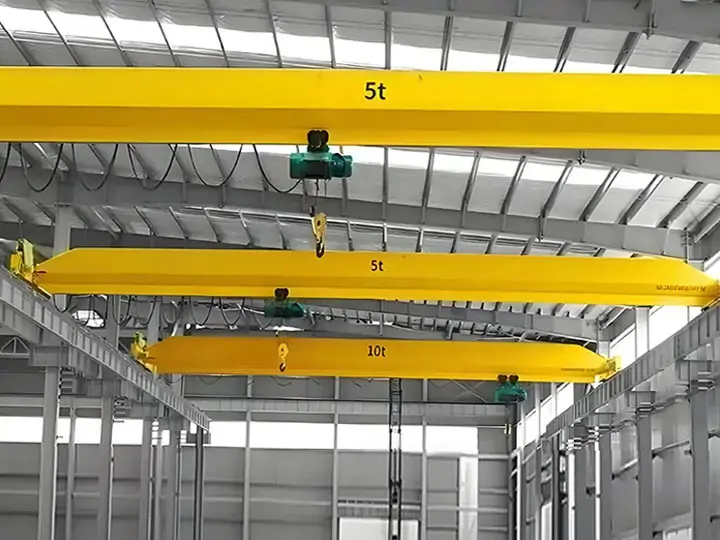
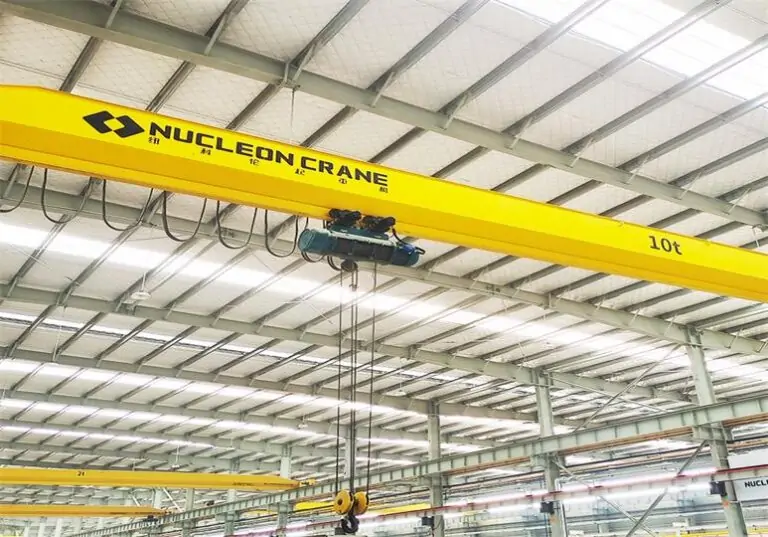
| Single girder overhead / bridge crane | Sub-assembly handling, light-to-medium coil or panel handling, general workshop lifting | Roughly 1–20 t | Lighter loads, standard headroom, cost-sensitive installations |
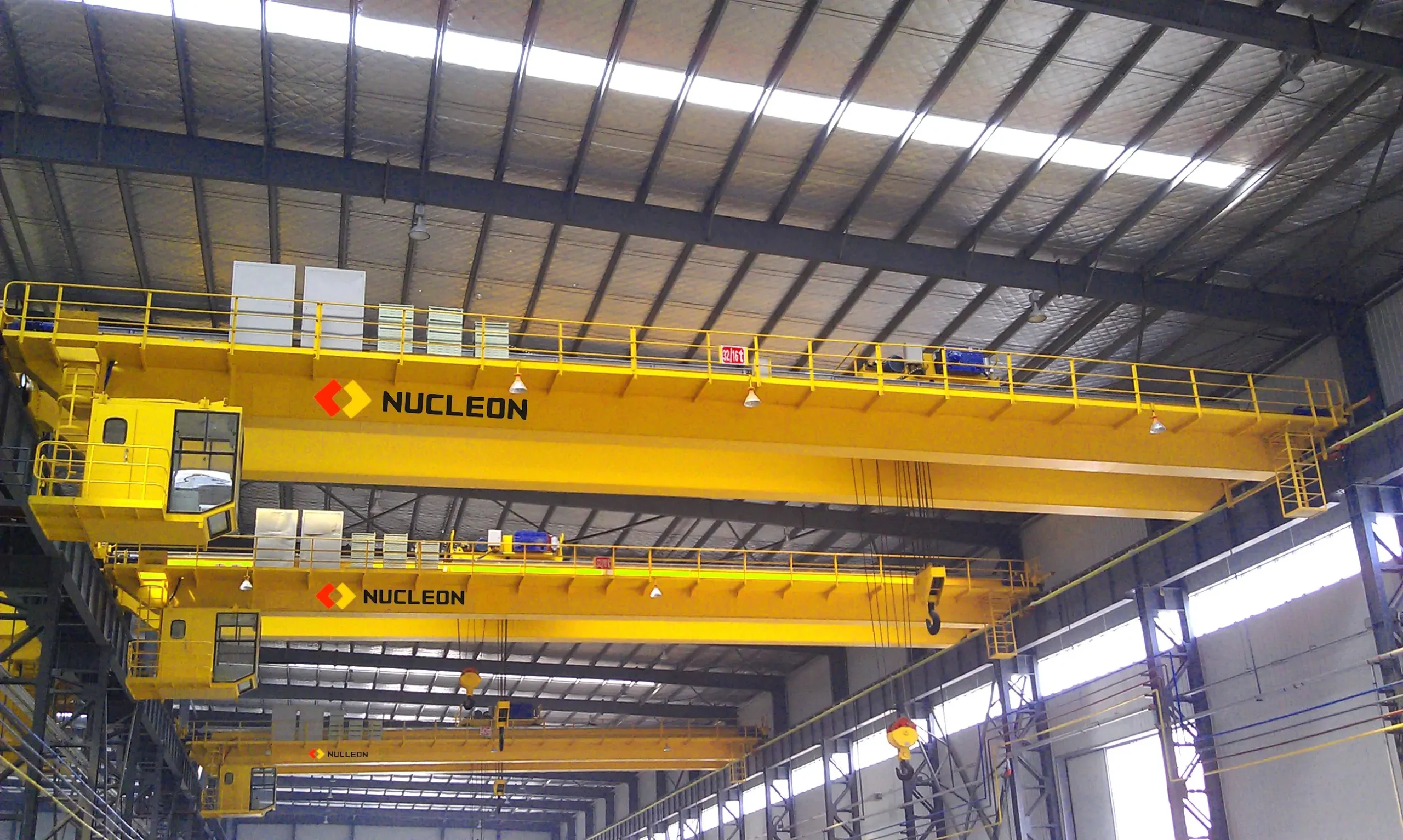
| Double girder overhead / bridge crane | Die handling, coil handling, heavier press-shop lifts | Roughly 5–50 t+ | Heavier loads, longer spans, higher hook height needed |
| Workstation / light crane system | Assembly-cell material flow, engine and component handling at individual stations | Up to roughly 2–3 t per point | High-frequency, ergonomic lifting at fixed work cells, often supplementing a larger crane |
| Explosion-proof overhead crane | Paint shop, primer areas with solvent vapor | Typically light-to-moderate, driven by application not tonnage | Area is classified as an explosive atmosphere zone, regardless of load weight |
| Козловой кран | Outdoor storage yards, buildings without runway support | Wide range depending on design | Building can't support an elevated runway, or lifting happens outdoors |
A production line rarely runs on one crane type — press shops typically pair a double girder crane for dies and coils with lighter single girder or workstation cranes for surrounding material flow. Sizing the whole plant to the heaviest single lift is one of the most common ways automotive buyers overspend: a die-handling double girder crane covering the press bay does not need to be duplicated at every assembly workstation, where a lighter workstation crane system does the job at a fraction of the structural and installation cost.
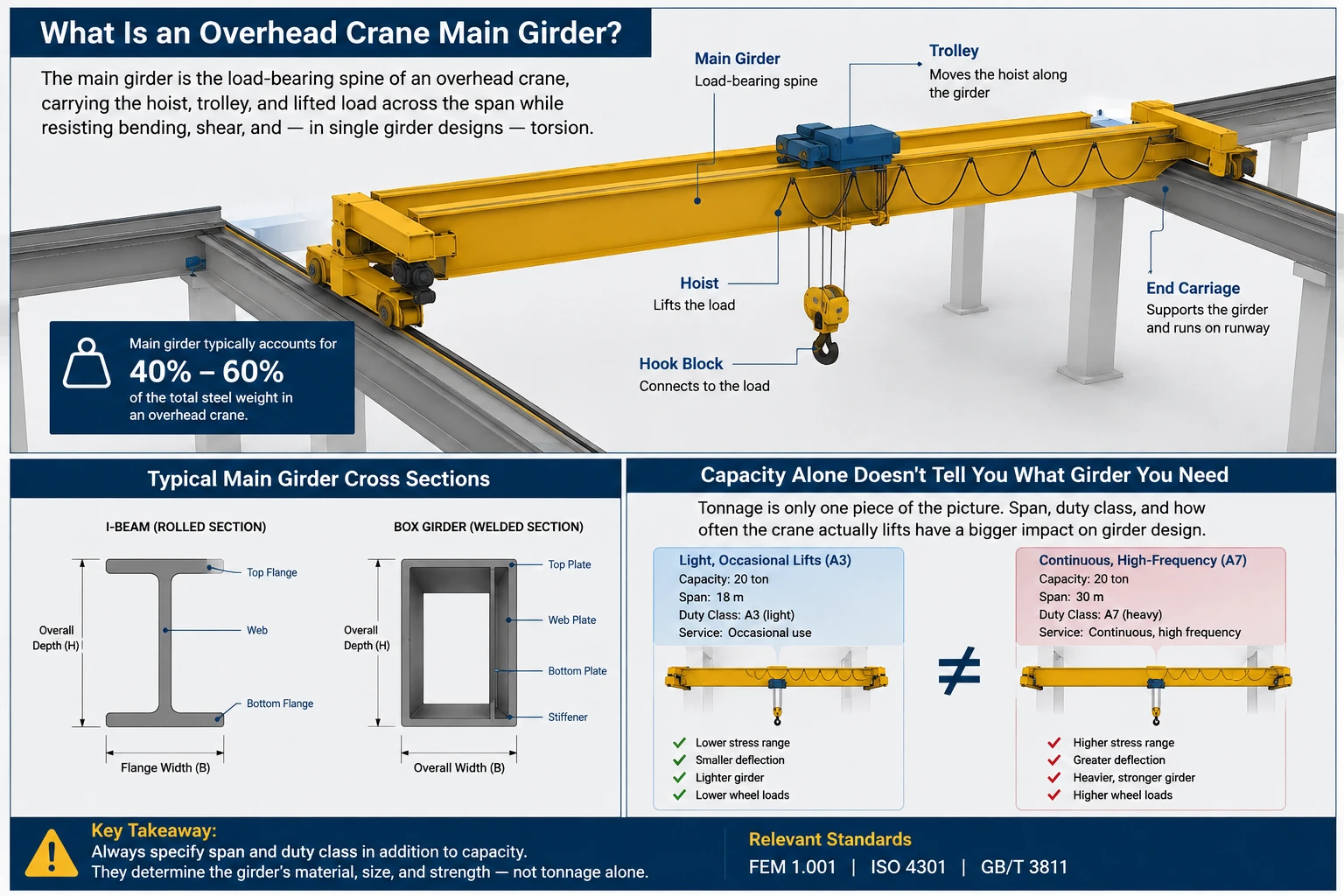
Single girder cranes generally cover lighter, shorter-span jobs efficiently; double girder cranes take over once load, span or required hook height push past what a single girder structure can economically support. The dividing line isn't fixed — it depends on the specific span and lifting height combination — which is why capacity alone is a poor way to choose between the two.
Capacity, Duty Class and Suspended Load: Getting the Sizing Right
Suspended Load Is Not the Same as Component Weight
The crane has to lift the die, panel or engine plus everything hanging below the hook — spreader beam, die clamp, magnet, sling or fixture — not just the part itself. Buyers who spec capacity from a parts list ("the die weighs 8 tons, so we need an 8-ton crane") routinely leave out the lifting fixture, and in die handling that fixture is not negligible — die clamps, spreader bars and gripper attachments add real weight that has to sit inside the crane's rated capacity, with margin, not at its ceiling.
Duty Class Matters More Than Tonnage in a High-Frequency Line
Two cranes rated for the same tonnage can have very different service lives if one runs occasional lifts and the other runs continuous multi-shift production — which is what duty class, not capacity, is designed to capture. Duty classification standards such as ISO 4301-1 и FEM 9.683 group cranes by total expected operating cycles and load spectrum over their service life, independent of rated capacity. A maintenance crane lifting a die a few times a week for occasional servicing and a press-shop crane changing dies multiple times per shift across two or three shifts can carry an identical tonnage rating and still need very different gearboxes, brakes, wire rope and structural fatigue design — because the second one is doing vastly more work cycles over its life. Automotive production-line cranes running this kind of repetitive, multi-shift schedule generally sit toward the heavier end of the duty spectrum, closer to continuous industrial service than to the light, intermittent use of a general workshop crane.
The Common Procurement Mistake: Sizing by Peak Weight Alone
Selecting a crane by its single heaviest lift while ignoring how often that lift repeats is the most common sizing mistake in automotive procurement, and it cuts both ways. Underspecifying duty class on a crane that turns out to run near-continuous shifts leads to premature brake, gearbox and wire-rope wear well before the tonnage rating would suggest a problem — the crane can still lift the load, it just wears out doing it. Overspecifying the opposite way — putting a heavy-duty, high-cycle spec on a crane that only sees occasional maintenance lifts — pays for structural and mechanical capacity the application will never use. The fix isn't a fixed multiplier on tonnage; it's stating actual lift frequency, shift pattern and load spectrum alongside the weight when requesting a quote.
Environment Classification Is a Separate Decision From Capacity and Duty
A crane sized correctly for load and duty class can still be the wrong crane if the environment it's going into isn't accounted for separately — standard, wash-down, explosion-proof and cleanroom areas each call for different construction, not just a different rating on the same base design. Paint shops need explosion-protected electrics regardless of how light the load is; wash-down or high-particulate areas near coating lines need sealed enclosures to keep moisture and debris out of motors and controls; cleanroom-adjacent assembly (increasingly common around battery and electronics sub-assembly in EV plants) has its own contamination-control requirements. Treating environment as a footnote to capacity, rather than a fourth parameter alongside capacity, duty class and speed, is how a correctly-sized crane ends up non-compliant for the area it's installed in.
Speed, Precision and Automation for Automotive Duty
Positioning Precision Can Matter More Than Top Speed
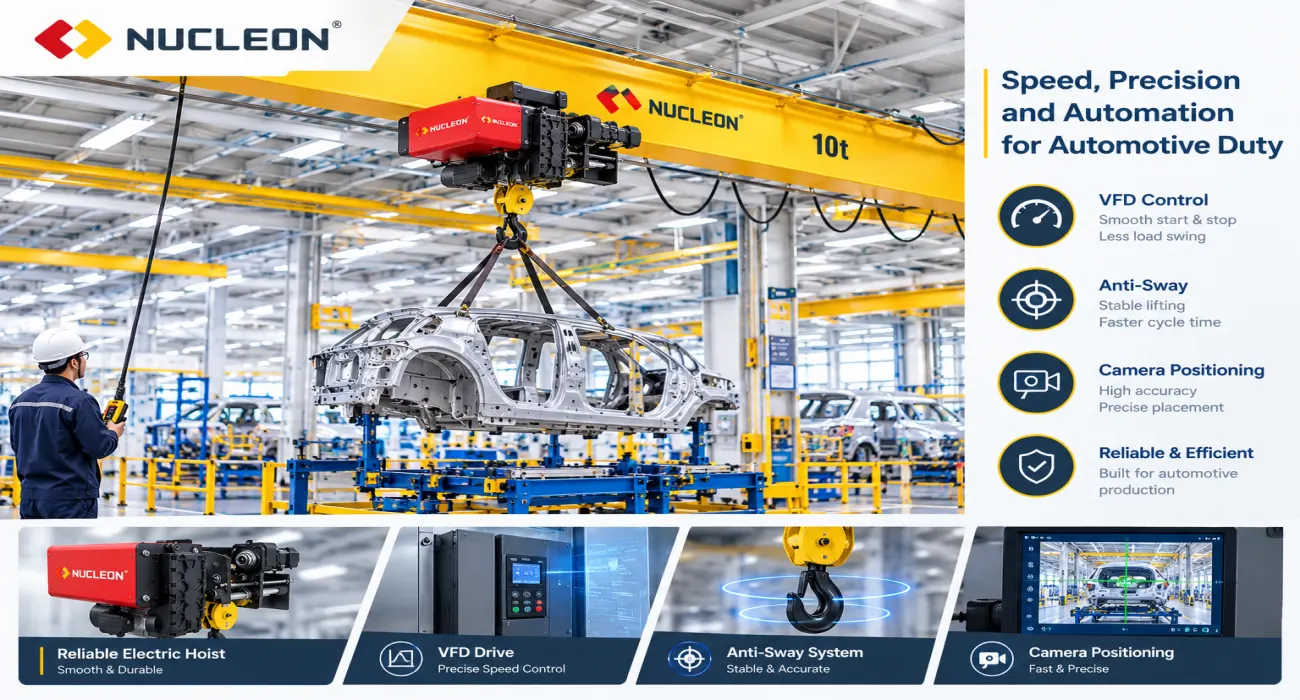
In high-frequency automotive lifting, how precisely and smoothly a load lands at its target position often affects cycle time more than how fast the crane can travel between points. A crane that travels quickly but oscillates or overshoots at the drop point loses more time settling the load than it gained in transit — which is why body-in-white and assembly stations, where a panel or module has to land within tight tolerance on a fixture, weigh positioning control as heavily as rated speed. Press-shop die handling has the opposite problem in the other direction: a die gripper crane needs smooth, controlled lowering onto the bolster, not top-end travel speed, since a rough set-down risks misalignment or die damage.
VFD, Anti-Sway and Smart Positioning Features
Variable frequency drives, anti-sway control and camera-assisted positioning reduce the operator skill and time needed to land a load accurately, which is why they show up disproportionately often on automotive-line cranes compared to general warehouse cranes. Smooth acceleration and deceleration through VFD control reduces load swing on the way to a fixture; sway-damping and hook-centering features are specifically aimed at repetitive, high-precision placements — the kind of lift automotive assembly does hundreds of times a shift, rather than the occasional heavy lift a general fabrication shop crane handles. Buyers comparing two crane quotes at the same tonnage and speed rating should ask what positioning-assist features are included, since two crane control packages that look identical on a spec sheet by rated speed alone can behave very differently under a real production cycle time.
Hook Approach, Building Constraints and What to Send in an RFQ
Hook Approach and Building Clearance
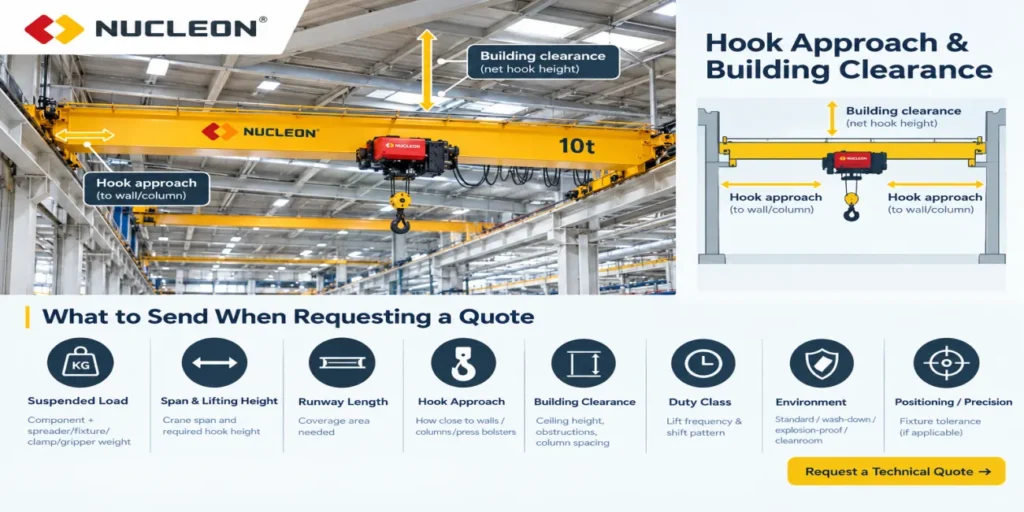
Two cranes rated at the same capacity, span and lifting height can still cover different amounts of usable floor area if their hook approach — how close the hoist can get to the end of the runway or a side wall — differs, which is a common source of dead zones near press bolsters and storage racks. Building clearance works the same way in the vertical direction: HVAC ductwork, lighting, sprinkler lines and existing structural steel all eat into available hook height, and a crane spec built from ceiling height alone, without accounting for those obstructions, often arrives at site with less usable lift height than planned. This is one of the more common sources of retrofit cost on automotive crane installations — not because the crane itself was wrong, but because the quote didn't specify enough about the building it was going into.
What to Send When Requesting a Quote
A quote request built around capacity and span alone is missing most of what actually determines whether the crane will fit and perform — a complete RFQ for an automotive-line crane should include all of the following together, not just the load weight.
- Suspended load: component weight plus spreader/fixture/clamp/gripper weight
- Span and lifting height
- Runway length or coverage area needed
- Hook approach requirement (how close to walls/columns/press bolsters)
- Building clearance: ceiling height, obstructions, column spacing
- Duty class or, if unknown, actual lift frequency and shift pattern
- Environment classification: standard, wash-down, explosion-proof (paint shop) or cleanroom
- Positioning/precision requirements (fixture tolerance, if applicable)
Sending these together, rather than a single tonnage figure, is what lets a supplier quote a crane that's specified for the actual application instead of a generic tonnage match.
Получить коммерческое предложениеЗаключение
An overhead crane for automobile industry applications is specified correctly when capacity, duty class, environment and hook approach/building clearance are matched to the actual production process — not when the tonnage on the nameplate matches the heaviest single load. Start by identifying which process area the crane serves (press shop, BIW, paint shop, assembly or maintenance), since each has a different duty cycle, environment and precision requirement; then size for suspended load and duty class together, not tonnage alone; and send hook approach, building clearance and environment classification with the quote request to avoid retrofit costs — or compliance gaps — later.
Окончательный выбор оборудования должен быть подтвержден сертифицированным инженером и соответствовать местным правилам эксплуатации подъемного оборудования.

Специалист по оборудованию
Успешный менеджер по работе с кранами с обширным опытом в управлении крупномасштабными проектами и операционным контролем. Подтвержденный опыт увеличения доходов и обеспечения соблюдения требований безопасности.
Часто задаваемые вопросы
Q1: What capacity overhead crane do I need for an automotive plant?
Capacity depends on suspended load — component weight plus any spreader, clamp or fixture — not the raw part weight alone. Press-shop die and coil handling typically needs the highest single-lift capacity on the line, often a double girder crane in the roughly 5–50 t range, while body-in-white and assembly stations usually run lighter, more frequent lifts under 5 t. Always size from the full suspended load and expected shift pattern, not the die or component weight in isolation.
Q2: Single girder or double girder crane for automotive manufacturing?
Single girder cranes generally suit lighter, shorter-span jobs like sub-assembly or component handling, while double girder cranes suit heavier press-shop die and coil handling or longer spans. The deciding factors are load, span and required hook height together — not tonnage alone — so the same capacity can call for either type depending on the span and lifting height involved.
Q3: Why does duty class matter more than tonnage for automotive cranes?
Duty class reflects total operating cycles and load spectrum over the crane's service life, which tonnage doesn't capture. A crane running multi-shift, high-frequency die changes wears its brakes, gearbox and wire rope far faster than a crane rated for the same tonnage but used a few times a week, so two cranes at identical capacity can need very different duty specifications.
Q4: What information should I include when requesting an automotive crane quote?
Beyond capacity and span, include lifting height, runway length, hook approach requirements, building clearance and obstructions, duty class or actual lift frequency, and any positioning-precision requirements. Quotes based on tonnage alone are the most common source of mismatched cranes and later retrofit costs.
Q5: Do automotive assembly lines need variable speed (VFD) cranes?
High-frequency, precision-placement work like body-in-white and final assembly generally benefits from VFD and anti-sway control, since smooth positioning at the fixture affects cycle time more than top travel speed. Press-shop die handling similarly needs controlled, smooth lowering rather than maximum speed, even though the tonnage involved is usually higher.
Q6: Can I use a standard overhead crane in an automotive paint shop?
Generally no. Paint shops and primer areas classified as explosive atmosphere zones need an explosion-protected crane with spark-proof brakes, sealed electrical enclosures and non-sparking hook hardware, regardless of how light the load is. Environment classification should be treated as a separate selection parameter from capacity and duty class, not assumed from the tonnage involved.
Связанные статьи
- Руководство по выбору редуктора/корпуса для крана: как выбрать правильное передаточное число, крутящий момент и номинальную нагрузку.
- Руководство по техническому обслуживанию крановых тележек и колес: осмотр, износ, регулировка и замена.
- Overhead Crane Main Girder: Materials & Structure
- Взрывозащищенный мостовой кран: когда он вам действительно нужен?

 English
  العربية
  Español
  Français
  Português
  Русский