Neither a wire rope hoist nor a chain hoist is inherently longer-lasting. Under the same rated capacity, duty class, load spectrum and lifting cycles, service life depends far more on how well the hoist is matched to the application than on which lifting medium it uses.
That answer frustrates a lot of buyers, because the question usually isn't really "which material lasts longer" — it's "which one should I buy for my factory, and how do I avoid an expensive mistake." A procurement manager comparing quotes rarely has the engineering time to dig into duty ratings and wire rope discard criteria before placing an order, which is exactly where most of the wrong purchases start.
This guide breaks down how wire rope and chain hoists actually fail, why duty class and cycle count predict lifespan better than the lifting medium does, what each option really costs over five to ten years, and the procurement mistakes that shorten hoist life regardless of which type you choose.
Table of Contents
Wire Rope Hoist Vs Chain Hoist: Quick Reference
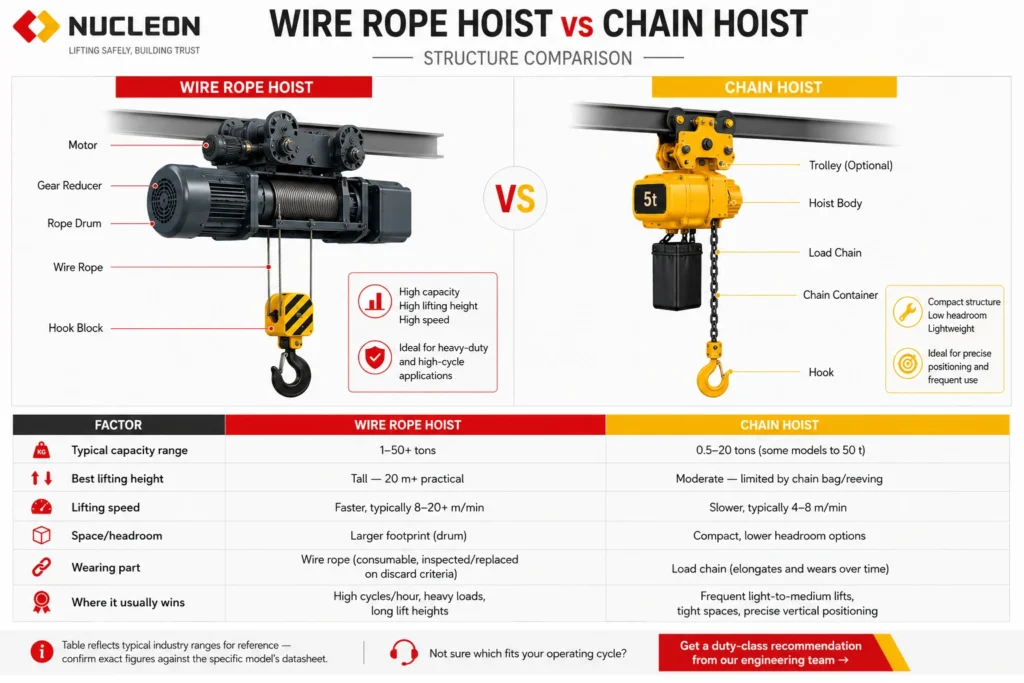
| Factor | Wire Rope Hoist | Chain Hoist |
| Typical capacity range | 1–50+ tons | 0.5–20 tons (some models to 50 t) |
| Best lifting height | Tall — 20 m+ practical | Moderate — limited by chain bag/reeving |
| Lifting speed | Faster, typically 8–20+ m/min | Slower, typically 4–8 m/min |
| Space/headroom | Larger footprint (drum) | Compact, lower headroom options |
| Wearing part | Wire rope (consumable, inspected/replaced on discard criteria) | Load chain (elongates and wears over time) |
| Where it usually wins | High cycles/hour, heavy loads, long lift heights | Frequent light-to-medium lifts, tight spaces, precise vertical positioning |
Table reflects typical industry ranges for reference — confirm exact figures against the specific model's datasheet. Not sure which fits your operating cycle? [Get a duty-class recommendation from our engineering team →]
Get Solution QuoteHow Wire Rope and Chain Hoists Fail Differently
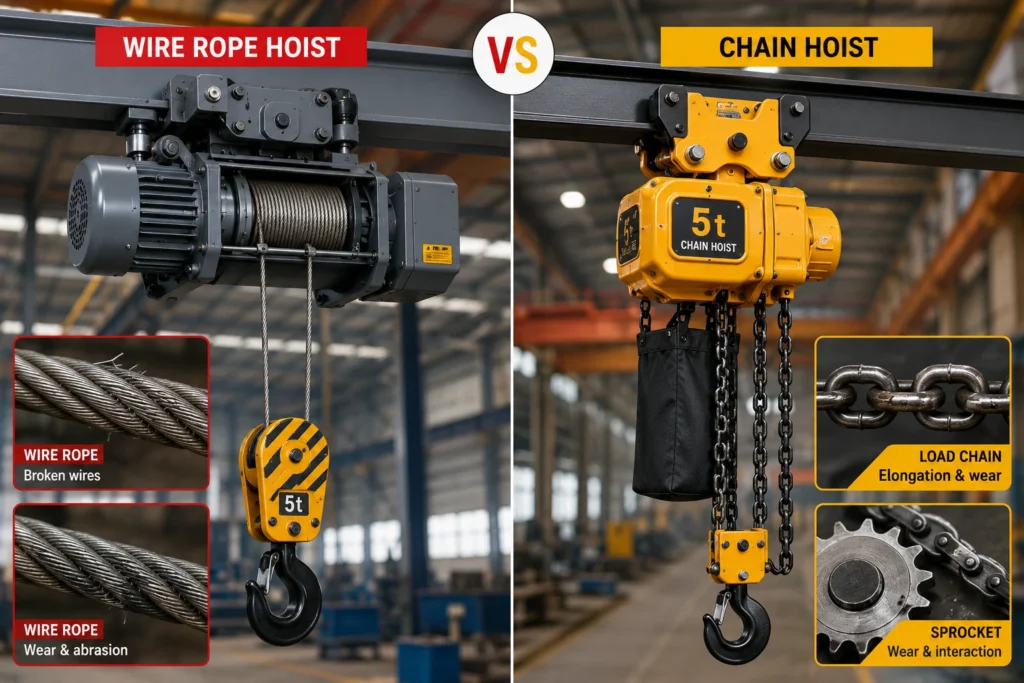
A wire rope hoist and a chain hoist wear out through two different mechanisms, which is why comparing them as "durable vs less durable" misses the point. Wire rope fails through fatigue and progressive wire breakage; chain fails through elongation and link wear. Each has its own inspection logic, and neither failure mode is automatically worse.
Wire Rope Failure: Fatigue, Wire Breaks and Bending Cycles
Wire rope doesn't fail suddenly — it degrades gradually through bending fatigue as it runs over the drum and sheaves, until it reaches a discard threshold. Every time the rope bends around the drum or a sheave under load, individual wires inside the strands flex and eventually fatigue. Over enough cycles, broken wires accumulate, along with wear, corrosion, or deformation (kinking, birdcaging, core protrusion). Standards such as ISO 4309 and the construction/inspection guidance referenced in ASME B30.16 define discard criteria based on the number of broken wires per lay length, diameter reduction, and visible damage — not a fixed calendar age.
This is why a wire rope hoist operating at high cycles per hour with tight reeving (multiple falls, small sheave diameters) will reach its rope-replacement point far sooner than the same hoist used for occasional, gentle lifts — even though both are "the same wire rope hoist" on paper.
Chain Failure: Elongation, Link Wear and Sprocket Interaction
Load chain fails through a different path — gradual elongation and link wear from repeated articulation over the sprocket, checked by measuring chain stretch against the manufacturer's limit. As the chain runs over the pocket wheel (sprocket) under load, the link surfaces wear against each other and against the sprocket pockets, and the chain stretches slightly with each cycle. Once elongation exceeds the manufacturer's allowable percentage (commonly checked over a fixed link count), the chain and often the sprocket need replacement, because a stretched chain no longer seats correctly and accelerates sprocket wear.
The practical takeaway: chain wear is more forgiving of occasional overload spikes than wire rope fatigue is, but it is less forgiving of dirt, inadequate lubrication, and corrosive environments, which accelerate both link wear and pocket wheel wear simultaneously.
Why "Which Lasts Longer" Is the Wrong First Question
Asking whether wire rope or chain lasts longer skips the variable that actually determines the answer: how the hoist is used. A 3-ton wire rope hoist and a 3-ton chain hoist rated for the same capacity can have completely different service lives depending on lifting height, cycles per hour, load spectrum (how often it lifts at full rated capacity vs. partial load), and environment. That's the variable the next section deals with.
Duty Class and Operating Cycle Decide the Winner, Not the Lifting Medium
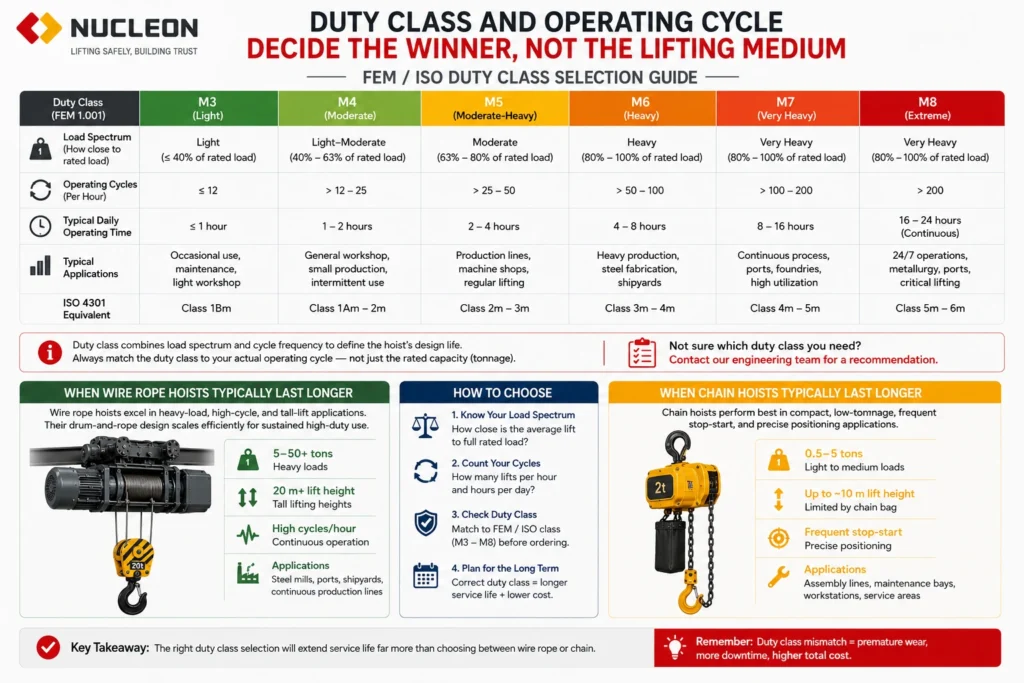
The single factor that predicts hoist lifespan better than lifting medium is duty class — how the manufacturer rated the hoist for a given combination of load spectrum and cycle frequency. Buying by tonnage alone, without checking duty class against your actual cycle count, is the single most common reason hoists (wire rope or chain) wear out faster than expected.
Match Duty Class to Your Actual Daily Cycles, Not Just Tonnage
Two hoists with identical rated capacity can have very different real-world lifespans if their duty classes don't match the application's cycle rate. FEM 1.001 and ISO 4301 classify hoists by combining load spectrum (how close to full rated load the average lift is) with the number of operating cycles, producing classes typically labeled M3 through M8 (FEM) or equivalent ISO classes. A hoist built for occasional, light-duty lifting — several lifts per hour, mostly under half load — will wear out well ahead of schedule if it's actually running continuous full-load cycles on a production line.
As a practical check: if your operation runs more than roughly 20–30 lifts a day at or near rated capacity, or the hoist runs multiple hours per shift, ask for the specific FEM/ISO duty class rating, not just the tonnage, before ordering.
When Wire Rope Hoists Typically Last Longer
Wire rope hoists tend to outlast chain hoists in applications combining heavy loads, tall lifting heights, and high cycle counts, because their drum-and-rope design scales more efficiently to that combination. Above roughly 5–10 tons, or where lift height exceeds what a chain bag can reasonably store, wire rope's higher line speed and larger effective capacity per hoist body make it the design that's actually engineered for sustained high-duty use — steelmaking, ports, shipyards, and continuous production lines fall into this category.
When Chain Hoists Typically Last Longer
In compact, lower-tonnage settings with frequent stop-start cycling and precise positioning needs, chain hoists tend to hold up better because their construction tolerates side-pulling and shock loading with less cumulative fatigue damage than rope. Assembly lines, maintenance bays, and workstation cranes under roughly 5 tons — where lifts happen often but loads are lighter and headroom is tight — are where chain hoists are typically specified, and where a wire rope hoist's added cost and size deliver little extra service life in return.
Maintenance, Replacement and Total Cost of Ownership
The lifting medium itself is only one line item in what a hoist actually costs to own — inspection labor, consumable replacement, and downtime usually matter more than the purchase price difference. Comparing quotes on sticker price alone is the second most common procurement mistake after ignoring duty class.
Wire Rope Inspection and Replacement Add a Recurring Cost Line
Wire rope is a wearing part, not a permanent one — it needs periodic inspection and eventual replacement based on measurable discard criteria, and high-cycle operations should budget for this as a recurring cost, not a one-time repair. Beyond the rope itself, the rope guide, drum grooves, and sheaves also wear over the hoist's life and periodically need attention. In high-frequency environments, some buyers are surprised that a low-priced wire rope hoist arrives without a spare rope or rope guide included, pushing real first-year cost above the quoted price.
Chain Wear Is Slower to Show But Still a Real Cost
Chain hoists have lower per-unit consumable costs, but neglected lubrication and unmeasured elongation are the two most common ways chain-hoist owners end up paying more than expected. A chain that's run past its allowable elongation accelerates sprocket wear, turning what should have been a chain-only replacement into a chain-and-sprocket replacement. Regular link-count measurement against the manufacturer's limit is inexpensive insurance against that outcome.
Compare Total Cost of Ownership, Not Just the Quote
The hoist with the lower quoted price is not necessarily the lower-cost hoist over five to ten years once consumables, maintenance labor, and downtime are added in. A fair comparison adds: purchase price + expected consumable replacement (rope or chain, over the hoist's service life at your cycle rate) + routine maintenance labor + estimated downtime cost per failure. For high-cycle, high-value production lines, downtime cost alone often outweighs the price difference between hoist types.
Procurement Mistakes and How to Choose the Right Hoist
5 Common Procurement Mistakes That Shorten Hoist Life
Buyers who focus only on tonnage and price tend to repeat the same five mistakes, regardless of whether they end up with wire rope or chain:
- Ordering by tonnage alone, without checking duty class against actual daily cycle count.
- Choosing the lowest quote without checking what's included — a low-priced hoist that excludes a spare rope, rope guide, or extended chain bag can cost more once those parts are added later.
- Ignoring lift height and reeving configuration, which changes real line speed and cycle time far more than the base hoist spec sheet suggests.
- Skipping environment fit — dusty, humid, or corrosive conditions accelerate wear on both chain and rope, and the wrong protection class (or missing rope guide type) shortens service life regardless of lifting medium.
- Treating the lifting medium as the main decision factor, when duty class, cycle rate, and maintenance plan predict service life more reliably.
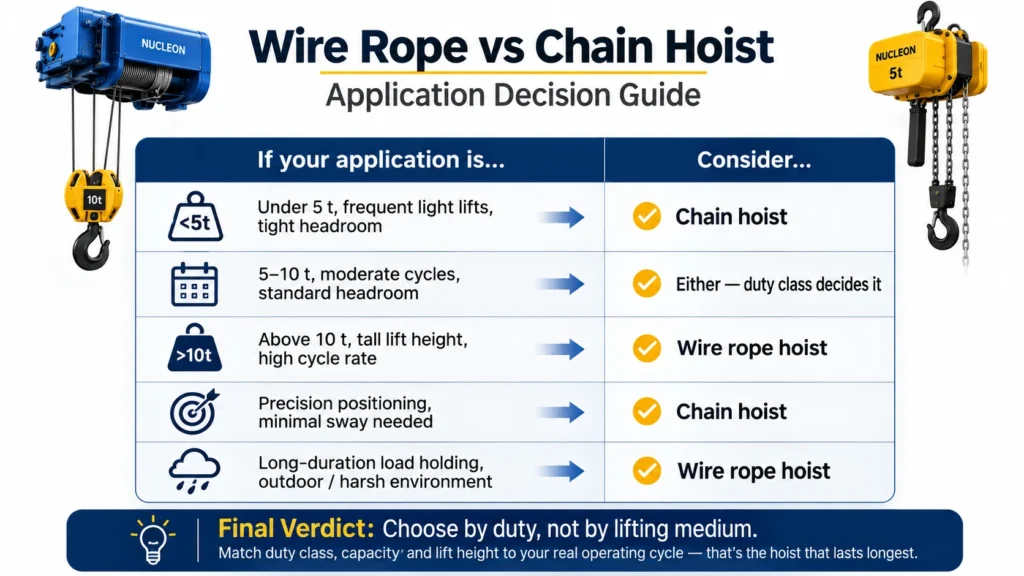
Wire Rope vs Chain Hoist: Application Decision Guide
| If your application is… | Consider… |
| Under 5 t, frequent light lifts, tight headroom | Chain hoist |
| 5–10 t, moderate cycles, standard headroom | Either — duty class decides it |
| Above 10 t, tall lift height, high cycle rate | Wire rope hoist |
| Precision positioning, minimal sway needed | Chain hoist |
| Long-duration load holding, outdoor/harsh environment | Wire rope hoist |
For loads under 5 tons in a standard workshop with frequent, light cycles, a chain hoist usually offers the better cost-to-performance ratio — but always confirm against your actual duty class, not tonnage alone.
Final Verdict: Choose by Duty, Not by Lifting Medium
The hoist that lasts longest is the one whose duty class, capacity, and lift height are correctly matched to your real operating cycle — not the one built from wire rope or chain by default. Once you know your daily cycle count, load spectrum, and lift height, matching duty class becomes a straightforward engineering conversation rather than a guess between two lifting mediums.
Conclusion
A wire rope hoist vs chain hoist comparison should start with duty class and operating cycle, not with which material sounds tougher — the hoist correctly matched to your load spectrum, lift height and cycle rate is the one that will actually last. Before ordering, confirm the FEM/ISO duty class against your real daily cycles, ask what consumables and spares are included in the quote, and compare total cost of ownership rather than sticker price alone.
Still unsure whether wire rope or chain fits your operation? [Talk to our engineering team for a duty-class recommendation and factory-direct quote →]

Equipment Specialist
Accomplished Crane Business Manager with extensive experience in heavy lift project management and operational oversight. Proven track record of driving revenue growth and ensuring safety compliance.
FAQ
Q1: Does a wire rope hoist always last longer than a chain hoist?
No. Neither type is inherently longer-lasting — service life depends on duty class, load spectrum, lifting cycles and maintenance, not on the lifting medium itself. A correctly matched chain hoist can outlast a poorly matched wire rope hoist, and vice versa.
Q2: How do I know what duty class I actually need?
Estimate your daily lifting cycles and how often loads are near full rated capacity, then match that to FEM 1.001 or ISO 4301 duty classes (typically M3–M8). If you run more than roughly 20–30 near-capacity lifts a day, ask the supplier for the specific duty class rating, not just tonnage.
Q3: Is a chain hoist cheaper to own over time than a wire rope hoist?
Not automatically. Chain hoists usually cost less upfront and have lower per-unit consumable costs, but total cost of ownership depends on cycle rate, maintenance discipline and downtime risk — a mismatched chain hoist in a high-cycle application can cost more in replacements and downtime than a correctly sized wire rope hoist.
Q4: What shortens wire rope hoist life the most?
High cycle counts combined with tight reeving (small sheave diameters, multiple falls) accelerate bending fatigue and wire breakage. Corrosive or dusty environments and inadequate rope guide selection also shorten service life faster than normal wear alone.
Q5: Can I upgrade a chain hoist to a wire rope hoist later if my lifting needs grow?
Generally not as a simple swap — wire rope and chain hoists differ in headroom, mounting, drum/sprocket design and electrical sizing, so a genuine capacity or height upgrade usually means specifying a new hoist rather than converting the existing one.
Related Articles
- FEM Wire Rope vs Chain Hoist: A Practical Comparison for Industrial Buyers
- The Difference Between Electric Chain Hoist And Electric Wire Rope Hoist
- Three Types Of Electric Chain Hoists
- What is the Difference Between Manual Chain Hoist and Electric Chain Hoist?
- How to Choose the Right FEM Standard Electric Hoist: A Practical Selection Guide

 English
  العربية
  Español
  Français
  Português
  Русский