The overhead crane main girder is the horizontal beam that carries the hoist and trolley across the span, transferring bending, torsion, and wheel loads down through the end trucks into the runway. Its steel grade and cross-section — not the tonnage on the nameplate — are what actually determine whether the crane is safe, durable, and correctly priced.
Most buyers compare cranes by capacity and steel grade name alone — "10-ton crane, Q355 girder" — without knowing what those numbers actually control. That gap is where oversized quotes, undersized structures, and expensive change orders come from.
This guide covers how main girder steel is selected, why some cranes use I-beam girders and others use welded box girders, and a practical framework for checking a supplier's girder proposal against your actual operating conditions — including two procurement mistakes that are easy to make and expensive to fix.
Table of Contents
What Is an Overhead Crane Main Girder?
Definition and Load-Bearing Role
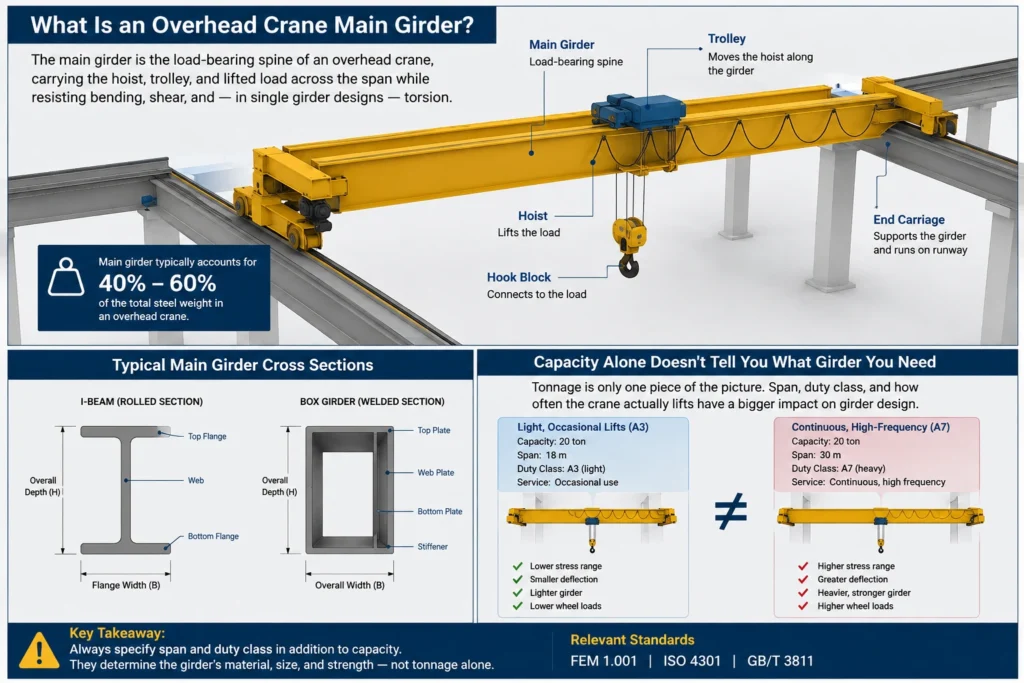
The main girder is the load-bearing spine of an overhead crane, carrying the hoist, trolley, and lifted load across the span while resisting bending, shear, and — in single girder designs — torsion. As the single largest fabricated component in the structure, it typically accounts for the largest share of the crane's total steel weight, commonly cited in the 40%–60% range for overhead cranes and somewhat higher for gantry cranes.
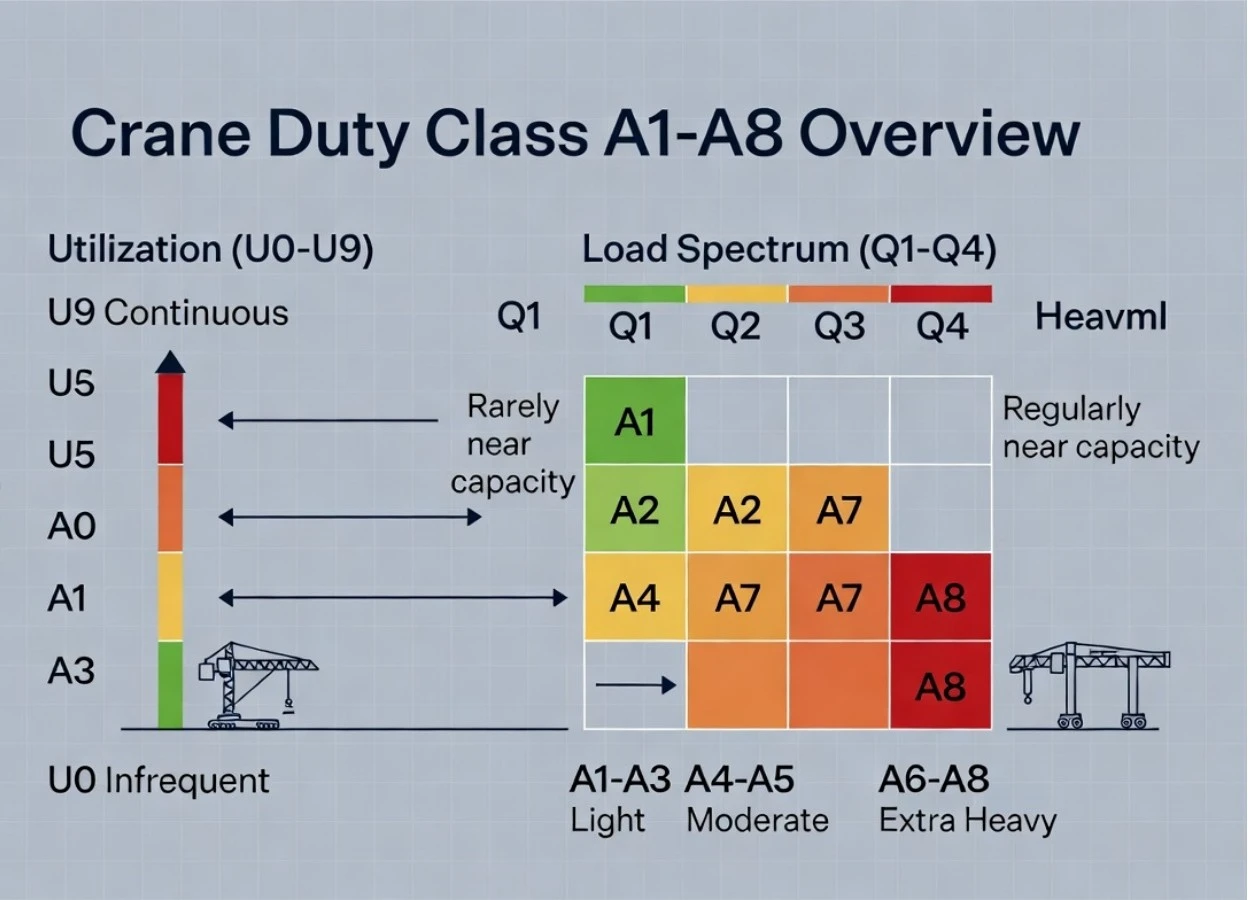
Because it carries nearly the entire structural load path, the main girder is also where design mistakes show up first — as excessive deflection, fatigue cracking at welds, or wheel loads the runway wasn't built for. That is why crane standards such as FEM 1.001, ISO 4301, and GB/T 3811 classify cranes into duty groups (from light, infrequent use up to continuous heavy-duty service) — the duty class, not the tonnage alone, is what a main girder is actually engineered against.
Capacity Alone Doesn't Tell You What Girder You Need
A crane's tonnage tells you the load; it does not tell you the girder. Two cranes rated for the same capacity can require entirely different main girders once span, duty class, and how often the crane actually lifts are factored in. A 20-ton crane on an 18-meter span running light, occasional lifts (duty class A3) and a 20-ton crane on a 30-meter span running continuous, high-frequency service (A7) will end up with different steel grades, different plate thicknesses, and different stiffener spacing — despite an identical nameplate rating. This is the first thing to check when a quote only lists tonnage: ask what span and duty class the girder was actually designed for.
Main Girder Materials: Steel Grades and How to Match Them
Main girder steel generally falls into three tiers, moving from cost-effective general-purpose grades to higher-strength and special-application steels:
| Steel Tier | Typical Application | China (GB) | Europe (EN 10025) | USA (ASTM) | Yield Strength |
| Low-carbon steel | Light-duty cranes, roughly ≤10–20t | Q235B | S235JR | A283 | ≥235 MPa |
| High-strength low-alloy | Medium-to-heavy duty, roughly 10–50t | Q355B | S355JR | A572 Gr.50 | ≥355 MPa |
| High-strength low-alloy | Heavy duty, roughly 50–300t | Q390B / Q420B | S355J2 / S420ML | A572 Gr.60/70 | ≥390–420 MPa |
| Special / weathering steel | Extreme cold, corrosive, or A6–A7 duty | Q460NE / Q355NH / Q690E | S460NL / S355J2W / S690QL | A537 Cl.2 / A588 / A514 Gr.B | ≥460–690 MPa |
Steel grades shown are the applicable standard main numbers for reference; specific plate thickness and testing requirements should be confirmed against the current standard edition and the fabricator's mill certificates.
Low-Carbon Steel Covers Most Light-Duty Cranes
Q235B (S235JR-equivalent) is the standard, cost-effective choice for light-duty, low-frequency cranes, typically up to around 10–20 tons depending on span. It welds easily with conventional processes and its toughness is adequate for general indoor use at room temperature.
The trade-off is strength: because yield strength is capped around 235 MPa, heavier loads require thicker plate to compensate, which adds structural weight faster than a higher-grade steel would. For cold-climate or outdoor cranes, the low-temperature-rated variants (commonly designated C/D grades) are typically specified instead, since standard Q235B toughness is only guaranteed at room temperature.
High-Strength Low-Alloy Steel Is the Mainstream Choice for Medium and Heavy Cranes
Q355, Q390, and Q420 grades (roughly S355–S420 equivalent) are the default material for most medium-to-heavy-duty overhead cranes, covering duty classes A3–A5 across the widest capacity range in general industrial use.
The advantage is strength-to-weight: at yield strengths of 355–420 MPa versus 235 MPa for basic carbon steel, a girder in this tier can typically use noticeably thinner plate for the same load, cutting structural self-weight and the resulting load on the runway and building. The trade-off is cost and fabrication: these grades typically carry a moderate price premium over Q235, and welding thicker sections (above roughly 25 mm) requires more controlled preheating and procedure to avoid cold cracking.
Special and Weathering Steels Target Extreme Operating Conditions
Grades like Q460NE, Q355NH (weathering steel), and Q690E are reserved for extreme-duty or harsh-environment applications — continuous heavy-duty operation, coastal or high-salt-spray sites, and cold-climate service where impact toughness must be guaranteed well below freezing (commonly tested down to around -40°C for these grades).
Weathering grades like Q355NH resist atmospheric corrosion far better than standard carbon steel, which can meaningfully reduce repainting and maintenance over the crane's service life for outdoor installations. Q690E, at the top of this tier, is typically reserved for large-tonnage special cranes — ladle handling, shipbuilding — where minimizing structural weight at very high load matters more than upfront material cost. These grades come at a real cost premium and generally require a fabricator experienced with their welding procedures.
Why "Higher Steel Grade" Doesn't Automatically Mean "Better Girder"
The most common material misjudgment in crane procurement is assuming a higher steel grade is a straightforward upgrade. Raising the yield strength lets a designer specify thinner plate for the same load rating — but a thinner section doesn't reduce the risk of local web or flange buckling, weld quality issues, or fatigue cracking under repeated loading. Those depend on the whole cross-section design and duty-class engineering, not the steel grade printed on the mill certificate.
A well-engineered Q235B girder, correctly sized for its actual duty class, can be a safer and more cost-effective structure than an undersized Q355 girder that was pushed thinner than it should have been to save weight. When comparing quotes, the steel grade alone tells you very little — ask for the calculated deflection and stability check behind it, not just the grade name.
I-Beam vs Box Girder: Why the Cross-Section Isn't Just About Cost
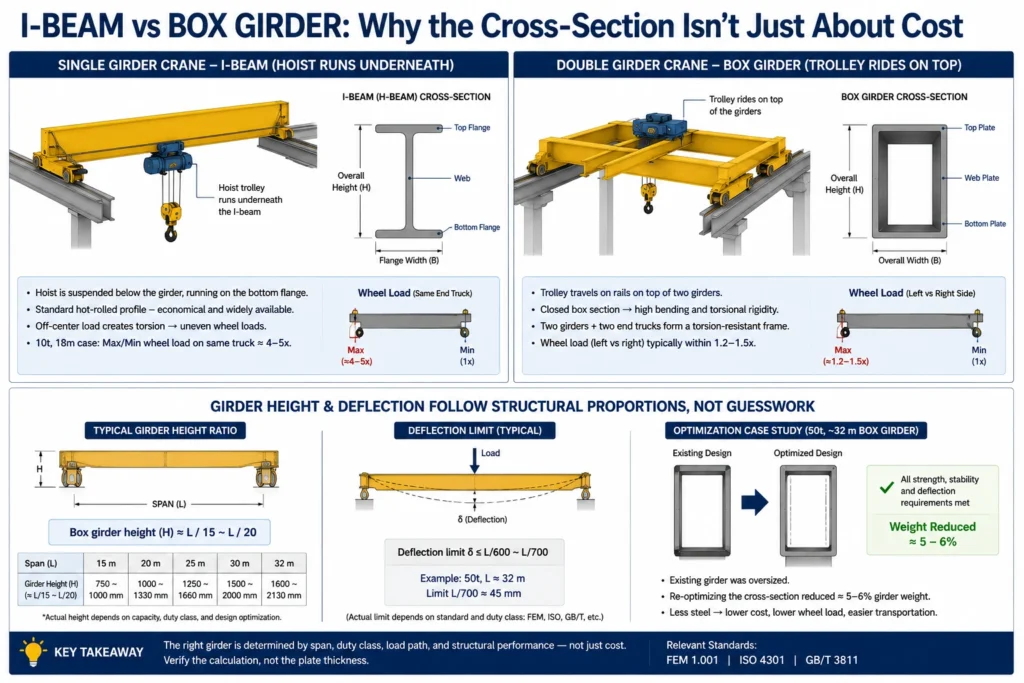
Beyond material grade, the shape of the girder's cross-section — I-beam or welded box — is determined by how the hoist trolley travels, not by which one is "better."
Single Girder Cranes Use I-Beams Because the Hoist Runs Underneath
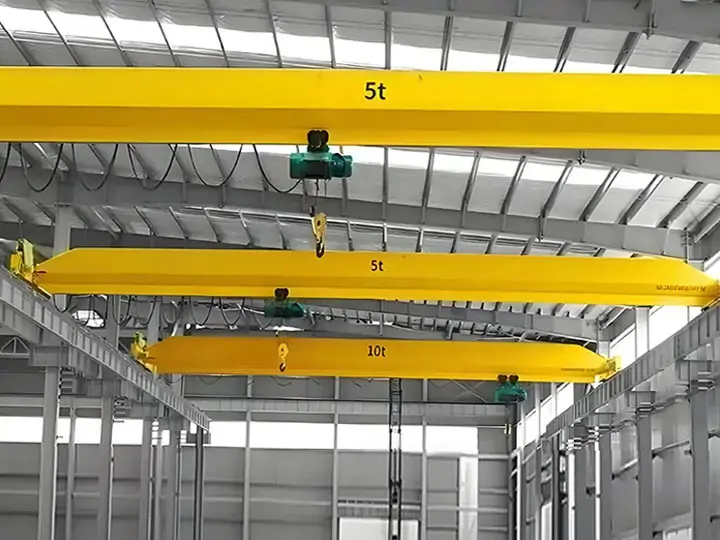
Single girder overhead cranes use an I-beam (or H-beam) main girder because the hoist trolley is suspended below it, running along the bottom flange. That mounting arrangement requires an open cross-section with both a top and bottom flange — a closed box section can't support a hoist tracking along its underside, which is why this configuration is inherent to single-girder, not double-girder, design.
Standard hot-rolled H-beam profiles come directly from the mill with flanges and web already formed, which is significantly cheaper to fabricate than welding four plates into a box. For the capacity and span range typical of single girder cranes, that standard profile provides sufficient strength without paying for a more complex structure.
The trade-off shows up in wheel loading: because the hoist load hangs off-center under one flange, it generates torsion that the end trucks transmit unevenly to the runway wheels. In a documented 10-ton, 18-meter single girder case, the maximum and minimum wheel loads on opposite ends of the same truck differed by roughly 4–5 times — a real design factor for runway beam sizing, not a minor detail.
Double Girder Cranes Use Box Girders Because the Trolley Rides on Top
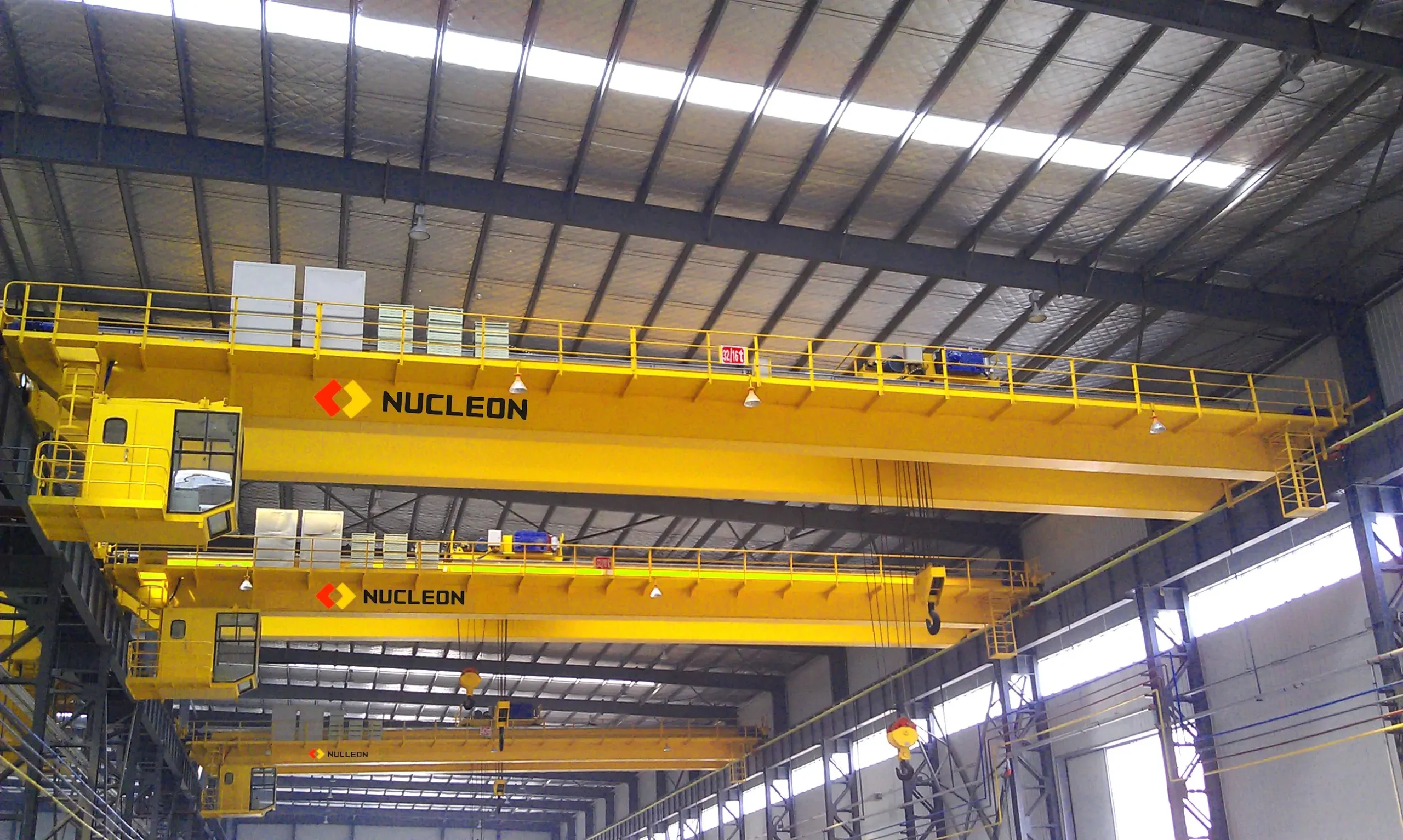
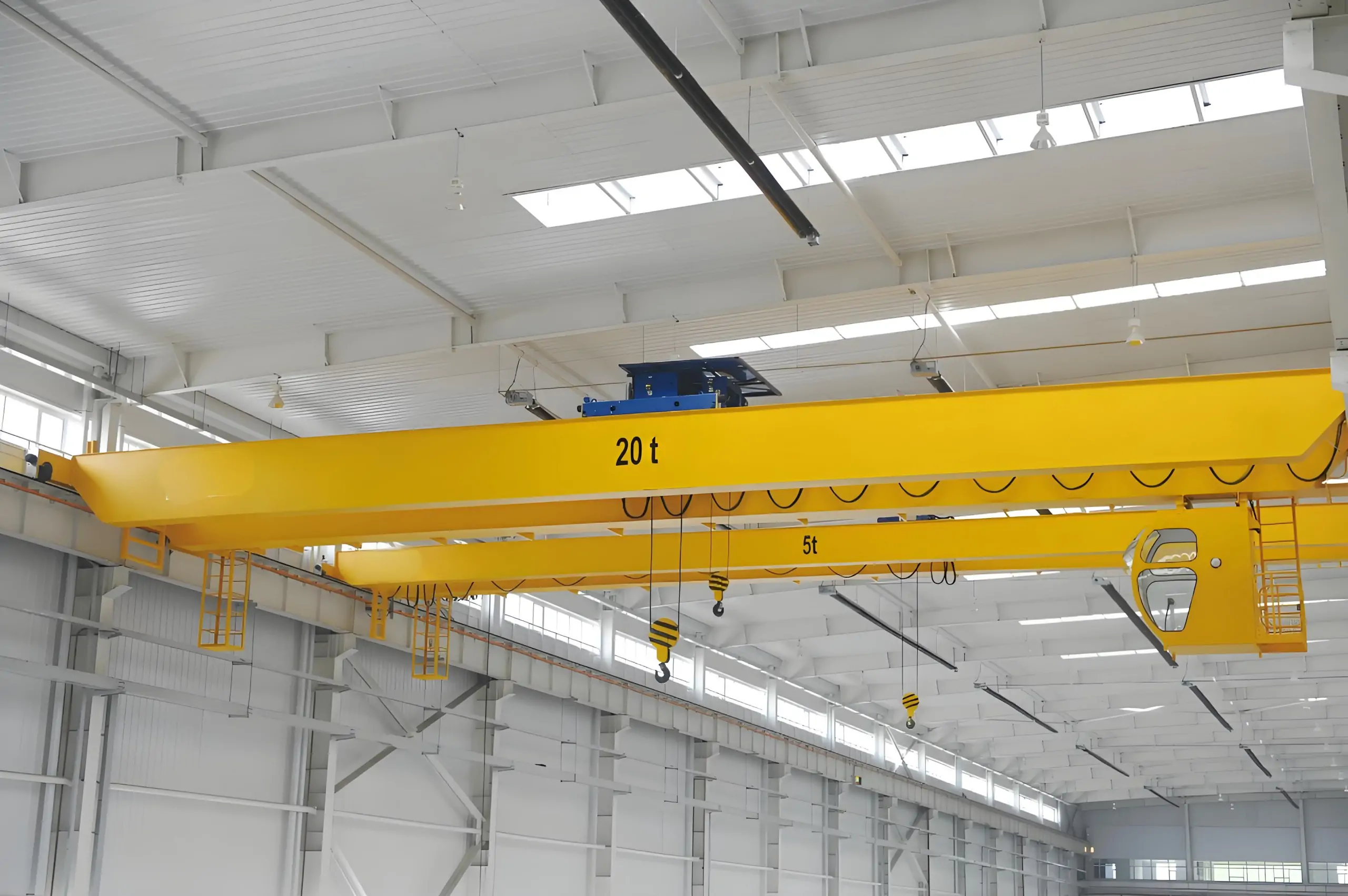
Double girder cranes use welded box sections because the trolley travels on rails on top of two parallel girders, not suspended beneath one. With the trolley on top, the cross-section is no longer constrained by the need to support an underslung hoist, so designers can choose the shape with the best combined bending and torsional resistance — a closed rectangular box. The two girders and two end trucks also form a frame that shares torsional load across the whole structure, rather than one beam resisting it alone.
That symmetry is the direct payoff: wheel load between the left and right sides of a double girder crane typically stays within about a 1.2–1.5x ratio, versus the 4–5x swing seen on a single girder crane. The trade-off is weight and fabrication cost — box girders require more steel, more welding, and internal diaphragms — but they also free up more usable hook height, since the hoist rides above the girders rather than hanging below one.
Girder Height and Deflection Follow Structural Proportions, Not Guesswork
Box girder height is typically sized to roughly 1/15 to 1/20 of the span, a ratio reported in published crane structural design practice that balances stiffness against added dead weight — go shorter and deflection rises; go taller and you add steel without a proportional safety gain. Deflection itself is checked against a fraction of the span (commonly in the L/600–L/700 range depending on the applicable standard and duty class); one published academic case study of a 50-ton, roughly 32-meter box girder used a limit near L/700, about 45 mm.
That same structural optimization research found the existing girder in that case was actually oversized relative to what the deflection and stability checks required — re-optimizing the cross-section cut roughly 5–6% of the girder's weight while still meeting every stability and deflection requirement. The takeaway for buyers: a heavier girder is not automatically a safer one. Oversizing adds steel cost, wheel load, and transport weight without necessarily adding usable safety margin — which is exactly why the calculation, not the plate thickness, is what should be verified.
How to Choose the Right Main Girder: A Buyer's Decision Framework
The Real Cost of a Main Girder Isn't the Price Per Ton of Steel
Comparing crane suppliers on steel price per ton is one of the easiest ways to end up with a higher total cost. A main girder's actual cost is driven by plate weight plus welding volume, the number of internal stiffeners and diaphragms, machining, weld inspection (NDT), painting, transport, and installation — not the raw material line alone.
This connects directly to the sizing question above: an oversized or overly conservative girder increases self-weight, which raises the wheel load transmitted to the runway and building structure, and increases transport and crane-erection cost — even when the steel itself was bought cheaply per ton. A lighter, correctly-engineered girder can cost less end-to-end than a heavier one quoted at a lower unit steel price.
What to Verify Before You Sign a Purchase Order
A short set of checks catches most main-girder mismatches before they become a warranty dispute:
- Confirm the duty class (FEM/ISO/GB) matches your actual lifts-per-hour, not just tonnage
- Ask for the calculated maximum deflection at rated load and span
- Get the steel grade and standard (GB/EN/ASTM) confirmed on the fabrication drawing, not only the quote
- For box girders, confirm stiffener and diaphragm spacing appears on the drawing
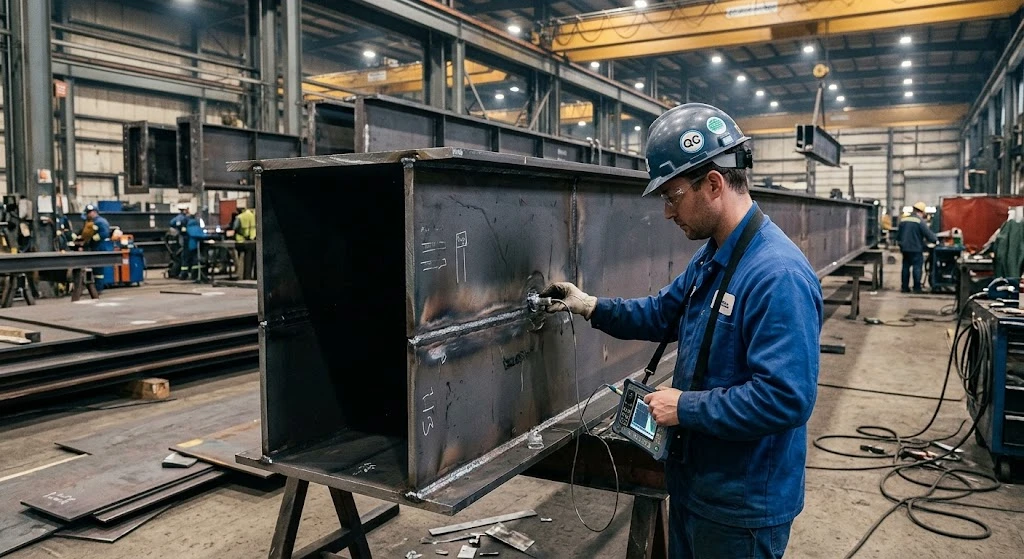
- Verify the weld inspection method (visual, MT, UT) and coverage percentage
- Ask whether wheel-load calculations account for your actual runway or corbel design, especially if retrofitting an existing building
For new-build facilities, most of the above is easy to accommodate at the design stage. For an existing building, the runway corbels are already cast — if the quoted wheel load exceeds what they were designed for, the realistic options are reinforcing the corbels or choosing a lower-wheel-load configuration, which is worth raising with the supplier before tonnage and span are locked in.
Conclusion
An overhead crane main girder is defined as much by its steel grade and cross-section as by its tonnage rating — and the two decisions that cause the most trouble are treating a higher steel grade as an automatic upgrade, and comparing suppliers on steel price per ton instead of total delivered and installed cost. Before signing off on an overhead crane main girder, confirm the duty class, ask for the deflection calculation, and get the steel grade and weld inspection scope in writing on the drawing — not just the quote.
Final equipment selection must be confirmed by a certified engineer and comply with local lifting-equipment regulations.

Equipment Specialist
Accomplished Crane Business Manager with extensive experience in heavy lift project management and operational oversight. Proven track record of driving revenue growth and ensuring safety compliance.
FAQ
Q1: What steel is used for an overhead crane main girder?
Most overhead crane main girders use Q235B (S235JR-equivalent) for light-duty cranes, Q355–Q420 (S355–S420-equivalent) for medium-to-heavy-duty cranes, and special high-strength or weathering grades like Q460NE, Q355NH, or Q690E for extreme-duty, corrosive, or cold-climate service. The right grade depends on tonnage, span, and duty class together, not tonnage alone.
Q2: What's the difference between an I-beam and a box girder main girder?
An I-beam girder is used on single girder cranes because the hoist trolley runs along its exposed bottom flange; a box girder is used on double girder cranes because the trolley travels on top, between two girders. Box girders handle torsion more evenly and allow greater hook height, but cost more to fabricate.
Q3: Does a higher steel grade always mean a stronger main girder?
Not automatically. A higher grade allows thinner plate for the same load, but thinner sections still need correct engineering against local buckling, fatigue, and deflection. A well-designed lower-grade girder can outperform an undersized higher-grade one — always ask for the calculated deflection and stability check, not just the steel grade.
Q4: How is overhead crane main girder height determined?
Box girder height is typically sized to roughly 1/15 to 1/20 of the crane's span, balancing stiffness against added dead weight, and checked against a maximum deflection limit — commonly in the L/600–L/700 range depending on the applicable standard and duty class.
Related Articles
- Differences Between Single Girder vs Double Girder Overhead Cranes
- Explosion-Proof Overhead Crane: When Do You Actually Need One?
- Crane Wire Rope: Inspection & Replacement Guide
- Overhead Cranes in Peru & Chile: Mining Demand & Supplier Guide (2026)
- Overhead Crane Inspection: OSHA vs CE vs GB Standard — What Buyers and Exporters Actually Need to Know

 English
  العربية
  Español
  Français
  Português
  Русский