Peru and Chile's overhead crane demand is anchored overwhelmingly in copper mining — Chile holds the world's largest copper reserves and has been its largest producer since 1983, while copper accounts for roughly a quarter to a third of Peru's total exports — and in both countries, the crane's real operating environment is the mine-site maintenance shop, not a standard factory floor.
If you're sourcing overhead cranes for a Peruvian or Chilean mining operation, the detail that changes your compliance approach more than any price comparison is this: mining safety regulations in both countries — Chile's DS N°132 and Peru's DS N°024-2016-EM — govern how lifting equipment must be operated at the mine site, including specific provisions for bridge cranes, and sit separately from whatever structural design standard (FEM, ISO, or ASME) the crane itself was engineered to.
This guide covers where demand concentrates in each country, what capacities and configurations mining maintenance shops actually order, what DS 132 and DS 024-2016-EM require, and how to evaluate suppliers for mining-sector projects specifically.
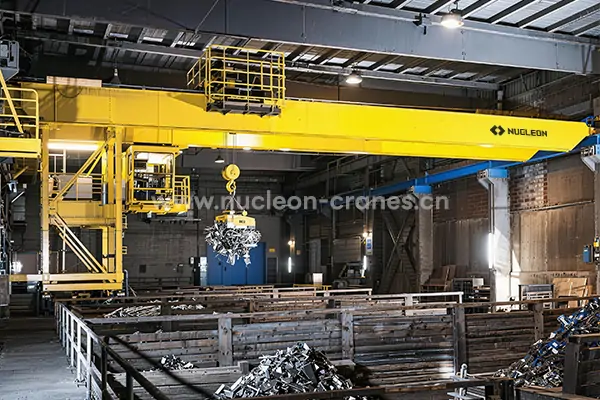
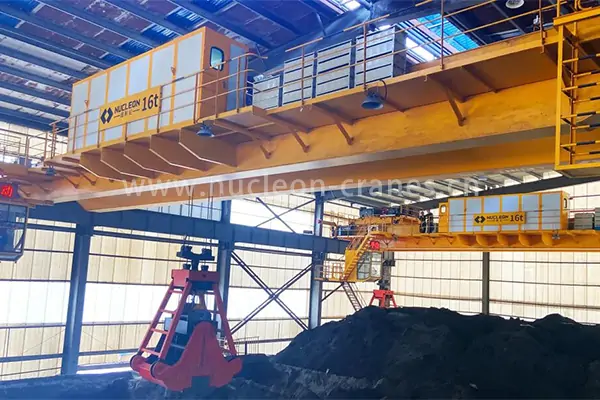
Table of Contents
Quick Reference: Overhead Crane Price Range by Capacity (Peru & Chile Mining Market)
| Capacity | Typical Configuration | Market Reference Price ($) |
| 1–5 tons | Single girder, standard span | $2,200 – $6,500 |
| 5–10 tons | Single/double girder | $5,500 – $15,000 |
| 10–20 tons | Double girder, dust/corrosion protected | $13,000 – $35,000 |
| 20–50 tons | Double girder, heavy duty (mine maintenance shop) | $30,000 – $95,000+ |
Reference range only — final pricing depends on span, duty class, dust/corrosion protection, altitude derating, and whether local safety-documentation support is included. [Get a factory-direct quote for your specification →]
Where Demand Concentrates: Chile's Atacama Copper Belt vs. Peru's Mining Regions
Chile's overhead crane demand concentrates around the Atacama Desert copper belt in the north, where the world's largest open-pit and underground copper operations sit, while Peru's demand spreads across a wider set of mining regions serving both copper and polymetallic (gold, silver, zinc) operations.
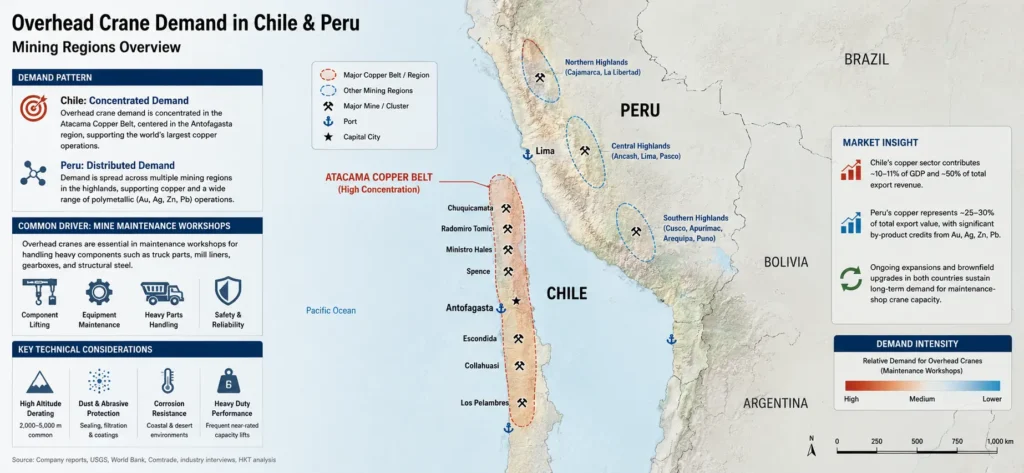
- ==Chile's Atacama and Antofagasta regions== host the country's flagship copper operations — including some of the largest open-pit and underground mines globally — where overhead cranes serve equipment-maintenance workshops handling truck components, mill liners, and heavy machinery parts rather than production-line material handling.
- ==Chile's copper sector== contributes a substantial share of national GDP and export revenue, and continued brownfield and greenfield investment through the current decade sustains steady demand for maintenance-shop crane capacity as existing operations expand and modernize.
- ==Peru's mining regions== (spanning the southern and central highlands) serve both large-scale copper operations and a broader base of polymetallic mining, with copper alone representing roughly a quarter to a third of the country's total export value — driving parallel demand for mine-maintenance overhead cranes across a more geographically distributed set of sites than Chile's more concentrated northern belt.
- ==Both countries' maintenance-shop demand== shares common technical requirements: altitude derating for equipment operating at high-elevation sites, dust and abrasive-particulate protection, and heavy-duty configurations built for frequent near-rated-capacity lifts on mining equipment components rather than the lighter, precision-positioning demand typical of automotive or electronics manufacturing.
The practical implication: a mining-sector crane quote should specify site altitude and dust/corrosion exposure alongside standard capacity and span figures — these two variables affect component selection (motor derating, sealing, coatings) more than they would in a standard industrial or warehouse application.
What Overhead Crane Capacities and Types Are Actually in Demand
Demand in both countries centers on heavy-duty double girder cranes for mine-site maintenance workshops, with a smaller parallel stream of lighter cranes for processing-plant and administrative-support facilities.
- 10–50 ton double girder overhead cranes dominate mine-maintenance-shop demand in both countries, handling truck engines, mill components, and heavy machinery parts under continuous, dust-exposed operating conditions.
- Explosion-proof and corrosion-resistant configurations see targeted demand in ore-processing and chemical-handling areas of mine sites, where standard electrical components wear faster than in a clean industrial environment.
- Gantry cranes serve equipment-laydown and workshop-yard applications at larger mine sites where structures can't always support overhead runway rails.
- Lighter 1–10 ton cranes appear in mine-site administrative buildings, smaller processing facilities, and port-adjacent copper-concentrate handling infrastructure — a distinct, lower-duty segment from the maintenance-shop core demand.
Price for mining-sector configurations typically runs above standard industrial pricing at comparable tonnage, reflecting the added cost of dust/corrosion protection and altitude-rated components — buyers comparing quotes should confirm these are itemized rather than assumed to be included in a standard industrial-grade quote.
Compliance: What Chile's DS 132 and Peru's DS 024-2016-EM Actually Require
Chile's DS N°132 (Reglamento de Seguridad Minera, enforced by SERNAGEOMIN) and Peru's DS N°024-2016-EM (Reglamento de Seguridad y Salud Ocupacional en Minería) both govern mining-site operational safety — including specific provisions covering lifting equipment — separately from whatever structural design standard the crane itself was built to.
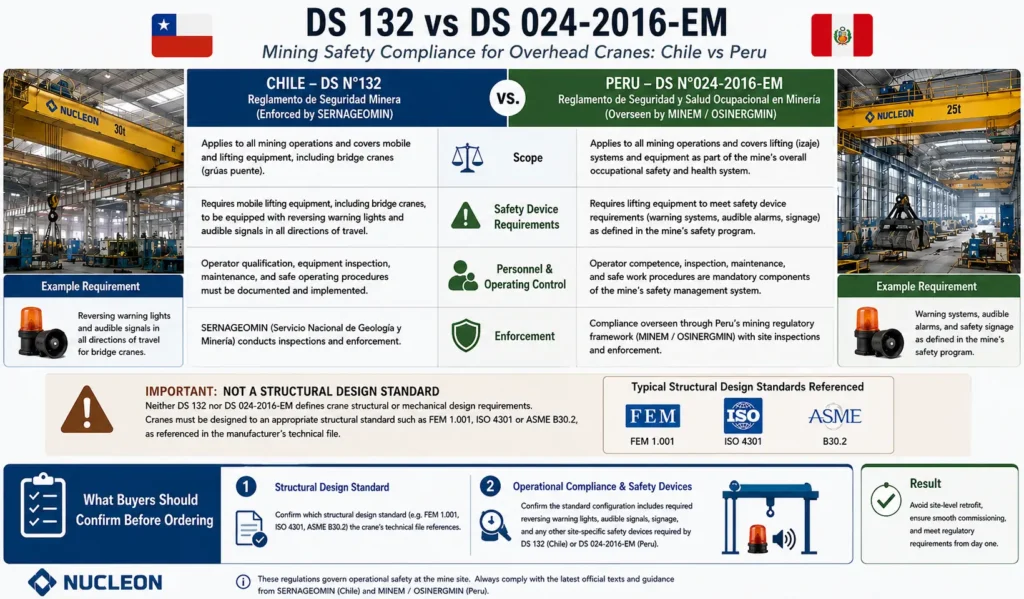
- Chile's DS N°132 sets mine-site safety requirements across all mobile and lifting equipment used in mining operations, including specific provisions for bridge cranes (grúas puente) — for example, requirements that mobile lifting equipment, including bridge cranes, be equipped with reversing warning lights and audible signals in all directions of travel. SERNAGEOMIN (Chile's National Geology and Mining Service) enforces the regulation and conducts site inspections.
- Peru's DS N°024-2016-EM governs occupational safety and health across mining operations broadly, with lifting (izaje) systems and equipment covered as part of the mine's overall operational safety program, overseen through Peru's mining regulatory framework (MINEM/OSINERGMIN).
- Neither regulation is a crane structural design standard — both operate at the level of site operating procedure, training, and equipment safety-device requirements (warning systems, operator qualification, inspection routines), while the crane's structural and mechanical design basis is typically referenced separately against FEM 1.001, ISO 4301, or ASME B30.2 in the manufacturer's technical file.
- The practical consequence for buyers: a mine-site crane needs both a properly referenced structural design standard and equipment configured to satisfy the site's specific DS 132 or DS 024-2016-EM operational requirements (warning devices, signage, and documented safe-operating procedures) — confirming the crane ships with the required warning/signal equipment pre-installed avoids a site-level retrofit after delivery.
Before ordering for a mining-sector project, confirm two things with your supplier: which structural design standard the crane's technical file references, and whether the standard configuration already includes the reversing warning lights/audible signals and any other site-specific safety devices your mine's safety department will require during commissioning.
Choosing a Supplier for Peru or Chile Mining Projects
Chinese manufacturers compete strongly on cost and configuration flexibility for mine-maintenance-shop cranes, while European and North American suppliers hold established positioning in large-scale flagship mining operations where decades-long service relationships and specialized heavy-duty engineering matter more than unit price.
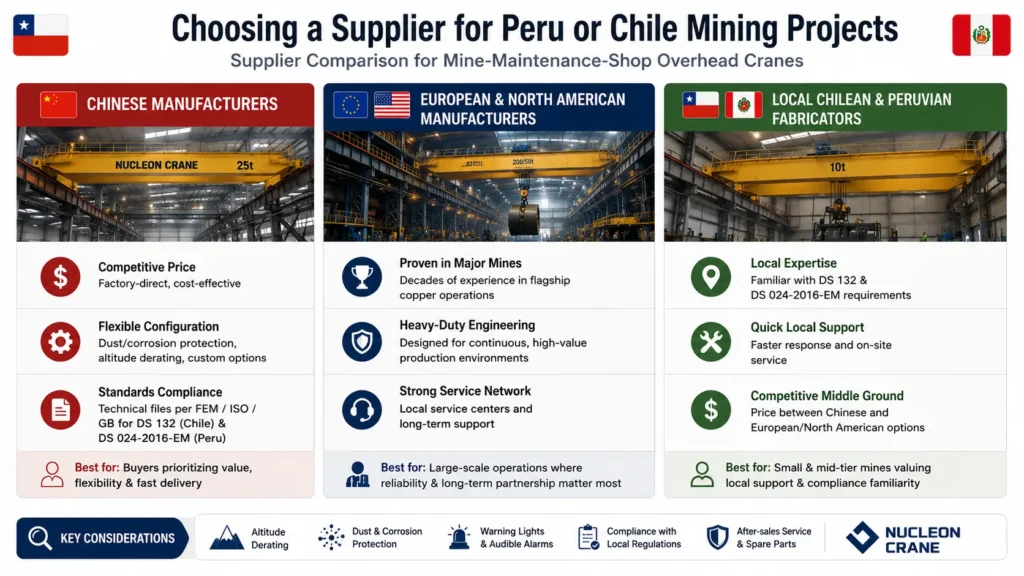
- Chinese manufacturers offer competitive landed cost and can typically configure dust/corrosion protection and altitude derating as standard options, with technical files referencing FEM, ISO, or GB/T 3811 — compatible with what Chilean and Peruvian mining-safety review expects at the design-reference level.
- European and North American manufacturers maintain strong positioning at major flagship copper operations, where established local service networks and specialized heavy-duty engineering for continuous, high-value production environments justify a materially higher unit cost.
- Local Chilean and Peruvian fabricators serve smaller and mid-tier mining operations with configurations built around familiarity with DS 132/DS 024-2016-EM site-inspection expectations, typically at a price point between the two options above.
For buyers prioritizing factory-direct pricing on mining-configured equipment (dust/corrosion protection, altitude derating, and pre-installed warning devices), Nucleon Crane supports technical file preparation aligned with FEM/ISO/GB standards for Peru and Chile mining-sector projects.
Conclusion
Peru and Chile's overhead crane demand is concentrated in mine-maintenance-shop applications — heavy-duty, dust-exposed, often altitude-derated — rather than standard factory-floor use. The compliance detail that matters most for mining-sector buyers isn't finding a mining-specific crane design standard (neither country has one) — it's confirming the crane's technical file references a recognized structural standard (FEM, ISO, or ASME) separately from confirming the equipment ships configured to satisfy DS 132's or DS 024-2016-EM's site-level operational safety requirements, including reversing warning devices for bridge cranes.
Ready to source overhead cranes for a Peru or Chile mining project?

Equipment Specialist
Accomplished Crane Business Manager with extensive experience in heavy lift project management and operational oversight. Proven track record of driving revenue growth and ensuring safety compliance.
FAQ
Q1: Do Chile's DS 132 and Peru's DS 024-2016-EM set structural design requirements for overhead cranes?
No. Both regulations govern mine-site operational safety — including specific provisions like reversing warning lights/signals for bridge cranes under Chile's DS 132 — but the crane's structural design basis is referenced separately against standards such as FEM 1.001, ISO 4301, or ASME B30.2 in the manufacturer's technical file.
Q2: What's the price range for a heavy-duty mining overhead crane in Peru or Chile?
A 10–20 ton double girder crane configured for mine-maintenance-shop use (dust/corrosion protection, altitude derating) typically runs $7,000–$18,000 as a market reference — above standard industrial pricing at comparable tonnage due to the added protective configuration.
Q3: Which regions drive the most overhead crane demand in Peru and Chile?
In Chile, demand concentrates in the Atacama and Antofagasta regions around the country's flagship copper operations. In Peru, demand is more geographically distributed across the southern and central highland mining regions, serving both copper and polymetallic operations.
Q4: What should I confirm before ordering a crane for a mine-site maintenance shop?
Confirm the crane's referenced structural design standard (FEM, ISO, or ASME), the site's altitude and dust/corrosion exposure level, and whether the standard configuration includes reversing warning lights/audible signals and other safety devices your mine's safety department will require during DS 132 or DS 024-2016-EM-governed commissioning.
Related Articles
- Overhead Cranes in Mexico: Industry Applications, Compliance & Supplier Guide
- Overhead Crane Inspection: OSHA vs CE vs GB Standard — What Buyers and Exporters Actually Need to Know
- Overhead Cranes in Nigeria & Kenya: Types, Prices & How to Choose the Right One
- OSHA vs CE Overhead Crane Compliance: A Practical Checklist for Buyers and Exporters (2026)
- Explained: What A1–A8 Means and How to Choose the Right One
- Overhead Cranes in Brazil: Market Demand, Compliance & Supplier Guide (2026)

 English
  العربية
  Español
  Français
  Português
  Русский