
A crane end truck is the structural assembly at each end of an overhead crane bridge that houses the wheels, bearings, and (on driven ends) the travel motor and gearbox. Crane end truck maintenance is not just wheel inspection — most premature wheel failures trace back to end truck alignment or crane skewing, not the wheel itself.
If you manage crane maintenance or are sourcing replacement end trucks and wheels, you've likely run into this exact problem: a wheel wears unevenly, gets replaced, and then wears the same way again a few months later. That's rarely bad luck — it's usually a symptom being treated as the disease.
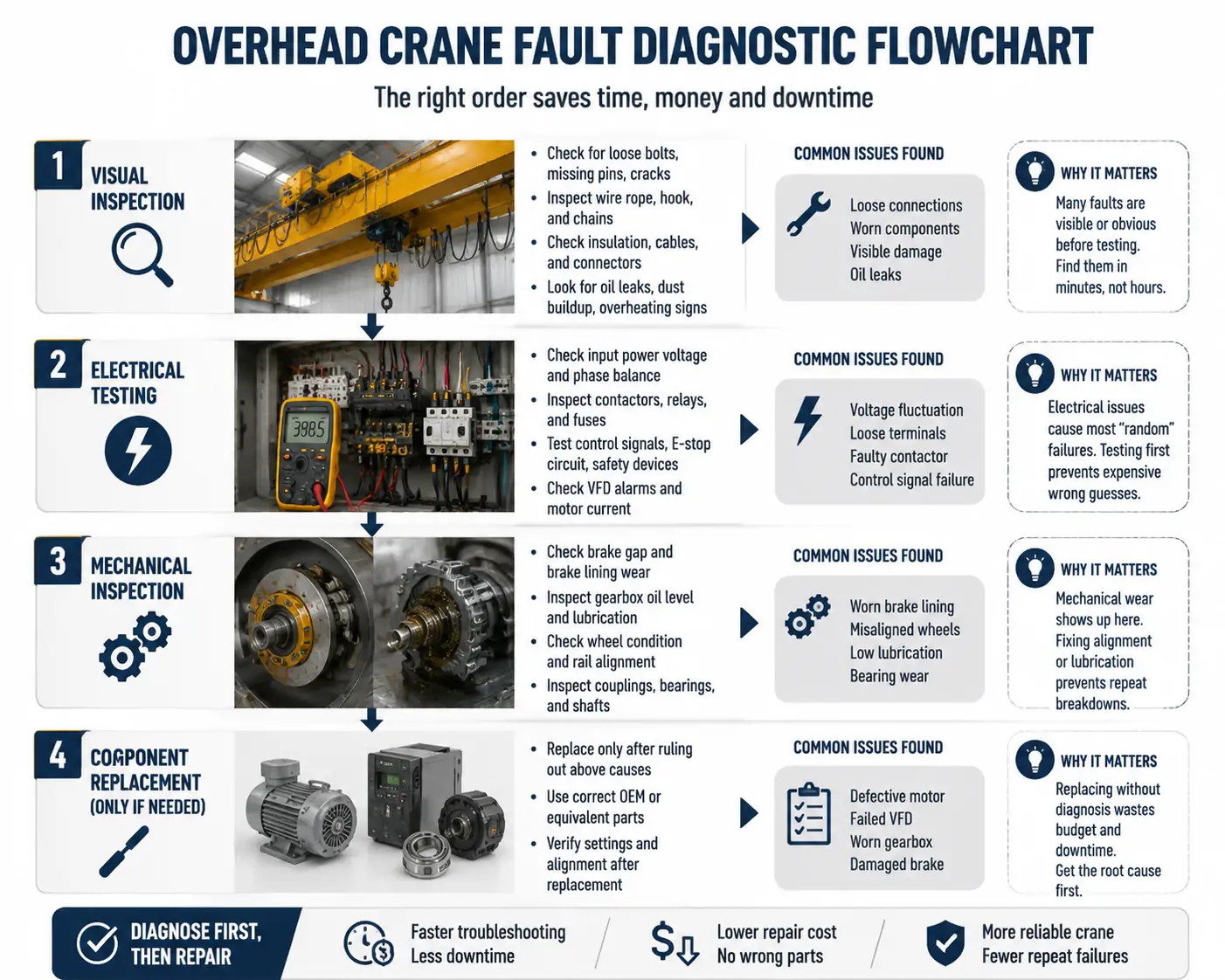
This guide walks through how to inspect end trucks and wheels, how to tell a wheel problem from an alignment problem, when replacement is actually justified, and what to specify so a replacement wheel doesn't repeat the failure. It follows the same inspection-to-decision logic used in CMAA Specification No. 70 and ANSI/ASME B30.2 crane maintenance guidance.
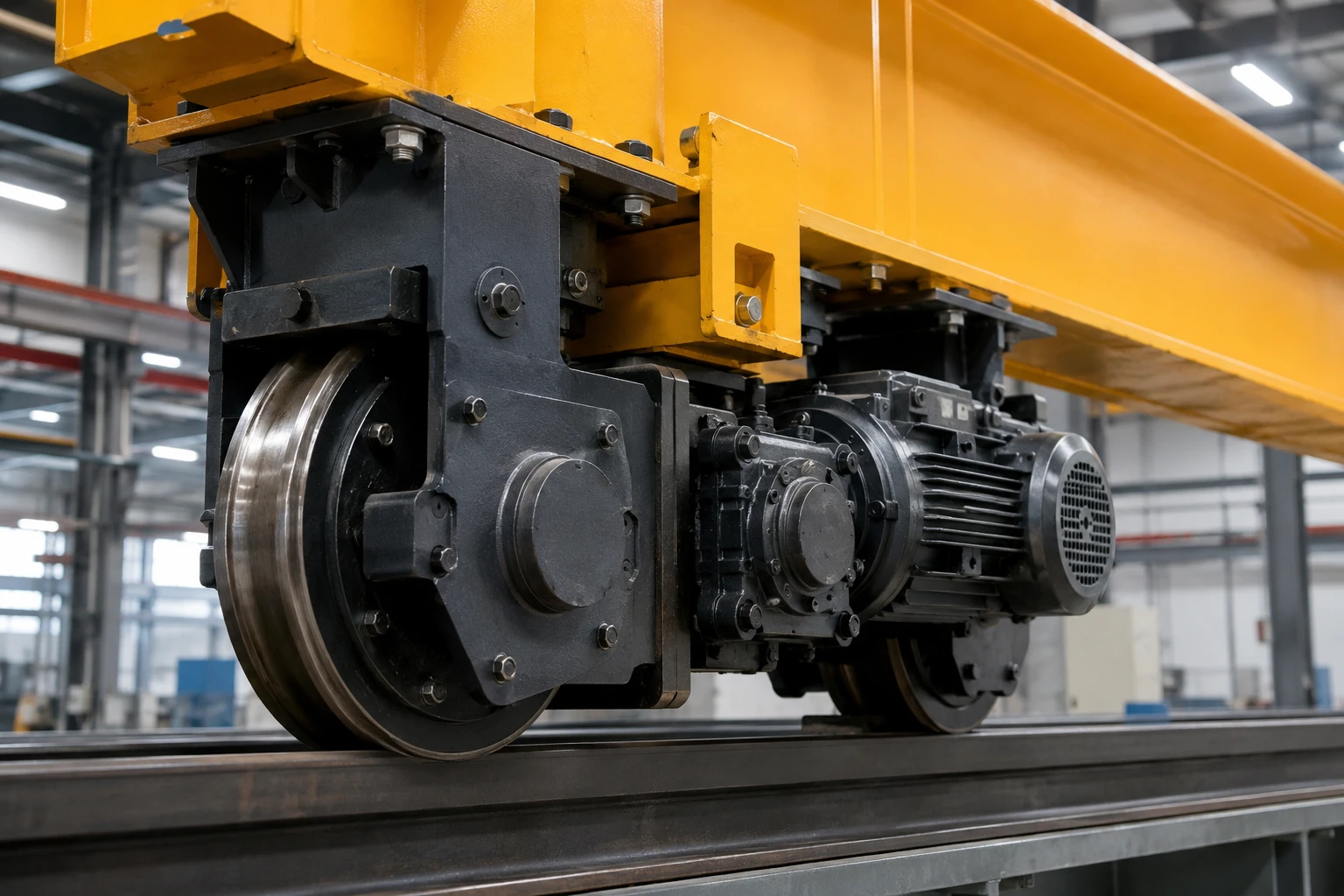
Table of Contents
Quick Diagnostic Reference
Before the detailed sections below, use this table to narrow down what you're likely dealing with. It's the fastest way to avoid the most common mistake in crane wheel maintenance: replacing a wheel when the real problem is upstream of it.
| Field Symptom | Most Likely Cause | What to Check First |
| Wear concentrated on one side of the wheel flange | End truck / runway misalignment | Rail gauge and parallelism, end truck squareness |
| Crane travels diagonally ("crabs") across the runway | Skewing / uneven wheel alignment | Wheel alignment, drive synchronization between end trucks |
| Flat spot on wheel tread | Wheel slip under braking, or drive/VFD fault | Brake adjustment, drive control, wheel-to-motor coupling |
| Wheel diameters uneven side-to-side | Uneven load distribution or mismatched wheel wear rates | Load positioning, individual wheel wear logs |
| Grinding or rumbling noise at the wheel | Bearing or gearbox wear | Bearing condition, lubrication, gear mesh |
| Rail head shows abnormal edge wear | Flange contact from a misaligned or skewed crane | Same as diagonal travel — alignment, not the rail |
| Same wheel position keeps needing replacement | Root cause was never fixed — likely geometry, not the wheel | Full runway and end truck alignment survey |
If you're seeing repeated wheel replacements at the same position, the wheel was probably never the problem. [Get an end truck / wheel spec review →]
Get Solution QuoteHow to Inspect Crane End Trucks and Wheels
A routine inspection covers five things, not just the wheel tread
A proper end truck inspection checks bolted connections, wheel wear, bearings, flanges, and lubrication — checking the wheel tread alone misses most of the failure modes that actually cause downtime. End truck manufacturer manuals (R&M, ACE World, Louden/Acco) converge on the same core checklist: end truck-to-bridge bolt torque, wheel tread and flange condition, bearing play and noise, drive wheel and gearbox condition where applicable, and lubrication of wheel bearings and, on geared drive wheels, the pinion. Skipping the bolt and bearing checks is common because they're less visible than wheel wear, but a loose end truck-to-bridge connection will itself cause the misalignment that then chews up the wheel you were inspecting in the first place.
Inspection frequency should follow duty class, not a calendar default
How often you inspect should scale with how hard the crane works, not a fixed monthly schedule. A crane in FEM/CMAA duty class A3–A4 (occasional to light-duty use) can often run on a quarterly or semi-annual visual inspection cycle, while a crane in A5–A6 (regular, moderate-to-heavy production use) typically needs monthly wheel and end truck checks, and a A7–A8 crane (continuous, heavy-cycle operation such as steel mills or scrap yards) may warrant weekly checks plus a documented monthly detailed inspection. These are typical practice ranges, not fixed rules — your crane's actual duty class rating and manufacturer manual should set the final interval. CMAA No. 70 and ANSI/ASME B30.2 both require documented periodic inspection but leave the exact frequency to be set by usage severity.
Don't judge wheel wear by eye alone — use manufacturer dimensional limits
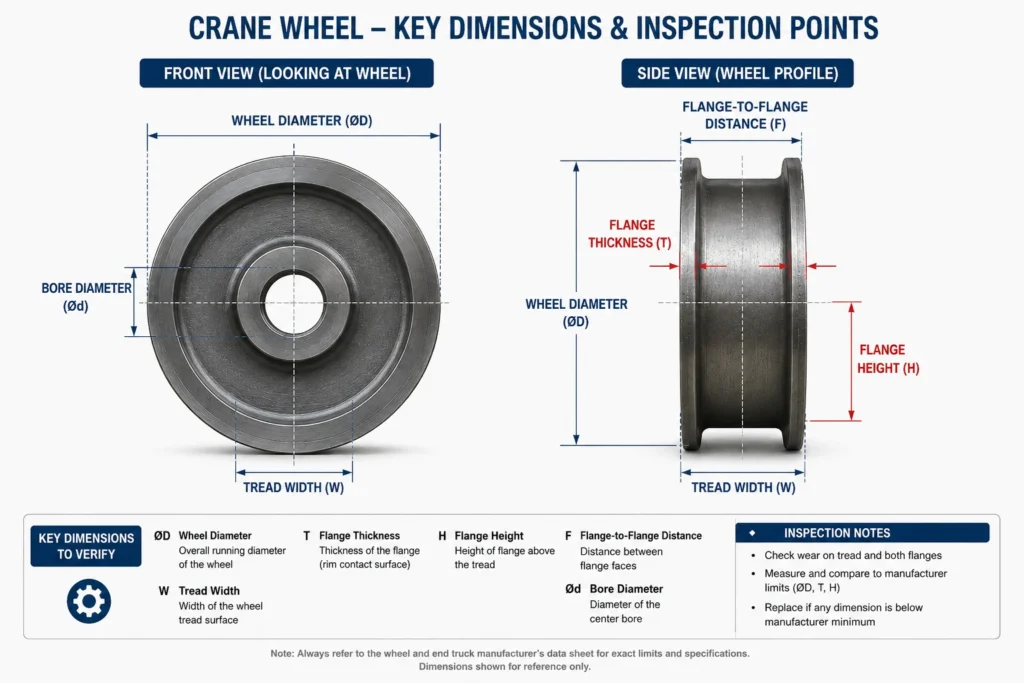
Visual "looks worn" judgment is not a valid replacement criterion — wheel replacement limits are manufacturer- and wheel-design-specific dimensional values. Manufacturers define replacement limits using measured values: wheel diameter reduction, flange thickness, and groove depth on double-flanged wheels, compared against the original design dimensions. A wheel that looks rough but is still within the manufacturer's diameter and flange-thickness tolerance may still have useful life left, while a wheel that looks acceptable but has an out-of-round tread or a hairline flange crack may need immediate replacement. This is why generic "replace at X% wear" rules you'll see in some guides are a poor substitute for checking the actual wheel drawing or manufacturer spec sheet.
Root Causes of Wheel Wear: Alignment, Skewing & Duty Class
One-sided flange wear is usually an alignment problem, not a wheel problem
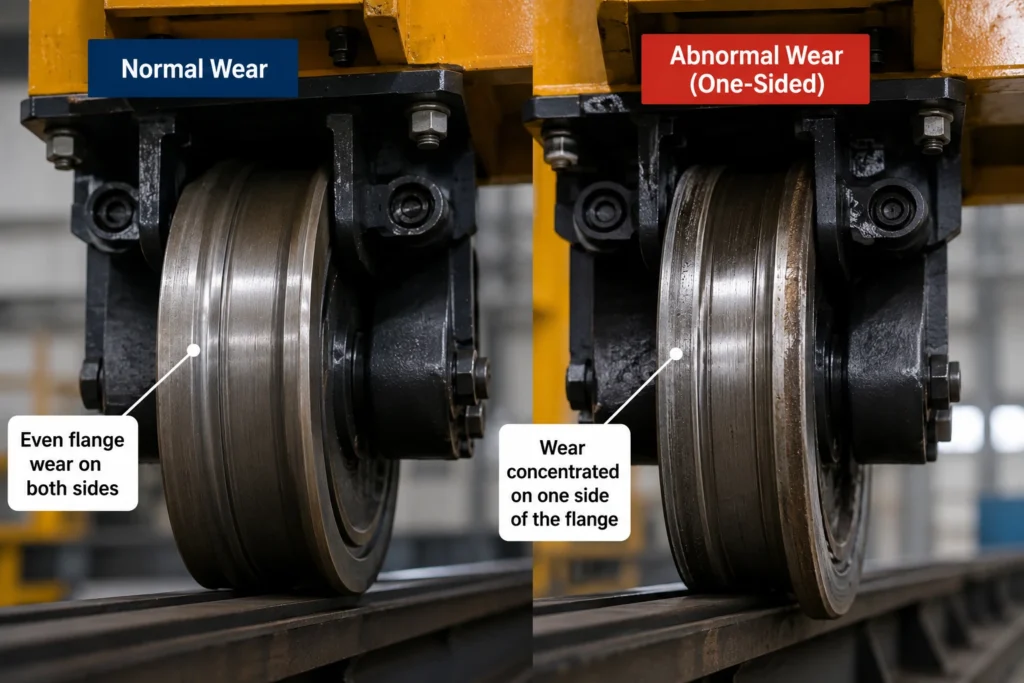
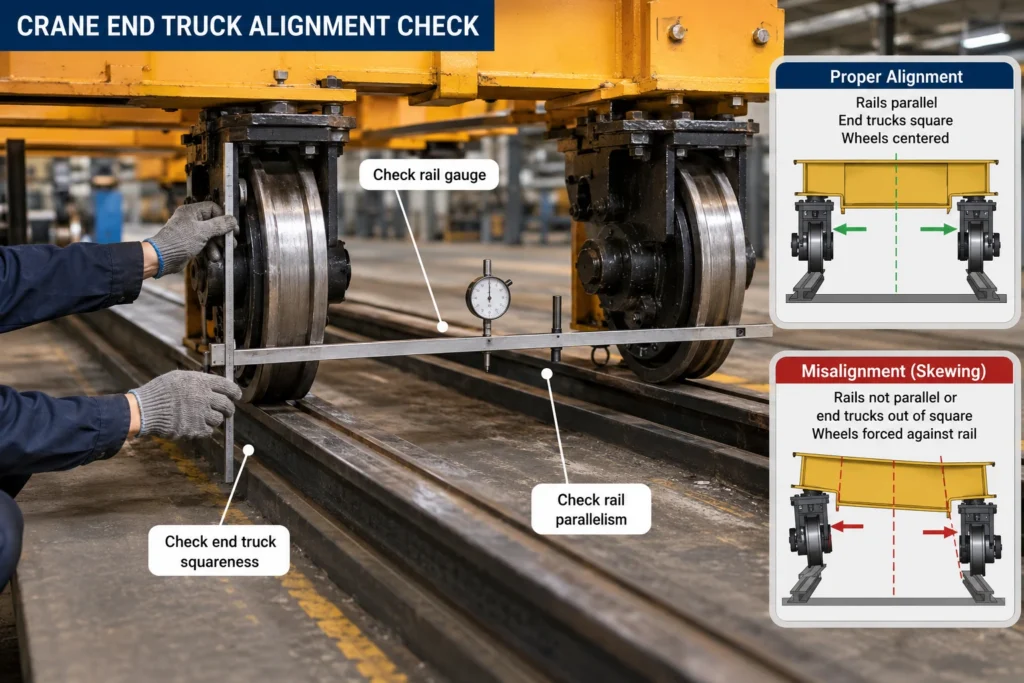
The single most common purchasing mistake in crane wheel maintenance is replacing a worn wheel without checking end truck and runway alignment first. When a wheel shows heavy wear concentrated on one flange, the typical instinct is "wheel worn → replace wheel." But that wear pattern is a classic signature of the crane running out of square — the end truck, rail gauge, or overall crane geometry is off, so one wheel flange is being driven into the rail on every pass. If you replace the wheel without correcting the alignment, the new wheel will develop the same one-sided wear, often within a similar timeframe, because the geometry that caused it is still there. The fix sequence should be: confirm the wear pattern → check rail gauge and parallelism and end truck squareness → correct alignment → then replace the wheel, not the other way around.
Crane skewing accelerates both wheel and rail wear together
A crane that "crabs" or travels diagonally across the runway is skewing, and skewing wears both the wheel flange and the rail head simultaneously. Skewing happens when the two end trucks don't travel at exactly matched speed, or when rail gauge and parallelism have drifted from the original installation. The flange-to-rail contact under skew is far more aggressive than normal rolling contact, so you'll typically see accelerated wear on both sides — the wheel flange and the edge of the rail head — at the same time. If you're only tracking wheel replacement cost and not rail condition, you're likely underestimating the total bill this problem is generating.
Tonnage tells you the load; duty class tells you how hard the wheel actually works
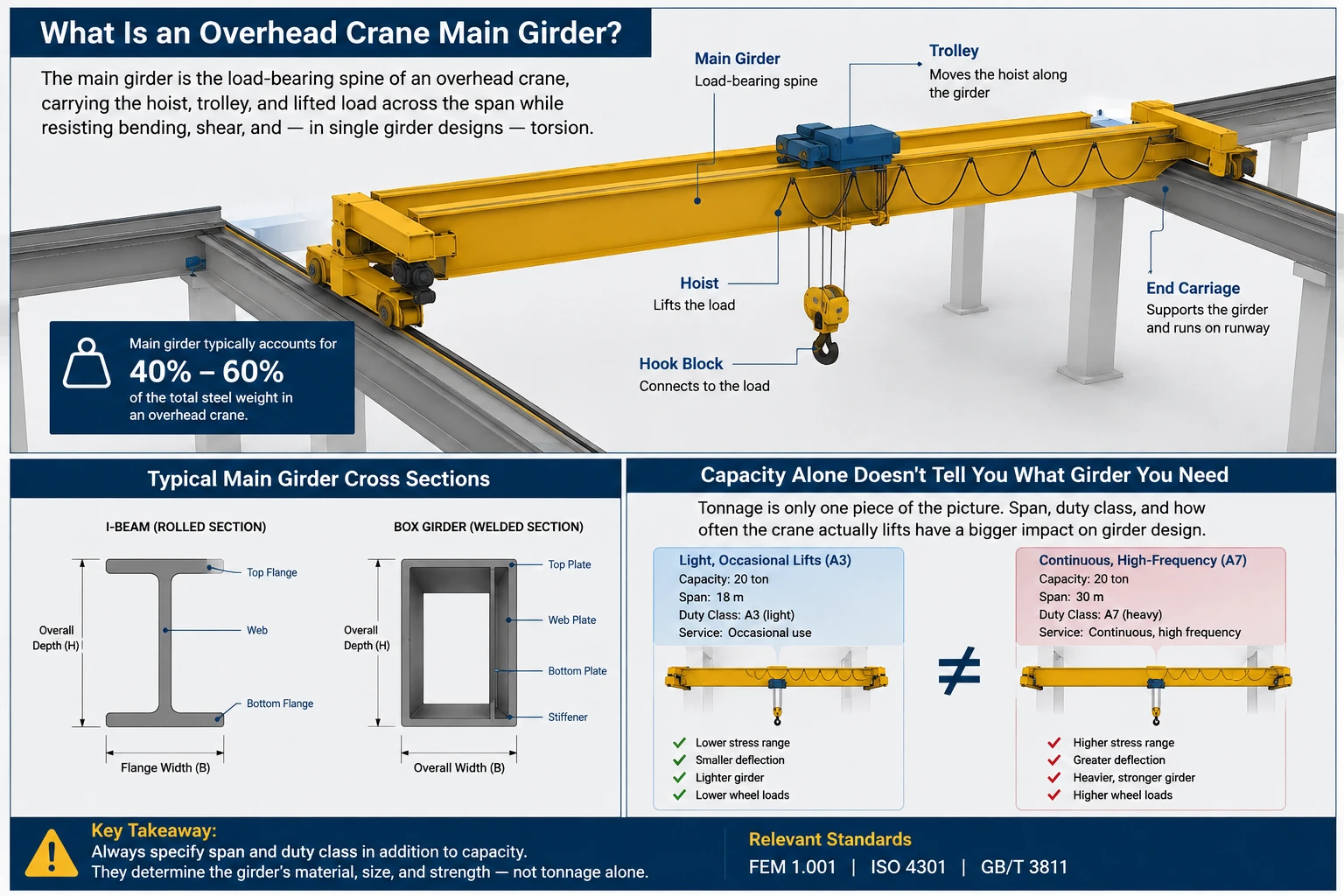
Two cranes with identical capacity can have completely different wheel service life if their duty class differs. A 20-ton crane rated FEM/CMAA class A3–A4 (occasional lifts, light cyclic loading) and a 20-ton crane rated A7–A8 (continuous, heavy-cycle production use) put very different cumulative fatigue loading on the same nominal wheel size, because duty class reflects load spectrum and cycle frequency, not just peak capacity. Capacity alone does not determine end truck or wheel service life — two wheels of the same diameter, rated for the same tonnage, can have meaningfully different expected service lives once you factor in duty class. This is the same logic behind [Crane Duty Class A1–A8: What It Means for Your Crane], and it's worth checking your crane's duty class rating before assuming a wheel failed "early."
When and How to Replace Crane Wheels
Replace based on measured limits and wear pattern, not a fixed percentage rule
There is no single universal "replace at X% wear" number for crane wheels — the correct limit comes from the wheel's diameter, flange thickness, and groove dimensions as set by the manufacturer. A wheel operating past its manufacturer-defined diameter or flange-thickness limit is at meaningfully higher risk of flange failure or derailment risk under load, but that limit varies by wheel design and duty class, so it should be checked against the specific wheel drawing or manufacturer data — not a rule of thumb copied from an unrelated crane. If alignment has already been ruled out as the cause and wear is genuinely at end-of-life limits, replacement is the right call; if alignment hasn't been checked yet, replacement alone won't solve the underlying problem.
A replacement wheel has to match the whole wheel-rail system, not just the diameter
Ordering a replacement wheel by diameter alone is the second most common purchasing mistake after skipping the alignment check. "400 mm crane wheel" is not a complete specification. A correctly matched replacement should confirm: wheel diameter, tread width, flange dimensions, wheel material and hardness, bearing arrangement, axle diameter, whether it's a drive or non-drive (idler) wheel, the rail profile it will run on, the actual wheel load, the crane's duty class, and travel speed. Two wheels that look like the same size on paper can still be a poor match if the rail profile, hardness, or bearing bore don't line up with the existing runway and end truck — "close enough" dimensions are a common source of premature repeat failures.
The real cost of a wheel problem is downtime, not the wheel itself
Comparing wheel A's price to wheel B's price misses most of the actual cost of a wheel failure. The full cost typically includes the wheel itself, labor, crane downtime, any production interruption caused by that downtime, potential rail damage from the wear pattern that caused the failure, and emergency freight if the part wasn't in stock. If a wheel is replaced without fixing an underlying alignment problem, that full cost — not just the wheel price — gets paid again on the repeat failure. This is the strongest argument for a proper root-cause check before ordering a replacement wheel: skipping it doesn't save time, it defers the same cost to a second breakdown.
Conclusion
Crane end truck and wheel problems almost always trace back to one of three things: the wheel is genuinely worn to its dimensional limit, the crane's alignment or geometry is off and wearing the wheel unevenly, or a replacement wheel was matched by diameter alone instead of the full wheel-rail system. Before ordering a replacement wheel, check for one-sided flange wear or diagonal travel as signs of an alignment issue, confirm actual wear against manufacturer dimensional limits rather than a fixed percentage, and specify the full wheel-rail system — not just diameter — when you do order. Get this sequence right and you replace a wheel once instead of on a repeating cycle.
Need help specifying a replacement end truck or wheel set, or want a second opinion on a wear pattern you're seeing? Our engineering team can review your crane's duty class, wheel dimensions, and runway specs before you order.

Equipment Specialist
Accomplished Crane Business Manager with extensive experience in heavy lift project management and operational oversight. Proven track record of driving revenue growth and ensuring safety compliance.
FAQ
Q1: How often should crane end trucks and wheels be inspected?
Inspection frequency should scale with duty class, not a fixed calendar. Light-duty cranes (A3–A4) are often fine on quarterly or semi-annual checks, moderate-use cranes (A5–A6) typically need monthly checks, and heavy continuous-use cranes (A7–A8) may need weekly visual checks plus a documented monthly detailed inspection.
Q2: How do I know if a worn wheel needs replacing or if it's an alignment problem?
Check the wear pattern first. Even, symmetric tread wear is usually normal service wear; wear concentrated on one side of the flange, or a crane that travels diagonally, points to end truck or runway alignment rather than a wheel that simply needs replacing.
Q3: What causes crane wheel flange wear?
Flange wear is typically caused by flange-to-rail contact from misalignment or skewing — when a crane's end trucks aren't square to the runway or aren't traveling at matched speed, one or both wheel flanges get driven against the rail on every pass, accelerating wear well beyond normal rolling contact.
Q4: What information do I need to order a replacement crane wheel?
More than just diameter: tread width, flange dimensions, wheel material and hardness, bearing arrangement, axle diameter, drive vs. non-drive wheel, rail profile, actual wheel load, crane duty class, and travel speed. Matching only the diameter is a common cause of repeat wheel failures.
Q5: How much does crane wheel replacement actually cost?
The wheel itself is usually the smallest part of the real cost. Total cost typically includes labor, crane downtime, any production interruption, potential rail damage from the wear pattern, and emergency freight — all of which get paid again if a replacement wheel is installed without fixing the alignment issue that caused the original wear.

 English
  العربية
  Español
  Français
  Português
  Русский