

There are dozens of crane configurations on the market, but four types of cranes for construction projects account for the vast majority of industrial and infrastructure applications: overhead cranes, козловые краны, port cranes, and jib cranes. If you've narrowed your search to these four, you're already asking the right question.
The harder question is: which one is actually built for your job site?
Each crane type has a clearly defined strength zone. Overhead cranes dominate enclosed industrial facilities. Gantry cranes flex across open yards without fixed infrastructure. Port cranes handle extreme marine loads at scale. Jib cranes solve precision lifting in spaces other cranes simply can't reach.
This comparison cuts through the noise. You'll find side-by-side data on capacity, mobility, installation, operating environment, certification requirements, and total cost of ownership — everything a serious buyer needs to make a confident, defensible decision.
Оглавление
- Comparing the 4 Main Types of Cranes for Construction: The Numbers That Matter First
- Overhead Travelling Crane : Maximum Efficiency in Enclosed Spaces
- Gantry Crane: Deployment Flexibility Without Compromise
- Port Crane: Built for the Extremes of Marine Logistics
- Jib Crane: Precision Where Other Crane Types Fall Short
- The Decision Framework: Four Questions That Determine Your Answer
- Certification and Compliance Comparison
- Заключение
- Часто задаваемые вопросы
- Q1: What are the main types of cranes used in construction projects?
- Q2: Can I use a gantry crane instead of an overhead crane to save on building structure costs?
- Q3: What is the minimum building height required for an overhead crane?
- Q4: Are port cranes suitable for non-marine heavy lift construction projects?
- Q5: Can a jib crane be installed under an existing overhead crane system?
Comparing the 4 Main Types of Cranes for Construction: The Numbers That Matter First
Before diving into detail, here is a direct comparison across the dimensions that drive most purchasing decisions.
| Comparison Factor | Мостовой кран | Козловой кран | Портовый кран | Консольный кран |
| Typical Capacity Range | 1–500 tons | 0.5–1,000 tons | 40–800 tons | 0.1–10 tons |
| Мобильность | Fixed bay | Ground rail / rubber tire | Fixed to mobile | Fixed arc (180°–360°) |
| Installation Complexity | Высокий | Средний | Очень высокий | Low |
| Best Environment | Enclosed industrial | Open yard / outdoor | Marine / port terminal | Workshop / plant workstation |
| Avg. Installation Time | 1–4 weeks | 3–10 days | 3–6 months | 1–3 days |
| Key Design Standard | ISO 4301 | EN 13001 | ISO 23853 / FEM | FEM 1.001 |
| Certification (EU Market) | СЕ | СЕ | CE + FEM | СЕ |
| Typical Service Life | 20–30 years | 15–25 years | 25–35 years | 15–25 years |
This table is your reference point. The sections below explain the reasoning behind every row.
Overhead Travelling Crane: Maximum Efficiency in Enclosed Spaces
Core Design Logic
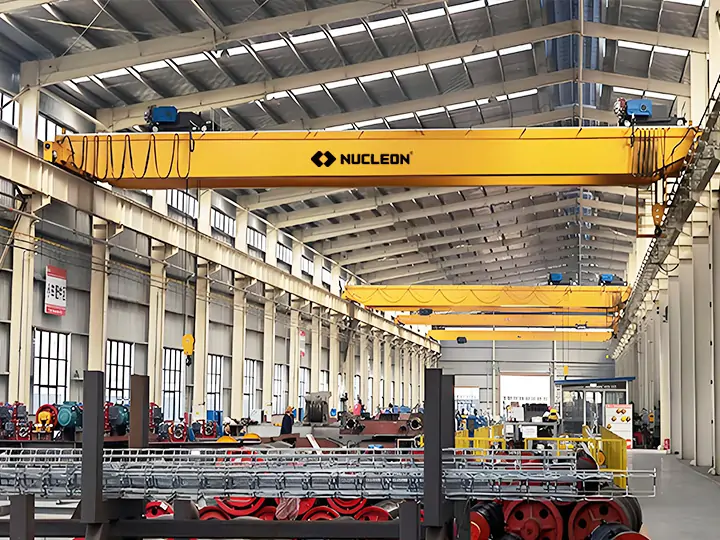
An overhead crane runs on elevated runway beams fixed to a building's structural columns or dedicated support frames. The bridge travels along these beams; the hoist travels along the bridge. The result is full X-Y-Z coverage across an entire bay — with no floor space consumed.
This design philosophy prioritizes throughput and precision in a fixed, enclosed footprint. Nothing else delivers the same combination of lift frequency, hook travel accuracy, and bay coverage.
Where It Wins
Overhead cranes are the undisputed choice for:
- Heavy industrial manufacturing: Steel fabrication, machinery assembly, heavy casting facilities
- Precast concrete plants: Repetitive mold handling at 10–80 ton loads
- Large-scale warehousing: Coil storage, plate storage, long-bar handling
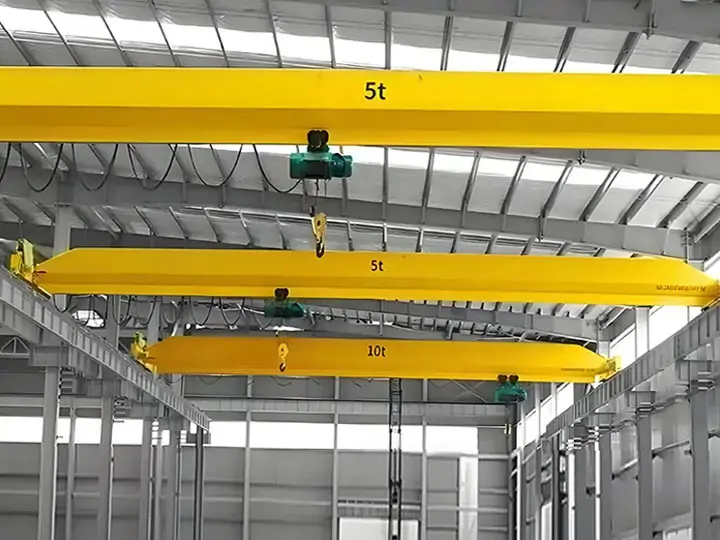
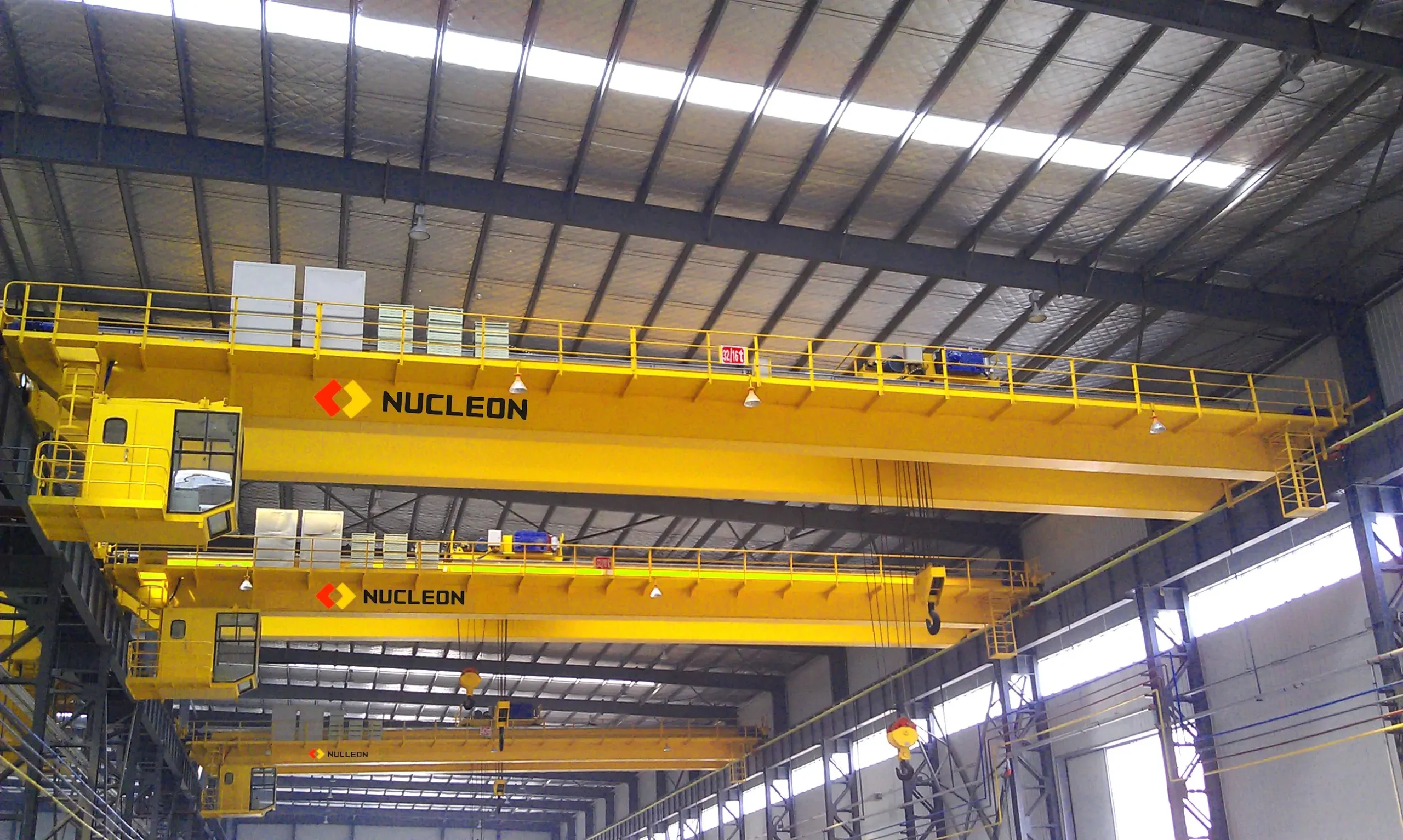
Single-girder configurations handle loads up to 20 tons efficiently. Double-girder configurations extend capacity beyond 300 tons and offer greater hook height — critical when lifting above existing machinery or mezzanine structures.

Стандартный однобалочный мостовой кран, разработанный методом конечных элементов.
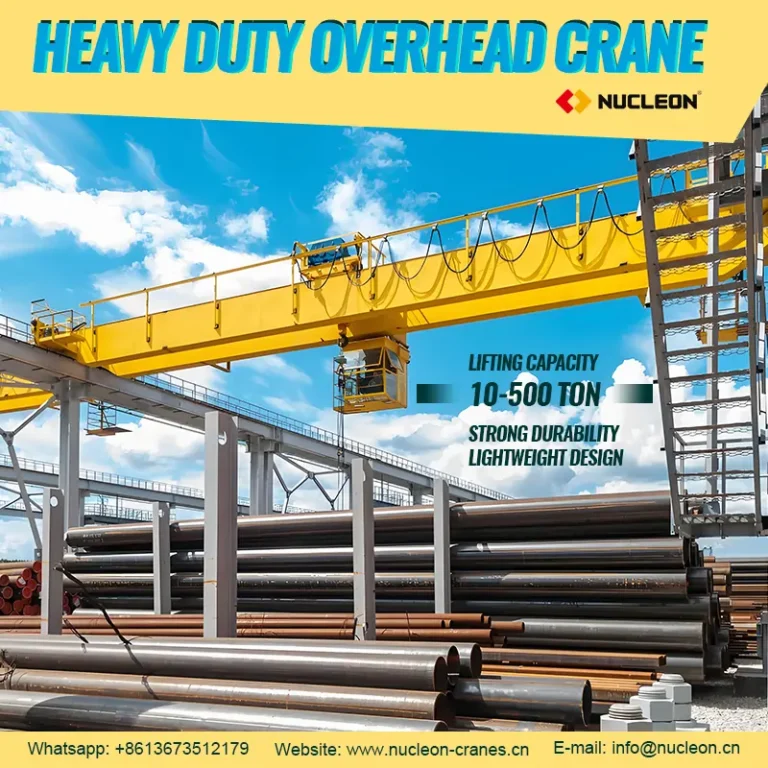
Стандартный двухбалочный мостовой кран, разработанный методом конечных элементов.
What Buyers Often Underestimate
The building structure must support the runway beam loads. For new construction, this is planned from day one. For retrofits, a structural assessment is mandatory before specification. Skipping this step has delayed more projects than any other single oversight in industrial crane procurement.
Installation timeline for a standard double-girder system with runway beams typically runs 2–4 weeks. Budget this into your project schedule early.
Overhead Crane Verdict
Choose an overhead crane when: You run an enclosed operation with repetitive, high-frequency lifting, demand pinpoint load placement, and either have or are building the structural support to carry it.
Gantry Crane: Deployment Flexibility Without Compromise
Core Design Logic
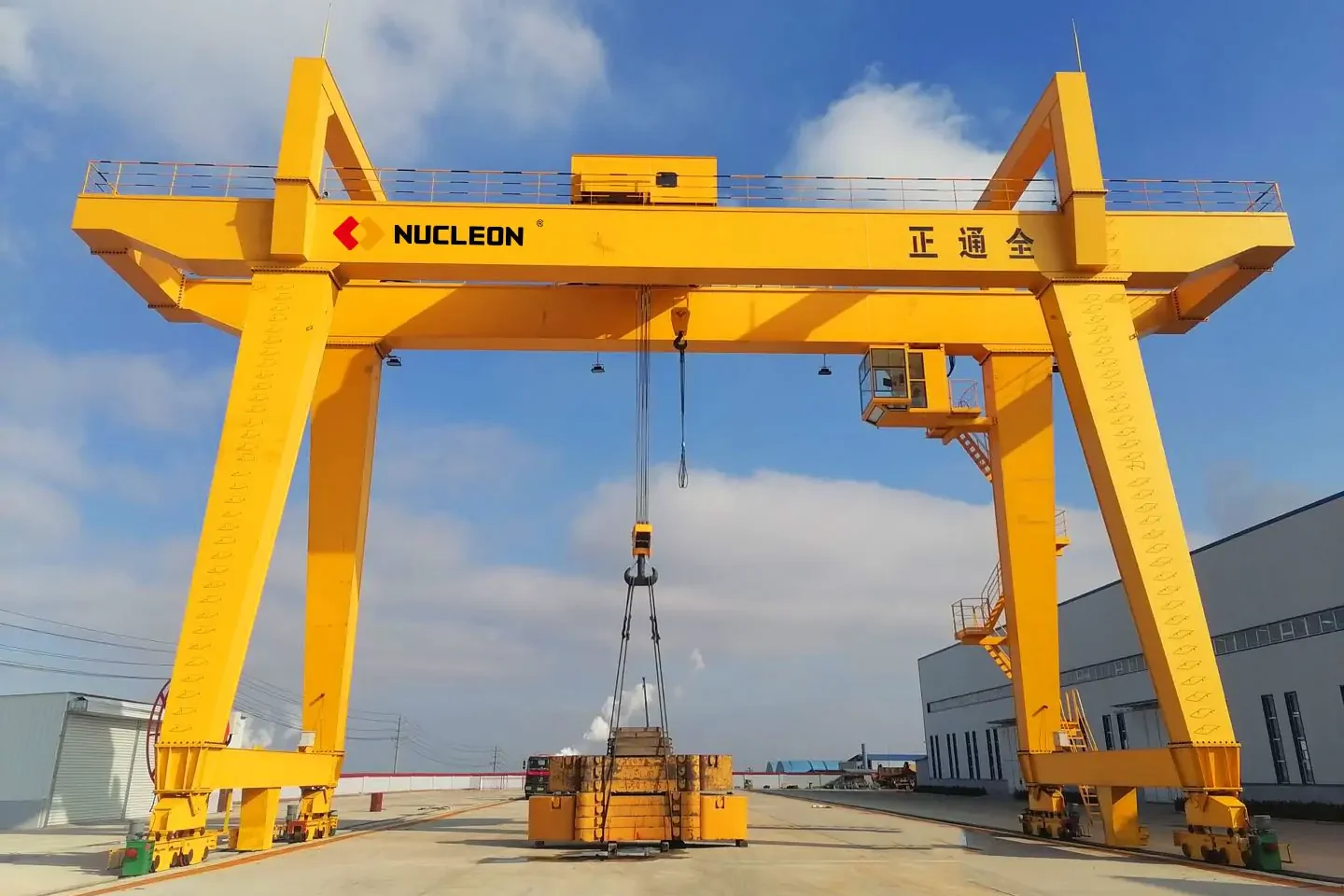
A gantry crane carries its own support structure. Two legs carry the bridge beam, traveling on ground-level rails or rubber tires. No building structure required. This single difference opens up deployment scenarios that are completely off-limits for overhead cranes.
Where It Wins
Among all types of cranes for construction, gantry cranes cover the widest range of applications:
- Open precast yards: Handling concrete beams, columns, and wall panels
- Shipyards and dry docks: Moving hull sections and heavy assemblies
- Rail construction projects: Placing sleepers, beams, and track infrastructure
- Temporary construction sites: Deployable, relocatable between project phases
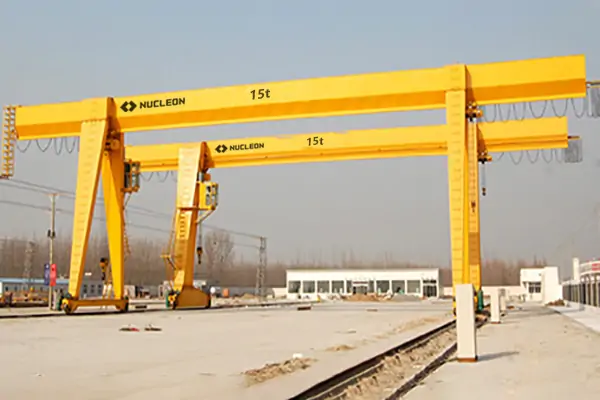
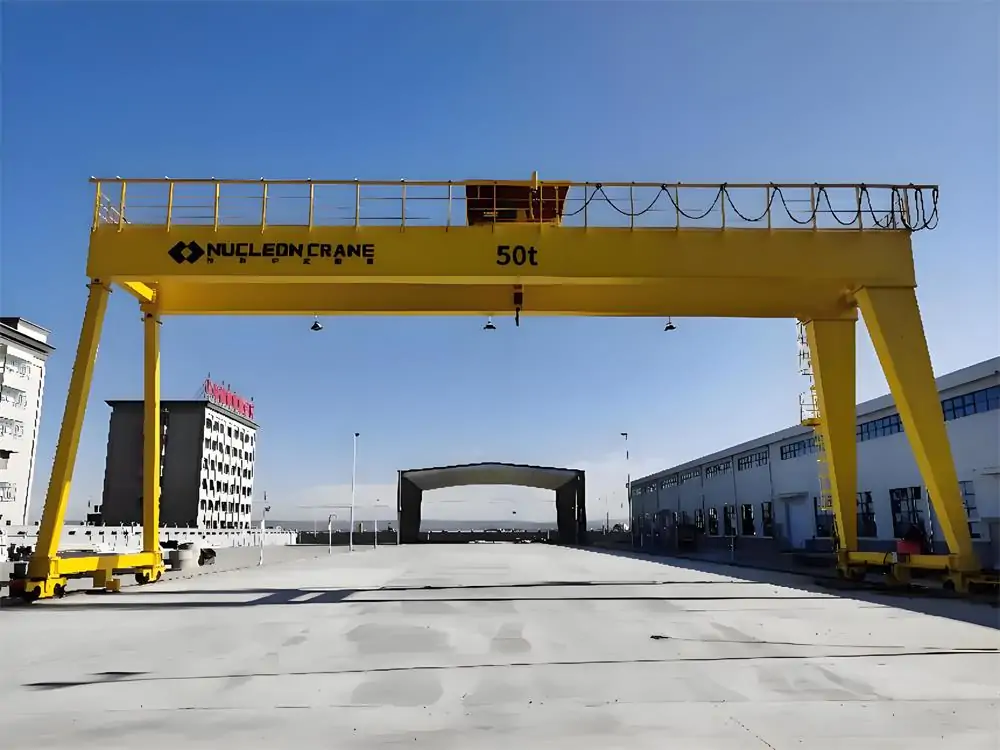
L-Type Single Girder Gantry Crane
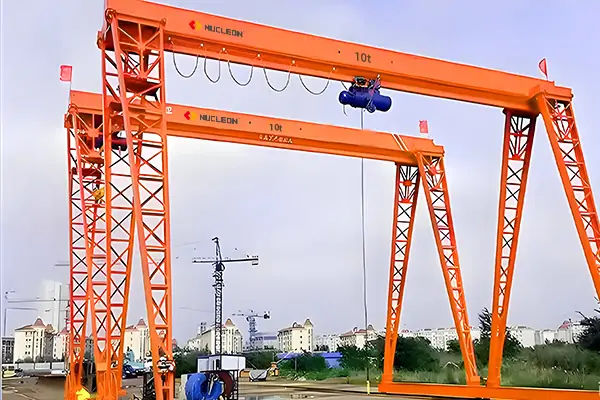
Козловой кран MH с одной фермой
Structural Variants and Their Trade-offs
| Variant | Key Advantage | Key Limitation |
| Rail-mounted gantry | High capacity, stable | Fixed rail path, ground prep required |
| Rubber-tired gantry (RTG) | High mobility, flexible routing | Higher maintenance, lower top capacity |
| Semi-gantry | One side shares building runway | Site-specific, less flexible |
| Portable / shop gantry | Rapid deploy, low cost | Light duty only (under 5 tons) |
What Buyers Often Underestimate
Ground bearing capacity is the most frequently overlooked gantry crane specification. Rail-mounted systems transfer concentrated loads through the rail to the ground. Undersized foundations cause rail settlement, misalignment, and accelerated wheel wear. Always commission a ground investigation report before finalizing rail layout.
For outdoor gantry cranes, wind load rating is a safety-critical specification. EN 13001-2 provides the calculation framework. Confirm the design wind speed matches your site's regional requirement.
Gantry Crane Verdict
Choose a gantry crane when: your site is open or lacks building structure for overhead runways, you need to handle bulky or long materials, or you require the flexibility to relocate equipment between project phases.
Port Crane: Built for the Extremes of Marine Logistics
Core Design Logic
Port cranes are not simply large cranes. Their purpose-engineered systems withstand continuous operation in conditions that rapidly degrade standard industrial equipment. Salt air corrosion, 24/7 operating cycles, and load weights that dwarf most other construction applications define this category.
Among the types of cranes for construction and logistics, port cranes represent the highest engineering specification tier. "Port crane" covers several distinct equipment types — each serves a specific role.
The Three Main Types Explained
Ship-to-Shore (STS) Crane — Quay Operations
The defining machine of container terminal operations. Outreach spans reach 50–70 meters to cover the full beam of ultra-large container vessels. Lifting capacity typically runs 40–65 tons per lift cycle. A single STS crane can handle 25–35 container moves per hour under efficient terminal management.
These are among the most structurally complex cranes in existence. Procurement lead times of 18–36 months are standard for new STS cranes from major suppliers.
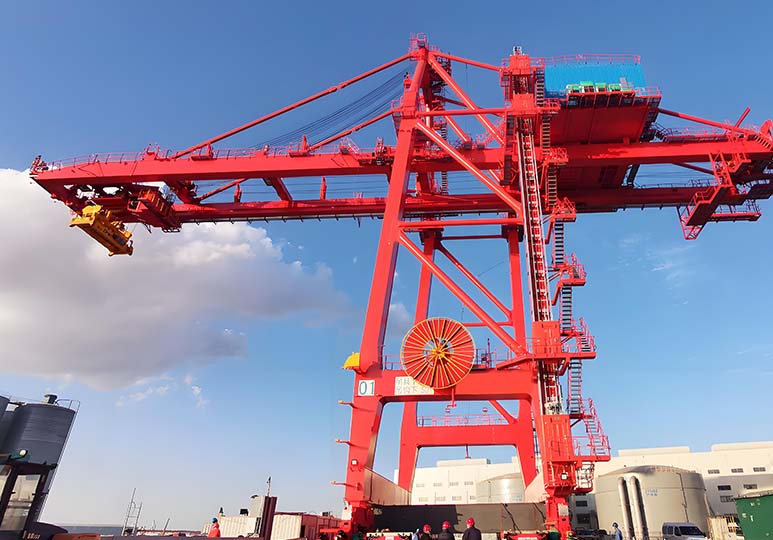
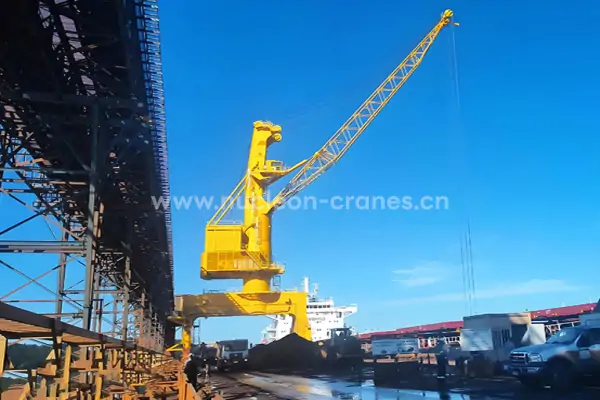
Мобильный портовый кран — Flexible Multi-Cargo Handling
Rail-mounted or rubber-tired, with lifting capacities from 40 to 200 tons. Mobile harbor cranes handle containers, bulk cargo, general cargo, and project cargo from a single machine. This versatility makes them the preferred choice for multipurpose terminals and smaller ports with variable cargo mixes.
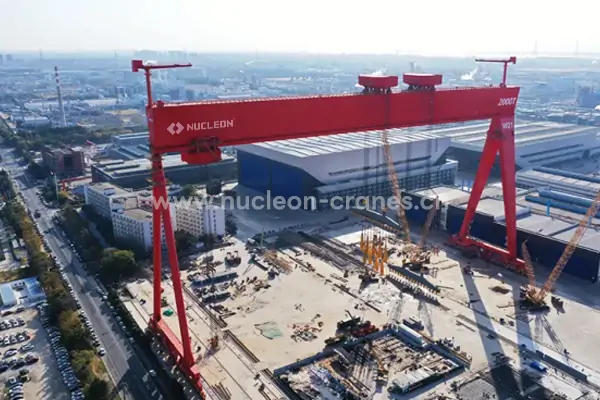
Shipyard Gantry Crane — Shipbuilding and Heavy Lift
Used in shipyards and dry docks for hull block assembly and heavy component placement. Capacities range from 50 to 800 tons. Some shipbuilding portal cranes are configured as tandem lift systems, doubling effective capacity for ultra-heavy lifts.
Corrosion Protection: Non-Negotiable
Marine environments impose the most aggressive corrosion conditions in any crane application. ISO 12944 defines corrosion protection categories; port cranes require C4 (high) or C5 (very high) classification depending on direct seawater exposure. This affects steel preparation, primer selection, topcoat specification, and coating thickness — all of which must be documented in the supply contract.
Port Crane Verdict
Choose port crane equipment when: your project involves marine cargo handling, container terminal operations, shipbuilding, or dry dock construction. This category requires specialized procurement, longer lead times, and dedicated marine-grade engineering.
Jib Crane: Precision Where Other Crane Types Fall Short
Core Design Logic
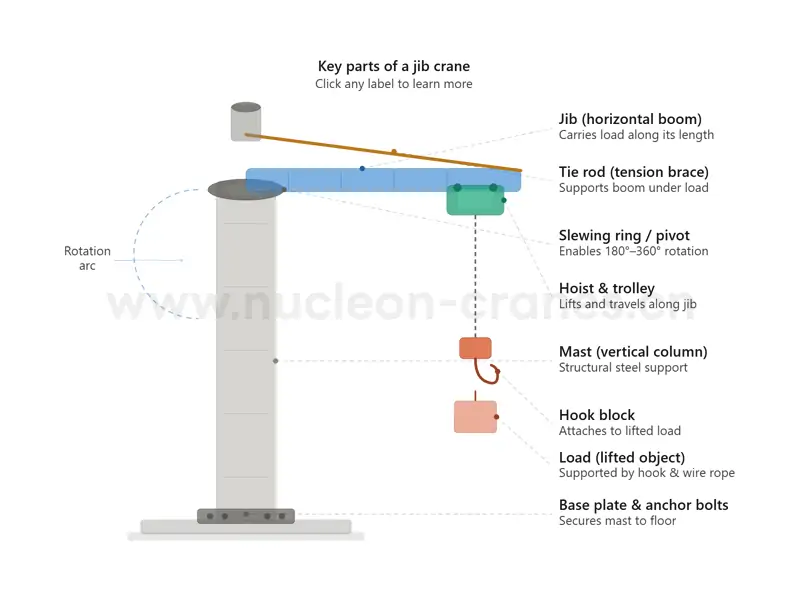
A jib crane is a horizontal arm — the jib — mounted to either a floor-standing pillar or a wall bracket. It rotates through a defined arc and lifts within that coverage zone. Capacities range from 0.1 to 10 tons.
The jib crane's value is not raw capacity. It is coverage density — the ability to serve a specific workstation or structural zone with fast, precise, independent lifting, without requiring the full overhead crane to travel across the entire bay.
Configuration Options
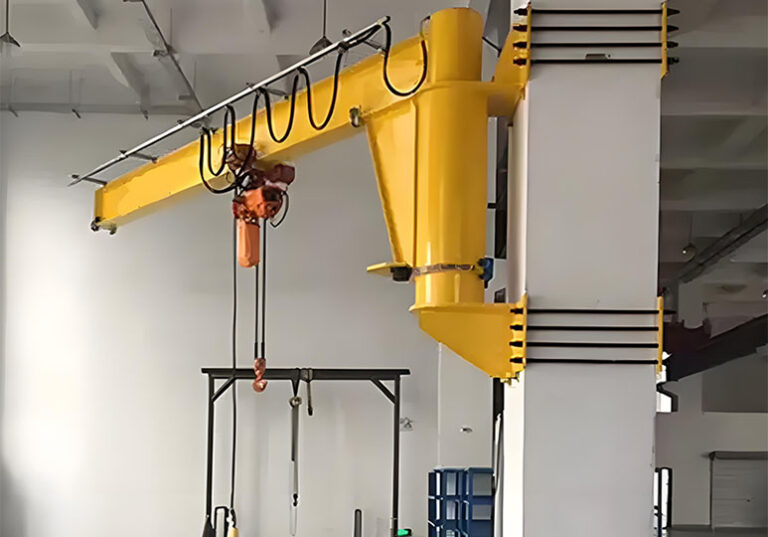
Wall-mounted jib crane: Fixed to a structural column or wall. Rotation up to 180°. Lowest installation cost. Depends on the host structure's load capacity.
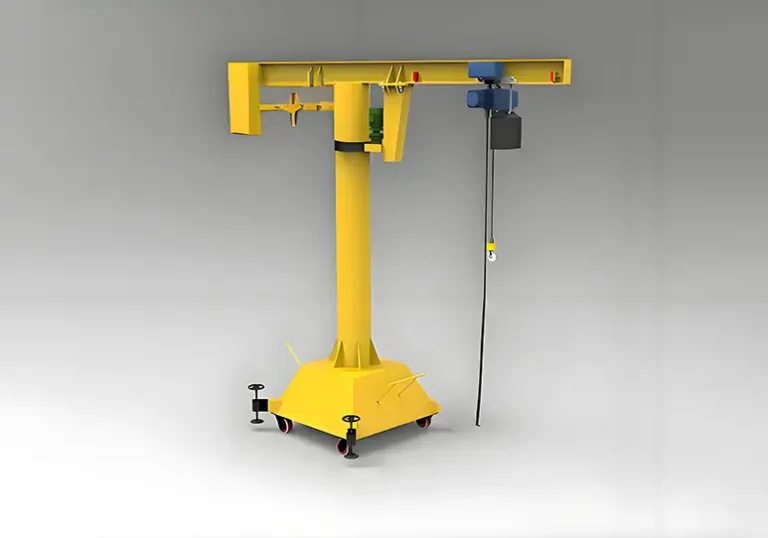
Pillar-mounted (freestanding) jib crane: Independent floor anchor. Full 360° rotation. Requires foundation design and anchor bolt installation. Most flexible placement.
Articulating jib crane: Two-segment arm with an additional pivot at mid-span. Reaches around obstacles and into confined positions. Common in automotive plant construction and aerospace facility builds.
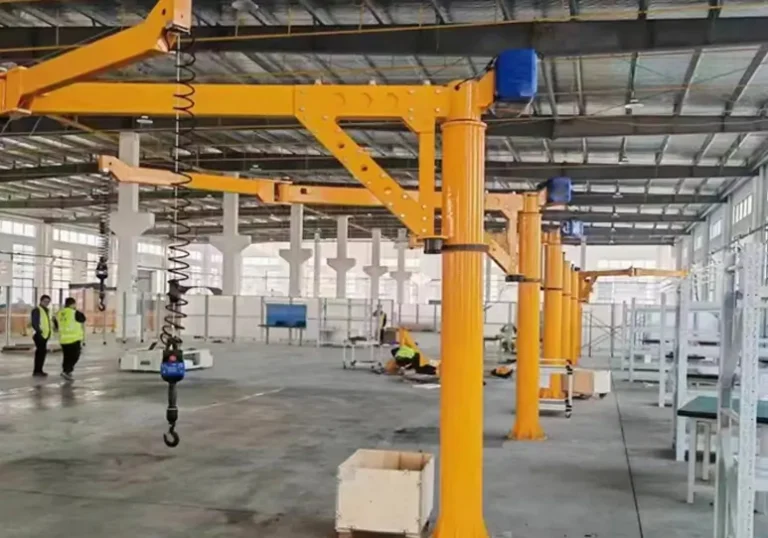
Where Jib Cranes Add Measurable Value
The most effective deployments pair jib cranes with overhead cranes:
- Стреловые краны service individual workstations and column zones outside the overhead crane's efficient travel path
- They handle light, high-frequency moves that would otherwise consume overhead crane capacity
- They cover corners and end bays where bridge travel time is longest
A well-designed facility layout uses jib cranes to absorb routine light lifts, reserving the overhead crane for heavy, precision, or cross-bay moves. This combination measurably increases throughput without expanding runway infrastructure.
Jib Crane Verdict
Choose a jib crane when: you need localized lifting at specific workstations, your overhead crane can't efficiently service every corner and column zone, or you need an independent light-duty lift capability with minimal footprint and fast installation.
The Decision Framework: Four Questions That Determine Your Answer
Understanding the types of cranes for construction is only half the work. Matching them to your specific project conditions is where the decision gets made.
Question 1 — What is your maximum load, and how often do you lift it?
For high-frequency operations involving loads exceeding 20 tons, operators typically select either an overhead crane or a gantry crane. When the load surpasses 100 tons and sits in an outdoor yard, they prefer a gantry crane. In marine environments with loads over 40 tons, experts recommend a port crane. For loads under 10 tons at a specific workstation, a jib crane offers the most suitable option.
Question 2 — Is your site enclosed, open, or marine?
Enclosed → overhead crane is the baseline candidate. Open yard → gantry crane. Marine / port terminal → port crane category. Any environment, localized workstation → add jib cranes.
Question 3 — How permanent is the installation?
Permanent enclosed facility → overhead crane. Permanent open yard → rail-mounted gantry. Project-based or relocatable → rubber-tired gantry or portable gantry. Permanent workstation support → pillar or wall-mounted jib.
Question 4 — What is your total cost of ownership horizon?
Budget only the purchase price and you will almost certainly underspend on installation quality and overspend on maintenance over the crane's service life. A well-specified overhead crane with proper runway and electrical installation typically costs 30–50% more upfront than a budget alternative — and delivers significantly lower maintenance cost over a 20-year lifecycle.
Certification and Compliance Comparison
| Standard / Certification | Мостовой кран | Козловой кран | Портовый кран | Консольный кран |
| CE Marking (EU/EEA) | Required | Required | Required | Required |
| EAC Certification (CIS) | Required | Required | Required | Required |
| ISO 4301 (Load Classification) | Core standard | Applicable | Applicable | Applicable |
| EN 13001 (Design) | Applicable | Core standard | Applicable | Applicable |
| ISO 23853 (Container Interface) | — | — | Required (STS) | — |
| FEM 1.001 | Applicable | Applicable | Required | Core standard |
| ISO 12944 (Corrosion) | C2–C3 typical | C2–C4 depending | C4–C5 required | C2–C3 typical |
| ASME B30 (North America) | B30.2 | B30.2 | B30.2 | B30.9 |
Always verify the applicable standards for your specific market and project type with your crane supplier and local regulatory authority before finalizing specifications.
Заключение
The comparison is clear. These four types of cranes for construction are not competing for the same jobs — they are each engineered for fundamentally different operating conditions.
Overhead cranes deliver the highest efficiency in enclosed industrial facilities where repetitive, precision lifting is the core operation. Козловые краны provide the deployment flexibility that overhead cranes cannot — open yards, relocatable installations, and large-span outdoor operations. Port cranes are purpose-built for the extreme demands of marine logistics, with engineering standards and corrosion protection that reflect those demands. Стреловые краны solve the last-meter precision problem at individual workstations, most effectively as a complement to overhead crane systems.
Match the crane to the actual conditions of your project — not to the lowest available price point or the most familiar brand name. The right selection among the types of cranes for construction reduces downtime, lowers lifecycle cost, and keeps your project moving on schedule.

Специалист по оборудованию
Успешный менеджер по работе с кранами с обширным опытом в управлении крупномасштабными проектами и операционным контролем. Подтвержденный опыт увеличения доходов и обеспечения соблюдения требований безопасности.
Часто задаваемые вопросы
Q1: What are the main types of cranes used in construction projects?
The four most widely used types of cranes for construction are: overhead cranes (for enclosed industrial facilities), gantry cranes (for open yards and outdoor sites), port cranes (for marine and terminal operations), and jib cranes (for workstation-level precision lifting). Beyond these, tower cranes and mobile cranes are commonly used in vertical building construction. This guide focuses on the four types most relevant to industrial and infrastructure construction buyers.
Q2: Can I use a gantry crane instead of an overhead crane to save on building structure costs?
Yes, in many cases. If your facility is new construction and the overhead crane runway would require significant structural upgrades, a rail-mounted gantry crane can be a cost-effective alternative. The trade-off is that gantry cranes consume ground-level space with their legs and rail infrastructure. Evaluate both options with a full installed-cost comparison, not just equipment price.
Q3: What is the minimum building height required for an overhead crane?
It depends on your required hook height, the crane's structural depth, and headroom above the load. A rough minimum is: hook height + 1.5× load height + crane structural depth + safety clearance. For a 5-meter hook height requirement, you typically need at least 8–10 meters of clear building height. Always confirm with your crane engineer during the design phase.
Q4: Are port cranes suitable for non-marine heavy lift construction projects?
Technically some port crane types — particularly mobile harbor cranes — are used in heavy lift applications beyond traditional port settings. However, they are engineered and priced for port-grade duty cycles. For most non-marine heavy construction, large-capacity gantry cranes or crawler cranes are more appropriate and cost-effective choices.
Q5: Can a jib crane be installed under an existing overhead crane system?
Yes, and this is one of the most effective crane system configurations for high-density manufacturing and assembly facilities. The jib crane serves individual workstations while the overhead crane handles cross-bay and heavy lifts. Confirm clearance dimensions with both crane suppliers before ordering.

 English
  العربية
  Español
  Français
  Português
  Русский