

An overhead crane inspection is a structured examination of a bridge crane's structural, mechanical, and electrical systems to confirm it is safe and compliant before, during, and after service — as defined under OSHA 29 CFR 1910.179 and expanded by ASME B30.2. It is not a single event. It is a layered program of four distinct inspection types, each with its own frequency, performer, and scope, running in parallel throughout the crane's service life.
Facility managers and equipment supervisors often learn this the hard way: scheduling one annual third-party visit and calling it an inspection program leaves most of the compliance gap open. The daily operator check, the periodic in-service review, and the initial commission inspection each serve a specific function that the others cannot replace. Understanding what each tier covers — and why the intervals are set as they are — is the foundation of any crane safety program that will actually hold up under an OSHA review or an incident investigation.
This guide explains all four inspection types, how frequency is determined, what a qualified inspector specifically looks for at each level, and where most facilities unknowingly fall short.
Оглавление
What Overhead Crane Inspection Is — and Why Each Tier Exists
An overhead crane inspection is a systematic review of a lifting system's condition, covering the hoist, hook block, wire rope or chain, structural members, drive mechanisms, brakes, limit switches, runway rails, and electrical systems, as classified under OSHA 29 CFR 1910.179 and ASME B30.2.
The reason inspection is divided into tiers rather than handled as one comprehensive event comes down to the nature of crane failure. Most crane incidents do not result from a single catastrophic event. They develop progressively — a limit switch that begins to mis-trip, a wire rope that loses one or two wires per lay-length over weeks, a brake that holds adequately at half-load but slips under full rated capacity. Daily checks catch the acute failures that appear between shifts. Periodic inspections catch the gradual degradation that daily checks cannot quantify. Annual inspections catch the structural and systemic issues that neither daily nor monthly checks are technically equipped to assess. Each tier is calibrated to a different failure rate and detection window.
The Four Types of Overhead Crane Inspection Under OSHA and ASME
Initial Inspection: Before the Crane Ever Lifts a Load
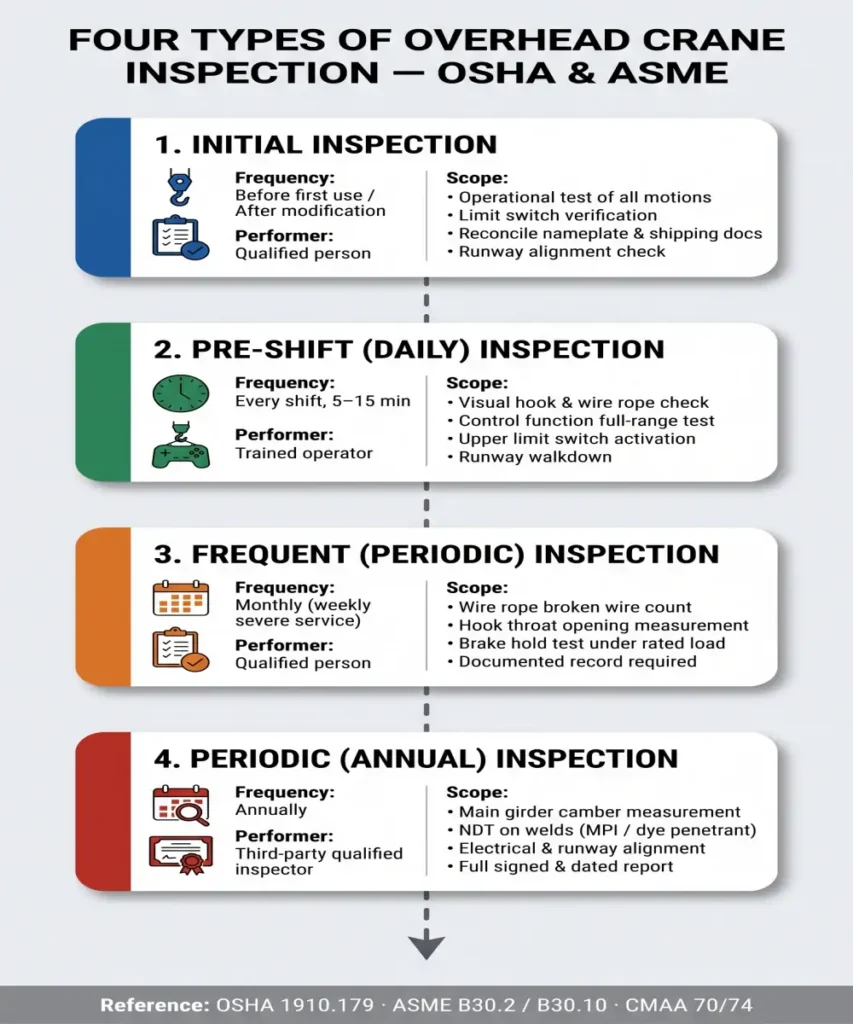
Every new overhead crane, and every crane that has been substantially modified or repaired, requires an initial inspection before it is placed into service. This requirement, specified in OSHA 1910.179(j)(1)(i) and reinforced in ASME B30.2, exists because installation introduces its own failure modes: runway rail alignment that looks correct visually but is outside tolerance under load, end trucks that bind at certain travel positions, limit switches that were set at factory height and need site-specific adjustment.
The initial inspection should include an operational test of all motions — hoisting, lowering, bridge travel in both directions, trolley travel in both directions — both with and without a load. Limit switches (upper, lower, and travel) must be verified to activate correctly. For facilities importing cranes, the initial inspection is also the moment to reconcile the as-delivered crane against its shipping documentation: nameplate rated capacity, hook type and condition, wire rope reeving and dead-end attachment, and electrical grounding. Missing this step at commissioning is the most common reason warranty claims become complicated disputes.
Pre-Shift (Daily) Inspection: The Operator's First Line of Defense
The pre-shift inspection is a short visual and functional check performed by the crane operator at the start of every shift, typically taking 5–15 minutes depending on crane size. It is classified as a "frequent" inspection under OSHA 1910.179 and is the only inspection tier that does not require a qualified technician — but it does require a trained, designated operator who knows what normal looks like on that specific crane.
The core purpose is detecting anything that changed since the previous shift: a wire rope that picked up a kink overnight, a limit switch that failed to reset, a hook latch damaged during the last lift of the previous shift, or controls that respond sluggishly. Items covered include: hook and latch condition, wire rope or hoist chain for visible broken wires, corrosion or deformation, brake function during a no-load test lift, all control functions through a full-range check, limit switch operation (raise the hook to verify upper limit activation), and a visual walkdown of the runway for debris or obvious structural anomaly.
One critical judgment the daily check cannot reliably make: quantitative assessment of wear. An operator can see a broken wire but cannot determine whether a rope has reached its removal threshold. That distinction belongs to the periodic tier.
Frequent (Periodic) Inspection: Quantifying Wear Before It Becomes Failure
The frequent periodic inspection is performed at monthly intervals for cranes in normal-to-heavy service, and the interval may shorten to weekly for severe-duty applications. Unlike the daily check, this inspection is conducted by a "qualified person" — someone whose training, knowledge, and experience is recognized for the specific crane type being assessed.
The engineering rationale for monthly frequency on most overhead cranes is based on typical wear accumulation rates for the highest-risk components. Wire rope in regular service loses measurable section area from internal wire fatigue and abrasion. Brake linings compress and change friction characteristics. Hook throat openings gradually deform under repeated load cycling. These changes happen faster than an annual inspection would catch them, but slowly enough that monthly monitoring is appropriate for standard service.
What a qualified inspector specifically checks at this tier:
- Wire rope: Broken wires counted over one rope lay-length and over a rope diameter's length — ASME B30.2 specifies removal thresholds (typically six broken wires per lay on a six-strand rope, though the exact figure depends on rope construction and must be confirmed against the applicable standard). Surface corrosion, kinking, bird-caging, and evidence of heat damage.
- Hook: Throat opening measured against original dimension — a hook showing more than approximately 15% increase over its original throat opening is generally cause for removal from service per ASME B30.10. Twist deformation of more than 10 degrees from the plane of the unbent hook, and any visible crack.
- Hoist chain (if chain hoist): Stretch — elongation exceeding 3% of original length over a specified number of links is a typical removal indicator, though the chain manufacturer's documentation governs the specific threshold.
- Brake system: Operational test under rated load to verify the brake holds without drift after lowering.
- Limit switches: Functional verification at upper limit, lower limit (if equipped), and bridge/trolley travel limits.
Monthly inspection records must include the date, the inspector's identity, and the equipment identifier. OSHA's requirement here is explicit: oral confirmation is not sufficient.
Periodic (Annual) Inspection: Structural and Systemic Assessment
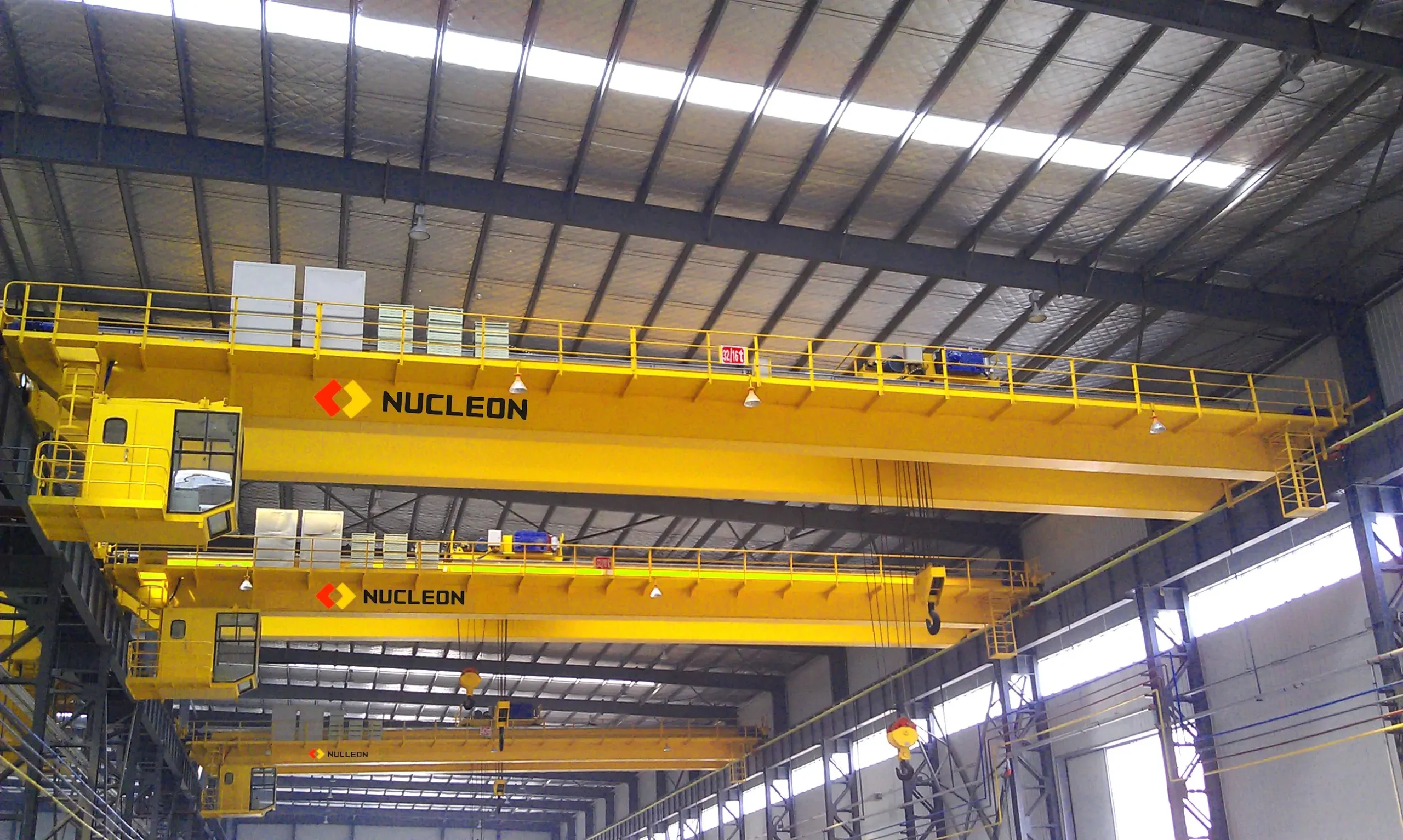
The annual periodic inspection is the most comprehensive tier, requiring a qualified inspector — typically a third-party specialist — to examine the crane's structural and mechanical condition in full, often including physical access to the bridge girder, end truck compartments, and hoist machinery platform. It builds on everything the frequent inspection covers and adds:
- Main girder camber: A bridge girder under repetitive load gradually loses the upward camber built in at fabrication. Measurement against original engineering documentation is the only reliable method; visual inspection from the floor is not adequate for girders longer than approximately 15 meters. A girder that has sagged beyond design tolerance has reduced margin against structural failure.
- Structural member integrity: Weld inspections at high-stress zones — specifically the girder-to-end-truck connection and any areas showing paint cracking or rust staining, which often indicate micro-cracking beneath the surface. Non-destructive testing (NDT) methods — magnetic particle inspection for ferromagnetic welds, dye penetrant for non-ferrous — may be applied when surface indicators warrant closer examination.
- Electrical system: Controller contactors for pitting and arcing damage; conductor bar condition along the runway length; overload protection function; grounding continuity from the hook to the building ground.
- Runway rail alignment: Rail gauge, elevation difference between rails, and straightness, checked against CMAA and manufacturer tolerances. Rail misalignment is one of the most common causes of wheel flange wear, which in turn loads the end truck structure eccentrically.
- Full documentation: The annual inspection report must be detailed, signed, dated, and retained. OSHA's position is consistent: undocumented inspections are treated as inspections not performed.
How Inspection Frequency Is Determined: The Role of Service Class
The single variable with the most impact on how often each inspection tier applies is the crane's service classification — defined by the CMAA (Crane Manufacturers Association of America) as Classes A through F, from standby/infrequent use to 24/7 severe-duty operation.
A facility with a 10-ton bridge crane used twice per day for light assembly (CMAA Class B) and a facility with a 10-ton crane cycling every 5 minutes in a hot-metals production environment (CMAA Class E) face entirely different wear rates on every component that a periodic inspection covers. The annual periodic inspection that is appropriate for Class B becomes dangerously inadequate for Class E, which typically warrants quarterly periodic inspections.
The operating environment compounds this. A crane in a coastal facility with salt-laden air corrodes structural members and electrical components faster than a climate-controlled assembly hall. Foundry environments — heat, scale, and chemical exposure — accelerate hoist chain and rope degradation significantly compared to clean industrial settings. ОША 1910.179 accounts for this by specifying that periodic inspection intervals depend on "activity, severity of service, and environment" — which means the intervals are a judgment call to be made by a qualified person for each specific crane, not a fixed calendar schedule.
The Idle Crane Rule That Most Facilities Miss
One of the most consistently overlooked requirements in OSHA 1910.179 applies specifically to cranes returning from inactivity. A crane that has been idle for one month or more but less than six months must receive a frequent inspection before being returned to service. A crane idle for more than six months requires a full periodic (annual-equivalent) inspection before use — regardless of when its last scheduled inspection occurred.
The failure mode this rule addresses is real: stationary equipment in industrial environments accumulates corrosion, moisture intrusion into electrical enclosures, and brake mechanism stiffening over weeks of non-use. A crane that passed its last inspection cleanly eight months ago and then sat in a coastal facility through a wet season may have brake components that will not release properly under power or wire rope with corrosion pitting that developed after its last documented review. The assumption that "we haven't used it, so nothing has changed" is directly contradicted by how corrosion and environmental degradation work.
Who Is Qualified to Perform Each Inspection Type
The level of qualification required scales with inspection tier — and this is where many facilities create compliance gaps by assigning the wrong personnel.
Pre-shift inspections must be performed by trained crane operators: people who have been specifically trained on the crane they operate, know its normal condition, and can recognize anomalies. This is not the same as any available shop employee.
Frequent periodic inspections require a "qualified person" — OSHA's definition covers someone who by possession of a recognized degree, certificate, or professional standing, or who by extensive knowledge, training, and experience has successfully demonstrated the ability to solve or resolve problems relating to the subject matter. In practice this typically means a certified crane technician or maintenance professional with documented crane-specific training.
Annual inspections should be performed by, or under direct oversight of, a third-party inspector with credentials such as NCCCO (National Commission for the Certification of Crane Operators) certification in the relevant category, or equivalent documented qualification under ASME B30.2. The independence of a third-party inspector matters both for compliance credibility and for objectivity: an in-house technician may normalize gradual deterioration that an outside inspector, comparing the crane's condition to a broader population of similar equipment, will flag.
The ASME standard that governs a specific crane determines which qualified-person definition applies. ASME B30.2 governs top-running overhead bridge cranes. ASME B30.17 covers underhung cranes and monorails. ASME B30.16 covers individual hoists. Applying B30.2 to a crane that should be governed by B30.17 is a compliance error — the inspection scope and removal-from-service criteria differ between standards.
Заключение
Overhead crane inspection is a four-tier program — initial, daily pre-shift, frequent periodic, and annual periodic — each serving a failure-detection function the others cannot cover. The right inspection frequency is not "annual" by default; it is determined by CMAA service class, operating environment, and activity level, and it may range from weekly (severe duty) to annual (light standby service). Two reference points are worth embedding in any facility's procedure: the idle-crane reactivation rules from OSHA 1910.179, which most programs overlook, and the specific removal-from-service thresholds for hooks, wire rope, and hoist chain, which are the difference between a documented judgment and an undocumented guess.
If you are establishing an overhead crane inspection program for newly commissioned equipment — particularly imported cranes arriving with factory certification but no local compliance documentation — start by confirming your CMAA service class, setting up a daily operator log from day one, and scheduling your initial inspection with a qualified third-party inspector before the crane lifts any production load.
Have questions about setting up an inspection program for your facility's cranes? Contact our engineering team → for guidance specific to your application and duty cycle.

Специалист по оборудованию
Успешный менеджер по работе с кранами с обширным опытом в управлении крупномасштабными проектами и операционным контролем. Подтвержденный опыт увеличения доходов и обеспечения соблюдения требований безопасности.
Часто задаваемые вопросы
What is the difference between a frequent inspection and a periodic inspection for overhead cranes?
A frequent inspection covers operational safety items — hooks, rope condition, brakes, limit switches — and is performed at daily to monthly intervals, typically by a trained operator or qualified technician. A periodic inspection is a complete crane review at one-to-twelve-month intervals by a qualified inspector, adding structural assessment, dimensional measurement, and full documentation. Both are required under OSHA 1910.179; one does not substitute for the other.
How often does an overhead crane need to be inspected?
It depends on service class and environment, not a fixed calendar. A light-duty crane (CMAA Class A–B) in a clean environment typically requires annual periodic inspections. A heavy-to-severe service crane (CMAA Class D–F) may need periodic inspections quarterly. Daily pre-shift checks are required for any crane in active use, regardless of service class. Additionally, any crane idle for more than one month requires a re-inspection before returning to service.
Who can perform an overhead crane inspection?
Daily pre-shift checks: trained crane operators. Frequent periodic inspections: a qualified person with demonstrated crane-specific knowledge and training. Annual periodic inspections: a qualified inspector, typically third-party, with recognized credentials such as NCCCO certification and familiarity with the relevant ASME B30 standard for the specific crane type. Using unqualified personnel for any tier is a compliance violation under OSHA 1910.179.
What causes an мостовой кран to be taken out of service after inspection?
Common removal-from-service conditions include: hook throat opening exceeding approximately 15% over original dimension (per ASME B30.10); broken wires in wire rope reaching or exceeding the lay-length threshold specified in ASME B30.2; brake slip under rated load; any visible structural crack in the main girder, end truck, or hook block; and limit switches that fail to activate correctly. Any unsafe condition identified during inspection must be corrected before the crane is returned to service under OSHA 1910.179.
Does an idle overhead crane still need to be inspected?
Yes. OSHA 1910.179 explicitly requires that a crane idle for one to six months receive a frequent inspection before returning to service; a crane idle for more than six months requires a full periodic inspection. Environmental degradation — corrosion, moisture intrusion into electrical enclosures, brake mechanism stiffening — continues during idle periods, and a passed inspection from before the idle period does not remain valid.

 English
  العربية
  Español
  Français
  Português
  Русский