

An industrial overhead crane is a material handling machine that lifts and moves loads horizontally along a fixed elevated runway structure installed inside a facility. Unlike a forklift—which moves on the floor and requires clear travel paths—an overhead crane operates above the work area, leaving the floor free and reducing congestion. The core operating principle is straightforward: a hoist (the lifting unit) travels along a bridge beam, and the bridge itself travels along two parallel runway rails mounted to the building structure or freestanding columns.
The term EOT crane (Electric Overhead Travelling crane) refers to the same machine when driven by electric motors—which covers nearly all industrial installations today.
Оглавление
- How an Industrial Overhead Crane Works
- Main Types of Industrial Overhead Cranes
- Key Parts of a Single Girder Overhead Crane
- FEM Standard and Overhead Crane Classification
- The Overhead Travelling Crane and Building Structure
- Buying an Industrial Overhead Crane: Questions That Actually Matter
- Часто задаваемые вопросы
- What is the difference between a single girder and double girder overhead crane?
- What does EOT crane mean?
- Как часто необходимо проводить осмотр мостового крана?
- Do I need an explosion proof crane, or will a standard crane work in my facility?
- What information should I give a supplier to get an accurate quote?
How an Industrial Overhead Crane Works
Three motions define every overhead crane operation:
- Hoist motion – raises and lowers the load
- Bridge travel – moves the load along the length of the bay (long travel)
- Trolley travel – moves the load across the width of the bay (cross travel)
These three axes together give the crane access to virtually every point within its working rectangle. The operator controls all three motions via a pendant control station (a handheld push-button box hanging from the crane) or a radio remote control unit.
Power is supplied to the crane through a conductor bar or festoon cable system—both are methods of delivering electricity to a moving machine without tangled wires.
Main Types of Industrial Overhead Cranes
Однобалочный мостовой кран
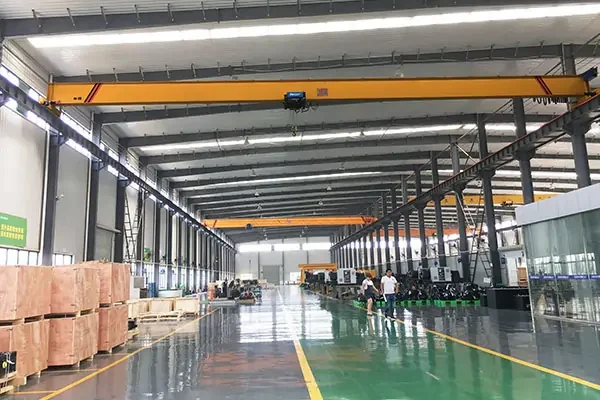
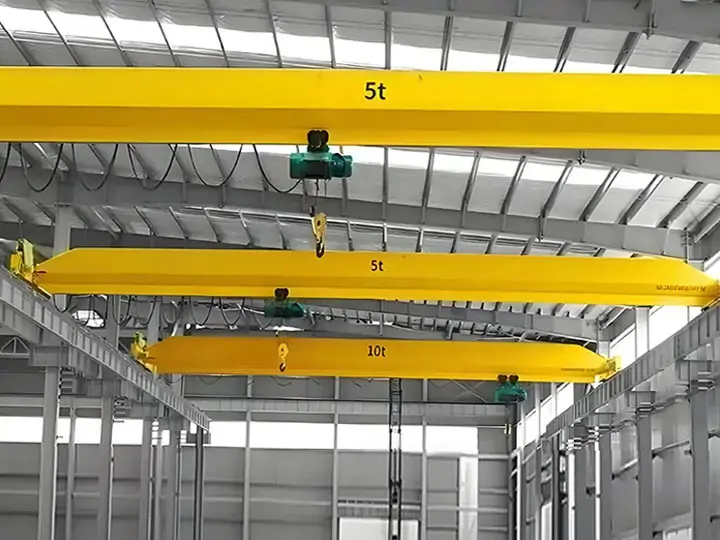
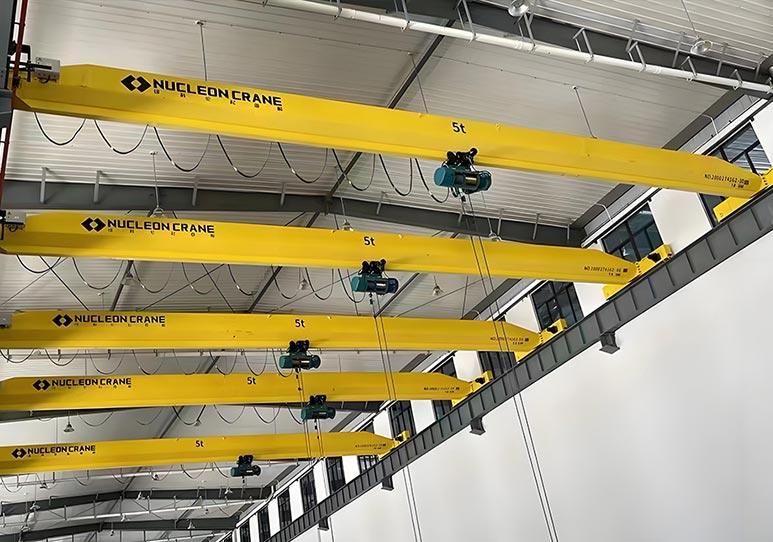
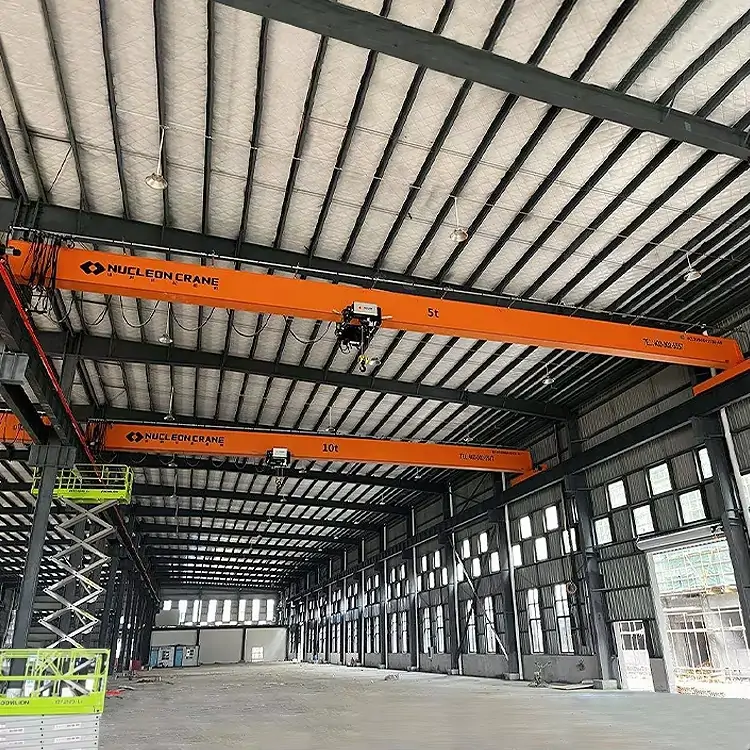
A single girder overhead crane uses one main beam spanning the runway rails, with the hoist trolley running underneath it on the bottom flange. This configuration is lighter, lower in headroom requirement, and less expensive to purchase and install.
It is the correct choice for most general-purpose facilities handling loads up to roughly 20 tonnes with moderate lift frequency. Asking for a single girder unit when your loads regularly exceed that range or your shifts run continuously is the most common over-simplification in procurement.
Двухбалочный мостовой кран
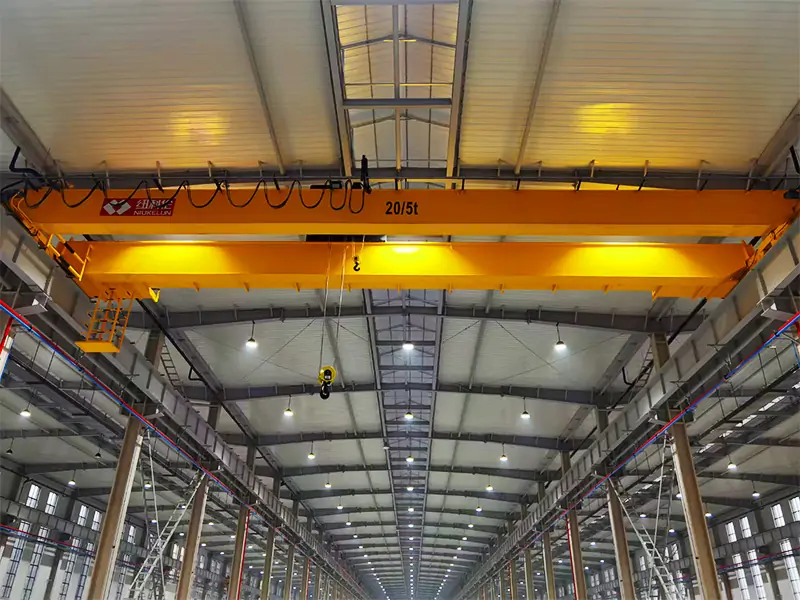
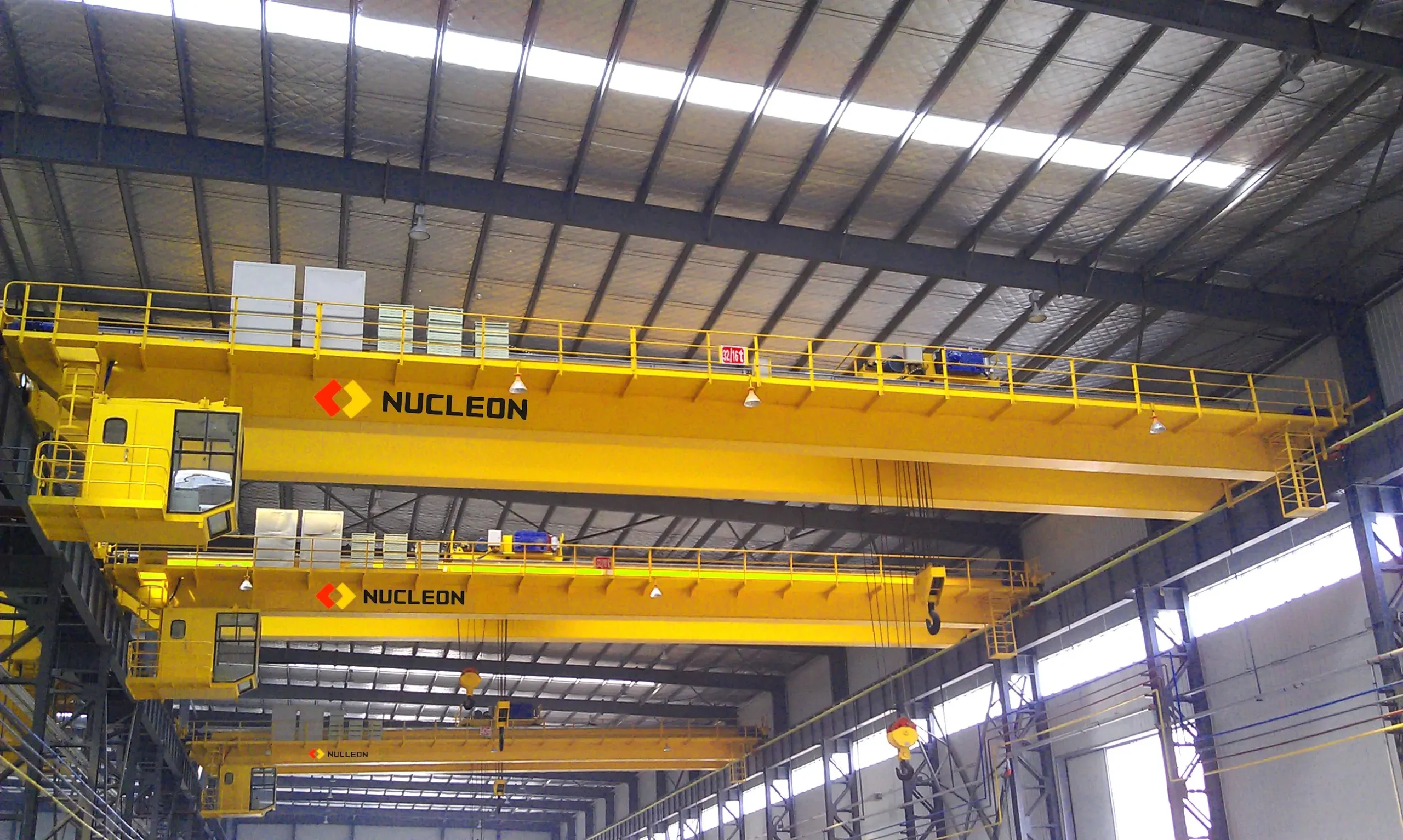
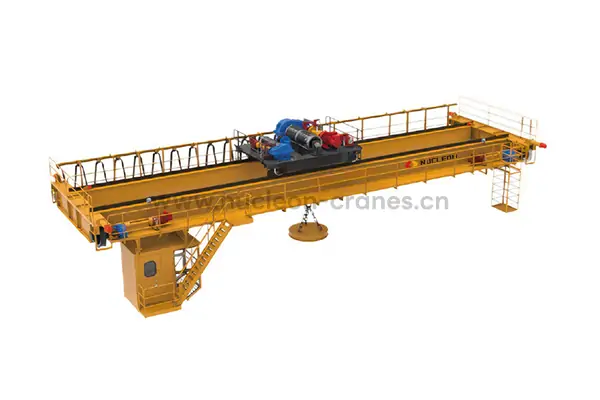
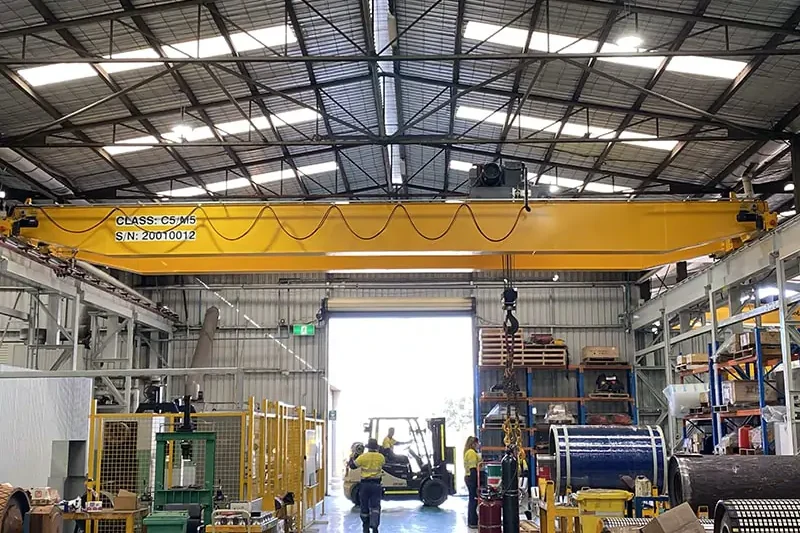
A double girder overhead crane uses two parallel main beams. The hoist trolley runs on top of the girders on a separate rail, which places the hook lower relative to the runway rail elevation—gaining usable hook height.
This configuration handles heavier capacities, accepts more specialized hoists (including wire rope hoists with higher duty classifications), and is the standard choice for steel mills, heavy fabrication, and any application requiring a cab-operated crane or underslung auxiliary hoist.
Explosion Proof Single Girder Overhead Crane
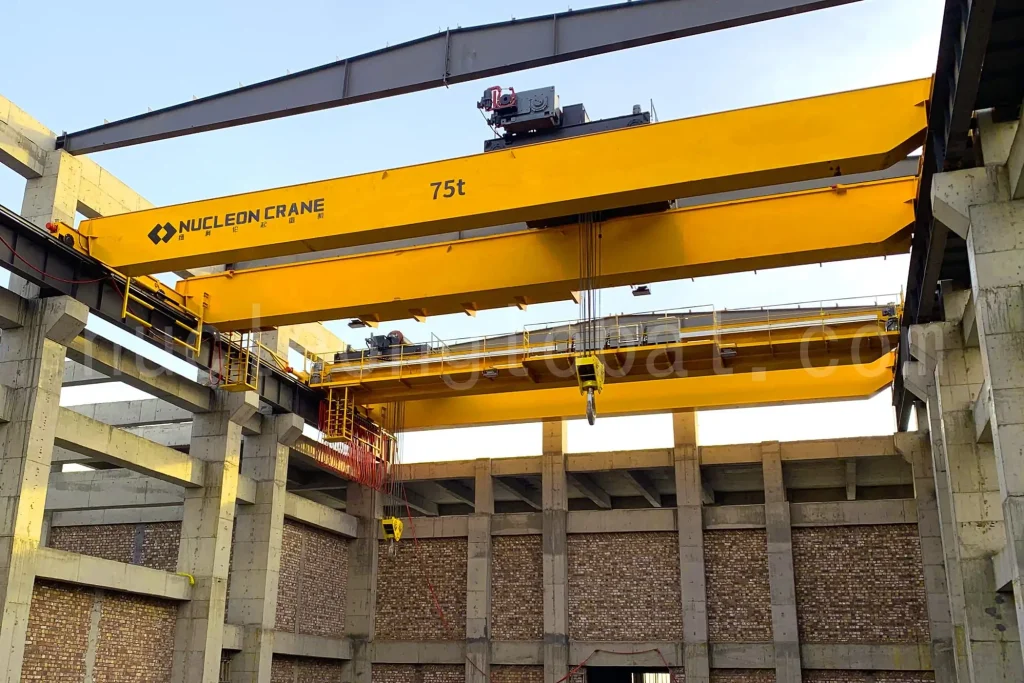
An explosion proof single girder overhead crane is a single girder unit where all electrical components—motors, controls, push buttons, limit switches—are housed in enclosures certified to contain or prevent ignition in flammable atmospheres. This type is required in chemical plants, paint facilities, fuel storage areas, and similar environments. The crane's mechanical structure is not fundamentally different; the distinction is entirely in the electrical specification and certification. Do not assume a standard crane can be retrofitted affordably for hazardous areas after purchase—specify the environment before quoting.
Key Parts of a Single Girder Overhead Crane
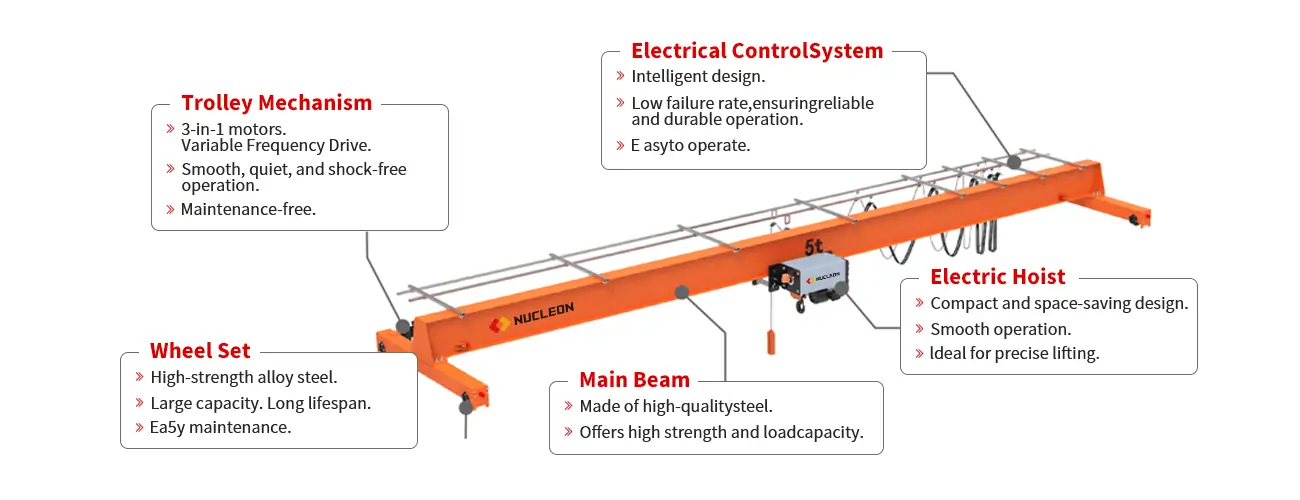
Understanding the main single girder overhead crane parts helps you ask better questions during procurement and maintenance planning:
| Компонент | Функция | Common Failure Point |
| Bridge girder | Spans the runway; carries the trolley load | Fatigue cracks at end truck welds |
| End trucks | Connect bridge to runway rails; carry travel wheels | Wheel and rail wear |
| Hoist unit | Contains motor, gearbox, drum/chain, hook block | Brake wear, rope/chain fatigue |
| Trolley frame | Carries hoist; travels on bottom flange (single girder) | Side guide roller wear |
| Conductor bar / festoon | Supplies power to moving bridge | Contact wear, cable abrasion |
| Control pendant / remote | Operator interface | Button stick, cable strain relief |
Note: Component classifications and inspection intervals are defined in standards such as FEM 1.001 and ASME B30.2, referenced during design and compliance review.
FEM Standard and Overhead Crane Classification
The FEM standard overhead crane classification system—published by the European Federation of Materials Handling—groups cranes into usage classes based on total lift cycles over their design life and the load spectrum (how often the crane runs at full capacity versus partial loads).
For a buyer, the practical takeaway is this: two cranes with the same rated capacity (say, 10 tonnes) can be built to completely different service lives and structural margins depending on their FEM class. A crane classified for light, infrequent use will not hold up in a production environment running two or three shifts. Always ask the supplier to state the FEM classification explicitly and confirm it matches your actual usage pattern—not your theoretical maximum load.
The Overhead Travelling Crane and Building Structure
An overhead travelling crane is only as reliable as the runway it runs on. The runway rails and their supporting structure—whether roof-mounted brackets or freestanding columns—must be designed to carry dynamic loads, not just static weight. Many procurement processes focus entirely on crane capacity and ignore runway specification until installation begins.
Before finalizing a purchase, confirm two things with the supplier:
- Wheel load data – the maximum force each end truck wheel applies to the runway rail under rated load
- Runway span and tolerance requirements – acceptable rail gauge variation and rail straightness limits
If you are retrofitting a crane into an existing building, have a structural engineer verify the building can accept the wheel loads before signing any contract.
Buying an Industrial Overhead Crane: Questions That Actually Matter
Most buyers ask about capacity and span. Those are necessary but not sufficient. The questions that prevent costly mistakes:
What is the actual lift frequency? Not the maximum possible, but the realistic daily cycle count. This determines duty class, which drives cost more than capacity does in the mid-range.
What is the hook height you need? Measured from floor to the underside of the hook at maximum lift. This determines whether single or double girder is feasible in your building.
Is the environment standard or classified? Dust, moisture, chemical vapors, or flammable gases each require specific protection classes on electrical components.
Who performs commissioning and ongoing inspection? In most markets, overhead cranes require periodic statutory inspection by a certified body. Confirm whether the supplier provides this or whether you need a third party.

Специалист по оборудованию
Успешный менеджер по работе с кранами с обширным опытом в управлении крупномасштабными проектами и операционным контролем. Подтвержденный опыт увеличения доходов и обеспечения соблюдения требований безопасности.
Часто задаваемые вопросы
What is the difference between a single girder and double girder overhead crane?
Single girder uses one main beam with the hoist hanging below it; double girder uses two beams with the hoist sitting on top. Double girder gains hook height, handles higher capacities, and suits heavier duty applications. Single girder costs less and fits lower buildings. The decision is driven by hook height requirement and daily usage intensity, not capacity alone.
What does EOT crane mean?
EOT stands for Electric Overhead Travelling crane. It describes a standard industrial overhead crane driven by electric motors for all three motions—hoisting, bridge travel, and trolley travel. The term is used interchangeably with overhead crane in most industrial procurement contexts.
Как часто необходимо проводить осмотр мостового крана?
Inspection frequency depends on local regulations and the crane's usage class. As a general reference, most national standards require a formal inspection by a qualified party at least annually, with operator-level pre-shift checks before each use. Higher-duty installations typically require more frequent formal inspections. Confirm the statutory requirement in your jurisdiction before commissioning.
Do I need an explosion proof crane, or will a standard crane work in my facility?
If any part of the crane's operating area is classified as a hazardous zone under your local electrical area classification standard, a standard crane is not acceptable regardless of how infrequently it operates there. Have your facility's hazardous area classification drawing reviewed before specifying the crane.
What information should I give a supplier to get an accurate quote?
Minimum required: rated lifting capacity, span between runway rails, hook height, bay length, lift frequency (cycles per hour and shifts per day), power supply voltage and frequency, and operating environment (temperature range, humidity, presence of dust or corrosive agents). Missing any of these will produce a quote that may not fit your application.

 English
  العربية
  Español
  Français
  Português
  Русский