

How much does a jib crane cost? As a market reference, a standard 0.5–2 ton unit typically runs from about $2,000 for a wall-mounted model to $8,000 for a floor-mounted crane with a heavier hoist and longer boom, while 5–10 ton cranes can reach $8,000–$35,000 or more. That is the equipment price only. Foundation work, installation, freight and local taxes usually sit outside it.
Where buyers get hurt is the comparison. Two quotations for a “1-ton jib crane” can differ by several times, because one is a short wall-mounted bracket with a manual hoist and the other is a 6 m motorized floor-mounted unit. The cheaper quote may also leave out the hoist, the foundation drawing or the load test altogether. Tonnage alone tells you very little about the price.
This guide gives price ranges by crane type, then explains the three things that most often account for a price gap: boom radius, what the quotation includes, and what your building or floor has to carry. By the end you should be able to read a jib crane price line by line and know which details to send to get an accurate one.
Quick price reference (equipment only, market reference ranges)
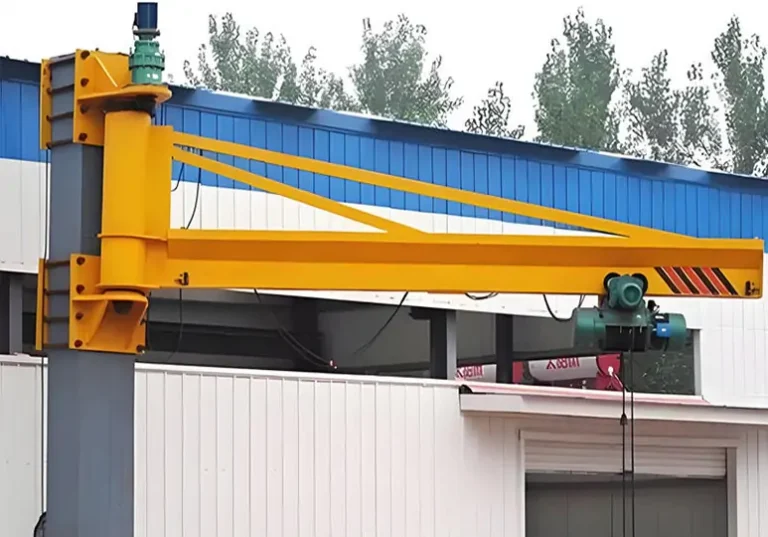
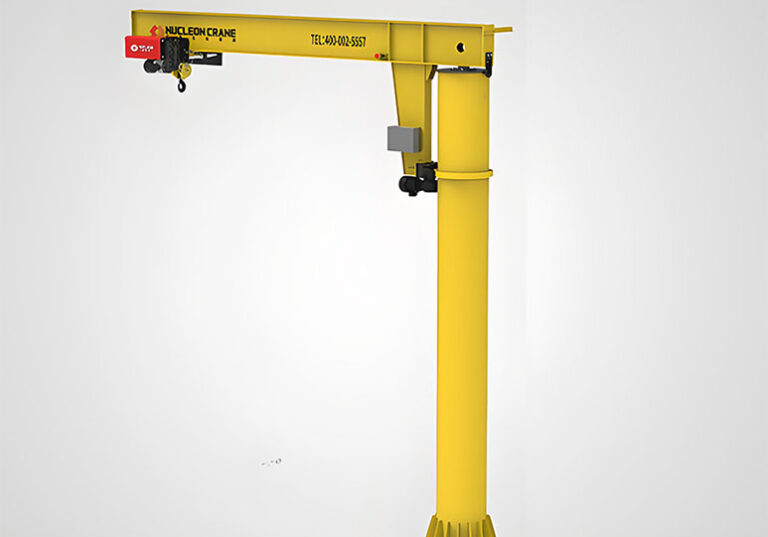
| Jib crane type and capacity | Market reference price | Main cost outside the quote |
| Wall-mounted cantilever, 0.5–1 t | $2,000–$3,500 | Wall or column check and reinforcement |
| Floor-mounted slewing, 0.5 t | $2,500–$3,500 | Foundation, anchor bolts, civil work |
| Floor-mounted slewing, 1 t | $3,500–$5,500 | Foundation, anchor bolts, civil work |
| Floor-mounted slewing, 2 t | $5,000–$8,000 | Foundation, anchor bolts, civil work |
| Heavy-duty floor-mounted, 5 t | $8,000–$14,000 | Reinforced foundation, engineering |
| Heavy-duty floor-mounted, 10 t | $10,000–$35,000 | Reinforced foundation, engineering |
| Portable on wheels, 0.5–2 t | $2,500–$6,000+ | Floor condition, ballasted base |
| Articulating, 80–600 kg | $1,500–$2,500 | Mounting wall or pedestal |
For one workstation and loads up to 2 t, budget roughly $2,000–$8,000 for the crane, then plan installation as a separate line. Low ends assume a short boom and basic controls; high ends add a longer boom, a higher duty class or remote control.
Need a number for your own site? Send your load, radius and site photos for a project quotation.
Получить коммерческое предложениеОглавление
How Much Does a Jib Crane Cost by Type and Capacity?
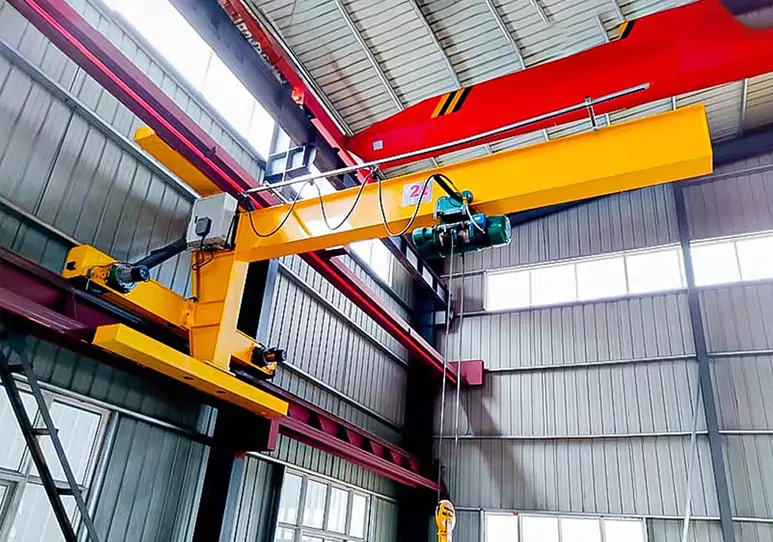
Настенные поворотные краны: cheapest to buy, but the wall decides the real cost
A wall-mounted jib typically costs around $2,000–$3,500 for 0.5–1 t, because it needs no mast and no new foundation. The catch is the load path. The boom turns every lift into a vertical load plus a pull-out moment at the upper bracket, and that moment must be carried by a concrete wall, a steel column or a building frame that was probably not designed for crane duty. If it falls short, strengthening plates, new anchors or a structural review can cost more than the crane itself, which is why a cheap wall-mounted quote sometimes ends up above a floor-mounted one.
Before you commit, ask the supplier for the bracket reaction forces, then have a local structural engineer confirm the wall or column can take them. Expect a limited rotation arc as well, often around 180°–270°, because the boom cannot swing through the wall.
Floor-mounted jib cranes: the foundation is part of the price
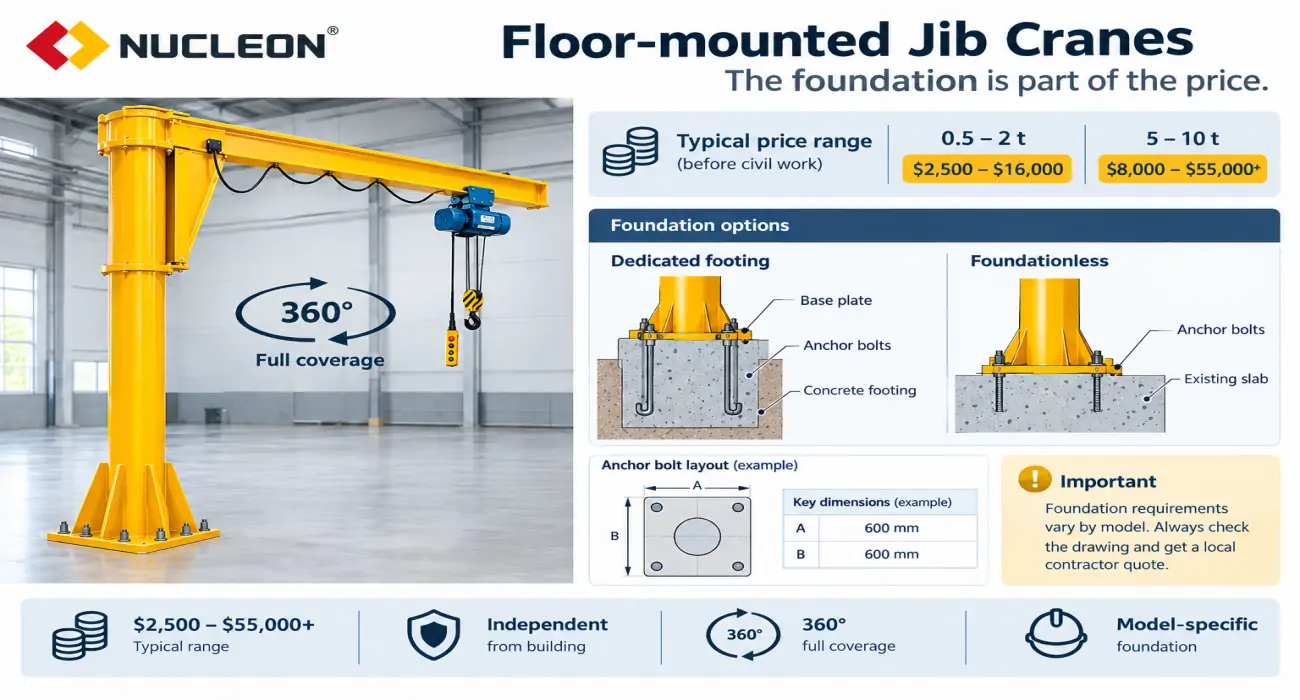
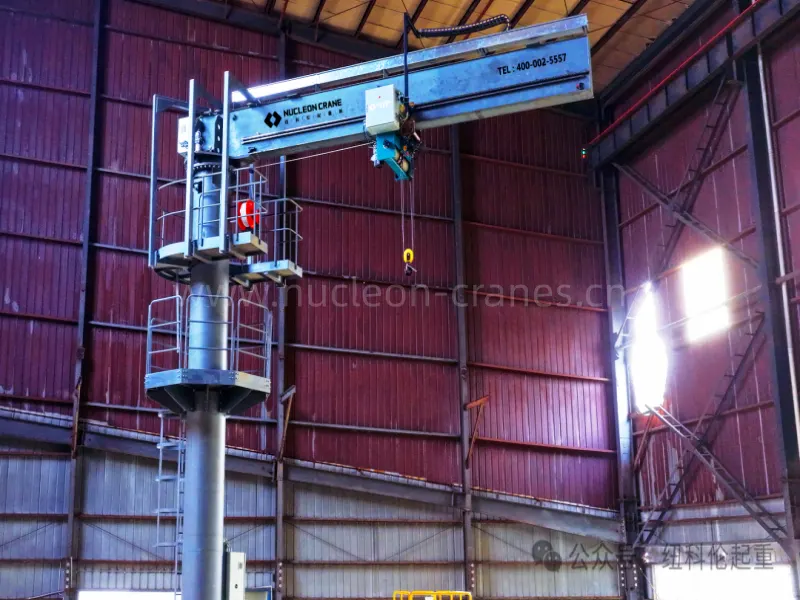
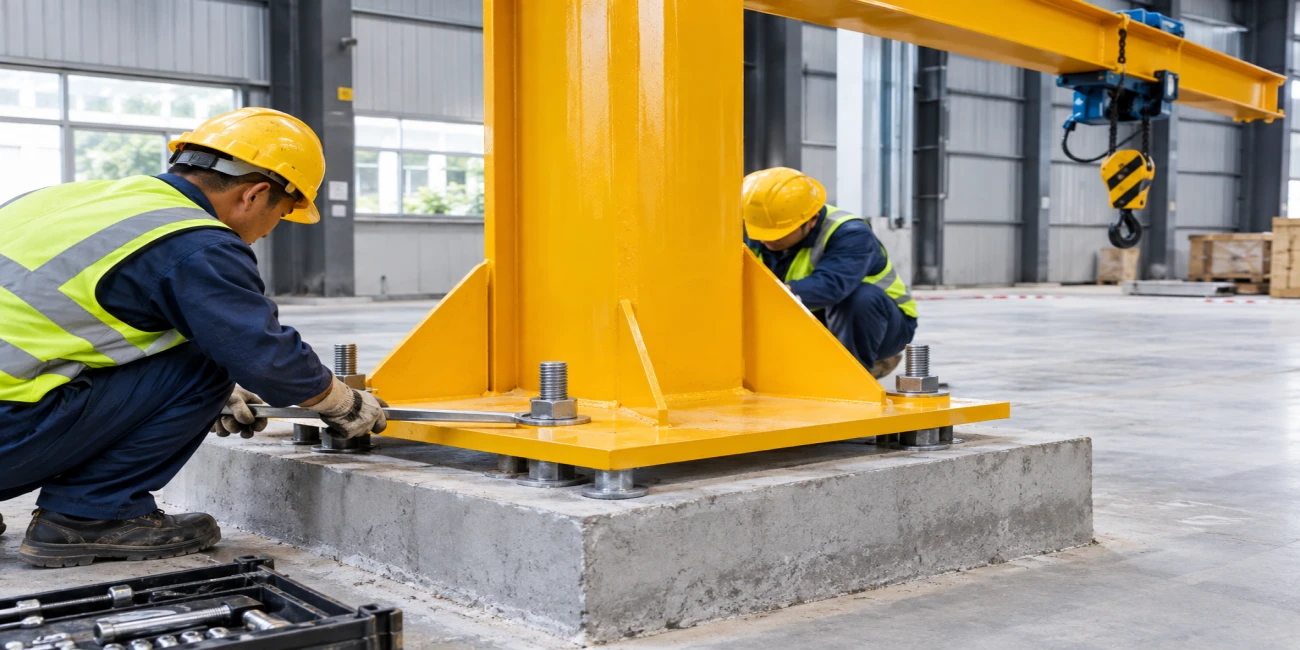
A floor-mounted jib, also called a pillar-mounted jib, typically costs around $2,500–$8,000 for 0.5–2 t and $8,000–$35,000 or more at 5–10 t, before any civil work. The mast acts as a cantilever fixed at its base, so the full lifting moment passes through the base plate and anchors into the concrete. Some models need a dedicated footing with embedded anchors. “Foundationless” designs bolt to an existing reinforced slab, but only when that slab meets the manufacturer’s requirements for concrete strength, thickness, reinforcement and edge distance.
Foundation requirements are model-specific, so never reuse a thickness figure from another crane’s drawing. Ask for the foundation drawing with base reactions and have a local contractor price it. The upside is independence from the building: a floor-mounted crane usually gives full 360° coverage without loading the wall structure.
артикуляционное, portable and heavy-duty jib cranes: narrower jobs, different pricing
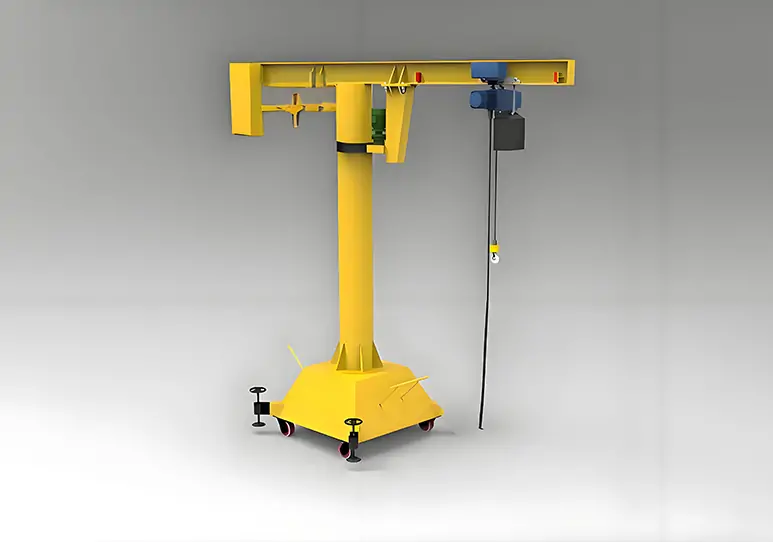
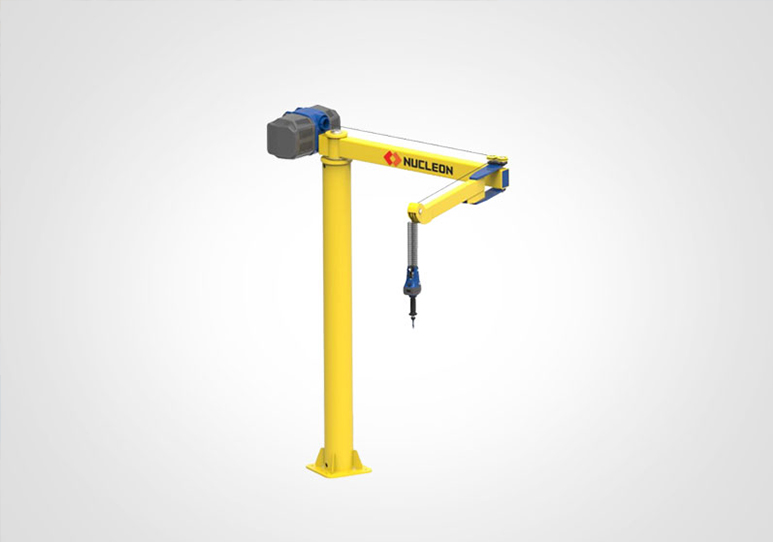
Articulating units, typically $1,500–$2,500 for 80–600 kg, use a two-arm design so the hook can reach around machines and into corners, which a straight boom cannot. Portable units, typically $2,500–$3,000 or more for 0.5–2 t, trade capacity for mobility on a ballasted or wheeled base, so the cost per ton is higher. Heavy-duty floor-mounted cranes at 5–10 t, typically $8,000–$35,000 or more, are engineered per project, with special boom lengths, hoists and foundation designs. A wall traveling jib, which runs along a wall-mounted rail, is quoted per project because the rail and wall structure drive the price.
| Your situation | Usually the best-value type |
| Suitable concrete wall or steel column, loads up to 2 t | Wall-mounted |
| Open floor, 360° coverage, loads up to 5 t | Floor-mounted |
| Tight space around machines, precise positioning | артикуляционное |
| Layout changes often, or leased building | Portable |
| Loads above 3 t or long radius | Heavy-duty custom |
Choose by mounting condition first and capacity second, since the structure that carries the crane drives cost more than the tonnage printed on the nameplate.
Special environments such as outdoor coating, stainless steel or explosion-proof design, and certification documents (for example a CE technical file, if your market requires one), are priced as separate upgrades, so state them in the enquiry. For model specifications, see Nucleon’s floor-mounted slewing, wall-mounted cantilever, articulating, portable и wall traveling jib cranes.
Why Two Jib Cranes with the Same Capacity Can Have Very Different Prices
Why a longer boom costs more at the same capacity
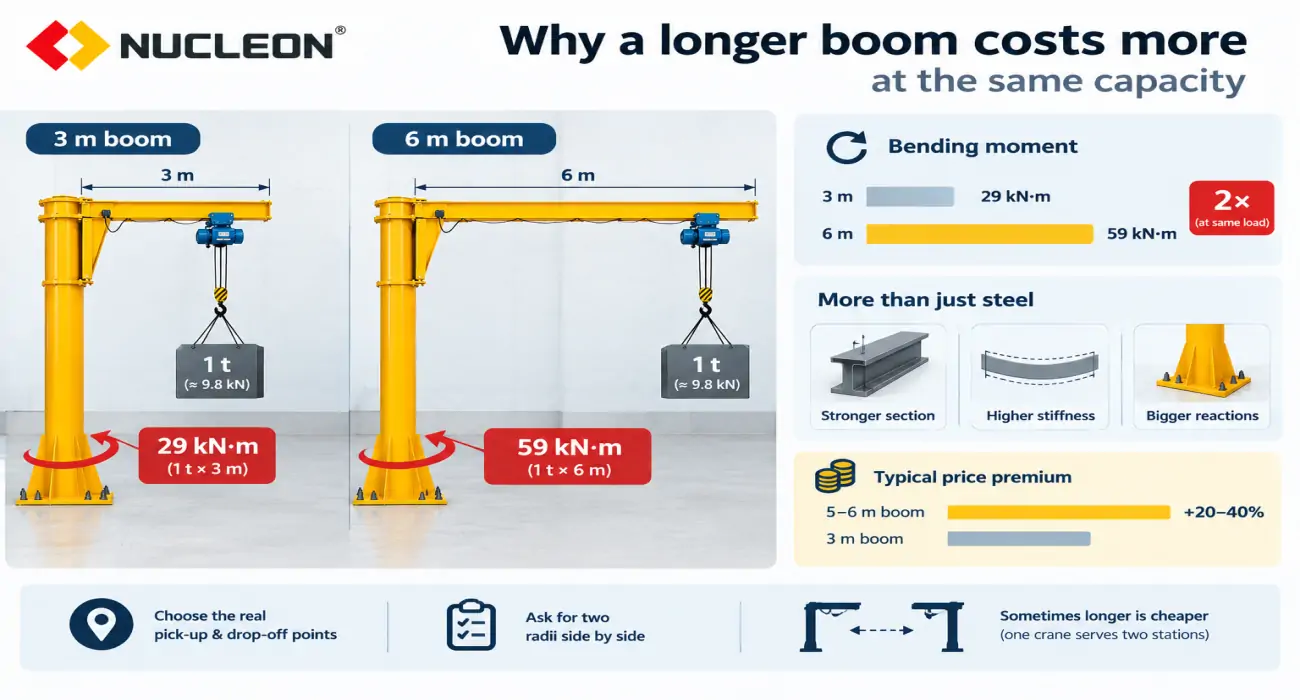
A longer boom costs more at the same capacity because bending moment grows with radius: it is roughly load multiplied by radius. A 1-ton load (about 9.8 kN) hanging at 3 m produces around 29 kN·m at the mast; at 6 m the same load produces around 59 kN·m. That is double the demand before adding the weight of the boom, hoist and trolley and the dynamic factors the design standard requires. Treat this as a rough check, not a design calculation.
The result is not just “more steel”. A longer boom needs a deeper or thicker section to stay strong, but also to stay stiff: deflection control often governs, because a sagging boom lets the hook drift and makes the trolley harder to push. The mast, base plate and anchors then carry a larger reaction too. Supplier price guides often put the premium for a 5–6 m boom over a 3 m boom at around 20–40%; treat that as a rough reference, since a specific design can land above or below it.
Choose the radius from the real pick-up and drop-off points plus hook approach, not from a round number, and ask suppliers to quote two radii side by side. A longer boom is sometimes the cheaper project, for example when one crane can serve two adjacent workstations that would otherwise need two.
Hoist, rotation and controls can change the price as much as the steel
Many jib quotes describe a “crane” that is only the structure, with the hoist priced separately. Electric chain hoists, wire rope hoists and remote controls typically add from a few hundred to around two thousand dollars on small cranes, and more at higher capacity and duty. Duty class matters here: two hoists rated 1 t can behave very differently on a production line than at an occasional maintenance station. Duty classes are defined under standards such as ISO 4301-1 и FEM 1.001, and hoists are covered by ASME B30.16 in North America.
Rotation is a second lever. Manual slewing is economical when an operator can start, guide and stop the load comfortably. Motorized slewing is worth pricing for repetitive cycles, heavy loads at long radius, or positions where the operator cannot stand near the load. Continuous 360° rotation also needs a power-transfer arrangement such as a collector ring, while a limited-turn design can use a managed cable with rotation stops. Match these choices to the real lifting path, then compare the jib crane range with the электрическая цепная лебедка и электрическая канатная таль options for duty and speed.
Capacity sets the floor, not the final price
Rated capacity is the load the crane can lift at its design radius, and it must cover everything hanging from the hook: the workpiece plus any spreader, clamp, magnet or rigging. Buyers who size by workpiece weight alone either under-buy or, trying to be safe, over-buy. “Need 2 t, buy 5 t” raises the mast, base, hoist, slewing and foundation cost together. As a market reference, a 1-ton jib crane commonly lands between about $3,500 and $9,500, and most of that spread comes from mounting type, radius and hoist rather than from the capacity itself.
Say how often the crane works, too. A station that lifts a few times a day and one that cycles every few minutes need different hoists and brakes at the same tonnage, so the quotation should state the duty class rather than tonnage alone. Nucleon’s standard jib models are listed at working grade A3, so a high-frequency production station should be discussed with an engineer before you order.
Comparing jib crane quotations? Send your load, working radius, lifting height and site photos, and our engineers will check the scope line by line.
Получить коммерческое предложениеJib Crane Installation Cost: What the Quote Does Not Show
The quote is not the project cost
Two cranes with the same capacity can carry very different installation budgets because they pass the load into the ground in different ways. A floor-mounted jib may need an independent concrete foundation, embedded parts or anchor bolts, which means excavation, reinforcement, curing time and a local concrete contractor. A wall-mounted jib may avoid a foundation, but only if the existing wall or column can resist both the load and the overturning moment; if not, reinforcement becomes the hidden line. Neither route is automatically cheaper. It depends on what the building already offers.
The table shows typical cost lines for a 1–2 t crane. These are market reference ranges, local labor rates vary widely by country, and a supplier’s price list usually covers only the first row.
| Cost line | Market reference range | Usually paid by |
| Crane equipment (structure, hoist if included) | $1,500–$8,000 | In the quotation |
| Freight to destination | $200–$700 | Depends on trade terms |
| Foundation and anchors | $300–$3,800 | Buyer, locally |
| Wall or column structural check (wall-mounted) | $200–$1,000 | Buyer, locally |
| Electrical connection | $200–$1,300 | Buyer, locally |
| Installation labor | $300–$2,000 | Buyer or supplier engineer |
| Load test and commissioning | $200–$400 | Must be stated in writing |
| Third-party inspection or permits | $200–$300 | Depends on country |
As a planning rule, a fully installed 1–2 t jib crane often costs roughly 1.5–2 times its equipment price, because foundation, labor, electrical work and testing are mostly fixed costs. The share falls as cranes get larger, and rises if the building needs strengthening.
Export projects: who pays for what
Under FOB, the seller delivers the crane onto the vessel at the origin port, and the buyer arranges sea freight, insurance, import duties, taxes and inland transport. Under CIF, the seller also pays sea freight and insurance to the destination port, but import duties, unloading, local transport and site works still sit with the buyer. Other trade terms shift the line again.
For a jib crane, the practical risk is not the term itself but the assumptions around it: who erects the crane, who supplies the lifting equipment and electrician on site, who pours and certifies the foundation, and who pays for the load test. Settle these in the quotation, in writing, before comparing prices. Otherwise a supplier that excludes them will always look cheaper.
Five things to check before you accept a quotation
- Hoist and trolley: included? Check model, duty class, lifting speed and lift length.
- Rotation, controls and power: manual or motorized, pendant or remote, voltage and frequency.
- Foundation or wall-bracket drawings: reaction loads, anchor details and who verifies the structure.
- Installation, commissioning and load test: who performs them, and who pays.
- Packaging, trade terms, import duties and local construction: responsibilities stated in writing.
A low quotation is often a quotation with missing assumptions rather than a better price. The usual pattern is a bare crane structure, a hoist with a lower duty class or without spare parts such as a spare chain, and no installation or test scope, and sometimes without the certificates or test reports your market requires. Line the quotes up against these five items and the gap normally shrinks or explains itself. If it does not, ask the lower-priced supplier to confirm the missing items in writing.
How to Get an Accurate Jib Crane Price Before You Order
Seven details to send with your enquiry
- Total suspended load, including fixtures, spreader or rigging
- Working radius and the rotation arc you need
- Lifting height, measured as hook height under the boom
- Duty: lifts per hour or shift, and how often loads are near the rated limit
- Mounting condition: wall or column material and photos, or floor slab thickness and strength
- Power supply: voltage, frequency and phase
- Destination, indoor or outdoor use, and corrosion environment (outdoor units usually need a stronger coating)
With these seven, a supplier can design to your duty instead of padding for unknowns, which is the main reason otherwise identical enquiries come back with such different jib crane prices. Photos of the intended position and a floor or wall drawing save several rounds of questions.
When the cheaper crane ends up costing more
A floor-mounted jib repeats its foundation cost each time it is relocated, so a low-priced unit in a layout that changes every few years can end up costing more than a portable or foundationless design. Reach works the same way: adding radius later usually means a new boom and often a new base. If the layout is uncertain, price a longer radius or a movable option now and compare the totals. If the position is permanent and the building is sound, the simplest wall-mounted or floor-mounted unit is usually the best value.
Заключение
How much does a jib crane cost? As a market reference, $2,000–$16,000 for most 0.5–2 t workshop units, with the fully installed budget often 1.5–2 times the equipment price once foundation, installation, freight and local works are counted. The price you pay is set by mounting type, boom radius, hoist and duty class, and by what the quotation leaves out, not by capacity alone.
Your next steps: define the total suspended load, radius and lifting height; confirm what your wall or floor can carry before comparing prices; then line up every quotation against the five checklist items. Send those details to Nucleon and our engineers will return a quotation that states scope, hoist duty class and installation responsibilities clearly, so you can compare like with like.
Talk to a Nucleon jib crane engineer. Share your load, radius and site details for a scope-checked quotation.

Специалист по оборудованию
Успешный менеджер по работе с кранами с обширным опытом в управлении крупномасштабными проектами и операционным контролем. Подтвержденный опыт увеличения доходов и обеспечения соблюдения требований безопасности.
Часто задаваемые вопросы
Q1: How much does a jib crane cost?
Most 0.5–2 t jib cranes cost between about $2,000 and $8,000 for the equipment alone. Wall-mounted units sit at the low end, floor-mounted units from roughly $2,500, and heavy-duty 5–10 t cranes can exceed $20,000. Foundation, installation, freight and local taxes are usually extra, and a fully installed small crane often costs 1.5–2 times the equipment price. Treat these as market reference ranges and confirm with a project quotation.
Q2: How much is a 1-ton jib crane?
A 1-ton jib crane commonly costs between roughly $1,500 and $4,500. The spread comes from mounting type, boom radius and whether the hoist is included. A short wall-mounted unit with a manual hoist sits near the bottom of that range; a 6 m floor-mounted crane with an electric hoist and motorized rotation sits near the top. Foundation and installation are additional. Confirm model details with the supplier.
Q3: Does a jib crane need a concrete foundation?
Floor-mounted jib cranes need a verified slab or foundation; wall-mounted ones need a verified wall or column instead. There is no universal thickness, because it depends on capacity, radius and base design, so follow the manufacturer’s foundation drawing. “Foundationless” models bolt to an existing reinforced slab, but only when it meets that model’s requirements. Have a local engineer confirm the structure.
Q4: Is a wall-mounted jib crane always cheaper than a floor-mounted one?
No, the equipment is cheaper, but wall or column reinforcement can erase the saving. A wall-mounted jib passes the lifting moment into the building, so the structure must be verified against the bracket reactions. If it passes, wall-mounted is usually the lowest-cost route. If reinforcement is needed, a floor-mounted crane with its own foundation may cost less overall.
Q5: What is usually not included in a jib crane price?
Foundation work, installation, import duties and local electrical connection are the items most often left out. Some quotations also exclude the hoist, controls, packaging, load testing or spare parts. Ask the supplier to list included and excluded items, the trade terms, and who handles each local task, so quotations can be compared on the same basis.
Связанные статьи
- Jib Crane Capacity Guide: How to Choose the Right Load Rating
- Jib Crane Installation Guide: Floor, Wall & Foundation Requirements
- Шарнирно-сочлененный или отдельно стоящий консольный кран: какой вариант лучше подойдет для вашего рабочего пространства и бюджета?
- Что такое консольный кран? Типы, конструкция и как выбрать подходящий.
- Что такое промышленный стреловой кран? Типы, применение и руководство по покупке

 English
 العربية
 Español
 Français
 Português
 Русский