

Ан articulating jib crane uses a two-arm, dual-pivot boom to reach around machines, columns, and other obstructions, while a free standing jib crane uses a single straight boom on an independent mast set in its own foundation, built for higher capacity and continuous-duty lifting. The right choice depends less on tonnage and more on two questions: how much clearance does your workspace actually give you, and how many lifts will this crane make per hour.
If you're specifying a crane for a machine-loading cell wedged between equipment, an articulating jib crane usually solves the access problem no straight-boom crane can. If you're equipping an open production bay running lifts all shift long, a free standing jib crane is almost always the more economical choice over its service life. This guide walks through the real trade-offs — capacity, rotation, installation cost, and the mistakes that show up after the purchase order is signed — so you can match the crane to the job instead of the other way around.
Оглавление
Quick Reference: Articulating vs Free Standing Jib Crane
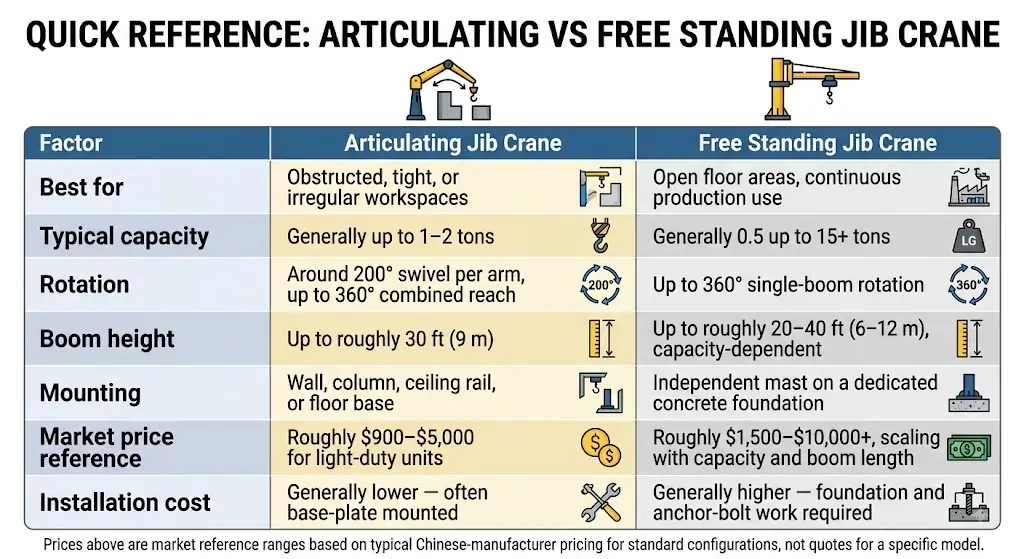
| Фактор | Консольный кран с шарнирной стрелой | Free Standing Jib Crane |
| Лучше всего подходит для | Obstructed, tight, or irregular workspaces | Open floor areas, continuous production use |
| Типичная вместимость | Generally up to 1–2 tons | Generally 0.5 up to 15+ tons |
| Вращение | Around 200° swivel per arm, up to 360° combined reach | Up to 360° single-boom rotation |
| Boom height | Up to roughly 30 ft (9 m) | Up to roughly 20–40 ft (6–12 m), capacity-dependent |
| Mounting | Wall, column, ceiling rail, or floor base | Independent mast on a dedicated concrete foundation |
| Справочная рыночная цена | Roughly $900–$5,000 for light-duty units | Roughly $1,500–$10,000+, scaling with capacity and boom length |
| Installation cost | Generally lower — often base-plate mounted | Generally higher — foundation and anchor-bolt work required |
Prices above are market reference ranges based on typical Chinese-manufacturer pricing for standard configurations, not quotes for a specific model. [Get a factory-direct quote from Nucleon Crane →]
Articulating vs Free Standing Jib Crane: Core Differences at a Glance
What an Articulating Jib Crane Actually Solves
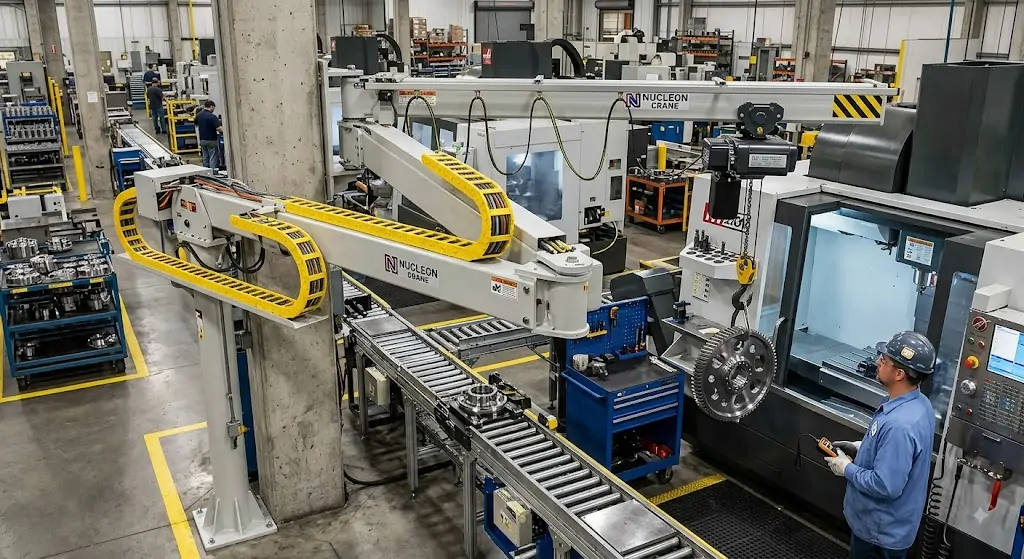
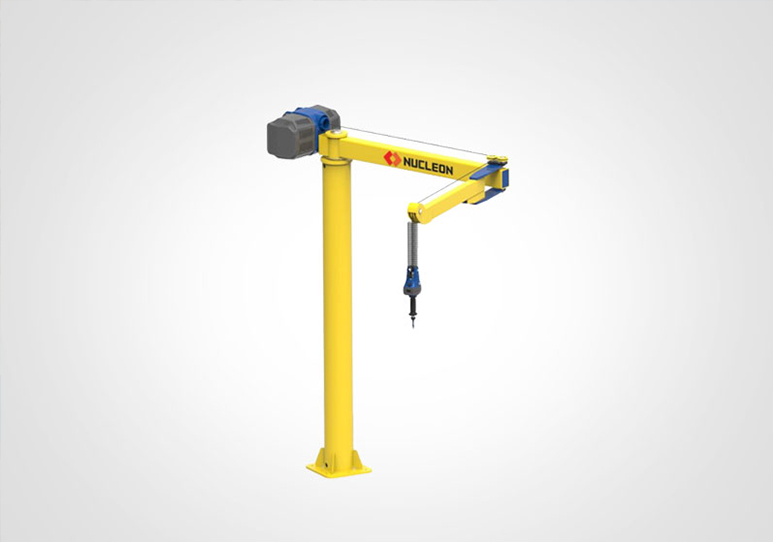
An articulating jib crane exists to get a load around an obstacle, not to lift the heaviest possible load. Its two-arm, dual-pivot design lets the boom fold and swing in a way a rigid straight arm cannot, which is why it shows up constantly in machine-loading cells, CNC tending, and maintenance bays where a column, conveyor, or adjacent machine blocks a direct lift path. The trade-off for that flexibility is mechanical complexity: two pivot points and a jointed power-feed system (typically an energy chain or festoon loop to handle the extra articulation) mean more moving parts than a straight boom, which is also why articulating units carry a higher relative maintenance load over time. Capacity is intentionally modest — most standard models top out well under free standing equivalents — because the priority in the design is precision and reach around obstructions, not maximum tonnage.
What a Free Standing Jib Crane Actually Solves
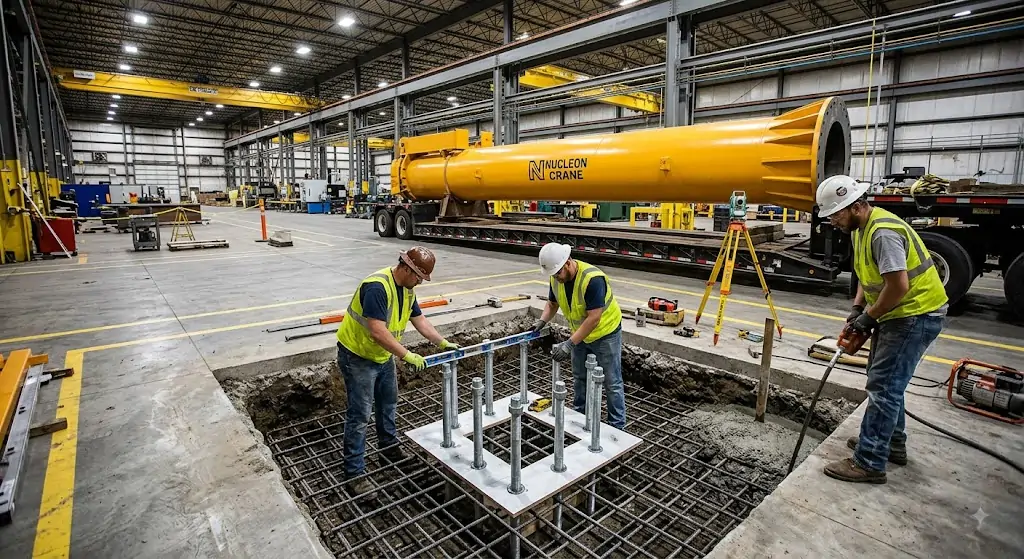
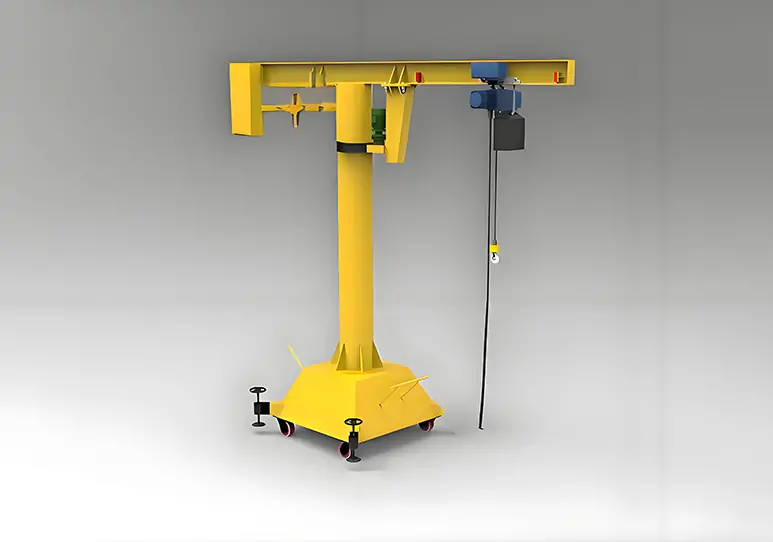
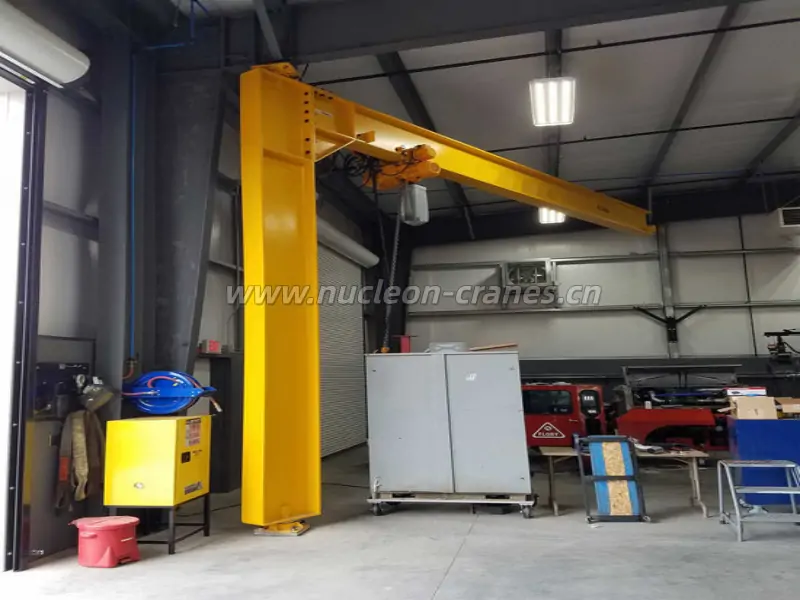
A free standing jib crane exists to deliver stable, repeatable capacity over an open working radius, not to squeeze into tight spaces. Because the mast is set into its own concrete foundation rather than relying on an existing wall or column, the structure can be engineered for far higher loads and full 360° rotation without transferring stress to the building. That's why free standing units dominate production lines and warehouse zones doing continuous or high-frequency lifting: the simpler single-pivot mechanism has fewer wear points than an articulating arm, so it holds up better under constant cycling over years of use. The cost of that stability is upfront: the crane needs a dedicated foundation, which is where buyers most often underestimate total project cost (more on that below).
Rotation, Reach, and Capacity You Can Actually Expect
Free standing jib cranes generally out-rotate and out-lift articulating models, but articulating models win on maneuverability inside the same footprint. As a market reference, free standing units commonly reach full 360° rotation with capacities that can run into the 15-ton range on heavier configurations, per ASME B30.11 provisions covering jib boom and underhung crane construction. Articulating units are typically rated for lighter loads — often in the sub-2-ton range — with swivel motion around 200° per arm section, because the jointed structure is engineered for controlled positioning rather than raw lifting capacity. Neither number should be read as a guarantee for a specific model; actual duty class (commonly referenced against FEM 1.001 or ISO 4301 classifications) and rated capacity should always be confirmed against the manufacturer's specification sheet for your exact configuration.
Choosing by Workspace and Duty Cycle, Not Tonnage
When Space Constraints Should Drive the Decision
If a machine, column, or conveyor sits between your hoist and the load, an articulating jib crane is usually the only jib-crane type that solves it without relocating equipment. The dual-arm geometry lets an operator route the hook around an obstruction rather than lifting over it, which matters most in retrofit situations where the building layout is already fixed. This is the scenario where articulating cranes earn their higher relative cost per ton of capacity: you're not paying for lifting power, you're paying for access. Facilities running dense equipment layouts — assembly cells, tool-and-die shops, CNC load/unload stations — are the classic fit. If your floor plan is genuinely open with no obstructions in the swing radius, this advantage disappears and a straight-boom crane becomes the more cost-effective option.
When Load Frequency Should Drive the Decision
The single biggest procurement mistake in jib crane selection is sizing by tonnage alone and ignoring how many lifts happen per hour. Two 2-ton jib cranes with identical nameplates can have completely different real-world requirements: one doing ten lifts a day is a light, intermittent duty application; one doing thirty lifts an hour on a production line is continuous duty, and that difference determines whether a free standing crane's higher-durability single-pivot design is worth the extra installation cost. As a practical threshold, workspaces running lifts more or less continuously through a shift are better served by free standing equipment even at moderate tonnage, because the mechanism simply has fewer wear points to fatigue under repeated cycling. Intermittent, low-frequency lifting — a handful of lifts spread across a shift — rarely justifies the added structural cost of a free standing foundation if an articulating or wall-mounted unit already fits the space.
Duty Class and Power Configuration
Confirm duty class and power requirements before finalizing crane type, not after. Both crane types are available in manual, electric hoist, and variable-frequency-drive configurations, and the choice compounds the space-versus-frequency decision above: a manual articulating crane for occasional precision work looks nothing like an electric free standing crane feeding a production cell every few minutes. Buyers who skip confirming whether they'll eventually need electric rotation, a powered hoist, or remote-control operation often end up paying for a second retrofit within a year or two of installation — a cost that a five-minute conversation with the supplier at quoting stage would have avoided.
Получить коммерческое предложениеCosts Buyers Often Underestimate
Upfront Price Is Only Part of the Comparison
Free standing jib cranes often carry a lower sticker price than buyers expect relative to capacity, but the foundation work behind them is where budgets slip. As a market reference, light-duty articulating units commonly run in the $800–$4,000 range while free standing units span roughly $1,500–$10,000+ depending on capacity and boom length — but comparing those two numbers alone is misleading, because they don't include what it takes to get either crane bolted down and running.
Installation and Foundation Costs
A free standing jib crane's price tag rarely includes what the concrete foundation, ground bearing capacity assessment, and anchor-bolt installation will add to the total project cost. This is one of the most common blind spots in procurement: teams compare crane list prices without pricing out the civil works, then discover mid-project that the floor slab needs reinforcement before the mast foundation can be poured. Articulating and wall-mounted units generally avoid this because they bolt to an existing structure or a lighter base plate, which is a real cost advantage worth weighing against their lower capacity ceiling.
Maintenance and Lifecycle Costs
Articulating jib cranes generally cost more to maintain over their service life than free standing units doing comparable duty, because the jointed arm and its power-feed system have more wear points. A low-priced hoist quote that excludes a spare hoist chain, festoon replacement parts, or pivot bearing service is a common example of a hidden cost that only surfaces after the crane is in daily use — the delivered cost ends up higher than the quoted price. Free standing cranes, with a simpler single-pivot mechanism, typically hold up longer under high-frequency use, which is part of why they're the more economical choice for continuous production duty even though the initial installation is pricier.
Common Procurement Mistakes to Avoid
Mistake 1: Selecting by Tonnage Alone
Two cranes rated for the same load can face entirely different real-world demands depending on lifts per hour and average load-to-capacity ratio. Before specifying tonnage, confirm daily operating hours, lifts per hour, and the duty class the application actually falls under — not just the heaviest single load you'll ever lift.
Mistake 2: Assuming Articulating Is the "Upgraded" Option
Articulating and free standing cranes solve different problems, not different tiers of the same problem. An articulating crane buys workspace flexibility; a free standing crane buys load stability and service life. Neither replaces the other, and choosing the more complex option for an open floor plan just adds maintenance cost with no functional benefit.
Mistake 3: Underpricing the Foundation
For free standing cranes specifically, get the foundation, floor-load assessment, and anchor-bolt installation quoted alongside the crane itself before comparing total project cost against an articulating or wall-mounted alternative.
Mistake 4: Skipping Future-Capacity Planning
Confirm upfront whether electric rotation, a powered hoist, variable-frequency control, or remote operation might be needed down the line. Retrofitting these after installation typically costs more than specifying them at the outset.
Заключение
The articulating vs free standing jib crane decision comes down to two questions, not one: how obstructed is your workspace, and how frequently will the crane actually cycle. Choose an articulating jib crane when equipment layout blocks a direct lift path and load frequency is moderate. Choose a free standing jib crane when you need maximum stability, higher capacity, or continuous-duty performance in an open floor area. Before ordering, confirm duty class, foundation requirements, and future power needs with your supplier — those three items prevent most of the budget surprises that show up after installation.
Окончательный выбор оборудования должен быть подтвержден сертифицированным инженером и соответствовать местным правилам эксплуатации подъемного оборудования.

Специалист по оборудованию
Успешный менеджер по работе с кранами с обширным опытом в управлении крупномасштабными проектами и операционным контролем. Подтвержденный опыт увеличения доходов и обеспечения соблюдения требований безопасности.
Часто задаваемые вопросы
Q1: Is an articulating jib crane more expensive than a free standing jib crane?
Not necessarily — it depends on capacity and installation. Articulating units often have a lower installation cost since they skip the foundation work, but free standing cranes usually offer more capacity per dollar. Compare total project cost, including foundation, not just the crane's list price.
Q2: Can a free standing jib crane be moved once installed?
Generally no, not easily — free standing units are set into a dedicated concrete foundation for stability, so relocating one means new civil works. If your layout may change, a foundationless or portable jib crane is usually a better fit than either articulating or free standing types.
Q3: What capacity range should I expect from an articulating jib crane?
Most standard articulating jib cranes are rated up to roughly 1–2 tons as a market reference, since the design prioritizes maneuverability around obstacles over raw lifting capacity. Higher-capacity articulating models exist but are less common and should be confirmed against the manufacturer's spec sheet.
Q4: Do articulating jib cranes need more maintenance than free standing ones?
Generally yes — the dual-pivot arm and its festoon or energy-chain power feed introduce more wear points than a free standing crane's single-pivot mast. Budget for pivot bearing service and power-feed component replacement as part of total lifecycle cost, not just the purchase price.
Q5: How do I know if I need a free standing jib crane instead of overhead crane?
If lifting is confined to a repeated route or single work cell, a free standing jib crane is usually more cost-effective. If material needs to move across a wider area or multiple work zones repeatedly, an overhead bridge crane is often the more economical long-term choice.
Связанные статьи
- Что такое консольный кран? Типы, конструкция и как выбрать подходящий.
- 4 Types of Cranes for Construction Projects — Overhead, Gantry, Port & Jib Crane Compared
- Что такое промышленный стреловой кран? Типы, применение и руководство по покупке
- Взрывозащищенный мостовой кран: когда он вам действительно нужен?
- Руководство по осмотру и замене тросов для кранов.

 English
  العربية
  Español
  Français
  Português
  Русский