

A precast concrete gantry crane is sized by three numbers that buyers often get wrong: the full suspended load rather than the element weight, a span set by storage rows rather than yard width, and a duty class set by lifts per shift rather than tonnage. For a typical production yard handling beams and slabs, that often points to a double girder gantry of 20–50 t, a span of about 20–35 m, and ISO 4301-1 duty class A5, with market reference prices of roughly $30,000–$90,000 for that band.
The usual trouble starts at the quotation stage. A request that lists only "tonnage and span" gets a quote that looks complete, but it says nothing about spreader weight, stack height, truck loading, shifts per day or the rail foundation. Those gaps are where a yard ends up with a hook that cannot clear a loaded stack, a crane worked harder than its class allows, or a runway that settles under the wheel loads.
This guide walks through the decisions in the order you need to make them: crane type, capacity, span and lifting height, duty class and outdoor specification, then what to send suppliers so quotes are comparable. It covers yard gantry cranes for casting, storage and loading, not the bridge launching gantries used to erect girders on site.
Оглавление
Quick Reference: Precast Yard Gantry Crane Types
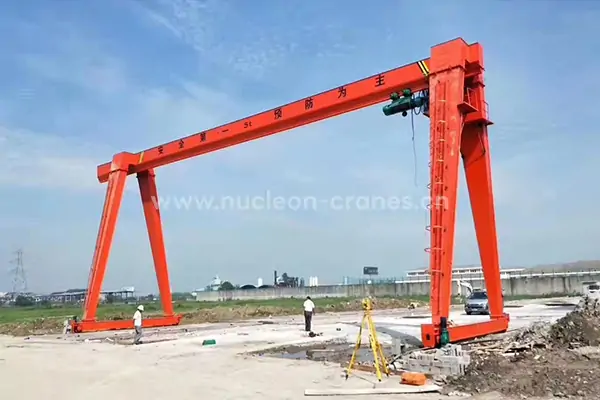
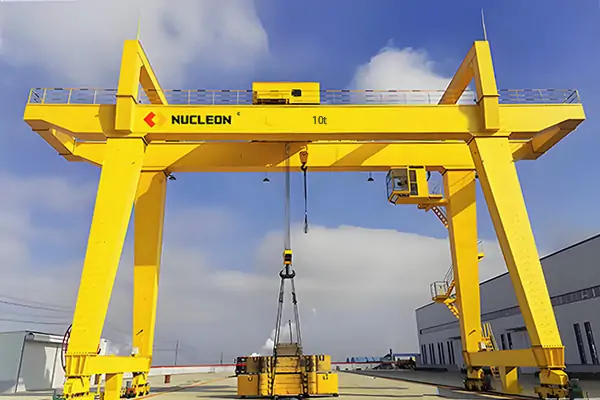
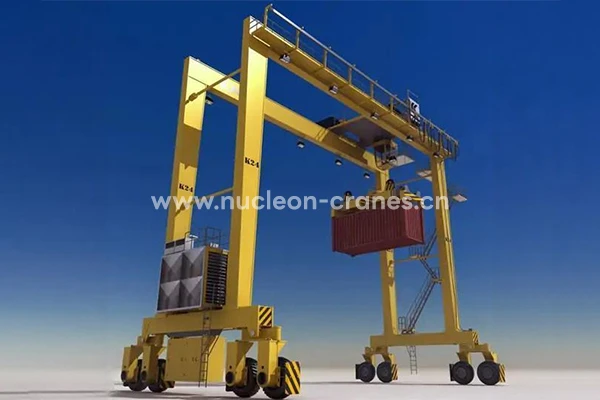
| Тип крана | Типичная вместимость | Typical span | Типичный класс службы | Best fit | Рыночная справочная цена |
| Single girder gantry (box, truss, L-leg or A-frame) | 5–20 t | 10–25 m | A3–A4 | Pipes, blocks, light slabs and panels, occasional lifts | $8,000–$30,000 |
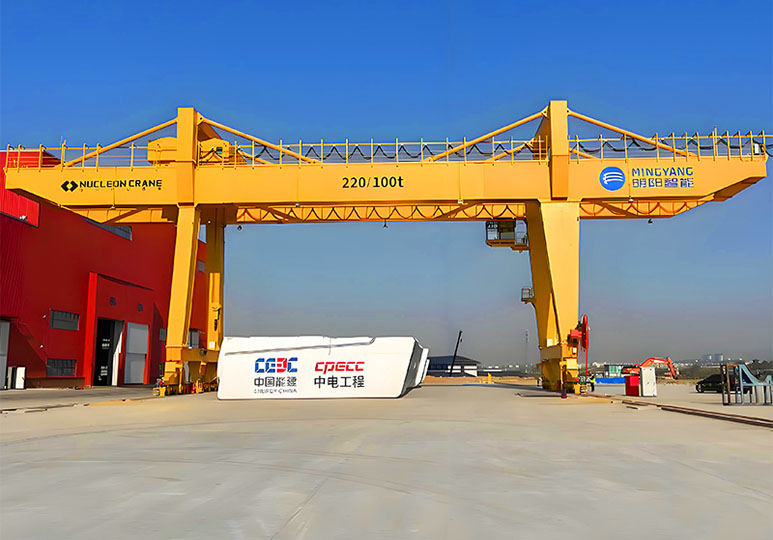
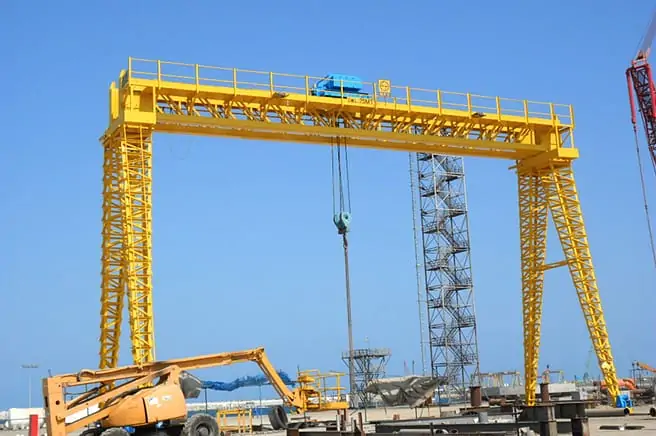
| Double girder box gantry | 20–50 t | 20–35 m | А5 | Beams, double-T slabs, daily yard transfer and truck loading | $30,000–$90,000 |
| Heavy double girder gantry (twin trolley or tandem pair) | 50–150 t | 30–40 m | A5–A6 | Bridge girders, box segments, very long elements | from about $100,000 |
| Rubber-tyred gantry (RTG) | 35–70 t | 23–35 m | А5 | Yards without rail foundations, flexible routing | $85,000–$280,000+ |
Capacities, spans and duty classes are typical industry reference ranges. Prices are market reference ranges at Chinese supplier price levels; span, duty class, controls and destination move the final figure more than tonnage does.
For beams and slabs handled daily, a 20–50 t double girder box gantry at duty class A5 is the usual starting point; lighter work can drop to a single girder design.
Nucleon models used in precast yards (ranges as listed on the product pages; confirm configuration for your project):
| Модель | Listed capacity | Listed span | Listed lifting height |
| Однобалочный козловой кран MH | 3–20 t | 7.5–31.5 m | 6–24 m |
| MG double girder gantry crane | 5–800 t | 18–36 m | 10–22,5 м |
| MG double girder truss gantry crane | 40–100 t (A5) | 20–40 m | 9–12 m |
| 20-ton gantry crane | 20 t (A4–A6) | 8–30 m | 6–20 m |
Need a configuration and price for your yard? Send your element list and yard layout for a quote → or message us on WhatsApp.
How to Choose a Precast Concrete Gantry Crane Type
What your yard actually lifts
Most precast yards mix several product types, and each one asks something different of the crane and the lifting device.
| Product | Typical handling needs | Usual lifting arrangement |
| Wall and façade panels | Thin, lifted by cast-in anchors, often turned from flat to vertical | Spreader or lifting beam; vacuum lifters where faces must stay unmarked |
| Floor slabs, hollow-core, double-T | Long and flat, multi-point lifts | Spreader beam with several lift points |
| Columns and piles | Long, two or more lifting points, often rotated | Adjustable spreader or twin hoists |
| Beams and girders | Heavy and long, spans between lift points | Spreader beam, twin trolley, or two cranes in tandem |
| Pipes, blocks, kerbs | Repetitive, small to medium weight | Clamps, tongs or slings |
| Bridge girders and box segments | Very heavy, handled in beam yards | Heavy double girder gantry, often in pairs |
Most yards mix several of these products, so size the crane for the heaviest element and choose the lifting devices for the most delicate one.
Single girder, truss girder or double girder?
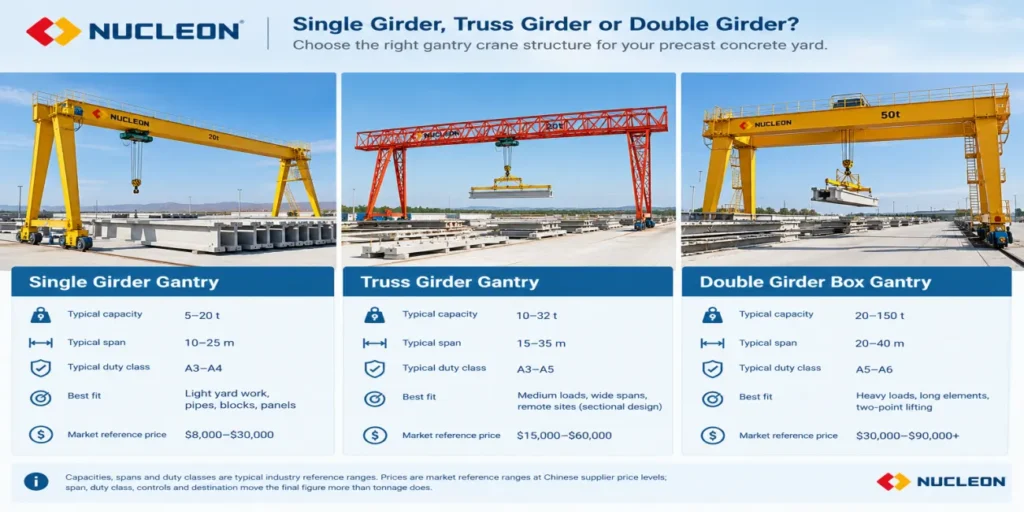
Choose single girder or truss designs for lighter, lower-frequency yard work, and move to double girder box designs once loads or duty rise.
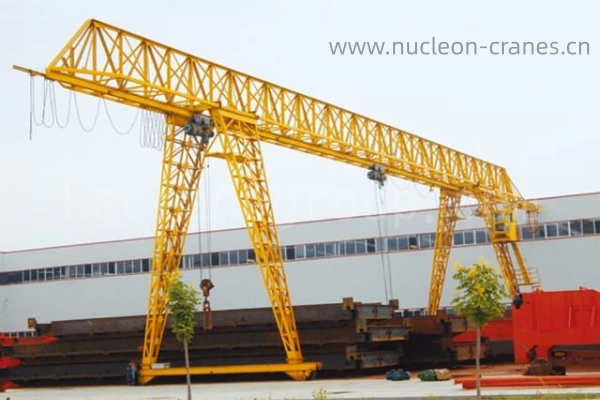
The reason is structural. A box girder pair is stiffer and carries the trolley on top rails, which gives more hook height for the same leg height and allows twin trolleys for two-point lifting. A single girder gantry is lighter and cheaper, but its capacity commonly tops out around 20–32 t in supplier catalogues, so heavier elements push you to double girder anyway. Truss girders sit in between: a lattice presents less wind area and weighs less over wide spans, and the girder can be built in sections for transport, but welded joints are more fatigue-sensitive, which makes truss designs a better match for A3–A5 yard work than for near-continuous heavy cycling. Our truss gantry crane guide и Анализ конструкции козлового крана go deeper on how each structure carries load.
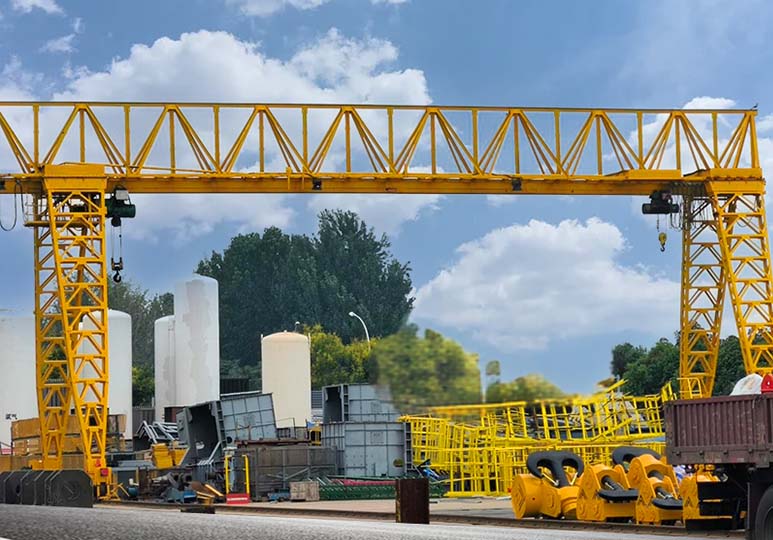
Nucleon supplied 20-ton truss girder gantry cranes to a precast concrete beam yard in Chile. The yard has no building to hang a runway from, so the cranes run on ground rails; several cranes of different spans work side by side, so separate production and storage bays can operate at the same time. The truss girders were built in sections, trucked for export and assembled on site, which is the practical reason many remote yards choose truss over box girders. For a view of the single girder range, see our single girder gantry cranes и MH box type single girder gantry crane.
Rail-mounted gantry, RTG or straddle carrier?
A rail-mounted gantry suits fixed storage rows; a rubber-tyred gantry or straddle carrier suits yards that need flexible routing and cannot justify rail foundations.
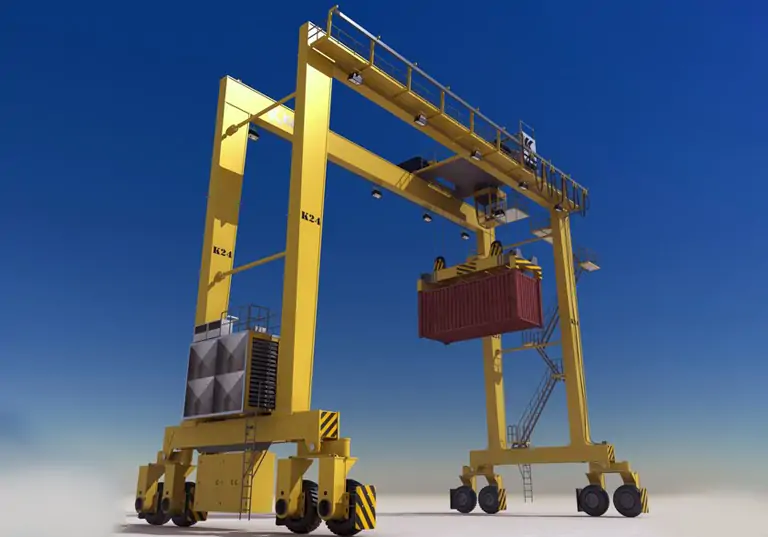
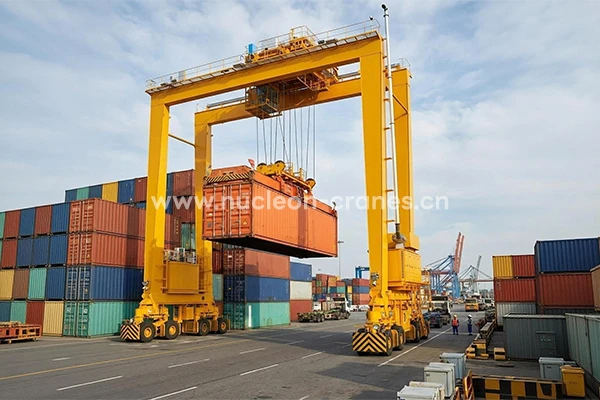
Rail-mounted cranes need continuous foundation beams for the rails, but they track straight, position more accurately and cost less to run. An RTG avoids the rail civil works and can move between bays, but it needs compacted or paved travel lanes, adds tyre and drive-system maintenance, and generally positions less precisely, so it fits storage and loading better than precision casting-line work; see our port crane and RTG range. A trackless straddle carrier goes a step further when lifting and long-distance transport must happen together. If the yard layout may change within a few years, flexibility can justify the higher price; if the layout is fixed and the same rows are served every day, rails almost always win on running cost.
One crane, two cranes or a semi-gantry?
Very long or very heavy elements can be lifted by two gantry cranes in tandem, or by one crane with two trolleys, instead of buying a single oversized crane.
A reported installation in Egypt used two 70 t double girder gantry cranes with a 32 m span to handle precast elements weighing up to 140 t and reaching 40 m long; the cranes can run independently or be linked synchronously (Stahl CraneSystems / International Crane Factory). Tandem lifting spreads the load and controls tilt, but it needs synchronised travel and hoisting, and the runway and each crane must be designed for uneven load sharing, not an assumed 50/50 split. A semi-gantry, with one leg on a ground rail and the other on an elevated runway along a building wall, is a useful third option when the casting bay and yard sit side by side and you want to avoid a second ground rail. For parallel bays, separate cranes per bay, as in the Chile yard above, mean one crane's maintenance does not stop the whole yard.
Capacity: Size for the Complete Lifting Package
Estimate the element weight, then add everything on the hook
Rated capacity must cover the element plus the spreader beam, slings and clamps, not the drawing weight alone.
Start with volume times density. Reinforced concrete is commonly taken as roughly 2.4–2.5 t/m³, so a wall panel 10 m long, 2.4 m high and 0.2 m thick (4.8 m³) weighs roughly 11.5 t; add a 1.5 t spreader beam and 0.3 t of slings and shackles and the lift is about 13.3 t, which points to the next standard rating up, typically 16 t or 20 t. As a heavier illustrative calculation, a 36 t box girder, a 2.5 t spreader beam and 0.5 t of rigging add up to 39 t before any margin. The next standard step is typically 40 t, only 1 t above the figure, so many buyers go one step higher, to 50 t, when the element weight has not been confirmed by weighing. The trade-off is real: each step adds structure, wheel loads and foundation demand, so if the weight is verified and the crane will rarely lift at its limit, a smaller step can be the better value. Some supplier guides suggest a 10–20% margin on top of the full lifting package; treat that as a starting point and let weight certainty and lift frequency decide.
Allow for stripping loads and moisture
Loads at demolding and in wet weather can exceed the calculated element weight.
Fresh elements can stick to moulds through adhesion and suction, and wet or freshly cured concrete carries absorbed water. Precast lifting design commonly adds a suction allowance based on contact area, and that calculation, together with the lifting anchors and the lifting layout, belongs to the precast element designer, not the crane supplier: anchor capacity depends on concrete strength at the time of lifting, edge distances and rigging angles. Tell your crane supplier the lift points and angles you use. A gantry crane should not be used to break a stuck mould free, because that load is unpredictable and is how overload limiters trip or structures are shock-loaded. Confirm weights from your own production records, set the overload limiter for the actual lifting package, and plan a mould-release method that does not rely on the crane.
Match the hoisting arrangement and lifting devices to the element
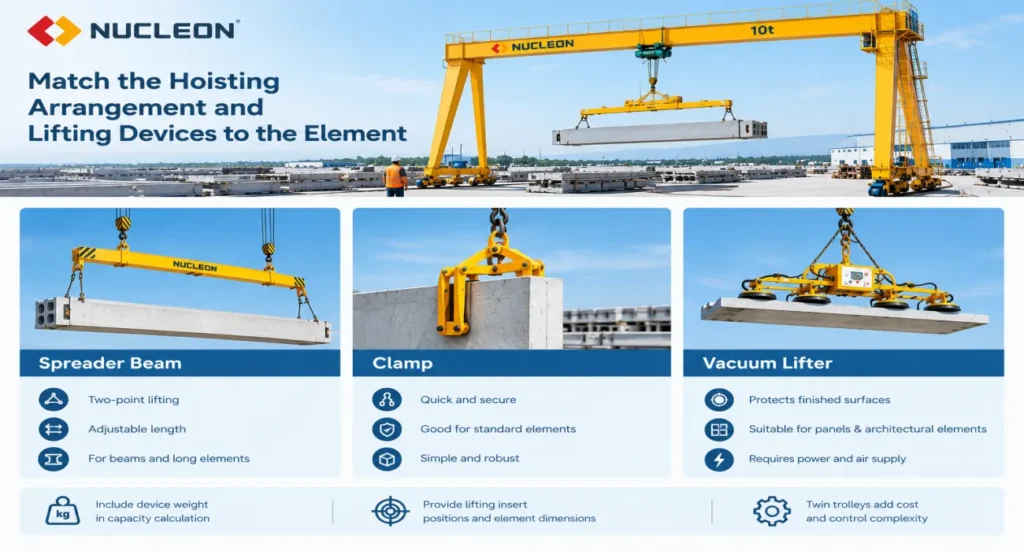
Long, asymmetric or fragile elements need two-point lifting, through twin hoists or a spreader beam, not a single hook.
Two-point lifting spreads stress across the lifting inserts and reduces the tilting and twisting that can crack precast elements. The spreader is as important as the crane: adjustable spreaders let one crane serve several element lengths, clamps suit beams and columns where surface contact is acceptable, and vacuum lifters protect finished architectural faces. Every device adds weight to the capacity calculation above, so a modular spreader system can be a better buy than several single-purpose ones. Twin trolleys add cost and control complexity but remove the spreader. For placing accuracy, ask for variable-frequency drives with a micro-speed range on hoist and travel, and consider anti-sway control for long elements in wind. Give the supplier the lifting insert positions and element dimensions, not just the weight.
Span and Lifting Height: Size for Storage Rows, Not Yard Width
Calculate span from rows, aisles and the truck lane
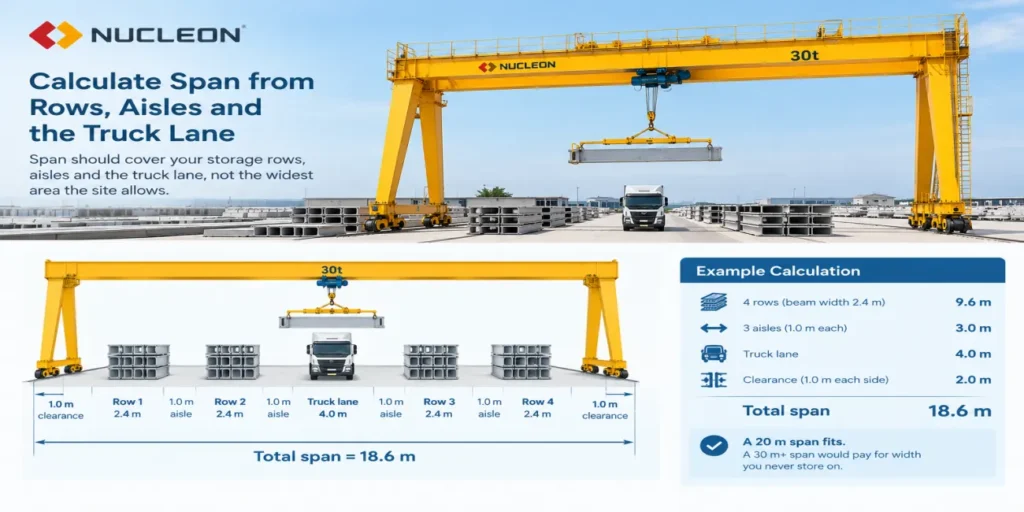
Span should cover your storage rows, the aisles between them and the truck lane, not the widest area the site allows.
Most precast yards store elements in a handful of parallel rows (commonly three to five), and every extra metre of span adds structural steel, deflection control and foundation demand faster than it adds useful coverage. As an illustrative calculation, with beams 2.4 m wide stored in four rows: four rows take 9.6 m, three 1.0 m aisles add 3.0 m, a 4.0 m truck lane brings it to 16.6 m, and about 1.0 m of clearance between each leg and the outer row adds 2.0 m, giving 18.6 m. A 20 m span fits; a "cover the whole yard" request at 30 m or more would pay for width you never store on. One condition changes the arithmetic: if long elements are stored across the rails rather than along them, the span must also exceed the element length, while storing them along the rails shifts the demand to rail length. Rail length should cover production, storage and loading zones and no more, since longer rails cost more in foundations and rail.
Use a cantilever if trucks load outside the legs
A cantilever lets the hook reach beyond the rail so trucks load alongside the crane instead of driving underneath it.
That keeps vehicles out from under the legs and shortens reversing in the loading zone. Specify the cantilever length from the actual truck position, and confirm the rated capacity and deflection at the cantilever tip, not only mid-span, because the structure is loaded differently there. A cantilever adds steel and is worth it where loading is frequent; for yards that load only occasionally, a truck lane inside the span is often cheaper.
Separate lifting height from clearance under the girder
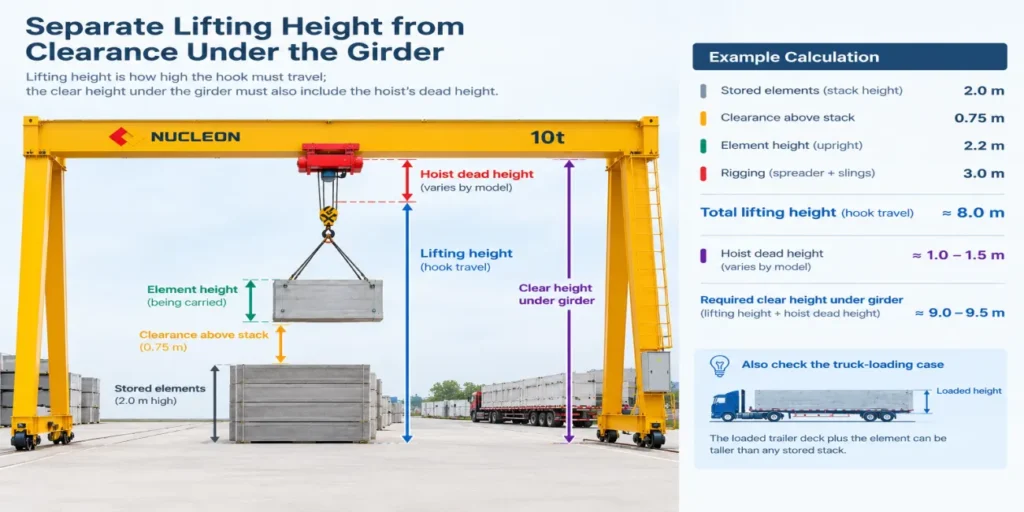
Lifting height is how high the hook must travel; the clear height under the girder must also include the hoist's dead height.
Lifting height is the stack top plus clearance, plus the height of the element being carried, plus the rigging below the hook. As an illustrative calculation: stored elements 2.0 m high, 0.75 m clearance above them, a 2.2 m element carried upright and 3.0 m of spreader and slings give about 8 m of hook height. The girder underside must then sit above that by the hoist's dead height (the distance from hook to girder at its highest position), which varies by hoist model, so ask the supplier for it in writing. Check the truck-loading case as well: a loaded trailer deck plus the element can be taller than any stored stack. Mixing up lifting height and clear height is a common quoting gap, and each extra metre of leg height adds steel and wind area.
Planning a yard layout? Send your row count, element dimensions and truck lane position, and our engineers will suggest a span and height. Свяжитесь с Nucleon
Duty Class and Outdoor Specification for Precast Yards
Set duty class from lifts per shift and load spectrum
Duty class follows how often, and how close to rated load, the crane works, not its tonnage; most production yards land at A5.
ISO 4301-1 and FEM 1.001 classify cranes (A1–A8) and mechanisms (M1–M8) by cycles and load spectrum together, so a 20 t crane lifting near-full beams on two shifts needs more than a 40 t crane that moves a few elements a day. Older FEM group names such as 2m and 3m map approximately to A5 and A6, so confirm which system a quotation uses before comparing. Supplier guidance for precast production yards commonly clusters around A5–A6, and the design loads behind the structure are set under the ISO 8686 series, so ask which version applies.
| Operating profile | Typical duty class (crane / mechanisms) | What it means |
| Standby or occasional stocking, a few lifts a day | A3–A4 / M3–M4 | Light yard, low cycle count |
| Daily yard transfer and truck loading, one shift | A5 / M5 | Most common production-yard choice |
| Casting-line support, two shifts, or frequent near-rated lifts | A6 / M6 | Heavier fatigue and thermal load on structure, gearboxes and brakes |
Write the lifts per shift and average load into your inquiry, then ask the supplier to confirm the class in writing for the crane structure and the mechanisms separately. Choosing a lighter class to save on the quotation is the most common way to buy a crane that wears out early, since gearboxes and brakes carry the penalty; see our crane gearbox selection guide for how duty affects the drive train.
Specify for wind, dust and ground
Outdoor precast yards need wind protection, dust sealing and a rail foundation designed for the crane's actual wheel loads.
Wind is the governing outdoor condition for a gantry: rail clamps or storm anchors, an anemometer and a defined out-of-service wind speed should be in the specification, and trolleys and electrical boxes benefit from rain covers. Concrete dust is fine and abrasive, so motors, brakes and control cabinets should have sealing suited to it (IP55 is a common reference rating), and the paint system should suit a wet, alkaline environment; confirm both in writing. Ground matters just as much: uneven settlement of a yard rail foundation causes skewing and wheel-flange wear that no maintenance schedule fixes, so give the supplier's wheel-load data to your civil engineer before the foundation is designed, and see our end truck and wheel maintenance guide for how misalignment shows up in service.
What to Confirm Before You Request Quotes
Send the same inputs to every supplier
A complete inquiry lets every supplier quote the same crane, which makes quotes comparable.
Include these items with every request:
- Element list: weight, length × width × height and lifting insert positions for the heaviest and the most common elements
- Below-hook equipment: spreader beam, clamps, vacuum lifter or lifting frame, with weights
- Yard layout: number of storage rows, stack layers, truck lane position and rail length
- Span and lifting height you have calculated, or the layout so the supplier can propose them
- Lifts per shift, shifts per day and average load as a share of rated load
- Site conditions: wind zone, ground and foundation plan, power supply voltage and frequency, temperature range
- Control preference: cabin, wireless remote or both, plus tandem or twin-trolley needs
- Destination, certification needs and trade terms
For more on how gantry cranes are classified and built, see our gantry crane guide.
Compare scope and certification, not just price
Two quotes for the same tonnage can differ widely in what they include, so compare scope line by line before comparing totals.
Check whether spreader beams, rails and anchor parts, cabin or remote control, installation supervision, load testing, freight and spare parts are included or excluded, and who is responsible for the foundation, power supply and local acceptance. Check the design basis, which for gantry cranes commonly references ISO 4301-1, FEM 1.001, EN 13001 or GB/T 3811 and GB/T 14406; ask for the standard numbers on the quotation, not clause numbers you cannot verify. For EU delivery, ask for the EC Declaration of Conformity under the Machinery Directive 2006/42/EC, and check which version of the machinery rules applies on your delivery date, since the directive is due to be replaced by Regulation (EU) 2023/1230. Request the manufacturer's ISO 9001 certificate and a load-test certificate too. Our gantry crane price guide и truss gantry crane price guide explain what moves price.
Заключение
A precast concrete gantry crane is right-sized when capacity covers the full lifting package, span covers your real storage rows and truck lane, and duty class matches lifts per shift. Specify those three things, plus lifting height and wind and ground conditions, and your quotes become comparable. Start by listing your elements and layout, then ask suppliers to confirm duty class and below-hook allowances in writing.
Ready to size a precast concrete gantry crane for your yard? Send your element list, yard layout and shift pattern, and our engineering team will return a recommended configuration with a market reference price.

Специалист по оборудованию
Успешный менеджер по работе с кранами с обширным опытом в управлении крупномасштабными проектами и операционным контролем. Подтвержденный опыт увеличения доходов и обеспечения соблюдения требований безопасности.
Часто задаваемые вопросы
Q1: How much capacity does a precast concrete gantry crane need?
Rated capacity must exceed the element weight plus every below-hook device. A 36 t girder with a 2.5 t spreader beam and 0.5 t of rigging needs 39 t before any margin, so most buyers round up to the next standard rating. Weight certainty and lift frequency decide how much extra margin is justified. Confirm the final rating with your supplier's engineer.
Q2: What span should a precast yard gantry crane have?
Span should match storage rows plus aisles, truck lane and leg clearance. Four rows of 2.4 m-wide beams, three 1 m aisles, a 4 m truck lane and 1 m of leg clearance each side total about 18.6 m, so a 20 m span would fit. If elements are stored across the rails rather than along them, the span must also exceed the element length.
Q3: What duty class does a precast concrete gantry crane need?
Most production yards specify duty class A5, moving to A6 for two shifts or frequent near-rated lifts. Class depends on lifts per shift and how close to rated load the crane works. Light stocking yards with only a few lifts a day may justify A3–A4. State the class in writing for crane structure and mechanisms.
Q4: How much does a precast concrete gantry crane cost?
Market reference prices run from about $8,000 to $90,000 for most yard gantry cranes up to 50 t. Heavy or tandem systems start around $100,000. Span, duty class, controls and cantilevers move the price more than tonnage alone. Rails, foundations, installation and freight are often separate, so compare scope item by item.
Q5: Who designs the lifting points on a precast element?
The precast element designer does. Anchor capacity depends on concrete strength at the time of lifting, edge distances and the rigging arrangement. Give your crane supplier the lift points, angles and loads so the crane and spreader suit them. The crane supplier sizes the crane; it does not verify the anchors cast into your elements.
Связанные статьи
- What Is a Gantry Crane? Parts, Types, Price & Maintenance Guide (what-is-a-gantry-crane)
- What Is a Truss Gantry Crane? (what-is-a-truss-gantry-crane)
- Gantry Crane Price Guide (gantry-crane-price)
- 20-Ton Truss Girder Gantry Cranes Exported to a Precast Concrete Beam Yard in Chile (case)

 English
 العربية
 Español
 Français
 Português
 Русский