A winch and a hoist are both drum-and-wire-rope lifting drives, but they are built for different jobs: a winch is an open-frame, custom-integrated drive typically rated under ASME B30.7, while an electric wire rope hoist is a self-contained, bolt-on lifting unit typically rated under ASME B30.16. Both can move heavy loads — that's exactly why the distinction gets missed.
If you're specifying a lifting drive for an overhead crane, gantry crane, or port/shipyard structure, "which one lifts more" is the wrong question. The real question is whether the equipment is engineered to hold, control, and repeatedly lower your load at your actual duty cycle — not just move it once on a test bench.
This guide breaks down the mechanical differences that actually drive the decision, gives you a selection framework based on capacity, duty class, and lift height, and walks through the three procurement mistakes that most often lead to a wrongly specified crane.
Оглавление
What Is a Crane Winch, and What Is an Electric Wire Rope Hoist?
Crane Winch: An Open-Frame, Custom-Integrated Drive
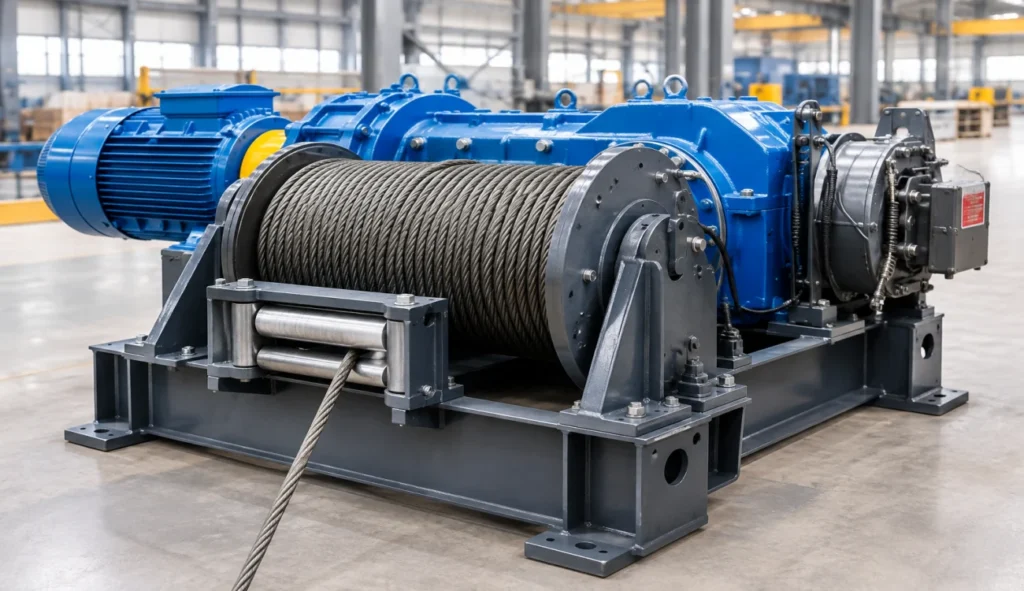
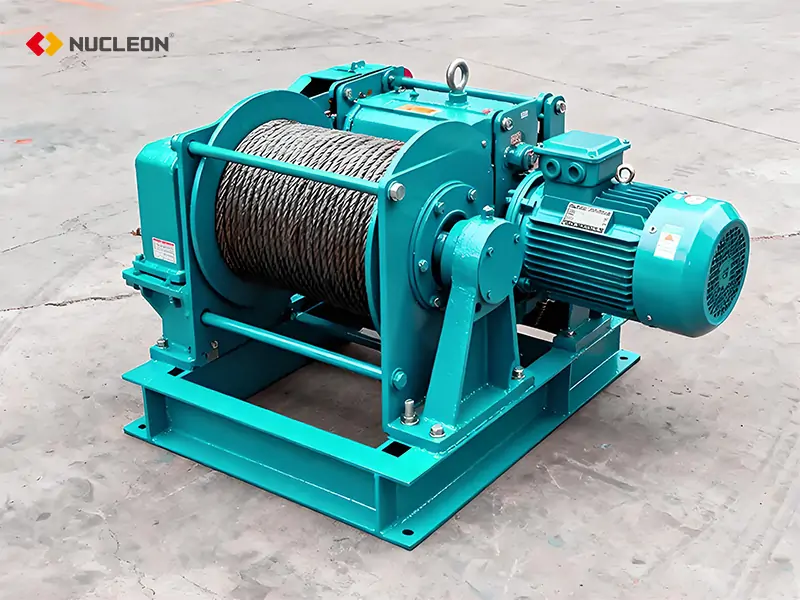
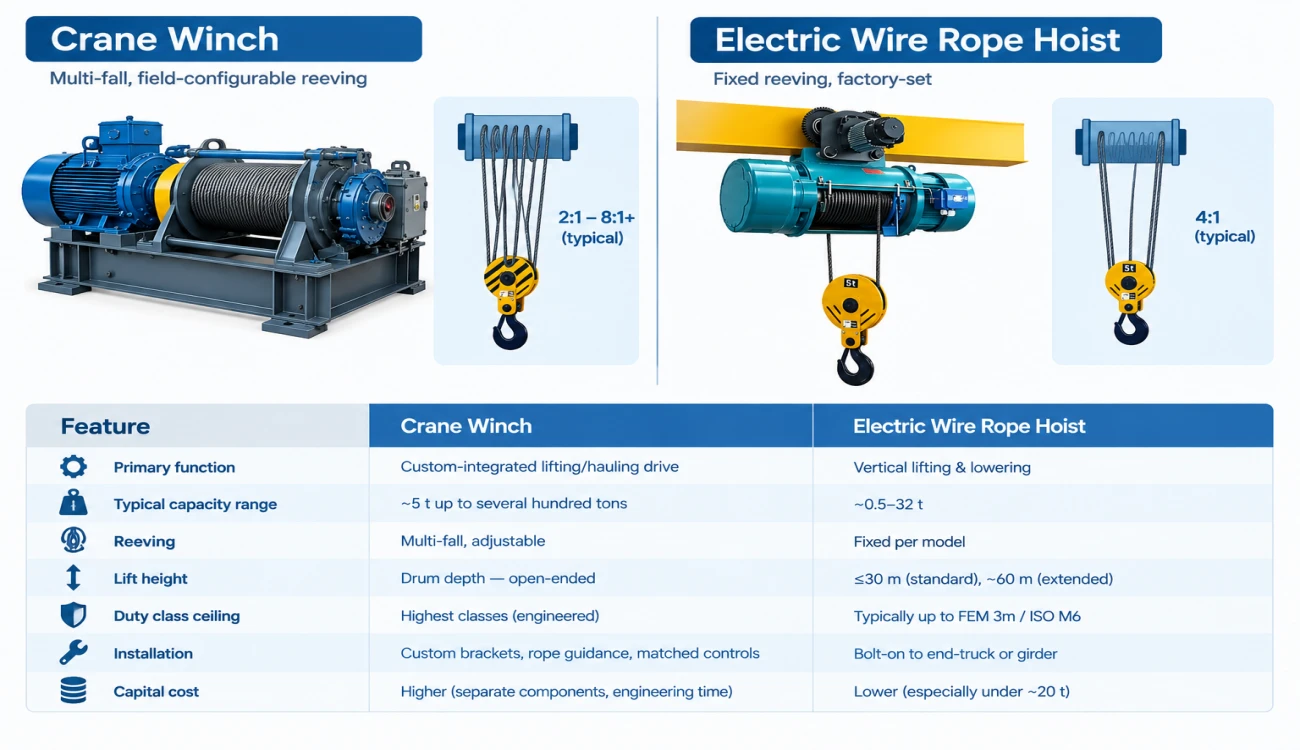
A crane winch is an open-architecture drive system — motor, gearbox, drum, and brake are selected and assembled separately, then integrated into the crane structure by the OEM. This is why winches show up on shipyard cranes, container cranes, and heavy metallurgical cranes: the drum and reeving can be engineered around a specific job rather than pulled from a fixed catalog.
Because each component is sourced and matched individually, a winch's drum can typically be configured for a 2:1, 4:1, or higher reeving ratio, and its rated capacity commonly spans a wide range — from a few tons on light industrial builds up to several hundred tons on marine and port machinery, depending on the manufacturer's product line. That configurability is the core advantage, and the trade-off is integration: a winch needs engineered mounting brackets, a rope-guidance system, and a matched control panel. It is not a plug-and-play component.
Электрическая канатная таль: A Self-Contained, Bolt-On Unit
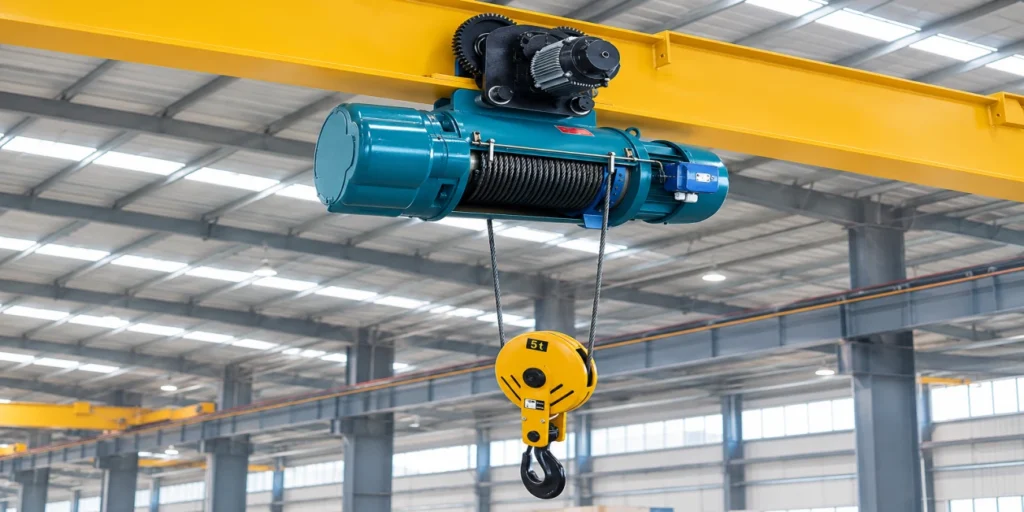
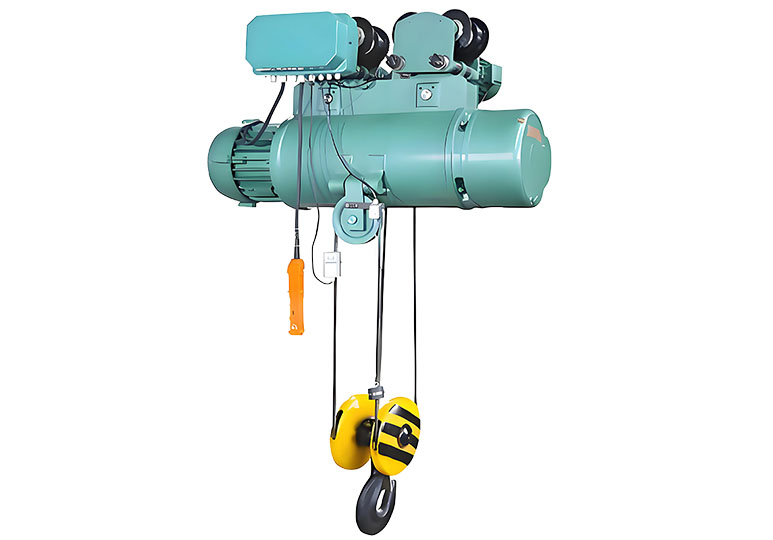
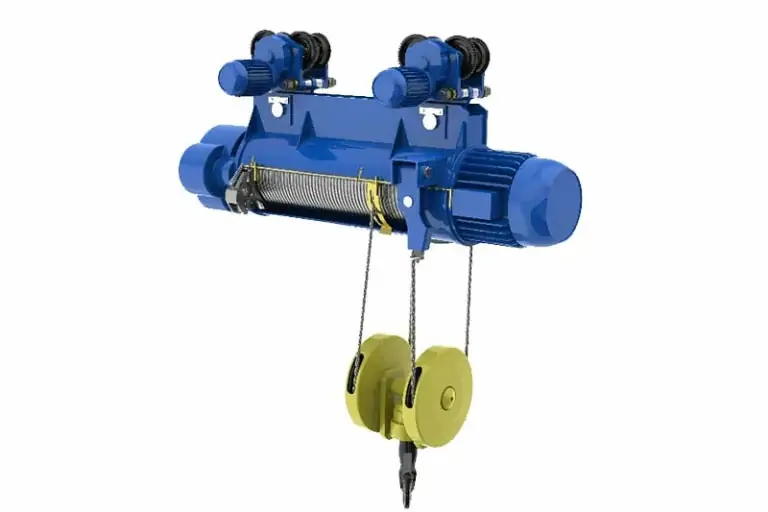
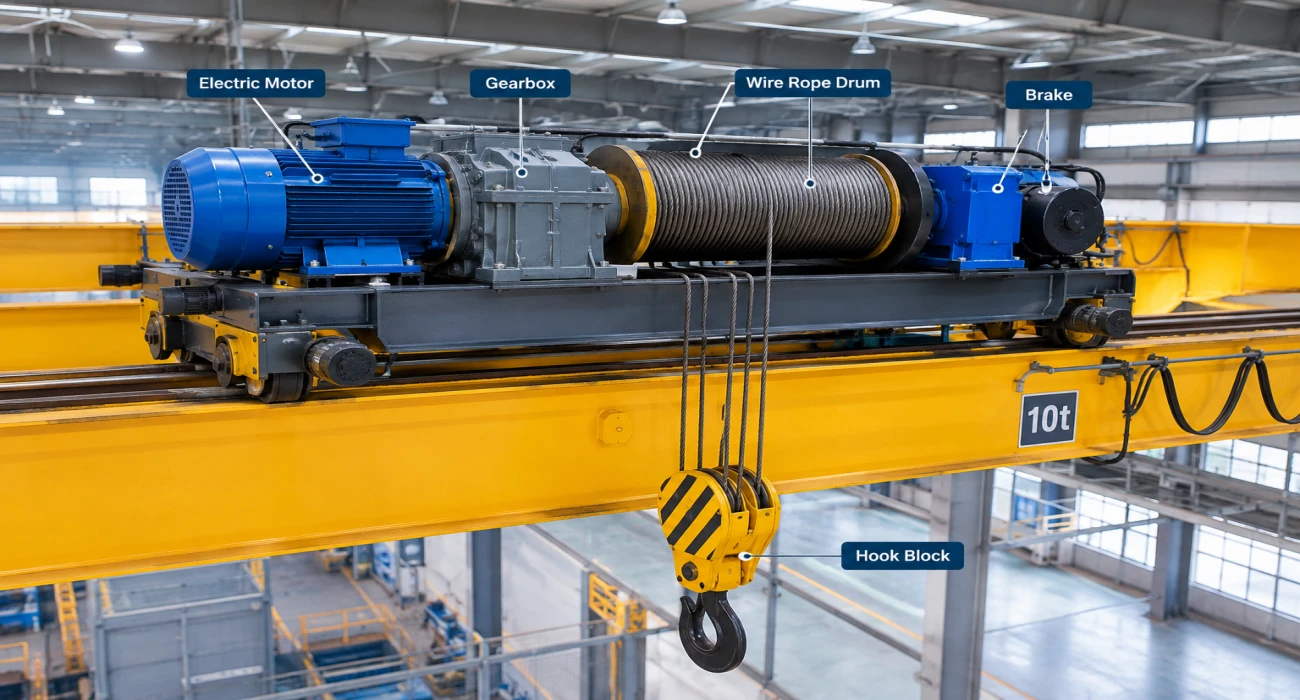
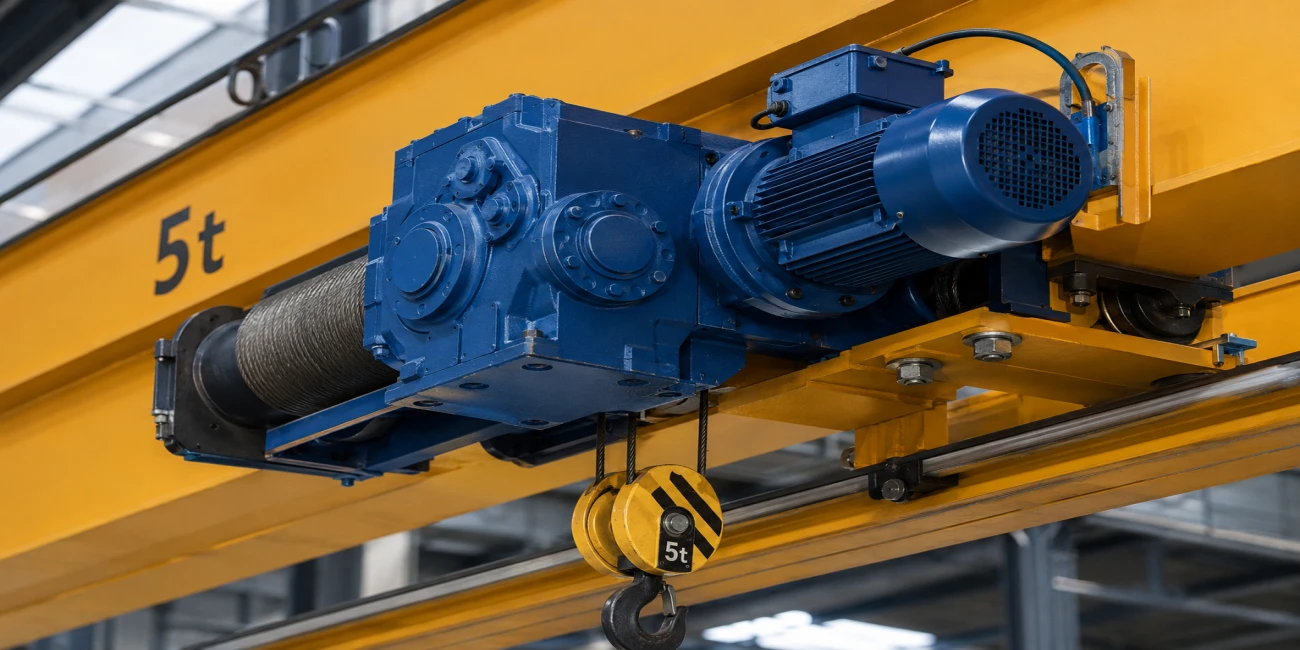
An electric wire rope hoist is a fully assembled, factory-tested unit — motor, gearbox, drum, rope guide, and hook in one housing — designed to bolt directly onto a crane's end-truck or bridge girder. Commercially available hoists commonly cover roughly 0.5–32 tons of capacity and lifting heights up to around 30 m as standard, with extended-drum models available for greater height at a cost premium.
Installation and commissioning take a fraction of the time a winch integration requires, which is exactly why hoists are the default lifting drive for manufacturing, warehousing, and general-purpose overhead cranes. Their limitation isn't lifting capacity — it's configuration flexibility (fixed reeving, catalog-defined height) and the duty-class ceiling of the standard product range.
Why "Both Can Lift Heavy Loads" Is the Wrong Starting Question
The genuinely useful comparison isn't lifting capability — it's brake design, reeving flexibility, and duty rating, because those three things determine whether the equipment survives your actual operating pattern. A machine engineered to pull a load horizontally along the ground under intermittent, ground-supported conditions is not automatically safe to suspend that same load freely in the air — the load-holding requirement is a different engineering problem, even when the drum and motor look similar on paper.
Winch vs Hoist: The Engineering Differences That Actually Decide Selection
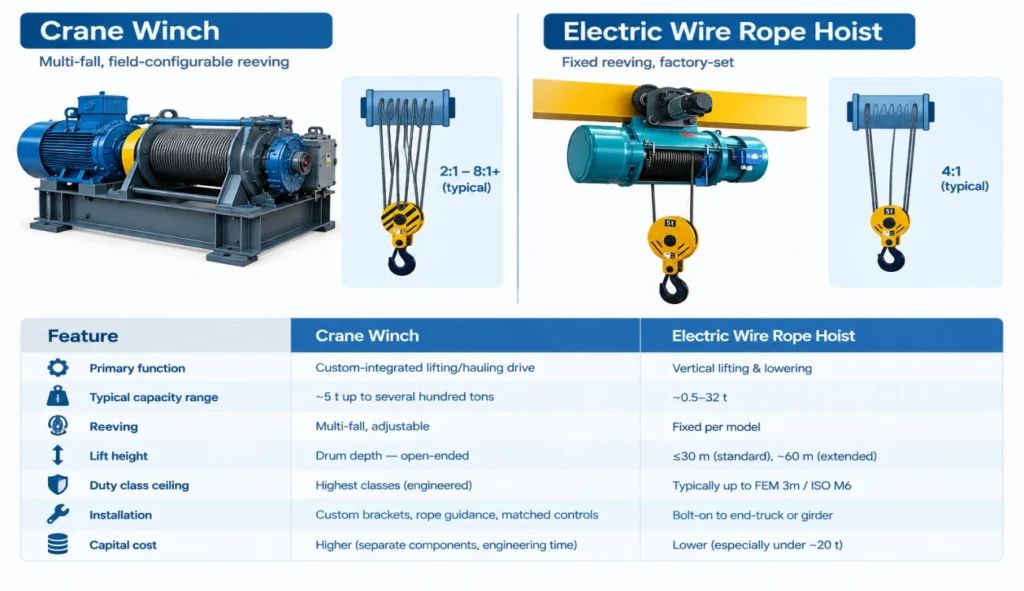
| Параметр | Crane Winch | Электрическая канатная таль |
| Primary function | Custom-integrated lifting/hauling drive | Vertical lifting and lowering of a freely suspended load |
| Typical capacity range | ~5 t up to several hundred tons (varies by manufacturer) | ~0.5–32 t as a standard catalog range |
| Reeving | Multi-fall, field-configurable (2:1 up to 8:1 or higher) | Fixed per model, set at the factory |
| Высота подъема | Governed by drum depth — effectively open-ended | Typically ≤30 m standard, ~60 m on extended-drum models |
| Duty class ceiling | Can be engineered to the highest classes | Standard catalog units typically top out around FEM 3m / ISO M6 |
| Installation | Custom brackets, rope guidance, matched controls | Bolts to end-truck or girder; short commissioning time |
| Capital cost | Higher — separate components, engineering time | Lower at equivalent capacity, especially under ~20 t |
Duty Class Overrides Capacity
Rated capacity only confirms a single lift is possible; duty class confirms the equipment survives the number of lifts per shift, per year, for its full service life — and that's the number that actually drives winch-vs-hoist selection. Под FEM 1.001 / ISO 4301-1, hoisting mechanisms are grouped from M1 (light, infrequent use) up to M8 (continuous heavy duty), based on load spectrum and operating hours — not on maximum tonnage. Buyers working to North American practice will see the same idea expressed through ASME B30.16 (hoists) and B30.7 (winches) alongside CMAA duty classifications (typically A–F for crane service), which follow the same principle even though the letter/number scheme is different.
A 10-ton wire rope hoist rated at FEM 3m/ISO M6, for example, is typically designed around a multi-thousand-hour service life at a given load spectrum — but a steel-mill charging crane running three shifts at high utilization can need an M8-class rating that simply isn't in most standard hoist catalogs. Specify by tonnage and price alone, and the failure mode is predictable: burned-out motor windings or gearbox and brake wear well inside the first maintenance interval, not because the hoist was underrated for the load, but because it was underrated for the cycle.
Brake Design and Load-Holding Safety
A winch and a hoist are not interchangeable at the brake level, and this is the safety distinction that gets skipped when the comparison stays at "which one lifts more." Many pulling-type winches (particularly ground-hauling designs) use a freespool clutch so the drum can pay out line freely — useful for horizontal recovery work, but a design that is not built to hold a freely suspended load if the clutch were to disengage. Equipment engineered and certified for vertical lifting — whether a crane winch or a wire rope hoist — instead uses a bi-directional load-holding brake designed specifically to control a suspended load, including on power loss.
This is exactly why "it's mechanically strong enough to lift the load" is not the same claim as "it is rated and certified to lift this load." The certification, not the raw pulling force, is what should end the debate.
Reeving Flexibility and Lift Height
A winch's reeving can be reconfigured on the same drive if load or geometry changes; a hoist's reeving is fixed at the factory, which is fine until your application's load range genuinely varies. On a shipyard gantry crane lifting both light outfitting components and heavy hull sections, a winch's rope-ratio flexibility has real operational value a hoist can't match. On a production crane with a consistent, predictable load, that same flexibility is a feature you're paying for and not using.
Lift height follows a similar logic: a hoist's drum depth caps its practical height (commonly ~30 m standard, ~60 m with an extended drum, at a cost premium), while a winch's open-frame drum design has no comparable catalog ceiling — which is why port, shipyard, and tower-crane applications above roughly 60 m of lift almost always specify a winch.
Price and Total Installed Cost
A wire rope hoist typically has a lower sticker price at equivalent capacity, especially under ~20 tons — but "cheaper hoist" and "cheaper installed system" are not the same number. As a market reference, standard European-style wire rope hoists in the 1–20 ton range are typically priced in the low-thousands to around $2,000–$10,000 depending on lifting height, speed, and duty class, while a comparable-capacity crane winch — once motor, gearbox, drum, brake, rope guidance, mounting structure, and controls are engineered and integrated — typically starts at several times that figure, largely because of the custom engineering and integration labor rather than the raw components.
The number that should decide the purchase isn't either sticker price — it's installed cost plus expected maintenance and downtime risk over the equipment's service life, which is where an underrated hoist quietly loses its apparent price advantage.
How to Choose Between a Winch and a Hoist for Your Crane
Match Duty Class to Your Actual Operating Cycle, Not Just Tonnage
Before comparing quotes, work out your real numbers: rated load, lift height, cycles per hour, hours per day, and load spectrum coefficient. That combination — not the tonnage on its own — is what determines the required FEM/ISO M-class or CMAA duty class, and that duty class is what should be compared across supplier quotes, not just the headline capacity.
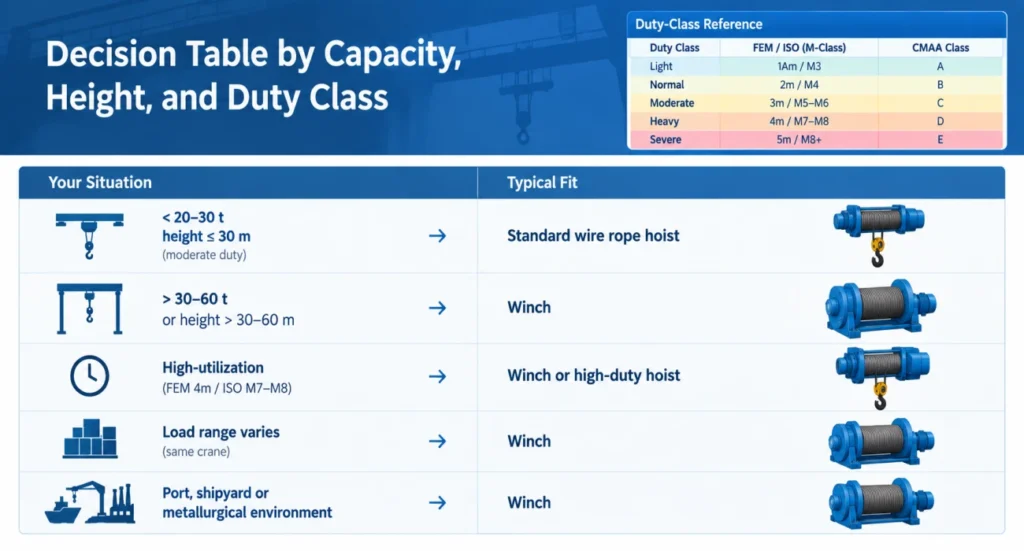
Decision Table by Capacity, Height, and Duty Class
| Your Situation | Typical Fit |
| Under ~20–30 t, height ≤30 m, moderate duty (up to FEM 3m/ISO M6) | Standard wire rope hoist — shorter lead time, lower capital cost |
| Over ~30–60 t+, or lift height beyond ~30–60 m | Winch territory for most manufacturers, though the exact crossover varies by catalog |
| High-utilization, multi-shift duty (FEM 4m/ISO M7–M8) at any tonnage | Winch, or a special-order high-duty hoist if your supplier offers one |
| Load range varies significantly between jobs on the same crane | Winch, for reeving flexibility |
| Port, shipyard, or metallurgical process-duty environment | Winch, as the standard equipment type in this segment |
Treat the capacity and height numbers above as reference ranges, not fixed physics. Published crossover points differ meaningfully by manufacturer — some suppliers' catalogs place the winch threshold around 30–35 tons, others extend standard hoist product lines well past 60–80 tons before recommending a winch. Ask any supplier for their specific duty-class and capacity chart rather than assuming a number you read on one manufacturer's page applies to another's product line.
When a Hybrid Main + Auxiliary Setup Makes Sense
On some cranes, a winch handles the highest-capacity, least-frequent lifts while a smaller, faster wire rope hoist handles routine daily lifting as an auxiliary — and doubles as a backup if the main drive needs service. This configuration is common on heavier process-duty cranes where occasional maximum-capacity lifts and frequent lighter lifts coexist on the same structure.
Common Procurement Mistakes When Choosing Between Winch and Hoist
Mistake 1: Assuming Lifting Capability Means Hoist-Rated Safety
Seeing that a piece of equipment can generate enough rope pull to move your load is not the same as confirming it is certified for suspended, freely-hanging operation. Brake holding capability, load-lowering control, and rope reeving design for vertical service are the actual qualifying factors — not raw drum torque.
Mistake 2: Comparing Tonnage Without Comparing Duty Class
A 20-ton hoist and a 20-ton winch are not equivalent if their duty ratings differ. Downgrading duty class to win on price is the single most common selection error we see in crane specification requests, and it's also the one that costs the most in year-one maintenance — request the duty-class documentation before comparing headline prices.
Mistake 3: Comparing Sticker Price Instead of Total Installed Cost
The lower quote on paper often excludes the engineering, mounting structure, control integration, and — if the duty class was understated — the early motor, gearbox, or brake replacement that follows. Ask for total installed cost and expected maintenance interval, not just the equipment line-item price, before finalizing a decision.
Заключение
The real difference between a winch and a hoist isn't pulling versus lifting — it's how each is engineered to control, brake, and repeatedly move a load within its rated duty cycle. Start your selection from duty class and lift height, not tonnage and price, and confirm the brake and reeving design match how you'll actually operate the equipment day to day.
Need help matching a winch or wire rope hoist to your crane's real operating cycle? Send our engineering team your lifting capacity, lift height, duty class, and cycles per hour, and we'll help you confirm which lifting drive fits — and which specification questions to ask any supplier.

Специалист по оборудованию
Успешный менеджер по работе с кранами с обширным опытом в управлении крупномасштабными проектами и операционным контролем. Подтвержденный опыт увеличения доходов и обеспечения соблюдения требований безопасности.
Часто задаваемые вопросы
Q1: What is the main difference between a winch and a hoist?
A winch is an open-frame drive custom-integrated into a crane structure; a hoist is a self-contained, bolt-on unit. Both lift vertically when rated for it, but they differ in reeving flexibility, lift-height limits, and duty-class ceiling — not simply in lifting direction.
Q2: Can a winch be used as a hoist?
Only if it is specifically designed, braked, and certified for vertical, freely-suspended lifting. General-purpose pulling winches with a freespool clutch are not rated for this and should never be substituted for a certified vertical-lifting drive.
Q3: At what capacity should I switch from a hoist to a winch?
There's no single industry-wide number — published thresholds range from roughly 30 tons to over 80 tons depending on the manufacturer's product line. Duty class and lift height often force the switch to a winch before tonnage alone would.
Q4: Is a wire rope hoist cheaper than a winch?
Usually yes at the equipment line-item level, especially under 20 tons, because a hoist is a standardized factory unit. A winch's higher price reflects custom engineering and integration — compare total installed and maintenance cost, not sticker price alone.
Связанные статьи
- What Is a Crane Winch? Types, Structure & Selection Guide
- Grab Bucket for Overhead & Gantry Cranes: Types, Capacity & Price Guide
- Crane Gearbox/Reducer Selection Guide: How to Choose the Right Ratio, Torque and Duty Rating
- Crane End Truck & Wheel Maintenance Guide: Inspection, Wear, Alignment & Replacement
- Тросовая или цепная лебедка: какая прослужит дольше?

 English
  العربية
  Español
  Français
  Português
  Русский