

Ceiling cranes for sale range from $1,800 for a basic 1-ton workstation system to $60,000+ for a heavy-duty double-girder bridge crane at 20+ tons — but the equipment price is only part of what you'll actually spend. For overseas buyers sourcing from Chinese manufacturers, the total landed and commissioned cost typically runs 30–60% higher than the FOB crane price, once structural reinforcement, runway installation, local certification, and commissioning are factored in.
This guide is written for factory procurement managers and equipment engineers evaluating ceiling crane systems for the first time or comparing suppliers. It covers the four main ceiling crane types, how to read the price drivers, and — critically — the hidden cost categories that consistently catch first-time importers off guard.
If you've already read a technical overview of ceiling crane types, this is the commercial companion: the decisions that determine what you actually pay and whether the crane performs as expected after installation.
Índice
Quick-Reference: Ceiling Crane Types & Price Ranges
| Tipo | Capacidade Típica | Intervalo de abrangência | Market Price Range | Melhor para |
| Single-girder bridge crane | 0.5–20 t | 5–28 m | $4,000–$25,000 | General manufacturing, warehouses |
| Double-girder bridge crane | 5–100 t | 10–50+ m | $12,000–$60,000+ | Heavy industry, steel, mold shops |
| Monorail crane | 0.25–10 t | Fixed path | $1,800–$9,000 | Assembly lines, sequential flow |
| Workstation crane (KBK) | 0,1–2 t | 3–12 m | $1,800–$8,000 | Ergonomic stations, cleanrooms |
Prices reflect typical Chinese supplier market reference ranges for standard configurations. Final delivered cost depends on span, duty class, hoist selection, and local installation scope — see the hidden costs section below.
Have your building drawings ready? Contact our engineering team for a free pre-quote structural check →
Understanding Ceiling Crane Types: Which Configuration Fits Your Facility?
Bridge Crane: The Workhorse for General Manufacturing
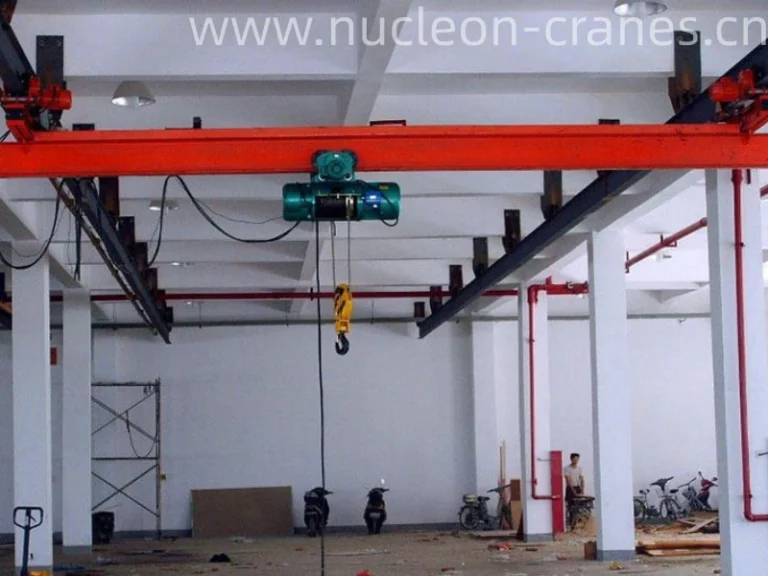
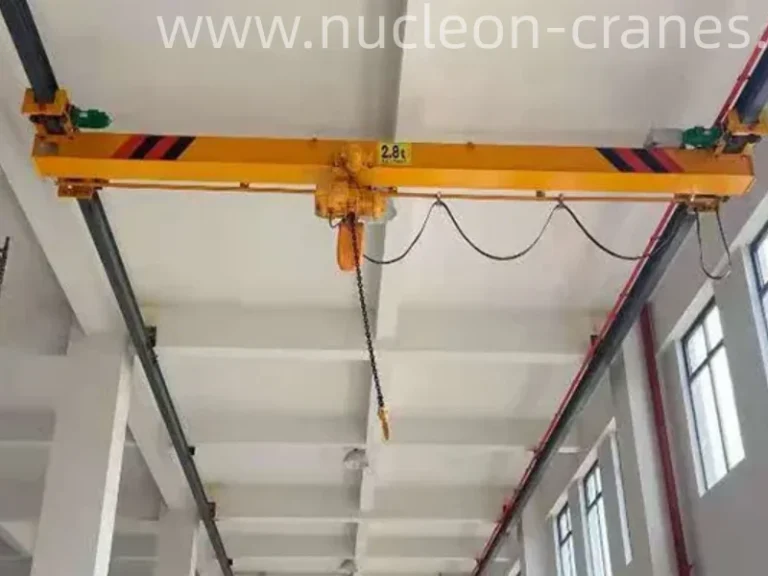
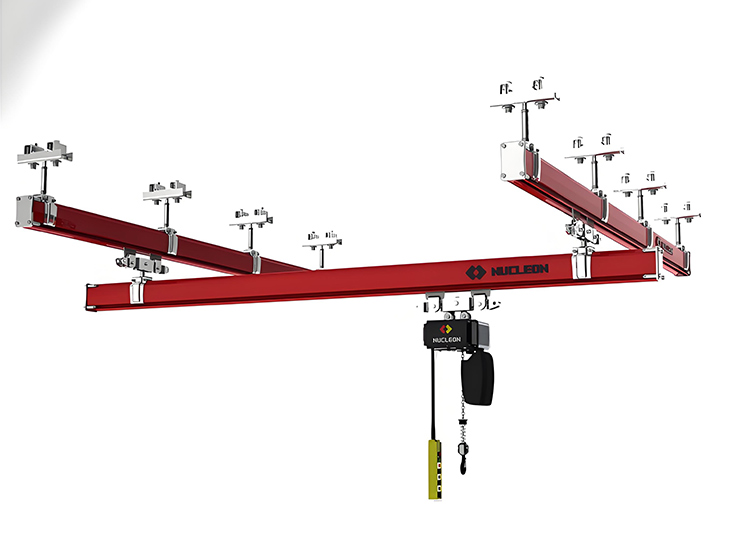
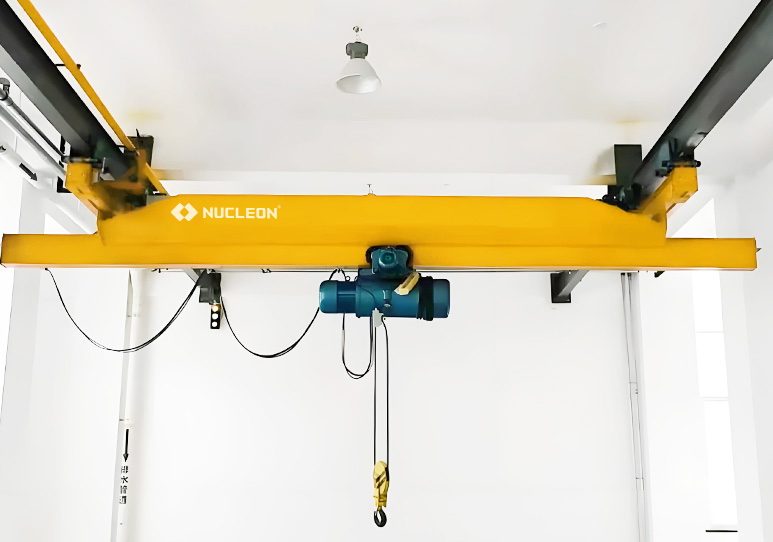
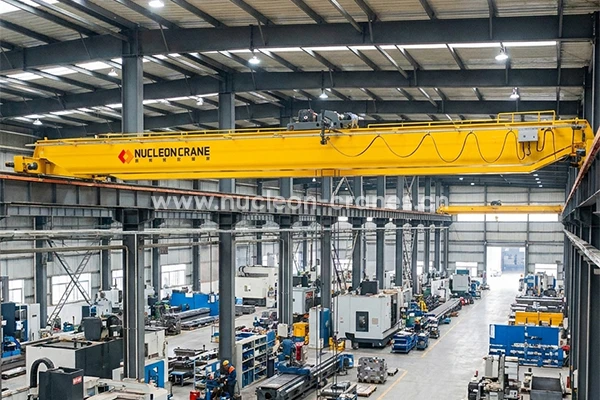
A single-girder ceiling-mounted bridge crane is the most cost-effective solution for loads up to 20 tons across spans under 28 m, and it covers the requirements of roughly 70% of general manufacturing and warehouse applications.
The hoist trolley runs on the bottom flange of the single girder, which reduces available hook height by approximately 300–500 mm compared to a top-running design. In most buildings with 7 m or more of clear height, this is not a constraint. Where it matters is in low-ceiling facilities or when lifting tall dies and molds — if your load plus rigging approaches the available hook height, you need a double-girder or top-running configuration instead.
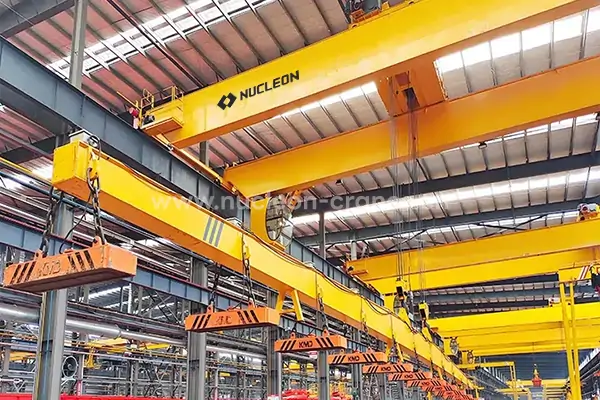
Double-girder bridge cranes become the correct choice above 20 tons, or when precise hook approach is critical (the trolley sits on top of the two girders, recovering that 300–500 mm). They cost roughly 2–3× more than an equivalent single-girder system, primarily due to the additional structural steel and the larger runway beams the heavier crane requires from the building structure.
Monorail Crane: Right for Fixed-Path Production, Wrong Everywhere Else
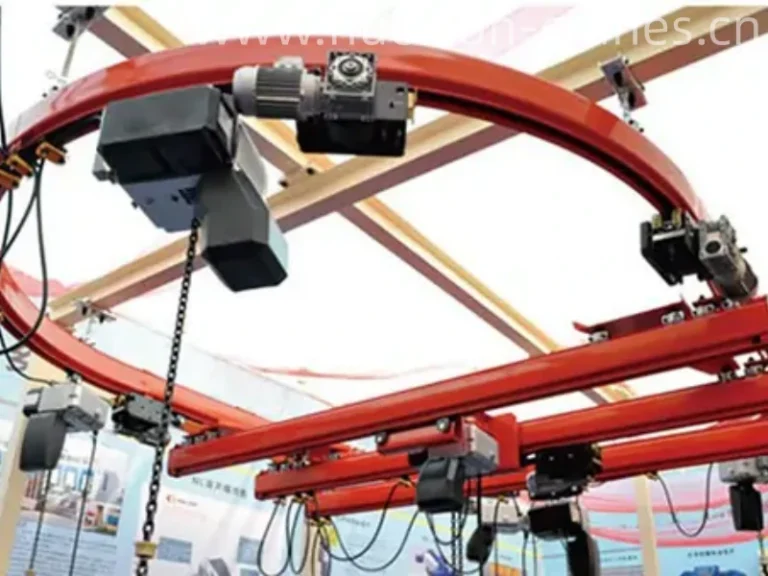
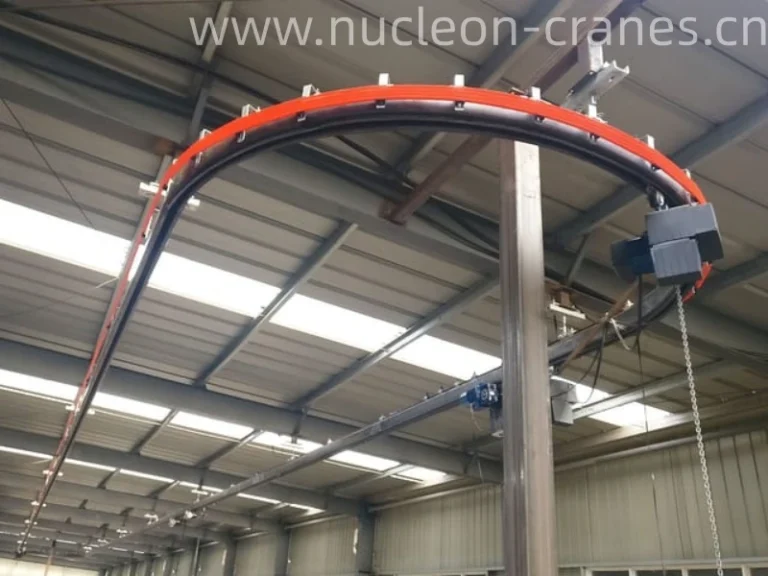
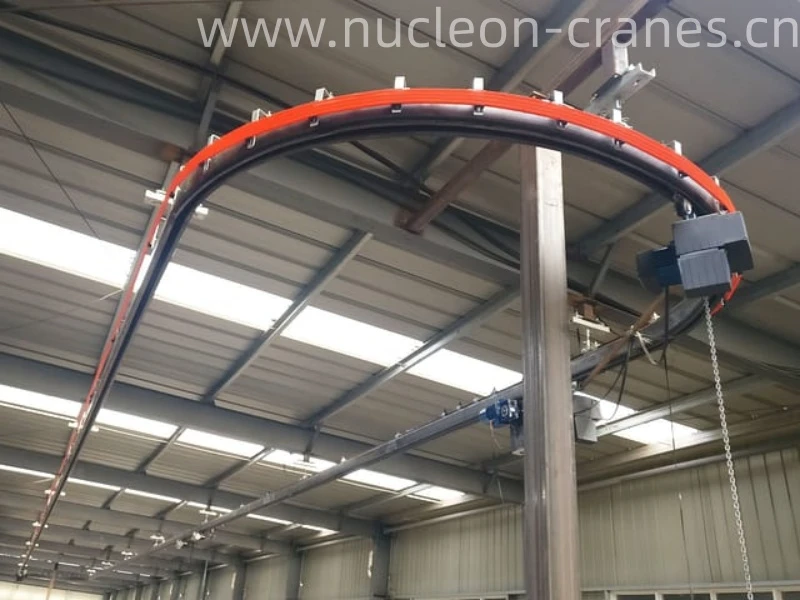
A ceiling-mounted monorail crane is the lowest-cost ceiling crane solution — and the most frequently over-specified one. Monorails excel when material always moves between the same two points: from a press to a conveyor, from a machining cell to an inspection table. The single track can follow straight lines, curves, and branches via switches, making them ideal for sequential assembly lines.
The constraint that buyers often overlook: a monorail crane gives zero lateral repositioning. If your pick-up or set-down points change even occasionally, the monorail becomes an obstacle rather than an asset. Most installations stay under 5 tons; enclosed-track heavy-duty monorail systems reach 10 tons under EN 14492-2, but beyond that, a bridge crane is almost always the better value.
Workstation Crane (KBK System): Ergonomics, Not Heavy Lifting
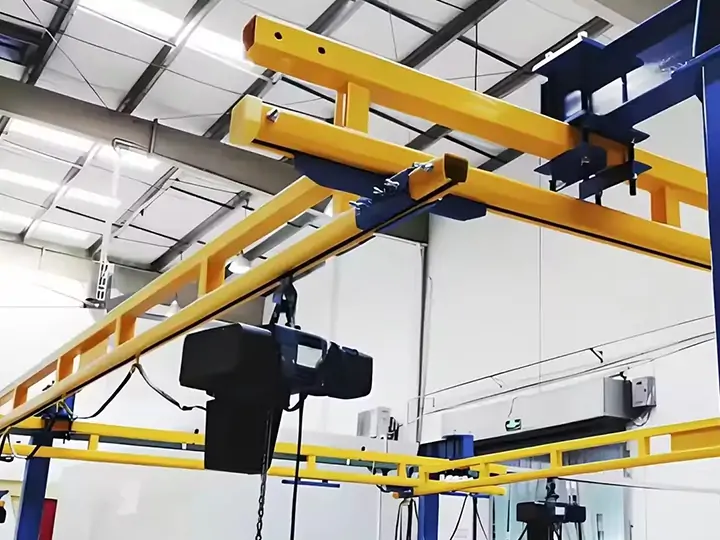
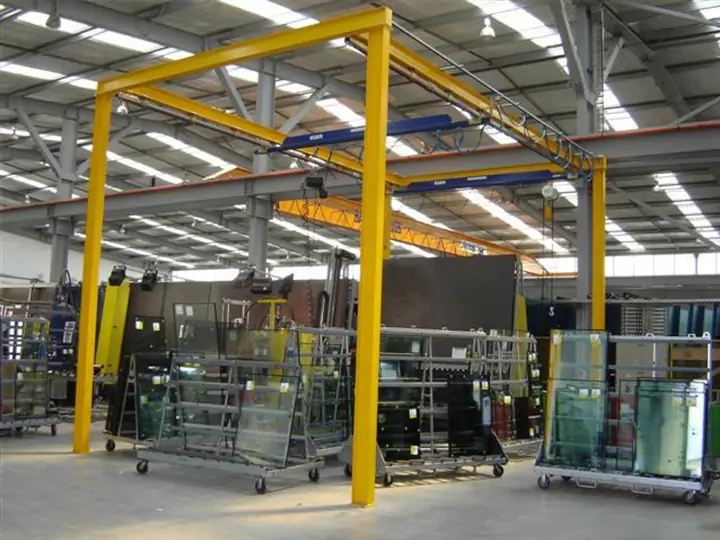
KBK (Kombiniertes Baukastensystem) workstation cranes use modular lightweight aluminum or steel rail suspended from the ceiling. The bridge and rails together typically weigh 8–15 kg/m, which means an operator can reposition loads with fingertip effort — the defining advantage for assembly and ergonomic applications.
Capacities run from 125 kg to 2,000 kg. At those weights, a KBK system is not competing with a bridge crane — it's replacing manual carrying and repetitive ergonomic stress. In facilities where workers lift 50–200 kg components dozens of times per shift, a KBK workstation system typically pays back its installed cost in reduced injury incidents and productivity losses within 12–24 months.
The ceiling-suspension design means KBK systems impose only vertical loads on the structure and are easier to reconfigure than runway-based bridge cranes — a key advantage in facilities where production layouts evolve.
The Three Price Drivers That Change Your Budget More Than Tonnage Does
Classe de serviço: a especificação que a maioria dos compradores ignora.
Duty class is the single most common source of premature crane failure in factory environments — and it's rarely discussed in supplier quotations unless the buyer explicitly asks.
FEM 1.001 defines eight duty classes (M1–M8) based on load spectrum and total lift cycles over the crane's design life. The structural members, brakes, motors, and hoist all scale with duty class. A 5-ton crane at M3 (light duty, ~63,000 total lift cycles) has substantially lighter components than a 5-ton crane at M5 (heavy duty, ~500,000 cycles). The M3 crane will typically be quoted at 20–35% lower cost.
The problem: if your operation runs two or three shifts with frequent lifts — say, a stamping line or a mold shop cycling every few minutes — the actual usage corresponds to M5 or M6. An M3 crane under M5 usage typically reaches structural fatigue in 3–5 years rather than the rated 15–20. At that point, the "savings" from the lower-spec crane are consumed several times over in emergency replacement, production downtime, and safety inspection costs.
The rule: estimate your annual lift cycles (lifts per shift × shifts per day × working days), then cross-reference against FEM 1.001 duty class tables. If your supplier doesn't ask for this information during the inquiry process, treat it as a red flag about their engineering depth.
Span: The Cost That Grows Nonlinearly
Every additional meter of bridge span increases girder weight nonlinearly — a 20 m span bridge can weigh 3–4× more than a 10 m span bridge of the same rated capacity. That weight increase cascades: heavier bridge means heavier runway beams, which means higher structural load on the building columns, which may trigger reinforcement costs.
FEM 1.001 limits bridge deflection under rated load to L/700 for general applications, which sets a practical floor on girder depth and weight for longer spans. Buyers comparing quotes across suppliers should verify that deflection limits are being respected — a quote with a suspiciously light bridge for a long span may be non-compliant.
Hoist Selection: Where Cheap Upfront Becomes Expensive Later
The hoist is the highest-wear component in a ceiling crane system and the one where cost-cutting creates the most visible downstream problems. Budget wire rope hoists from second-tier suppliers often use lower-grade rope with a shorter replacement interval, less precise VFD speed control, and no anti-sway function — all of which add operating friction that doesn't show up in the purchase price.
For overhead bridge cranes in continuous production, specifying a FEM/DIN-standard European-style hoist (or equivalent quality-tier) versus a basic Chinese market hoist typically adds $400–$1,800 to the equipment cost depending on capacity, but meaningfully extends service intervals and reduces rope replacement frequency. For facilities running three shifts, this tradeoff almost always favors the higher-spec hoist.
Ready to evaluate ceiling crane options for your facility?
Our engineering team reviews building drawings and lifting requirements at no cost, and provides a full specification + price breakdown within 48 hours.
Hidden Costs: What Your Ceiling Crane Quote Doesn't Include
This is where the gap between the FOB price and the total ownership cost is widest — and where overseas buyers are most frequently surprised.
Structural Assessment and Reinforcement
Before any ceiling crane installation, a licensed structural engineer must verify that the building structure can accept the combined static load (crane dead weight plus rated load) plus dynamic factors of 1.1–1.3× static, per EN 13001-2. This assessment is not optional — it's a legal requirement in most jurisdictions and a prerequisite for CE marking.
In buildings constructed before the 1990s, or in facilities not originally designed for overhead crane loads, structural reinforcement is common. Adding knee braces to columns, installing new runway support beams, or pouring reinforced anchor points can add $8,000–$40,000 to a project that was quoted at $20,000 for the crane itself. The only way to budget this accurately is to get the structural assessment done before finalizing crane specifications — not after the PO is signed.
Runway Installation and Alignment
Runway beams, brackets, and rail installation are almost never included in a crane equipment FOB quote. In practice, runway installation adds 15–30% to the crane equipment cost for a standard single-bay installation — more if the building requires new support brackets or if the span is wide.
EN 15011 specifies runway rail alignment tolerances of ±1 mm horizontal over any 2 m section, and ±10 mm total gauge variation across the full runway length. Misaligned runways are the primary cause of accelerated wheel wear, abnormal noise, and — in severe cases — end truck derailment. Laser alignment verification should be a line item in any installation contract; it is not automatically included.
Local Certification and Commissioning
In most markets, a ceiling crane is classified as a lifting appliance under machinery safety regulations. CE marking (EU Machinery Directive 2006/42/EC) requires a static overload test at 125% SWL and a dynamic test at 110% SWL, documented in a test certificate. ASME B30.2 has equivalent requirements in the US. Third-party inspection and certification fees typically run $1,500–$5,000 depending on jurisdiction and crane size — and in some countries, annual re-inspection is required.
Buyers who receive a crane with a Chinese national standard (GB/T) certificate and assume it satisfies local requirements often face a costly re-certification process, or worse, an insurance or regulatory compliance issue after a near-miss incident.
Spare Parts and After-Sales Coverage
Low-price crane quotes rarely include a commissioning spare parts kit. At minimum, a new crane installation should include: one set of brake linings, one set of hoist rope (or chain), and the key electrical consumables (contactors, limit switches). Sourcing these from a Chinese supplier after the crane is in service — particularly for non-standard hoist models — can take 4–8 weeks and carry a minimum order constraint that forces you to buy far more than you need.
Budget at minimum $500–$2,000 for initial commissioning spares as a separate line item in your procurement plan.
How to Evaluate a Ceiling Crane Supplier: A Practical Checklist for Overseas Buyers
Choosing a ceiling crane supplier is not just a price comparison. The right supplier provides engineering input before the PO, not just a catalog price.
What to Send in Your Initial Inquiry
A properly scoped inquiry saves weeks of back-and-forth and gets you comparable quotes. Send:
- Building structural drawings (or at minimum: column spacing, roof truss type, ceiling clear height)
- Maximum load weight and load dimensions (length × width × height of the heaviest item you will lift)
- Estimated daily and annual lift cycles
- Whether the crane will be used in special environments (dust, humidity, explosive atmosphere, cleanroom)
- Required certifications (CE, ASME, or local equivalent)
Suppliers who respond to this information with a detailed technical proposal — specifying duty class, hoist model, runway beam size, and deflection calculation — are demonstrating engineering capability. Suppliers who respond with a price list based only on tonnage and span are not.
Red Flags in a Supplier Response
- No duty class specified in the quotation
- Runway installation and structural assessment not mentioned (scope gap that will surface later)
- No declaration of which standard the crane is designed and tested to
- No mention of test certificate or load test procedure
- Lead time quoted without clarity on whether it includes factory acceptance testing
Certifications to Request
For most overseas buyers, the minimum documentation package should include: CE declaration of conformity (or equivalent regional certification), factory load test certificate, structural calculation report stamped by a qualified engineer, and an operation and maintenance manual in your working language.
Conclusão
A ceiling crane is a multi-year infrastructure asset, and the purchase decision should be treated accordingly. The type choice — bridge, monorail, or workstation — follows directly from three inputs: what you're lifting (weight and cycle frequency), the geometry of your space (span, headroom, layout), and what your building structure can accept.
For ceiling crane for sale inquiries, the number that matters most after equipment type and tonnage is duty class — it determines how long the crane will actually last in your specific operation. Getting that specification right before signing a contract is worth more than any other single optimization in the procurement process.
Ready to specify the right ceiling crane system for your facility? Our team provides free pre-inquiry structural checks and full specification proposals within 48 hours.

Especialista de Equipamento
Gestor de Negócios de Gruas com vasta experiência em gestão de projetos de elevação pesada e supervisão operacional. Histórico comprovado na promoção do crescimento da receita e na garantia da conformidade com as normas de segurança.
FAQ
Q1: How much does a ceiling crane cost?
Ceiling crane prices generally range from $3,500 for a basic 1-ton monorail or workstation system to $120,000+ for a heavy-duty double-girder bridge crane. The market reference range for a 5-ton single-girder bridge crane with standard electric hoist is roughly $12,000–$28,000 FOB China, depending on span, duty class, and hoist specification. Total installed cost — including runway installation, structural assessment, and local certification — typically runs 30–60% above the equipment FOB price.
Q2: What is the difference between a ceiling crane and an overhead crane?
There is no functional difference. "Overhead crane" is the standard term in ASME B30.2 and EN 15011; "ceiling crane" emphasizes the ceiling-mount installation method where the crane draws structural support from the roof framing rather than floor-mounted columns. Both terms refer to the same class of equipment. The distinction matters for building design and structural assessment purposes.
Q3: What duty class should I specify for my ceiling crane?
For one-shift general manufacturing with occasional lifts, FEM 1.001 class M3–M4 is generally appropriate. For two-shift operations with moderate cycle frequency, specify M4–M5. For three-shift continuous production, press shops, or mold handling applications, M5–M6 is the correct starting point. Underspecifying duty class is the most common cause of premature structural fatigue — a crane operated above its rated duty class will reach its design life in 3–5 years instead of the expected 15–20.
Q4: What certifications should a ceiling crane for sale have for import?
For facilities in the EU or exporting to EU markets, CE marking under the EU Machinery Directive 2006/42/EC is mandatory and requires a static overload test at 125% SWL and a dynamic test at 110% SWL. US facilities follow ASME B30.2. Chinese GB/T certificates do not satisfy CE or ASME requirements — buyers must explicitly request CE documentation, and verify that the test certificate is issued by an accredited body, not self-declared.
Q5: What hidden costs should I budget for when buying a ceiling crane?
Beyond the FOB equipment price, budget for: structural assessment and possible reinforcement ($0–$40,000 depending on building condition); runway beam installation (typically 15–30% of crane cost); local certification and commissioning testing ($1,500–$5,000); and initial spare parts kit ($500–$2,000). For a $20,000 crane in an existing older building, total project cost of $30,000–$40,000 is typical before the crane is operational.

 English
  العربية
  Español
  Français
  Português
  Русский