Introduction: Why the Drive System Choice Matters More Than You Think
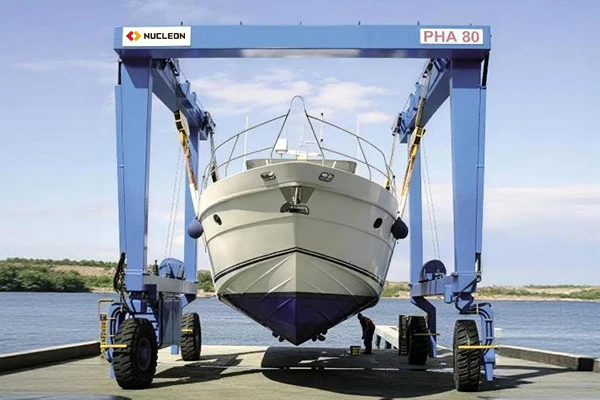
When evaluating a elevador de viagem marítima for your marina, most buyers focus on lifting capacity and wheel configuration first. But the drive system — electric or hydraulic — quietly determines your long-term operating cost, maintenance burden, and day-to-day reliability. Get this decision wrong, and you'll feel it every season.
Both electric marine travel lifts and hydraulic marine travel lifts are widely used across commercial marinas, boatyards, and yacht clubs globally. Each system has genuine strengths. The problem is that manufacturers rarely give you a straight comparison — they sell what they make.
This guide breaks down the real differences between electric travel lift marina setups and hydraulic travel lift marina configurations: how each system works, where each excels, where each falls short, and — critically — which marina profile fits which system. Whether you're upgrading aging equipment, building a new facility, or comparing bids, this article gives you a framework for making a defensible, cost-justified decision.
Bottom line upfront: For most modern marinas handling vessels up to 300 tons, electric marine travel lifts offer lower lifecycle costs and simpler maintenance. Hydraulic systems remain the stronger choice for extreme-capacity lifts and challenging remote environments. Read on for the full breakdown.
Before diving deep into electric vs. hydraulic comparisons, we recommend 👉[understanding the core factors in selecting a marine travel lift]. This way, this technical comparison will truly serve your actual decision-making.
Índice
What Is an Electric Marine Travel Lift?
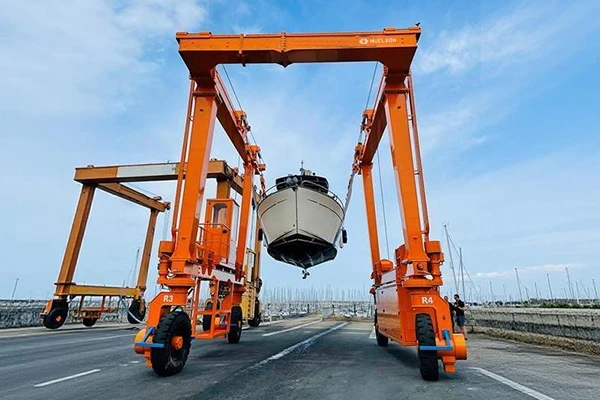
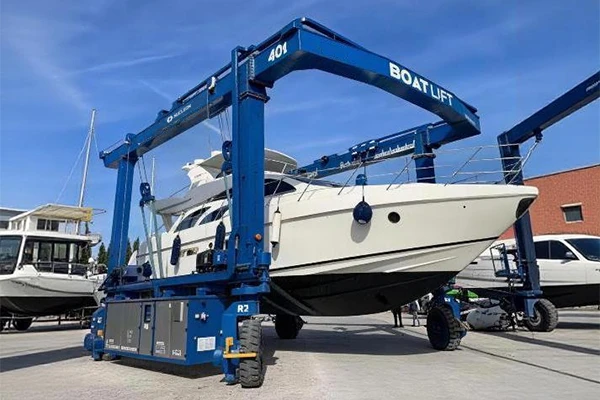
An electric marine travel lift uses electric motors — typically AC induction or permanent magnet motors with variable frequency drives (VFDs) — to power both travel movement and hoisting functions. The electric boat lift mechanism eliminates the need for a centralized hydraulic power unit, instead distributing drive power directly to individual wheel motors and hoist drums.
How the Electric Hoist Travel Lift Works
In a typical electric hoist travel lift configuration, each corner drive wheel has its own motor, and the hoist system uses electric winches with load-rated wire rope or lifting straps. A PLC-based control system synchronizes all motors, maintaining level lift and controlled travel speed. Modern units integrate load monitoring, anti-sway systems, and emergency braking into a single operator interface.
The electrical supply requirement is typically 380–480V three-phase AC, with power consumption ranging from 15 kW to 90 kW depending on capacity class. Energy recovery through regenerative braking is available on premium models, reducing net consumption during descent cycles.
Where Electric Travel Lifts Are Most Common
Electric travel lifts are the dominant choice in Europe and increasingly in North America for marinas handling vessels from 30 to 300 tons. Their adoption has accelerated alongside marina electrification trends and tightening environmental regulations on hydraulic fluid handling.
What Is a Hydraulic Marine Travel Lift?
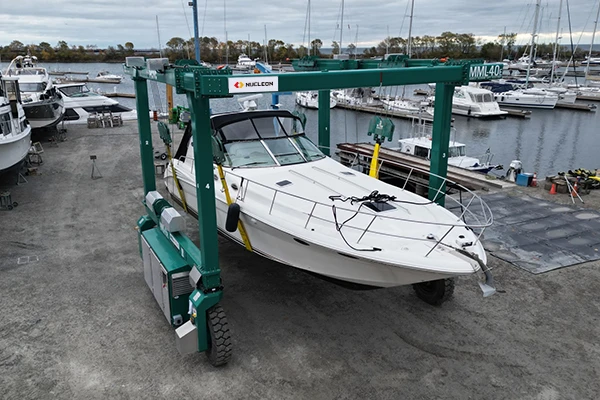
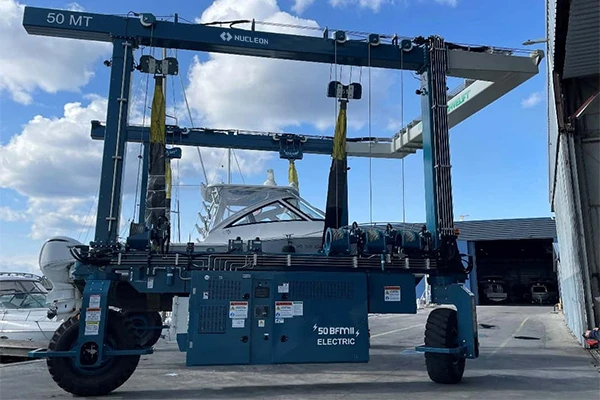
A hydraulic marine travel lift uses a centralized hydraulic power unit (HPU) to pressurize fluid circuits that drive travel motors, steering cylinders, and hoist cylinders. The hydraulic boat lift system transmits force through high-pressure hoses and control valves, giving operators smooth, stepless speed control across all functions.
How the Hydraulic Boat Lift System Works
Hydraulic travel lifts typically operate at system pressures between 200 and 350 bar. The HPU — usually diesel or electric powered — feeds independently controlled circuits for port/starboard travel, steering, and the hoist. Proportional valve technology allows fine-tuned speed adjustment, which many experienced operators prefer for precise boat positioning.
Capacity range is a key differentiator: hydraulic systems are more common in the 500–1,000+ ton class, where the force-density advantage of hydraulics is harder to match with electric alternatives at comparable cost.
Where Hydraulic Travel Lifts Are Most Deployed
Hydraulic marine travel lifts remain prevalent in large commercial shipyards, military vessel handling facilities, and remote boatyards where three-phase power infrastructure is limited or unreliable. Several major manufacturers — including Cimolai Technology and Wise Handling — offer hydraulic platforms targeting heavy lift and offshore applications.
Side-by-Side Comparison: Electric vs. Hydraulic Marine Travel Lift
The table below summarizes the key performance and operational differences between electric and hydraulic travel lifts across criteria most relevant to marina procurement decisions.
During the initial procurement phase, the price difference between electric and hydraulic models is significant. Hydraulic systems are typically more expensive due to their more complex structure. 👉[Understand the complete 2026 price ranges] to negotiate with confidence.
| Critérios | Electric Marine Travel Lift | Hydraulic Marine Travel Lift |
| Drive Mechanism | AC motors + VFD | Hydraulic pump + cylinders |
| Faixa de capacidade típica | 30–500 tons | 50–1,000+ tons |
| Eficiência Energética | High (regenerative braking available) | Moderate (heat loss in fluid circuits) |
| Maintenance Complexity | Low–Moderate (no fluid system) | Moderate–High (seals, hoses, fluid) |
| Environmental Risk | Low (no hydraulic fluid) | Moderate (spill risk, fluid disposal) |
| Cold Weather Performance | Good | Reduced (fluid viscosity issues below −10°C) |
| Precision Control | High (PLC + VFD synchronization) | High (proportional valve control) |
| Initial Purchase Cost | Moderate–High | Moderado |
| Lifecycle Cost (10 yr est.) | Baixo | Mais alto |
| Infrastructure Requirement | 3-phase power required | Flexible (diesel HPU option) |
| Noise Level | Baixo | Higher (pump noise) |
| Regulatory Compliance | Easier (EU Machinery Directive, ISO 4301) | More documentation for fluid handling |
Sources: ISO 4301-1:2016 (crane classification), EU Machinery Directive 2006/42/EC, manufacturer specification data (Cimolai Technology, Wise Handling, TravelLift Inc.) reviewed 2023–2024. Lifecycle cost estimates based on industry operator surveys; individual results vary by utilization rate.
Pros and Cons: Honest Assessment of Both Systems
Electric Travel Lift Advantages
Lower operating costs are the most cited advantage. Without a hydraulic circuit to maintain — no fluid changes, no seal replacements, no hose inspections — annual maintenance costs typically run 20–35% lower than comparable hydraulic units, based on operator-reported data from European boatyards.
Environmental compliance is increasingly important. Hydraulic fluid spills at waterfront facilities trigger reporting obligations under EU Water Framework Directive and U.S. Clean Water Act regulations. Electric travel lift advantages here are structural: there is no fluid to spill.
Quieter operation improves working conditions and reduces complaints in marina environments adjacent to residential or hospitality zones.
Energy monitoring and predictive maintenance are more accessible on electric platforms, where motor current draw, temperature, and cycle data feed directly into telematics systems.
Electric Travel Lift Disadvantages
Power infrastructure dependency is a real constraint. Sites without reliable three-phase supply face significant electrical upgrade costs before an electric travel lift becomes viable.
Higher component replacement cost for VFDs, PLC modules, and motor controllers can be significant when failures occur outside warranty, particularly in markets with limited technical service networks.
Capacity ceiling — while improving — means the heaviest commercial applications (600+ tons) still favor hydraulic architecture in most product catalogs.
Hydraulic Travel Lift Advantages
Force density and scalability give hydraulic systems a clear edge at the upper end of capacity requirements. For marinas regularly handling large fishing vessels, commercial craft, or superyachts above 400 tons, hydraulic travel lift advantages in structural simplicity at high loads are meaningful.
Diesel HPU option makes hydraulic lifts deployable where grid power is unavailable — remote island facilities, temporary installations, or developing market boatyards.
Operator familiarity in markets where hydraulic equipment has been the standard for decades reduces training costs and eases local service sourcing.
Hydraulic Travel Lift Drawbacks
Fluid management creates recurring cost and compliance obligations. Regular oil analysis, filter replacement, and hose inspection add labor and materials to annual maintenance budgets.
Cold-climate performance degrades as hydraulic fluid viscosity increases below −10°C, requiring heated storage or low-temperature fluid formulations — adding cost and complexity in northern facilities.
Energy waste through heat generation in hydraulic circuits is a measurable inefficiency, particularly during sustained operation in warm climates where fluid cooling demands increase.
Which Should You Choose? A Decision Framework for Marina Buyers
Choosing the best marina travel lift is not a universal answer — it depends on your specific facility profile. The following framework helps align system type with operational reality.
Choose an Electric Marine Travel Lift If:
- Your marina handles vessels primarily in the 30–300 ton range
- You have reliable three-phase grid power or are planning electrical infrastructure upgrades
- Environmental compliance and waterfront fluid management are operational priorities
- You operate in a moderate to warm climate with limited extreme cold exposure
- Your maintenance team has electrical/electronic competence or access to qualified service
- You are targeting lower 10-year lifecycle costs and can tolerate higher initial capital outlay
Choose a Hydraulic Marine Travel Lift If:
- You regularly handle vessels above 400 tons or require extreme-capacity lifts
- Your facility has limited or unreliable grid power and a diesel HPU is preferable
- Your team has established hydraulic service capability and prefers familiar technology
- You operate in a remote location with limited access to specialized electrical service
- Initial capital budget is constrained and lower upfront cost is a priority
Marina Lift Capacity Requirements: A Sizing Guide
| Marina Type | Typical Vessel Weight | Recommended System |
| Small recreational marina | 10–50 tons | Electric |
| Mid-size yacht club | 50–150 tons | Electric |
| Mixed commercial/recreational | 100–300 tons | Electric (preferred) or Hydraulic |
| Commercial boatyard | 200–500 tons | Electric or Hydraulic |
| Heavy commercial / naval facility | 500–1,000+ tons | Hydraulic |
Capacity ranges based on vessel weight classifications per ICOMIA standards and manufacturer product line data, 2023.
Conclusion: Make the Decision Based on Your Marina's Reality
The electric vs. hydraulic travel lift debate has a practical answer for most buyers: electric systems are the better long-term investment for the majority of modern marinas, offering lower lifecycle costs, simpler environmental compliance, and improving capacity coverage. But hydraulic systems are not obsolete — they remain the right tool for heavy commercial applications and infrastructure-constrained sites.
Use the decision framework above to map your facility's vessel profile, power infrastructure, maintenance capability, and regulatory environment against each system's strengths. Request lifecycle cost projections — not just purchase price — from at least two competing vendors. And verify that local service capability exists for whichever platform you select before signing.
The right marina travel lift buying guide is ultimately one that reflects your specific operational reality, not the industry's general average.

Especialista de Equipamento
Gestor de Negócios de Gruas com vasta experiência em gestão de projetos de elevação pesada e supervisão operacional. Histórico comprovado na promoção do crescimento da receita e na garantia da conformidade com as normas de segurança.
Perguntas frequentes (FAQ)
Q1: What is the typical lifespan of an electric marine travel lift compared to a hydraulic one?
Both electric and hydraulic marine travel lifts are designed for 20–30 year service lives when properly maintained, per ISO 4301 crane classification standards. In practice, electric travel lifts often reach the upper end of this range with lower cumulative maintenance cost, as they lack hydraulic seals and hose assemblies that typically require replacement every 5–8 years. The key longevity factor for electric units is protecting VFD and control system components from the marine environment — corrosion-resistant enclosures (IP55 or higher) are essential. Hydraulic units in cold climates may experience accelerated wear if fluid management protocols are not rigorously followed.
Q2: Can an electric marine travel lift operate during a power outage?
Most electric marine travel lifts are not designed for sustained operation during grid outages without auxiliary backup power. However, several manufacturers offer optional diesel generator backup packages or battery buffer systems that allow controlled lowering of a suspended vessel in an emergency. If power reliability is a genuine concern at your site, this should be a specific procurement requirement in your marina equipment specification. Hydraulic lifts with diesel HPUs have a natural advantage in off-grid scenarios, which is one reason they remain preferred in remote or island marina settings.
Q3: How do hydraulic fluid regulations affect marina operations in the EU and US?
In the EU, hydraulic fluid handling at waterfront facilities falls under the Water Framework Directive (2000/60/EC) and local port authority environmental regulations. In the US, spills reaching navigable waters trigger Clean Water Act notification requirements. Practically, this means hydraulic travel lift operators need spill containment plans, regular fluid condition monitoring, and documented disposal procedures — all of which add administrative and operational cost. Electric travel lifts eliminate this compliance layer. For marinas pursuing Blue Flag or Green Marina certifications, the absence of hydraulic fluid is a meaningful operational advantage.
Q4: What maintenance intervals should I plan for each system type?
For electric marine travel lifts, key maintenance tasks include: motor and brake inspection every 500 operating hours, VFD filter cleaning quarterly, wire rope/strap inspection per cycle (visual) and detailed inspection per ISO 4309 annually, and structural inspection per manufacturer schedule. For hydraulic travel lifts, add: hydraulic fluid analysis every 500 hours, filter replacement every 250–500 hours, hose and seal inspection every 6 months, and full hydraulic system service annually. Total annual maintenance hours typically run 30–40% higher for hydraulic systems based on manufacturer service data from Cimolai Technology and TravelLift Inc. (2023 service documentation).
Q5: Which marina equipment brands offer both electric and hydraulic travel lift options?
Several established manufacturers offer both drive system types, allowing direct comparison within a single product range. Notable brands include TravelLift (USA), Cimolai Technology (Italy), Wise Handling (China), and Marine Travelift — each producing models across the 30–1,000 ton capacity range in both electric and hydraulic configurations. When comparing bids, request total cost of ownership models covering a 10-year horizon, not just capital price. Also verify local service network coverage, spare parts availability, and warranty terms specific to your region, as after-sales support quality varies significantly by geography.


 English
  العربية
  Español
  Français
  Português
  Русский