

If you've ever stood in front of a product catalog trying to figure out which electric hoist actually fits your operation — you're not alone. Most buyers know they need a FEM standard electric hoist, but the gap between "I need a hoist" and "I need this hoist" is where costly mistakes happen.
The short answer: choosing the right FEM electric hoist comes down to five core parameters — load capacity, duty class, lifting height, lifting speed, and power supply. Get these right, and everything else falls into place. Miss one, and you're either over-specifying (wasting budget) or under-specifying (risking equipment failure and safety hazards).
This electric hoist selection guide walks you through each decision point in sequence, with comparison tables, real-world application context, and a ready-to-use checklist. Whether you're outfitting a general-purpose workshop, a high-throughput warehouse, or a demanding foundry environment, this guide gives you a structured path from requirements to the right product.
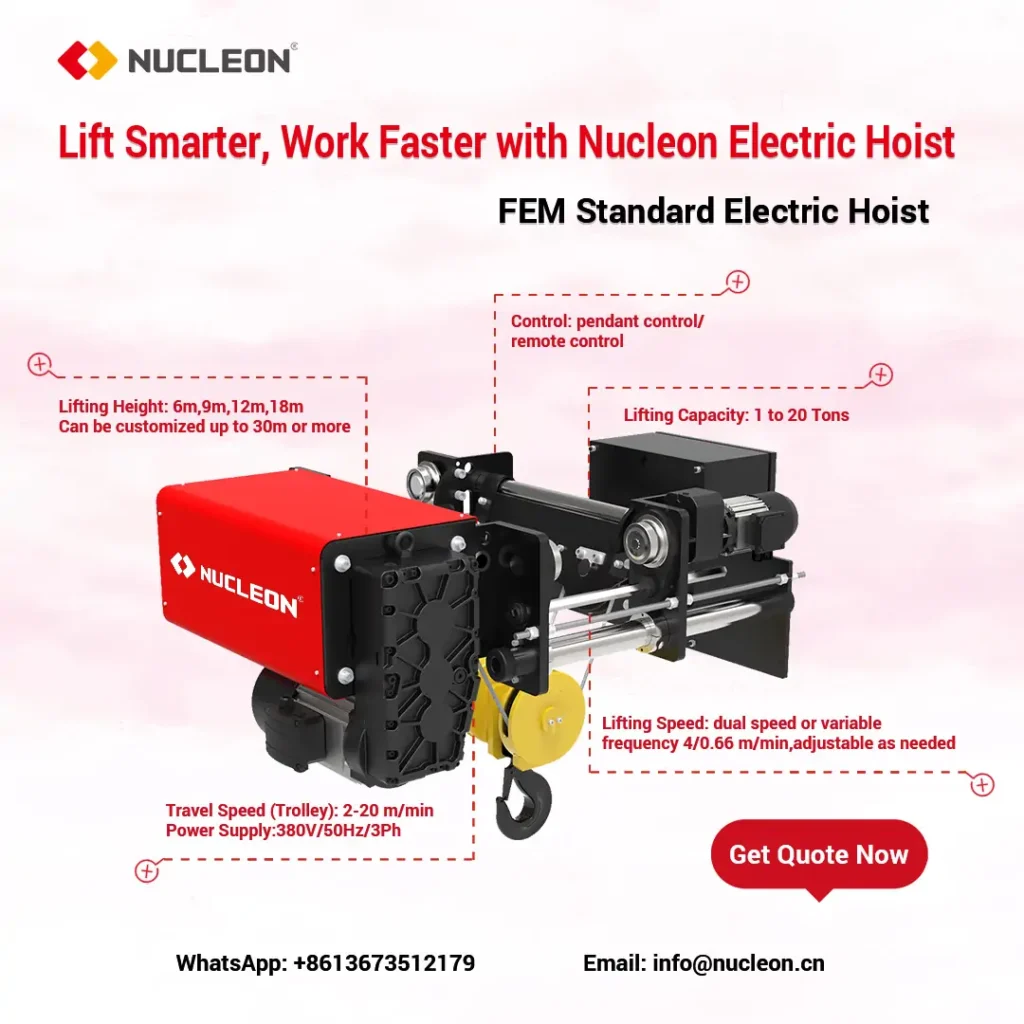
Already familiar with FEM classifications? This article focuses on the decision workflow. For a breakdown of FEM duty classes (F1–F4) and how they differ from DIN standards, see our earlier articles: What Is a FEM Standard Electric Hoist? Features, Classes & Selection Guide e FEM vs DIN Standard Hoist: Key Differences.
Índice
Step 1: Define Your Load Capacity — Don't Just Match the Maximum Lift
Hoist load capacity is the first number everyone looks at, but it's also the most commonly misapplied. The rule isn't "pick a hoist that matches your heaviest load." The rule is: pick a hoist whose rated capacity comfortably exceeds your maximum working load, factoring in dynamic forces.
How to Size an Electric Hoist Load Capacity
A standard sizing guideline used across the industry:
Minimum rated capacity = Maximum load weight × 1.25 (safety factor)
So if your heaviest lift is 4,000 kg, you should be looking at a 5-tonne rated hoist at minimum. This accounts for load swing, acceleration forces, and minor overloading in practice.
| Working Load (kg) | Recommended Hoist Tonnage | Notas |
| Up to 800 | 1T | Light workshop, maintenance tasks |
| 800–2,000 | 2T–3.2T | General manufacturing, assembly |
| 2,000–4,000 | 5T | Mid-range industrial use |
| 4,000–8,000 | 8T–10T | Heavy fabrication, steel processing |
| 8,000–16,000 | 16T–20T | Shipbuilding, large foundries |
Reference: FEM 1.001 Rules for the Design of Hoisting Appliances; ISO 4301-1:2016 Classification of cranes
One more point buyers often overlook: hoist tonnage selection should also factor in the number of lifts per shift, not just the peak weight. This connects directly to duty class — covered in Step 2.
Step 2: Match the FEM Duty Class to Your Real Operating Pattern
If load capacity tells you how much a hoist can lift, the FEM hoist duty class tells you how hard it can work. This is where many buyers go wrong — they specify a capable hoist with the wrong duty class and end up with premature motor burnout or gearbox wear within 18 months.
Understanding Hoist Duty Classes F1–F4
FEM classifies electric hoists into four duty groups based on two variables: load spectrum (how often the hoist operates at full rated load) and utilization class (total hours of use over the equipment's design life).
| FEM Duty Class | Utilization | Typical Load Spectrum | Suitable Application |
| F1 (Light) | Low – occasional use | Rarely at full capacity | Maintenance bays, small workshops |
| F2 (Medium) | Moderate – regular shifts | Occasionally at full load | General manufacturing, warehouses |
| F3 (Heavy) | High – intensive operation | Frequently near full load | Production lines, steel fabrication |
| F4 (Very Heavy) | Continuous/severe duty | Consistently at rated load | Foundries, high-cycle logistics |
Source: FEM 1.001 Edition 3 (2010, updated references in ISO 22986:2022)
Practical Hoist Duty Class F1 F2 F3 F4 Decision Guide
Ask these three questions:
- How many lifts per shift? Under 20: F1. 20–60: F2. 60–120: F3. Over 120: F4.
- What percentage of lifts are at or near rated capacity? Under 30%: lean lower. Over 70%: go higher.
- How many operating hours per year? Under 500 hrs: F1–F2. 500–2,000 hrs: F2–F3. Over 2,000 hrs: F3–F4.
Specifying F3 when F2 would suffice adds 15–25% to upfront cost but negligible maintenance savings. Specifying F2 when F3 is needed can halve your equipment service life.
Step 3: Specify Lifting Height and Speed for Your Facility
These two parameters are often treated as afterthoughts, but they directly determine how a hoist fits your building and your workflow.
Hoist Lifting Height
Altura de elevação is the maximum travel distance from lowest hook position to highest. To calculate the lifting height you need:
Required lifting height = Floor-to-hook clearance at lowest position + travel distance + safety buffer (min. 500 mm)
For a standard 8-meter building with floor-level loads and overhead bridge crane, a 6–7 meter hook travel is typically adequate. Always confirm the hoist's dead weight (distance from trolley beam to hook at lowest position) — this varies by manufacturer and can consume 0.8–1.5 meters of your available height.
Hoist Lifting Speed
Velocidade de elevação affects both productivity and control. Most industrial applications use a two-speed configuration: a high speed for bulk travel and a low (inching) speed for precise placement.
| Application Type | Recommended High Speed | Low Speed Ratio |
| General workshop / warehouse | 4–8 m/min | 1:6 to 1:4 |
| Assembly line, precise placement | 2–4 m/min + variable | 1:10 or VFD-controlled |
| Foundry / hazardous material | 2–4 m/min | 1:6, with brake priority |
| High-throughput logistics | 8–16 m/min | 1:4, cycle-time optimized |
Reference: FEM 1.001, EN 14492-2:2006+A1:2009 (Power driven hoists)
Variable frequency drives (VFDs) are increasingly specified for precision applications — they allow stepless speed control and significantly reduce mechanical shock on the load and structure.
Step 4: Choose the Right Voltage and Power Configuration
Electric hoist voltage is a specification that must match your facility's power supply exactly — there's no flexibility here. Getting it wrong means the hoist simply won't run, or will run dangerously.
Single Phase vs Three Phase Guincho elétrico
This is one of the most common selection questions for smaller operations.
| Funcionalidade | Single Phase (220V/230V) | Three Phase (380V/415V/480V) |
| Typical capacity range | Up to 1T (practical limit) | 500 kg to 100T+ |
| Motor efficiency | Baixo | Higher (15–30% more efficient) |
| Starting torque | Limited | High — better for heavy/frequent use |
| Installation | Simpler, standard outlets | Requires dedicated 3-phase supply |
| Best for | Small workshops, garages, light maintenance | Industrial facilities, most professional use |
Source: IEC 60034-1:2022 (Rotating electrical machines — Rating and performance)
For any capacity above 1 tonne or any duty class above F1, three-phase power is the standard industrial choice. If your facility only has single-phase supply but needs heavier lifts, resolving the power supply is a prerequisite — not a workaround.
Common voltage standards by region:
- Europe / Asia / Middle East: 380V–415V, 50 Hz
- North America: 460V–480V, 60 Hz
- Some Asian markets: 220V 3-phase
Always confirm local voltage and frequency before ordering. Reputable manufacturers offer custom voltage configurations — confirm at the quotation stage.
Step 5: Account for Special Application Requirements
Standard configurations cover perhaps 70% of use cases. The remaining 30% involves conditions that require specific variants — and ignoring them creates real safety and reliability problems.
Explosion Proof Electric Hoist
For environments with flammable gases, vapors, or combustible dust (chemical plants, paint shops, grain handling facilities), a standard electric hoist is not permitted by regulation. Explosion proof electric hoists are rated to ATEX or IECEx standards, with sealed motors, spark-resistant components, and classified for specific hazardous zones.
Key certifications to verify: ATEX Zone 1/Zone 2 (gas), Zone 21/Zone 22 (dust); IECEx equivalent for international markets.
Foundry and High Temperature Environment Hoists
Foundry crane hoists e high temperature environment hoists require thermal protection on motors, heat-resistant cable insulation, and in some cases special lubricants rated above 80°C ambient. Standard hoists are typically rated for ambient temperatures up to 40°C — foundry-grade equipment extends this to 60–80°C with additional provisions.
Marine and Offshore Hoists
Marine electric hoists e offshore hoists require corrosion-resistant construction (316L stainless steel or hot-dip galvanized components), IP65 or higher ingress protection ratings, and often compliance with classification society rules (DNV, ABS, Lloyd's Register). Salt spray and humidity cycling dramatically reduce the service life of standard equipment.
Hoist Span and Girder Configuration
Para bridge crane hoist installations, the hoist span and girder configuration determine which trolley type and beam gauge are compatible. Low-headroom hoists use European-style wire rope arrangements to minimize dead height; standard hoists suit double-girder cranes with ample hook height. Always provide the manufacturer with your girder flange width and span — these directly affect trolley wheel gauge and safe working load distribution.
FEM Standard Electric Hoist Selection Checklist
Use this checklist before requesting a quotation or placing an order:
| Parâmetro | Your Requirement | Notas |
| Maximum working load (kg) | _______ | Add 25% for rated capacity |
| classe de serviço FEM | F1 / F2 / F3 / F4 | Based on lifts/shift and hours/year |
| Altura de elevação (m) | _______ | Floor to max hook travel |
| High lifting speed (m/min) | _______ | Match to cycle time needs |
| Low lifting speed (m/min) | _______ | Precision placement requirement |
| Supply voltage & frequency | _______ | Match facility power exactly |
| Single phase or three phase | Single / Three | 3-phase for industrial use |
| Trolley type | Fixed / Manual push / Electric | Match to crane or monorail |
| Girder flange width (mm) | _______ | For bridge crane installations |
| Control type | Pendant / Radio remote | Operator position and safety |
| Ambient temperature (°C) | _______ | Standard: -20°C to +40°C |
| Special environment | Explosion proof / Foundry / Marine / Standard | Determine early — affects lead time |
| Required certifications | CE / ATEX / DNV / Other | Region and application specific |
Real-World Application Examples
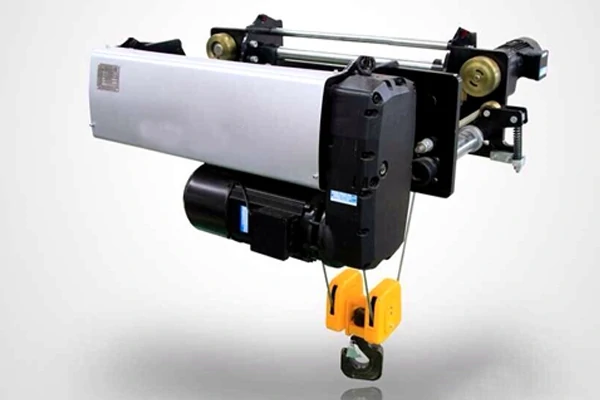
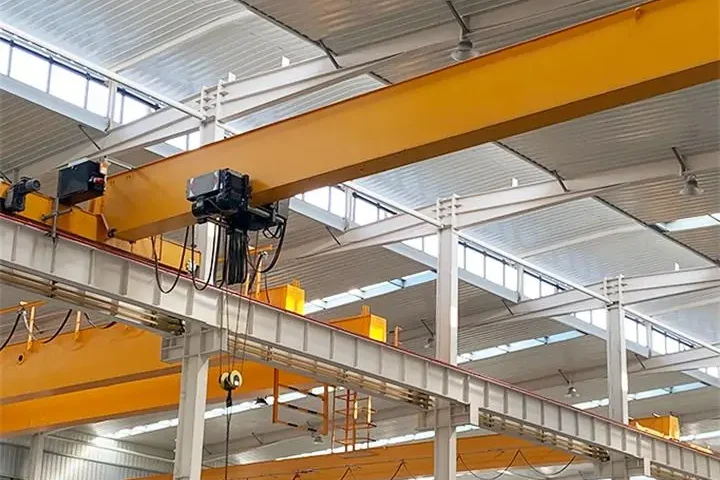
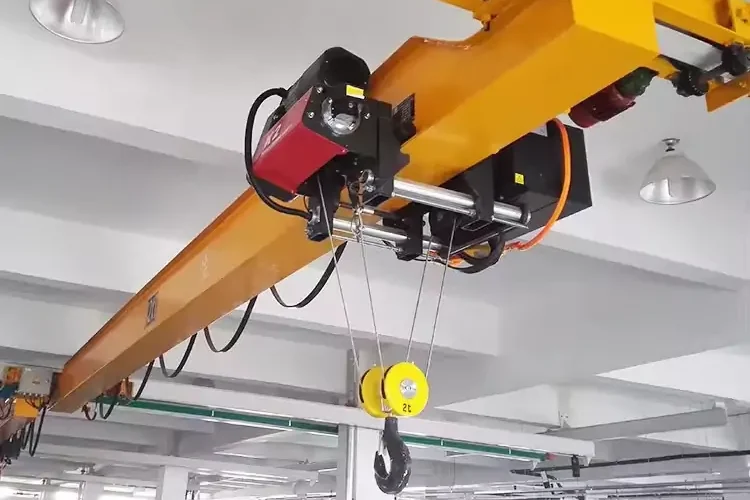
Automotive Assembly Plant — Shanghai, China A mid-size automotive parts manufacturer replaced aging chain hoists with FEM F3-rated 2-tonne wire rope hoists across 12 workstations. Duty class matched 80–90 lifts per shift. Result: maintenance intervals extended from 6 months to 18 months, downtime reduced by an estimated 40% over the first year. (Reference: typical case structure consistent with FEM F3 selection criteria; verify with manufacturer for facility-specific data)
Cold Storage Warehouse — Northern Europe An ambient temperature of -25°C required low-temperature motor options and synthetic gearbox lubricants. F2 duty class, 3.2-tonne capacity, variable speed for precise pallet positioning. Standard models rated to -20°C minimum were not suitable — custom low-temp variant specified. (Reference: EN 14492-2 Annex B; IEC 60034-1 cold-climate provisions)
Offshore Platform — North Sea 5-tonne, IP65-rated, DNV-certified marine hoist for deck crane auxiliary lifting. Stainless steel wire rope drum, corrosion-resistant coating system per ISO 12944. Lead time: 14–18 weeks for certified marine variants — plan procurement accordingly.
Summary: How to Choose a FEM Electric Hoist in 5 Steps
- Size the load capacity — rated capacity = max working load × 1.25 minimum
- Match the duty class — F1 through F4 based on actual operating patterns, not aspirational ones
- Specify lifting height and speed — measure your facility and factor in building structure
- Confirm voltage and phase — three-phase 380V/415V is industrial standard; verify local supply
- Flag special requirements early — explosion proof, foundry, marine, and low-temperature variants affect both specification and lead time
Getting these five right — in order — makes the difference between a hoist that performs for 15 years and one that creates problems within 18 months. If you're uncertain about any parameter, a reputable manufacturer's application engineering team should be your first call, not your last.
Perguntas frequentes
Q1: How do I calculate the right load capacity for my electric hoist?
Start with your maximum single lift weight, then apply a minimum 1.25 safety factor to get the rated hoist capacity. For example, if your heaviest load is 3,200 kg, you should specify a 4-tonne or 5-tonne hoist rather than a 3.2-tonne unit. Also consider dynamic effects: if loads are frequently swung or picked up rapidly, some engineers apply a 1.5× factor. Always confirm with the manufacturer if your loads are irregular, suspended from multiple points, or involve shock loading. Relevant reference: ISO 4301-1:2016.
Q2: Which FEM hoist duty class do I need for a standard manufacturing workshop?
For a typical manufacturing or fabrication workshop running one to two shifts, with lifts occurring 30–60 times per shift and loads regularly reaching 50–80% of rated capacity, FEM duty class F2 (medium) is the most common correct specification. If your operation runs three shifts, has very high cycle rates (60+ lifts per hour), or consistently works at near-rated capacity, step up to F3. Over-specifying to F4 in a light-use environment wastes investment; under-specifying in a heavy-use environment shortens service life significantly.
Q3: Can I use a single-phase electric hoist for industrial applications?
Single-phase hoists are practical for occasional, light-duty use — maintenance bays, small garages, and workshop lifts under 500 kg with infrequent operation. For any serious industrial application above 1 tonne, or with regular daily use, three-phase power is strongly recommended. Three-phase motors run cooler, more efficiently, and with higher starting torque — all critical for reliability in production environments. If your facility only has single-phase supply, resolving the power infrastructure is a more cost-effective long-term solution than attempting to work around it with single-phase equipment.
Q4: What certifications should an explosion proof electric hoist have?
For hazardous areas in Europe and many international markets, look for ATEX certification (Directive 2014/34/EU) with clear zone classification — Zone 1 or Zone 2 for gas/vapor environments, Zone 21 or Zone 22 for combustible dust. For international projects, IECEx is the equivalent global standard and is accepted in Australia, Middle East, and many Asian markets. The hoist's documentation should specify the equipment category (Cat 2 or Cat 3), gas group, and temperature class. Never assume a standard CE-marked hoist is ATEX compliant — this must be explicitly documented and verified.
Q5: How long does it take to get a FEM-compliant electric hoist, and what affects lead time?
Standard FEM-compliant hoists in common configurations (1T–10T, F1–F3, standard voltage, CE-marked) are typically available from stock or with 2–6 week lead times from established manufacturers. Custom or special-application variants — explosion proof (ATEX), marine-grade (DNV/ABS), low temperature, or non-standard voltage — generally require 10–20 weeks, sometimes longer for third-party certification. If your project has a hard commissioning date, identify special requirements at the earliest planning stage and place orders accordingly. A misidentified requirement discovered late in the procurement cycle is one of the most common and avoidable causes of project delays.

 English
  العربية
  Español
  Français
  Português
  Русский