

Cranes for ports fall into a handful of distinct categories — ship-to-shore (STS), rubber-tyred and rail-mounted gantry (RTG/RMG), mobile harbor cranes (MHC), and grab or portal cranes — and each one is built for a specific cargo type, berth layout, and throughput target. Picking the wrong category rarely shows up on the spec sheet; it shows up later, as a bottleneck at the quay or a maintenance bill nobody budgeted for.
If you're planning a new terminal, adding capacity to an existing one, or simply trying to understand what "port handling equipment" actually covers before you talk to a supplier, the hard part usually isn't identifying that STS cranes exist. It's knowing which parameters actually decide whether a crane fits your vessels, your yard, and your budget — and where buyers typically get that judgment wrong.
This guide covers what counts as port handling equipment beyond cranes, a fast comparison of the main crane types, realistic market price ranges, and the selection logic and procurement mistakes that determine whether a crane purchase pays off or becomes a long-term liability.
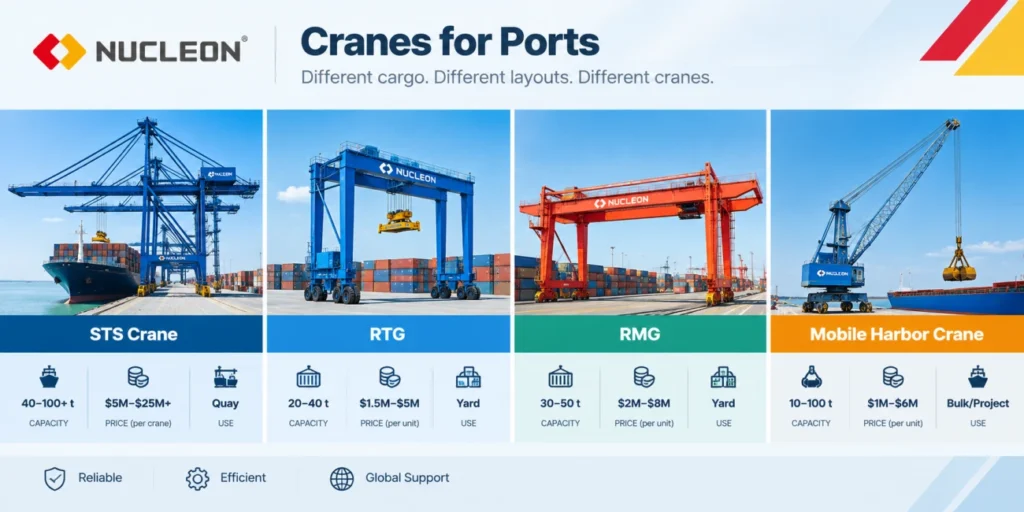
Table of Contents
Quick Reference: Port Crane Types at a Glance
| Crane Type | Typical Lifting Capacity | Max Outreach / Radius | Mobility | Best Fit |
| STS (Ship-to-Shore) | 40–80 t under spreader | Up to 65–72 m | Rail-fixed at quay | Dedicated container terminals |
| RTG | 35–70 t | 6–7 container rows wide | Rubber-tyred | Yard stacking, flexible layout |
| RMG | 35–60 t | 6–9 container rows wide | Rail-fixed | Automated/high-density yards |
| Mobile Harbor Crane | 100–150 t typical, up to 308 t on flagship models | Up to 48–64 m | Rubber-tyred, repositionable | Mixed container/bulk/breakbulk berths |
| Grab / Portal Crane | 10–50 t (grab load) | Fixed or slewing | Fixed/semi-fixed | Bulk cargo terminals |
Reference ranges only — actual capacity depends on working radius, duty class and configuration. Get a project-specific quote →
What Is Port Handling Equipment, and Where Do Cranes Fit In?
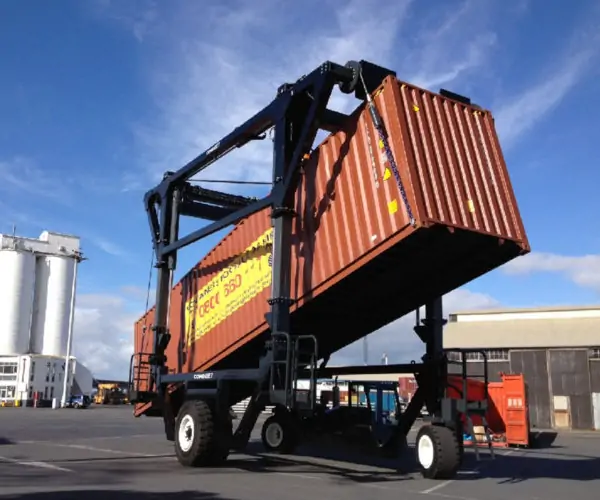
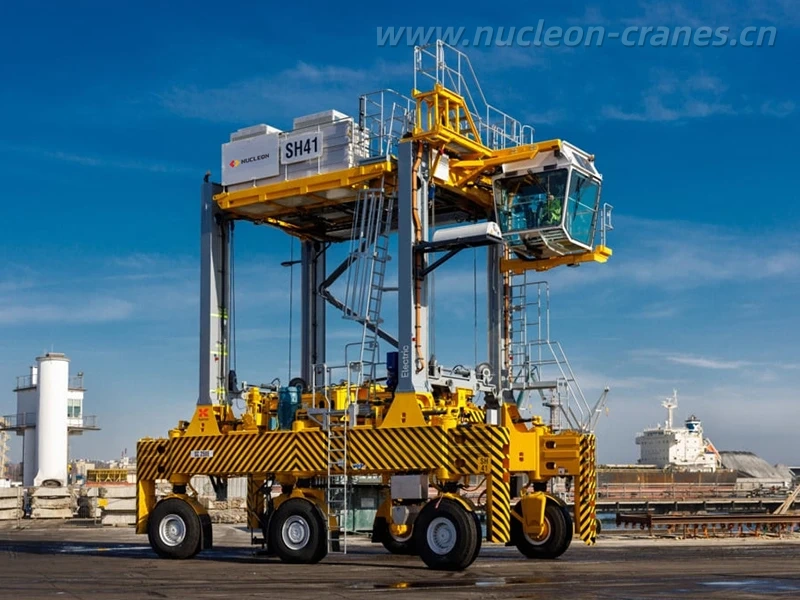
Port handling equipment is the full set of machines that move cargo between vessel, quay and yard — cranes are the largest category, but not the only one. Alongside STS, RTG/RMG, MHC and grab cranes, terminals also run container straddle carriers, reach stackers, terminal tractors and, for automated yards, automated guided vehicles (AGVs). Cranes handle the vertical lift; carriers and tractors handle horizontal movement within the yard.
The reason this distinction matters for procurement is that a "port crane" quote and a "port handling equipment" plan are not the same document. A terminal's throughput depends on how the crane fleet and the horizontal transport fleet work together — a fast STS crane feeding a yard with too few straddle carriers just creates a queue at the apron instead of at the berth. For a full breakdown of crane categories, functions and technical comparisons, see our complete guide to types of cranes used in ports; this article focuses on the decisions that determine which equipment — and which configuration of it — actually fits your operation.
Cranes for Ports Split by Where They Work, Not Just What They Lift
The first useful split isn't lifting capacity — it's whether the crane works at the quay, in the yard, or across both. STS cranes are quay-fixed and exist only to move containers between ship and shore. RTG and RMG cranes never touch a vessel; they stack and retrieve containers within the yard. Mobile harbor cranes are the exception that works both sides, which is exactly why they suit multi-purpose berths rather than dedicated container terminals.
This matters because buyers sometimes shop for "a port crane" as a single category, then discover mid-negotiation that an STS quote and an MHC quote are solving different problems. Confirming which side of the operation — quay or yard — the equipment needs to cover before requesting quotes prevents a supplier from steering the spec toward whatever they happen to stock.
Port Crane Types: A Fast Comparison
Ship-to-Shore (STS) Cranes Handle the Quay, Not the Yard
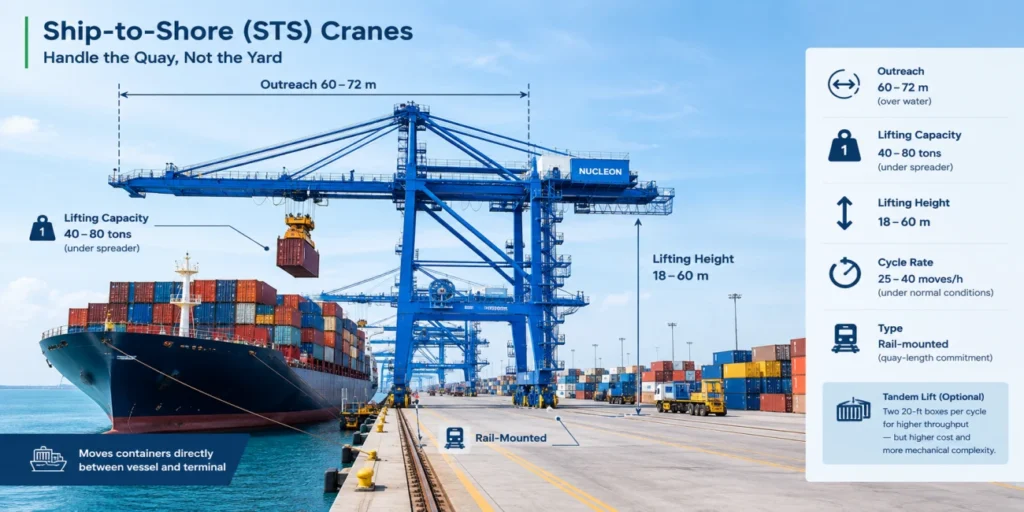
STS cranes are rail-mounted quay cranes purpose-built to move containers directly between a vessel and the terminal, with outreach as the defining spec rather than raw capacity. Modern STS cranes reach 60–72 meters over the water to span ultra-large container vessels, lift 40–80 tons under the spreader, and cycle at 25–40 moves per crane hour under normal conditions. Because they're rail-fixed, an STS crane is a quay-length, multi-decade infrastructure commitment — not a piece of equipment you reposition later if vessel calls change. Tandem-lift models that handle two 20-foot boxes per cycle add throughput but also add cost and mechanical complexity, so they only pay off at terminals running consistently high volumes.
RTG and RMG Cranes Stack the Yard, With Different Automation Ceilings
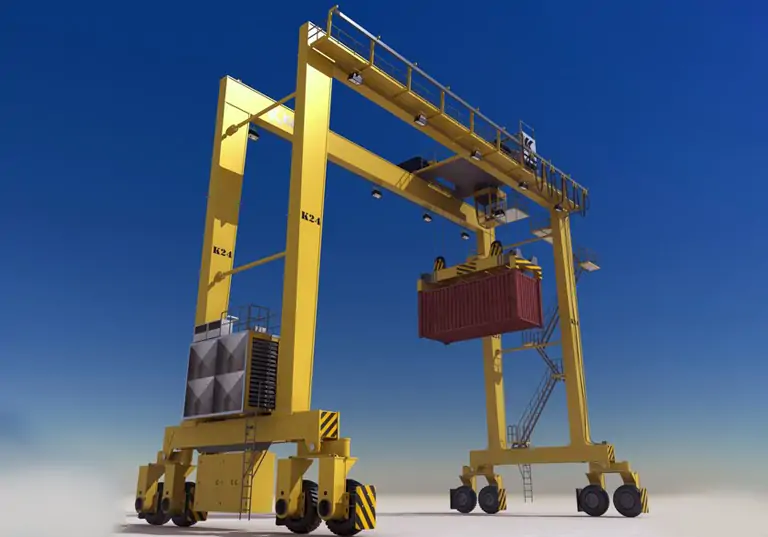
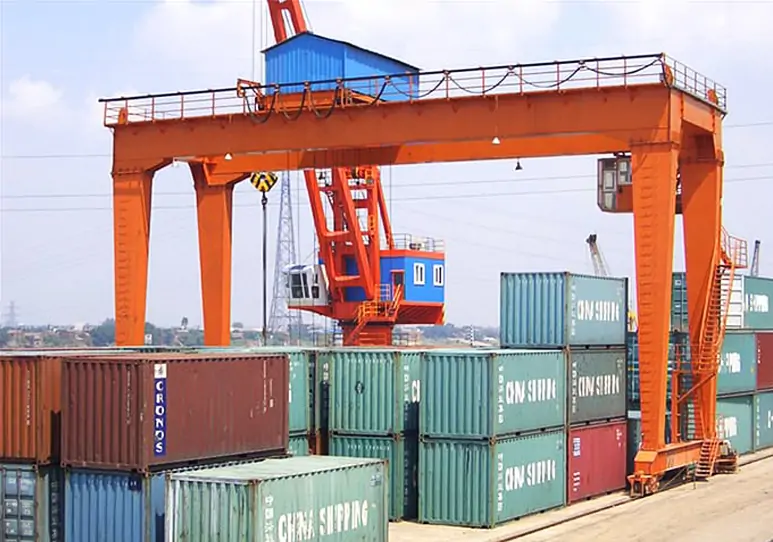
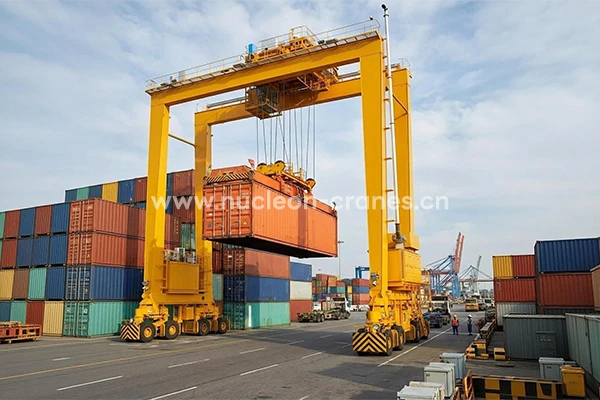
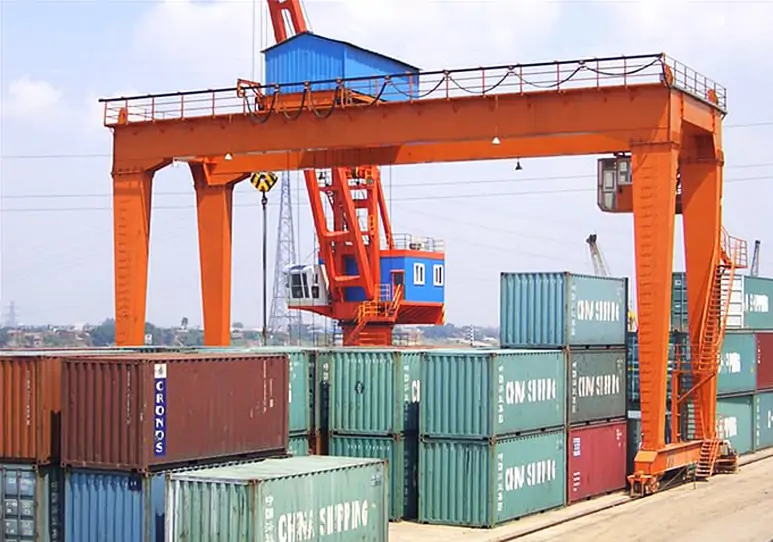
RTG cranes offer yard flexibility on rubber tyres; RMG cranes trade that flexibility for the precision and automation that fixed rails allow. Both stack containers 6 to 9 rows wide and several tiers high, in the 35–70 ton range. The practical difference is operational: an RTG can be driven between blocks without infrastructure work, which suits terminals whose layout still changes as volume grows. An RMG's fixed rail path is exactly what makes it programmable for AGV integration and unmanned operation — but that same fixed path means a layout change later is a civil-works project, not a driving maneuver. Terminals targeting full automation from day one generally standardize on RMG; terminals still finding their throughput pattern usually start with RTG and electrify later.
Mobile Harbor Cranes Trade Peak Capacity for Berth Flexibility
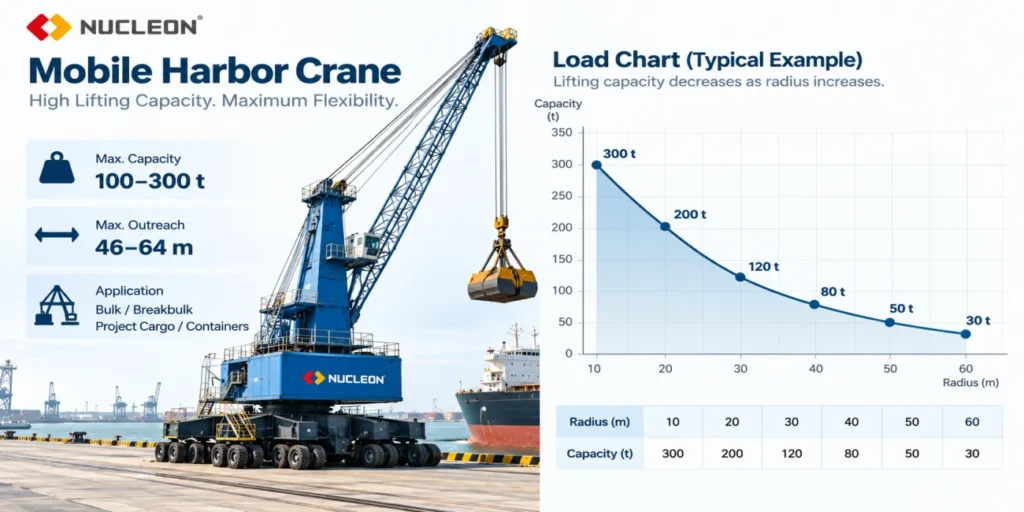
Mobile harbor cranes reposition along the quay to serve whichever vessel is berthed, at lifting capacities that outrank fixed cranes but with productivity that trails a dedicated STS on pure container volume. The product range spans widely by manufacturer and model: mid-range units typically max out around 100–150 tons at 46–51 meters outreach, while flagship models built for ultra-large bulk carriers and heavy-lift project cargo reach up to around 300 tons (Liebherr's largest MHC is rated 308 t) with outreach up to roughly 64 meters. That headline capacity, however, drops sharply with reach on every model in this category — see the next section for exactly how much. For terminals handling a genuine cargo mix — bulk, breakbulk, project cargo and containers at the same berth — that combination of mobility and rated range is usually a better fit than a fixed crane sized for peak container volume it may never see.
Grab and Portal Cranes Are Built Around Cycle Rate, Not Lift Height
Grab cranes and dock portal slewing cranes exist to move loose bulk cargo — coal, ore, grain, fertilizer — as fast as possible, so cycle rate matters more than any single lift figure. Grab loads typically run 10–50 tons per bite, but the number that actually drives terminal throughput is unloading rate, which on modern grab cranes reaches roughly 1,500–3,000 tonnes per hour depending on grab volume and cycle speed. Portal slewing cranes add a 360° rotating platform, which keeps hook height constant through the swing — useful for bulk handling but not something a fixed-boom crane can match. Neither type is a realistic fit for container work; they're a separate procurement track entirely, usually justified only when bulk cargo is a real share of terminal volume.
How Much Does a Port Crane Cost?
Price Scales With Structure Size and Automation, Not Just Tonnage
Port crane pricing spans roughly $60,000 for a light dock crane to well over $10 million for a large automated STS unit, so "port crane price" only becomes a useful number once you specify the type. As a market reference: STS cranes typically run from the low millions up to $10 million-plus depending on outreach and automation level; RTG cranes generally fall between roughly $300,000 and $2 million; RMG cranes range from about $1 million to $3 million, rising further with automation and TOS integration; general-purpose mobile harbor cranes typically run $300,000–$2 million; and lighter dock portal or harbor gantry cranes for smaller operations fall in the $60,000–$400,000 range. These are market-level reference bands, not quotes — the same crane category can vary several-fold depending on outreach, duty class, automation package and after-sales scope, so treat this as a starting filter for budgeting, not a final number.
New-Build Lead Time and Used Equipment Change the Real Cost Comparison
A lower sticker price on used equipment only pays off if the structural and mechanical condition holds up, so the purchase decision is really a risk-versus-lead-time trade-off, not just a price comparison. New STS and RMG cranes typically run 18–36 months from order to delivery; mobile harbor cranes are faster, usually 12–18 months. Used or refurbished equipment can cut acquisition cost by roughly 40–60%, but that saving is only real after a structural inspection and a review of maintenance history — wire rope condition, structural fatigue, and electrical system age don't show up in a sale listing. For terminals with an immediate operational gap, that inspection cost is small relative to the risk of buying a crane that needs major rework within its first year in service.
How to Select the Right Cranes for Your Port
Confirm Vessel Coverage and Outreach Before Comparing Capacity Numbers
For STS cranes especially, outreach and vessel coverage — not lifting capacity — usually determine whether a crane can actually serve your target vessels. A terminal expecting post-Panamax or ultra-large container vessels needs 60+ meters of outreach regardless of how much tonnage the spreader is rated for; a crane with generous capacity but insufficient reach simply can't work the outer rows of a wide-beam vessel. The practical selection sequence is: confirm the vessel classes you need to serve, translate that into a minimum outreach and lift height, and only then compare lifting capacity between shortlisted models — reversing that order is how buyers end up with a crane that's over-specified on tonnage and under-specified on reach.
Read the Load Chart at Your Working Radius, Not the Headline Capacity
Rated lifting capacity is a single-point number; the load chart at your actual working radius is the number that determines what the crane can really do on your quay. Manufacturer datasheets make this explicit: a mobile harbor crane rated at 154 tons typically holds that figure only out to about 16 meters of radius, then falls to roughly 89 tons by 30 meters and under 41 tons by 54 meters — the same machine, radically different usable capacity depending on where the load sits. A flagship 308-ton unit shows the same pattern at larger scale, dropping to around 100 tons by roughly 47 meters outreach. Buyers who compare suppliers purely on the largest number in the brochure, without checking the capacity curve at the radius they'll actually operate at, risk under-speccing the crane for their real cargo mix. Before finalizing a model, ask for the full load chart (capacity at every relevant radius), not just the maximum figure.
Weigh Infrastructure and Lifecycle Cost Alongside the Crane Body Price
Two cranes with an identical purchase price can carry very different total costs once foundation, power supply and maintenance are included, so infrastructure requirements belong in the comparison from day one. STS and RMG installations need quay structural reinforcement, rail foundations, and electrical infrastructure sized for 1–2 MW of draw during operation — costs that don't appear on the crane's own price tag but are unavoidable for either type. Mobile harbor cranes need far less civil works since they run on tyres, but carry their own recurring costs in tyres/undercarriage wear, power source (diesel-electric or full electric), and slewing/luffing system maintenance. Electrified yard cranes (E-RTG, RMG) cost more upfront than diesel equivalents but typically run meaningfully lower on energy and maintenance cost per move over a 15–25 year service life — which is the horizon that actually matters for a decision this size, not the purchase-order total. As a planning reference, ongoing maintenance across port crane types typically runs around 2–4% of purchase price per year, covering wire rope inspection/replacement, brake testing, structural crack detection and routine electrical/mechanical servicing — a figure worth applying to each shortlisted crane type before comparing purchase prices alone.
Common Port Crane Procurement Mistakes to Avoid
Comparing Crane Body Price Alone Skews the Decision
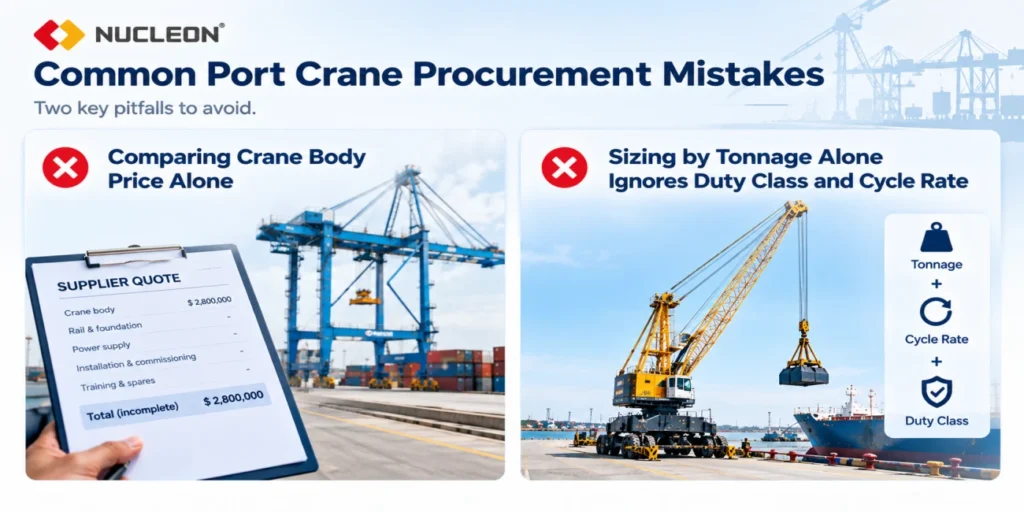
The most common port crane procurement mistake is comparing supplier quotes on crane body price without normalizing for what each quote actually includes. An STS or RMG quote that excludes rail foundation, power infrastructure, or commissioning looks cheaper than a turnkey quote from a competitor — until the excluded scope shows up as a separate line item later. The fix is procedural, not technical: request an itemized scope (crane body, controls, spares package, installation, commissioning, training) from every bidder before comparing headline prices, since the gap between a "crane price" and a "delivered, operating crane" cost is exactly where budgets get blown.
Sizing by Tonnage Alone Ignores Duty Class and Cycle Rate
A crane sized only by maximum tonnage, without checking duty class and expected cycle rate, is a common source of premature wear and unplanned downtime. A terminal running high-frequency, continuous operations needs a crane built for that duty class even if peak tonnage requirements are modest — the mechanical and electrical components simply wear faster under sustained cycling than the nameplate capacity alone suggests. Confirming expected moves-per-hour and duty class alongside tonnage, and matching that against the manufacturer's duty rating, is what separates a crane that lasts its full design life from one that needs major component replacement well ahead of schedule.
Selecting cranes for ports is a decision made once every 15–25 years per unit, so treat outreach, load-chart-at-radius, infrastructure cost, and duty class as equally weighted inputs — not as a checklist to confirm after tonnage has already been decided. Start by defining your vessel classes and cargo mix, then work backward into crane type, and request itemized quotes before comparing price across suppliers.
If you're evaluating port handling equipment for a new terminal or capacity expansion, our engineering team can review your vessel and cargo profile and recommend a matched crane configuration — contact us for a project-specific quote.

Equipment Specialist
Accomplished Crane Business Manager with extensive experience in heavy lift project management and operational oversight. Proven track record of driving revenue growth and ensuring safety compliance.
FAQ
Q1: How much does a crane for a port cost?
Port crane prices range from roughly $60,000 for a light dock crane to over $10 million for a large automated STS crane. STS cranes typically run $2 million–$10 million+, RTG cranes $250,000–$2 million, RMG cranes $1 million–$3 million, and mobile harbor cranes $300,000–$2 million, depending on outreach, capacity and automation level.
Q2: What port handling equipment works alongside cranes?
Cranes handle vertical lifting between vessel, quay and yard, but terminals also rely on container straddle carriers, reach stackers, terminal tractors, and AGVs for horizontal movement. Crane throughput only translates into terminal throughput if the horizontal transport fleet is sized to match it.
Q3: Why does a mobile harbor crane's capacity change with radius?
A mobile harbor crane's rated lifting capacity applies only at a specific working radius — for example, a 154-ton-rated unit may hold that figure only to about 16 meters, then drop to roughly 89 tons by 30 meters and under 41 tons by 54 meters. As the boom reaches further out, the crane's stability limit reduces the safe load, so buyers should check the full load chart, not just the maximum headline figure.
Q4: Is a used port crane a good option compared to buying new?
Used or refurbished port cranes can cost 40–60% less than new equipment, but that saving is only reliable after a structural inspection and a review of maintenance records. New-build lead times run 18–36 months for STS/RMG cranes and 12–18 months for mobile harbor cranes, so used equipment mainly makes sense when a terminal has an immediate operational gap new equipment can't fill in time.
Q5: What's the biggest mistake buyers make when selecting cranes for ports?
The most common mistake is comparing crane body prices without confirming what each quote includes — foundation work, electrical infrastructure, installation, and commissioning are often excluded from the headline price and appear later as separate costs. Requesting an itemized scope from every bidder before comparing price prevents this.
Related Articles
- What Is an STS Crane? Ship-to-Shore Crane Guide, Specs & Price
- Container Gantry Crane: Factory-Direct Pricing, CE Specs & Order Process (2026)
- Container Gantry Crane for Sale: RTG vs RMG vs STS — Pricing, True Costs & How to Choose
- What Is a Container Gantry Crane? Types, How It Works & How to Choose
- Straddle Carrier for Sale: Specs, Pricing & Factory-Direct Quote (2026)

 English
  العربية
  Español
  Français
  Português
  Русский