

TL;DR
- Straddle carriers for sale range from $25,000 to $290,000+, depending on capacity (5T–1,000T) and power type.
- Electric models cost 15–25% more upfront but cut operating costs by ~40% vs diesel over a 5-year cycle.
- Confirm ground-bearing capacity and clear height before ordering — these two specs invalidate more purchase orders than any other factor.
Straddle carriers for sale at Nucleon cover 5T to 1,000T capacity, with factory-direct pricing from $25,000 (5T industrial model) to $290,000+ (500T+ heavy civil engineering configuration). Units ship with CE certification and full documentation within 60–120 days depending on customization.
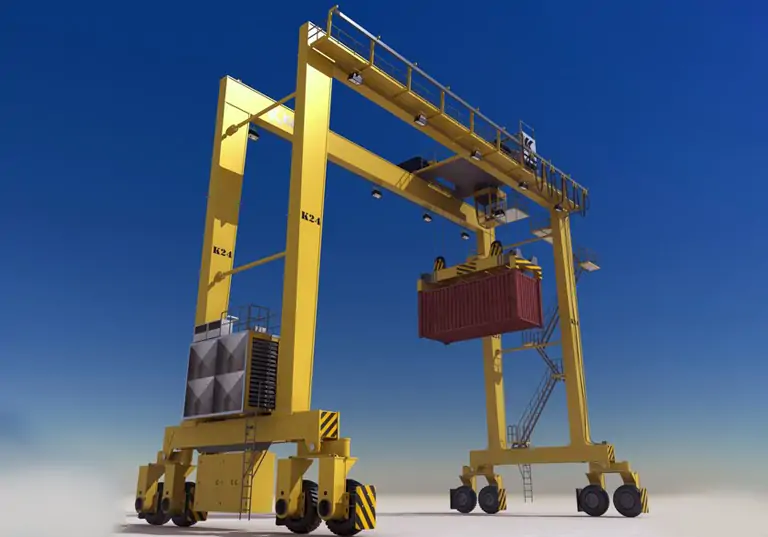
If your operation moves containers, precast concrete beams, or oversized steel components and needs a machine that lifts, transports, and stacks without auxiliary cranes — a straddle carrier is the right equipment class. The key purchase decision is not which brand, but which configuration: capacity tier, power source, wheel count, and lifting height.
This page gives you the specs, pricing, and order process to confirm your configuration and request a quotation.
Table des matières
Quick Reference: Straddle Carrier Specs & Price Guide
| Configuration | Capacité | Hauteur de levage | Wheel Config | Indicative Price (FOB) |
| Industrial (light) | 5T–30T | 1.5–4m | 4-wheel | $25,000–$60,000 |
| Industrial (heavy) | 30T–100T | 3–6m | 8-wheel | $60,000–$130,000 |
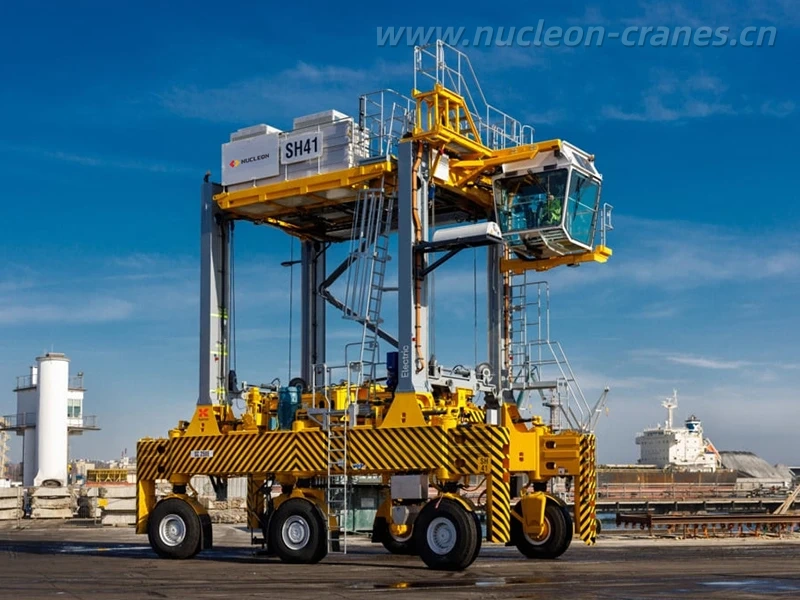
| Port / Container | 35T–80T | Up to 11.6m (1-over-4) | 8-wheel | $90,000–$190,000 |
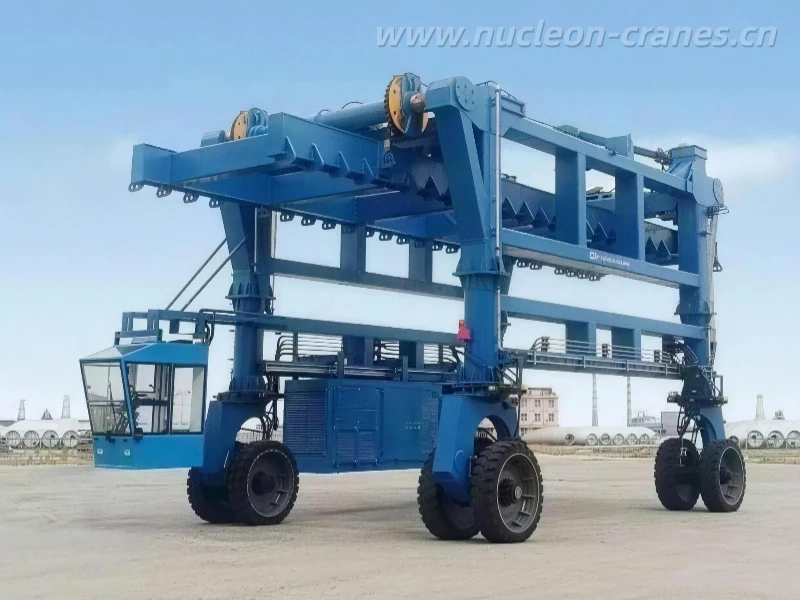
| Heavy Civil / Bridge | 100T–500T | 4–10m | 16–24 wheel | $140,000–$290,000+ |
| Custom / Ultra-heavy | 500T–1,000T | Project-specific | 24+ wheel | Quoted individually |
Prices are market reference (indicative, FOB China). Final price depends on configuration, certifications, and destination.
Request Exact Pricing for Your Load — Get a Quote
Confirm Your Configuration Before You Order
Buying the wrong configuration is the single most expensive mistake in straddle carrier procurement. These three parameters determine your machine — get them wrong and you're looking at a costly retrofit or a second purchase.
1.1: Capacity — Rated Load vs. Working Load Factor
The nameplate capacity of a straddle carrier assumes standard duty cycle (FEM Class A3–A5). In high-frequency operations — such as continuous container shuttling with lifts every 3–5 minutes — working load should be derated to 80–85% of rated capacity to stay within fatigue design limits (per FEM 1.001).
A common procurement error: ordering a 30T unit based on the heaviest single load, then running it at 28T continuously in a shift. Within 18 months, structural fatigue becomes visible on the main beam joints — a repair that costs 30–40% of the original machine price.
Rule: Calculate your 90th-percentile operating load (not peak load) and size the machine so that figure sits at ≤80% of rated capacity.
1.2: Lifting Height — Stacking Tier and Clear Height
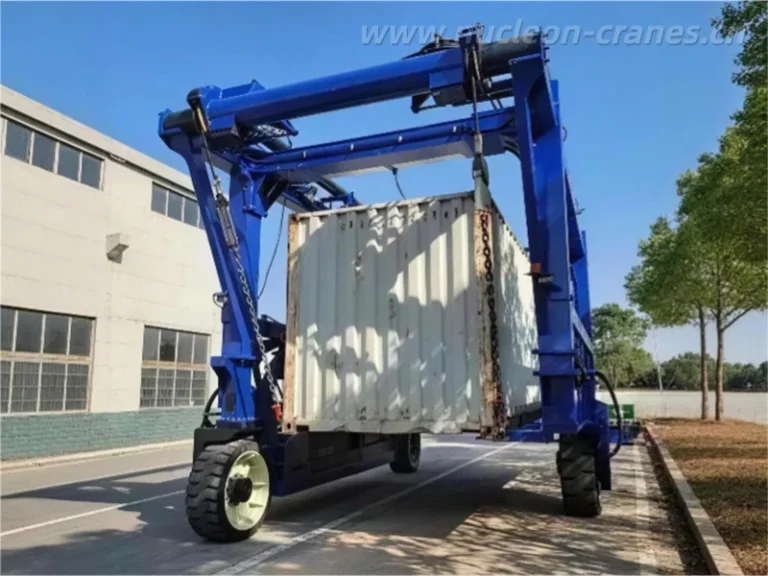
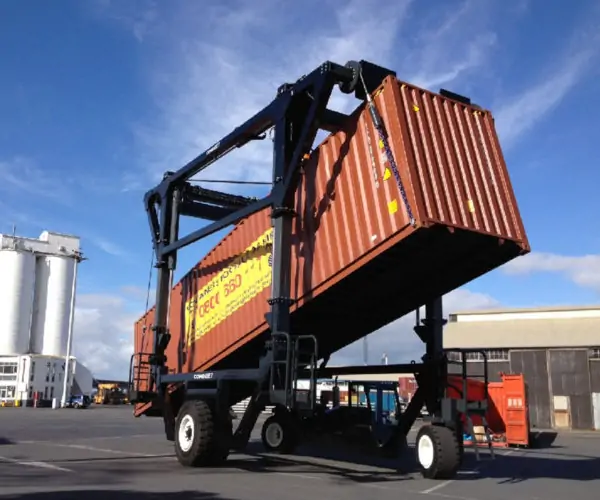
Straddle carriers are rated by stacking tier: 1-over-1, 1-over-2, 1-over-3, or 1-over-4. For 9'6" high-cube containers, 1-over-4 stacking requires approximately 11.6m of lifting height (per ISO 668 container height standards).
More critically: the machine's own structural height must fit under your facility's door or overhead obstruction. A standard 60T port straddle carrier stands 12–14m tall (unladen). Many buyers confirm load capacity and stacking tier but fail to measure their yard entry gate height — discovering the mismatch only at delivery.
Checklist before ordering:
- Maximum load height (incl. spreader clearance)
- Facility entry gate height (if indoor operations apply)
- Ground-bearing capacity (minimum 15T/m² for most 30T+ units)
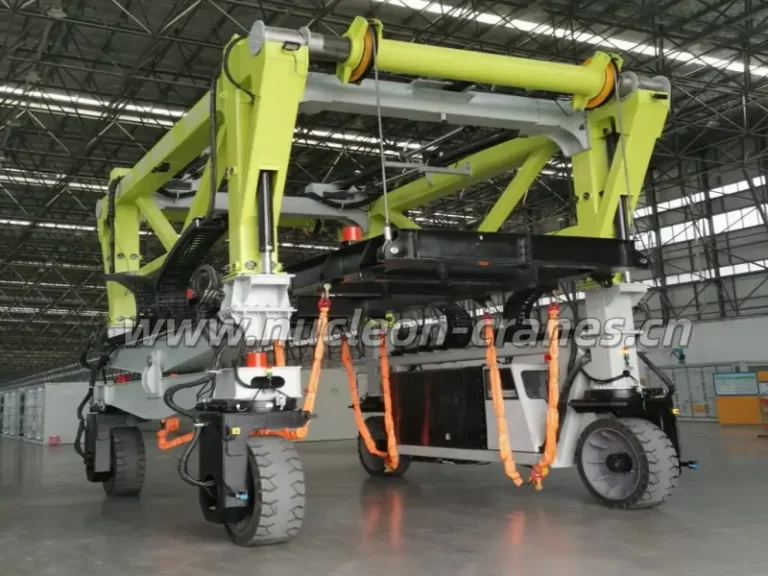
1.3: Power Source — Diesel vs. Electric
Choosing power source affects not just operating cost but site infrastructure requirements.
| Facteur | Diesel | Electric (Battery) |
| Upfront cost | Baseline | +15–25% |
| Fuel/energy cost (per shift) | ~$80–120 | ~$18–30 |
| 5-year operating cost | Plus haut | ~40% lower |
| Charging infrastructure needed | No | Yes (30–60kW charger) |
| Emission compliance (EU/port zones) | Check local regs | Zero-emission compliant |
| Complexité de la maintenance | Higher (engine, hydraulics) | Lower (motor + battery) |
| Cold-start reliability | Reliable | Battery degradation in <-10°C |
For indoor operations, emission-controlled port zones, or sites with grid power available, electric is now the default choice. For remote construction sites or locations without stable grid access, diesel remains the practical option.
⚠️Hidden Cost: Infrastructure
Electric straddle carriers require level, compacted surface with a minimum ground-bearing capacity of 15–20T/m². If your yard surface needs reinforcement, budget an additional $7,000–$30,000 for ground preparation — a cost that rarely appears in equipment quotations but directly determines whether the machine can operate safely.
Certifications & Supplier Evaluation
2.1: Which Certifications to Require
For export markets, the mandatory certifications depend on destination:
| Market | Required | Recommended |
| European Union | CE (Machinery Directive 2006/42/EC) | EN 13000, EN 14492-2 |
| China domestic | GB/T 3811-2008 (Crane Design), GB 6067-2010 (Safety) | GB/T 14406-2011 |
| North America | ASME B30.16 (overhead hoists, applicable sections) | OSHA 1910.179 compliance |
| General export | ISO 9001 (QMS), CE | ISO 4301 duty classification |
CE marking is mandatory for straddle carriers entering EU member states, covering both the structural frame and all lifting components under Machinery Directive 2006/42/EC. Request the full Declaration of Conformity and test load certificates — not just the CE mark on the nameplate.
⚠️ Procurement Red Flag
Several suppliers CE-mark the chassis but source the spreader and hydraulic system from sub-suppliers with separate — sometimes expired — certification. Always request component-level CE declarations for spreader, hoist, and control system separately.
2.2: Supplier Evaluation Checklist
Before issuing a purchase order, confirm:
- Factory inspection option: Can you or a third-party inspector visit before shipment?
- Load test documentation: Factory acceptance test (FAT) at 110% rated load, per GB 6067-2010 or equivalent
- Spare parts availability: Confirm local availability of hydraulic seals, spreader twist-locks, and control boards — downtime cost for a straddle carrier averages $800–$2,500/day
- After-sales support: On-site commissioning included? Remote diagnostics available?
- References in your industry: Ask for 2–3 customer references in the same application type (port vs. precast vs. construction)
Order Process & Delivery
3.1: Standard Lead Time by Configuration
| Configuration | Lead Time (from order confirmation) |
| 5T–30T industrial (standard config) | 45–60 days |
| 30T–100T (custom wheel / lifting height) | 60–90 days |
| 100T–300T heavy civil | 90–120 days |
| 500T+ ultra-heavy / fully custom | 120–180 days |
Lead times assume full payment or LC at sight; customized electrical or control systems may add 2–4 weeks.
3.2: What to Include in Your RFQ
To receive an accurate quotation within 24–48 hours, provide:
- Load weight (90th-percentile operating load, not peak)
- Load dimensions (L × W × H)
- Required lifting height (clearance required, not just stack height)
- Ground conditions (paved concrete, compacted gravel, soil type)
- Power preference (diesel / electric / hybrid)
- Destination port (for shipping estimate)
- Required certifications (CE / GB / ASME)
- Quantity (single unit vs. fleet order — fleet orders of 3+ units typically qualify for 5–8% volume pricing)
Conclusion
Straddle carriers for sale at Nucleon cover the full capacity range from 5T industrial units to 1,000T custom heavy-lift configurations. The right machine is determined by three non-negotiable parameters: operating load (sized to 80% of rated capacity), lifting height (including facility clearance), and power source (matched to site infrastructure).
Before you request a quote, confirm your ground-bearing capacity and maximum clear height — these two site parameters resolve more configuration questions than any spec sheet.
Ready to order or need a configuration recommendation? Obtenez un devis direct usine now.

Spécialiste en équipement
Chef d'entreprise expérimenté dans le domaine des grues, avec une vaste expérience en gestion de projets de levage lourd et en supervision opérationnelle. Antécédents avérés en matière de croissance du chiffre d'affaires et de respect des normes de sécurité.
FAQ
Q1: How much does a straddle carrier cost in 2026?
Straddle carriers for sale range from $45,000 to $580,000+ depending on capacity and configuration. A 5–30T industrial unit typically costs $45,000–$120,000 (FOB). Port-grade 60T container handlers run $180,000–$380,000. Units above 100T for heavy civil or bridge applications start at $280,000. Electric models carry a 15–25% upfront premium over equivalent diesel units but recover cost through lower operating expenses within 2–3 years in high-utilization applications.
Q2: What is the difference between a diesel and electric straddle carrier?
Electric straddle carriers cost 15–25% more upfront but reduce per-shift energy costs from ~$80–120 (diesel) to ~$18–30 (electric). They are zero-emission and suited for port restricted zones and indoor operations. The trade-off: electric models require 30–60kW charging infrastructure and may see battery performance degrade below -10°C. Diesel remains the better choice for remote sites or locations without reliable grid power.
Q3: What certifications should a straddle carrier have for EU import?
CE marking under Machinery Directive 2006/42/EC is mandatory for straddle carriers sold in the EU. Request both the chassis CE Declaration of Conformity and separate component-level declarations for the spreader and hoist system. Structural design should reference EN 13000 or EN 14492-2. Ask for the factory acceptance test (FAT) report showing 110% rated load testing before shipment acceptance.
Q4: How long does it take to receive a straddle carrier after ordering?
Standard lead time ranges from 45 days (5–30T standard config) to 120+ days (100T+ custom configurations). Fleet orders of 3+ units should build in additional scheduling time. Payment terms affect lead time: LC at sight or full advance payment typically locks the production slot; partial payment terms may extend delivery by 2–4 weeks depending on factory schedule.
Q5: What ground conditions does a straddle carrier require?
Most 30T+ straddle carriers require a minimum ground-bearing capacity of 15–20T/m² on a level, compacted surface. Uneven ground or soft soil requires reinforcement before the machine can operate safely — a preparation cost of $15,000–$60,000 that is not included in equipment pricing. Always confirm ground conditions with your civil engineer before finalizing the equipment order.

 English
  العربية
  Español
  Français
  Português
  Русский