

A Grúa pórtico para contenedores is a large portal-frame lifting machine designed to handle standardized ISO shipping containers in ports, intermodal rail yards, and logistics terminals, as classified under ISO 4301 and FEM 1.001. It moves containers between vessels, yard stacks, trucks, and railcars using a travelling trolley fitted with a twist-lock spreader — the device that grips a container's four corner castings for secure, repeatable lifts.
If you're evaluating container handling equipment for a new terminal or an expansion, the core decision you face is not just "which crane" — it's which configuration of lift height, span, power system, and duty class actually fits your operational profile. Getting that wrong is expensive: not at delivery, but three to five years in, when maintenance costs climb ahead of schedule and throughput targets slip.
This guide walks through the three primary container gantry crane types, how they work, the technical specifications that matter most, and the one selection criterion — duty class — that the majority of procurement teams underestimate.
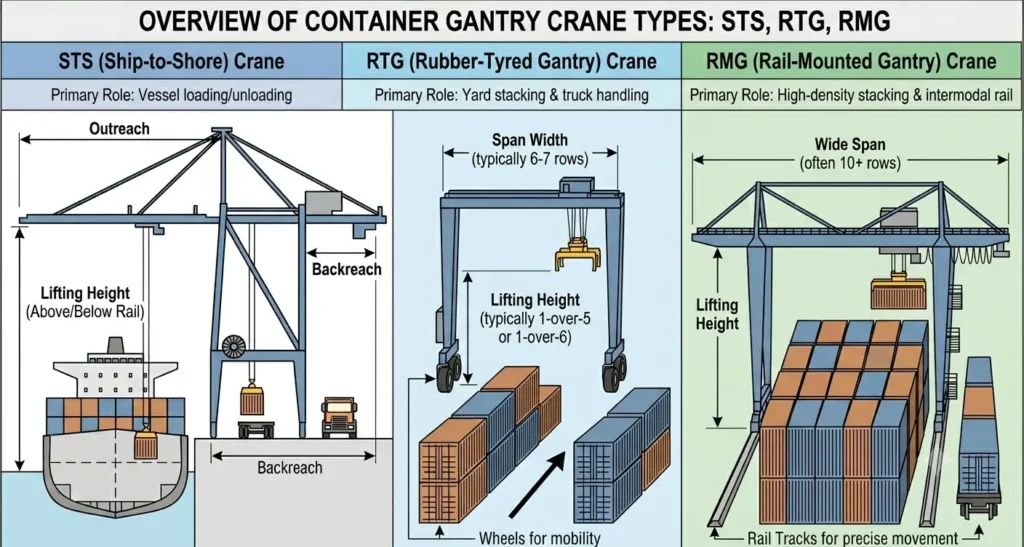
Tabla de contenidos
How a Container Gantry Crane Works
The Three Coordinated Motions That Move Every Container
Every container gantry crane — regardless of type — combines three simultaneous axes of motion: hoisting (vertical), trolley travel (horizontal along the bridge), and gantry travel (longitudinal along the yard or quay). Coordinating these three movements is what allows an operator or automated system to pick up a container from one position and set it down precisely somewhere else, often within positioning tolerances of ±25 mm in modern automated systems.
The spreader is the business end of this operation. It descends onto a container's top surface, and four twist-lock pins engage with the corner castings. Sensors confirm lock engagement before the hoist lifts. Modern telescopic spreaders adapt automatically to 20 ft, 40 ft, and 45 ft ISO containers without manual adjustment, which is what makes continuous high-cycle operation practical.
Key Components You Need to Understand Before Buying
The gantry frame — a portal structure of welded high-strength steel — carries the entire load, including wind-induced lateral forces that in coastal terminals can be the dominant design driver, not the container weight itself. The trolley houses the hoist drum, wire ropes, motors, and variable-frequency drives (VFDs); VFDs are important because they allow smooth speed ramping and energy regeneration during lowering. The electrical control system — typically PLC-based with anti-sway algorithms — governs all three axes and is where automation investment pays off most directly in cycle-time reduction.
The Three Main Types of Container Gantry Cranes
Ship-to-Shore (STS) Cranes: For Vessel Loading and Unloading


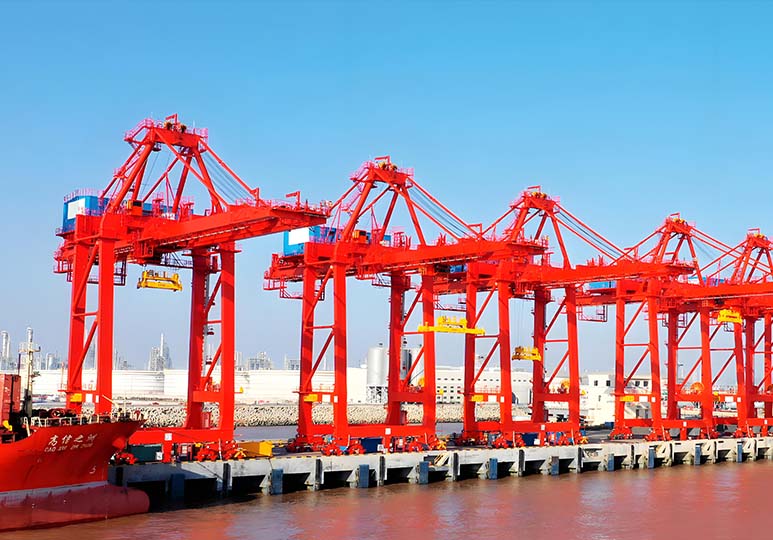
Grúas STS are the only equipment category purpose-built for the vessel-to-quay interface, and they are not interchangeable with yard cranes for that function. They are fixed to the quayside on rails, with a horizontal boom that extends out over the ship and retracts for vessel maneuvering. Outreach — the distance the boom extends over the vessel — determines which ship classes a terminal can service, and getting this specification wrong at procurement locks a terminal into a vessel size ceiling for decades.
As a general industry reference: Panamax STS cranes typically have outreach in the range of 40–45 m and lifts around 40–50 tons; Post-Panamax units extend to 48–65 m and 50–65 tons; and ultra-large vessel (ULCV) configurations can reach 65 m or more. Power is almost universally shore-supplied AC, typically at 6,600–13,200 V, converted internally to variable-frequency drives. Shore power is preferred over on-board generators because it reduces emissions and simplifies maintenance.
The selection mistake to avoid here: specifying STS outreach for today's largest vessel rather than the probable vessel mix over the crane's 25–30 year service life. Over-specifying outreach adds cost; under-specifying means the terminal can't serve larger ships without replacing equipment.
Rubber-Tired Gantry Cranes (RTG): Flexibility Over Fixed Infrastructure
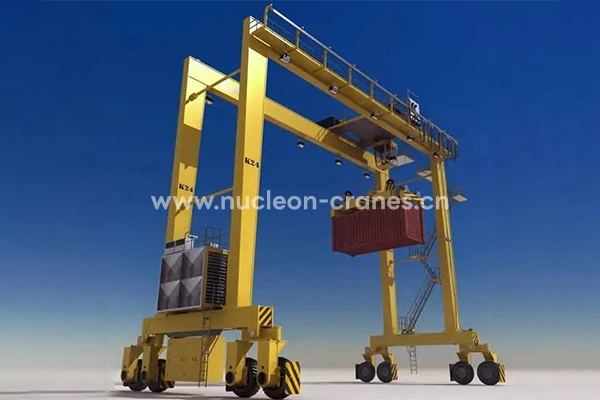
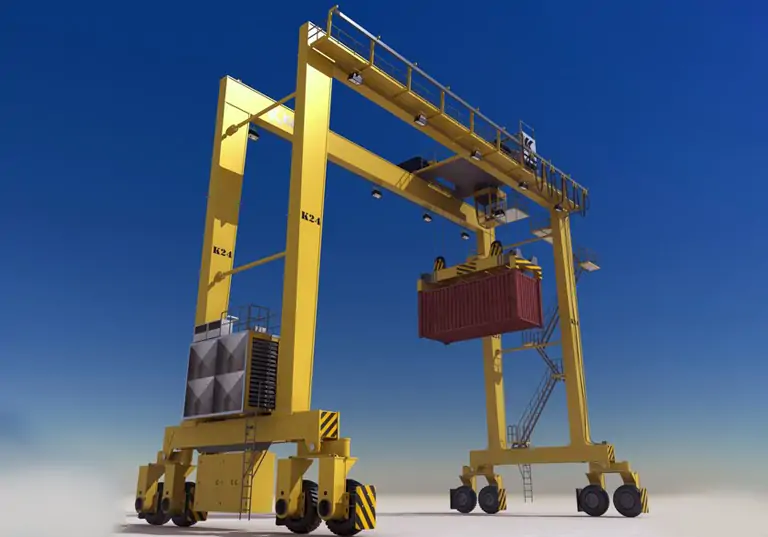
Grúa RTG
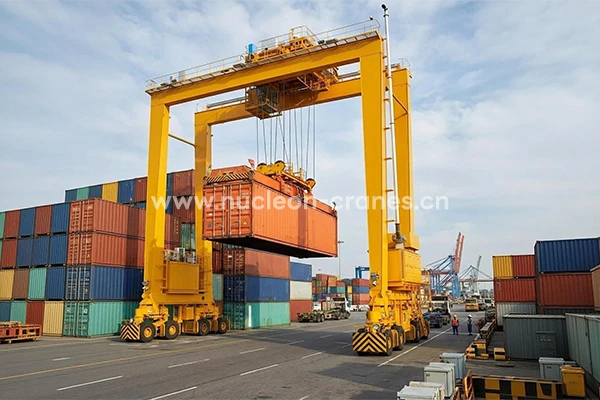
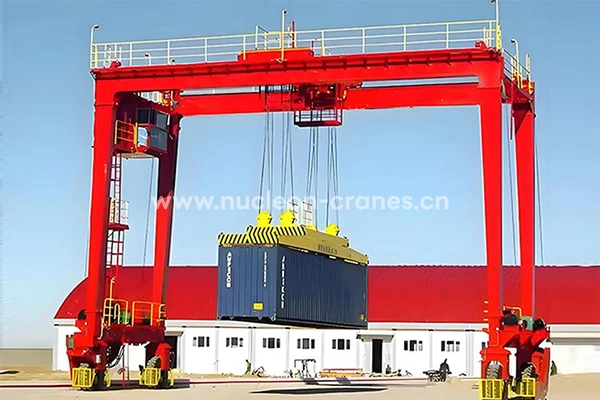
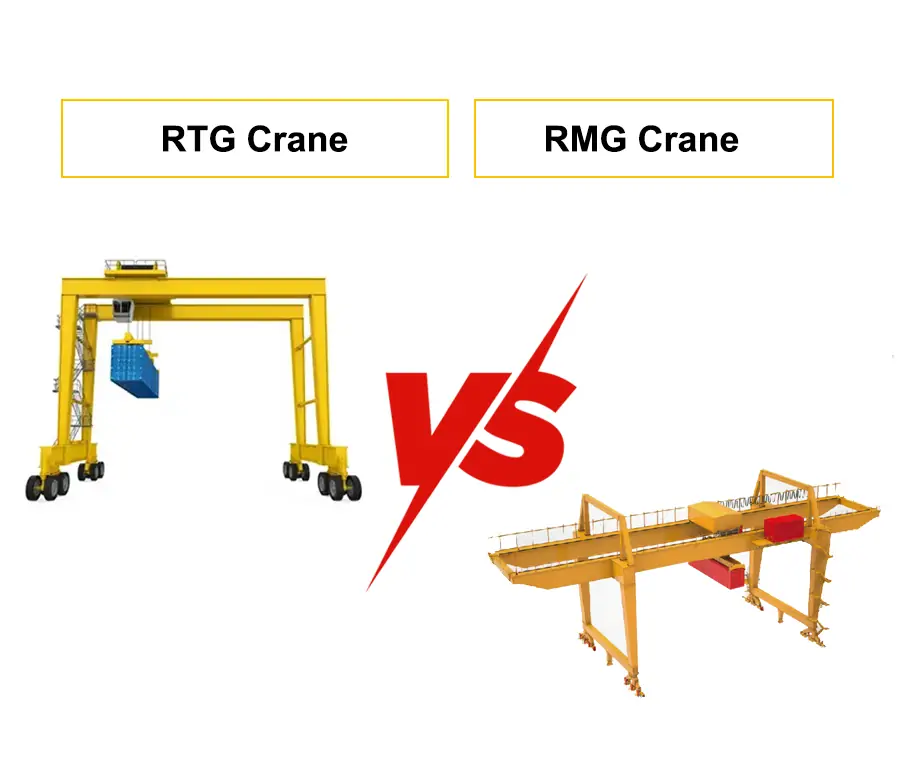
Grúas RTG are the workhorses of medium-sized and growing terminals. They travel on rubber tires rather than rails, which means they can be repositioned across yard blocks as traffic patterns change — a genuine operational advantage when a terminal's layout is not yet stable or throughput is uneven across zones.
Typical RTG configurations span 6+1 container lanes (roughly 23–26 m) and stack 5–6 containers high, giving a lift height of approximately 15.5–18.5 m. Capacity generally runs 35–41 tons for standard configurations, with heavy-duty variants reaching 70 tons for dense cargo routes. Hoisting speed in full-load condition typically falls around 20–25 m/min, with empty-hook return at 40–50 m/min.
The power system choice is the critical variable for RTG total cost of ownership. Diesel-only RTGs carry low upfront cost but high fuel and emissions overhead. Hybrid diesel-electric systems (with energy storage buffering peak demand) reduce fuel consumption significantly over high-utilization life — the payback timeline depends on cycle intensity and local fuel costs, but at continuous operation the economics typically favor hybrid within a few years. Full electric RTGs, powered via cable reel or conductor rail, eliminate diesel entirely; they require infrastructure investment but are increasingly the default choice for terminals with sustainability mandates or high cycle rates.
Rail-Mounted Gantry Cranes (RMG): Precision and Automation for Dense Yards
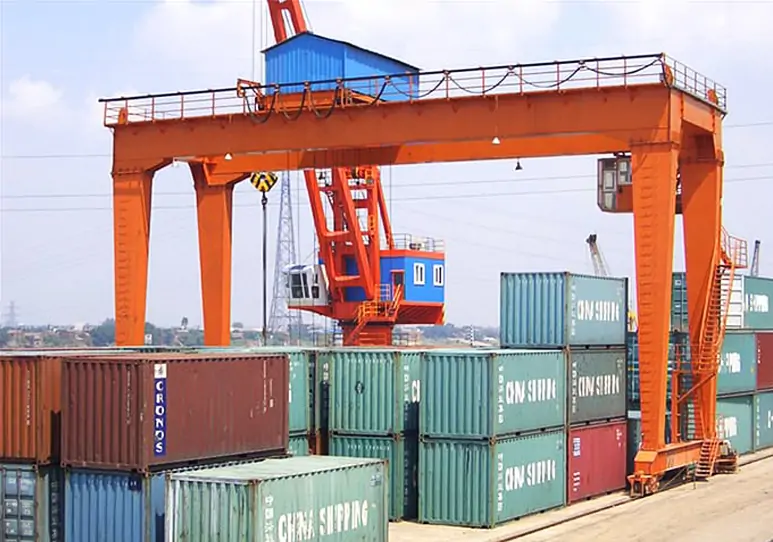
Grúa RMG
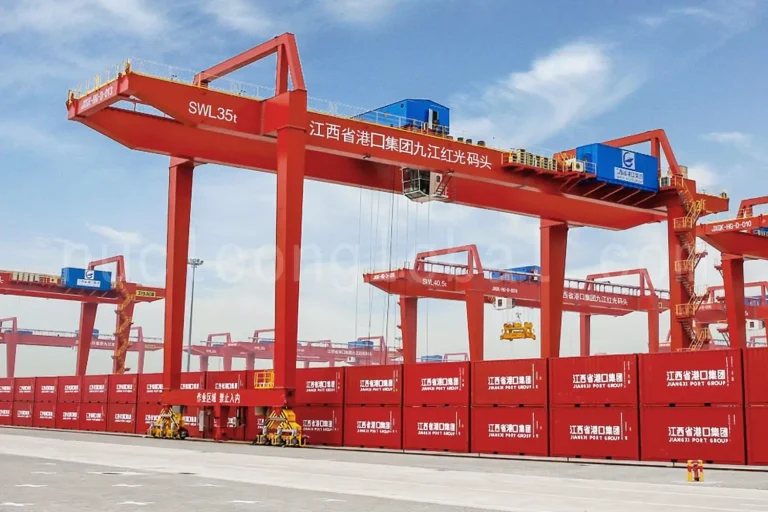
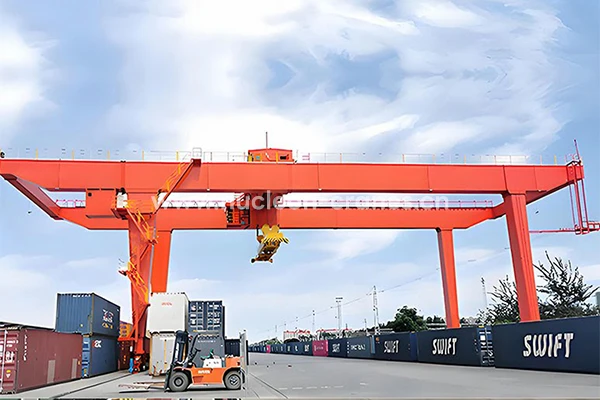
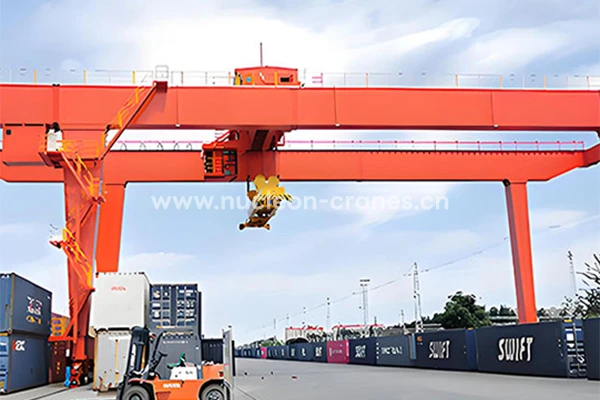
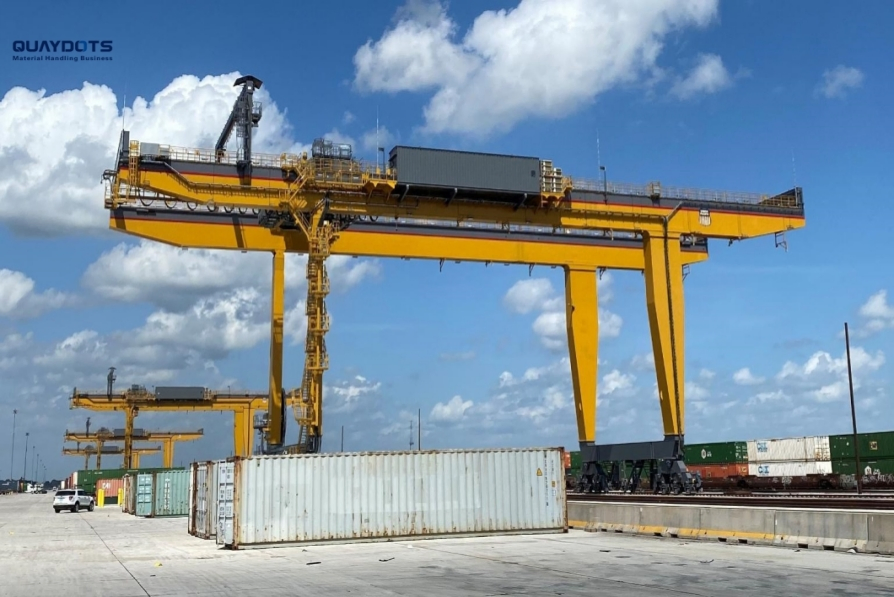
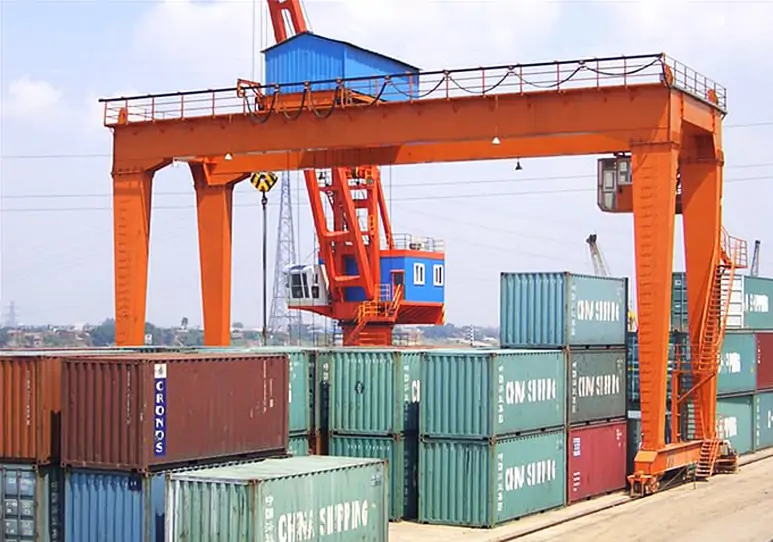
RMG cranes travel on fixed steel rails and are the preferred choice wherever consistent stacking geometry and automation compatibility are priorities. Because rail guidance eliminates the lateral wander inherent to tire-mounted cranes, RMGs achieve tighter positioning repeatability — typically ±20–30 mm — which matters when stacking containers 6–8 high with automated guidance systems.
The trade-off versus RTG is infrastructure: rails, concrete foundations, and electrical supply via busbar or festoon cable must be installed before the crane arrives. This front-loads cost and reduces layout flexibility — once the rails are in, the yard geometry is fixed. For a terminal confident in its long-term layout and committed to automation, that trade-off is favorable. For a terminal still developing its land use plan, it is a risk.
RMGs are the backbone of fully automated terminal designs. Modern automated RMG systems operate 24/7 with minimal on-site staffing, integrating with Terminal Operating Systems (TOS) for real-time container tracking and AGV handoff. Positioning accuracy of ±20 mm enables high-density stacking that meaningfully increases yard capacity versus a manual RTG yard.
The Specification That Most Procurement Teams Miss: Duty Class
Duty class determines how long a crane actually lasts under your operating conditions
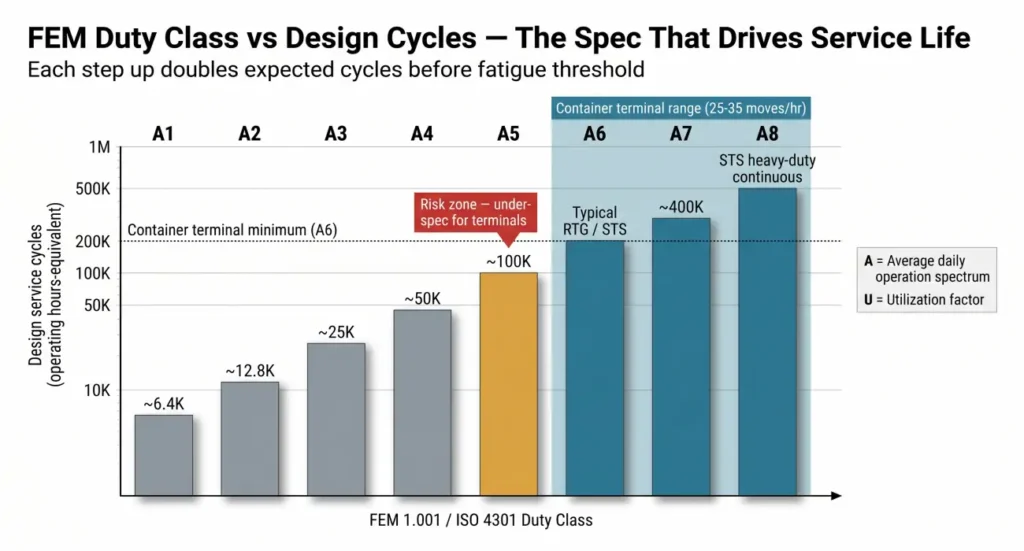
Lifting capacity — the tonnage figure on the nameplate — tells you the maximum load. Duty class tells you how many cycles the crane is designed to perform over its service life without fatigue failure, which is the specification that actually governs maintenance frequency and replacement timeline.
Under FEM 1.001 (and the aligned ISO 4301 framework), cranes are categorized from A1 (light, infrequent use) through A8 (continuous heavy-duty use). Container terminal cranes operating at high throughput — say, 25–35 moves per hour for extended shifts — will typically require FEM duty class A6 to A8. A crane specified at A4 or A5 for the same workload will reach fatigue thresholds ahead of its nominal design life, meaning structural inspections escalate, components require early replacement, and unplanned downtime becomes a budget line item rather than an exception.
The procurement mistake is common: a buyer compares two cranes by rated capacity and price, selects the lower-priced unit, and discovers 4–5 years later that the duty class was specified for a lighter operating profile. The crane is not broken — it is simply being used beyond what it was designed for. Retrofit or replacement at that point costs far more than the original price difference.
Before issuing any RFQ, document your expected cycles per hour, operating hours per day, and planned service life. Present that to suppliers and require them to confirm the duty class mapping. If they cannot map your operating profile to a specific FEM class, that is a due-diligence gap.
Environmental and Site Factors That Shape Your Specification
Wind, seismic zone, and ground conditions affect structure more than load does
Coastal container terminals experience sustained wind loading that, in structural design terms, can exceed the moment generated by the container payload. Standard operational limits for container gantry cranes generally follow a pattern: normal operation up to around 20 m/s; reduced-speed cautious operation in the 20–25 m/s range; shutdown and storm anchoring required above 28–30 m/s. These thresholds are reference values — your specific crane's limits will be confirmed by the manufacturer based on the structural design for your site's wind zone.
For terminals in seismic zones, additional base bracing or isolation systems are required. This is not optional: it is a compliance requirement under local building and equipment codes, and it adds meaningfully to structural cost. Budget for it from the start rather than discovering it during permit review.
Ground bearing capacity matters most for RTG deployments. RTG cranes concentrate very high point loads through their corner feet, and if the yard surface was not designed for this, pavement failure is a recurring maintenance cost that often surprises terminal operators who focused the pre-purchase analysis entirely on the crane itself.
How to Choose: RTG vs. RMG vs. STS
Match crane type to operational profile, not to the lowest quote
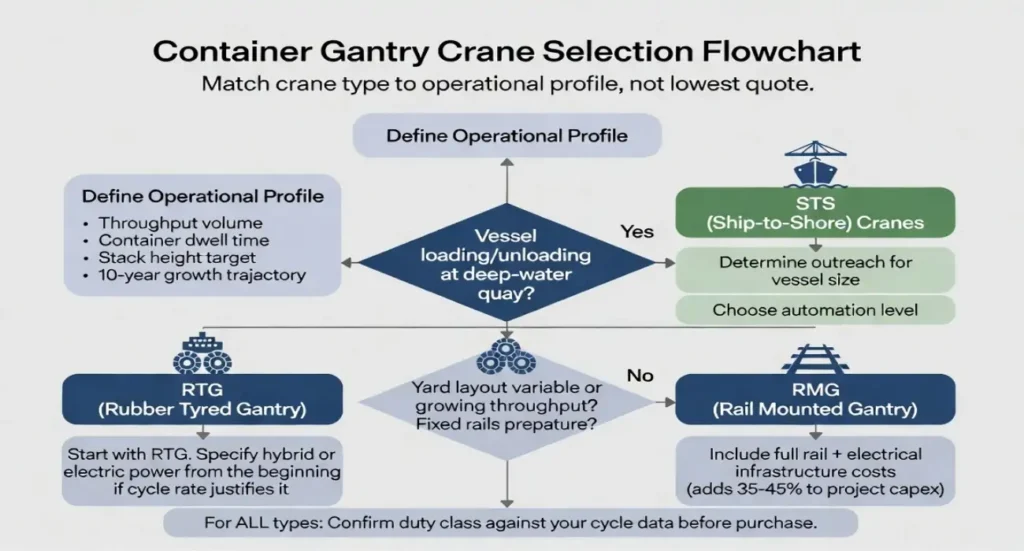
The right framework is to start with your operational profile — throughput volume, container dwell time, stack height target, automation ambition, and 10-year growth trajectory — and let that drive crane type selection. The selection tree is straightforward:
If you are handling vessel loading and unloading at a deep-water quay, you need STS cranes. There is no substitution. The question then becomes outreach (vessel size ceiling) and automation level.
If you are managing a yard with variable layout or growing throughput where locking into fixed rail geometry feels premature, RTG is the right starting point — but invest in hybrid or electric power from the outset if your cycle rate justifies it. Retrofitting power systems later costs more than specifying correctly now.
If your yard layout is established, you are planning for high automation, and you want maximum space efficiency through tight stacking geometry, RMG is the correct choice. Factor in the full rail and electrical infrastructure cost in the capex model — equipment price alone understates the project cost by 35–45%.
For all three types, confirm duty class against your cycle data before signing any purchase agreement.
Conclusión
A container gantry crane is the mechanical backbone of any container terminal, but "which crane" is a less important question than "which specification fits your actual operating profile." The three main types — STS for quayside vessel transfer, RTG for flexible yard operation, and RMG for automated high-density stacking — each have clear application boundaries.
The single most actionable step before any procurement: calculate your expected cycles per shift, map that to FEM duty class, and require suppliers to confirm the match in writing. That one step prevents the most common and most costly container crane procurement error. If you are in early-stage planning, engage a qualified terminal engineer to model your throughput projections before finalizing crane specifications.
Related article:
Container Gantry Crane for Sale: RTG vs RMG vs STS — Pricing, True Costs & How to Choose.
Container Gantry Crane Brands: Official Resources, Model Lookup & Authentic Supplier Guide

Especialista en Equipos
Gerente de Negocios de Grúas con experiencia y amplia trayectoria en gestión de proyectos de elevación pesada y supervisión operativa. Historial comprobado de impulso del crecimiento de los ingresos y garantía del cumplimiento de las normas de seguridad.
Preguntas frecuentes
P1: What is the difference between an RTG and an RMG container gantry crane?
RTG cranes travel on rubber tires and can be repositioned across yard zones, making them suitable for terminals with evolving layouts and moderate automation levels. RMG cranes run on fixed rails, offering tighter positioning accuracy and full automation compatibility — but they require permanent rail and electrical infrastructure, which locks in yard geometry. Choose RTG for flexibility; choose RMG when your layout is fixed and automation is the goal.
Q2: What lifting capacity do I need for a container gantry crane?
Standard ISO containers at maximum gross weight reach 30.48 tons for a 20 ft unit and 32 tons for a 40 ft unit. Container yard cranes are typically specified in the 35–65 ton range to accommodate payload plus spreader and hook weight, with a safety margin. However, capacity alone is not sufficient — duty class (FEM 1.001) must be confirmed against your expected cycle volume, or the crane will underperform its nominal service life.
Q3: What is duty class, and why does it matter in crane procurement?
Duty class (classified under FEM 1.001 and ISO 4301 as groups A1–A8) defines the cumulative load spectrum and number of operating cycles a crane is designed to handle over its service life. A crane specified at too low a duty class for a high-throughput terminal will reach structural fatigue thresholds earlier than planned, increasing maintenance costs and reducing uptime. Always document your cycle rate before issuing an RFQ and require the supplier to confirm the duty class mapping explicitly.
Q4: Can container gantry cranes be automated?
Yes, and automation readiness varies significantly by crane type. RMG cranes are the most automation-compatible and form the core of fully unmanned terminal designs. RTG cranes can support semi-automation and remote operation but require additional sensor and guidance systems. STS cranes can be semi-automated for trolley positioning, but the variable dynamics of ship movement make full automation technically challenging. Confirm automation compatibility and TOS integration capability with the supplier before purchase.
Q5: What site preparation is required before installing a container gantry crane?
Requirements vary by crane type. RMG cranes require rail track installation, concrete foundations engineered to rail load specifications, and busbar or festoon electrical supply. RTG cranes require yard pavement designed for their concentrated corner-foot loads — standard asphalt is often inadequate. STS cranes require quayside rail and high-voltage shore power supply. In seismic zones, additional structural requirements apply under local codes. Site preparation costs can represent 35–45% of total project cost for RMG installations and should be included in any capex comparison.

 English
  العربية
  Español
  Français
  Português
  Русский