

A jib crane is a lifting device with a horizontal arm (the "jib" or boom) mounted on a vertical column or wall bracket, used to lift and rotate loads within a fixed work area — typically ranging from about 250 lbs up to 15 tons depending on type and mounting. Unlike an puente grúa, which covers an entire building span, a jib crane is built to serve one workstation or a small cluster of them with fast, repeatable, precise lifts.
If you're evaluating whether a jib crane is the right fit for a specific work cell — a machine loading station, an assembly bay, a maintenance area — the practical questions are less about "what is a jib crane" in the abstract and more about which type matches your rotation needs, your lifting frequency, and your floor or wall space.
This guide covers how a jib crane works, the main types and where each fits, and a selection framework that goes beyond spec sheets — including the duty class question that most competitor guides skip and the capacity mistake that trips up more buyers than any other.
Tabla de contenidos
What Is a Jib Crane?
A jib crane consists of a horizontal boom that a trolley and hoist travel along, mounted on a vertical support that allows the whole boom to rotate — giving it a circular or partial-circular working area rather than the rectangular coverage of a bridge or grúa pórtico. That's the core distinction from other overhead lifting equipment: a jib crane trades large-area coverage for fast, repeatable, localized lifts.
How a Jib Crane Works
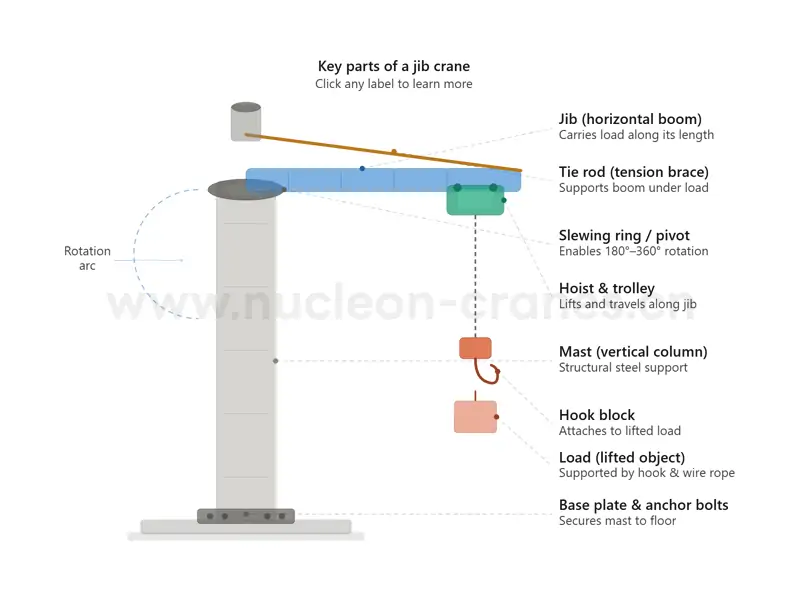
The boom carries a trolley (manual, motorized, or pneumatic) that positions the hoist along its length, while the vertical mast or wall bracket allows the entire boom to swing through a rotation arc — 360° on freestanding and mast-type units, typically 180–200° on wall-mounted units. The hoist itself does the lifting and lowering, exactly as it would on a bridge crane; what makes a jib crane distinct is the boom-and-rotation geometry that gets the load where it needs to go within the work cell without a full bridge structure overhead.
Typical Capacity and Span Range
Jib crane capacity typically ranges from about 250 lbs on light articulating units to 15 tons on the largest freestanding designs, with boom length (span) commonly running up to around 40–50 feet on the biggest freestanding and mast-type units. These are reference figures, not a fixed menu — actual capacity and span for a specific model should be confirmed against the manufacturer's current spec sheet, since capacity depends on type, mounting, and duty class together, not span or type alone.
One spec that's easy to get wrong on paper: usable lifting height is not the same as your building's clear height. The hoist body, hook travel, wire rope reeving, and any lifting attachment (sling, beam, or fixture) all subtract from the ceiling height before you get a usable hook range — as a rule of thumb, budget for the hoist body (often 0.3–0.5 m), hook travel, the lifting attachment (roughly 0.2 m or more), and a safety margin of at least 0.5 m, which together commonly total a meter or more of "lost" height that a quick eyeball measurement of the building misses. Confirm usable height with your supplier using actual component dimensions, not just the clear height of your building.
Jib Crane Types
The main jib crane types — freestanding, wall-mounted, wall-traveling, mast-type, and articulating — differ mainly in how they're supported and how much rotation and capacity that support allows, which is why choosing between them starts with your mounting constraints, not your load weight.
Freestanding Jib Crane
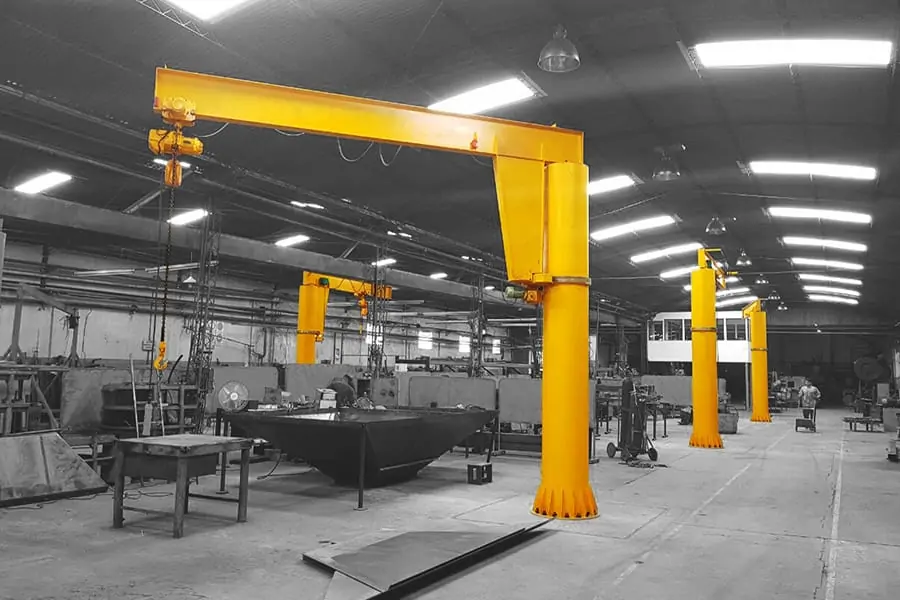
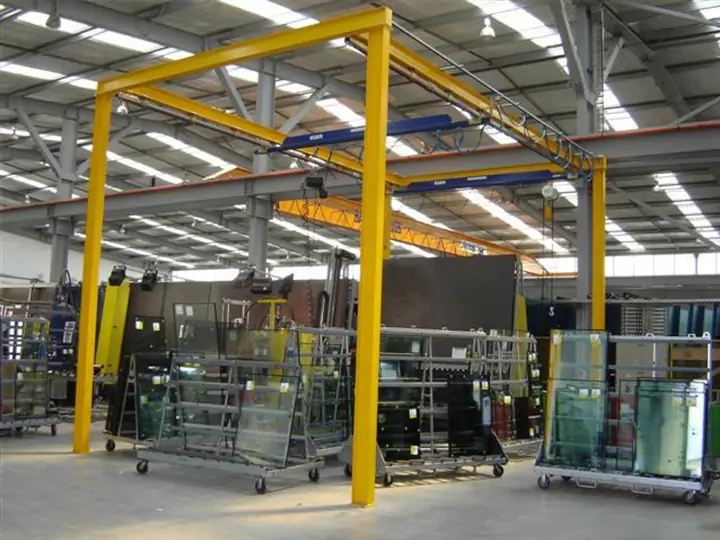
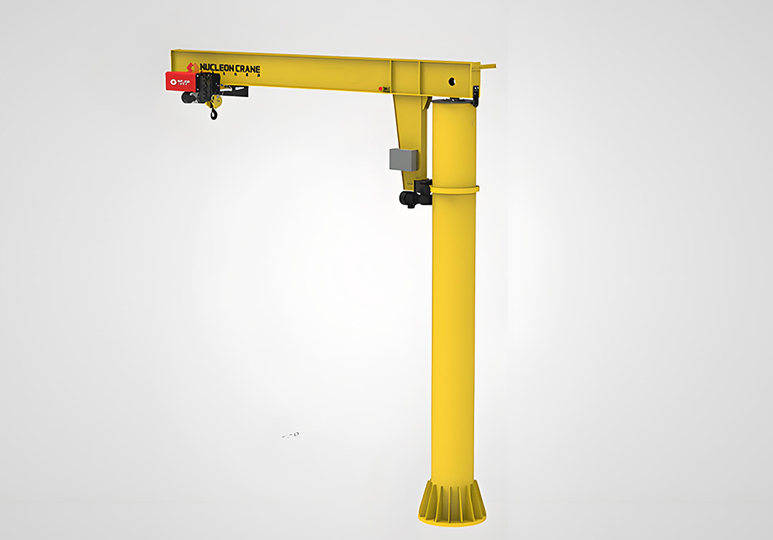
A freestanding jib crane is floor-mounted on its own foundation or base plate, offering the highest capacity (up to around 15 tons) and full 360° rotation among jib crane types, at the cost of requiring dedicated floor space and, in most configurations, a poured concrete foundation. It's the type to default to when you need maximum capacity and rotation and have the floor space to support a permanent installation — common in machine shops, loading docks, and as a supplement under a larger bridge crane system.
Wall-Mounted Jib Crane
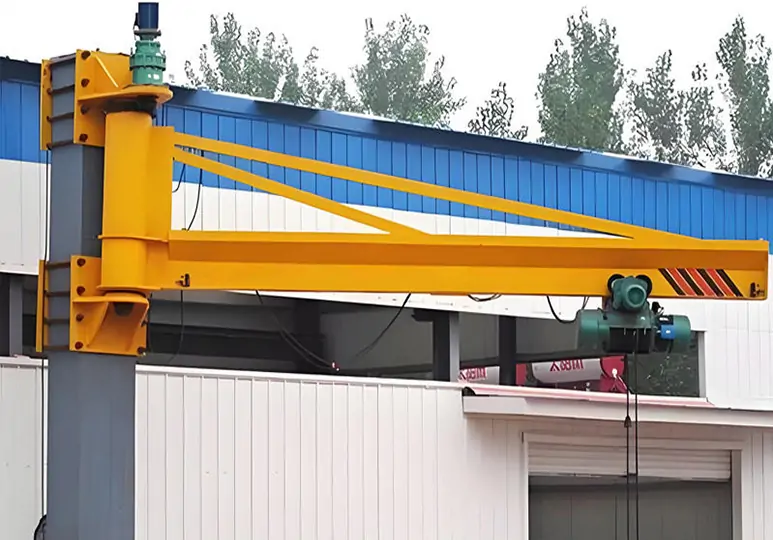
A wall-mounted jib crane attaches to an existing wall or structural column instead of the floor, trading full rotation (typically limited to 180–200°) and some capacity (commonly up to around 5 tons) for zero floor footprint. It's the right call when floor space is at a premium and the work cell only needs coverage on one side — a common fit for assembly line stations and maintenance bays along a building perimeter.
Wall-Traveling Jib Crane
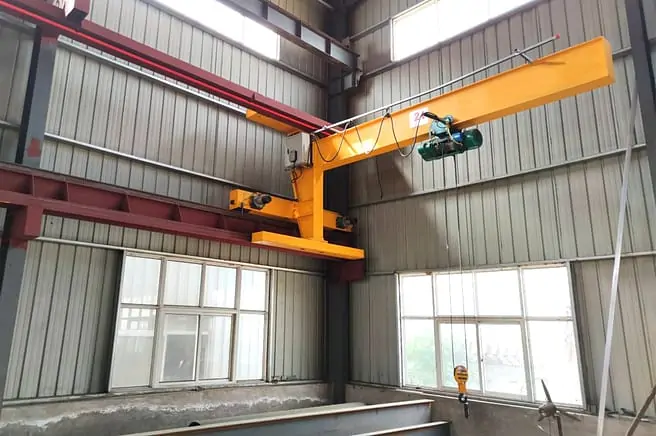
A wall-traveling jib crane mounts on a rail fixed along a wall, adding longitudinal travel to the jib's rotation so one unit can serve several workstations spaced along that wall instead of just one — a good fit for long, narrow workshops, typically in the 1–5 ton range. It costs more than a fixed wall-mounted unit because of the rail and travel mechanism, but it can replace several fixed wall-mounted cranes along the same wall, which often makes it the more economical choice once you're covering more than two or three stations in a row.
Mast-Type Jib Crane
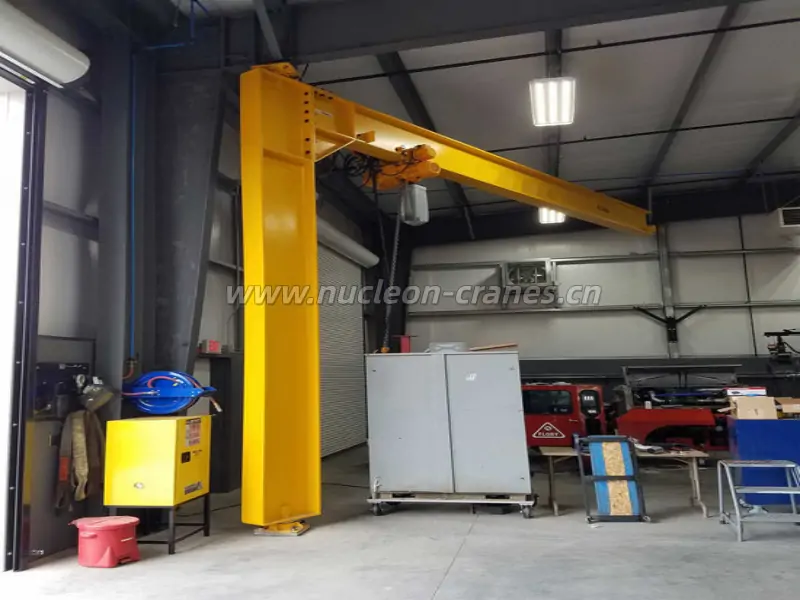
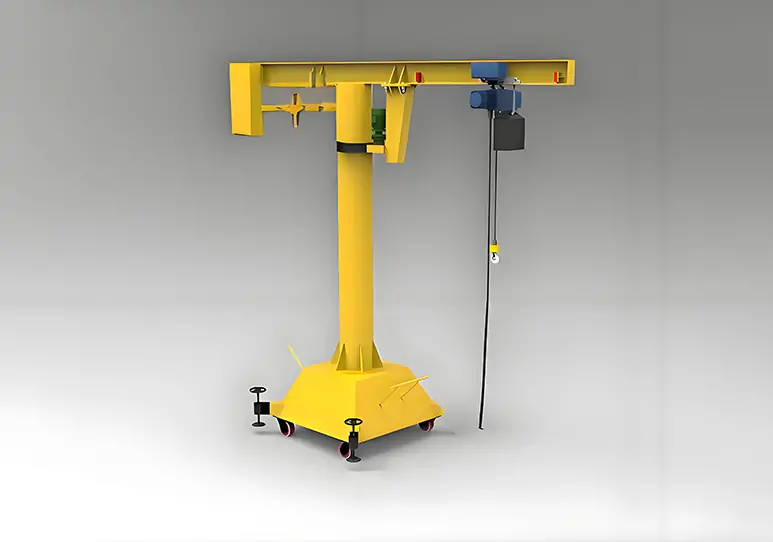
A mast-type jib crane is floor-supported like a freestanding unit but gets additional stability from being tied to an overhead building beam or truss, which lets it use a lighter foundation — often just a few inches of reinforced concrete instead of a full dedicated foundation. This makes it a more economical alternative to a full freestanding crane when the building structure can provide that overhead tie-in point, while still offering 360° rotation and capacity up to roughly 10 tons in most standard designs.
Grúa giratoria articulada
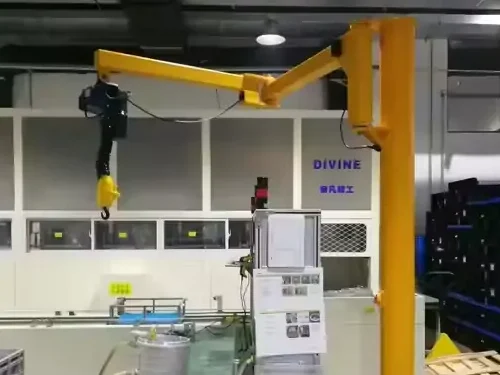
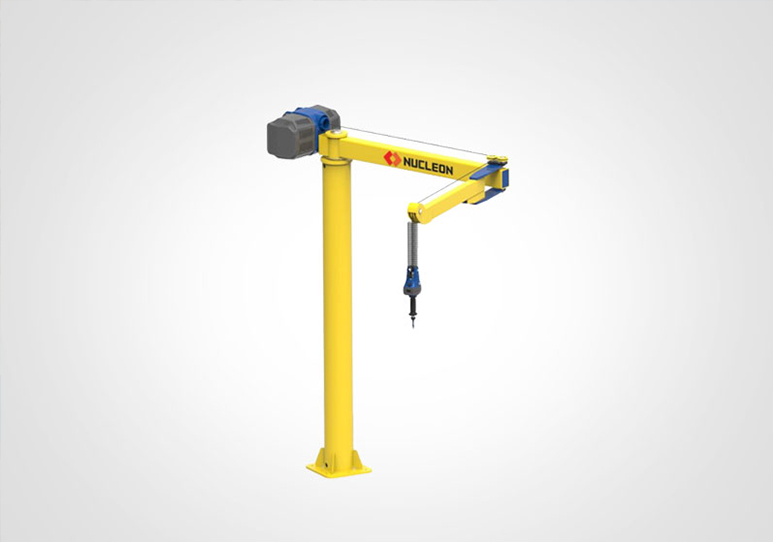
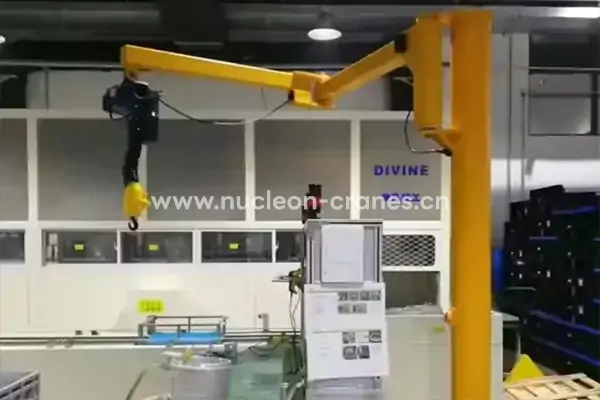
An articulating jib crane has two arms connected by a pivot point instead of one straight boom, letting it reach around obstacles and into confined spaces that a single-boom design can't — at the cost of a much lower capacity, typically around 1 ton. The extra pivot point is what makes it maneuverable around machinery and into tight corners, but it's also why it can't match a freestanding or mast-type crane's capacity — the second arm adds reach flexibility, not lifting strength.
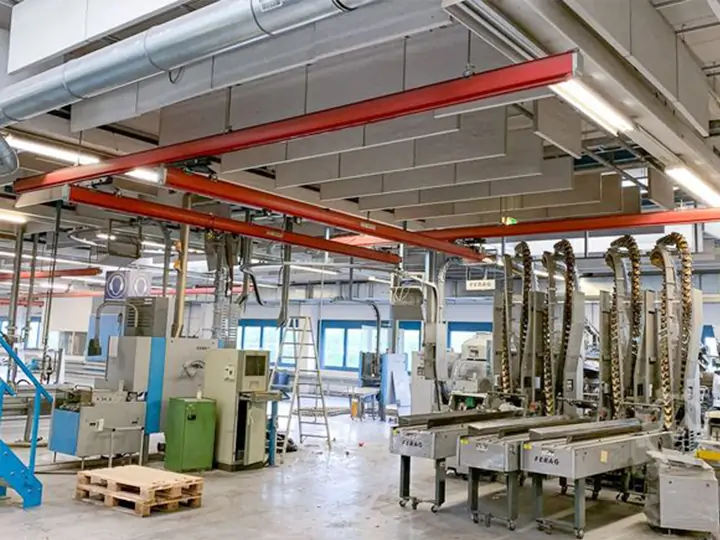
A quick note on a related but distinct system: if your application is 2 tons or under with high-frequency, precision handling — think fine assembly work — a flexible rail system (often called KBK, using lightweight aluminum or steel track) is worth evaluating alongside traditional jib cranes rather than assuming a jib crane is your only option. KBK systems are a different product category from the boom-and-mast jib cranes covered above, generally offering smoother positioning and lower noise for light, frequent lifts, at a different price point than a comparable traditional jib crane — worth a separate conversation with your supplier if this describes your use case.
How to Choose the Right Jib Crane for Your Application
Choosing the right jib crane type starts with your rotation and floor-space constraints, then moves to duty class and lift frequency — capacity alone is the wrong starting point, since two crane types can share a capacity number while suiting completely different work cells.
Match Rotation Range to Your Workstation Layout
A workstation that needs coverage on only one side fits a wall-mounted crane's 180–200° rotation; a workstation that needs to serve multiple sides or a central loading point needs the 270–360° rotation that only freestanding or mast-type designs provide. Map your actual load paths — where materials arrive and where they need to go — before picking a type, rather than defaulting to the type with the most rotation "to be safe," since more rotation range usually also means more floor footprint and cost.
Confirm Duty Class and Lift Frequency Before Capacity
A jib crane's real-world capacity and service life depend on duty class — how often it lifts and how close to rated capacity those lifts run — just as much as they do for overhead and gantry cranes, so the nameplate tonnage alone doesn't tell you whether a given model fits a high-frequency work cell. A jib crane doing a handful of lifts per shift at moderate load and one cycling every couple of minutes near rated capacity need different duty classes even at identical tonnage — see our crane duty class guide for how to estimate which one applies to your application before requesting a quote.
Floor Space, Foundation & Existing Structure Constraints
Confirm foundation requirements (or the lack of them), available overhead tie-in points for mast-type units, and wall/column load-bearing capacity for wall-mounted units before settling on a type — these structural constraints often narrow the choice faster than capacity does. A facility with a solid overhead truss but limited floor space, for instance, is a strong candidate for mast-type over freestanding, while a facility with open floor space and no suitable overhead tie-in point may need to default to freestanding even if a mast-type unit would otherwise fit the job.
For freestanding units specifically, the foundation is not a minor detail — an inadequate column foundation is one of the more common causes of tip-over incidents in the field. A dedicated reinforced concrete foundation (commonly rated C20 or higher, with a typical minimum depth around 1.5 m and properly embedded anchor bolts) is standard practice; pouring the column onto an existing factory floor slab, sharing a foundation with adjacent equipment, or under-sizing the anchor bolts are the specific shortcuts that show up in incident reports. This is worth confirming explicitly with your installer rather than assuming "a foundation" and "the right foundation" are the same thing.
Common Jib Crane Selection Mistakes
Most jib crane selection problems come from comparing types on capacity alone, without accounting for how differently each type reaches that capacity.
Assuming Articulating and Freestanding Jib Cranes Have Similar Capacity
Treating an articulating jib crane as a "more flexible version" of a freestanding crane at similar capacity is one of the most common jib crane misjudgments — articulating units typically top out around 1 ton, versus up to 15 tons for freestanding designs, because the second arm's pivot point trades lifting strength for reach around obstacles. If your application needs both maneuverability around obstacles and meaningful capacity, that combination usually isn't available in a single jib crane type — it's worth discussing the trade-off directly with a supplier rather than assuming an articulating unit scales up the way a freestanding one does.
A related version of this mistake is picking the rotation-capable type without checking what's actually in the swing path. A common real-world case: a 2-ton precision CNC machine loading station gets specified with a freestanding jib crane rated for a 5-meter rotation radius, but a neighboring machine physically blocks roughly 60° of that 270–360° arc — leaving a dead zone right where the operator needed clearance. An articulating jib crane, which can bend around that obstruction instead of needing a clear circular sweep, would have been the correct choice for that specific layout. The lesson isn't "articulating is better" — it's that rotation type has to be checked against your actual floor plan and neighboring equipment, not just the open-space rotation spec on a data sheet.
Oversizing the Boom "Just in Case"
Specifying a longer boom or higher capacity than your workstation actually needs adds cost and can reduce maneuverability within the work cell, without a corresponding benefit — boom length should match your confirmed farthest lifting position, not be rounded up by default. An oversized boom on a wall-mounted or mast-type unit also increases the load on the mounting structure, which can push you into a more expensive foundation or wall-reinforcement requirement than the job actually calls for.
Ignoring Duty Class for "Light" Applications
Assuming a jib crane serving a "light" application doesn't need a duty class review is a common oversight — a low-tonnage crane cycling very frequently can still need a higher duty class than its capacity alone would suggest. As with overhead and gantry cranes, it's the combination of load and frequency that determines duty class, not tonnage in isolation. Most jib cranes are designed to a light duty class (roughly A1–A3) by default, which covers the majority of standard applications — but if your application runs high frequency (upwards of 100 cycles per shift) at 2 tons or more, ask your supplier to recalculate fatigue strength for that specific usage rather than accepting the standard light-duty design. Skipping that recalculation is a common reason boom weld joints develop problems within just 2–3 years instead of lasting the crane's intended service life.
Conclusión
A jib crane's right type comes down to rotation needs, floor or wall constraints, and duty class — not just the tonnage on a spec sheet. Before you request a quote: map your actual load paths to confirm the rotation range you need, check what your floor, wall, or overhead structure can support, and estimate your realistic lift frequency so duty class gets specified correctly the first time. If you're ready to compare pricing across jib crane types, our companion pricing guide breaks down typical cost ranges by type and capacity.
La selección final del equipo debe ser confirmada por un ingeniero certificado y cumplir con las normativas locales sobre equipos de elevación.
Have a Specific Work Cell in Mind?
Send us your workstation layout, rotation needs, and lift frequency, and our engineering team can help you narrow down the right jib crane type before you compare quotes.

Especialista en Equipos
Gerente de Negocios de Grúas con experiencia y amplia trayectoria en gestión de proyectos de elevación pesada y supervisión operativa. Historial comprobado de impulso del crecimiento de los ingresos y garantía del cumplimiento de las normas de seguridad.
Preguntas frecuentes
Q1: What is a jib crane used for?
A jib crane is used for repetitive, localized lifting within a fixed work area — machine loading, assembly stations, and maintenance bays are common uses. It's best suited to a single workstation or small cluster of them, unlike a bridge crane which covers an entire building span.
Q2: What's the difference between a freestanding and a wall-mounted jib crane?
A freestanding jib crane is floor-mounted with full 360° rotation and capacity up to around 15 tons, while a wall-mounted jib crane attaches to an existing wall or column with 180–200° rotation and typically up to around 5 tons capacity — the trade-off is rotation and capacity versus zero floor footprint.
Q3: Can an articulating jib crane lift as much as a freestanding jib crane?
No — articulating jib cranes typically max out around 1 ton because the two-arm pivot design trades lifting strength for the ability to reach around obstacles. Freestanding jib cranes can reach up to around 15 tons but don't have that same maneuverability around obstructions.
Q4: Does a jib crane need a special foundation?
It depends on the type — freestanding jib cranes typically need a dedicated poured foundation, mast-type units need only a few inches of reinforced concrete plus an overhead structural tie-in, and wall-mounted units need no floor foundation at all, just adequate wall or column load capacity.
Q5: How do I know what duty class my jib crane needs?
Duty class depends on how often the crane lifts and how close to rated capacity those lifts run — not on tonnage alone. A jib crane cycling frequently near capacity needs a higher duty class than an occasional-use unit at the same tonnage; see our crane duty class guide for a full estimation framework.

 English
  العربية
  Español
  Français
  Português
  Русский