If you're evaluating material handling equipment for a workshop, warehouse, or production line, chances are you've encountered the term industrial jib crane — and wondered whether it's the right fit for your operation. The short answer: for localized, repetitive lifting tasks within a defined work zone, a jib crane is often the most cost-effective and space-efficient solution available.
This guide walks you through everything a procurement decision-maker needs to know — from the core types and technical specifications, to real-world applications and a practical buying checklist. Whether you're sourcing a jib crane for a factory assembly cell or a warehouse loading bay, the insights here will help you avoid common pitfalls and select the right equipment with confidence.
By the end of this article, you'll understand how different jib crane configurations compare, what capacity and span parameters matter most, and how to evaluate suppliers effectively.
1. What Is an Industrial Jib Crane?
An industrial jib crane is a type of material handling equipment consisting of a horizontal arm (the jib or boom) attached to a vertical mast or wall, capable of rotating to cover a defined arc or full 360°. It is designed to lift, lower, and swing loads within a specific work area, making it ideal for repetitive lifting tasks at individual workstations or loading points.
Unlike overhead cranes that span entire bays, jib cranes operate within a contained radius — typically from 2 m to 10 m of arm length — delivering targeted lifting capability without the infrastructure costs of a full gantry system. A hoist (electric chain hoist, wire rope hoist, or manual) is mounted on the jib arm to provide the actual lifting force.
Industrial jib cranes are widely used across manufacturing, logistics, shipbuilding, and maintenance environments. Their compact footprint, straightforward installation, and low maintenance requirements make them a practical first choice for facility managers looking to improve ergonomics and throughput at specific work points.
Core Components
- Mast / Column: The vertical structural element, either floor-mounted or wall-attached
- Jib Arm (Boom): The horizontal arm that carries the trolley and hoist
- Rotation Mechanism: Manual (slew ring) or motorized, enabling 180°–360° swing
- Trolley: Moves the hoist along the jib arm to adjust the horizontal reach
- Hoist: The lifting device — electric chain hoist, wire rope hoist, or pneumatic
- Base Plate / Foundation Anchor: Transfers loads to the floor or wall structure
2. Main Types of Industrial Jib Cranes
Choosing the right jib crane type depends on your structural environment, required rotation arc, and the nature of the load. Below is a breakdown of the five most common configurations found in industrial settings.
2.1 Grúa pluma de pared
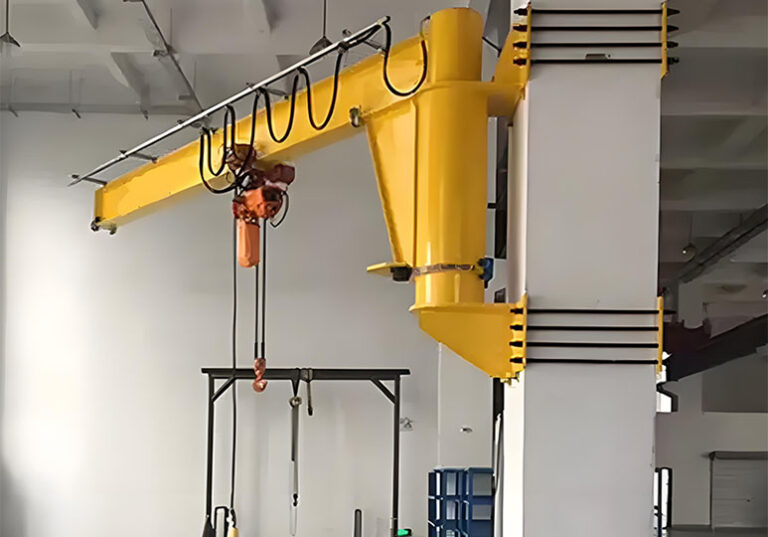
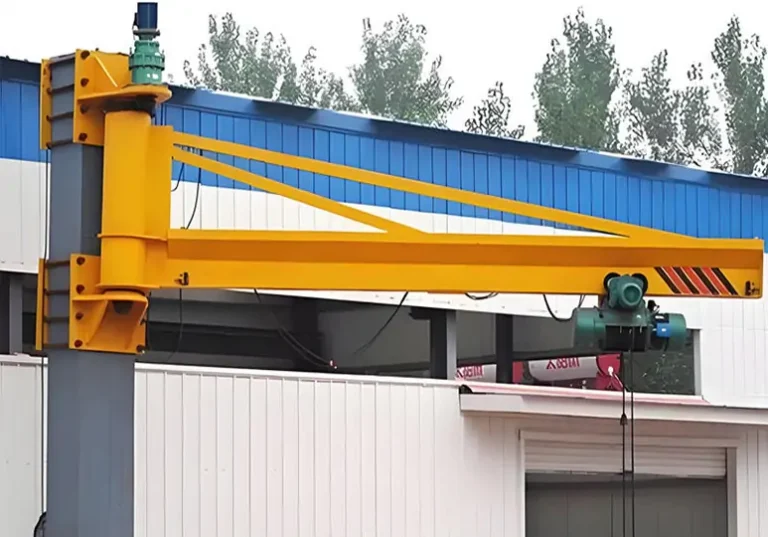
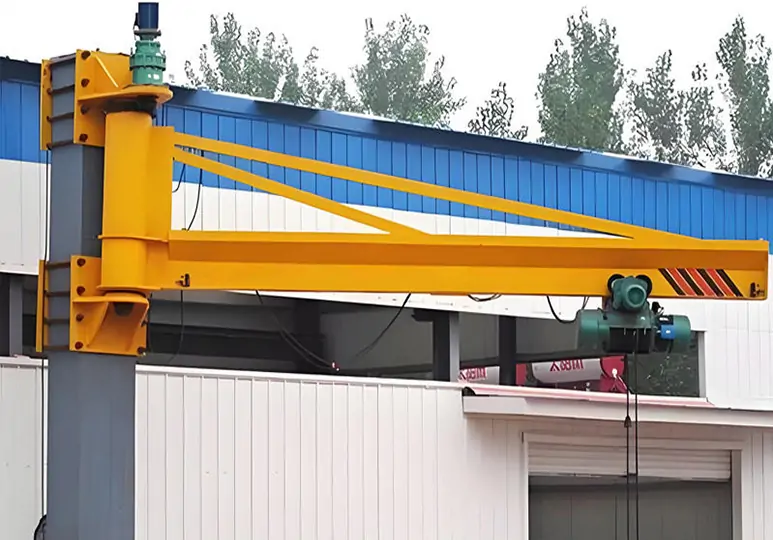
A wall mounted jib crane fixes directly to an existing structural wall or column, eliminating the need for a separate floor foundation. It typically offers a rotation arc of 180° to 200°. This makes it an excellent choice for workstations positioned along a building's perimeter, where floor space is limited or obstructions prevent column installation.
Typical capacity range: 100 kg – 5,000 kg | Arm length: 2 m – 8 m
Best for: Assembly lines, machine tool tending, loading docks adjacent to walls
Key consideration: Wall or column must be structurally rated to handle cantilever loads. A structural assessment is mandatory before installation.
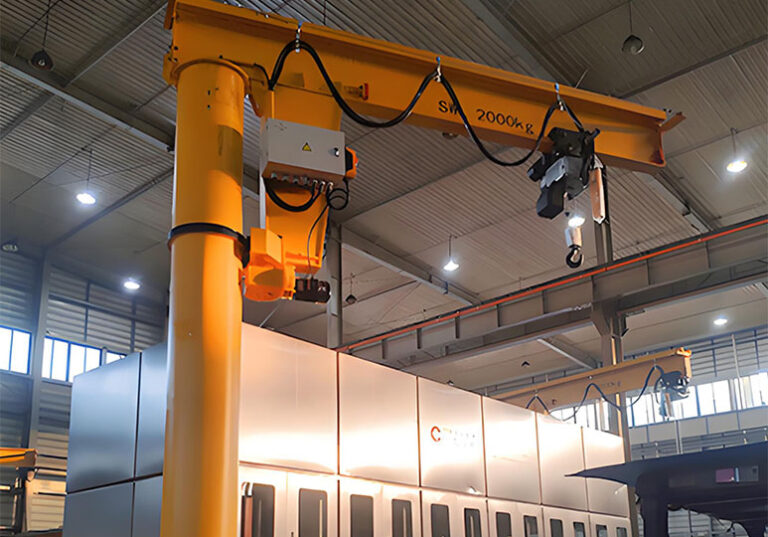
2.2 Floor Mounted (Free Standing) Jib Crane
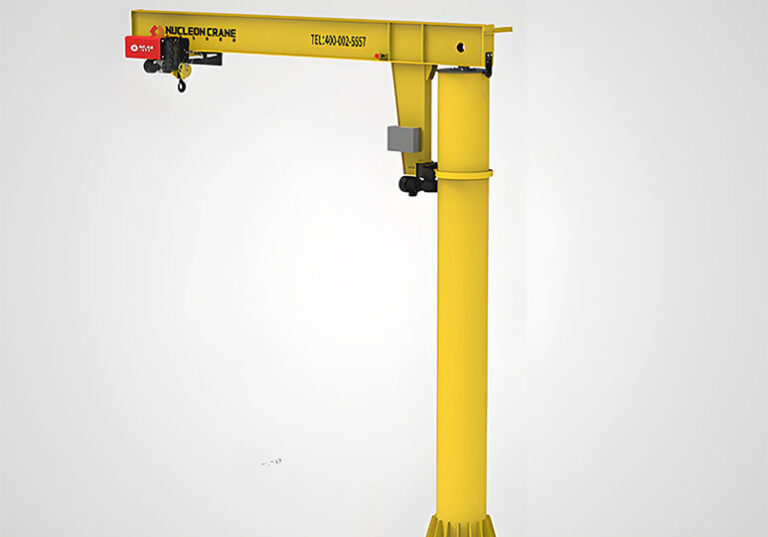
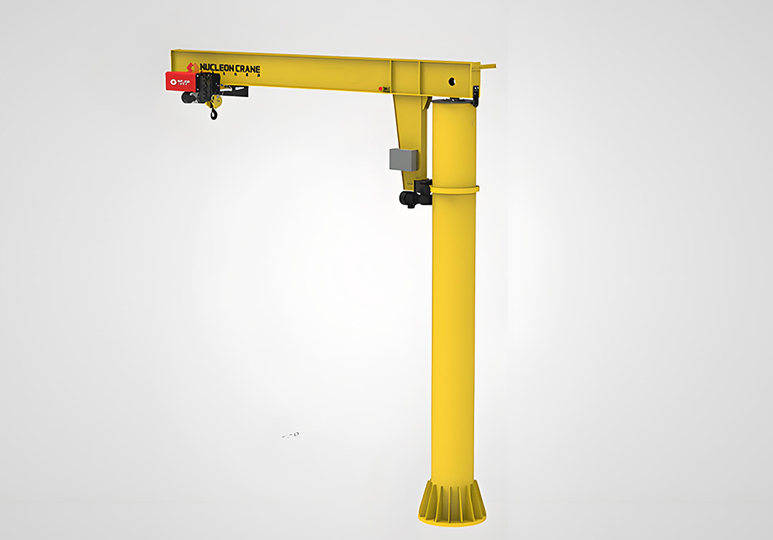
A floor mounted jib crane — also called a free standing jib crane — uses a dedicated steel column anchored to a reinforced concrete foundation. It offers a full 360° rotation, making it the most versatile configuration for open floor areas. Because it is self-supporting, it can be positioned anywhere on the floor plan without dependency on building structure.
Typical capacity range: 250 kg – 10,000 kg | Arm length: 3 m – 12 m
Best for: Central workstations, fabrication cells, warehouse receiving areas
Key consideration: Requires substantial foundation work (concrete depth typically 600 mm – 1,200 mm depending on capacity). Plan civil works early.
2.3 Grúa giratoria articulada
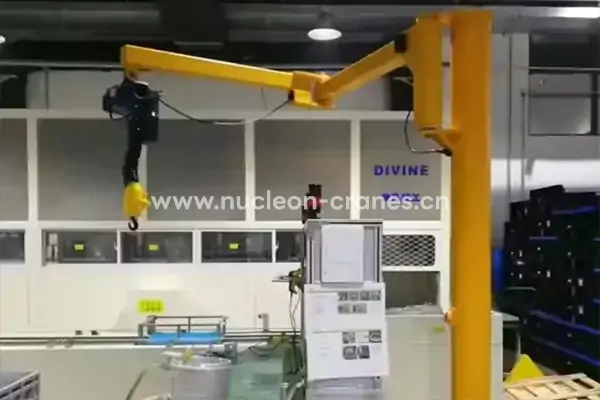
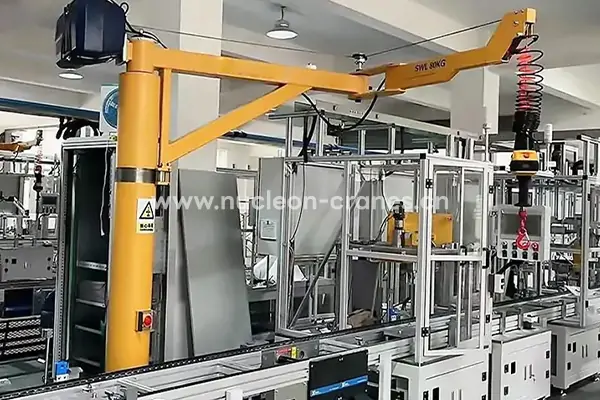
An articulating jib crane features two boom sections connected by a pivot joint, allowing the outer arm to fold or swing independently. This dramatically increases the effective coverage area and allows the crane to reach around obstacles that a straight-arm design cannot. Motorized articulation enables precise load positioning.
Typical capacity range: 100 kg – 2,000 kg | Effective reach: up to 7 m
Best for: Automotive assembly, aerospace maintenance, complex workstation layouts
2.4 Grúa de pluma móvil portátil
A mobile portable jib crane mounts on a wheeled base, giving it the flexibility to reposition as production needs change. Most models require manual pushing and feature a mechanical outrigger system that stabilizes the crane during lifting. They require no permanent installation, making them ideal for facilities that reconfigure frequently or have multiple low-frequency lift points.
Typical capacity range: 250 kg – 1,000 kg | Arm length: 1.5 m – 4 m
Best for: Maintenance workshops, outdoor work areas, rental or temporary operations
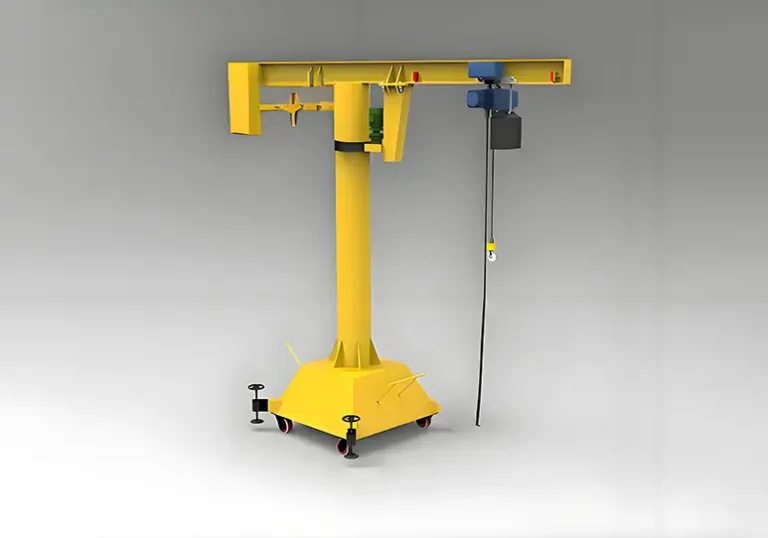
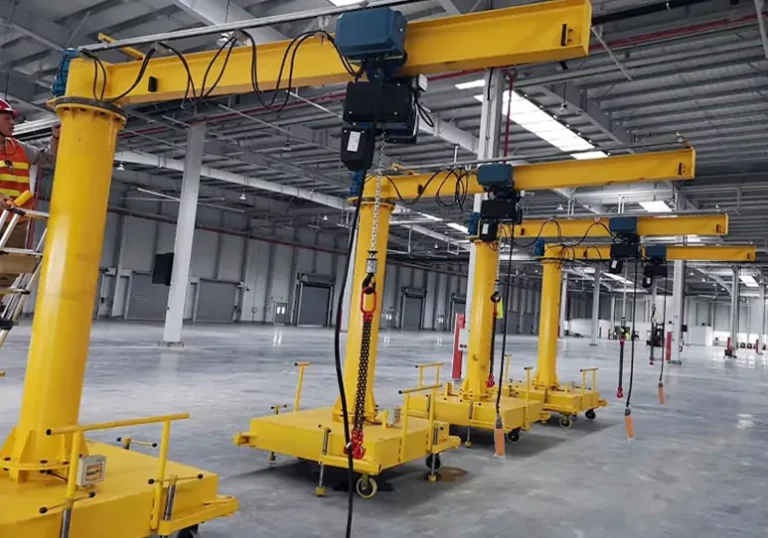
Table 1: Jib Crane Type Comparison
| Tipo | Rotación | Capacity (typical) | Foundation Required | Best Application |
| Wall Mounted | 180°–200° | 100 kg–5,000 kg | None (wall fixing) | Perimeter workstations |
| Floor Mounted / Free Standing | 360° | 250 kg–10,000 kg | Concrete foundation | Central work cells |
| Articulating | Up to 360° | 100 kg–2,000 kg | Wall or floor | Complex reach requirements |
| Mobile Portable | 360° | 250 kg–1,000 kg | Ninguno | Flexible/temporary use |
Source: FEM 1.001 (European Federation of Materials Handling), ISO 4301-1:2016 — Cranes: Classification. Data representative of standard commercial products as of 2023–2024.
3. Key Technical Specifications to Evaluate
Understanding the core parameters of a jib crane is essential before issuing a purchase order. Misspecifying any of these figures can result in equipment that is either unsafe or significantly underperforming.
3.1 Jib Crane Capacity
Jib crane capacity refers to the rated load — the maximum weight the crane is designed to lift safely at its rated radius. Industry standard ratings range from 125 kg to 10,000 kg for most industrial applications. Critical note: capacity decreases as the load is positioned further along the arm toward the tip. Always confirm the rated capacity at the working radius you actually need, not just the headline figure.
Practical rule: Apply a safety margin of at least 25% above your maximum anticipated load. For example, if your heaviest lift is 800 kg, specify a 1,000 kg rated crane.
3.2 Jib Crane Span (Arm Length)
Jib crane span — often called arm length or outreach — defines the horizontal distance from the rotation axis to the hook's furthest position. Standard commercial spans range from 2 m to 12 m. Longer arms introduce greater bending moments on the mast and foundation, requiring heavier structural sections and deeper anchoring. Specify the minimum span needed to cover your work zone; over-specifying adds cost without benefit.
3.3 Jib Crane Rotation Angle
The rotation angle (or slewing angle) determines how much of a circle the crane arm sweeps. Wall mounted models are limited to 180°–200° by the wall itself. Free standing models can achieve a full 360°. For multi-station coverage, articulating models with motorized slewing can extend the effective arc. Verify that the planned rotation arc does not conflict with adjacent equipment, columns, or overhead obstructions.
3.4 Lifting Height
Lifting height measures the vertical distance between the lowest hook position (at floor level) and the maximum hook height under the jib arm. The building's clear height and the crane's structural geometry directly constrain this distance. Therefore, you must ensure that the required lifting height is achievable given your facility's ceiling clearance, and you should factor in the hoist body height and any end travel limits.
Table 2: Typical Jib Crane Specification Ranges
| Parámetro | Standard Range | Typical Industrial Value | Referencia estándar |
| Capacidad nominal | 125 kg – 10,000 kg | 500 kg – 3,000 kg | ISO 4301-1:2016 |
| Arm Length (Span) | 1.5 m – 12 m | 3 m – 6 m | FEM 1.001 |
| Rotation Angle | 180° – 360° | 270° – 360° | EN 13001-1:2023 |
| Altura de elevación | 2 m – 8 m | 3 m – 5 m | EN 14492-2:2006+A1 |
| Clase de servicio | A1 – A8 | A3 – A5 (workshop) | ISO 4301-1:2016 |
Source: EN 13001-1:2023, ISO 4301-1:2016, FEM 1.001 (3rd Edition). Data reflects commonly specified values in European and international industrial installations, 2022–2024.
4. Industrial Jib Crane Applications by Sector
Jib cranes are found in virtually every sector where localized, repetitive lifting is needed. Their flexibility and low footprint make them a standard fixture across manufacturing, logistics, and infrastructure.
4.1 Jib Crane for Workshop & Production Line
In workshop and production line environments, jib cranes are typically installed at individual machining centers, welding stations, or assembly cells. A single floor mounted jib crane covering a 4 m radius can service an entire machining cell, handling workpiece loading and unloading without requiring an overhead crane bridge to travel across the bay. This reduces congestion and improves cycle times.
Case reference: A major European automotive parts supplier (Tier 1, Germany) installed 12 wall mounted jib cranes with 1,000 kg capacity along a crankshaft machining line, reducing manual handling incidents by 40% and cutting cycle time by 12%. (Source: Demag Cranes application report, 2022)
4.2 Jib Crane for Warehouse & Material Handling
Warehouse operations use jib cranes at receiving docks, staging areas, and mezzanine levels. A mobile portable jib crane at a receiving dock allows operators to unload palletized or irregular loads from trucks without a fixed infrastructure investment. For higher-frequency operations, a floor mounted jib crane for material handling at inbound inspection stations can dramatically improve throughput.
4.3 Jib Crane for Factory Maintenance
Maintenance departments benefit greatly from articulating jib cranes and portable models. Removing heavy machine components — motors, gearboxes, rolls — requires precise positioning that fixed cranes cannot always provide. An articulating jib crane can reach over machine guards and into confined spaces that a straight-arm unit would miss.
5. Jib Crane vs. Overhead Crane: Which Should You Choose?
A common procurement question is whether to invest in a jib crane or an overhead crane. The answer depends on your coverage requirements, budget, and facility structure.
Table 3: Jib Crane vs. Puente grúa — Decision Matrix
| Factor | Grúa pluma | Puente grúa |
| Coverage Area | Localized (circular zone) | Full bay or aisle |
| Installation Cost | Lower (no runway structure) | Higher (runway, end trucks) |
| Flexibilidad | High (especially portable) | Low (fixed runway) |
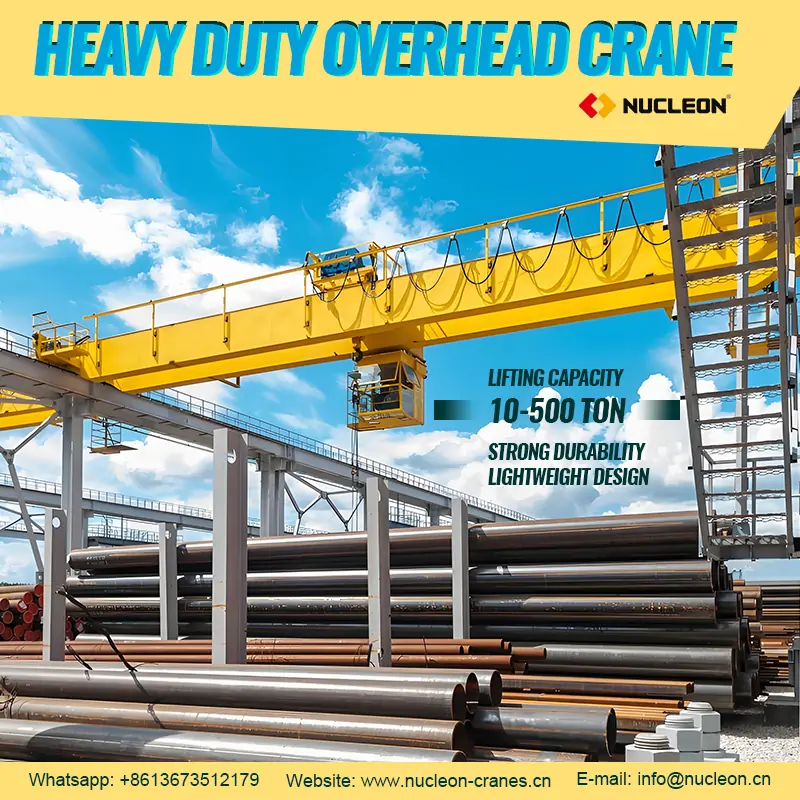
| Capacity Range | Up to ~10 t (typical) | Up to 500 t or more |
| Mejor ajuste | Workstation, single machine | Full bay, multi-zone lifting |
| Facility Modification | Minimal | Significant |
Source: Compiled from Konecranes, Demag, and Spanco technical documentation, 2023. Overhead crane data reflects standard under-running bridge cranes.
Consider this practical guidance: if your lifting requirement is contained within a 10 m radius and does not need to travel across the full building bay, a jib crane will deliver the same functionality at 30%–60% of the total installed cost of an overhead crane. For full-bay coverage or loads above 10 t, an overhead crane provides the appropriate solution.
6. Industrial Jib Crane Buying Guide: 7 Key Steps
Purchasing an industrial jib crane requires more than selecting a catalogue model. Use this structured process to ensure you specify, source, and commission the right equipment.
Step 1 — Define the Duty Cycle
Identify how many lifts per hour and per shift the crane will perform. This determines the ISO duty class (A1–A8) and directly affects the structural design, motor sizing, and hoist selection. Under-specifying duty class is the most common cause of premature jib crane failure.
Step 2 — Confirm Structural Suitability
For wall mounted models, commission a structural engineer to verify the wall or column can handle the cantilever moment. For floor mounted units, confirm the concrete slab thickness and reinforcement. Never rely solely on a supplier's standard foundation drawing without local verification.
Step 3 — Specify the Hoist Type
Match the hoist to the application: electric chain hoists for capacities up to 5 t in clean environments; wire rope hoists for higher capacities or frequent duty; pneumatic hoists where explosive atmospheres or water ingress are concerns. Specify inverter-controlled drives for smooth load positioning on precision assembly tasks.
Step 4 — Verify Compliance and Certification
Require CE marking (for EU/EEA markets), compliance with EN 13001 (crane safety), and hoist compliance with EN 14492-2. In North America, verify ASME B30.12 compliance. Request the full technical file, including FEM classification, proof load test certificate, and installation manual.
Step 5 — Evaluate the Supplier
Request references for similar installations in your industry. Confirm the supplier can provide local after-sales support, spare parts availability, and inspection services. A jib crane from an established manufacturer (e.g., Demag, Konecranes, Spanco, Gorbel) will carry a better-documented warranty and parts ecosystem than a low-cost import with no local support.
Step 6 — Plan the Installation
Coordinate civil works (foundation, wall fixing, electrical supply) before the crane arrives. Establish the commissioning schedule, operator training requirements, and the initial inspection process. In the EU, a conformity assessment by a notified body may be required for certain crane classes.
Step 7 — Establish a Maintenance Plan
A well-maintained jib crane has a service life of 20+ years. Establish a documented maintenance schedule: daily operator checks, monthly lubrication and brake inspection, annual load testing, and periodic structural inspection per EN 13001-3-1 or equivalent. Factor maintenance costs into your total cost of ownership calculation.
7. Jib Crane Maintenance Essentials
Jib crane maintenance is straightforward but must be systematic. The most frequent failure modes in industrial jib cranes are: slew bearing wear (from inadequate lubrication), hoist brake degradation (from overloading or excessive cycling), and structural fatigue at the mast-to-foundation joint (from dynamic overloading).
- Daily: Visual inspection of hooks, chains/wire rope, limit switches, and brake function
- Monthly: Lubricate slew ring, check fastener torques, inspect hoist rope/chain for wear
- Annually: Full load test to rated capacity, structural weld inspection, electrical safety check
- Every 5 years: Comprehensive structural assessment by a qualified engineer
Maintenance intervals should be adjusted based on actual duty cycle. High-frequency applications (A5–A8 duty class) require shorter inspection intervals than light-use maintenance cranes.
Conclusion: Making the Right Jib Crane Decision
An industrial jib crane is one of the most practical investments a facility can make for improving localized material handling efficiency. The key is matching the crane type and specification to your actual operational requirement — not simply choosing the lowest-cost option or the highest-capacity catalogue model.
Start by defining your lifting frequency and load profile. Then match that to the correct jib crane type (wall mounted, floor mounted, articulating, or mobile). Specify the capacity with a proper safety margin, verify structural suitability, and choose a supplier with documented after-sales capability. A correctly specified jib crane, properly maintained, will deliver a return on investment within 18–36 months in most industrial applications.
If you're ready to begin the selection process, the next practical step is to prepare a lifting study covering your work zone dimensions, load weights, duty cycle, and facility structural data — then present this to two or three qualified jib crane suppliers for a comparative quotation.

Especialista en Equipos
Gerente de Negocios de Grúas con experiencia y amplia trayectoria en gestión de proyectos de elevación pesada y supervisión operativa. Historial comprobado de impulso del crecimiento de los ingresos y garantía del cumplimiento de las normas de seguridad.
Preguntas Frecuentes (FAQ)
Q1: How much does an industrial jib crane cost?
Industrial jib crane price varies significantly by type, capacity, and configuration. A basic manual wall mounted jib crane (500 kg capacity, 3 m arm) typically ranges from USD 1,500–4,000 ex-works. A motorized floor mounted jib crane with electric hoist (2,000 kg, 5 m arm) generally falls in the USD 8,000–20,000 range. Custom jib crane configurations — including special coatings, explosion-proof electrics, or stainless steel construction — can exceed USD 30,000. Always request delivered and installed pricing, as civil works, electrical supply, and commissioning can add 30%–50% to the equipment cost.
Q2: What is the difference between a wall mounted and a free standing jib crane?
A wall mounted jib crane attaches to an existing structural wall or column and offers approximately 180°–200° of rotation. It requires no floor foundation but demands a structurally adequate wall. A free standing jib crane (floor mounted) uses its own anchored column and provides a full 360° rotation arc. The free standing version suits open floor areas and high-capacity applications; the wall mounted variant works best where floor space is limited and the wall structure provides sufficient support.
Q3: What rotation angle does a jib crane need for my application?
For a single workstation, 180° often suffices if you mount the crane on a wall and place the work zone in front of the station. For a central work cell that requires coverage on multiple sides, you need 270°–360° of rotation, which typically requires a free standing or articulating configuration. Always map out the required sweep area on a floor plan before you specify the rotation angle. Keep in mind that 360° rotation cranes need clearance from all obstacles — columns, conveyors, racking — within the full sweep radius.
Q4: Can a jib crane be used outdoors?
Yes. Outdoor jib cranes are used at loading docks, construction sites, marine terminals, and equipment yards. For outdoor use, specify hot-dip galvanized or painted structural steel (minimum C3–C4 corrosion protection per ISO 12944), IP55 or higher-rated electrical components, and stainless steel fasteners in coastal or high-humidity environments.If the crane will operate in wind-exposed areas, verify that the structural calculations include wind loading per EN 13001-2 or an equivalent local standard.
Q5: How do I choose between an electric hoist and a manual hoist for my jib crane?
Choose an electric hoist when: lift frequency exceeds 10 lifts per shift, loads exceed 250 kg, you need precise speed control, or operator fatigue is a concern. Use manual hoists (lever hoists or hand chain blocks) for infrequent lifts under 500 kg in environments where electrical supply is impractical (remote maintenance sites, hazardous areas without EX equipment). For production line use, we strongly recommend inverter-controlled electric hoists with variable speed for load positioning accuracy and reduced wear.


 English
  العربية
  Español
  Français
  Português
  Русский