

Crane wire rope inspection is the process of checking a rope's broken wires, diameter, corrosion, and deformation against standard discard criteria to decide whether it can stay in service. It matters because a rope that fails under load can drop the rated capacity onto people or product below it, and because a poorly timed replacement either wastes serviceable rope or leaves a facility running a rope that should already be out.
If you manage procurement or maintenance for overhead, gantry, or mobile cranes, the real problem usually isn't finding the discard numbers — those are published in ASME B30.2, ISO 4309, and similar standards. The harder problem is knowing which of your cranes are actually close to those limits, and not getting burned when a "same diameter" replacement rope turns out to behave nothing like the one it replaced.
This guide walks through how inspection and discard criteria actually work, why calendar-based replacement schedules miss the real driver of rope wear, and the procurement and maintenance mistakes that most often shorten a new rope's life before it has a chance to earn its keep.
Índice
Understanding Crane Wire Rope Inspection
Crane wire rope inspection is a scheduled, standards-based check of a rope's condition — broken wires, diameter, corrosion, and deformation — used to decide whether the rope stays in service, as defined under standards such as ASME B30.2 e ISO 4309.
What Counts as a Proper Inspection
A proper inspection combines a quick daily visual pass with a deeper monthly and annual examination — skipping either level leaves failure modes undetected.
The daily pre-shift check is a visual scan for obvious damage — kinks, visible broken wires, crushing, bird-caging — done by the operator or a designated person before the shift starts. It takes a few minutes and exists to catch gross damage before a lift, not to certify the rope's overall condition. The monthly thorough inspection goes further: the inspector runs the full working length, measures diameter at several points, and probes between strands for wires that have broken but not yet popped through the surface. The reason the two levels exist separately is that valley breaks and internal corrosion — the failure modes that actually cause sudden rope failure — are essentially invisible in a fast daily glance and only show up under a slower, hands-on pass.
Inspection Frequency by Standard
Under normal duty, most crane wire rope needs a documented thorough inspection at least monthly, with the interval shortening as duty severity increases.
Frequency guidance across ASME B30.30, ISO 4309, and Europe's EN 12385 series converges on the same logic even though the exact intervals differ by clause: normal-duty running ropes get a documented monthly or periodic check, while heavy or severe service — high cycle counts, near-rated loads, harsh environments — compresses that interval to as often as every one to three months. For buyers sourcing rope or replacement crane components from Chinese manufacturers, note that China's GB/T 5972 standard covers the same discard logic (broken wires, diameter loss, corrosion, and a combined-deterioration method) and is worth cross-checking against ASME or ISO criteria when a supplier's spec sheet references it, since the exact thresholds are not identical across standards.
Who Is Qualified to Sign Off
Only a designated competent or qualified person — someone with documented training in wire rope condition assessment — should make the final discard decision, not a general maintenance technician.
This distinction matters because the daily visual check can be performed by an operator, but the monthly and annual inspections that actually determine discard require someone who can distinguish a crown break from a valley break, judge corrosion severity, and know when a measurement is within tolerance versus a discard trigger. Facilities that skip this — letting whoever is available sign the inspection log — tend to discover the gap only after an incident, when documentation is reviewed and the "competent person" requirement was never actually met.
How Wire Rope Wears and Fails
Wire rope degrades through a small number of recognizable mechanisms — broken wires, diameter loss, corrosion, and mechanical deformation — and each one signals a different underlying problem.
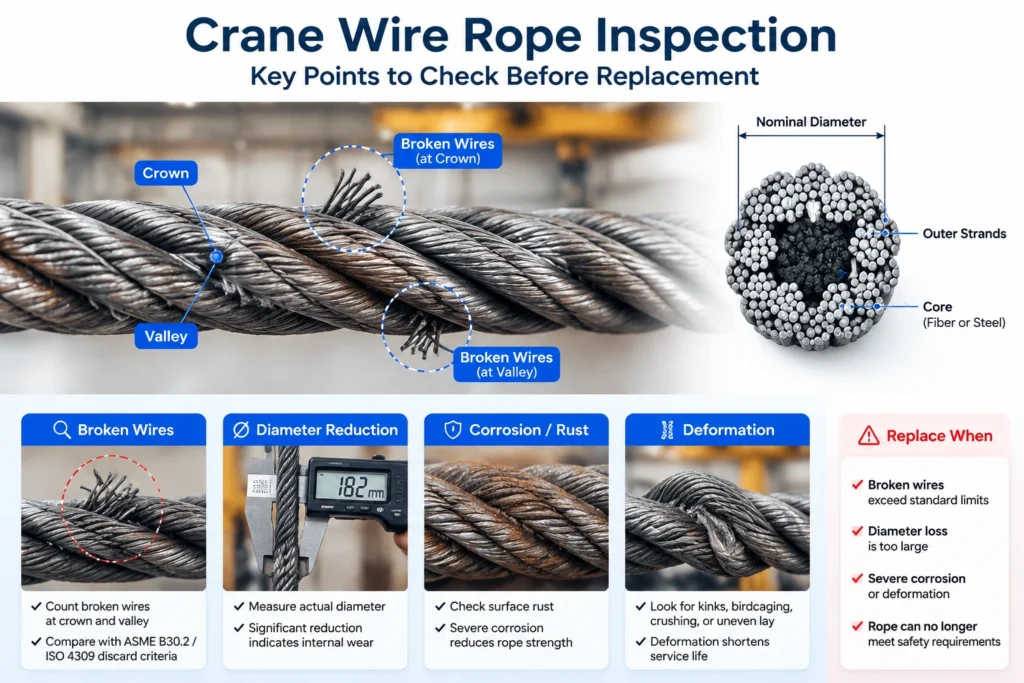
Broken Wires: Crown Breaks vs. Valley Breaks
A broken wire on the rope's outer surface (crown break) is a normal wear indicator; a break between strands (valley break) signals internal fatigue and is treated far more seriously.
Crown breaks form where outer wires contact sheaves and drums and are caused by ordinary abrasion — they're visible and relatively easy to count during a monthly inspection. Valley breaks occur at the contact point between adjacent strands, deeper in the rope's structure, and typically mean the core or inner wires are already failing before any external sign appears. That's why most standards apply a much lower discard threshold to valley breaks — often just two in one lay length, versus ten or more crown breaks depending on rope construction and machine classification — and why an inspector who only scans the rope's surface can miss the more urgent failure mode entirely. Wire rope working in a dusty, high-cycle steelmaking environment tends to show valley breaks earlier than the same rope in light, intermittent warehouse service, which is one more reason the discard decision has to be measured, not scheduled.
Diameter Reduction and Core Damage
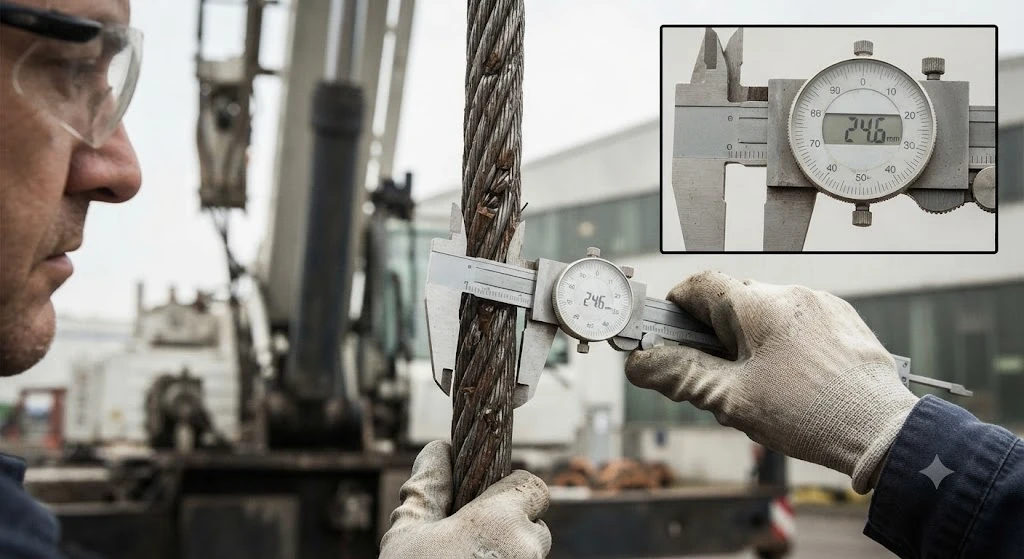
A rope's diameter shrinking by roughly 5–8% from nominal (the exact figure varies by standard) indicates internal wear or core compression and is grounds for discard even without visible surface damage.
The mechanism is straightforward: as inner wires wear against each other or the core compresses under repeated loading, the rope loses cross-sectional area and therefore load-bearing capacity, and that loss shows up as a smaller measured diameter before it shows up as anything visible on the surface. This is precisely why a caliper measurement at three or more points, taken during every monthly inspection, catches problems that a purely visual check does not. Fiber-core (FC) ropes are more prone to this kind of internal compression under sustained heavy loads than independent-wire-rope-core (IWRC) construction, which is one reason IWRC is generally preferred for crane duty over FC in anything but light, intermittent service.
Corrosion, Kinking, and Other Immediate-Removal Conditions
Certain conditions — kinking, bird-caging, core protrusion, heat exposure above roughly 400°F (204°C), and severe corrosion — call for immediate rope removal regardless of broken wire count or diameter measurement.
These are treated as automatic discard triggers rather than measured thresholds because each one represents a form of damage that standard broken-wire or diameter criteria weren't designed to capture: a kink permanently deforms the wire structure at that point regardless of how many wires happen to be broken there, and heat exposure alters the steel's metallurgy in a way no visual count reflects. In coastal or chemical-processing environments, external corrosion often progresses faster than the inspection interval assumes, so facilities in those conditions typically shorten their inspection cycle below the standard's default rather than wait for the next scheduled check to catch it.
When to Replace: A Duty-Based Decision Framework
Wire rope service life is set by how hard and how often the rope is worked, not by how many years it has been installed — two ropes installed on the same day can need replacement years apart.
Wire Rope Life Depends on Duty, Not Calendar Time
Two identical bridge cranes installed on the same date can need a wire rope change a year apart, because one runs 300 near-rated lifts a day and the other runs ten.
This is the single most common planning mistake in wire rope management: treating replacement as a fixed-interval maintenance item ("replace every X years") instead of a condition- and duty-driven decision. A crane in a steelmaking shop cycling 300 times a day at loads close to rated capacity will accumulate fatigue and wear on a timeline measured in months, while a crane doing ten light lifts a day in a warehouse can run the same rope for several years past that point. Scheduling replacement purely by calendar time either scraps rope with plenty of service life left — an avoidable cost — or, more dangerously, leaves a heavily used rope in service past the point where inspection would have already flagged it, if inspection had been tied to actual duty rather than a generic annual date. The practical takeaway: use inspection findings and duty tracking to set the replacement point, not a fixed calendar reminder.
Key Duty Factors to Track
The four factors that predict wire rope wear faster than calendar time are lifting cycle count, duty/working class, load spectrum, and environmental exposure.
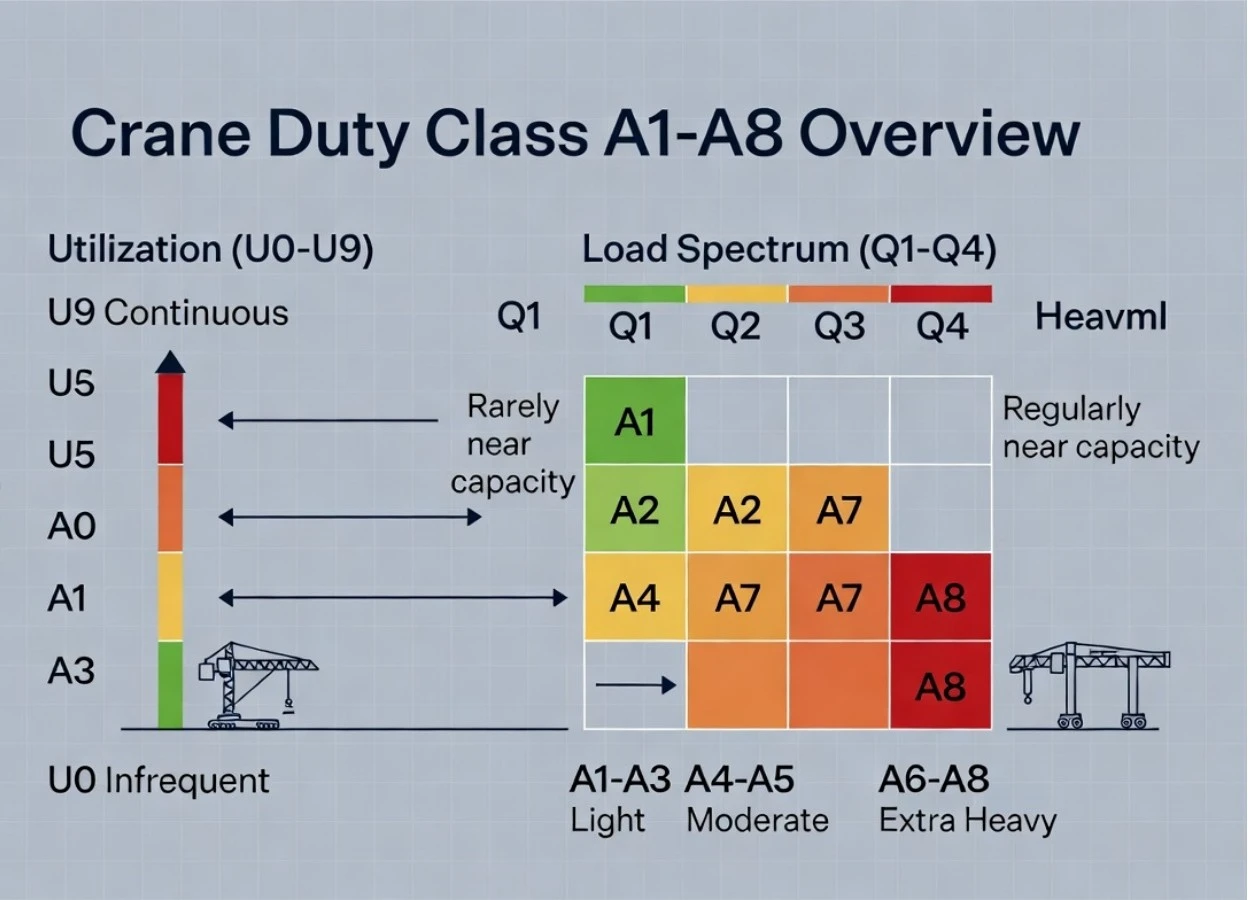
Lifting cycles — the number of load/unload events — correlate directly with fatigue accumulation, which is why ASME B30.30 ties inspection intervals to operating hours as well as calendar months. Duty or working class, expressed as FEM classes M3–M8 or the equivalent ISO/CMAA A1–A8 groupings, describes how often and how close to rated capacity a crane typically operates, and a rope on an M6–M8 crane should be inspected and budgeted for replacement far more aggressively than the same rope on an M3 unit. Load spectrum — what fraction of lifts are near maximum rated load versus well under it — matters because fatigue damage accumulates disproportionately at higher load ratios; a crane that occasionally lifts at rated capacity but mostly handles lighter loads wears its rope more slowly than one that runs near capacity routinely. Environmental exposure — heat, corrosive atmosphere, abrasive dust — accelerates degradation independent of cycle count, which is why two ropes with identical duty cycles can still wear at different rates if one operates in a foundry and the other in a clean assembly plant. Tracking these four factors, even informally, gives a maintenance team a far better replacement forecast than a generic "replace every 12–24 months" rule.
Replacement Criteria Reference (Standards Comparison)
| Critério | ASME B30.2 (typical reference) | ISO 4309 | Notas |
| Broken wires, standard running rope | ~10–12 randomly distributed in one lay, or ~4 in one strand | Varies by machine class (M1–M8) and Rope Category Number | Thresholds are class-dependent, not a single universal number |
| Valley breaks | As few as 2 in one lay length | Counted and weighted separately, more severe than crown breaks | Lower tolerance than crown breaks across standards |
| Diameter reduction | ~5% from nominal | ~5–8% depending on rope class | Below-threshold loss still warrants closer monitoring |
| Outer wire wear | ~1/3 of original outer wire diameter | Similar threshold, class-dependent | Concentrates where rope contacts sheaves/drum |
| Inspection interval, normal duty | Roughly monthly thorough + daily visual | Set per risk assessment and machine classification | Heavy/severe duty shortens the interval |
Figures above are typical reference ranges for orientation only — always confirm the exact clause and rope-category allocation against the specific standard and machine classification that applies to your crane before making a discard decision.
For loads and duty cycles at the higher end (FEM M6 and above, or frequent near-rated lifting), plan inspection and replacement budgeting around actual cycle counts rather than the calendar-only intervals in the table.
Common Procurement and Maintenance Mistakes
Most premature rope failures trace back to a handful of repeatable mistakes made at the time of purchase or replacement, not to the rope itself being defective.
Same Diameter Doesn't Mean Same Rope
Two ropes of identical nominal diameter can differ enough in construction to behave completely differently on the same crane — diameter alone is not a valid purchasing spec.
Even at a common size like 16 mm, ropes can vary by strand construction (6×19 versus 6×36 versus 35W×7), core type (independent wire rope core versus fiber core), lay direction (left versus right), lay pattern (regular lay versus Lang lay), and breaking-force grade. Each of those differences changes something that matters operationally: strand count and lay pattern affect flexibility and fatigue resistance, core type affects crush resistance and how the rope performs under sustained heavy load, and minimum sheave diameter requirements shift with construction even at identical nominal rope diameter. The common failure pattern is a buyer specifying "16 mm wire rope" from a catalog and receiving a rope that fits the drum but performs worse — flexing less well, wearing faster on the sheaves, or fighting the original rope's rotation characteristics. Before ordering a replacement, confirm at minimum the rope construction, core type, lay direction, breaking force, and manufacturer specification against the original — not just diameter and length. When the original documentation isn't available, matching against the crane manufacturer's spec sheet is safer than matching against the worn-out rope's measured diameter alone.
Replacing Only the Rope Can Shorten Its Life
Installing a new rope on a worn sheave or drum groove routinely cuts the new rope's expected service life to a fraction of what it should be — often failing again within months.
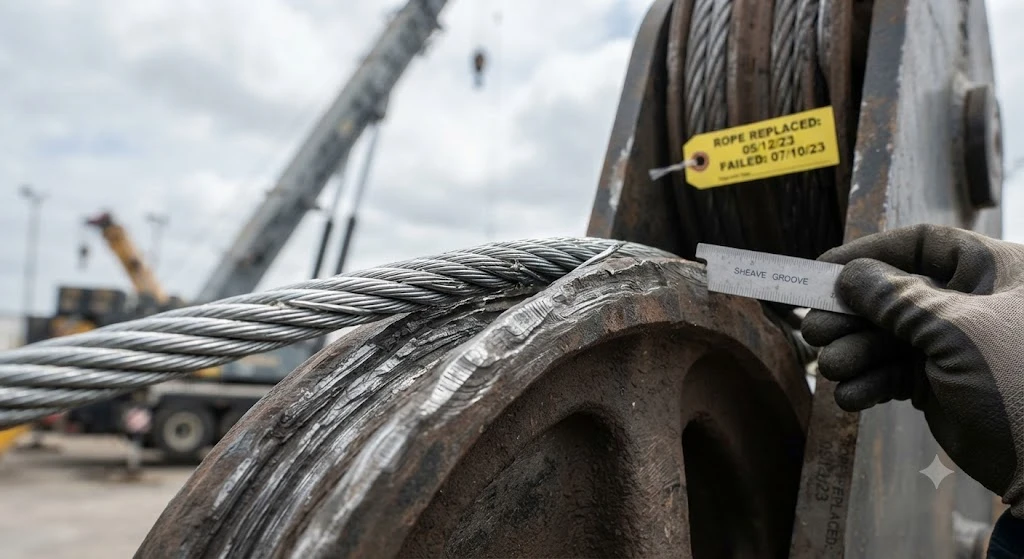
The mechanism is mechanical, not a rope defect: a deep or misshapen sheave groove, a deformed drum groove, a stiff sheave bearing, or a rope that isn't spooling evenly onto the drum all concentrate stress on specific sections of the new rope every time it runs over that point. A brand-new rope run over a worn groove will show broken wires, flattening, kinking, or localized wear in the same spot the old rope failed — because the actual root cause was never addressed. The trade-off buyers often don't account for: skipping a groove/bearing inspection at replacement time looks like a cost saving in the moment, but it commonly means paying for a second rope replacement within a fraction of the expected service interval, plus the labor and downtime that comes with it twice instead of once. Any time a rope is replaced, checking drum groove condition, sheave groove wear, equalizer pulley condition, rope guides, and sheave bearing freedom of movement should be part of the same job — not a separate, deferred task.
Lubrication Matters More Than Early Replacement
Under-lubrication, not broken wires, is the most common condition found during field inspections — and it is largely preventable at low cost compared to premature replacement.
Many facilities only address wire rope condition once broken wires accumulate, while routine lubrication and cleaning gets skipped or deferred. Insufficient lubrication accelerates internal wire-on-wire wear, speeds up corrosion (since the lubricant film is what keeps moisture off internal wires), lets the core lose its supporting structure, and brings fatigue cracking forward. The practical trade-off: a documented lubrication and cleaning schedule is a small, recurring cost, while the alternative — waiting for a rope to show enough wear to force replacement — is a larger, less predictable cost that also increases downtime risk. For high-cycle overhead cranes especially, a regular inspection-and-lubrication routine is generally a better use of budget than carrying extra rope in stock as a hedge against premature failure. If your current maintenance plan doesn't include a lubrication interval separate from the inspection interval, that's usually the first gap worth closing.
Conclusão
Crane wire rope inspection and replacement comes down to one shift in thinking: track duty (cycles, load spectrum, working class, environment) and measured condition instead of a fixed calendar date, and treat rope, sheave/drum condition, and lubrication as one connected system rather than separate line items. Three things to do this month: pull your inspection logs and check whether monthly thorough inspections are actually documented and dated; confirm your next replacement order specifies construction, core, and lay direction rather than just diameter; and add a lubrication check to your next scheduled inspection if it isn't already a separate line item. Getting crane wire rope inspection and replacement right is less about knowing every clause number and more about consistently acting on what the rope and the machine are actually telling you.
Have a specific rope, duty class, or replacement question you're weighing? Our engineering team can help you work through the spec sheet before you order — reach out and we'll walk through it with you.

Especialista de Equipamento
Gestor de Negócios de Gruas com vasta experiência em gestão de projetos de elevação pesada e supervisão operacional. Histórico comprovado na promoção do crescimento da receita e na garantia da conformidade com as normas de segurança.
FAQ
Q1: How often should crane wire rope be inspected?
Crane wire rope needs a daily visual check before each shift and a documented thorough inspection at least monthly under normal duty. High-cycle or severe-duty cranes — near-rated loads, harsh environments, or heavy daily cycling — typically need that thorough inspection every one to three months instead, and any rope idle for a month or more needs a thorough check before it goes back into service.
Q2: How many broken wires mean a wire rope must be replaced?
There's no single universal number — thresholds depend on rope construction and machine classification, but standard running rope is commonly discarded around 10–12 randomly distributed broken wires in one lay, while valley breaks trigger replacement at a much lower count, sometimes just two. Always check the exact clause for your specific rope category and crane class rather than applying a generic figure.
Q3: Does crane wire rope have a fixed lifespan?
No — wire rope doesn't have a fixed lifespan; service life is driven by lifting cycles, load spectrum, duty class, and environment far more than by years installed. Two identical ropes installed on the same day can need replacement a year or more apart depending on how hard and how often each crane actually works.
Q4: Can a same-diameter rope always replace the original?
Not reliably — diameter alone doesn't capture construction, core type, lay direction, or breaking-force grade, all of which affect performance even at identical nominal size. Before ordering, confirm construction, core, lay direction, and breaking force against the original spec, not just diameter and length.
Q5: How much does crane wire rope replacement typically cost?
For a typical 10–20 ton overhead crane, replacement rope itself is generally a few hundred to a few thousand dollars depending on diameter, length, and construction, as a market reference range rather than a quoted price. That figure can climb well beyond the rope cost alone if worn sheave grooves, drum grooves, or bearings need addressing at the same time — which is why a rope-only budget often understates the real cost of a proper replacement.
Artigos relacionados
- Inspeção de pontes rolantes: normas OSHA vs CE vs GB — O que compradores e exportadores realmente precisam saber
- Pontes rolantes no México: aplicações industriais, conformidade e guia de fornecedores
- Ponte rolante leve versus ponte rolante pesada: qual escolher?
- Ponte rolante treliçada Nucleon Crane: Busca de modelos, certificações e suporte
- Guia de Reparo e Falhas Comuns em Pontes Rolantes: O Que Realmente Causa as Falhas (E o Que Verificar Primeiro)
- Conformidade entre OSHA e CE para pontes rolantes: um guia prático para compradores e exportadores (2026)

 English
  العربية
  Español
  Français
  Português
  Русский