

Overhead crane safety devices are the limit switches, load limiters, buffers, anti-collision sensors, brakes, emergency stops and warning signals that stop a crane before overload, over-travel or collision becomes an accident. No single device covers every hazard, so a sound configuration layers them: when one misses, another still acts.
The harder question for a buyer is not which devices exist, because every supplier's list looks alike. It is whether each one is specified correctly for your site. A limit switch that works for years in a clean assembly hall can fail within months in a foundry, and a single-stage limit that saves money on the quotation tends to return the saving as gearbox wear.
This guide explains what each of these overhead crane safety features does, how the devices work together, how to match them to your working environment, and what to inspect and calibrate so they keep working after commissioning.
Overhead crane safety devices are protective components (also called bridge crane safety devices) that limit a crane's travel, load and speed, warn personnel and stop motion automatically when a hazard is detected, as framed by ASME B30.2 and EN 15011.
Table of Contents
How Overhead Crane Safety Devices Are Organized
Every device does one of four jobs
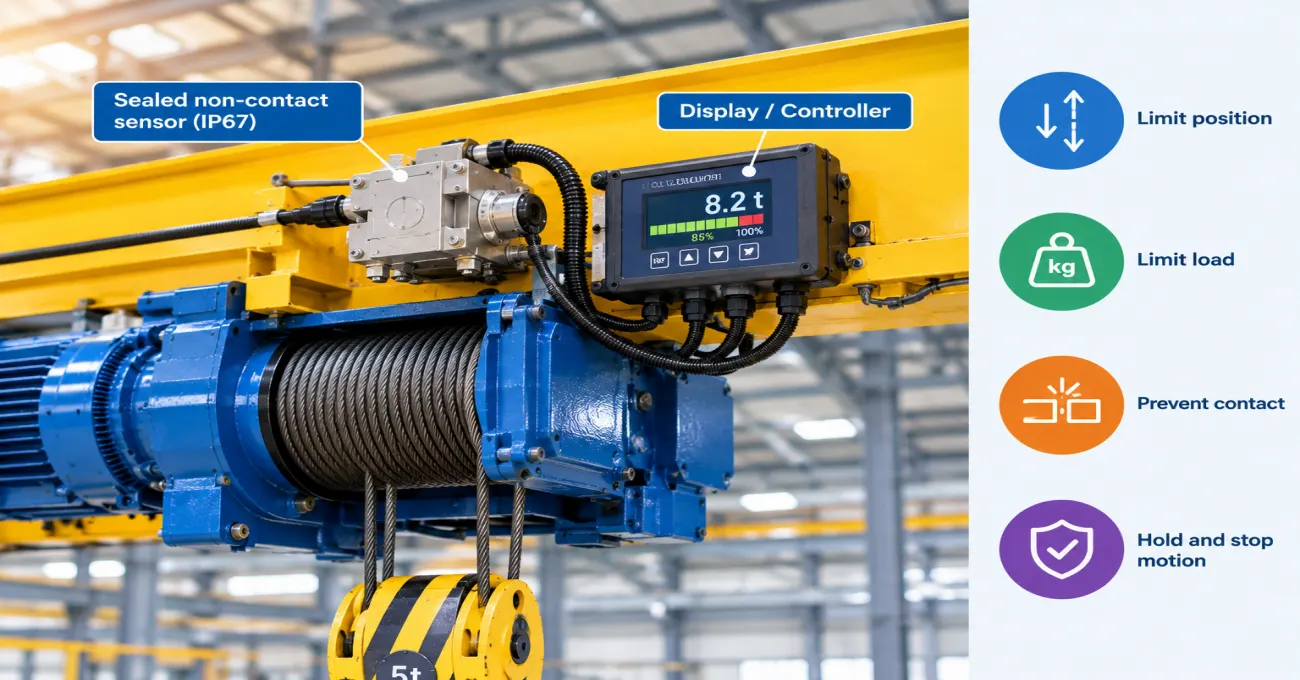
Every safety device on a bridge crane does one of four jobs: limit position, limit load, prevent contact, or hold and stop the motion.
The four jobs fail in different ways, which is why one device cannot cover for another. An overload limiter knows nothing about where the hook is, and a travel limit knows nothing about how heavy the load is. The table shows how the jobs map to hardware.
| Job | Typical devices | Triggers when | Typical response |
| Limit position | Hoist upper/lower limits, bridge and trolley travel limits | Hook or carriage reaches a set position | Slow down, then stop |
| Limit load | Overload limiter with load cell | Load nears or exceeds rated capacity | Alarm, then cut hoisting (lowering stays available) |
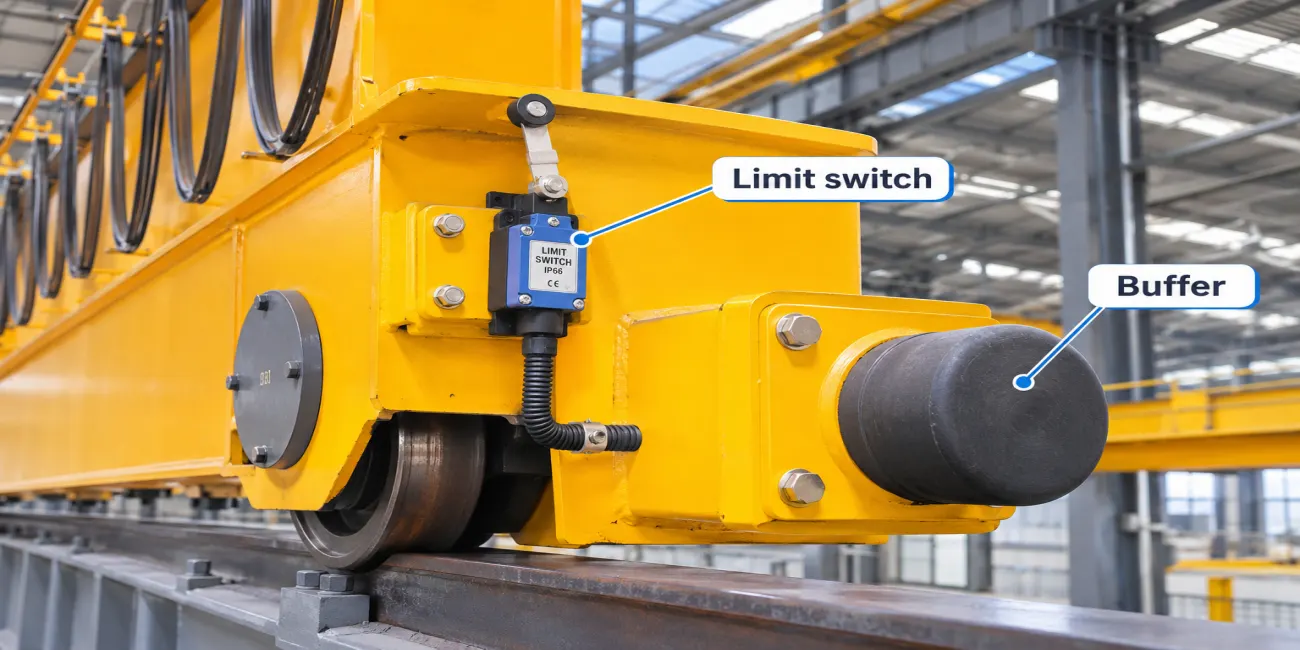
| Prevent contact | Buffers, rail stops, anti-collision sensors | End of runway, or another crane or obstacle within a set distance | Warn, slow, stop; absorb impact |
| Hold and stop | Service and holding brakes, emergency stop, main isolator | Power loss, operator command or fault | Brakes set; power is cut |
When you review a quotation, check that every row is covered. A crane missing a whole row, not just one component, is the real red flag.
Layering beats relying on one device
Safety devices work as a chain of detect, decide, act and inform, so no hazard should depend on a single device.
A sensor (limit switch, load cell, laser head) sends a signal to the control circuit, which may be a contactor circuit, a PLC or a safety relay. The circuit then stops the motors and sets the brakes, and an alarm light or display tells the operator why. Well-designed circuits are fail-safe: a broken wire or a failed device should stop the crane, not let it carry on.
Redundancy is the second layer. A hoist, for example, often carries an operating upper limit plus a separate final upper limit that cuts main power if the first one fails. The trade-off is cost and test effort, since every extra device needs its own periodic check. Add layers where the consequence of failure is worst: over-hoisting, end-of-runway impact and overload.
Core Overhead Crane Safety Devices in Detail
Limit switches: use two stages, not one
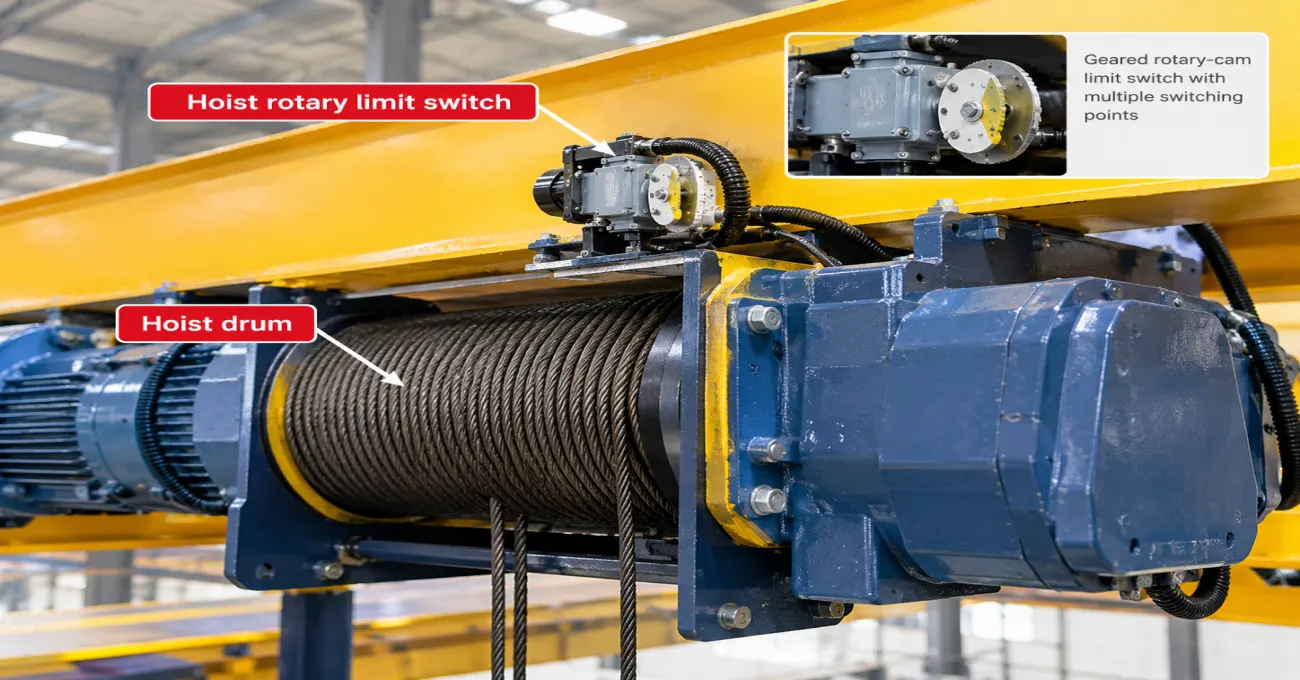
Two-stage limits, which decelerate first and then stop, protect the crane structure; a single hard cut-off at full speed only moves the damage somewhere else.
The reason is kinetic energy. A loaded bridge at full travel speed carries a lot of it, and a cut-off at the last moment forces the brakes, end carriages and buffers to absorb all of it at once. Some projects specify only a final power-cut switch on the bridge, trolley and hoist to trim the initial budget. The result is a shock load every time the crane reaches the end of travel, which raises wear on the bridge drive gearbox and, on the hoist side, the risk of the wire rope jumping its groove.
In practice, specify a slow-down limit set ahead of the stop limit, with the distance based on the crane's speed and braking behavior, so the crane arrives at the end of travel already slow. For the hoist, specify an upper limit plus a separate final upper limit, and a lower limit that keeps enough rope wraps on the drum. Two common hardware types are the geared or rotary-cam limit, which can provide several adjustable switching points, and the gravity (heavy-hammer) limit, which trips when the hook block lifts a weight. Treat all of them as safeguards, not as the normal stopping point. In the US, OSHA 29 CFR 1910.179(n)(4) requires the upper limit of each hoist to be tried out under no load at the start of every operator's shift, with the block inched in or run in slowly, and states that this limit must never be used as an operating control. The same standard (1910.179(k)(1)(ii)) has the trip setting determined by empty-hook tests at increasing speeds up to maximum speed, which is a useful test to ask for at commissioning. Outside the US, local rules and the manufacturer's manual govern, but the practice carries over.
Overload limiters: warn first, then cut hoisting
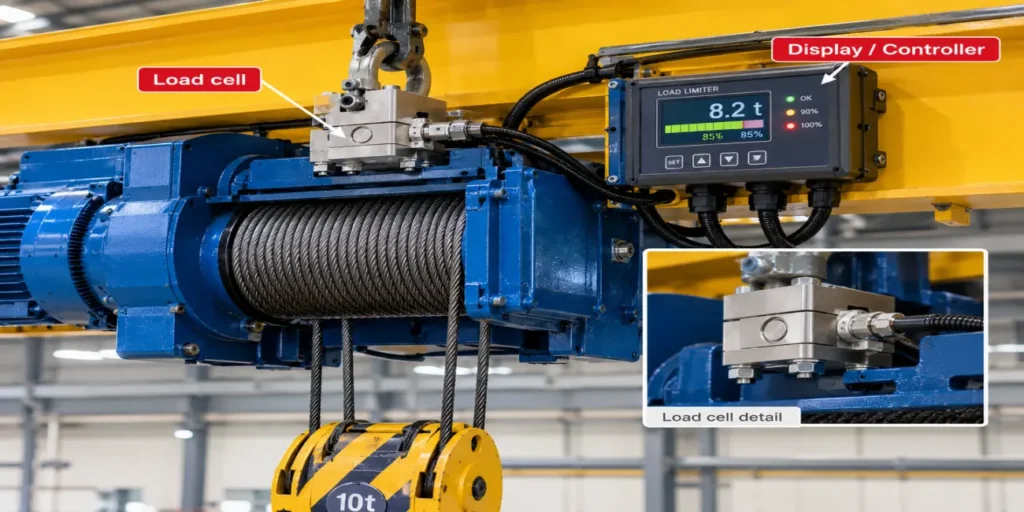
An overload limiter warns as the load nears rated capacity and cuts hoisting at the limit while still allowing the load to be lowered.
In overhead crane overload protection, a load cell or strain sensor in the hoist suspension or rope end sends a signal to an indicator or controller. Many systems warn at roughly 90% of rated load and cut hoisting at or slightly above 100%, depending on the governing standard and the manufacturer's setting, so confirm the actual settings with the supplier. Lowering remains available so the operator can set the load down safely.
Know its limits. A load limiter reads the load in the hoist; it does not prevent a snagged or side-pulled load, and sudden shock can exceed the limit before the circuit reacts. It also does not replace matching the crane's duty class (FEM or ISO 4301) to the real lifting frequency. Treat it as protection against misuse, not as permission to lift to the limit every shift.
Buffers, rail stops and anti-collision sensors
Buffers absorb the energy a crane still has at the runway end; anti-collision sensors reduce the chance it gets there.
Buffers come in spring, polyurethane and hydraulic types, and the right one depends on the crane's mass and speed, so ask the supplier for the energy-absorption basis, not just the buffer type. Regulator guidance also draws a line on where they sit: Alberta's occupational health guidance treats rail-mounted stops as the real stopping device and notes that a rubber bumper fixed to the crane itself cannot prevent contact with other equipment.
Where two or more cranes share a runway, add anti-collision sensors. Laser, infrared, radar and position-based (RFID or encoder) systems all exist, and the choice depends on the site: steam, dust, rain and reflective surfaces affect optical types differently, so ask for a trial or a site-condition assessment. Poorly matched sensors give false alarms, and operators who get false alarms tend to bypass the system, which leaves the crane worse off than before.
Brakes, emergency stops and warning devices
Brakes, emergency stops and warning signals are the last line of defense, acting when everything else has been missed.
Every motion (hoist, trolley, bridge) needs a brake, and the hoist brake is sized with a margin over the load torque as set by the governing standard. The emergency stop is a latching red mushroom button that cuts power to the drives and needs a deliberate manual reset. Fit one at every control station, whether pendant, radio remote or cab. For radio control, also confirm that loss of signal stops the crane.
Warning devices matter more than they look. OSHA 29 CFR 1910.179 requires a gong or other effective warning signal on cranes with a power traveling mechanism (floor-operated cranes excepted), sounded when starting the bridge and when the load approaches people. Spring-return pendant controls, which drop to off when released, add a further layer of protection.
Matching Safety Devices to Your Working Environment
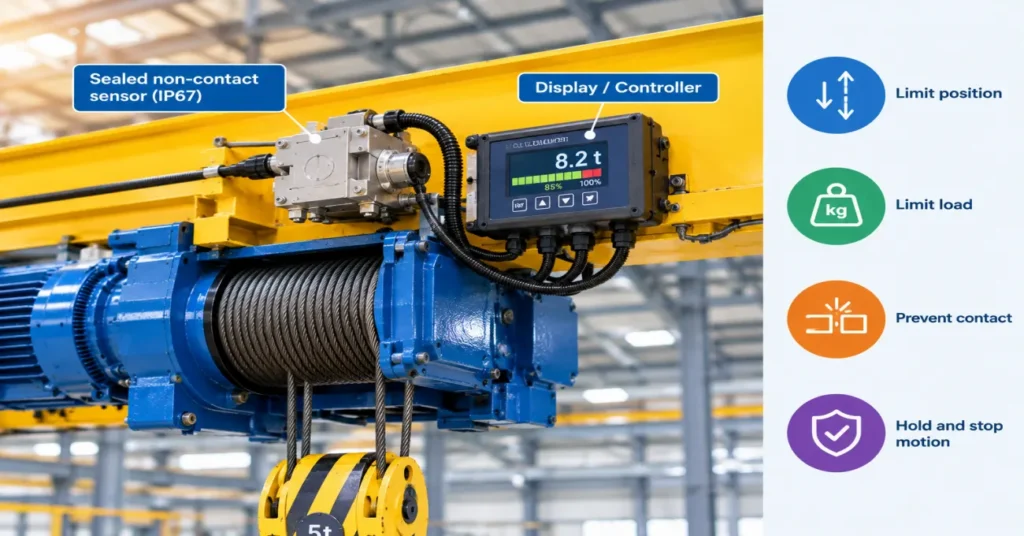
Hot, dusty, humid or corrosive sites need sealed non-contact sensors
In hot, dusty, humid or corrosive environments, replace mechanical contact limit switches with sealed non-contact proximity switches or rotary encoders rated IP67 or higher.
The reason is the contacts. In metallurgical and foundry shops, and at ports and quays with salt-laden air, a traditional mechanical travel switch is prone to contact oxidation, sticking or outright failure, and the failure is silent: the crane simply does not stop where it should. Non-contact sensing has no contacts to oxidize, and a rotary encoder also gives continuous position, which makes slow-down zones easier to set.
The condition matters. In a clean, dry assembly hall, standard switches are usually adequate, and the premium is not justified. The trade-offs for sealed sensing are higher unit cost, a controller that can read the signals, and a new weak point: the IP rating covers the sensor enclosure, not the cable gland, connector or junction box, so those need the same attention. Also check the sensor's temperature rating against both ambient and radiant heat.
Outdoor, multi-crane and hazardous-area sites
Outdoor, multi-crane and hazardous-area cranes each need protection that a standard indoor package does not include.
| Site condition | Add or upgrade | Why |
| Outdoor runway | Rail clamps or anchoring, rain covers, wind-rated brakes | Wind can move or tip an unrestrained crane; rain degrades electrics |
| Several cranes on one runway | Anti-collision sensors plus rail-mounted stops | A positive stop is the backstop when sensors miss |
| Gas or dust hazardous area | Explosion-protected electrics and sensors | Sparks and heat from standard components can ignite the atmosphere |
| Hot metal handling | High-temperature-rated sensors, redundant hoist limits | Heat shortens component life; failure consequences are severe |
For a hazardous area, the protection classification (for example ATEX or IECEx zones) must match the area classification on your site, so supply that to the manufacturer at enquiry stage.
Compare quotations on staging, ratings and calibration
Two quotations can list the same safety devices and still differ widely, so compare staging, ratings and calibration, not just device names.
Use this safety checklist when you request or compare quotes:
- Limits: how many stages per motion, which sensor type, and what IP rating.
- Load limiter: where the sensor sits, what the display shows, and whether a calibration record is supplied at delivery.
- Anti-collision: the detection technology, and how the stopping distance was set.
- Buffers: the type and the energy it is designed to absorb.
- Emergency stop: present at every control station, including the remote.
- Documents: test records and a recommended calibration interval.
Specific model parameters should be confirmed with the manufacturer before ordering, because the reference values in this guide are typical ranges, not guarantees for any one crane.
Ask for test evidence at acceptance, not just a device list
Ask for a written test record for each safety device at factory acceptance and again at site commissioning, because an installed device has not yet been shown to work.
"Standard Safety Devices" on a quotation is not a specification. Ask the supplier to list each device by name, the motion it protects, what it does when triggered (alarm, slow, stop) and how it is tested; without that, two quotes cannot be compared.
Then agree the test scope before ordering:
- Limit switches: trip points tested with an empty hook at increasing speeds up to maximum speed, for hoist, bridge and trolley.
- Overload limiter: set points checked against known test weights, with the calibration record handed over.
- Emergency stops and brakes: every control station tested, and brake holding checked on each motion.
- Anti-collision: the stopping distance demonstrated, not just the alarm.
- Site commissioning: the same checks repeated after installation, plus any load test your local regulation requires.
Ask for the records and settings in writing at handover, together with the manual's recommended inspection and calibration intervals. The trade-off is time: factory and site tests add to the schedule, so write them into the contract rather than negotiating them at shipment.
Inspection, Calibration and Hidden Costs
A realistic testing routine
Test limit switches and emergency stops at the start of each shift, and test load limiters under controlled conditions at scheduled intervals.
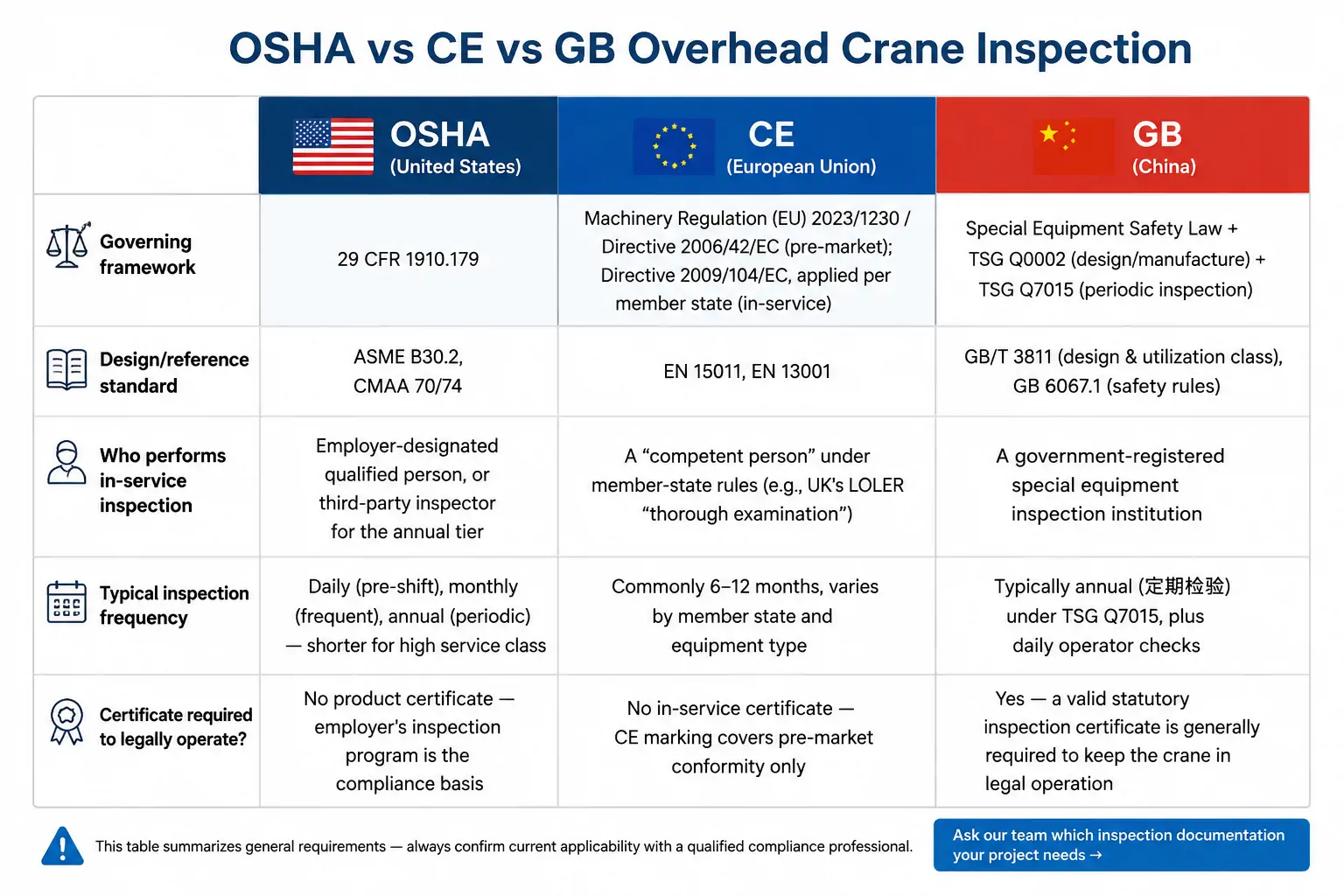
A practical routine has three tiers. Operators run unloaded function checks at the start of the shift, inching the hook into the upper limit and pressing the emergency stop (for hoist upper limits this is also the OSHA 1910.179(n)(4) requirement in the US). Maintenance staff then inspect wiring, switch mounting, cams and buffers at regular intervals, and a certified inspector carries out periodic examination and load testing as local rules require. Frequencies vary by jurisdiction and duty class, and standards such as OSHA 1910.179 and ASME B30.2 distinguish frequent from periodic inspection. Keep written records, because they are the evidence a safety audit asks for.
Load cell drift is a hidden running cost
Load cells drift under long-term vibration and cyclic stress, so a load limiter that was accurate at commissioning needs scheduled professional calibration.
The cost does not appear on the quotation. Drift moves the zero point, and the failure shows up in two opposite ways: the limiter may not alarm on a real overload, or it may trip repeatedly at rated load and stop production. The first is a safety and compliance exposure; the second is downtime with a direct production cost. Budget for calibration as a recurring service, ask the supplier how it is done and how often, and treat sudden changes in alarm behavior as a prompt to recheck before anyone adjusts the setpoint.
Common misjudgments at a glance
Most safety-device problems trace back to a handful of specification and operating decisions made before the crane arrives.
| Misjudgment | Consequence | Better practice |
| Single-stage limit (final power cut only) | Shock loads, gearbox wear, rope-jump risk | Slow-down stage followed by a stop stage |
| Contact switches in hot, dusty or corrosive sites | Silent failure, crane fails to stop | Sealed non-contact sensing, IP67 or higher |
| No calibration plan for the load limiter | Missed overloads or nuisance trips | Scheduled calibration with records |
| Using limits as normal stopping points | Premature wear of the safeguard | Operate to stop positions; limits stay in reserve |
Only the first three come from the field experience supplied for this article; the last is standard practice and is included for completeness.
Conclusion
Overhead crane safety devices work only as a set: position limits, load protection, contact prevention and brakes each cover a failure the others cannot. The specification details decide whether they hold up, namely two-stage limits, sensor ratings that suit the environment, and a calibration plan for the load limiter.
Before you order, do three things. Write your site conditions (temperature, dust, humidity, outdoor exposure, hazardous area, number of cranes per runway) into the enquiry. Ask each supplier to state limit stages, sensor IP ratings and load-limiter calibration support. And set up the test routine and records before the crane is handed over. If you have a specific site or duty question, contact the Nucleon Crane engineering team.

Equipment Specialist
Accomplished Crane Business Manager with extensive experience in heavy lift project management and operational oversight. Proven track record of driving revenue growth and ensuring safety compliance.
FAQ
What safety devices are required on an overhead crane?
Requirements depend on the jurisdiction and the applicable standard, but travel and hoist limits, overload protection, brakes, an emergency stop and an audible warning are the usual baseline. In the US, OSHA 1910.179 specifically requires a warning signal on power-traveling cranes other than floor-operated ones. Confirm the exact list with local regulations and the manufacturer.
What is the most important safety device on an overhead crane?
No single device is most important, because each covers a different failure. The hoist upper limit prevents over-hoisting, the load limiter prevents overload, and brakes and the emergency stop hold and halt motion. A crane that depends on one of them alone is under-protected. What matters is that all four jobs in the table above are covered and tested.
What is the difference between a limit switch and an overload limiter?
A limit switch watches position and stops motion at a set point; an overload limiter watches weight and stops hoisting near or above rated load. They protect against different hazards, so neither replaces the other. Both need regular testing, and the load limiter additionally needs periodic calibration to stay accurate.
How often should overhead crane safety devices be tested?
Test limit switches and emergency stops at the start of every shift, with a more detailed maintenance inspection at regular intervals and a certified periodic inspection and load test as local rules require. Exact frequencies depend on the jurisdiction, the duty class and the operating environment, so follow the applicable regulation and the manufacturer's manual.
How does an anti-collision system work on an overhead crane?
Sensors, such as laser, infrared, radar or position-based units, measure the distance to another crane or obstacle. When the distance falls below a preset value, the system warns the operator, slows the crane and then stops it. The right technology depends on dust, steam, rain and reflective surfaces at the site, so confirm performance under your conditions.

 English
 العربية
 Español
 Français
 Português
 Русский