

The most cost-effective warehouse crane solutions for SMEs are the ones the building can actually carry and the duty actually justifies. For light-steel or rented warehouses that usually means a low-headroom single-girder crane, a gantry crane, a jib crane or a mobile gantry. Market reference prices for the equipment run from about $800 to $15,000, and the real budget depends on what surrounds that number.
The trap for small and medium businesses is buying by catalog. A crane specified with heavy-industry habits (a high duty class, generous tonnage) costs more to buy and loads the runway harder. In a leased or light-steel building the structure often sets the limit first. The equipment price is then only the beginning of the bill.
This guide is deliberately not another list of crane types; our warehouse crane selection guide et crane types overview cover that. Here you will see which solution fits which building, how to avoid over-specifying, and which costs a quotation tends to hide.
Quick Reference: Which Solution Fits Your Building
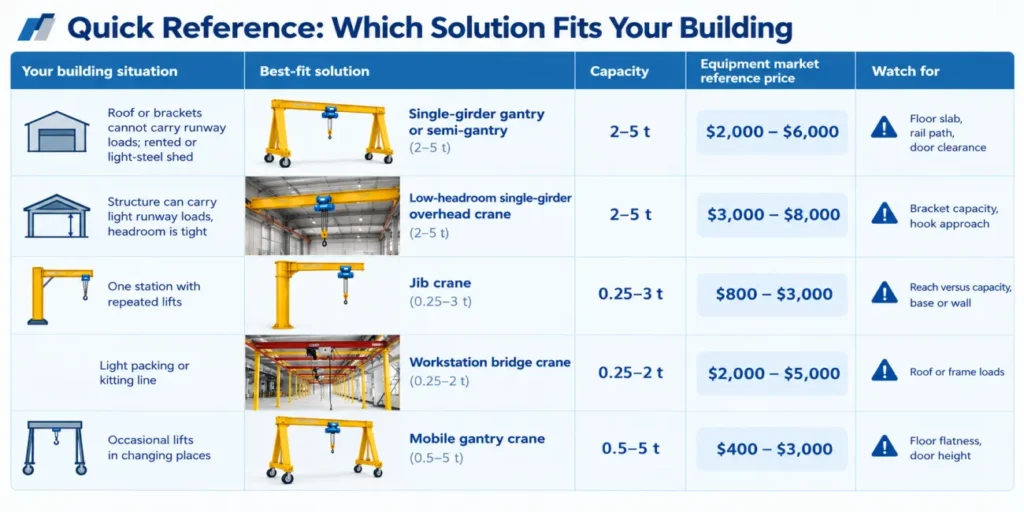
| Your building situation | Best-fit solution | Equipment market reference price | Watch for |
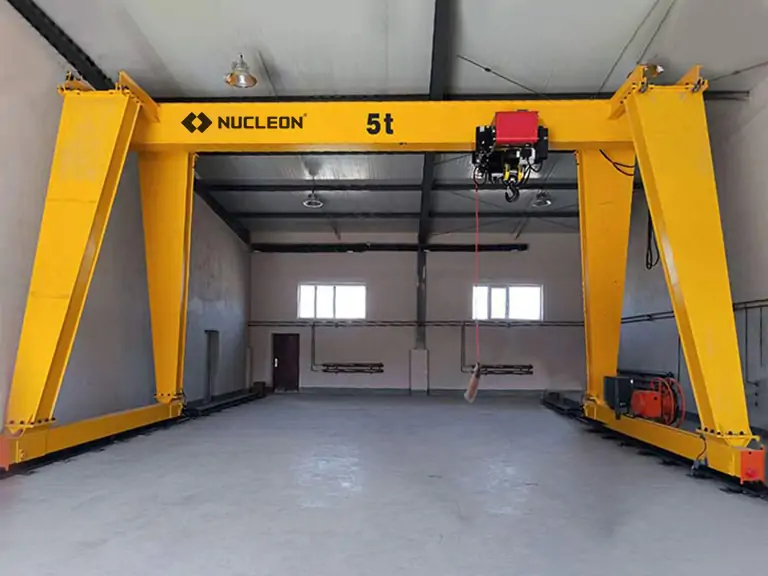
| Roof or brackets cannot carry runway loads; rented or light-steel shed | Single-girder gantry or semi-gantry (2–5 t) | $2,000–$6,000 | Floor slab, rail path, door clearance |
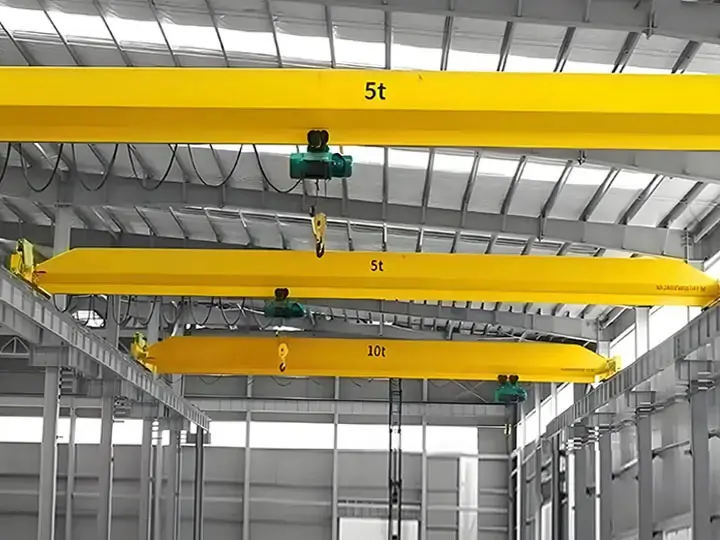
| Structure can carry light runway loads, headroom is tight | Low-headroom single-girder overhead crane (2–5 t) | $3,000–$8,000 | Bracket capacity, hook approach |
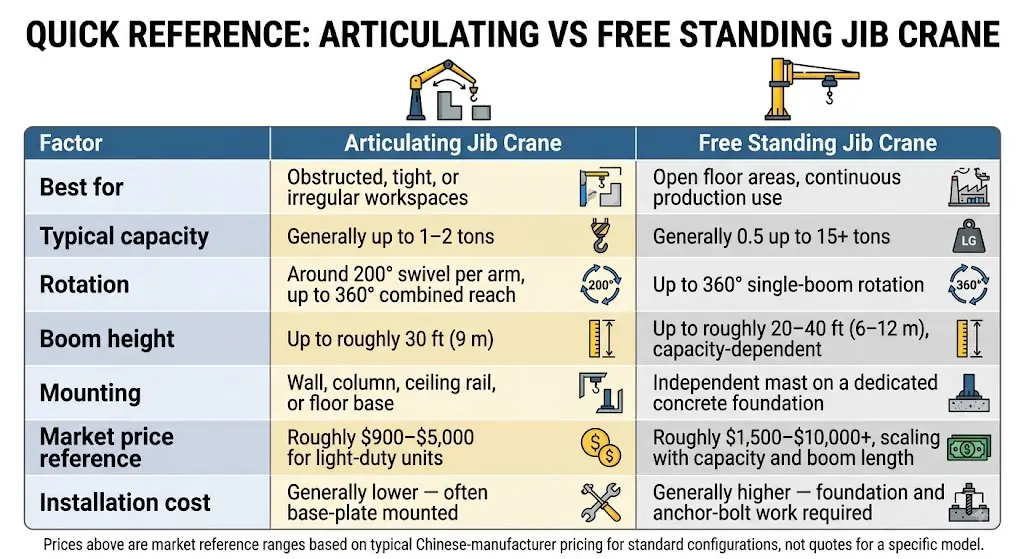
| One station with repeated lifts | Jib crane (0.25–3 t) | $800–$3,000 | Reach versus capacity, base or wall |
| Light packing or kitting line | Workstation bridge crane (0.25–2 t) | $2,000–$5,000 | Roof or frame loads |
| Occasional lifts in changing places | Mobile gantry crane (0.5–5 t) | $400–$3,000 | Floor flatness, door height |
Prices are equipment only, typical market references that vary with span, hoist and configuration. Please contact us to confirm exact model parameters.
Pick the crane your structure can carry and your duty justifies; the cheapest equipment quote is rarely the cheapest installed cost.
Table des matières
Warehouse Crane Solutions for SMEs Start with the Building, Not the Catalog
Light-Steel and Rented Buildings Often Limit Runway Loads
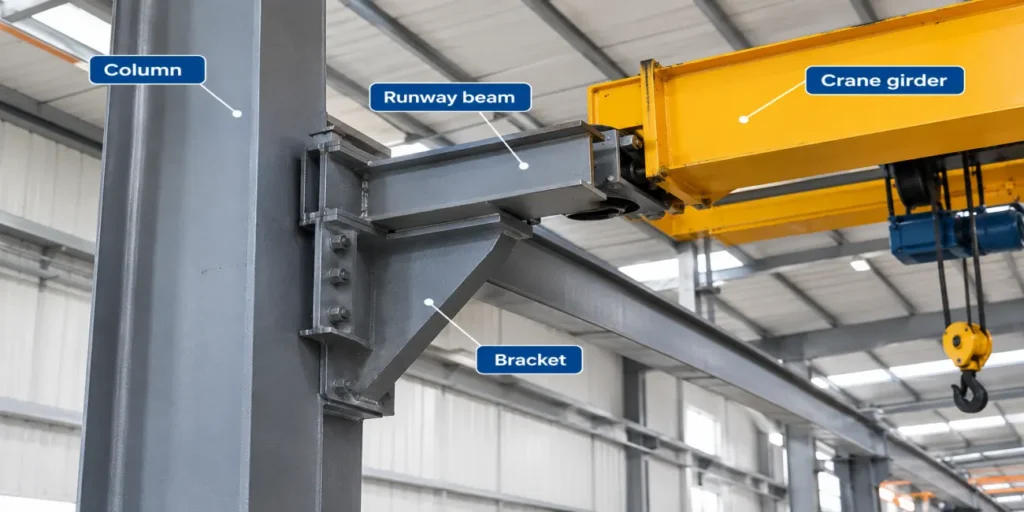
Many SME warehouses are light-steel or rented standard buildings whose column brackets commonly limit runway loads to roughly 5–10 tons; verify the actual figure for your building. The reason is design intent: these buildings were rarely sized for a crane, so brackets and runway supports carry only what the original designer assumed.
Ask the landlord or building engineer for the bracket and column capacity drawings before choosing a crane. If the limit is near your planned load, the options are a lighter crane, a gantry that transfers load to the floor, or reinforcement. Treat the 5–10 ton range as consultant experience to check against your own drawings, not a guaranteed figure.
Low Headroom Makes Hook Height the Constraint
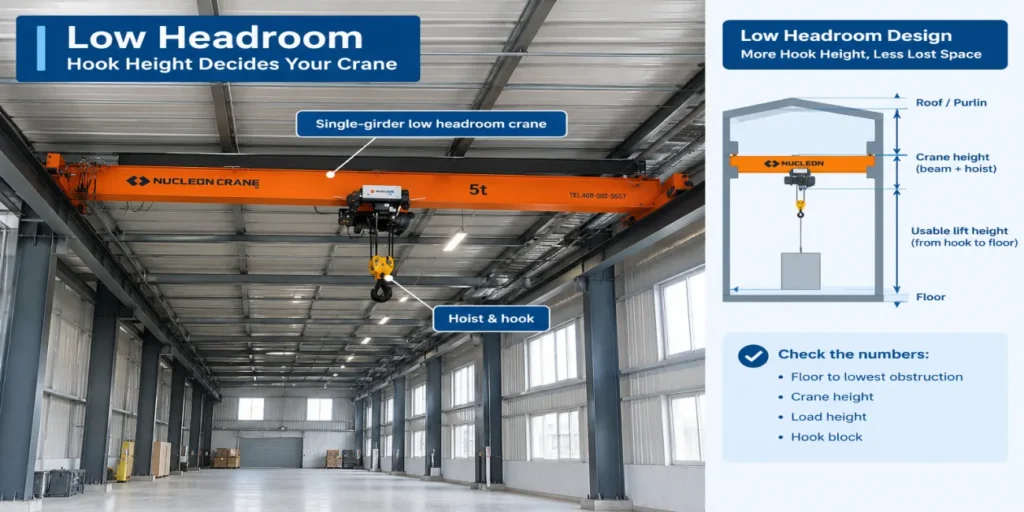
When the roof is low, hook height decides which crane works. Lighting, ducts and purlins already reduce clear height. The crane girder and hoist then take their own depth from what remains, so the usable lift can end up far below the roof height.
A low-headroom single-girder or underslung crane is designed to give back hook height, and it is usually the better fit for light-steel sheds that can carry modest runway loads. Draw a section from floor to lowest obstruction, include the load height and hook block, and confirm the numbers close before you ask for prices.
Overhead Crane vs Gantry Crane: Let the Structure Decide
In an overhead crane vs gantry crane decision, the structure decides: if the building cannot carry runway loads, use a gantry. A gantry crane runs on floor-level rails and sends its loads into the slab, so it avoids stressing brackets or the roof. The trade-offs are a clear floor path and slightly reduced headroom from the legs.
If the building can carry the loads, an overhead crane covers the floor more freely and keeps the floor clear. Check slab thickness and rail path for a gantry, or runway capacity for an overhead crane, before you compare prices. For a wider comparison, see our bridge crane vs gantry crane guide and our 5-ton gantry crane for workshop and warehouse.
Specify for SME Duty, Not Heavy-Industry Habit
Intermittent Warehouse Duty Usually Fits Class A3–A4
Intermittent SME warehouse duty usually fits ISO 4301-1 class A3–A4, so specifying A5/A6 out of heavy-industry habit adds cost without adding value. Classes are set by load spectrum and number of cycles. A5/A6 suits sustained, heavy use, whereas storage, tool changes and die assembly are typically low in annual operating hours.
A3–A4 roughly corresponds to FEM 1Am–2m, though mappings between classification schemes are approximate, so ask the supplier to state the equivalent they design to. To decide, record lifts per hour, hours per day and typical load against rated load. If the crane runs several shifts or often lifts near its rating, go higher. A higher class means heavier motors, gearboxes, brakes and structure, which raises the price and also loads the runway harder, and that matters in a building with limited bracket capacity.
Size Capacity from the Total Suspended Load
Size capacity from the heaviest total suspended load: the product plus the pallet, spreader, clamp and rigging. The hook carries everything hanging from it, so product weight alone understates the real load.
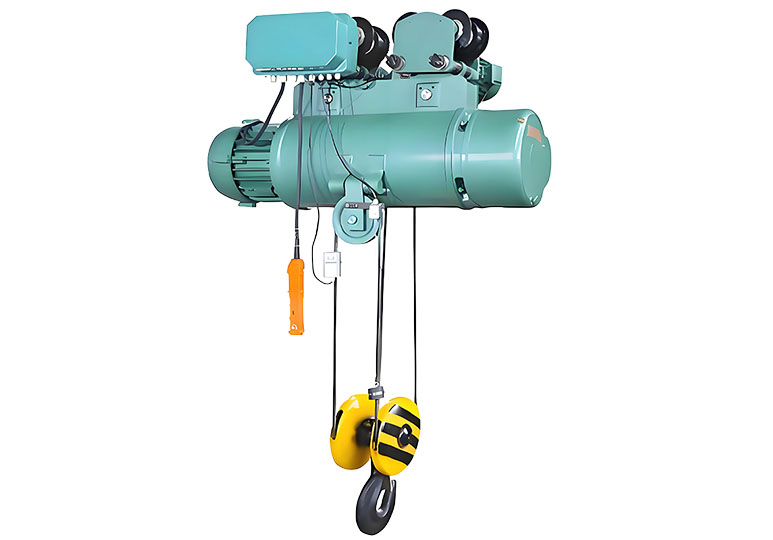
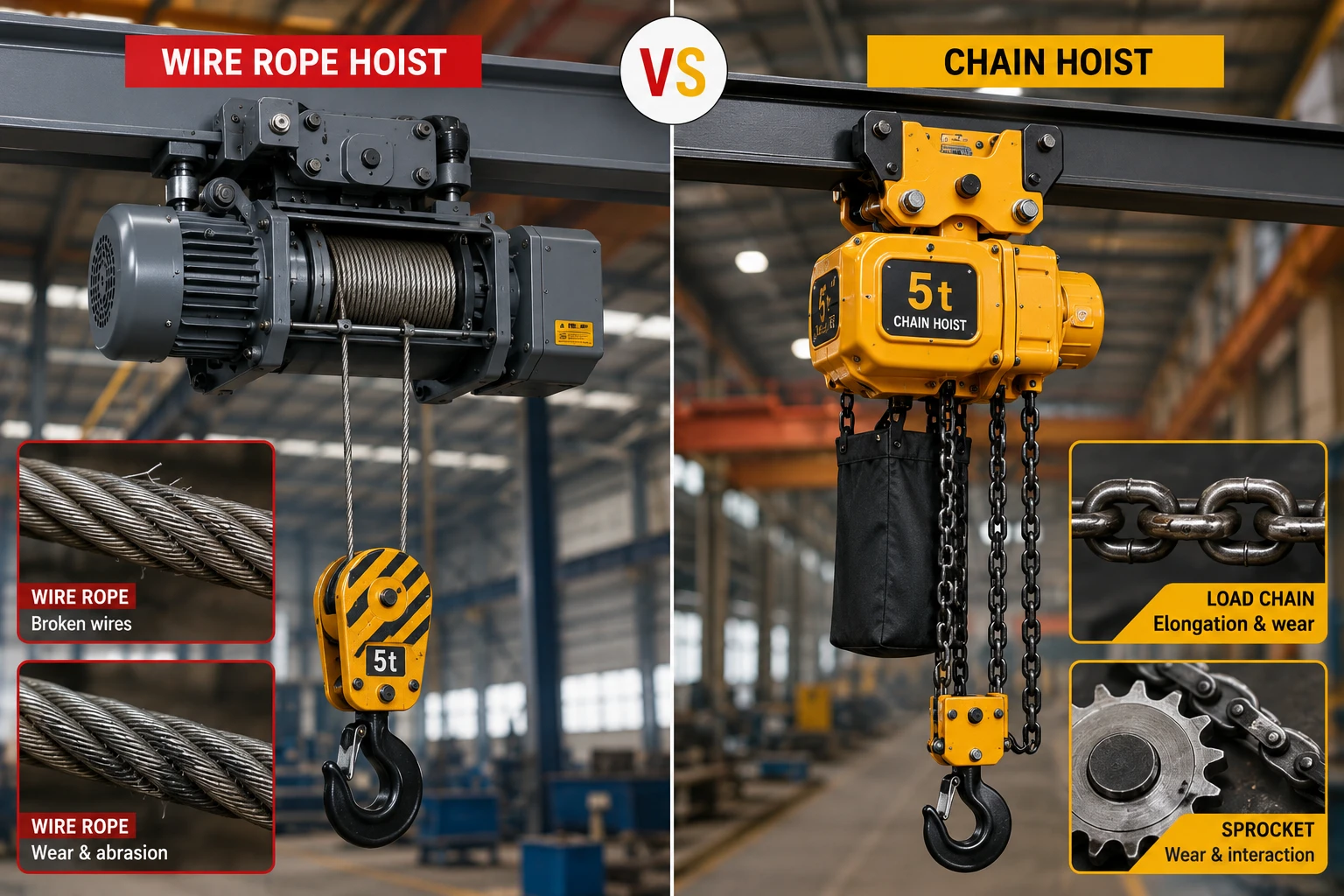
Write down the heaviest load today, the heaviest you foresee, and the accessory weight, then ask the supplier to round up to the next standard rating. There is no universal multiplier, and applicable hoist and crane rules sit in standards such as ASME B30.2, ASME B30.16 and EN 14492-2. Oversizing raises the girder, hoist and runway cost, and undersizing raises overload risk. For light lifting a palan à chaîne is typically the economical choice; for higher duty compare it with a wire rope hoist, as covered in our wire rope vs chain hoist guide.
Want a second opinion on your building and duty? Send us the bracket or column drawing, heaviest load, bay length, hook height and power supply. Our engineers will suggest a configuration and a market reference quote for your warehouse crane solutions for SMEs.
Obtenir un devis de solutionTotal Cost of Ownership: What the Equipment Quote Leaves Out
Five Cost Layers Sit Behind Every Quotation
Every crane quotation hides five cost layers, and a low equipment price often just moves cost into another layer. Use this table to compare quotes on the same scope:
| Cost layer | What drives it | Ask the supplier |
| Equipment and hoist | Capacity, span, duty class, hoist type | Which hoist, which class? |
| Runway, supports and building check | Existing bracket capacity, new columns, reinforcement | Who supplies wheel loads and drawings? |
| Installation, commissioning, load test | Local labour, site access, inspection | Supervised or turnkey? |
| Freight, duties and taxes | Destination, trade terms | What do the terms cover? |
| Maintenance, spares and downtime | Duty class, parts availability | What is in the starter spares kit? |
Light-duty installed budgets normally exceed the equipment price alone; see our gantry crane price guide for installed-cost context.
Compare quotes by installed scope, because the cheapest equipment quote often leaves runway, installation or building work to you.
Budget for a Structural Check of Brackets and Runway Beams
Budget for a structural check of the existing brackets and runway beams, because their shear and bearing capacity can force reinforcement. Crane wheel loads, plus an impact allowance, are transferred to supports that may have been designed for something else.
Get the supplier’s wheel loads, ask a local structural engineer to check them against the building drawings, and decide early between three options: reinforce, use a gantry, or choose a smaller crane. Reinforcement cost varies too widely to give a single figure, so treat it as a line item to quote, not an assumption.
Hook Approach Creates Dead Zones at Both Bay Ends
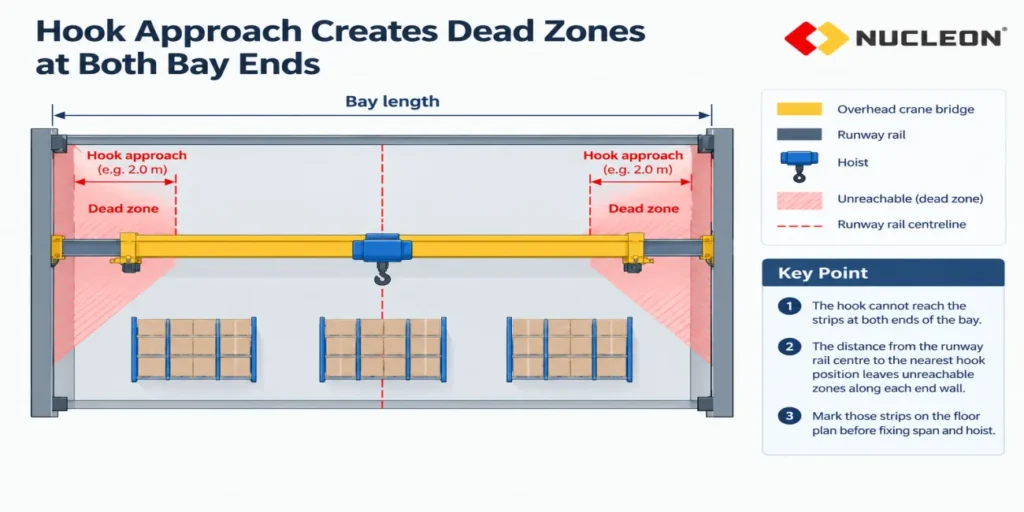
Plan the layout around the hook approach, because the hook cannot reach the strips at both ends of the bay. The distance from the runway rail centre to the nearest hook position leaves unreachable zones along each end wall.
Mark those strips on the floor plan before fixing span and hoist. You can then move racking or work positions, pick a compact hoist with a shorter hook approach, or add a grue à flèche murale at the end. Missing this during planning is a common reason for later layout changes.
Before You Request Quotes
Ask for Documents and Standards First
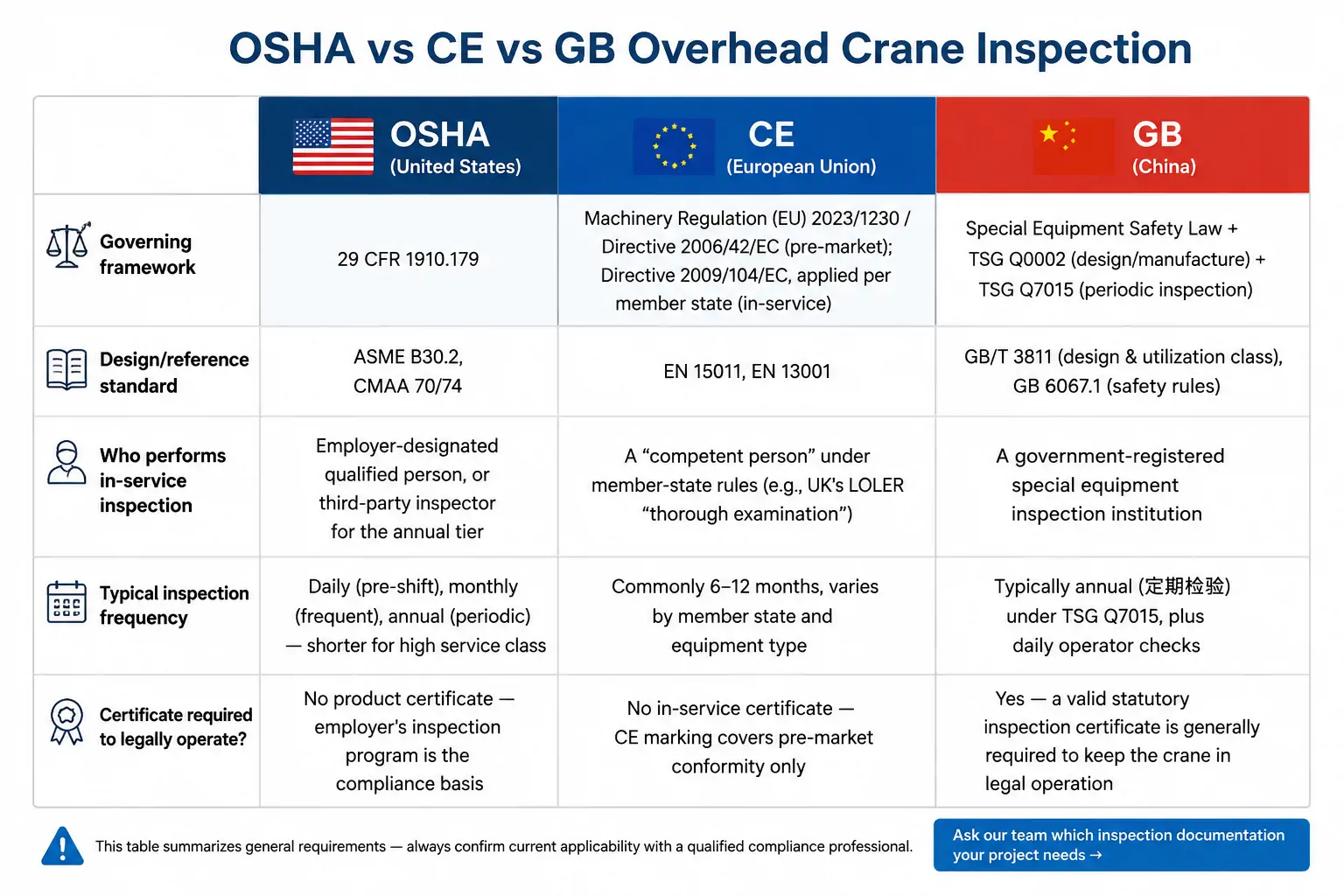
Ask for drawings, applicable standards and a test plan before paying a deposit. Request general arrangement drawings with wheel loads, and the standards the crane follows: EN 15011 or ASME B30.2 for bridge and gantry cranes, EN 14492-2 or ASME B30.16 for hoists, and ISO 4301-1 or GB/T 3811 for classification and design. Which marking or certificate applies depends on your destination, so confirm it with the supplier and your local regulator.
Send a Complete Enquiry
Send a complete enquiry so every supplier prices the same job:
- Building drawing, bracket or column capacity data, column spacing
- Heaviest suspended load and lift frequency (lifts per hour, hours per day)
- Span, hook height and the lowest roof obstruction
- Power supply (voltage, phase, frequency) and environment
- Control type and whether installation support is needed
Conclusion
Warehouse crane solutions for SMEs work best when the building, duty and budget are settled before the catalog is opened. Check what the brackets and floor can carry, specify A3–A4 duty only where it genuinely fits, and compare quotes by installed scope. Before you order:
- Get the building’s bracket and runway capacity in writing.
- Draw the hook height and dead zones on your layout.
- Line up every quote across the five cost layers.
Send us your drawing and heaviest load, and we will propose a configuration with a market reference price.

Spécialiste en équipement
Chef d'entreprise expérimenté dans le domaine des grues, avec une vaste expérience en gestion de projets de levage lourd et en supervision opérationnelle. Antécédents avérés en matière de croissance du chiffre d'affaires et de respect des normes de sécurité.
FAQ
Q1: What is the most cost-effective warehouse crane for a small business?
It depends on the building, but a jib crane or mobile gantry is usually the cheapest to buy. Market reference equipment prices run from about $800 to $6,000. They avoid a full runway. A single-girder crane costs more but covers a whole bay, so match the choice to lift frequency.
Q2: Can I install an overhead crane in a rented or light-steel warehouse?
Sometimes, but only if the brackets and runway supports can carry the crane. Many such buildings limit loads, so get the capacity drawings and a structural check first. If the structure cannot carry it, a gantry crane that loads the floor, or a lighter crane, is the usual alternative.
Q3: Is ISO class A3–A4 enough for a warehouse crane?
For intermittent SME use it often is, but check your real duty first. A3–A4 fits low annual operating hours and loads well below rating. If you run several shifts or lift near rated load often, a higher class is needed. Record lifts per hour and hours per day.
Q4: How much does a crane for a small warehouse cost in total?
Equipment alone typically falls between $800 and $15,000, depending on type, capacity and span. The total is higher once runway, structural checks, installation, load testing and freight are included. Compare quotes by installed scope, and see our gantry crane price guide for installed-cost context.
Articles connexes
- Types de ponts roulants d'entrepôt : Guide complet de chaque type
- Comment choisir les grues d'entrepôt adaptées à votre établissement
- Overhead Crane Safety Devices: Complete Guide
- How Much Does a Jib Crane Cost? Price Guide by Type, Radius and Installation
- How Much Does an Overhead Crane Cost? Price Guide by Capacity, Span and Duty Class

 English
 العربية
 Español
 Français
 Português
 Русский