

Overhead crane span and lifting height are the two measurements that decide whether a crane fits your workshop and can do your job. Span is the distance between the centres of the two crane rails. Lifting height is how far the hook can travel up and down.
Most buyers start with the wrong numbers. The width of the building is not the crane span, and the lifting height on a quotation is not always the height your load can actually reach. These mistakes usually show up late, after the order, when the crane arrives and either does not fit or cannot lift over the machine in front of it.
This guide explains both measurements in plain terms, shows how to work them out from your building, and lists what to send a supplier so your quotation is right the first time.
Overhead crane span is the distance between the centres of the two runway rails the crane travels on. Hauteur de levage is the distance the hook can move from its lowest to its highest position.
| Term you will hear | What it means | Common mistake |
| Crane span | Distance between the centres of the two rails | Using the building width instead |
| Hauteur de levage | How far the hook can travel up and down | Assuming it is the height your load can reach |
| Highest hook position | How high above the floor the hook can go | Not saying where the measurement starts |
| Hook approach | How close the hook can get to a wall or the end of the runway | Assuming the hook reaches every corner |
Two quotations can only be compared if every number says where it starts and where it ends.
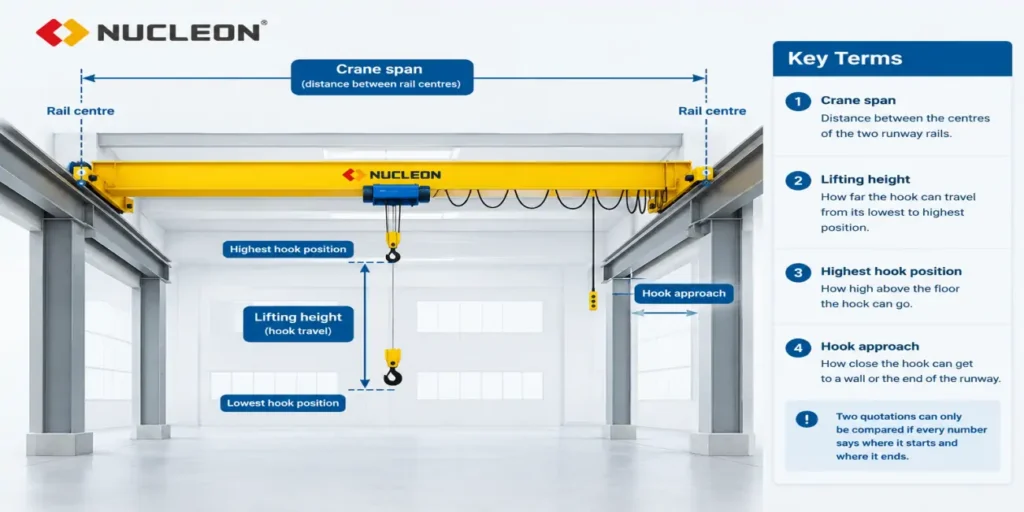
Table des matières
Overhead Crane Span and Lifting Height: What Each Measurement Means
Crane span is measured between the rails, not between the walls
Crane span is the distance between the centres of the two rails, so it is always smaller than the width of your building.
Three different numbers are easy to mix up: the distance between column centres, the clear width between the columns, and the distance between the rails. Only the last one is the crane span. The space between the wall and the rail is taken up by the crane's end sections, the rail supports and safety gaps. How much space that takes depends on the crane design and how the rails are supported, so there is no single number to subtract.
The most common mistake we see in enquiries is sending the building width as the crane span. The supplier then quotes a crane that does not fit between the rails, or the rails have to be redesigned after the order. Always take the figure from your building drawings and the supplier's dimension drawing.
Lifting height is how far the hook travels, not always how high your load can go
A crane's stated lifting height is how far the hook can travel, which is not the same as the height your load can reach.
The hook cannot go all the way up to the crane. The hoist and trolley need space above it, which limits how high it can rise. Suppliers also measure from different starting points, such as the floor or the top of the rail, so always ask for the highest hook position above the floor.
Then there is everything under the hook. Slings, lifting beams, clamps, magnets and grab buckets all take up height. If your load has to pass over a machine, the load itself and its rigging both need to clear it. A crane that meets the lifting height on paper can still fail to complete the job.
Check that the hook can reach every work station
The span covers the width of the bay, but you also need to check whether the hook can reach the places where you actually work.
Hook approach is how close the hook can get to the side wall or to the end of the runway. The crane's end sections and trolley frame take up room, so a workstation right against a wall or at the end of the bay can sit just outside the hook's reach even when the span is correct.
To check this, mark every pick-up and set-down point on your floor plan and note how close the hook needs to get at each one. The supplier's dimension drawing then confirms whether the hook can get there. A compact crane design can improve the reach, but it also changes the roof height needed and often the price, so look at span, hook reach and roof height together.
How to Work Out the Crane Span for Your Workshop
In a new building, choose the crane span first and then set the columns
If you are building new, decide the crane span first, because moving columns later costs far more than choosing the right span now.
The rail positions decide where the supports and foundations go. A simple order of work avoids most problems:
- Mark every place the hook must reach.
- Note how close the hook must get to each wall or end.
- Ask the supplier for the crane's end dimensions.
- Ask your structural engineer for the rail support dimensions and safety gaps.
- Agree a span the supplier can build.
- Set the column spacing to match.
For a rough first estimate, use: crane span ≈ distance between column centres − 2 × the offset from the column centre to the rail centre. That offset is usually a few hundred millimetres, but it depends on how your rails are supported, so take it from the structural drawing. If your column spacing is already fixed, work the other way round: measure the distance between the rails you can build and check that the hook still reaches every station.
In an existing building, measure the real rail positions
In an existing building, measure what is actually there rather than relying on the bay width or the old drawings.
Columns are not always perfectly straight, so measure the clear distance at more than one height. If you are replacing a crane, measure the distance between the existing rail centres directly. Rails that were installed slightly off, or are worn, will not match the original drawing.
If you plan to reuse the existing rails and beams, ask a structural engineer to check them against the new crane's weight. They were designed for the old crane, and a heavier or different crane can turn a simple replacement into a steelwork project.
A longer span costs more than the extra length
Each extra metre of span makes the crane heavier and puts more load on the rails and columns, so choose the shortest span that still reaches every station.
You can see the effect in Nucleon's own range. Our 5-ton EOT crane page lists a total crane weight of 2,220–8,990 kg across spans of 7.5–28.5 m, with the force on each wheel rising from 28.7 to 47.9 kN (values depend on span and configuration). The same 5-ton capacity can therefore ask very different things of your runway depending on how wide the bay is.
If the load is heavy for the span, the design often moves from a single girder to a double girder crane. Our guide to overhead crane main girder materials and structure explains why. Where a standard span is available, it is usually cheaper and quicker than a custom one, unless your process truly needs the extra reach.
How to Work Out the Lifting Height You Need
Start from the roof and take away what the crane uses up
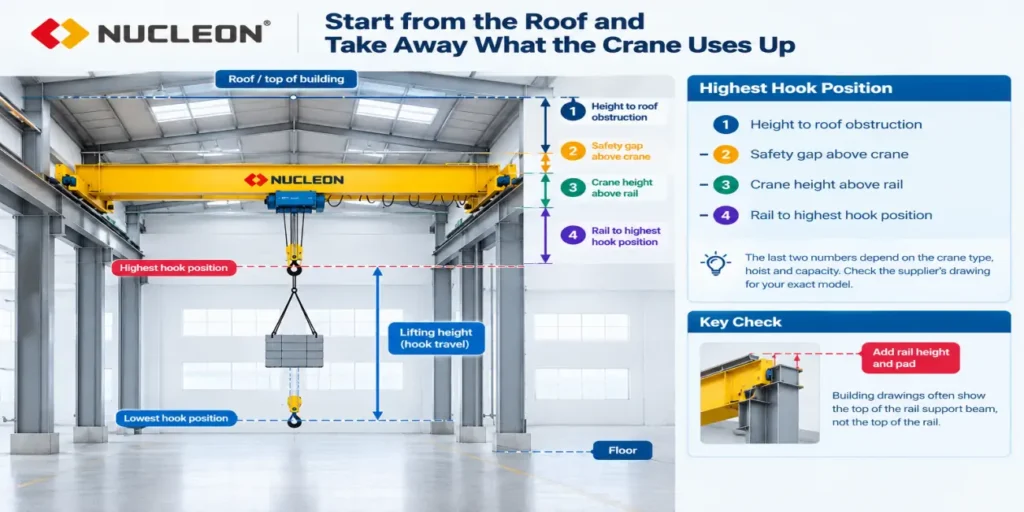
The highest your hook can go is limited by your roof, so start at the roof and subtract the space the crane needs.
Highest hook position =
height from floor to the lowest roof beam or obstruction
− safety gap above the crane
− height of the crane above the rail
− distance from the rail down to the hook at its highest point
The last two numbers depend on the crane type, the hoist and the capacity, so they come from the supplier's dimension drawing for your exact model. A single "2 metres" allowance is not safe to rely on.
Our engineers can send the dimension drawing for the exact model you are considering, so you can fill in these four numbers with real values.
One easy slip: building drawings often show the top of the rail support beam, not the top of the rail. Add the height of the rail itself, and any pad under it, to find where the rail top really is.
Add everything that hangs under the hook
The hook height you need equals the height you set the load down at, plus the height of the load, plus everything between the load and the hook.
That includes slings, lifting beams, clamps, magnets or grabs, plus the room to pass over any machine on the way. The example below uses simple, made-up numbers to show the method. Replace every number with the figures from your own building and the supplier's drawing.
| Article | Example value |
| Floor to lowest roof obstruction | 9.0 m |
| Safety gap above the crane | 0.3 m |
| Crane height above the rail | 0.9 m |
| Rail to highest hook position | 1.2 m |
| Highest hook position | 9.0 − 0.3 − 0.9 − 1.2 = 6.6 m |
| Machine the load must pass over | 3.5 m, plus 0.3 m clearance |
| Load height | 1.8 m |
| Slings (top of load to hook) | 1.2 m |
| Hook height needed | 3.8 + 1.8 + 1.2 = 6.8 m |
In this example the hook is 0.2 m too low, even though the crane's stated lifting height looks fine. Shorter slings, a more compact hoist or a higher rail would fix it. Ordering a bigger crane would not.
If your roof is low, try these fixes in order
When the numbers do not work, try the least disruptive fix first and move down the list only if you need to.
- Shorten the rigging. Shorter slings or a slimmer lifting beam cost the least and are worth checking first.
- Choose a low-headroom hoist or compact crane. These designs use less height above the hook. The trade-off is a different hoist type and usually a higher price, so check that the capacity and duty level still suit you. Our HD type European single girder bridge crane is one compact option.
- Consider a double girder crane. The trolley rides on top of the girders, which can let the hook go higher relative to the rail, but the crane stands taller above it. Check both figures before assuming it helps.
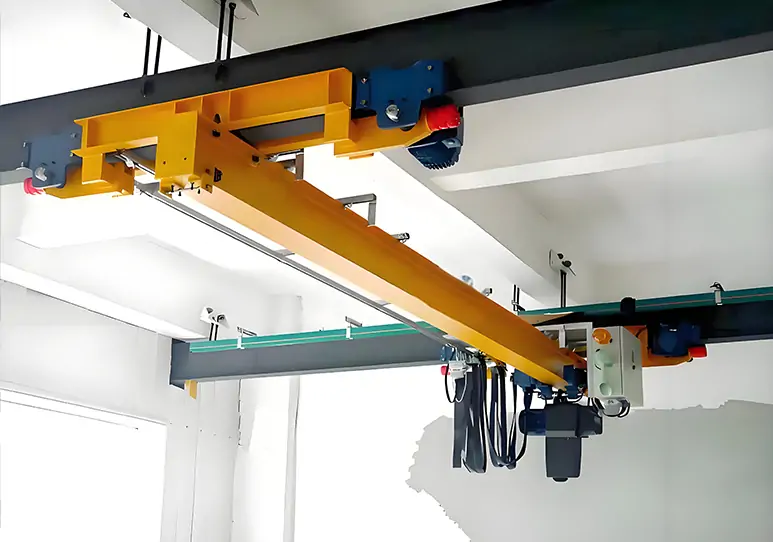
- Consider an underslung crane. It hangs below the beams and does not sit on top of rails. It suits light to medium loads and moderate spans. See our LX type suspension bridge crane et NLX European underhung crane.
- Lower the rails or change the building. This works only if the structure allows it and there is still enough clear height below. It is cheapest in a new building and most expensive in an old one.
Which Crane Type Fits Your Building
Match the crane type to your load, span and roof height together
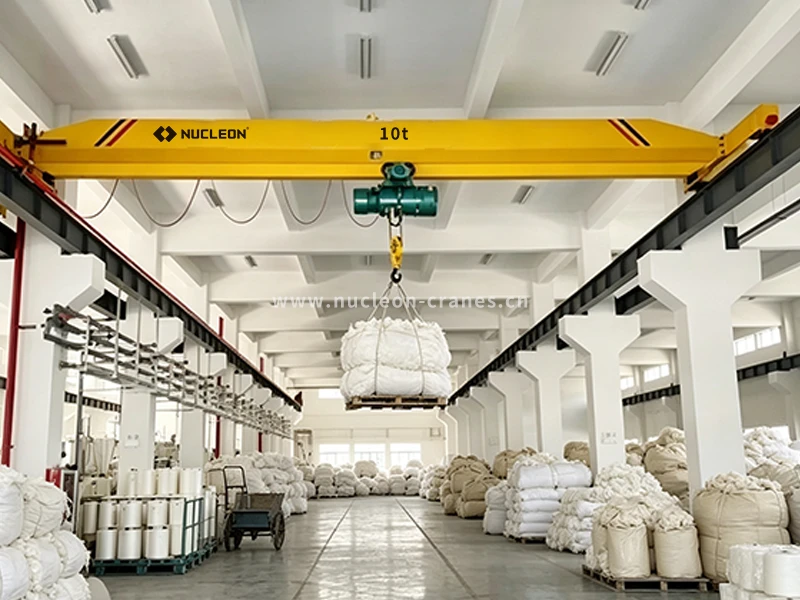
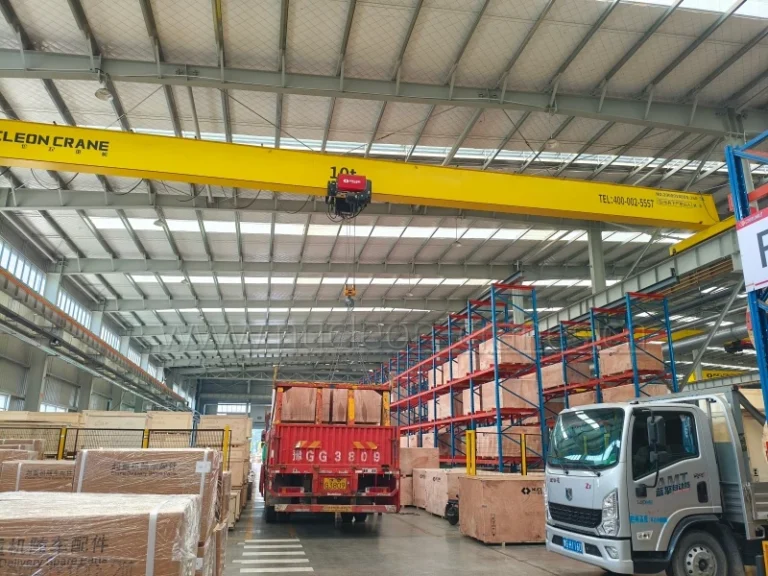
Choose the crane type by looking at load, span and roof height together, because each one points to a different answer.

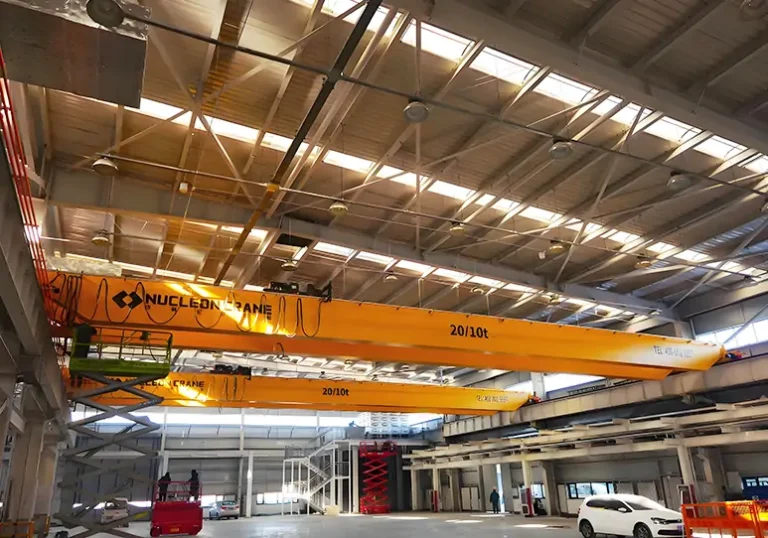
| Crane type (Nucleon model) | Capacity, span and lifting height | Choose it when |
| Standard single girder (LD type) | 1–32 t; span 7–31.5 m; lifting height 6–18 m standard, extendable | General workshops with moderate use and some roof height to spare |
| European compact single girder (HD type) | 1–20 t; span 3–34.5 m; lifting height 6–30 m | Roof height is tight and you still need long hook travel |
| Double girder (LH or QD type) | LH: span 10.5–31.5 m, height 5–32 m. QD: 5–800 t, height 5–26 m | Heavy loads, long spans or busy use |
| Underslung (LX or NLX type) | LX: 1–10 t, span 3–22.5 m, height 5–13 m. NLX: up to 10 t, span 3.5–35 m, height 3–30 m | Very low roofs with light to medium loads |
Ranges come from Nucleon's product pages (October 2026). Confirm the exact figures for your configuration with our engineers.
For general workshop use with some roof height to spare, a single girder crane is usually the lowest-cost choice. Tight roofs or heavy, busy use change the answer. Our comparison of ponts roulants à poutre unique vs ponts roulants à double poutre goes into more detail.
Check the rails and the building before you compare prices
The crane is only part of the cost, because a longer span or heavier crane can also mean stronger rails, beams and columns.
A low roof can add costs too, such as a low-headroom hoist, lowered rails or building changes. These rarely appear in the crane price, so a cheap quotation can hide the most expensive part of the project. Ask your structural engineer to check the rails and columns against the crane weight the supplier gives you, and compare options on the total installed cost, not the crane price alone.
If your building cannot carry the load at all, the rails can sit on their own columns instead. For light loads, a freestanding bridge crane avoids loading the building structure.
Compare quotations on the same measurements
Quotations are only comparable when every supplier gives the same measurements and lists what they leave out.
Ask each supplier for the span, the runway length, the highest and lowest hook positions (and where they are measured from), how close the hook gets to the walls, and a dimension drawing with the crane's weight on each wheel. Then compare what is excluded: rails and beams, power supply, installation and testing. If one offer shows a lower highest hook position than the others, it may assume a standard hoist where your roof needs a compact one, or it may measure from a different starting point.
Real examples: span and lifting height on recent Nucleon orders
In recent Nucleon orders, lifting height varies independently of span, because it is set by the building and the job rather than by the width of the bay.
The examples below were reported in the trade press (Hoist Magazine); customer names are not disclosed, and every figure was customised to the project.
| Destination | Grue | La portée | Hauteur de levage | As reported |
| Macedonia | 10 t HD European single girder | 10.75 m | 5,5 m | Order finalised after several technical consultations and adjustments to the proposed solution |
| Guatemala | 10 t European single girder | 19.55 m | 9 m | Described as suited to facilities with limited headroom and heavy lifting needs |
| Peru | 10 t HD single girder | 20 m | 6 m | 45 m travel length; shipped with 90 m of rail and a 45 m bus bar |
| Angola | 10 t European single girder | 25 m | 10 m | A5 duty; the customer also ordered the supporting crane steel structure |
| Brésil | Two 10 t overhead cranes (metal fabrication) | 23.55 m | 6.5 m | Two-speed lifting |
| Yemen | Six 5 t LD single girder | 16.5 m | 6 m | Installation planned with Nucleon engineering support |
Two points stand out. A 10 m span and a 25 m span can both sit under a lifting height of around 5.5–10 m, so you cannot guess one number from the other. And several orders included rails, bus bar or supporting steel, which is why the quotation should state exactly what is and is not in the scope.
Common Mistakes and What to Send Us
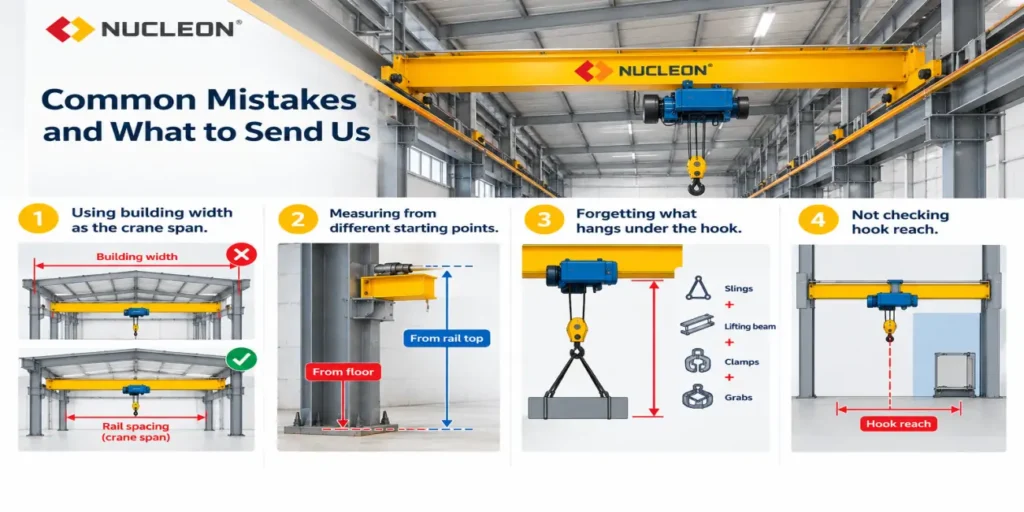
Four measurement mistakes that cause rework
Most rework on span and lifting height comes from four mistakes, and each can be caught on paper before you order.
- Using building width as the crane span. The building width, the column spacing and the rail spacing are three different numbers. A wrong span means a crane that does not fit.
- Measuring from different starting points. One quotation measures from the floor and another from the rail top. A difference of several hundred millimetres may just be a different starting point.
- Forgetting what hangs under the hook. Slings, beams, clamps and grabs use up height, so a crane that looks tall enough can still fail the lift.
- Not checking hook reach. The span covers the bay, but the hook may not reach a workstation next to the wall.
Each mistake is cheap to fix on paper and expensive after installation, when it can mean new rail steel, a replacement hoist or changes to the building.
What to send with your enquiry
Send your drawings and the details below together, and we can size the crane and send you a dimension drawing instead of a guess.
- Floor plan and a side-view drawing of the bay, showing the distance between column centres
- Height of the rail support beam (and the rail type, if rails already exist)
- Height from the floor to the lowest roof beam, pipe or other obstruction above the crane path
- The crane capacity you need, and the heaviest lift including slings and attachments
- How often you will use it: lifts per hour and hours per day
- The work stations the hook must reach, and how close it must get at each one
- The highest and lowest hook positions you need, and where you measure them from
- The runway length, and any other crane or fire-wall limit in the bay
- Your power supply and operating environment
You do not need all of this to start. If you only have a few measurements and some photos, send them and our engineers will tell you what else is needed.
Not sure your numbers add up? Send your drawings and notes to the Nucleon Crane team and we will check the span and lifting height with you before you order.
<details> <summary><strong>For engineers: standards and technical notes</strong></summary>
- Duty class is not geometry. Duty classification (ISO 4301-1 / FEM) describes how hard the crane works. It does not set span or headroom.
- Design standards. Bridge and gantry cranes are commonly designed to EN 15011, or to GB/T 3811 and GB/T 14405 for Chinese-standard cranes (Nucleon's product pages cite GB/T 14405). Confirm which edition applies to your project.
- Track tolerances. Wheel and track tolerances are covered by ISO 12488-1. The built runway has to stay within the applicable limits, so confirm the runway can be built and aligned to the chosen span.
- Deflection. Allowable vertical girder deflection is a fraction of the span, set by the applicable standard, so girder depth and weight rise with span. Nucleon's 10-ton page states main girder deflection within L/800 at full load and A5 duty; confirm the figure for each model.
- Wheel loads. Ask for the maximum and minimum wheel loads from the supplier's general arrangement (GA) drawing. Runway beams, brackets and columns must be checked against them, including dynamic effects. Reusing an existing runway needs the same check.
- Rail height. Rail designations such as QU70 or QU100 refer to the rail head width in millimetres, not the overall section height. Take the real height from the rail section drawing.
- Runway beam depth. In a top-running crane the bridge rides on the rail, so the beam depth normally sits below the rail and does not itself reduce hook height. It matters when the building drawing gives the beam top level instead of the rail top, or when the runway is suspended from the roof structure. Confirm against the model GA.
- Terminology. Suppliers use "headroom" and "hook approach" differently. Define every dimension by its start and end points on the GA drawing.
Conclusion
Overhead crane span and lifting height are worked out from your drawings, not from a rule of thumb: span from the rail centres and what the hook must reach, and lifting height from the roof down, with the slings included.
Before you ask for a quotation, do three things. Measure the column spacing and the rail centres separately. Work out the highest hook position using the crane's real dimensions and your real rigging. If the roof is low, choose the crane type first, then confirm the hook height. A crane chosen with the right overhead crane span and lifting height will fit the first time, and the quotations you collect will be easy to compare.

Spécialiste en équipement
Chef d'entreprise expérimenté dans le domaine des grues, avec une vaste expérience en gestion de projets de levage lourd et en supervision opérationnelle. Antécédents avérés en matière de croissance du chiffre d'affaires et de respect des normes de sécurité.
FAQ
Q1: What is the difference between building width and overhead crane span?
Crane span is the distance between the rail centres, which is always less than the building width. The gap covers the crane's end sections, the rail supports and safety gaps, and it changes with the crane design. Take the exact figure from your building drawings and the supplier's dimension drawing instead of subtracting a fixed amount.
Q2: How do I calculate overhead crane span for my workshop?
Start with the rail centre distance you can build, then check the hook reaches every work station. For a rough estimate, use column centre spacing minus twice the offset from the column centre to the rail centre. Read that offset from your structural drawing, then ask the supplier to confirm the final span.
Q3: How do I work out the lifting height I need?
Add the height you set the load down at, the load height and the slings. Then check the building allows it: take the lowest roof height, subtract the safety gap, the crane's height above the rail and the rail-to-hook distance. The last two come from the supplier's dimension drawing for your model.
Q4: Can I get more lifting height in a low building?
Often yes, and a bigger crane is not the answer. Try shorter slings first, then a low-headroom hoist, a double girder layout or an underslung crane, depending on your load and span. Lowering the rails or changing the roof is the last resort. Recheck the full calculation for whichever option you choose.
Q5: Does a longer span make an overhead crane more expensive?
Yes, usually by more than the extra length. A longer span makes the crane heavier and puts more load on the rails and columns, which can mean stronger runway steel. Choose the shortest span that reaches every station, and compare quotations on the total installed cost, not the crane price alone.
Articles connexes
- Pont roulant pour l'industrie automobile : Guide d'application et de sélection
- Crane End Truck & Wheel Maintenance Guide: Inspection, Wear, Alignment & Replacement
- Pont roulant antidéflagrant : quand en avez-vous réellement besoin ?
- Pont roulant LD ou HD : lequel choisir ?
- Guide des pannes courantes et de réparation des ponts roulants : Quelles sont les véritables causes des pannes (et que vérifier en premier) ?


 English
 العربية
 Español
 Français
 Português
 Русский