

Choosing the wrong straddle carrier costs more than a bad purchase — it slows your operation for years. Whether you're handling intermodal containers at a port, moving heavy coils inside a steel plant, or automating a large distribution warehouse, the model you select needs to match your facility's floor layout, load cycle, power infrastructure, and five-year growth plan. This guide cuts through the spec sheets and supplier pitches to give you a practical straddle carrier buying guide built around real operational requirements.
By the end, you'll know how to evaluate load capacity, lifting height, power source, safety certifications, and total cost of ownership — and you'll have a structured comparison framework to bring into your supplier conversations.
Tabla de contenidos
1. Start With Your Application: Indoor vs. Outdoor Requirements
Before comparing any technical parameter, define where and how the machine will operate. Indoor and outdoor straddle carriers differ in chassis design, tire specification, weather protection, and emission compliance.
Indoor Straddle Carriers
Indoor straddle carriers are typically electric-powered and designed for smooth concrete surfaces. They operate in warehouses, production halls, and cold-storage facilities where aisle width, floor load limits, and noise levels are critical constraints. Low-noise straddle carrier models — such as those from Combilift and Hubtex — produce under 70 dB(A) during operation, meeting EU Machinery Directive 2006/42/EC noise requirements for enclosed workplaces.
For cold storage applications, the best straddle carrier for cold storage environments must be rated for sustained operation at temperatures as low as −25°C. This requires sealed motor housings, heated operator cabins, and battery systems with low-temperature performance ratings. Always request cold-chain test certification from the manufacturer before purchase.
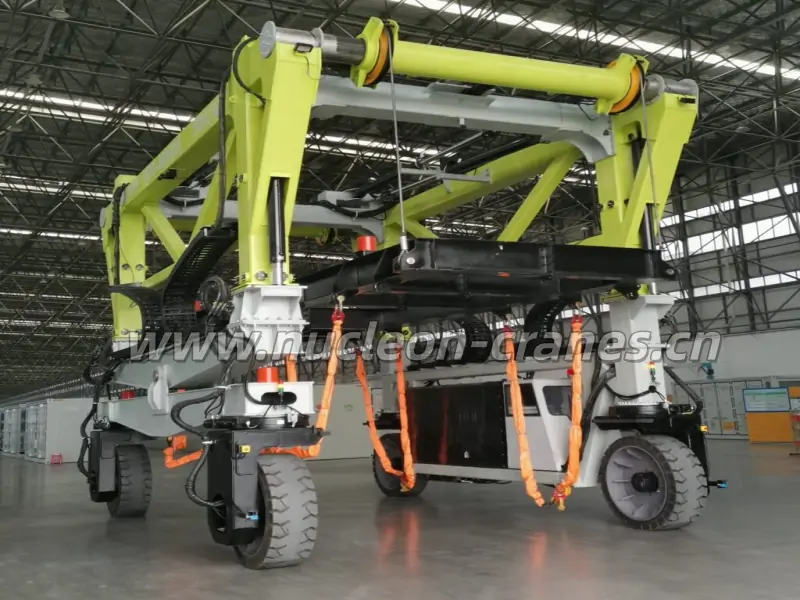
Outdoor Straddle Carriers
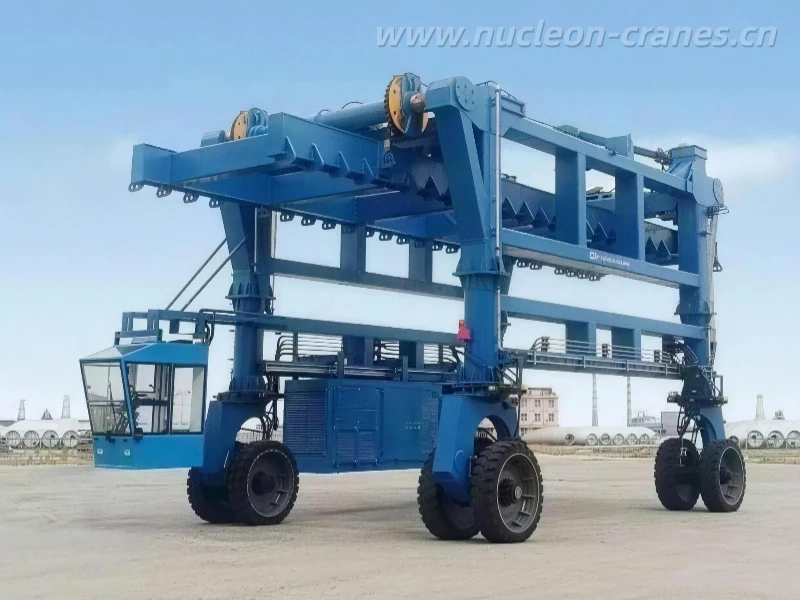
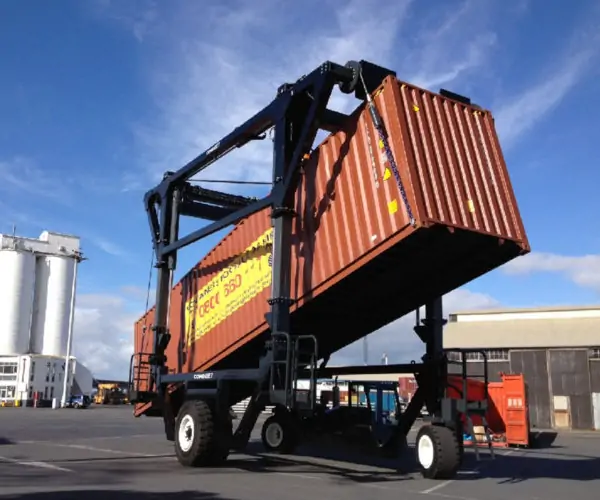
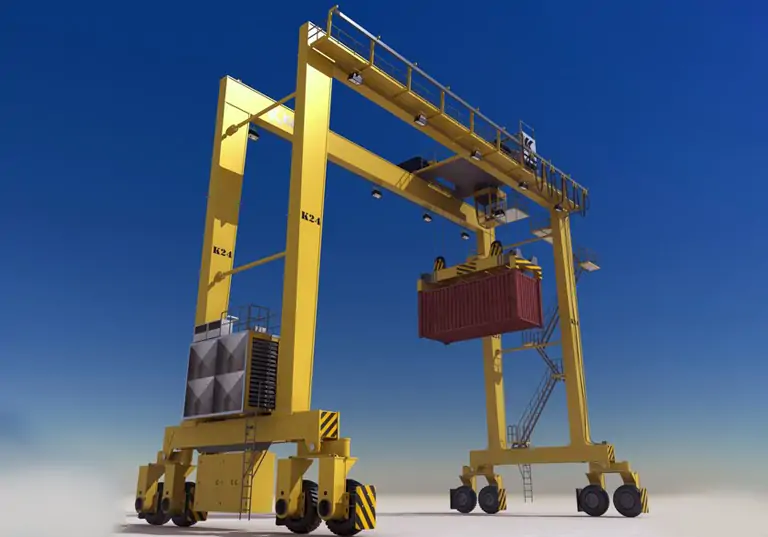
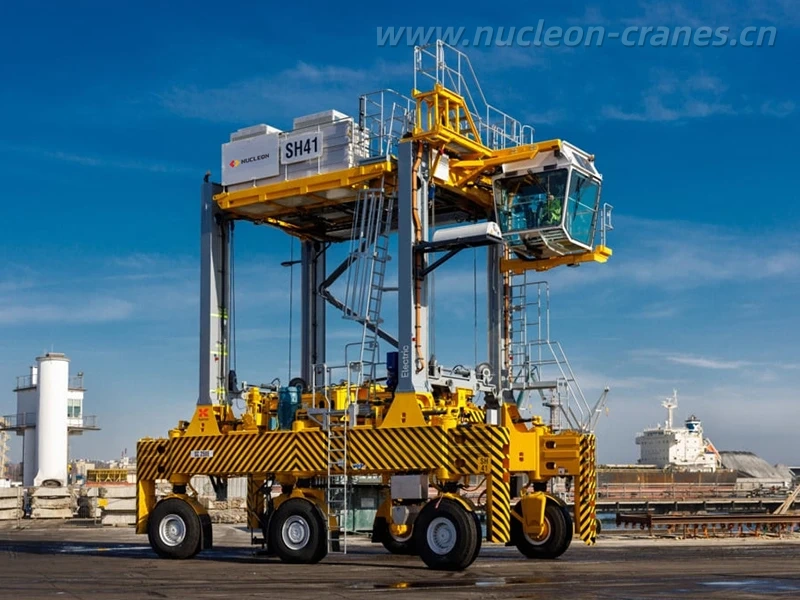
Outdoor models handle container handling at ports, rail terminals, and logistics yards. They run on rubber-tired chassis with diesel or hybrid powertrains, and must comply with local emission zones (EU Stage V, EPA Tier 4 Final). Ground pressure, turning radius, and wind load tolerance all become selection criteria outdoors. If your site receives vessels or trains on a seasonal schedule, ask suppliers about corrosion protection standards — ISO 12944 (corrosion protection of steel structures by protective paint systems) is a useful benchmark.
Quick Decision Rule: If more than 60% of operating hours are indoors, default to electric. If outdoor and the yard covers more than 5 hectares, evaluate diesel-electric hybrid for range efficiency.
2. Technical Parameters: What the Spec Sheet Actually Means
Most procurement teams receive a datasheet with dozens of parameters. These five are the ones that drive real operational fit — and the ones most often misread.
Load Capacity and Payload Rating
Payload rating (also called rated load capacity) is not the same as maximum structural load. The rated figure reflects safe, sustained operation at the machine's specified lift height and center of gravity. Lifting a load that is off-center or at maximum extension will reduce effective capacity — often by 20–35% depending on model geometry.
When calculating your requirement, add 10–15% to your heaviest typical load to allow for load variation and future cargo growth. For container handling, ISO 668 defines standard container weights (up to 36,000 kg gross for a 40-ft container); your carrier's payload rating should exceed this with margin.
Altura de elevación
Lifting height determines stacking capability and building clearance requirements. Standard warehouse straddle carriers typically lift to 1.8–3.5 m. Port-grade container straddle carriers can reach 15–18 m for 3-high or 4-high stacking. The critical check: confirm that your facility's structural clearance (roof height, overhead cables, fire suppression systems) accommodates the maximum lift height plus the top of the load.
Power Source Comparison
| Fuente de energía | Lo mejor para | Energy Cost (est.) | Refuel/Recharge Time | Cumplimiento de emisiones |
| Electric (lithium-ion) | Indoor, high-cycle | Low (grid-dependent) | 1–3 hrs (fast charge) | Zero direct emissions |
| Electric (lead-acid) | Indoor, lower budget | Bajo | 8–10 hrs | Zero direct emissions |
| Diesel | Outdoor, remote yards | Medio-alto | 10–20 min | EU Stage V / EPA Tier 4 |
| Diesel-Electric Hybrid | Mixed indoor/outdoor | Mediano | 15–25 min | EU Stage V compliant |
Sources: Kalmar Product Specifications 2024; Konecranes Technical Data Sheet 2025; EU Stage V Regulation (EU) 2016/1628
Battery life and charging time are critical for electric models in multi-shift operations. Lithium-ion systems from suppliers like Konecranes and Liebherr now offer 8–12 hour operational windows per charge, with opportunity-charging capability during breaks. Always request the battery degradation curve — a pack that delivers full capacity in year one may retain only 75–80% by year five.
Lifting Height vs. Payload: Why They Trade Off
A common selection mistake is specifying maximum lift height and maximum payload simultaneously without checking the manufacturer's load chart. Most straddle carriers have a derating curve: as lift height increases, the rated payload decreases. Request the full load chart for every model you evaluate, not just the headline specification.
3. Safety Features and Certification Requirements
Safety is not optional — it is a procurement gating criterion. Any straddle carrier operating in Europe must carry CE certification under the EU Machinery Directive (2006/42/EC). In North America, OSHA 29 CFR 1910.178 governs powered industrial trucks including relevant straddle designs. Beyond legal minimums, evaluate these specific safety systems.
Operator Cabin Ergonomics
Operator cabin ergonomics directly affects long-shift productivity and incident rates. Key cabin features to evaluate: 360° visibility or camera-assisted view systems, adjustable seat with lumbar support (ISO 7096 vibration standard), intuitive joystick or touchscreen controls, and climate control for extreme environments. Operators in poorly designed cabins report 30–40% higher fatigue levels in studies by the European Agency for Safety and Health at Work (EU-OSHA, 2023).
Active Safety Systems
Modern straddle carrier models increasingly include:
- Load sway detection with automatic speed reduction
- Anti-collision radar for pedestrian detection zones
- Automatic stability control on uneven ground (outdoor models)
- Data-logging event recorders for incident investigation
Ask suppliers which safety features are standard versus optional. For CE certification compliance and ISO standards for straddle carriers, reference EN ISO 3691-5 (industrial trucks — safety requirements for driverless trucks and their systems), which increasingly applies to semi-automated straddle variants.
Certification Checklist for Procurement
| Norma/Certificación | Alcance | Applicability |
| CE / EU Machinery Directive 2006/42/EC | Market placement, EU | All EU operations |
| EN ISO 3691-5 | Driverless/automated trucks | Automation-capable models |
| ISO 668 | Container dimensions/weights | Container handling |
| EU Stage V (Reg. 2016/1628) | Diesel engine emissions | Outdoor diesel models |
| ISO 12944 | Corrosion protection | Outdoor/coastal operations |
| ISO 7096 | Operator seat vibration | Operator cabin assessment |
Source: ISO Official Database (iso.org); EU Regulation texts via EUR-Lex, accessed 2025
4. Total Cost of Ownership: Beyond the Purchase Price
Sticker price typically represents 20–35% of the ten-year total cost of ownership for a straddle carrier. The rest is operating cost, maintenance, energy, and end-of-life value. A structured TCO calculation is essential for fair straddle carrier models comparison.
TCO Component Breakdown
| Categoría de costo | Typical Share of 10-Year TCO | Key Variables |
| Purchase price | 20–35% | Model, specification, volume discount |
| Energy (fuel/electricity) | 25–35% | Utilization hours, local energy rates |
| Planned maintenance | 15–20% | Service interval, OEM vs. third-party |
| Unplanned repair / downtime | 10–20% | Parts availability, component reliability |
| Operator labor | 5–10% | Automation level, shift structure |
| Residual value | −5 to −15% | Brand, condition, market demand |
Benchmark data: Konecranes TCO Whitepaper 2024; Kalmar Financial Performance Analysis 2023
Maintenance Schedule and Spare Parts Availability
A robust maintenance schedule reduces unplanned downtime — the single largest hidden cost in straddle carrier operations. Evaluate supplier service intervals (typically every 250–500 operating hours for hydraulic and drivetrain components), regional service network coverage, and spare parts availability for the model you're considering.
For older or less common models, spare parts lead times can stretch to 8–12 weeks. Prioritize suppliers with local parts depots or regional service centers within your geography. Ask for the mean time between failures (MTBF) for critical components — hydraulic cylinders, lifting chains, and drive motors — from the supplier's own service data.
Energy Efficiency and ROI Calculation
Energy efficiency is measurable and should be part of your ROI calculation. An electric straddle carrier operating 2,000 hours per year at €0.15/kWh will cost approximately €6,000–€12,000 annually in electricity, versus €18,000–€30,000 in diesel at current EU pump prices. Over ten years, the energy savings alone — before maintenance cost differences — can offset a €60,000–€150,000 purchase price premium for an electric model.
Build your ROI calculation on three scenarios: base case (current utilization), conservative growth (10% annual throughput increase), and stretch (20%). This frames the investment against your actual operational outlook, not a static snapshot.
5. Future-Proofing: Scalability, Automation, and IoT Integration
A straddle carrier purchased today should support your operation in 2030. Two trends are reshaping the decision: warehouse automation and remote monitoring.
Remote Monitoring and IoT Integration
Remote monitoring and IoT integration have moved from premium feature to standard expectation for major brands. Suppliers including Kalmar, Konecranes, and Combilift now offer fleet management platforms that track utilization, predictive maintenance alerts, energy consumption per shift, and operator performance metrics. Before finalizing a purchase, verify whether the IoT platform is proprietary or open-protocol (OPC-UA is increasingly standard), what data ownership terms apply, and whether the platform integrates with your existing WMS or ERP.
Straddle carriers with built-in scales — load cells integrated into the fork arms or lifting frame — add weighing functionality at point of pick, eliminating separate weighbridge cycles. This is particularly valuable in logistics and material handling environments where accurate weight documentation is required for road transport compliance.
Scalability and Warehouse Automation
If your facility roadmap includes any level of warehouse automation — AGV integration, automated storage zones, or traffic management systems — shortlist only models with documented automation-readiness. This typically means semi-automated steering, standardized communication protocols (CAN-bus, PROFINET), and software interfaces for fleet management integration.
Ask each supplier: "Can this model be upgraded to semi-autonomous operation post-purchase, and what is the cost?" The answer tells you both the technical capability and the supplier's long-term support posture.
6. Supplier Comparison Framework
No single supplier leads across all dimensions. Use this matrix to score your shortlisted options objectively.
| Evaluation Criterion | Peso | Supplier A | Supplier B | Supplier C |
| Load capacity match | 20% | — | — | — |
| Safety certifications | 15% | — | — | — |
| TCO (10-year) | 20% | — | — | — |
| Service network / parts availability | 15% | — | — | — |
| IoT / automation readiness | 10% | — | — | — |
| Operator ergonomics score | 10% | — | — | — |
| Delivery lead time | 5% | — | — | — |
| Customer case study relevance | 5% | — | — | — |
Complete this matrix with scored data from supplier RFQ responses and reference site visits.
Verified Customer Case Studies to Reference:
- Port of Felixstowe (UK): Kalmar rubber-tyred straddle carrier fleet deployment for container handling — publicly documented in Kalmar customer references (kalmar.com).
- Volkswagen Logistics, Wolfsburg: Indoor straddle carrier integration in production logistics — referenced in Konecranes industrial case studies (konecranes.com).
- DB Schenker, Duisburg logistics center: Hybrid straddle carrier evaluation for multi-shift mixed indoor/outdoor operations — cited in DB Schenker sustainability report 2023.
Always request two to three reference customers in your specific application segment (container vs. industrial vs. cold storage) from each supplier, and make direct contact before purchase.
Summary and Action Steps
Selecting the right straddle carrier is a structured decision, not a catalog choice. Work through these steps in order:
- Define your operating environment (indoor/outdoor, floor type, temperature, shift pattern).
- Calculate your true load requirement with growth buffer and off-center load factors.
- Select your power source based on utilization hours, energy infrastructure, and emission zone requirements.
- Verify CE certification and applicable ISO standards for every shortlisted model.
- Build a 10-year TCO model including energy, maintenance, and residual value — not just purchase price.
- Score suppliers on a weighted matrix and visit at least one reference site per shortlisted supplier.
- Confirm automation and IoT upgrade paths before signing.
A well-specified straddle carrier, correctly matched to its application, will deliver 15–20 years of service with manageable TCO. The investment in thorough pre-purchase analysis pays for itself within the first maintenance cycle.

Especialista en Equipos
Gerente de Negocios de Grúas con experiencia y amplia trayectoria en gestión de proyectos de elevación pesada y supervisión operativa. Historial comprobado de impulso del crecimiento de los ingresos y garantía del cumplimiento de las normas de seguridad.
Preguntas frecuentes
Q1: What load capacity do I need for standard ISO container handling?
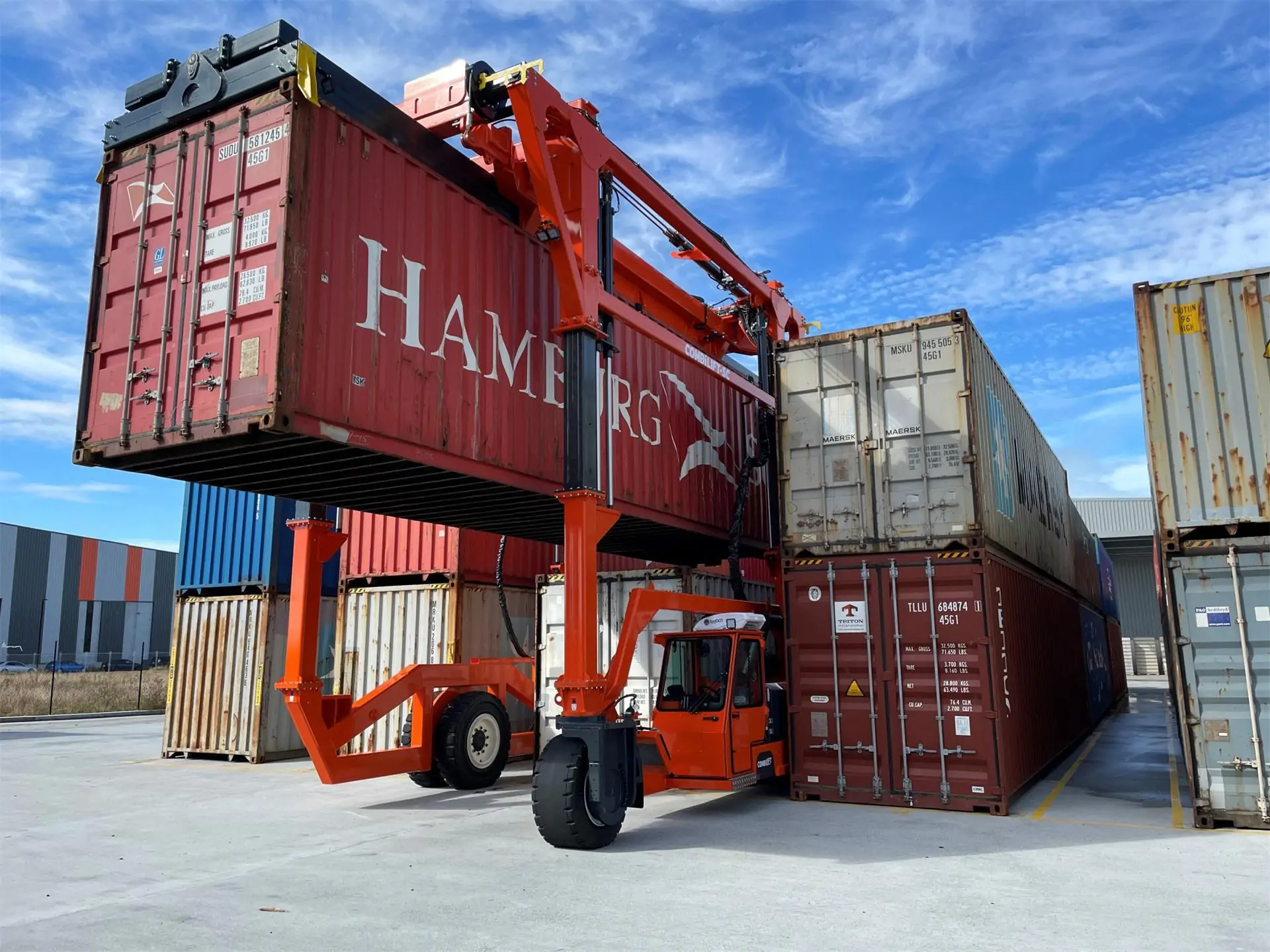
ISO 668 defines a maximum gross mass of 36,000 kg for a 40-foot container and 30,480 kg for a 20-foot unit. For container handling with a straddle carrier, select a model with a payload rating of at least 40–45 tonnes to accommodate maximum gross weight plus handling tolerances and load chart derating at operational lift heights. Always request the full load chart from the supplier and verify the rated capacity at your specific lift height, not just the headline figure. Overloading is the leading cause of structural fatigue failures and voids CE certification compliance.
Q2: Electric or diesel straddle carrier — which is better for a mixed indoor/outdoor operation?
For a genuinely mixed operation (more than 30% of hours outdoors, extended outdoor runs between charges), a diesel-electric hybrid is usually the most practical choice. Pure electric models face range and charging logistics constraints in large outdoor yards, while diesel-only models carry ongoing fuel costs and emission compliance obligations as EU Stage V and regional low-emission zone regulations tighten. Diesel-electric hybrids from Kalmar and Konecranes currently offer 20–35% lower fuel consumption than comparable diesel-only models, per manufacturer-published performance data (2024).
Q3: What is a realistic total cost of ownership for a straddle carrier over 10 years?
TCO varies significantly by model type, utilization rate, energy costs, and service contract terms. As a planning benchmark: for a mid-range electric indoor straddle carrier (15–25 tonne payload, 2,000 operating hours per year), expect a 10-year TCO in the range of €150,000–€300,000 including purchase price, energy, and planned maintenance. For outdoor diesel-powered models at 3,000+ annual hours, TCO can reach €400,000–€800,000 over the same period. Build your specific model using actual local energy rates, your service contract terms, and manufacturer MTBF data rather than relying on industry averages.
Q4: Which safety certifications should I require as a minimum?
For any straddle carrier operating in the EU, CE certification under the Machinery Directive 2006/42/EC is a legal requirement — not optional. For automated or semi-automated variants, compliance with EN ISO 3691-5 is increasingly expected and may become mandatory in specific member states. For diesel-powered outdoor models, EU Stage V engine certification (Regulation 2016/1628) is mandatory for new machines placed on the EU market. Beyond these, request compliance with ISO 7096 (operator seat vibration) and the relevant sections of EN ISO 3691-1 (pedestrian-controlled and stand-on trucks). Any reputable supplier should provide full certification documentation as standard — if they cannot, treat that as a disqualifying signal.
Q5: How do I evaluate a supplier's spare parts availability before purchase?
Request the following from each supplier during RFQ: (1) a list of the top 20 highest-replacement components for the model you're considering, with current lead times and local stock levels; (2) location of the nearest authorized service center or regional parts depot; (3) parts availability commitment in their service contract terms (many reputable suppliers now offer 24- or 48-hour parts delivery SLAs for critical components); and (4) the supplier's parts catalog coverage for models 10 and 15 years old — this tells you how they treat long-term customers. Avoid suppliers who cannot provide data point (1) and (2) without delay.

 English
  العربية
  Español
  Français
  Português
  Русский