

Al adquirir un polipasto eléctrico para uso industrial, una pregunta surge repetidamente entre los compradores europeos y los del mercado de exportación: ¿Debo especificar? un polipasto FEM ¿O un polipasto DIN? Estas dos normas dominan el mercado europeo, pero su lógica de clasificación, las definiciones de sus ciclos de trabajo y los cálculos de su vida útil difieren de maneras que afectan directamente al coste, la fiabilidad y los intervalos de mantenimiento de los equipos.
Esta guía aclara las dudas. Tanto si está evaluando una configuración FEM de polipasto de cable para una nueva línea de producción como si compara las opciones estándar FEM de polipasto de cadena con alternativas homologadas según la norma DIN, las secciones siguientes ofrecen una comparación estructurada y basada en datos, desde sus orígenes históricos hasta un marco de selección práctico que puede utilizar hoy mismo.
En resumen: El método de elementos finitos (FEM) es más adecuado para aplicaciones donde el ciclo de trabajo y la vida útil teórica son los criterios de diseño principales. El método DIN es más sencillo para los compradores que necesitan definiciones estandarizadas de clases de carga y prefieren un sistema de clasificación directamente vinculado a los ciclos de conmutación. Ninguno es universalmente superior; la elección correcta depende de su perfil operativo real.
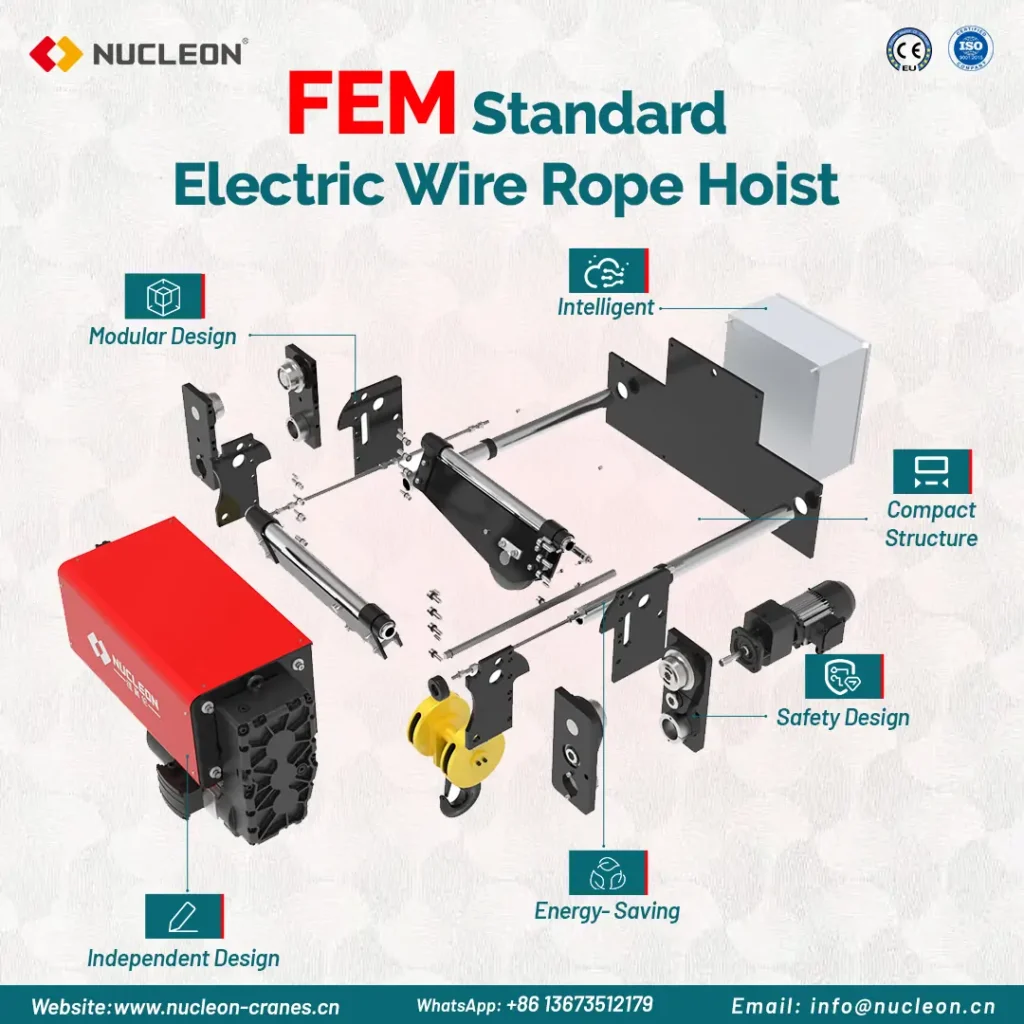
Tabla de contenidos
¿Qué son las normas FEM y DIN?
Las normas FEM y DIN son los dos principales marcos normativos que rigen el diseño, la clasificación y la seguridad de los polipastos en Europa. Ambas son ampliamente aceptadas por los fabricantes y usuarios finales de polipastos, pero abordan el problema de la clasificación desde perspectivas diferentes.
FEM estándares para Federación Europea de la Manutención — Federación Europea de Manipulación de Materiales. La norma FEM para polipastos (específicamente FEM 9.511 y el documento más amplio FEM 1.001 para estructuras de grúas) define las clases de servicio de los polipastos en función de una combinación del espectro de carga y el número total de horas de funcionamiento. Esto hace que la clasificación FEM sea particularmente útil para aplicaciones con procesos intensivos donde se dispone de datos de tiempo de funcionamiento.
ESTRUENDO se refiere a Instituto Alemán de Normas, El Instituto Alemán de Normalización (DIN) ha elaborado la norma DIN 15020 (para polipastos de cable) y las normas DIN relacionadas para polipastos de cadena, que clasifican los equipos según la frecuencia de conmutación (arranques por hora) y la capacidad de carga. El enfoque de DIN está profundamente arraigado en el sector manufacturero alemán y sigue siendo ampliamente utilizado por las empresas de ingeniería alemanas y sus socios internacionales.
Tanto el polipasto estándar FEM como el estándar DIN productos de elevación son fabricados por importantes marcas europeas, entre ellas: Nucleón,Demag, Stahl, Verlinde y Yale. Es fundamental comprender qué norma sustenta la especificación de un producto antes de comparar presupuestos o afirmaciones sobre su rendimiento.
Historia y origen de FEM y DIN
Historia del elevador FEM
FEM se fundó en 1953 en Bruselas como organismo paneuropeo de comercio y normalización para la industria de la manipulación de materiales. Sus comités técnicos comenzaron a publicar directrices para la clasificación de polipastos y grúas en la década de 1960, y el documento FEM 9.511 se convirtió en la referencia del sector para los polipastos eléctricos. Posteriormente, el marco de FEM se armonizó con la norma ISO 4301, la norma internacional para la clasificación de grúas, lo que lo hizo altamente compatible con las especificaciones de adquisición globales.
El sistema de clasificación FEM se popularizó en Francia, Italia y los países del Benelux, así como en los mercados de exportación de Oriente Medio y Asia, donde predominaban los fabricantes de equipos originales europeos. Actualmente, la clasificación de polipastos FEM sigue siendo un requisito habitual en las especificaciones de las licitaciones internacionales.
Origen de la norma DIN
La participación de DIN en las normas para polipastos se remonta a la reconstrucción industrial alemana de la posguerra en la década de 1950. La norma DIN 15020, que abarca los polipastos de cable y sus componentes, se convirtió en obligatoria para los equipos utilizados en las instalaciones industriales alemanas y posteriormente se utilizó como referencia en aplicaciones de construcción y manipulación portuaria en toda Europa Central. La fortaleza de la norma DIN reside en su claridad prescriptiva: proporciona a los equipos de compras umbrales de rendimiento específicos y verificables, en lugar de un modelo de ciclo de vida calculado.
La relación entre FEM y DIN evolucionó a lo largo de las décadas. Con el auge de las normas armonizadas EN (Norma Europea), en particular la EN 14492-2 para polipastos motorizados, tanto FEM como DIN han sido parcialmente sustituidas en las nuevas certificaciones de productos. Sin embargo, los equipos antiguos y muchos contratos vigentes aún hacen referencia directa a FEM y DIN, por lo que comprender ambas normas sigue siendo fundamental para la operatividad.
Clasificación de polipastos: FEM vs DIN Polipasto estándar
Sistema de clasificación FEM
La clasificación FEM para polipastos utiliza dos parámetros: grupo de mecanismos y factor de espectro de carga. El grupo de mecanismos (M1 a M8, o en notación antigua 1Am a 4m) refleja el total de horas de funcionamiento teóricas durante la vida útil de diseño del polipasto. El factor de espectro de carga (L1 a L4) tiene en cuenta la frecuencia con la que el polipasto funciona a su capacidad nominal o cerca de ella.
Clases comunes de elementos finitos que se encuentran en las adquisiciones:
| Clase FEM | Grupo de Mecanismos | Caso de uso típico |
| FEM 1m | M3 | Uso poco frecuente, mantenimiento ligero. |
| FEM 2m | M4 | Uso moderado del taller |
| FEM 3m | M5 | Uso en producción regular |
| FEM 4m | M6–M7 | Funcionamiento continuo de alta resistencia |
Fuente: Documento de clasificación de polipastos FEM 9.511; Referencia cruzada EN 13001-1:2015
Sistema de clasificación DIN
La clasificación DIN de los polipastos se basa principalmente en: grupo operativo (Betriebsgruppe), designados como B1 a B6 según el marco anterior de la norma DIN 15020, o mediante valores ED (Einschaltdauer — factor de servicio) como DIN ED1, ED2, ED3 y ED4. El valor ED expresa el porcentaje de tiempo que el motor del polipasto está energizado en relación con el tiempo total del ciclo.
| Clase DIN | Valor ED | Inicios/Hora | Aplicación típica |
| ED1 | 15% | Hasta 60 | Elevación esporádica, almacenes |
| ED2 | 25% | Hasta 120 | Líneas de montaje, talleres |
| ED3 | 40% | Hasta 240 | Producción automatizada |
| ED4 | 60% | Hasta 360 | Manipulación industrial intensiva |
Fuente: DIN 15020-1 (polipastos de cable); datos técnicos del fabricante Demag y Stahl (2022–2024)
Cómo se relacionan las clasificaciones FEM y DIN
Una equivalencia aproximada que se cita con frecuencia en la práctica industrial (aunque no está estandarizada formalmente):
| Clase FEM | Equivalente aproximado a la norma DIN |
| FEM 1m (M3) | ED1 |
| FEM 2m (M4) | ED2 |
| FEM 3m (M5) | ED3 |
| FEM 4m (M6) | ED4 |
Nota: Estas equivalencias son aproximadas. Verifique siempre con el fabricante del polipasto para conocer su perfil de funcionamiento específico.
La principal diferencia en la comparación de clases de polipastos radica en que el método de elementos finitos (FEM) considera el historial de carga a lo largo del tiempo, mientras que la norma DIN se centra en la frecuencia de conmutación por hora. Para aplicaciones con patrones de carga variables, el FEM ofrece un ajuste más preciso. Para aplicaciones con ciclos repetitivos y predecibles, la norma DIN suele ser más sencilla de especificar y verificar.
Diferencias en la capacidad de carga y el ciclo de trabajo
Ciclo de trabajo del polipasto explicado
El concepto de ciclo de trabajo es fundamental en la comparación entre FEM y DIN. En términos sencillos, el ciclo de trabajo describe la intensidad de uso de un polipasto: no solo el peso de las cargas, sino también la frecuencia de funcionamiento y la fracción de su capacidad nominal a la que se utiliza.
Clase de servicio FEM El cálculo integra tanto el espectro de carga (la distribución estadística de las cargas reales frente a la capacidad nominal) como las horas totales de funcionamiento. Esto proporciona una imagen más precisa de la tensión acumulada en los componentes mecánicos, en particular en la caja de engranajes, el tambor y la cuerda/cadena.
Valores ED de DIN Son más sencillos y se centran en el motor. Las normas DIN ED1 a ED4 definen el porcentaje de tiempo de funcionamiento por ciclo, lo que indica directamente la capacidad térmica del motor. Un polipasto con clasificación DIN ED2 a 25% significa que el motor puede soportar 25% de tiempo de funcionamiento antes de necesitar un período de enfriamiento.
Implicaciones prácticas para la selección de la capacidad de carga
Al seleccionar la capacidad de carga del polipasto según cada norma, los equipos de compras deben tener en cuenta lo siguiente:
- Según el método de elementos finitos (FEM), un polipasto con una capacidad nominal menor pero un grupo de mecanismos superior (por ejemplo, un FEM de 2 toneladas y 3 m) puede ser más apropiado que una unidad FEM de 3,2 toneladas y 1 m si la frecuencia real de elevación es alta pero las cargas son moderadas.
- Según la norma DIN, la clasificación ED afecta directamente al dimensionamiento del motor. Una especificación incorrecta de la clase ED provoca el sobrecalentamiento del motor y fallos prematuros, una de las averías más comunes en polipastos que utilizan equipos con clasificación DIN inadecuada.
| Parámetro | Enfoque de elementos finitos | Enfoque DIN |
| Base de servicio | Horas de funcionamiento totales + espectro de carga | Tiempo de funcionamiento del motor por ciclo |
| Variable de diseño principal | Grupo de mecanismos (M1–M8) | Valor de DE (DE1–DE4) |
| Influencia de la capacidad de carga | Mediante factor de espectro de carga (L1–L4) | A través de la capacidad nominal en el ED dado |
| Idoneidad para cargas variables | Alto | Moderado |
| Adecuado para ciclos repetitivos | Moderado | Alto |
Fuente: Compilado a partir de los marcos de clasificación FEM 9.511, DIN 15020-1 e ISO 4301:1990.
Vida útil y mantenimiento
Vida útil del polipasto según el método de elementos finitos (FEM).
La vida útil del FEM es un valor calculado y diseñado. Al especificar un polipasto eléctrico FEM con un grupo de mecanismos M5, el fabricante diseña todos los componentes de soporte de carga (engranajes, cojinetes, tambor de cable y poleas) para lograr una vida útil teórica expresada en horas de funcionamiento totales (por ejemplo, 3200 horas para M5 en muchas configuraciones).
Esta vida calculada constituye la base para intervalos de mantenimiento planificados. Los polipastos con clasificación FEM suelen incluir programas de mantenimiento del fabricante vinculados a las horas de funcionamiento, lo que facilita la elaboración de un modelo de coste del ciclo de vida. Los principales fabricantes europeos, como Demag y Stahl, publican matrices de mantenimiento basadas en FEM que los equipos de compras e instalaciones pueden utilizar directamente.
Vida útil del polipasto según la norma DIN
La vida útil de los polipastos con certificación DIN se define de forma menos explícita en términos de horas totales de funcionamiento y más en términos de ciclos periódicos de inspección y revisión vinculados a la clase ED y los años de servicio. La normativa industrial alemana (BGV D8 / DGUV Vorschrift 52, actualizada en 2018) establece intervalos de inspección para los polipastos con clasificación DIN según su grupo operativo.
Diferencias de mantenimiento Entre FEM y DIN en la práctica:
| Aspecto | Polipastos con clasificación FEM | Polipastos con clasificación DIN |
| Base de vida útil | Horas totales de funcionamiento (calculadas) | Ciclos de inspección periódica |
| Programación del mantenimiento | Matriz de mantenimiento basada en horas (fabricante de equipos originales) | Basado en el tiempo y en ciclos |
| Disparador de revisión | Umbral de horas de funcionamiento | Intervalo de calendario + evaluación de la condición |
| Estándar de documentación | FEM 9.755 (guía de mantenimiento) | DGUV Vorschrift 52 / Registros de inspección DIN |
| Facilidad para modelar costos | Alto (modelo de ciclo de vida basado en horas) | Moderado (depende del seguimiento del uso real) |
Fuente: FEM 9.755:2001; DGUV Vorschrift 52 (edición de 2018); Documentación técnica de Stahl CraneSystems (2023)
Para aplicaciones de alta utilización, el modelo de vida útil basado en horas de FEM generalmente permite proyecciones más precisas del costo total de propiedad (TCO). Para aplicaciones de menor intensidad, donde el tiempo calendario es el factor de envejecimiento dominante, el modelo de intervalo de inspección de DIN suele ser suficiente.
¿Qué estándar debería elegir?
Polipasto estándar FEM vs DIN: marco de decisión
La elección entre las especificaciones FEM y DIN para polipastos depende, en última instancia, de su perfil operativo, el contexto de aprovisionamiento regional y su capacidad de gestión del mantenimiento. El siguiente marco de referencia abarca los escenarios más comunes.
Elija el polipasto estándar FEM cuando:
- Su aplicación implica cargas variables; el polipasto rara vez funciona a su capacidad nominal máxima.
- Necesitas crear un modelo de coste del ciclo de vida basado en las horas de funcionamiento.
- Las especificaciones de su proyecto o el documento de licitación hacen referencia a la norma ISO 4301 o a la norma europea EN 14492-2 (alineada con el método de elementos finitos).
- Usted está realizando compras para mercados de exportación en Oriente Medio, el Sudeste Asiático o América Latina, donde la norma FEM se utiliza con más frecuencia que la DIN.
Elija un polipasto estándar DIN cuando:
- Su aplicación se caracteriza por ciclos de elevación altamente repetitivos y predecibles (líneas de montaje, prensas de estampado, producción de automóviles).
- Su equipo de mantenimiento o contratista de servicios está más familiarizado con los protocolos de inspección DIN y las regulaciones DGUV.
- Las especificaciones técnicas provienen de un fabricante de equipos originales (OEM) alemán o de una instalación que cumple con los estándares alemanes.
- El rendimiento térmico del motor con un ciclo de trabajo definido es una preocupación primordial en el diseño.
Guía de selección de estándares para polipastos: Referencia rápida
| Criterio | Prefiero FEM | Preferir DIN |
| Patrón de carga | Variable | Repetitivo / predecible |
| Contexto operativo | Internacional / multisitio | Fabricante alemán de productos nacionales / Fabricante alemán de equipos originales |
| Enfoque de mantenimiento | Ciclo de vida basado en horas | Intervalo de inspección |
| Alineación regulatoria | ISO 4301 / EN 14492-2 | DGUV / Betriebssicherheitsverordnung alemán |
| Modelado del costo total de propiedad | Más fácil | Requiere seguimiento en tiempo de ejecución |
| sectores comunes | Puertos, industria general, procesos | Automoción, máquinas herramienta, acero |
Casos de aplicación en el mundo real
Caso 1 — Ensamblaje de automóviles (se aplica la norma DIN): Un proveedor de primer nivel del sector automotriz en Baden-Württemberg utiliza polipastos de cadena con clasificación DIN ED3 (240 arranques/hora) para el traslado de bloques de motor en una línea de montaje de alta velocidad. El ciclo repetitivo y predecible facilitó la especificación y verificación de la clasificación DIN durante las pruebas de aceptación. El mantenimiento se gestiona según el protocolo de inspección anual DGUV Vorschrift 52. (Referencia: Representativo de las especificaciones comunes de los elevadores de montaje de automóviles alemanes; verifique con la documentación real de su fabricante de equipo original).
Caso 2 — Manipulación portuaria (FEM aplicado): Una instalación de manipulación de contenedores en el puerto de Amberes especificó polipastos de cable de acero con clasificación FEM 4m (M7) para los mecanismos de las grúas de agarre. El perfil de carga variable —las grúas suelen manejar cargas que oscilan entre 30% y 100% de capacidad nominal— hizo que la clasificación basada en el espectro de carga de FEM fuera una herramienta de diseño más precisa que una clasificación fija DIN ED. (Referencia: Aplicación representativa del polipasto FEM en la manipulación portuaria europea; clasificación FEM según FEM 9.511)
Preguntas frecuentes
P1: ¿Qué polipasto estándar, el FEM o el DIN, es más aceptado internacionalmente?
Las especificaciones estándar de FEM para polipastos suelen ser más aceptadas en licitaciones internacionales, especialmente en Oriente Medio, el norte de África y la región Asia-Pacífico. Esto se debe, en parte, a que el enfoque de clasificación de FEM se alinea estrechamente con la norma ISO 4301, el marco internacionalmente reconocido para la clasificación de grúas y polipastos. La norma DIN sigue predominando en Alemania y en países con fuertes vínculos industriales alemanes (Austria, Suiza y algunas zonas de Europa del Este). Si su proyecto implica adquisiciones transfronterizas o contratistas EPC internacionales, especificar la equivalencia con FEM o ISO 4301 reduce la ambigüedad.
P2: ¿Puede un polipasto con clasificación FEM cumplir con los requisitos DIN, y viceversa?
En muchos casos, sí, pero no automáticamente. Un polipasto clasificado como FEM 3m (M5) puede cumplir con las especificaciones de rendimiento de la norma DIN ED3, pero el fabricante debe confirmar la equivalencia formal con la documentación justificativa. Algunos fabricantes europeos de polipastos (Demag, Stahl, R&M) producen líneas de productos con doble clasificación, tanto FEM como DIN, por este motivo. Al especificar un polipasto para un proyecto que haga referencia a ambas normas, solicite una declaración de conformidad que aborde explícitamente ambos sistemas de clasificación.
P3: ¿Cómo puedo verificar la clasificación FEM o DIN de un polipasto durante su adquisición?
Solicite al fabricante o proveedor lo siguiente: (1) la ficha técnica que indique el grupo de mecanismo (FEM) o el grupo operativo/clase ED (DIN); (2) el cálculo de diseño o el certificado de clasificación; y (3) los registros de pruebas o la documentación de la prueba de aceptación en fábrica (FAT). Para los polipastos con marcado CE vendidos en la UE, la Declaración de Conformidad debe hacer referencia a las directivas aplicables (Directiva de Máquinas 2006/42/CE) y a las normas armonizadas (EN 14492-2). Los documentos de clasificación deben coincidir con los datos de la placa de características del polipasto.
P4: ¿La elección de un polipasto estándar FEM o DIN afecta a la disponibilidad de piezas de repuesto?
Indirectamente, sí. Los polipastos diseñados y fabricados según las normas DIN suelen utilizar componentes —tambores de cable, reductores, ganchos— que cumplen con las dimensiones estándar DIN, lo que facilita la intercambiabilidad con otros componentes que cumplen con dichas normas. Los polipastos diseñados mediante el método de elementos finitos (FEM) pueden utilizar componentes optimizados para la vida útil de un grupo de mecanismos específico, lo que puede resultar en piezas más específicas del fabricante. Antes de seleccionar un polipasto, confirme la disponibilidad de repuestos y los plazos de entrega de los componentes críticos (cable/cadena, pastillas de freno, interruptores de límite) con su proveedor de servicios local.
P5: ¿Cuál es la relación entre FEM, DIN y EN 14492-2?
La norma EN 14492-2 es la norma europea armonizada vigente para polipastos motorizados, y el marcado CE de los polipastos vendidos en la UE ahora hace referencia a esta norma en lugar de a FEM o DIN directamente. Sin embargo, la EN 14492-2 incorpora conceptos de clasificación que son coherentes con FEM 9.511 e ISO 4301. En la práctica, los fabricantes utilizan internamente la clasificación FEM o DIN para diseñar los productos y luego los certifican según la EN 14492-2 para el marcado CE. Al revisar las especificaciones de un polipasto, la clase FEM/DIN indica la capacidad de carga y la vida útil de diseño; el marcado CE según la EN 14492-2 indica el cumplimiento de las normas de seguridad para el mercado de la UE. Ambas informaciones son necesarias para una evaluación completa de la compra.

 English
  العربية
  Español
  Français
  Português
  Русский