
If you're ready to schedule overhead crane inspection services, the first number you need is your CMAA service class — not your crane's tonnage. Class determines whether you need an annual visit or quarterly inspections, which changes your annual spend by 3–4×. The market reference for qualified third-party inspection runs roughly $38–$750+ per crane unit, depending on crane type, complexity, and service class. Most standard bridge cranes under 40 tons come in at $100–$300 for a periodic inspection; a high-complexity Class E foundry crane with load testing can run significantly higher.
This page covers exactly what you get in a compliant overhead crane inspection package, how to prepare your site and documentation before the inspector arrives, how long your crane will be offline, and the one scheduling decision that cuts your total annual inspection cost more than any other factor.
Ready to schedule now?
Tabla de contenidos
Overhead Crane Inspection Service Packages at a Glance
| Service Type | Typical Frequency | Who Performs | Crane Offline | Market Reference Price |
| Initial / commissioning inspection | Once — before first use | Qualified third-party inspector | 2–4 hours | $150–$400 per crane |
| Frequent (periodic) inspection | Monthly–quarterly | Qualified technician | 1–2 hours | $38–$125 per crane |
| Annual periodic inspection | Yearly (severe service: quarterly) | Qualified third-party inspector | 3–8 hours | $150–$750+ per crane |
| Load test (OSHA 125% capacity) | At commissioning + post-major repair | Qualified engineer + technician | 4–6 hours | $250–$1,000+ per event |
| Idle crane re-inspection (1–6 months idle) | Before return to service | Qualified technician | 2–3 hours | $75–$200 per crane |
| Full re-inspection (6+ months idle) | Before return to service | Qualified third-party inspector | 3–6 hours | $150–$450 per crane |
Prices are market reference ranges based on North American service provider data (2025–2026). Actual cost varies by crane type, height, accessibility, and site environment. Multi-crane sites typically receive a reduced per-unit rate.
Not sure which service you need? Tell us your CMAA class, crane type, and last inspection date. Get a recommendation in 24 hours →
What Your Overhead Crane Inspection Package Includes
Structural and Mechanical Assessment
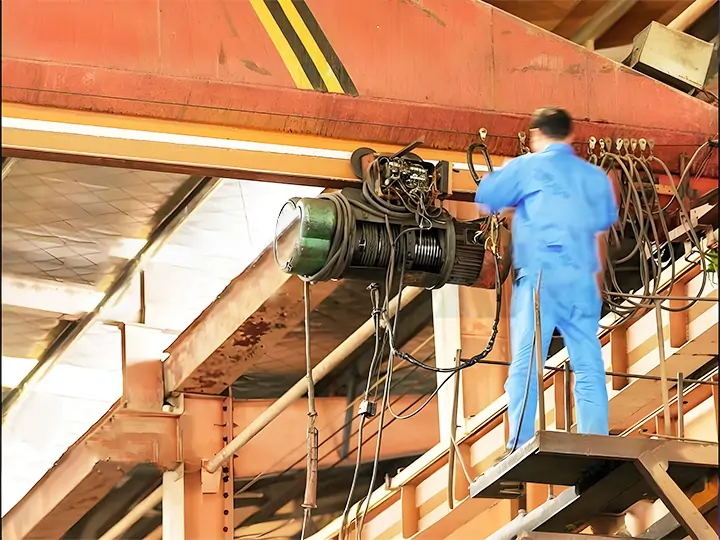
A compliant overhead crane inspection under OSHA 29 CFR 1910.179 y ASME B30.2 covers three domains: structural, mechanical, and electrical. The structural assessment includes main girder condition (checking for sag, lateral deflection, and weld cracking at high-stress zones), end truck integrity, runway rail alignment and fastener security, and bumper condition. For annual inspections, inspectors access the bridge catwalk physically — checks from the floor are not sufficient for girders or end truck weld zones.
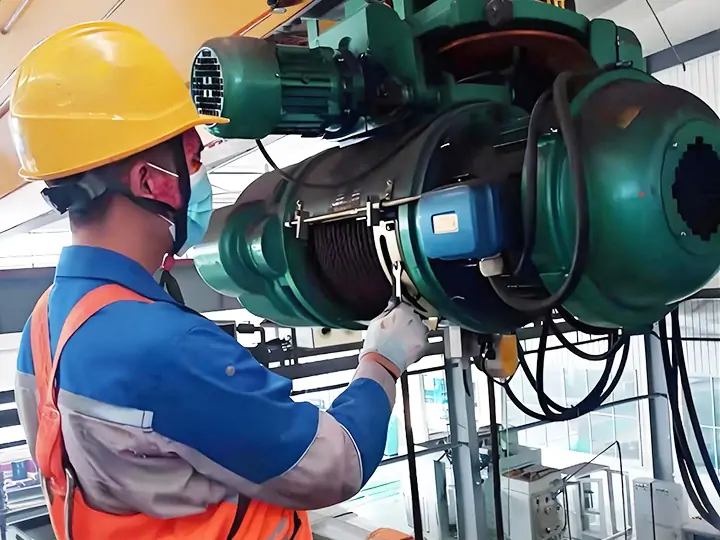
Mechanical assessment covers the hoist drum and rope grooves for wear, wire rope for broken wires and corrosion (with broken-wire counts taken per rope lay-length, not per full rope length — a distinction that matters for removal-from-service decisions), hook throat opening measured against original dimension, brake function tested under rated load, and trolley wheel flange wear.
Electrical assessment includes conductor bar condition, panel contactor pitting, limit switch function across all travel axes, overload protection, and grounding continuity from hook to building ground. Electrical failures are the third most common cause of unplanned crane downtime, after wire rope and brake issues — a fact that makes the electrical scope one of the least negotiable parts of a compliant inspection package.
Documentation You Receive After Inspection
Every compliant inspection closes with a written report that day. What a professional provider delivers, and what you should require before signing a service agreement:
- Itemized pass/fail status for each inspection point
- Photographs of all deficiencies, labeled by location and component
- Deficiency classification by severity: safety stop (crane must be removed from service immediately), code violation (requires correction within a defined period), and recommendation (monitor or plan for next service cycle)
- Inspector name, credentials, and signature
- Equipment identifier tied to your crane tag number
- Date and OSHA/ASME standard references for each finding
If a provider cannot commit to same-day written reporting with photographs, ask why. Verbal summaries with a report "to follow later" create documentation gaps that become OSHA liability if an incident occurs before the written report is received.
What Is Not Included (Know Before You Sign)
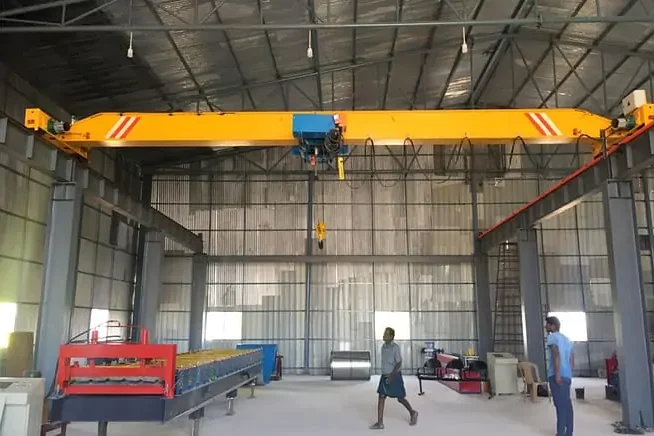
Standard overhead crane inspection service does not include repairs. If the inspection identifies deficiencies, your provider will quote repairs separately — which is the correct model. Be cautious of providers who offer unusually low inspection prices, then quote repairs at above-market rates for every item they flag. Ask any prospective provider: "Do your inspectors have any revenue tie to the repairs they recommend?" A third-party inspector whose income is entirely from inspection fees — not repair work — gives you the most objective assessment.
Also typically excluded from base pricing: man-lift or aerial work platform rental for high-clearance cranes, hazardous environment premiums (chemical plants, foundries, extreme heat), and travel time beyond a defined radius. Clarify these line items in your quote request.
How to Prepare for Your Overhead Crane Inspection: Pre-Inspection Checklist
Sending a provider the right information upfront cuts quote turnaround from days to hours and eliminates the most common cause of day-of scope disagreements. Here is what to gather before you contact us:
Equipment information (one entry per crane):
- Crane type (single girder / double girder / underhung / gantry / jib)
- Crane tag number or equipment identifier
- Rated capacity (tons)
- Span (meters or feet)
- Year of installation and manufacturer
- CMAA service class (if known — if not, describe lifts per hour and application)
- Date and type of last inspection (with report on hand, if available)
- Any known deficiencies or abnormal behavior since last inspection
Site information:
- Building clearance height to the crane runway
- Access to bridge catwalk: yes / requires man-lift
- Number of cranes on the same runway (runway must be fully offline during inspection)
- Any site safety induction or PPE requirements the inspector must complete before entering
- Preferred inspection window (operating hours, production shutdown windows)
Providing this information in your initial inquiry reduces back-and-forth by 80% and allows your provider to give a fixed-price quote — rather than a wide range that defaults to the high end to account for unknowns.
How Long Will Your Crane Be Offline? Planning Your Downtime
The hidden cost of overhead crane inspection that does not appear on the invoice is production downtime. A crane cannot be operated while being inspected — and on a shared runway, all cranes on that runway must be offline for the safety of the inspection team.
Reference downtime by crane type, from our service experience:
| Crane Type / Complexity | Typical Inspection Time | Full Runway Offline |
| Polipasto eléctrico de cadena (under-hung) | 30–60 min | 1 hour |
| Single-girder bridge crane, ≤10 ton, standard | 1.5–2.5 hours | 2–3 hours |
| Single-girder bridge crane, 10–30 ton | 2–4 hours | 3–5 hours |
| Double-girder bridge crane, 10–50 ton | 4–6 hours | 5–7 hours |
| Double-girder bridge crane, 50+ ton / Class D–F | 6–8 hours | Full shift |
| Load test (any class) | Add 2–3 hours | Add 2–3 hours |
The multi-crane downtime decision: Facilities with multiple overhead cranes on separate runways have a choice: schedule each crane individually across multiple days, or batch all cranes into a 1–2 day site visit. Batching is almost always the right decision — not just for cost (multi-unit rates typically run 15–25% less per crane), but for downtime. Individual scheduling means each runway goes offline on a different day, multiplying total production disruption. A single coordinated visit takes the whole site offline once, usually over a planned shutdown window or weekend, and gets all documentation into one consolidated report.
This is the single biggest lever for reducing the true all-in cost of an overhead crane inspection program at a multi-crane facility — yet it is rarely raised by providers who bill by the visit rather than by the program.
How to Evaluate and Select a Qualified Inspection Provider
Credentials to Verify Before Booking
The qualification gap in overhead crane inspection is real. OSHA 1910.179 requires inspections by a "qualified person," but outside of California there is no state licensing requirement that defines minimum credentials for crane inspectors. This means buyer due diligence is the only filter between a compliant inspection and a clipboard exercise.
Verify the following before booking:
- Inspector-level certification: NCCCO (National Commission for the Certification of Crane Operators) certification in the relevant category, or documented equivalent qualification under ASME B30.2
- Standard familiarity: The inspector should know which ASME B30 standard governs your crane type — B30.2 for top-running overhead bridge cranes, B30.11 for underhung, B30.16 for hoists, B30.17 for monorails. Applying the wrong standard means the wrong removal-from-service criteria
- Inspector experience hours: Ask how many hours of hands-on repair experience the inspector has before being qualified for inspection work. Inspectors who have only inspected — never repaired — often miss functional issues that experienced repair technicians recognize immediately
- Independence: Ask directly whether the inspector's income depends on repair revenue. Third-party-only inspection providers, who do not offer repair services, have no incentive to over-report deficiencies
What the Quote Should Contain
A professional overhead crane inspection quote should specify: fixed price (not open-ended hourly), scope of inspection by OSHA/ASME standard, crane units and identifiers covered, expected inspection duration and runway downtime, deliverables (written report, photographs, record retention period), and what triggers a scope change and additional cost. If the quote is a single number with no scope breakdown, ask for one. Scope ambiguity at the quote stage becomes disputes at the invoice stage.
Conclusión
Scheduling overhead crane inspection services is a three-step decision: confirm which service type you need (initial, frequent, annual periodic, or idle reactivation), gather your equipment and site information before requesting a quote, and evaluate providers on credentials and report quality — not on price alone. If you operate multiple cranes, batch them into a single coordinated visit. That one scheduling decision typically reduces both your per-unit cost and your total annual downtime more than any other lever available to you.
Get your overhead crane inspection program started today. Our certified inspectors cover all crane types and service classes, deliver same-day written reports, and provide fixed-price quotes with no hidden adders.

Especialista en Equipos
Gerente de Negocios de Grúas con experiencia y amplia trayectoria en gestión de proyectos de elevación pesada y supervisión operativa. Historial comprobado de impulso del crecimiento de los ingresos y garantía del cumplimiento de las normas de seguridad.
Preguntas frecuentes
How much does an overhead crane inspection cost?
The market reference for a periodic annual inspection runs $150–$750+ per crane unit for most standard bridge cranes, based on North American service provider pricing at roughly $62–$88 per inspector-hour. A simple electric chain hoist may require 30–60 minutes; a complex 50-ton double-girder crane under severe service can take 6–8 hours with two inspectors. Multi-crane sites typically receive a reduced per-unit rate when all units are inspected in a single visit.
How long will my crane be out of service during inspection?
Expect 1.5–3 hours for a standard single-girder bridge crane under 10 tons, and 4–6+ hours for a complex double-girder crane in heavy or severe service. On a shared runway, all cranes on that runway must be offline for the inspection team's safety. Planning a site-wide batch inspection during a shutdown window minimizes total production impact.
What documentation do I receive after an overhead crane inspection?
A compliant inspection closes with a same-day written report including: pass/fail status for each inspection point, photographs of all deficiencies, classification of findings by severity (safety stop / code violation / recommendation), inspector name and credentials, equipment identifier, and applicable OSHA/ASME standard references. These records must be retained for the equipment's service life under OSHA 1910.179.
Do I need to prepare anything before the inspection team arrives?
Yes. Provide your crane's type, rated capacity, span, year of manufacture, CMAA service class, and last inspection date before booking. On the day, ensure the runway is cleared and locked out, that site safety inductions are arranged, and that your crane log or previous inspection report is available for the inspector to review. Missing any of these delays the inspection and can extend chargeable time.
Can one provider handle both inspection and any repairs found?
Yes — and most full-service providers offer this. However, ask whether inspection fees and repair fees are independent. A provider whose inspection revenue depends on finding repair work has a conflict of interest. Best practice: receive the inspection report, review all findings, then decide whether to use the same provider for repairs or get a second opinion on major items. A reputable provider will not pressure you into immediate repairs on the day of inspection.
Artículos relacionados
- ¿Qué es la inspección de grúas puente? Tipos, frecuencia y elementos clave de la lista de verificación.
- Inspección de grúas puente: frecuencia, lista de verificación y costos (2026)
- ¿Cuándo hacer mantenimiento a una grúa viajera?
- Inspección de grúas puente: Normas oficiales, recursos y enlaces rápidos
- Inspección de grúas puente: Normas OSHA, CE y GB: lo que compradores y exportadores realmente necesitan saber.


 English
  العربية
  Español
  Français
  Português
  Русский