
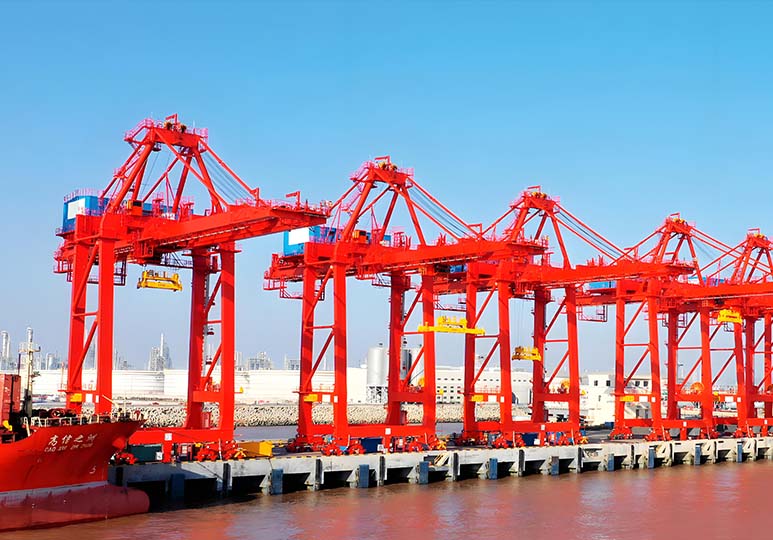
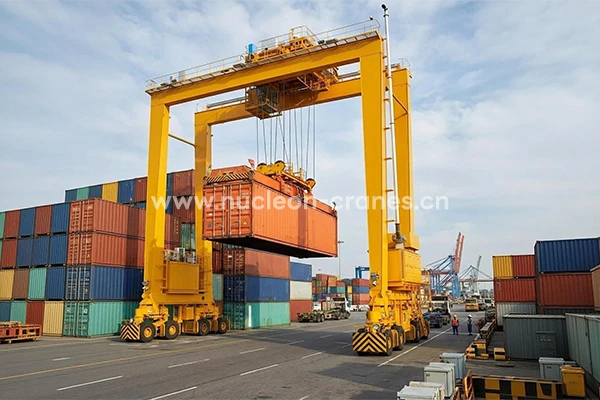
An STS crane (ship-to-shore crane) is a large rail-mounted gantry crane installed along a container terminal's quay, built to lift containers directly between a vessel and the shore. It's also called a quay crane or container crane, and it's the machine that defines what a modern container port looks like from the water.
If you're evaluating STS cranes for a new berth or a fleet upgrade, tonnage alone won't tell you whether a crane fits your terminal. Outreach, lifting height above rail, and hoist speed decide which vessel classes a crane can actually serve — and factory-direct pricing for a complete unit typically runs from around $700,000 to well over $5 million, depending on class and configuration.
This guide walks through what an STS crane is and how it differs from related port equipment, how to read a manufacturer's specification sheet, the main configuration options, what drives price, and what to check before you commit to a supplier — including a real four-model spec range from Nucleon's own STS Quay Crane line.
جدول المحتويات
Quick Reference: Nucleon STS Quay Crane Range
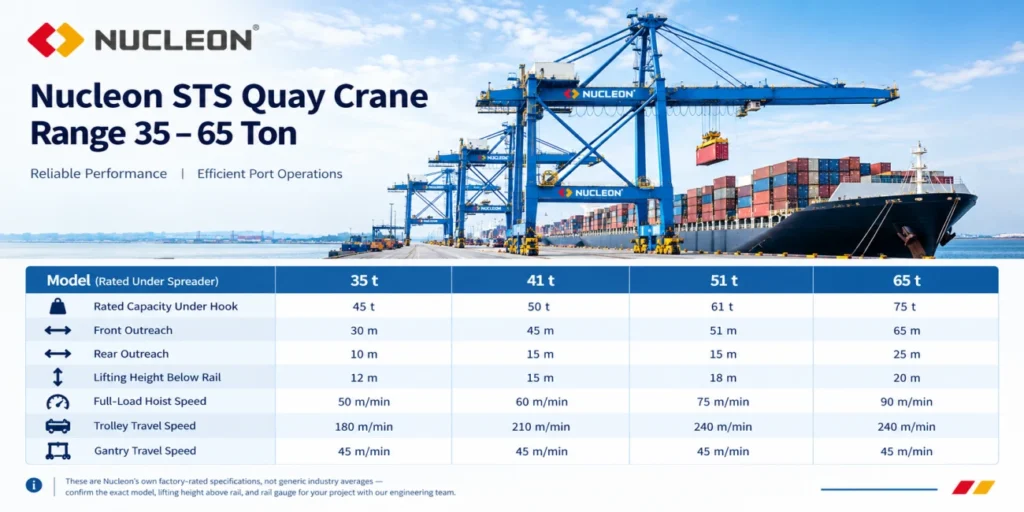
| Model (Rated Under Spreader) | 35 t | 41 t | 51 t | 65 t |
| Rated Capacity Under Hook | 45 t | 50 t | 61 t | 75 t |
| التواصل الأمامي | 30 m | 45 m | 51 m | 65 m |
| الوصول الخلفي | 10 m | 15 m | 15 m | 25 m |
| Lifting Height Below Rail | 12 m | 15 m | 18 m | 20 m |
| Full-Load Hoist Speed | 50 m/min | 60 m/min | 75 m/min | 90 m/min |
| سرعة سير العربة | 180 m/min | 210 m/min | 240 m/min | 240 m/min |
| Gantry Travel Speed | 45 m/min | 45 m/min | 45 m/min | 45 m/min |
These are Nucleon's own factory-rated specifications, not generic industry averages — confirm the exact model, lifting height above rail, and rail gauge for your project with our engineering team. Get a quote for an STS Quay Crane →
احصل على عرض أسعار الحلولWhat Is a Ship-to-Shore (STS) Crane?
A ship-to-shore crane is a rail-mounted quayside gantry crane that transfers ISO containers between a vessel and the terminal, using a boom that extends out over the ship, as classified under فيم 1.001 و ASME B30.2 structural and mechanism standards.
STS Crane vs. Quay Crane vs. Container Crane
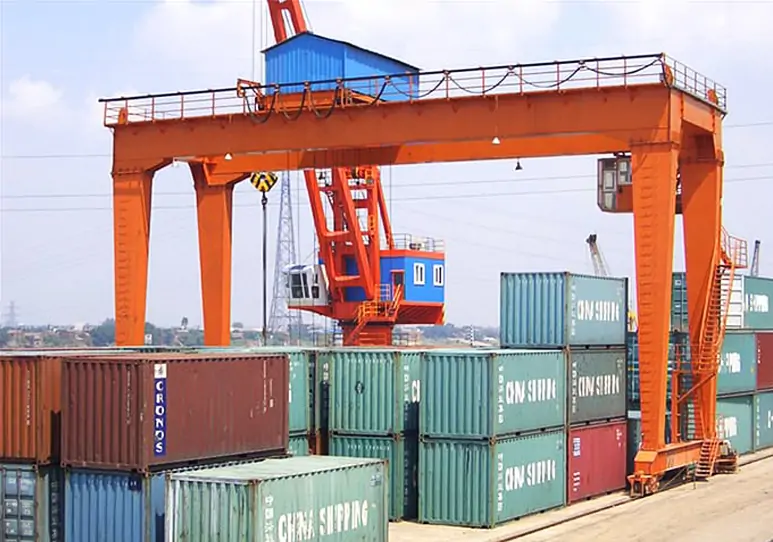
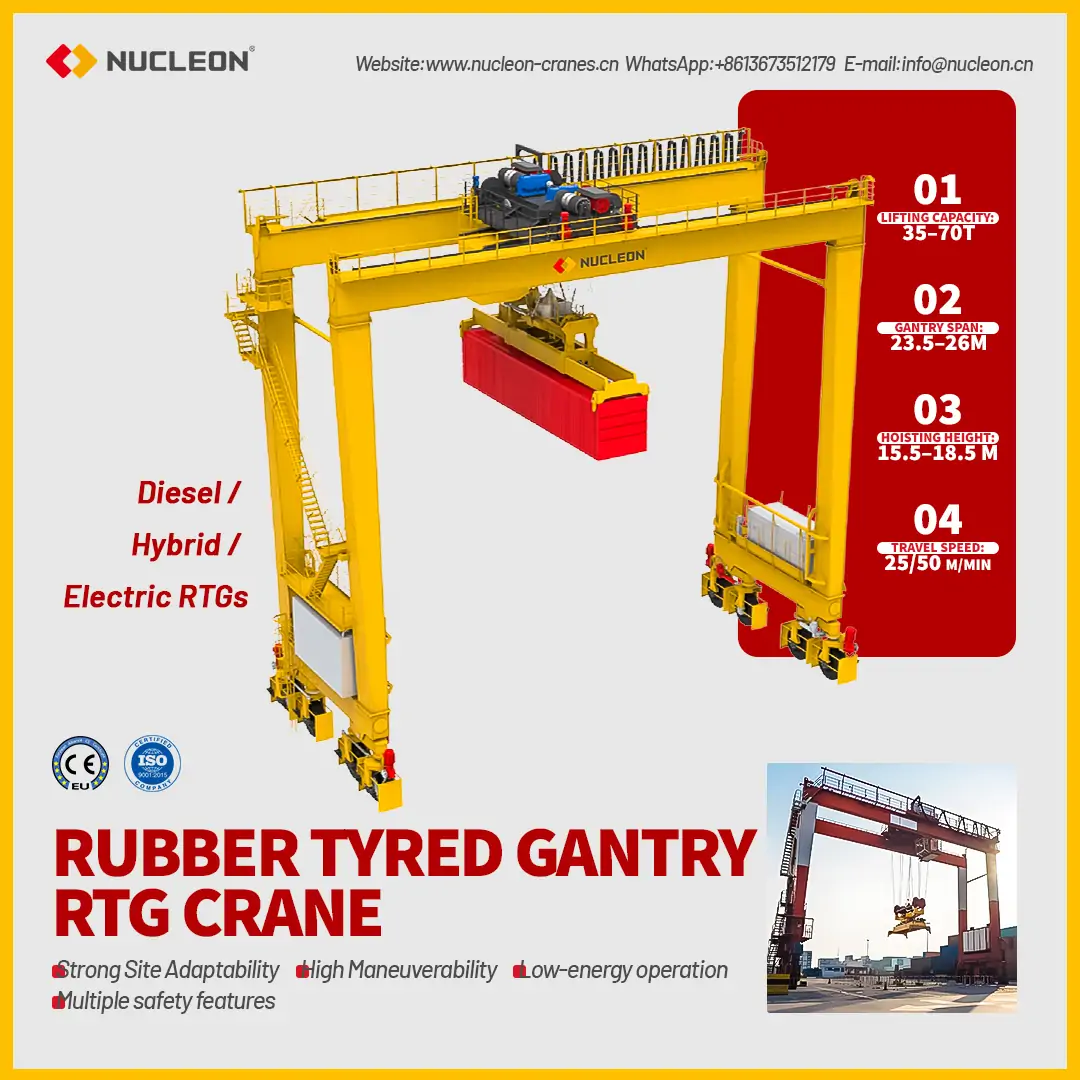
These three terms describe the same machine. "Quay crane" refers to its position on the berth; "container crane" describes its cargo; "ship-to-shore" describes its function. Some suppliers also call it a container gantry crane, though that broader term can include RMG and RTG yard cranes that never touch a vessel — an STS crane specifically works the ship-side interface, traveling on fixed quay rails rather than yard rails or rubber tires.
STS Crane Classes: Panamax to ULCV
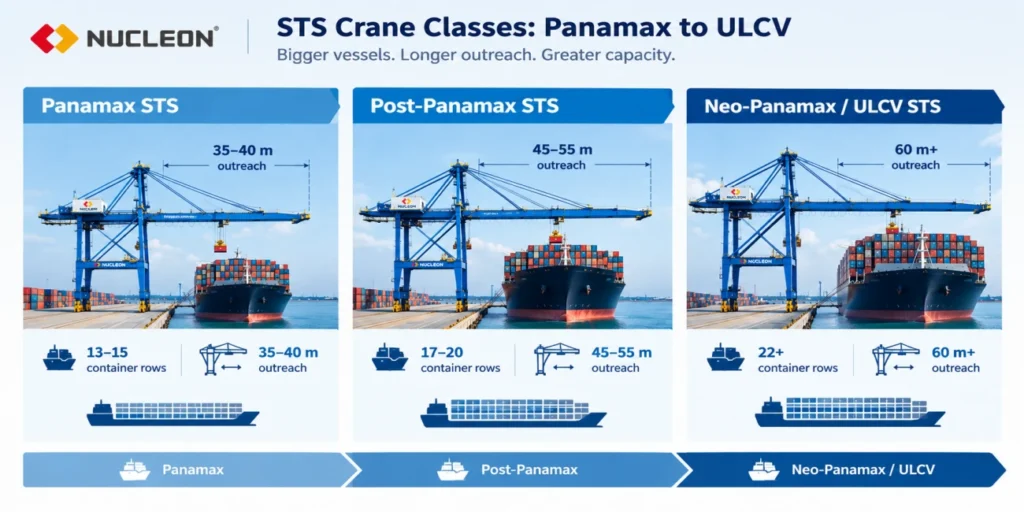
STS cranes are grouped by the vessel class they're built to serve, and outreach is the parameter that actually defines the boundary between classes — not tonnage.
- Panamax STS — roughly 35–40 m outreach, serving vessels up to about 13–15 container rows across the beam.
- Post-Panamax STS — roughly 45–55 m outreach, covering 17–20 rows.
- Neo-Panamax / ULCV STS — 60 m or more outreach, built for 22+ rows on today's largest container ships.
A terminal that buys a crane sized to today's vessel calls, without checking the vessel forecast for the next 10–15 years, is the single most common reason a "sufficient" crane becomes a bottleneck within a decade. Since a quay-mounted STS crane isn't relocatable and a structural upgrade is a major capital project in its own right, the outreach decision made at order time effectively locks in which ships the berth can serve for the crane's full 25-plus year service life.
STS Crane Specifications: What the Numbers Actually Mean
Lifting Capacity: Under-Spreader vs. Under-Hook
Rated capacity under spreader is the number that matters for container operations — under-hook capacity is a different, higher figure and isn't interchangeable with it. In Nucleon's range, a 65-ton (under-spreader) model is rated at 75 tons under hook, because the spreader itself adds weight that isn't part of the payload figure. When comparing quotes across suppliers, confirm which figure is being quoted — mixing the two makes two "50-ton" cranes look identical when their actual container-handling capacity may differ.
Twin-lift and tandem-lift configurations complicate this further: a crane rated for single 40-foot lifts needs a different spreader and, often, a different reeving arrangement to handle two 20-foot boxes simultaneously. Buying the tonnage rating without confirming the spreader is compatible with your intended lift mode is a common source of post-delivery disappointment — the crane structurally can lift the load, but the attachment on order can't.
Outreach and Backreach
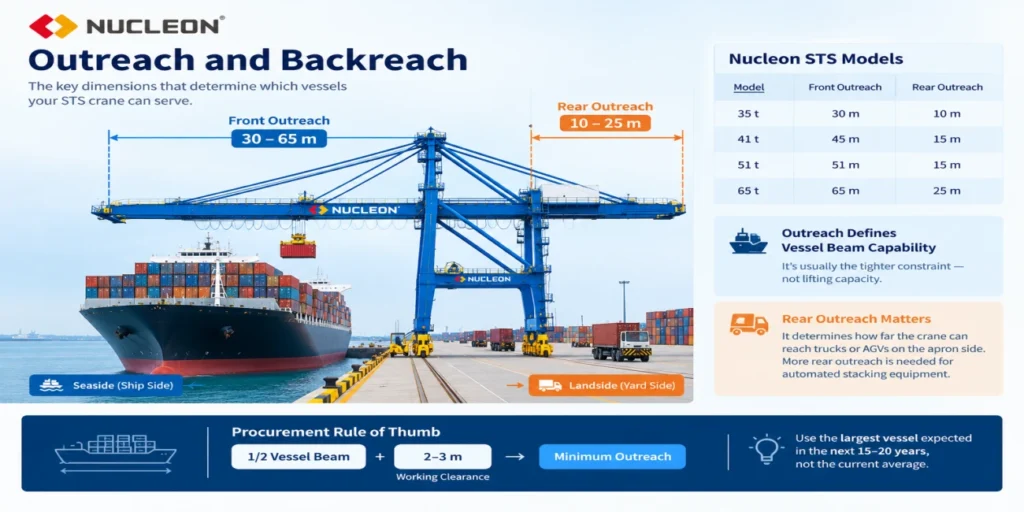
Outreach defines which vessel beam widths a crane can fully service, and it's usually the tighter constraint — not lifting capacity. Front (seaside) outreach on Nucleon's four models runs from 30 m on the 35-ton unit up to 65 m on the 65-ton unit, while rear (landside) outreach runs from 10 m to 25 m. Rear outreach determines how far the crane can reach trucks or AGVs on the apron side; a terminal running automated stacking equipment usually needs more rear outreach than one served by conventional yard trucks, regardless of the seaside spec.
The rule of thumb procurement teams use: half the design vessel's beam, plus 2–3 m of working clearance, is the minimum outreach to specify — and the design vessel should be the largest one your terminal expects to call in the next 15–20 years, not the current average.
Lifting Height Above and Below Rail
Lifting height above rail sets the tallest deck stack a crane can clear, and below-rail depth sets how far the spreader can reach down into the ship's hold. Below-rail depth on Nucleon's range scales from 12 m on the 35-ton model to 20 m on the 65-ton model, tracking the deeper holds found on larger vessels. Above-rail height needs to be checked against the highest tidal condition and the tallest deck stack your design vessel can carry — a figure that has been increasing steadily as vessel sizes have grown, and underspecifying it creates a clearance problem that can't be fixed without a major structural retrofit.
Hoist, Trolley and Gantry Speed
Loaded hoist speed — not the no-load figure on a spec sheet — is what actually drives crane productivity, measured in moves per hour. Across Nucleon's range, full-load hoist speed scales from 50 m/min on the smallest model to 90 m/min on the largest, and trolley travel from 180 to 240 m/min. A supplier quoting only no-load peak speeds is presenting a best-case number; loaded speed is typically 40–60% lower, and that's the figure that should go into any throughput calculation for berth planning.
How to Choose the Right STS Crane
Start From the Design Vessel, Not the Tonnage Number
A 50-ton STS crane isn't a single specification — two cranes with the same tonnage rating can serve completely different vessel classes if their outreach differs. The buying mistake we see most often is a procurement team requesting quotes by tonnage alone, then discovering mid-negotiation that the quoted outreach doesn't cover their actual vessel mix. Specify outreach, lifting height above rail, and design vessel beam before tonnage — tonnage is the easiest parameter to compare across suppliers, which is exactly why it gets over-weighted in early-stage sourcing.
Match the Duty Class and Reeving to Your Operating Pattern
STS cranes at active container terminals are generally specified to FEM/ISO working class A7 or A8 — heavy to very heavy duty — because they run near-continuously across multiple shifts. A lower duty class reduces upfront structural and mechanism cost, but on a high-utilization berth it shortens component life and increases downtime, which is a more expensive trade than the initial savings. Reeving configuration follows the same logic: four-rope reeving suits most mid-range cranes, while eight-rope setups used on heavier or dual-hoist units trade some hoist speed for load-handling stability.
Don't Price the Crane Without the Quay
A factory quote for the crane itself is not the full cost of getting an STS crane operating on your berth. Quay rail condition and gauge, wheel-load bearing capacity of the civil structure, available power supply (a single large STS crane can draw upward of 1,500 kVA at peak), storm anchoring points, and site erection all sit outside the crane's factory price — and confirming compatibility on all of them, before signing, is what actually prevents a budget overrun. Buyers who compare only FOB crane prices across suppliers, without normalizing for what's included, routinely find the cheaper quote becomes the more expensive installed project.
STS Crane Price: What Drives the Cost
Typical Market Reference Ranges
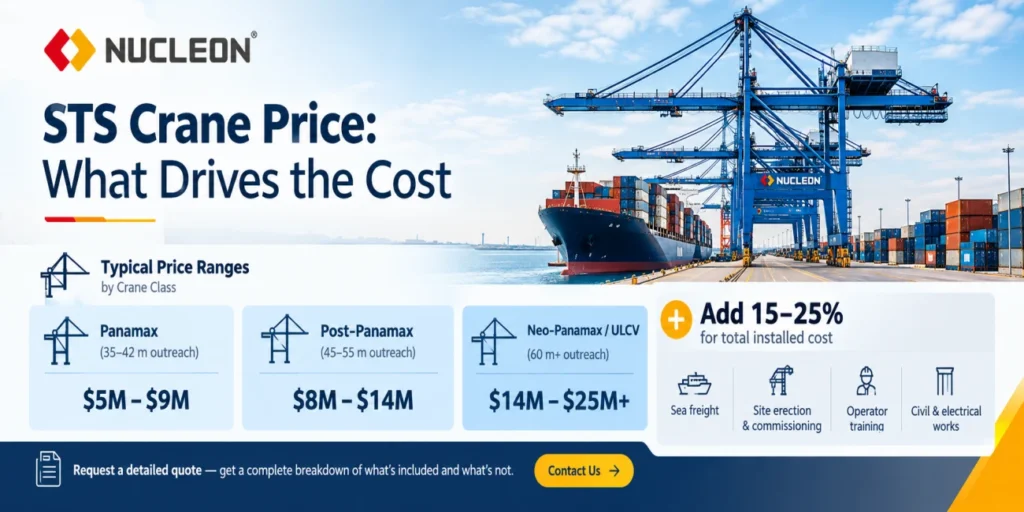
STS crane pricing tracks the same classes as the specification itself. As a market reference for factory-direct sourcing:
| Crane Class | Typical Price Range |
| Panamax (35–42 m outreach) | roughly $2M–$4M |
| Post-Panamax (45–55 m outreach) | roughly $4M–$6M |
| Neo-Panamax / ULCV (60 m+ outreach) | roughly $7M–$12M+ |
These figures move with automation level (remote operation or anti-sway packages can add $1M or more), power system, dual- vs. single-hoist configuration, and country of manufacture — Chinese factory-direct pricing is typically positioned toward the lower end of each range compared with established European brands offering broadly comparable specifications.
What a Factory Quote Includes — and What It Usually Doesn't
A crane's FOB or EXW price covers the structure, mechanisms, electrical system, and standard spreader. It typically does not include sea freight, site erection and commissioning, operator training, or the civil and electrical works needed to receive it — items that commonly add 15–25% to the total installed cost. Requesting a fully scoped quote, and confirming what's excluded, is the only way to compare two supplier prices on equal terms rather than comparing one factory price against another's all-in project cost.
خاتمة
An STS crane is defined by outreach and lifting height as much as by tonnage, and the specification decisions made at order time lock in which vessels a berth can serve for 25-plus years. Before requesting quotes, confirm your design vessel and required outreach, match duty class to your actual operating pattern, and price the quay infrastructure alongside the crane itself — not just the factory number on the quote sheet.
Looking to spec or price an STS crane for your terminal? Nucleon's engineering team can review your vessel class requirements and recommend a configuration from our 35–65 ton STS Quay Crane range. Contact us for a technical consultation and quote →

أخصائي معدات
مدير أعمال الرافعة الناجح الذي يتمتع بخبرة واسعة في إدارة مشاريع الرفع الثقيل والإشراف التشغيلي. سجل حافل في قيادة نمو الإيرادات وضمان الامتثال لقواعد السلامة.
التعليمات
Q1: What does STS stand for in cranes?
STS stands for ship-to-shore, describing the crane's function of transferring containers between a vessel and the terminal quay. It's also commonly called a quay crane or container crane. All three terms refer to the same rail-mounted machine used at container ports worldwide.
Q2: How much does an STS crane cost?
STS crane prices generally run from about $5 million for a Panamax-class unit to over $20 million for an ultra-large-vessel-capable crane, as a factory-direct market reference. Automation packages, dual-hoist configuration, and country of manufacture shift the price within that range, and freight, erection, and commissioning typically add 15–25% on top of the factory price.
Q3: What outreach do I need for a Post-Panamax vessel?
Post-Panamax vessels typically need 45–55 m of outreach to be fully served, covering roughly 17–20 container rows across the beam. A practical rule is to size outreach at half the design vessel's beam plus 2–3 m of clearance, and to base that calculation on the largest vessel expected over the next 15–20 years rather than today's average call.
Q4: What's the difference between capacity under spreader and under hook?
Capacity under spreader is the container payload rating, while under-hook capacity is a higher figure that includes the spreader's own weight. Nucleon's 65-ton model, for example, is rated 75 tons under hook. Always confirm which figure a supplier is quoting before comparing two cranes by tonnage alone.
Q5: How long does it take to get an STS crane delivered and running?
Manufacturing typically takes several months to over a year depending on configuration and order backlog, with sea freight and site erection adding further time before commissioning. Because lead times can extend well past a year for larger or more customized units, ordering early against a terminal's planned opening date is essential to avoid a schedule conflict with civil works.
مقالات ذات صلة
- رافعة جسرية للحاويات: أسعار المصنع مباشرة، ومواصفات CE، وعملية الطلب (2026)
- رافعة جسرية للحاويات للبيع: مقارنة بين RTG وRMG وSTS - الأسعار والتكاليف الحقيقية وكيفية الاختيار
- ما هي رافعة الحاويات الجسرية؟ أنواعها، وكيفية عملها، وكيفية اختيارها
- رافعة حاويات الموانئ مشروحة: كيف تختار النظام المناسب لمحطتك
- أنواع الرافعات المستخدمة في الموانئ: الأسماء والوظائف والتطبيقات مشروحة
- أنواع مختلفة من الرافعات الحاوية: أيها الأنسب لعملياتك؟


 English
  العربية
  Español
  Français
  Português
  Русский