

Overhead cranes in Saudi Arabia are a market of about USD 57.58 million in 2026, growing at a 6.22% annual rate through 2034. The crane that clears customs and survives a Riyadh summer is not simply the one with the right rated load. Three decisions separate a smooth project from a stalled one: the duty class, the climate configuration, and SASO conformity paperwork finished before shipment.
Most quotes buyers collect compare only tonnage and price. They say little about how often the crane will lift, what a Saudi summer does to motors and panels, or who handles certificates and spares. Those gaps are where the real cost of ownership sits.
This guide is written for procurement managers and plant engineers. It covers where demand comes from, what compliance involves, how to specify a crane for Saudi conditions, and how to budget and shortlist suppliers.
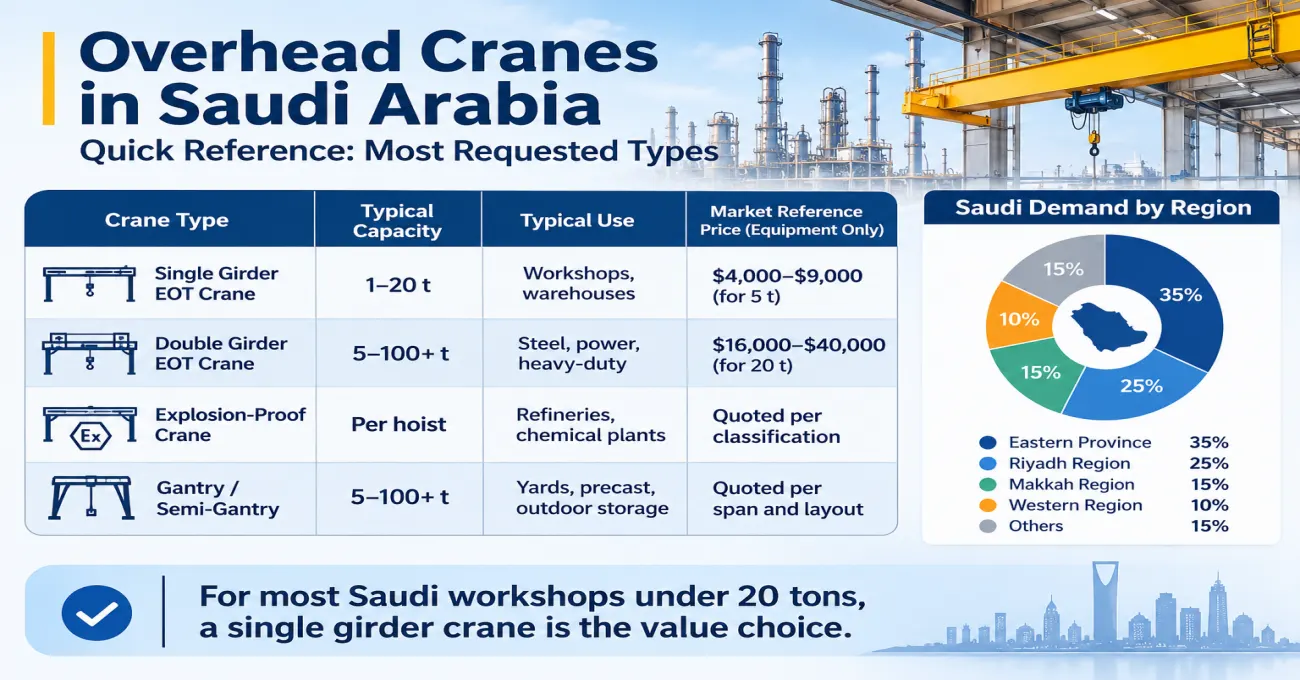
Quick reference: overhead cranes most requested for Saudi industrial sites

| نوع الرافعات | السعة النموذجية | Typical Saudi use | Market reference price (equipment only) |
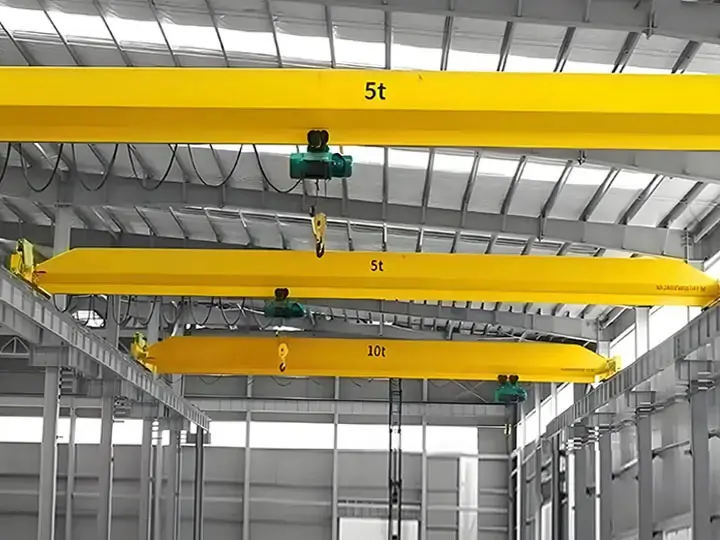
| Single girder EOT crane | 1-20 طن | Workshops, warehouses, light to medium assembly | Roughly $4,000–$9,000 for a 5 t unit |
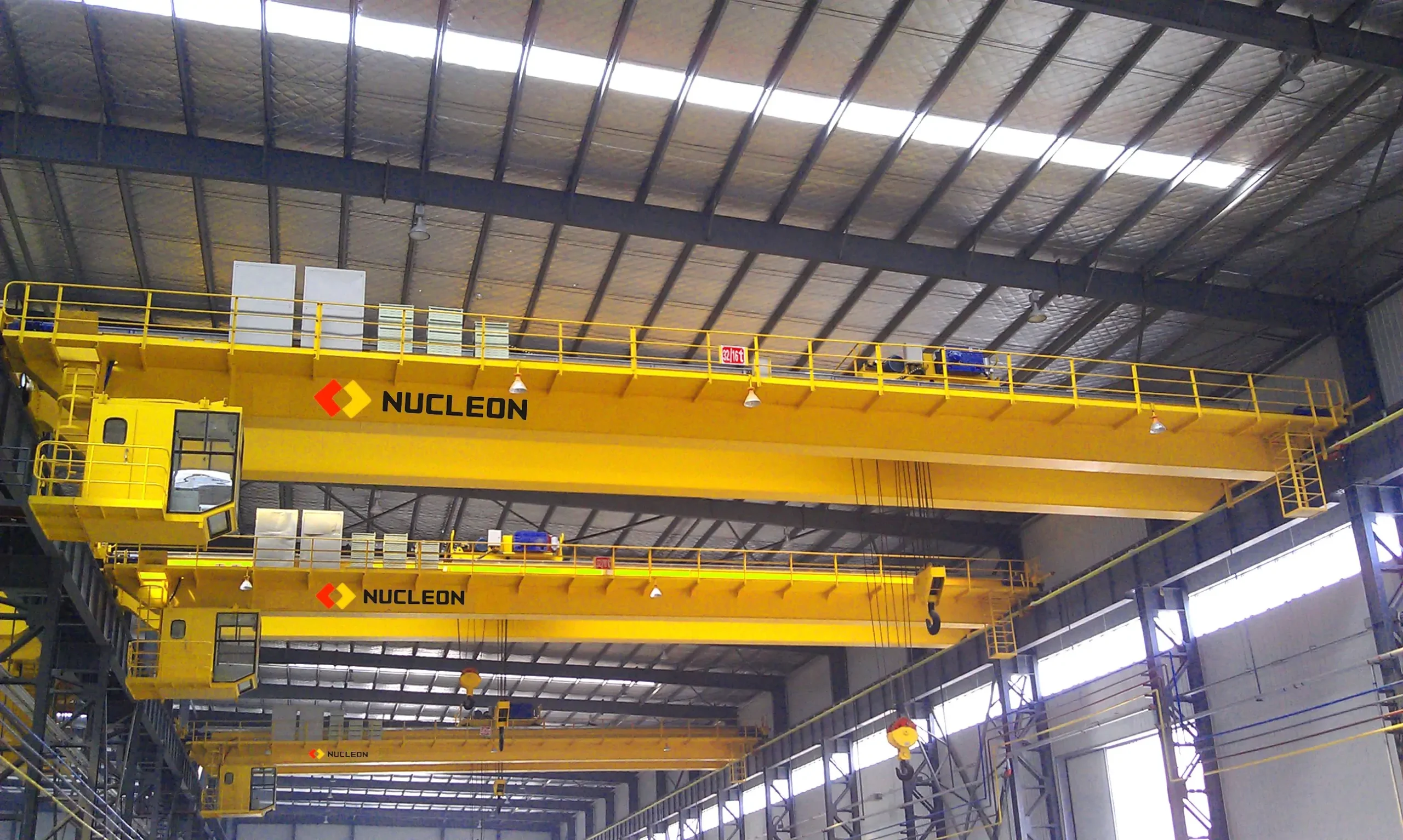
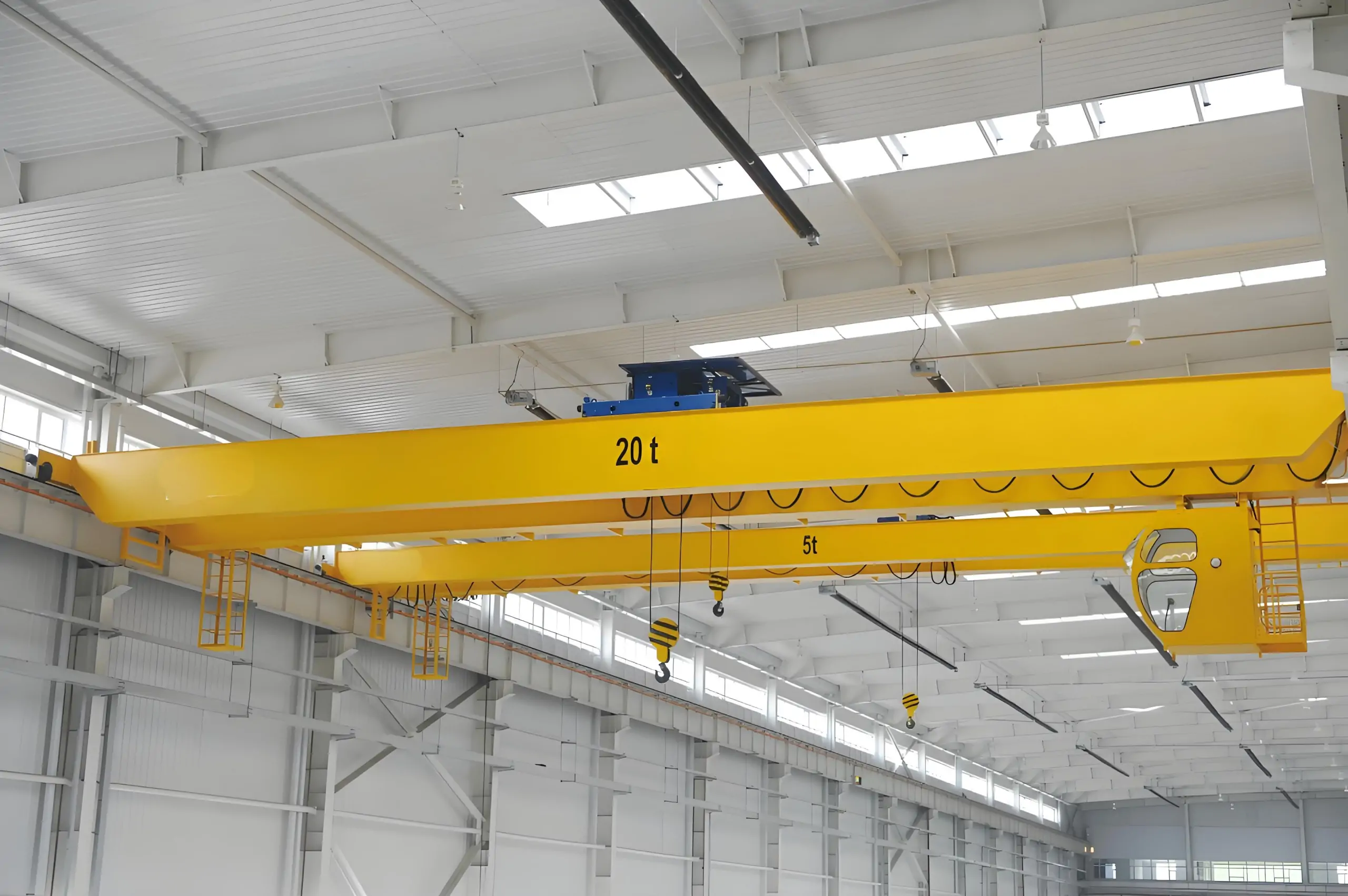
| Double girder EOT crane | 5–100+ t | Steel, fabrication, power, heavy maintenance bays | Roughly $16,000–$40,000 for a 20 t unit |
| Explosion-proof crane | Per hoist and duty | Refineries, chemical and gas facilities | Quoted per hazardous-zone classification |
| Gantry / semi-gantry crane | 5–100+ t | Yards, precast, outdoor storage | Quoted per span and rail layout |
Prices are market reference ranges for standard configurations. They exclude sea freight, SASO certification, installation and site works, and the exact figure for any model should be confirmed with the factory.
For most Saudi workshops under 20 tons, a single girder crane is the value choice; heavy or continuous duty moves the decision to double girder.
Send your duty data for a Saudi-ready quote →
احصل على عرض أسعار الحلولجدول المحتويات
Overhead Cranes in Saudi Arabia: Where Demand Comes From
Saudi Overhead Crane Market Size and Growth
Saudi demand for overhead cranes is steady rather than explosive, rising about 6% a year to 2034. IMARC projects the market to reach about USD 93.3 million by 2034. The driver is industrial construction: new industrial cities such as Sudair, Jubail, Yanbu and Ras Al Khair, where each new plant typically needs several cranes of different capacities. A single plant project therefore often means a multi-crane order rather than one unit.
The Kingdom also leans on imports. Trade data cited by DGCRANE shows Saudi imports of bridge and gantry cranes (HS 842619) at about USD 49.6 million in 2024, with China supplying 53%. The two figures use different scopes, so treat them as separate pictures of the same market, not numbers to add together.
The trade-off is price pressure. Competition is strongest in standard single girder cranes, and EPC contractors often name preferred brands during design. A supplier who waits for the tender usually arrives after the specification is fixed.
Regional Demand: Riyadh, Eastern Province and Jeddah
Riyadh, the Eastern Province and Jeddah account for about 90% of demand, and each imposes different conditions. IMARC puts the split at 42% for the Northern and Central Region, 25% for the Eastern Region, 23% for the Western Region and 10% for the South. The environment behind each share changes what you should specify:
| منطقة | Share | Typical industries | Conditions to plan for |
| Northern & Central (Riyadh) | 42% | Manufacturing, logistics, construction | Inland heat, fine dust |
| Eastern (Jubail, Dammam) | 25% | Petrochemical, steel, heavy industry | Corrosive air, hazardous areas |
| Western (Jeddah, Yanbu) | 23% | Ports, manufacturing, Red Sea projects | Salt-laden humid air |
| Southern (Jazan, Asir) | 10% | Emerging industrial zones | Mixed, project-specific |
The condition column is a general guide to typical site environments, not a rule for every plant. Always take the real environment from your own site survey.
Capacity and Crane Types in Demand
Bridge cranes of 11–50 tons form the commercial core of demand for overhead cranes in Saudi Arabia. Bridge cranes hold about 45% of the market and the 11–50 ton band about 40% of lifting-capacity demand, while cranes above 50 tons are the fastest-growing at roughly 6.8% a year. In practice that band, served by bridge cranes (also called EOT cranes), is double girder territory: steel fabrication, equipment assembly and power-plant maintenance.
Larger capacity brings a building question, not just a crane question. Higher-capacity cranes typically need stronger building structures and specialised installation teams. Before you request prices for a 32 t crane, check that the runway beams and columns were designed for the wheel loads it will impose.
Saudi Compliance for Overhead Cranes: Settle It Before Shipment
SASO Technical Regulation for Lifting Equipment
SASO’s Machinery Safety Part 3 regulation covers overhead travelling cranes, so suppliers must prove conformity before sale. The regulation is the Technical Regulation for Machinery Safety, Part 3: Lifting Equipment (01-05-21-182), and its scope includes overhead travelling and portal bridge cranes, hooks, slings and safety components. It was released by SASO in December 2021.
Saudi Arabia crane standards work on two layers. SASO’s regulation controls market access. International standards such as ISO 4301-1, EN 15011 and IEC 60204-32 describe how the crane itself is classified, designed and wired, and they feed the technical file that SASO assesses.
The assessment is documentary and technical. Suppliers must carry out an iterative risk analysis, and safety instructions, warnings and labels must be provided in Arabic. Type 1a, the assessment type under ISO/IEC 17067, involves product testing or inspection. A crane built to a good standard can still be held up if the file, labels or manual are not in the required form. For overhead cranes in Saudi Arabia, this regulation is the first filter before any sale.
SASO Certificate of Conformity: Documents and Timeline

SASO issues a model conformity certificate for lifting equipment, and the application needs a complete document set. The official service covers equipment under Part 3 of the Machinery Safety regulation, excludes used equipment, and accepts applications from manufacturers, importers and exporters.
The required documents are a commercial registration, an industrial license for manufacturers, a supplier declaration of conformity, drawings with descriptive data, and a product test report. SASO states the certificate is issued within 8 business days once all requirements are met. That clock starts only when the file is complete, so the real timeline depends on how quickly drawings and test reports are ready.
| Document | Usually prepared by | Typical hold-up |
| Commercial registration | Importer or applicant | Applicant not yet registered |
| Industrial license | الشركة المصنعة | Missing for non-manufacturer applicants |
| Supplier declaration of conformity | الشركة المصنعة | Not matched to the exact model |
| Drawings and descriptive data | الشركة المصنعة | Incomplete for custom configurations |
| Product test report | Manufacturer or test body | Report does not cover the ordered model |
The hold-up column reflects common file-preparation problems, not SASO rules. CE and ISO certificates can support the technical file but do not replace the SASO certificate. Because the certificate is issued per model, ask how a customised configuration is treated. Portal names have changed over time, so confirm the current application route with your certification body.
When to Start Certification
Certification should start before the purchase order, because cargo cannot be fixed once it reaches the port. Nameplates, Arabic labels and the manual are produced during manufacturing, and correcting them at a Saudi port is rarely realistic. A late discovery usually means clearance delays and a crane that sits idle while the plant waits for production to start.
Before you sign, ask the supplier for five things:
- Certificate status for the exact model, and who is the applicant
- The technical file and risk assessment for that model
- Arabic labels, warnings and operating manual
- A timeline for each certificate, in writing
- Payment milestones tied to certificate issue, not only to shipment
Specifying an Overhead Crane for Saudi Duty and Climate
Duty Classification: Why Tonnage Is Not Enough

Choose by duty class first: tonnage says what the crane lifts, duty class says how often and how hard. A 10-ton crane is not one product. It is a light-duty maintenance tool on one site and a production machine on another. Duty classification under ISO 4301-1 (A3–A7 or M3–M7 appear in most quotes) combines operating hours with how close the crane runs to full load. That combination sets motor and gearbox sizing, brake design, wheel life and structural fatigue allowance.
As a general guide, a crane lifting a few times a day in a maintenance bay typically sits in a lighter class, while the same rated load on a continuous line may need a heavier class. The price difference is real, but the failure pattern is predictable: an undersized class shows up as premature wear on gearboxes, brakes and wheels, and that repair costs more than specifying correctly would have.
To get a comparable quote, give every supplier the same inputs:
- Maximum lifting capacity
- Working hours per day
- Lifting cycles per hour
- Load spectrum (how often the crane lifts full load versus light load)
- Travel distance, plus span, hook height and site voltage and frequency (many Saudi sites use 60 Hz, so do not assume a 50 Hz default)
Heat, Dust, Coastal and Hazardous Conditions
Heat, dust, salt air and hazardous zones each need specific configuration, not a standard factory package. Saudi sites differ more than one “desert” label suggests:

| Condition | Where it is typical | What to specify |
| Heat and strong sun | Inland workshops, outdoor gantries | Higher motor insulation class (F or H under IEC 60034), brake thermal capacity, high-temperature lubricants, panel cooling or sunshades |
| تراب | Steel, cement, mineral processing | Sealed motors and panels with a suitable IP rating (IEC 60529), sealed gearboxes, protected conductor systems |
| Coastal salt air | Jeddah, Yanbu, Jubail, Dammam | Coating system for high-corrosivity environments (ISO 12944), corrosion-resistant fasteners, sealed enclosures |
| Potentially explosive atmosphere | Oil, gas, chemical plants | Explosion-proof crane and hoist selected from the site’s zone classification (ATEX or IECEx) |
Heat deserves its own line because a crane works at the top of the building, where air is hotter than at floor level, and in direct sun for outdoor units. Standard electrical gear is commonly rated for a lower ambient than the temperature inside a Saudi steel shed in summer, so ask each supplier to state the design ambient temperature on the quote.
Higher specification adds cost. It is still cheaper than replacing motors, panels or coatings after the first summer. For hazardous areas, treat explosion protection as a design requirement taken from the zone classification, not a standard crane with an add-on. Oil, gas and petrochemical facilities apply strict standards that shape crane design and supplier qualification, so check the client’s own specification first.
Single Girder vs. Double Girder Overhead Cranes
Single girder cranes suit moderate duty up to about 20 tons; double girder suits heavy duty, long spans and high hook height. A single girder carries the hoist on one beam, which keeps weight, runway loads and price down. That is why it dominates light and medium workshop use. A double girder carries the trolley on rails above two girders, which gives greater hook height, higher stiffness over long spans and room for a maintenance walkway.
The choice follows duty and geometry, not just load. If the plant is continuous, the span is long, or the hook height is tight, double girder usually pays back even at lower tonnages. Compare the رافعة علوية أحادية العارضة و رافعة علوية ذات عارضة مزدوجة ranges before you finalise, or read the full single vs double girder comparison.
Budgeting and Choosing a Supplier for Saudi Projects
Overhead Crane Project Cost Beyond the Quote
Budget the whole project, because the crane price is only one line of the cost. A complete Saudi budget typically includes five items beyond the equipment price:
- SASO conformity assessment and inspection fees
- International transport, insurance and port charges
- Local installation and commissioning
- Runway rails, steel structure and power supply upgrades at the plant
- Operator training and spare parts stock
Quotes often differ because they cover different scope, not because one supplier is cheaper. Ask each supplier to list in writing what is included, and compare on the same delivery terms. Some exporters offer a component supply route with girders fabricated locally; if you consider that, ask your certification body how conformity responsibility is assigned before you decide.
How to Choose an Overhead Crane Supplier in Saudi Arabia: Local, Global and Direct
Saudi buyers choose among global OEMs with local plants, Saudi manufacturers and direct exporters, trading price against proximity. Overhead crane manufacturers in Saudi Arabia range from international groups to approved national builders:
| Supplier model | Strength | Watch-out |
| Global OEM with local plant | Local fabrication and service; Konecranes manufactures in Jubail and Demag has a facility in Al Khobar | Highest price |
| Saudi manufacturer | Local presence; Eastern Morris Cranes was approved by Saudi Aramco as a national manufacturer in 2004 | Capacity and lead time vary by project |
| Direct exporter (for example from China) | Price and customisation; China supplies a majority of imports | Certification, installation and spares must be arranged explicitly imarcgroupkscranegroup |
No model is right for every project. Buyers with client-approved vendor lists often must stay with approved names, while buyers of standard single girder cranes for general workshops can reasonably compare several overhead crane suppliers in Saudi Arabia and abroad, provided the SASO route and after-sales terms are clear.
After-Sales Terms to Confirm Before You Buy
Write installation, spares and response time into the quote before you compare prices. A low price without these terms usually costs more over the crane’s life. Large industrial clients in Jubail, Yanbu and Riyadh increasingly request service agreements with guaranteed response times. Ask each supplier, and compare the answers against their published service terms.
- Who installs and commissions locally, and how long it takes
- Which critical spares ship with the crane (brake parts, limit switches, contactors, wheels)
- Remote technical support hours and expected response time
- Whether warranty starts at commissioning or at shipment
- Whether manuals and training are provided in Arabic
How Nucleon Supports Saudi Projects
Nucleon (Xinxiang) Crane Co., Ltd. was founded in 2005 and manufactures overhead cranes, gantry cranes, electric hoists, jib cranes and port cranes for industrial buyers, including those sourcing overhead cranes in Saudi Arabia. Our products carry CE certification for selected product lines, including electric hoists, gantry cranes and single girder bridge cranes, and the company holds ISO certification. Single girder overhead cranes range from 1 to 20 tons, and double girder overhead cranes from 5 to 800 tons.
For Saudi enquiries, our engineers start from the duty data described in this guide: capacity, working hours per day, cycles per hour, load spectrum, travel distance and site conditions. Each quote comes with drawings and a written scope. Our service terms include customised design, on-site installation service or guidance for heavy cranes, operation training, free spare parts in the first year and a 5-year warranty on overhead and gantry cranes.
SASO model conformity is arranged per project, with the buyer and a certification body, before the order is placed. We can provide the drawings and descriptive data that the application requires. Agreeing the certification route and timeline in writing first keeps a project from stalling at the port.
خاتمة
Overhead cranes in Saudi Arabia reward buyers who specify by duty class, match the configuration to the site’s heat, dust and salt conditions, and confirm SASO certification before the order is placed. Compare quotes on the whole project cost, not the equipment line alone.
Your next steps: collect your duty data (capacity, hours per day, cycles per hour, load spectrum, travel distance), ask each supplier for certificate status and a written scope, and request spares and response time in the quote. If you want a second pair of eyes on a specification, send your requirements to Nucleon Crane’s engineering team.

أخصائي معدات
مدير أعمال الرافعة الناجح الذي يتمتع بخبرة واسعة في إدارة مشاريع الرفع الثقيل والإشراف التشغيلي. سجل حافل في قيادة نمو الإيرادات وضمان الامتثال لقواعد السلامة.
التعليمات
Q1: What are the SASO requirements for cranes?
Overhead cranes fall under SASO’s Machinery Safety Part 3 regulation. Applicants need a commercial registration, a supplier declaration of conformity, drawings, descriptive data and a test report, and SASO states issue within 8 business days once complete. Used equipment is excluded, and the exact route depends on the model, so confirm it with your certification body.
Q2: What overhead crane capacity is most common in Saudi Arabia?
The 11–50 ton band is the largest segment for overhead cranes in Saudi Arabia. It holds about 40% of lifting-capacity demand, serving steel fabrication, equipment assembly and power-plant maintenance. Cranes up to 10 tons are common in workshops, while cranes above 50 tons are the fastest-growing segment, driven by heavy industry and shipbuilding.
Q3: How do I choose the right duty class for my crane?
Start from usage, not load. Duty class depends on working hours per day, lifting cycles per hour and how often the crane lifts near full load. Send these inputs to every supplier so quotes are comparable. An undersized class causes early wear on gearboxes, brakes and wheels.
Q4: How much does an overhead crane for Saudi Arabia cost?
Equipment prices vary widely by capacity and duty. As a market reference, a standard 5 t single girder unit typically falls around $4,000–$9,000, and a 20 t double girder around $16,000–$40,000. These exclude freight, SASO certification, installation and site works, so budget those separately.
Q5: Can a standard overhead crane operate in Saudi summer heat and dust?
Only if its components are rated for the site conditions. Ask the supplier to state design ambient temperature, motor insulation class and enclosure protection rating on the quote. For coastal or hazardous sites, add corrosion protection or explosion-proof design based on the site’s actual conditions.
مقالات ذات صلة
- Single Girder vs Double Girder Overhead Cranes
- الرافعات العلوية في إندونيسيا: الطلب والامتثال ودليل الموردين في قطاعي التعدين والتصنيع (2026)
- الرافعات العلوية في بيرو وتشيلي: دليل الطلب والموردين في قطاع التعدين (2026)
- الرافعات العلوية في المكسيك: تطبيقات صناعية، والامتثال، ودليل الموردين
- الرافعات العلوية في نيجيريا وكينيا: أنواعها وأسعارها وكيفية اختيار الرافعة المناسبة
- الرافعات العلوية في البرازيل: طلب السوق، والامتثال، ودليل الموردين (2026)
- الرافعات العلوية في فيتنام: نمو السوق، والامتثال، ودليل الموردين (2026)

 English
 العربية
 Español
 Français
 Português
 Русский