

Mexico's overhead crane demand is being reshaped by nearshoring — the wave of manufacturers relocating production closer to the US market — concentrated across four distinct industrial clusters: automotive assembly in the Bajío region, heavy industry and steel around Monterrey, electronics and appliance manufacturing along the northern border, and mining operations in the north and northwest.
If you're sourcing overhead cranes for a Mexican facility, the detail that changes your compliance timeline more than any price comparison is this: Mexico's NOM-006-STPS regulation governs how the crane must be operated, inspected, and maintained in the workplace — it is not a structural design standard, and satisfying it does not by itself confirm the crane's structural design basis (FEM, ISO, or ASME) is documented the way a Mexican safety auditor will expect to see it.
This guide covers where Mexican overhead crane demand actually concentrates by region and industry, what capacities and configurations are typically ordered, what NOM-006-STPS does and doesn't require, and how to evaluate Chinese, US, and local Mexican suppliers against your project's real constraints.
جدول المحتويات
Quick Reference: Overhead Crane Price Range by Capacity (Mexico Market)
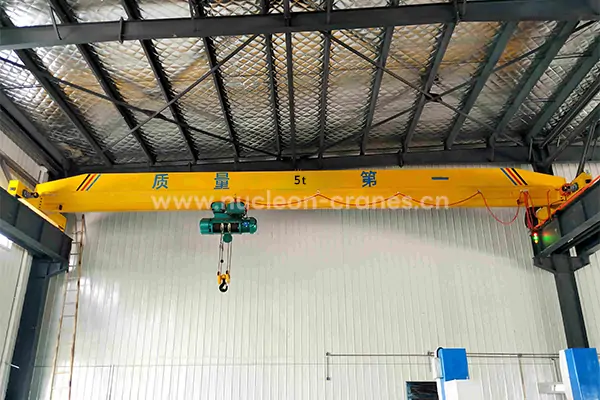
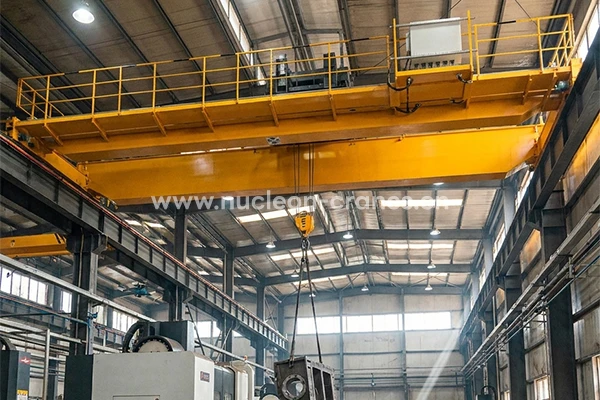
| سعة | التكوين النموذجي | سعر السوق المرجعي ($) |
| 1-5 أطنان | عارضة مفردة، امتداد قياسي | $2,200 – $6,500 |
| 5-10 أطنان | عارضة مفردة/مزدوجة | $3,500 – $8,000 |
| 10-20 طنًا | عوارض مزدوجة | $12,000 – $32,000 |
| 20-50 طنًا | Double girder, heavy duty (steel/mining) | $28,000 – $85,000+ |
Reference range only — final pricing depends on span, duty class, electrification, and whether NOM-006 documentation support and local installation are included. [احصل على عرض سعر من المصنع مباشرة وفقًا لمواصفاتك →]
احصل على عرض أسعار الحلولMexico's Overhead Crane Market: Where Demand Concentrates by Region and Industry
Mexico's overhead crane demand splits across four industrial clusters with distinct crane profiles, and the nearshoring wave has made the Bajío automotive corridor the fastest-growing of the four.
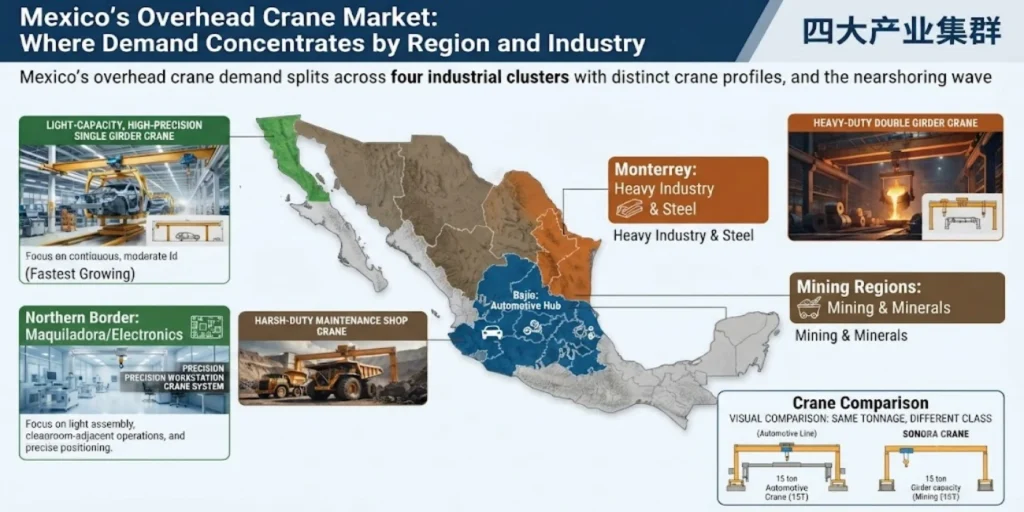
- ==The Bajío region== (Guanajuato, Querétaro, San Luis Potosí, Aguascalientes, Puebla) hosts the bulk of Mexico's automotive assembly and parts supply chain, with major OEM and Tier 1 plants driving continuous investment as manufacturers relocate production out of Asia toward US-adjacent capacity. This segment favors lighter-capacity, higher-precision single girder cranes for line-side assembly, stamping, and equipment installation work, with duty cycles built around continuous, moderate-load operation rather than heavy lifting.
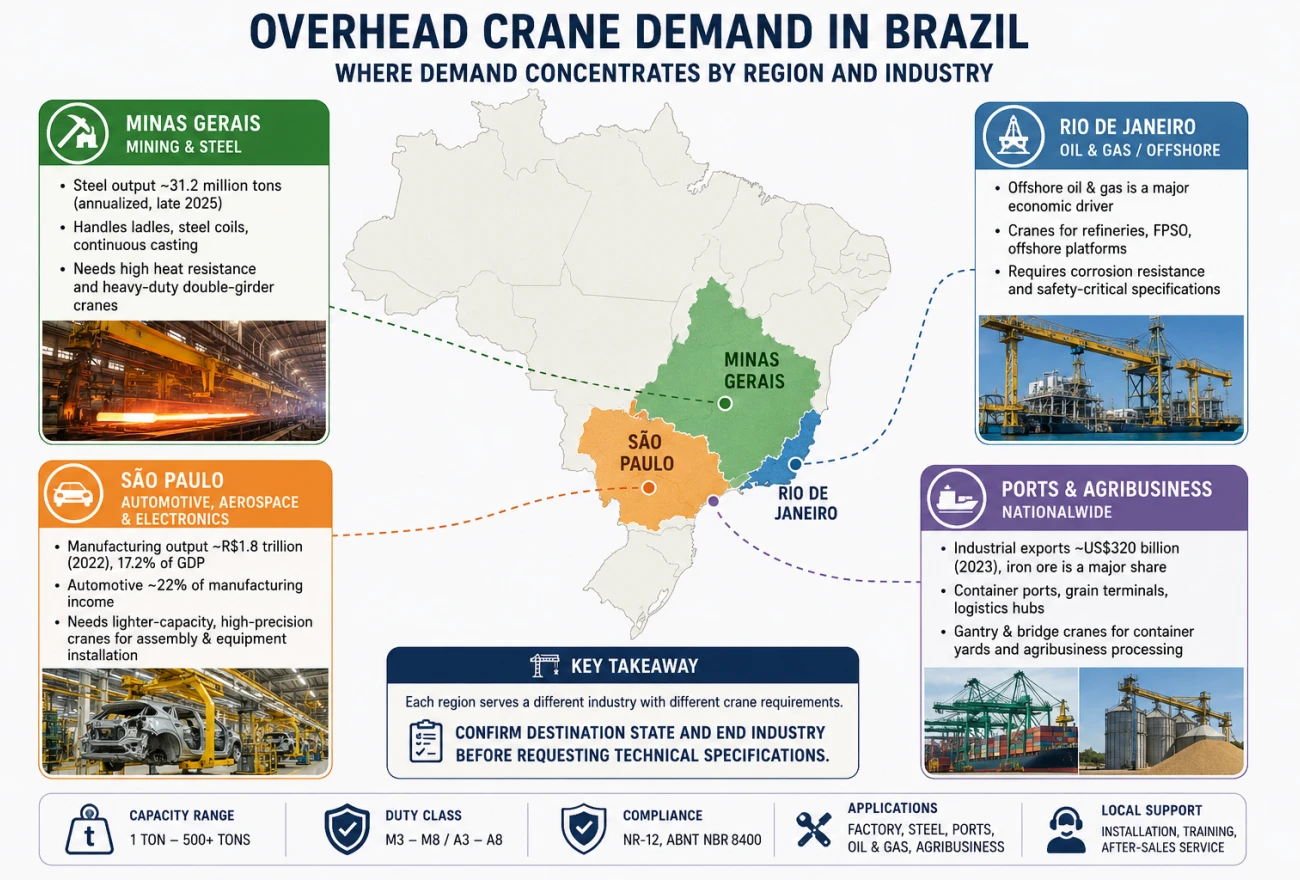
- ==Monterrey and Nuevo León== anchor Mexico's steel, cement, and heavy-machinery manufacturing base — the country's traditional industrial heartland. Cranes here skew toward heavy-duty double girder configurations for ladle handling, coil transport, and structural steel fabrication, closer in profile to Brazil's Minas Gerais steel demand than to Bajío's automotive-line demand.
- ==The northern border corridor== (Tijuana, Ciudad Juárez, Reynosa, Mexicali) is dominated by maquiladora electronics, appliance, and medical-device manufacturing, where demand centers on lighter-capacity, precision-positioning cranes and workstation/monorail systems suited to cleanroom-adjacent and light-assembly environments.
- ==Mining regions== in Sonora, Chihuahua, and Zacatecas (copper, silver, and gold) drive a separate heavy-duty demand stream for maintenance-shop cranes rated for harsh, dusty environments and frequent near-capacity lifts on mining equipment components.
الآثار العملية: a generic "Mexico" quote request without specifying the destination cluster will typically mis-size duty class and environmental protection — a crane specified for Bajío's continuous-duty automotive line looks very different from one specified for a Sonora mining maintenance shop, even at the same tonnage.
ما هي قدرات وأنواع الرافعات العلوية المطلوبة فعلياً؟
Demand splits along the same regional lines, with automotive/electronics pulling the lighter, precision end of the market and steel/mining pulling the heavy-duty end.
- رافعات أحادية العارضة من 1 إلى 10 أطنان dominate Bajío automotive and northern-border electronics/appliance assembly, prioritizing precise positioning and duty cycles suited to continuous production lines over raw lifting capacity.
- 20–50+ ton double girder cranes serve Monterrey's steel and heavy-machinery sector and mining maintenance operations in the north, where structural durability and heat/dust resistance matter more than positioning precision.
- رافعات جسرية see concentrated demand at Mexico's Pacific and Gulf ports (Manzanillo, Veracruz, Lázaro Cárdenas), reflecting the country's role as a growing manufacturing-export hub under USMCA.
- Workstation and monorail cranes appear across automotive and electronics assembly lines for line-side material transport — a segment growing directly alongside the nearshoring-driven expansion of Bajío and border-region manufacturing footprint.
Price typically runs below fully-imported US-brand equipment once freight and import duties under USMCA rules of origin are factored in, but the gap narrows for heavy-duty steel/mining configurations where established local service networks carry more weight than unit price. Buyers comparing quotes should confirm whether NOM-006 documentation support, customs clearance, and on-site installation are included as line items, since these vary significantly by supplier.
Compliance: What NOM-006-STPS Actually Covers — and What It Doesn't
NOM-006-STPS (updated to its 2023 edition, in force since late 2024) governs the operational safety conditions for material-handling machinery — including cranes, hoists, and winches — in Mexican workplaces; it is a workplace-safety operating regulation, not a structural crane design standard.
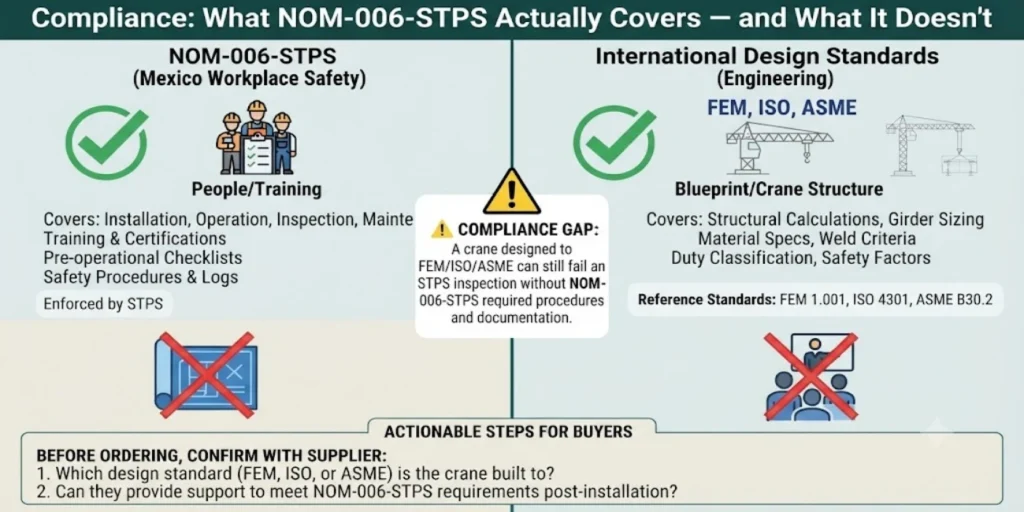
This is the distinction buyers new to the Mexican market most often miss:
- NOM-006-STPS (enforced by the Secretaría del Trabajo y Previsión Social, STPS) sets requirements for how lifting machinery must be installed, operated, inspected, and maintained at the workplace level — covering operator training, safe procedures, and maintenance documentation for equipment including cranes and hoists. It does not specify how the crane itself must be structurally calculated.
- The crane's structural and mechanical design basis — girder sizing, duty/utilization classification, component ratings — is typically referenced against international standards such as فيم 1.001, ISO 4301, ، أو ASME B30.2, since Mexico does not maintain a separate mandatory national design standard specific to overhead cranes the way Brazil's ABNT NBR 8400 does.
- The practical consequence: a crane can carry complete FEM/ISO/ASME design documentation and still fail an STPS workplace inspection if the facility hasn't implemented NOM-006's required operating procedures, training records, and maintenance program — the compliance gap in Mexico sits at the operational level, not the design level.
Before ordering, confirm with your supplier: which design standard was the crane engineered to (FEM, ISO, or ASME), and separately, whether the supplier or a local partner can support setting up the NOM-006 operating procedures and training documentation your facility will need post-installation — the second item is the one most commonly overlooked, since it's a facility-side obligation rather than something a manufacturer's export documentation covers by default.
Choosing a Supplier: China vs. US vs. Local Mexican Manufacturers
For the 1–30 ton segment covering most automotive, electronics, and general manufacturing demand, Chinese manufacturers compete on cost and lead time, US-based suppliers compete on USMCA logistics simplicity and established service networks, and local Mexican manufacturers compete on NOM-006 process familiarity.
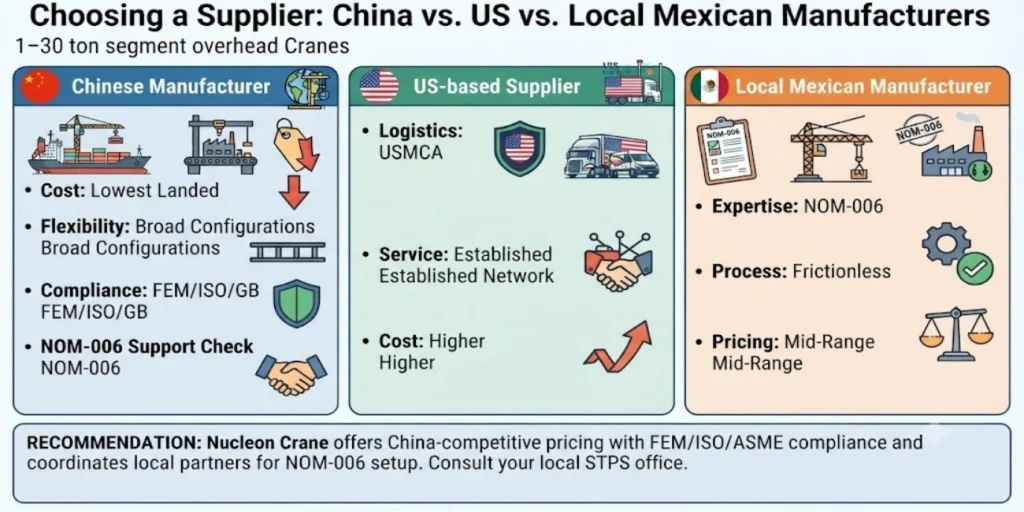
- المصنعين الصينيين typically offer the lowest landed equipment cost and broadest configuration flexibility for standard single/double girder cranes, with design documentation commonly built around FEM, ISO, or GB/T 3811 — engineering-compatible with what Mexican structural review expects, though buyers should confirm the supplier can support NOM-006 operating-documentation needs directly or through a local partner.
- US-based suppliers benefit from USMCA's simplified cross-border logistics and shorter freight times to Bajío and border-region facilities, along with established service networks already familiar with Mexican plant requirements — typically at a materially higher unit cost than Chinese-sourced equivalents for comparable specifications.
- Local Mexican manufacturers and integrators specialize in NOM-006 documentation and STPS inspection familiarity, which reduces operational compliance friction, generally at a price point between Chinese and US-imported equipment.
For buyers prioritizing factory-direct pricing with engineering documentation that maps cleanly to FEM/ISO/ASME references, رافعة نووية supports technical file preparation suited to Mexican structural review and can coordinate with local partners on NOM-006 operating-documentation setup — worth confirming directly against your specific state's STPS regional office requirements.
خاتمة
Mexico's overhead crane demand is concentrated but not uniform — Bajío wants precision automotive-line cranes, Monterrey wants heavy-duty steel-handling equipment, the border corridor wants light-assembly and workstation systems, and mining regions want harsh-environment maintenance-shop cranes. The compliance detail most buyers miss isn't a design-standard mismatch — it's assuming NOM-006-STPS (an operational safety regulation) substitutes for structural design documentation, or vice versa. Confirm both separately before ordering: the design standard referenced in the manufacturer's technical file, and who will support your facility's NOM-006 operating procedures and training records after installation.
Ready to source overhead cranes in Mexico?

أخصائي معدات
مدير أعمال الرافعة الناجح الذي يتمتع بخبرة واسعة في إدارة مشاريع الرفع الثقيل والإشراف التشغيلي. سجل حافل في قيادة نمو الإيرادات وضمان الامتثال لقواعد السلامة.
التعليمات
Q1: Is NOM-006-STPS a design certification for overhead cranes in Mexico?
No. NOM-006-STPS is a workplace operating-safety regulation covering installation, operation, inspection, and maintenance of lifting machinery — it does not specify the crane's structural design calculation. The crane's structural design basis is typically referenced against FEM 1.001, ISO 4301, or ASME B30.2, since Mexico does not maintain a separate mandatory national crane design standard.
Q2: What's the price range for a 10-ton overhead crane sourced for a Mexican factory?
Factory-direct pricing for a 10-ton single or double girder overhead crane typically runs $3,500–$8,000 as a market reference, depending on span, duty class, and electrification. NOM-006 documentation support, customs clearance, and installation are typically quoted separately.
Q3: Which region in Mexico has the highest overhead crane demand right now?
The Bajío corridor (Guanajuato, Querétaro, San Luis Potosí) is currently the fastest-growing segment, driven by automotive and parts-supplier nearshoring investment. Monterrey remains the largest base for heavy-duty steel and industrial demand, while the northern border region drives electronics and appliance-assembly demand.
Q4: Should I choose a Chinese, US, or local Mexican crane supplier?
Chinese manufacturers generally offer the lowest landed cost for standard configurations. US suppliers offer USMCA logistics advantages and established local service networks at a higher price point. Local Mexican manufacturers reduce NOM-006 operational-compliance friction. The right choice depends on whether your project prioritizes cost, service network maturity, or compliance-process simplicity.
مقالات ذات صلة
- الرافعات العلوية في نيجيريا وكينيا: أنواعها وأسعارها وكيفية اختيار الرافعة المناسبة
- دليل الأعطال الشائعة وإصلاح الرافعات العلوية: ما الذي يسبب الأعطال فعلياً (وما الذي يجب فحصه أولاً)
- الامتثال لمعايير إدارة السلامة والصحة المهنية (OSHA) مقابل معايير الاتحاد الأوروبي (CE) فيما يتعلق بالرافعات العلوية: قائمة مرجعية عملية للمشترين والمصدرين (2026)
- الرافعات العلوية في البرازيل: طلب السوق، والامتثال، ودليل الموردين (2026)
- الرافعات العلوية في فيتنام: نمو السوق، والامتثال، ودليل الموردين (2026)
- رافعة علوية مقاومة للانفجار: متى تحتاج إليها فعلاً؟

 English
  العربية
  Español
  Français
  Português
  Русский