

A jib crane for machine shop use is a 0.5–2 t unit with a 3–5 m boom, an electric chain hoist and 180° to 360° of rotation. Floor-mounted versions sell for around $1,500–$9,000 on the market and 0.5–1 t wall-mounted versions for around $2,000–$8,000, before foundation, freight and installation.
Select by working radius. The hook can't travel the full boom, so the reach you get is shorter than the arm length on the quote, and the safe area is shorter again once doors, columns and conveyors come out.
Quick reference: jib crane types for CNC machine shops
| يكتب | التناوب | Nucleon range* | Best fit | سعر السوق المرجعي |
| Floor-mounted slewing jib crane | حتى 360 درجة | 0.5–10 t, lift height 2–6 m, working grade A3 | Open floor beside or between machines | $1,500–$9,000 (0.5–2 t) |
| Wall-mounted cantilever jib crane | 180°–200° | 0.5–1 t, lift height 5–6 m, working grade A3 | Machines along a wall with a strong wall or steel column | $2,000–$8,000 (0.5–1 t) |
*Published product ranges. Confirm the exact model against its drawing. Prices are market reference ranges for scoping.
For one CNC machine and loads under 1 t, a wall-mounted unit is the cheapest dedicated lift. A machine away from a wall, or a heavier load, calls for a floor-mounted pillar.
احصل على عرض أسعار الحلولQuick sizing rules
- Working radius: distance from the rotation center to the farthest loading point, plus a few hundred millimeters. Ask the supplier to confirm working radius, not arm length.
- Rated load: workpiece + fixture + lifting beam or slings. Example: 800 + 150 + 50 = 1,000 kg, which fills a 1 t unit completely, so a 2 t unit gives headroom.
- Height under boom: open door or spindle opening height + part height + attachment + hook block headroom + safety margin.
- Rotation: the smallest arc that reaches every loading point. Wall-mounted units swing 180°–200°, and a floor-mounted pillar goes up to 360°.
جدول المحتويات
Layout: Matching the Jib Crane to the CNC Cell

Wall bracket or floor-mounted pillar
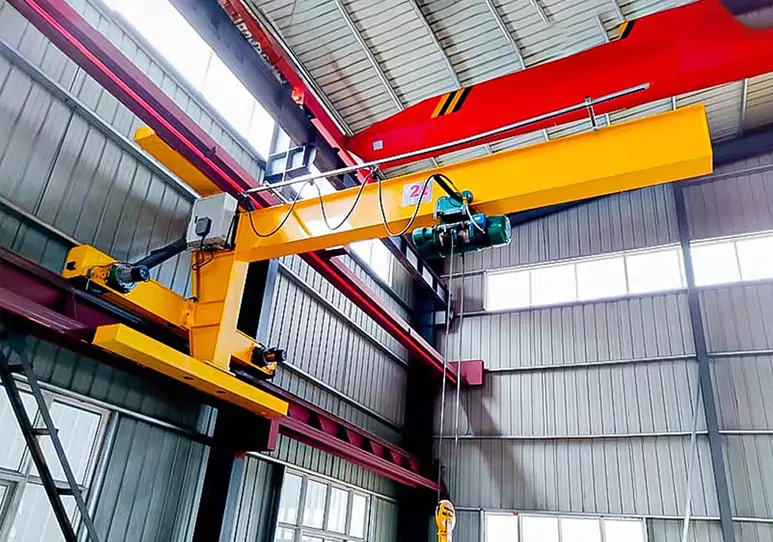
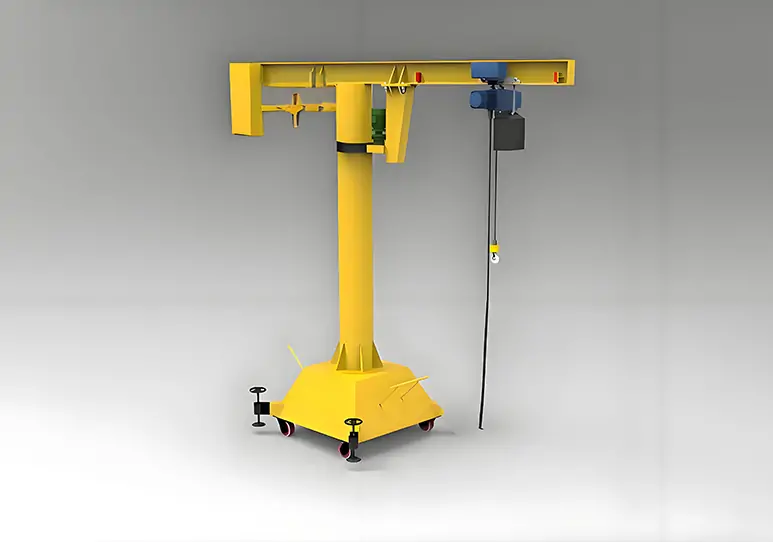
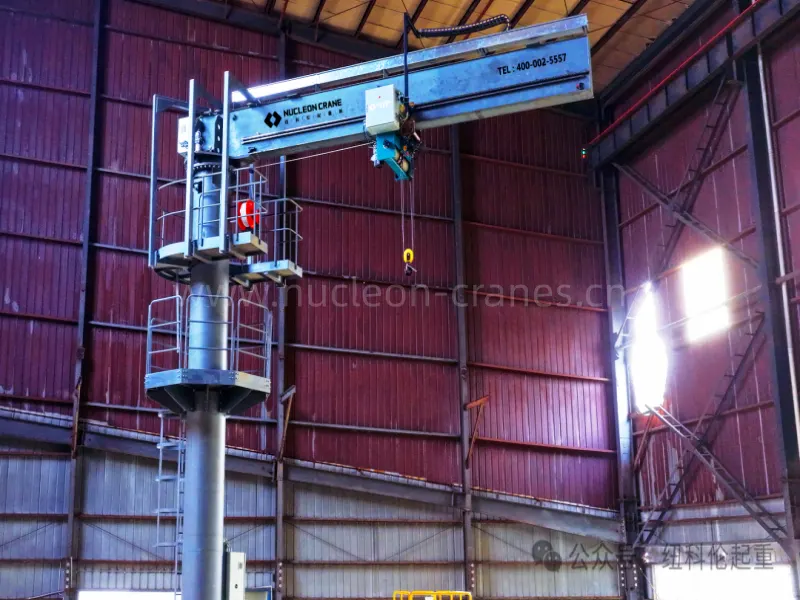
A wall bracket saves floor space and foundation work, while a floor-mounted pillar swings further and carries more. The bracket borrows the building's structure, so the aisle stays clear, but the swing stops at 180°–200° and the wall has to resist the bending moment from the boom. Light masonry can't. A pillar stands on its own base, and Nucleon's floor-mounted range reaches 10 t against 1 t for wall-mounted. The price is floor space and a foundation. Once load or radius pushes the moment past what a wall can take, the pillar is the only option left.
How much arc do you need?
Fit the arc to three points: where the part is picked up, where it sits on the machine table and where it is set down. Every extra degree has a cost in floor and headroom that must stay clear, and in chances for the boom to meet a door, a duct or the next jib. In a crowded shop even a 360° pillar often gets rotation stops fitted.
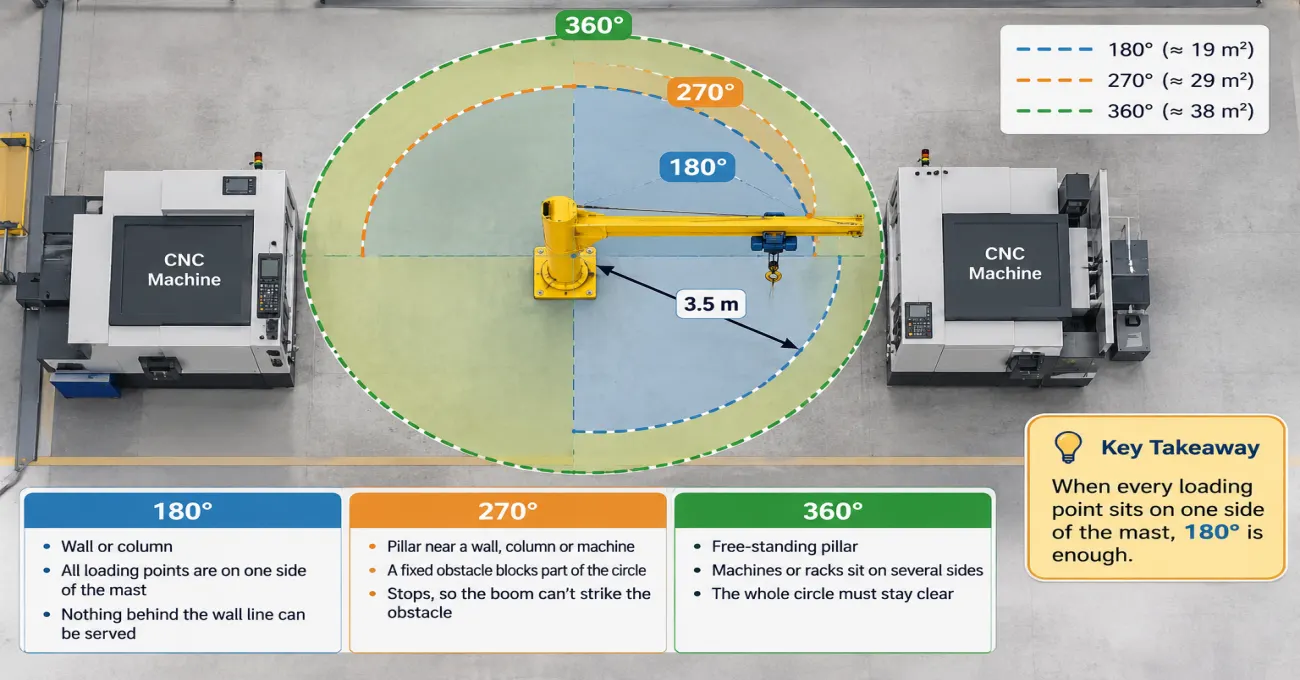
| التناوب | التركيب | Fits when | ترقبوا |
| 180° | جدار أو عمود | All loading points are on one side of the mast | Nothing behind the wall line can be served |
| 270° | Pillar near a wall, column or machine | A fixed obstacle blocks part of the circle | Stops, so the boom can't strike the obstacle |
| 360 درجة | Free-standing pillar | Machines or racks sit on several sides | The whole circle must stay clear |
At an illustrative 3.5 m working radius, a full circle covers about 38 m², 270° about 29 m² and 180° about 19 m². When every loading point sits on one side of the mast, 180° is enough.
Single-machine, shared and line layouts
A jib dedicated to one machine removes the wait for the central bridge crane, and sharing saves money only when lifts are rare. With a shared jib, the next operator stands idle while the first holds the hook.
| Scheme | Works when | ترقبوا |
| One jib per machine | Heavy parts, long clamping time, machines far apart | More masts and bases to pay for |
| One jib shared by 2–4 machines | Machines clustered inside one working radius, light and infrequent lifts | Simultaneous loading causes waiting |
| Jibs in a row along a line | Long shafts, or parts moving between stations | Adjacent arcs need a planned overlap and stops |
| Jib plus overhead crane | Bridge crane handles bay-wide moves, jib handles machine-side lifts | Hook height must clear the runway |
Two arcs overlap only when the distance between their centers is smaller than the sum of their working radii. A larger distance leaves no hand-off zone. Keep the forklift lane and walking path outside the boom sweep, and fit stops wherever two arcs overlap so the booms can never meet.
Working Radius vs Jib Arm Length: How to Size Reach
Arm length, working radius and effective working area
| شرط | Meaning | Why it matters at a CNC machine |
| Jib Arm Length | Physical length of the boom | Appears on the quote and says nothing about reach |
| Working Radius | Horizontal distance from the rotation center to the hook's reachable position | Decides which loading points the hook can reach |
| Effective Working Area | The area where the hook can work safely once obstacles and limits are removed | Decides whether the crane serves the machine in practice |
Specify working radius, not arm length: arm length is what the supplier builds, working radius is what the machinist can actually use. The mast or bracket takes up part of the boom. The trolley stops short of the tip because of its end stops and body. The hook block needs room to approach.
Subtracting what the machine takes up
Start with an illustrative 4.0 m arm. After end stops, trolley body and mast offset, the working radius might come out at about 3.4–3.6 m, depending on the trolley and stop positions. The effective area shrinks again: an open CNC door, a tool-changer cover, a chip conveyor, a coolant tank, a column inside the circle. A long part hanging below the hook may reach the spindle area from one angle only. Measure from the rotation center to the farthest point where the load center must land, then have the supplier confirm that its stated working radius covers that point with a few hundred millimeters to spare.

What reach does to the mast and foundation
One ton at 4 m puts 4 ton-meters of moment on the mast. At 6 m the same load puts 6 ton-meters, 50% more, before counting the weight of the boom. Mast, rotation bearings, base and foundation are all sized for that moment. A longer boom also deflects more, which makes fine positioning into a chuck harder. Some jib cranes come with a load chart that cuts capacity toward the tip, so ask for it in writing, and size the radius to the effective working area.
Unsure about your working radius? Send the floor plan, machine list and building details to our engineers. See the Nucleon jib crane range أو اتصل بنا.
Capacity, Hoist and Height for CNC Workloads
Everything on the hook counts toward the load
The design load is the workpiece plus whatever holds it: fixture, magnet or clamp, lifting beam, slings. Take an illustrative case. An 800 kg workpiece, a 150 kg fixture plate and a 50 kg lifting beam add up to 1,000 kg, the full rating of a 1 t unit before the first lift. A 2 t unit leaves room. Ask the manufacturer for its design basis instead of adding your own multiplier, since hoist weight and impact are normally built into the structure. Oversizing has a cost too, because mast, base and foundation grow with the rating.
Chain hoist or wire rope hoist?
Electric chain hoists handle most CNC work up to about 2 t, and wire rope hoists take over above that. A chain hoist is compact, positions finely and costs less. Wire rope earns its higher price as capacity, lift height or duty go up.
| Capacity class | Example loads (illustrative) | رافعة |
| 0.5 t | Vises, fixtures, chucks, small blanks | رافعة كهربائية بسلسلة |
| 1 طن | Mid-size workpieces, rotary tables, pallets | رافعة كهربائية بسلسلة |
| 2 طن | Larger castings, heavy fixtures | Electric chain or wire rope hoist |
| 3–5 t | Large castings, heavy workholding | Wire rope hoist in most cases |
| Above 5 t, or loads crossing bays | Heavy blanks, dies | Consider a bridge crane |
Hoists in this class are generally designed to EN 14492-2 or ASME B30.16. For the chain hoist choice itself, see manual vs electric chain hoists.
Duty class and slow approach
At a machine, loading accuracy and duty class matter more than spare tonnage. A two-speed or variable-frequency hoist gives a slow final approach, so a part goes into a chuck or fixture without chasing the swing. Duty class follows lifting cycles and load spectrum under ISO 4301 أو فيم 1.001, with little connection to tons. Nucleon's floor-mounted and wall-mounted jib cranes are listed at working grade A3, so confirm with our engineers how that maps to your lifts per hour. Rotation works the same way: manual slewing fits light loads and infrequent lifts, and powered rotation pays off for heavy or repeated loading.
Height under boom
Hook height has to clear the open door, the part and the rigging at once. Add the door or spindle opening height, the part height, the attachment or sling, the hook block headroom and a safety margin. A boom set at head height clears the operator and can still fail with a tall part lifted out of a machining center. The ceiling sets the upper limit, so check both before fixing the mounting height. Lift height and height under boom are different numbers, so ask for both on the drawing.
Jib Crane for Machine Shop: Price and Procurement Checks
Market price by capacity
For 0.5–2 t machine-shop work, floor-mounted units run around $1,500–$9,000.
| سعة | مثبت على الأرض | مثبت على الحائط |
| 0.5 t | $1,500–$5,000 | 2000 دولار - 5000 دولار |
| 1 طن | $2,000–$7,000 | $2,500–$8,000 |
| 2 طن | $2,500–$9,000 | n/a |
| 3 طن | $3,000–$15,000 | n/a |
| 5 طن | $5,000–$20,000 | n/a |
These market reference ranges assume a boom of about 3–12 m and an electric hoist. The spread comes from boom length, manual or powered rotation, hoist brand and speed, pendant or radio control, paint and scope of supply. Use them for budgeting, and get a written quote for the actual specification.
Foundation and wall checks

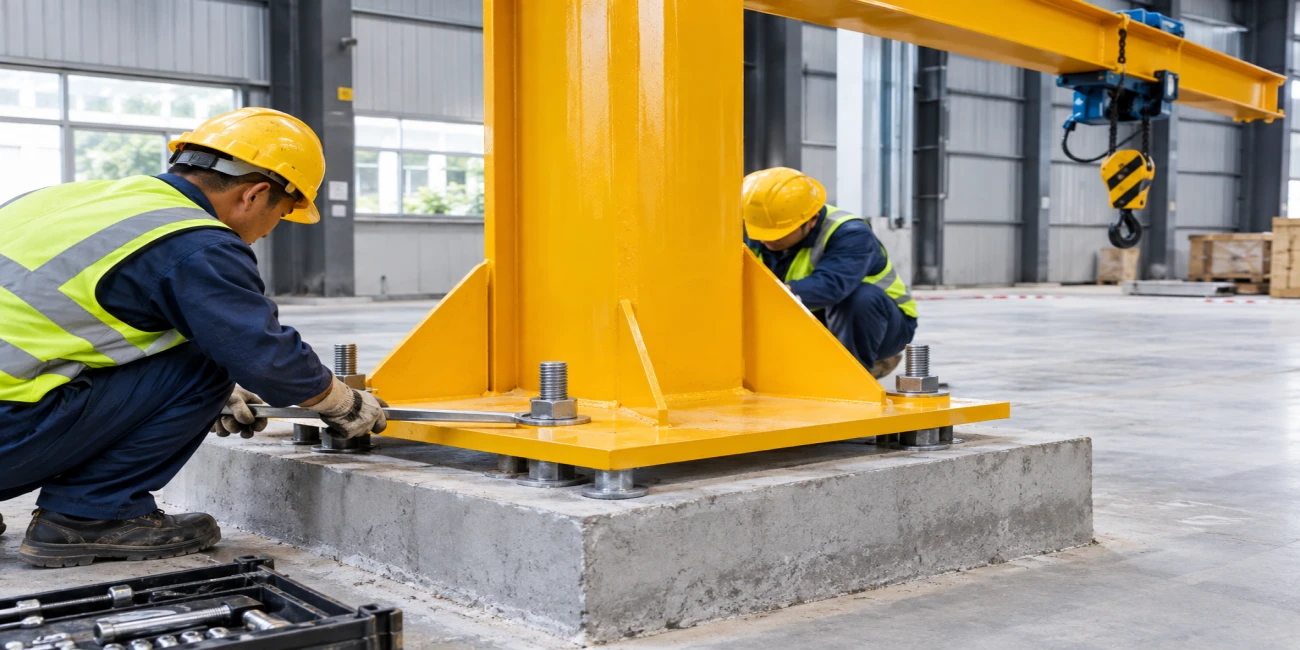
Both mounting types pass the load moment into the building. A floor-mounted jib bolts to a base plate on a suitable slab or to anchors in a poured foundation, and the supplier's foundation drawing gives footprint, depth and anchor layout, which all grow with capacity and radius. A wall bracket pushes vertical load plus a horizontal pull-and-push pair into the wall. Thin, masonry or unreinforced walls may not carry that, so a steel column or reinforcement is often needed. A structural engineer should confirm the slab, wall or column in every case.
Column mounting adds one more question. The column fixes the rotation center, so a column standing in front of a machine door, in a forklift lane or at the operator's working position puts the crane in the wrong place at any capacity.
What the quote should list
Two jib cranes with the same tonnage and arm length can differ widely in scope.
| Item to confirm | Why it matters |
| Working radius and hook height | Decides whether the hook reaches every loading point |
| Hoist type, speed and working grade | Affects positioning accuracy and service life |
| Rotation: manual or powered, arc and stops | Affects operator effort and collision control |
| Power supply and control (pendant or remote), voltage and frequency | Must match the local supply |
| Foundation drawing or wall-bracket loads | Needed to plan civil work |
| Packing, freight, installation, load test, documents, trade terms | Sets the landed cost for export orders |
Ask for the design standard. EN 14985 covers slewing jib cranes, hoists follow EN 14492-2 or ASME B30.16, classification follows ISO 4301 or FEM 1.001, and GB/T 3811 applies to China-built structures. Add the load-test certificate, the manual, and CE conformity for EU shops.
With your inquiry, send the floor plan showing machines, doors, columns and forklift lanes, the heaviest load on the hook in kg, working radius and hook height at each loading point, lifts per hour and shifts per day, slab thickness or wall construction, voltage and frequency, and any coolant mist or dust limits.
خاتمة
Start from the floor plan: mark each loading point, measure the working radius from the proposed mast center and add up the load on the hook. Send those with your heaviest part to our engineers through the Nucleon jib crane range or the رافعة ذراع دوارة page, and we will confirm radius, capacity and mounting before you order a jib crane for machine shop use.

أخصائي معدات
مدير أعمال الرافعة الناجح الذي يتمتع بخبرة واسعة في إدارة مشاريع الرفع الثقيل والإشراف التشغيلي. سجل حافل في قيادة نمو الإيرادات وضمان الامتثال لقواعد السلامة.
التعليمات
Q1: What size jib crane does a CNC machine need?
Most CNC cells fall in the 0.5–2 t class. Add the workpiece, fixture and lifting beam, then check the rated capacity at your working radius. An 800 kg part with 200 kg of fixture and beam fills a 1 t unit completely. Confirm mast, base and foundation for that same radius.
Q2: How much does a jib crane for a machine shop cost?
A floor-mounted 0.5–2 t unit runs around $1,500–$9,000 as a market reference. Foundation work, freight, installation and load testing are often quoted separately. Ask for the foundation drawing early, because slab or wall reinforcement can change the total more than the crane price does.
Q3: Can one jib crane serve two CNC machines?
Yes, when both loading points sit inside the same effective working area. Measure from the mast center to each chuck or table, and confirm both machine doors can open without meeting the boom. Shared use suits light, infrequent lifts. Heavy parts or long clamping times call for one jib per machine.
Q4: Should I choose manual or powered rotation?
Manual slewing suits loads under about 1 t lifted a few times an hour. Powered rotation is worth it above about 2 t, or when loading repeats every few minutes. Powered units also hold position better when a part is being set into a chuck, so the operator works at the controls instead of pushing the boom.
Q5: Can a wall-mounted jib crane go on any wall?
No. The wall or column must be verified for the bracket loads. Thin, masonry and unreinforced walls often fail that check, and a steel column or added reinforcement is the usual fix. A structural engineer should approve the mounting before the order is final.
مقالات ذات صلة
- What Is the Difference Between Manual Chain Hoist and Electric Chain Hoist?
- What Is Electric Hoist? Electric Hoist Price and Capacity
- كم تبلغ تكلفة رافعة ذراع الرافعة؟ دليل الأسعار حسب النوع ونصف القطر والتركيب
- دليل سعة رافعة الجيب: كيفية اختيار تصنيف الحمولة المناسب
- رافعة سلكية مقابل رافعة سلسلة: أيهما يدوم لفترة أطول؟

 English
 العربية
 Español
 Français
 Português
 Русский