
Choosing the wrong warehouse crane doesn't just waste budget — it creates bottlenecks, safety risks, and costly retrofits down the line. Whether you're outfitting a new distribution center or upgrading aging material handling equipment, the decision deserves more than a quick catalog browse.
This guide cuts through the confusion. You'll learn what types of warehouse cranes exist, how to match crane specifications to your facility's real requirements, and what separates a solid long-term investment from a regrettable purchase. By the end, you'll have a clear, practical framework for selecting a warehouse crane that fits your workflow, ceiling height, floor layout, and budget — without over-engineering or under-specifying.
If you've ever asked "what type of crane is used in warehouses?" or struggled to compare an overhead crane against a gantry option, this is the resource you've been looking for.
1. What Are Warehouse Cranes?
Warehouse cranes are material handling equipment designed to lift, move, and position heavy loads within an enclosed or semi-enclosed facility. Unlike mobile cranes used on job sites, warehouse cranes are typically fixed or rail-mounted systems that operate within defined travel paths — either along runways attached to the building structure, on freestanding legs, or from a fixed wall-mounted arm.
The primary function of an industrial warehouse crane is to reduce manual handling strain, increase throughput, and move loads that forklifts either can't reach or can't safely handle — such as loads directly above machinery, long structural members, or precision components requiring controlled lowering.
Most warehouse crane systems pair a structural frame (the bridge, gantry, or jib) with an electric hoist or chain hoist as the lifting mechanism. The hoist handles vertical movement; the crane structure handles horizontal travel. This combination determines the crane's effective working envelope inside your facility.
Understanding this basic architecture is the starting point for any warehouse crane selection process. Once you know what you're dealing with structurally, comparing types becomes far more straightforward.
2. Main Types of Warehouse Cranes
Selecting a warehouse crane starts with knowing which category of crane actually applies to your situation. The four most common types used in warehouses each have distinct advantages, constraints, and ideal use cases.
Overhead Cranes (Bridge Cranes)
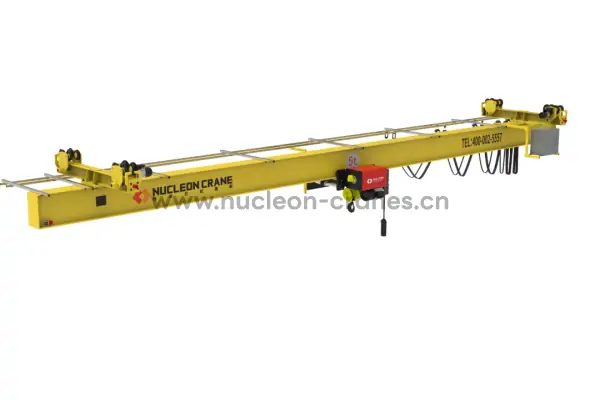
Однобалочный мостовой кран
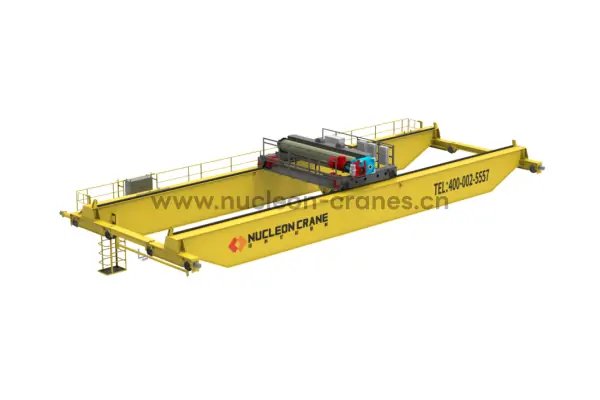
Двухбалочный мостовой кран
Overhead cranes — also called bridge cranes — are the workhorse of heavy industrial warehouses. The bridge travels along elevated runway rails mounted to the building's structural columns or roof framing. A trolley moves laterally across the bridge, and the electric hoist rides on the trolley.
This configuration gives an overhead crane for warehouse use the largest possible coverage area — essentially the full floor plan beneath the runways. Double-girder designs handle higher capacities (typically 10 tons and above), while single-girder models are more economical for lighter loads in the 1–10 ton range.
Лучше всего подходит для: High-bay warehouses, heavy manufacturing support, steel service centers, shipbuilding support facilities, automotive parts distribution.
Козловые краны
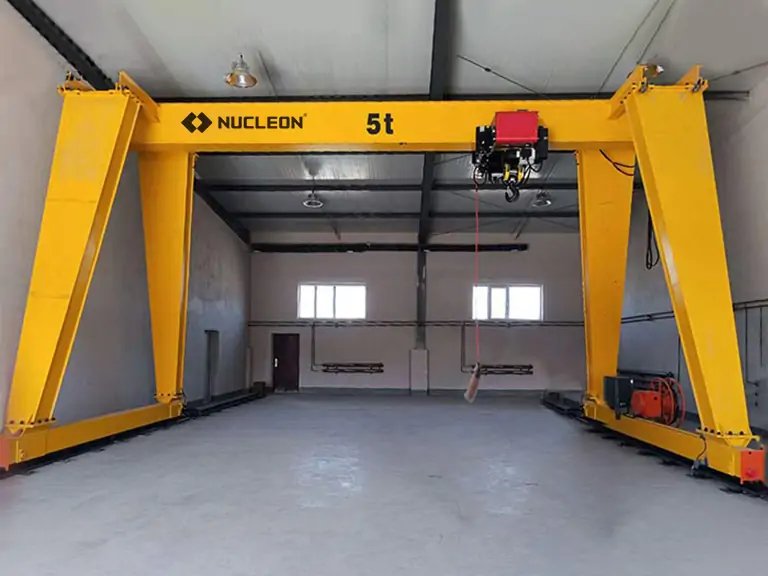
Full Gantry Crane
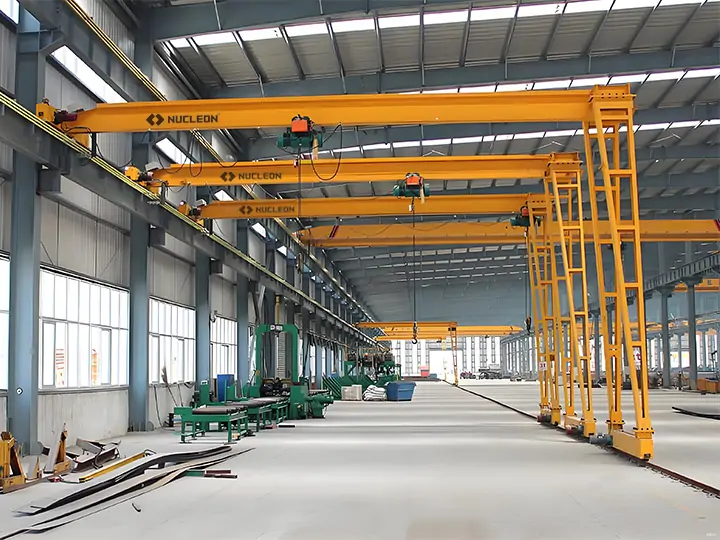
Полукозловой кран
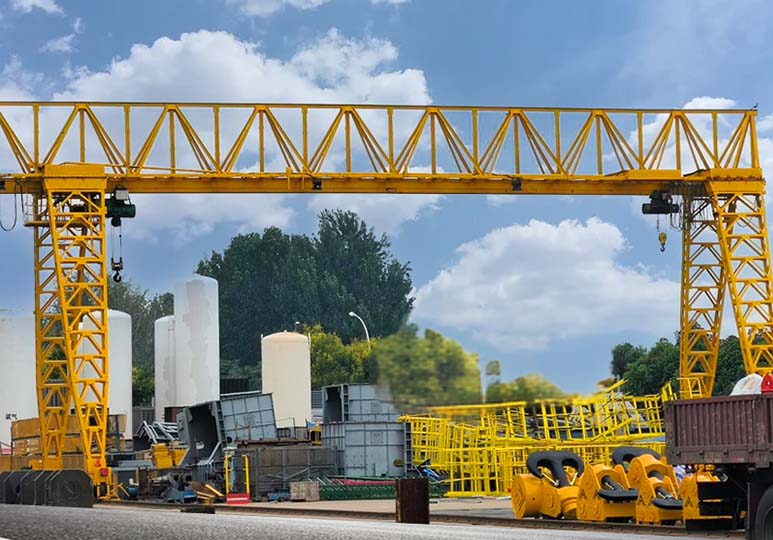
Gantry cranes are structurally similar to bridge cranes but supported by legs rather than the building. This makes them suitable for facilities without adequate roof structure to support runway loads, or for outdoor/semi-outdoor applications. Full-gantry designs have two legs; semi-gantry designs have one leg on the floor and one rail on the wall.
A gantry crane for warehouse use is particularly valuable in retrofit scenarios where installing overhead runway systems would require expensive structural reinforcement. Many gantry cranes are also available in adjustable-height or portable configurations.
Лучше всего подходит для: Facilities with low-capacity roof structures, outdoor storage yards, dock areas, pre-engineered metal buildings.
Jib Cranes
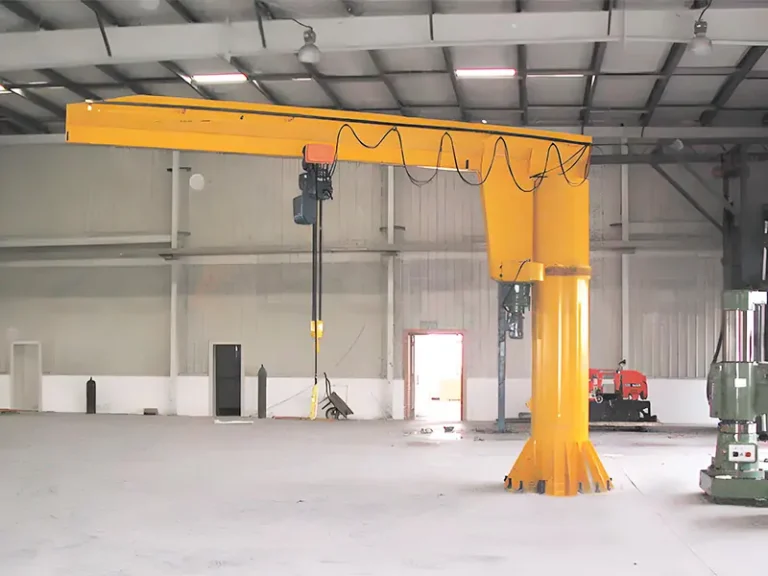
Floor Mounted Jib Crane
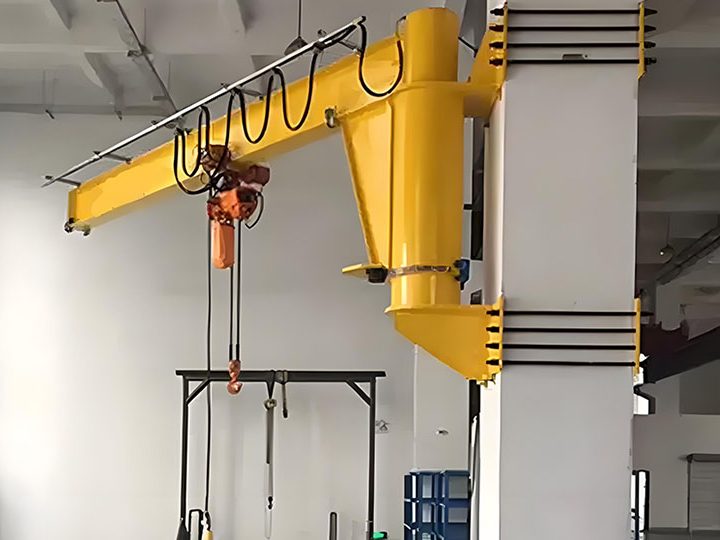
Настенная поворотная консольная колонна
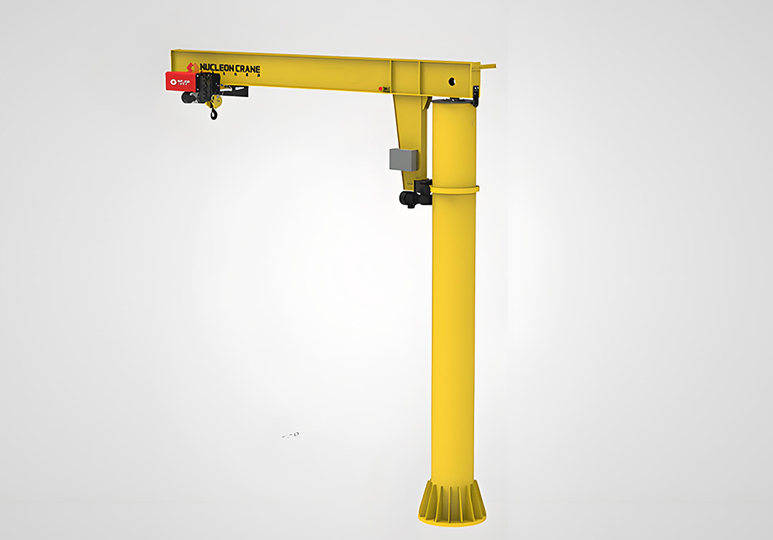
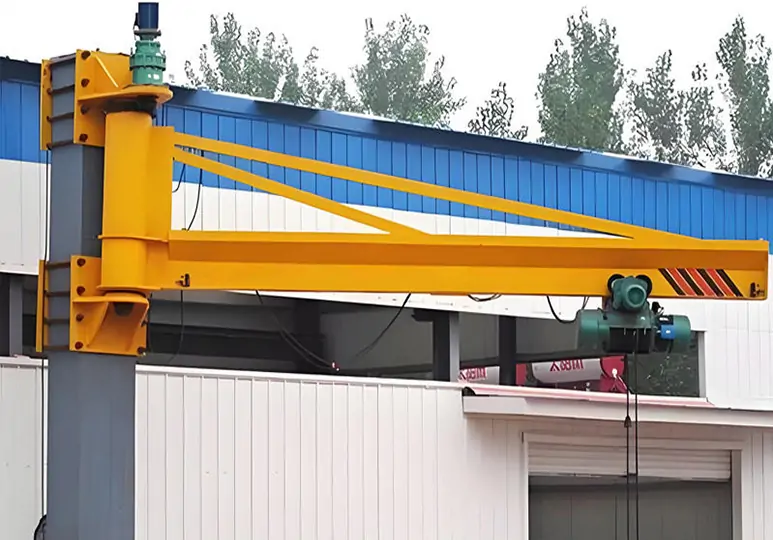
A jib crane for warehouse use consists of a horizontal arm (the jib or boom) mounted to a wall bracket or floor-mounted mast. The hoist travels along the underside of the jib. While the coverage area is limited to a 180° or 360° arc, jib cranes excel at serving a single workstation or machine bay with high frequency.
Wall-mounted jib cranes preserve floor space; mast-mounted versions provide full 360° rotation and can be positioned anywhere on the floor.
Лучше всего подходит для: Assembly stations, CNC machine tending, loading dock assistance, maintenance bays, repetitive single-point lifting tasks.
Electric Hoists and Chain Hoists
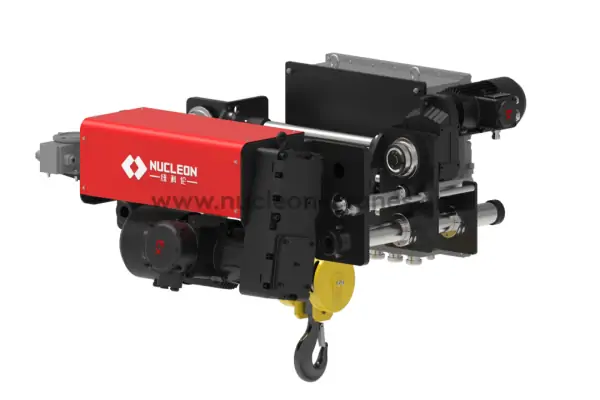
FEM Standard Explosion-proof Electric Hoist
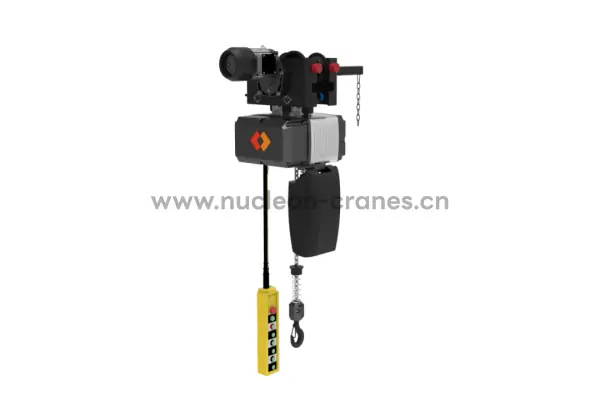
Талреп
Electric hoists и цепные подъемники are not standalone cranes — they are the lifting mechanism mounted on all the above systems. However, in lighter-duty warehouse environments, a simple electric chain hoist mounted on an I-beam monorail or trolley beam can serve as a cost-effective, low-infrastructure solution for loads under 2 tons.
Лучше всего подходит для: Small warehouses, infrequent lifting tasks, budget-constrained operations with light loads.
3. Key Factors to Consider When Selecting Warehouse Cranes
Warehouse crane selection is not a one-size-fits-all exercise. Several facility-specific and operational variables directly determine which crane type, capacity, and configuration will actually work.
Structural Capacity of Your Building
Before specifying any overhead crane, a structural engineer must assess whether your building's columns and roof framing can carry the additional dead load (crane weight) plus dynamic live load (lifted load plus impact factor). Most overhead crane standards — including CMAA Specification 70 and EN 15011:2011+A1:2014 — require impact load factors of 10–25% above the rated capacity applied to the runway structure.
If your building cannot support runway loads, a freestanding gantry crane — which transfers all loads to the floor slab — is often the more practical path.
Lifting Capacity (SWL)
The crane's Safe Working Load (SWL) must exceed your maximum anticipated load with a safety margin. Industry practice and most applicable standards (ASME B30.2, ISO 4301) recommend selecting a crane rated at least 25% above your heaviest routine load — not because you plan to lift at that weight regularly, but to preserve structural margins and hoist service life.
Avoid the common error of sizing to your current heaviest load without accounting for future inventory changes. Specifying slightly higher capacity up front is nearly always cheaper than replacement later.
Span and Lifting Height
Span (the horizontal distance between runway rails or gantry legs) and lifting height (hook height at maximum lift) are the two geometric parameters that define the crane's working envelope. Both must be calculated precisely:
Span = the clear distance between the faces of the runway girders or supporting columns, minus the required side clearances per CMAA/EN standards
Lifting height = the distance from the floor to the underside of the hook at maximum lift, accounting for hook approach (the minimum distance the hook can reach toward the headroom obstruction)
Undersizing either dimension is one of the most common and costly warehouse crane selection mistakes.
Duty Cycle and Service Classification
How often will the crane operate? A crane used 2–3 times per day has fundamentally different mechanical requirements than one running 20+ cycles per hour. CMAA defines service classifications from Class A (standby/infrequent) through Class F (continuous heavy duty). Selecting the wrong class leads to premature component wear, more frequent maintenance, and potential structural fatigue.
For most warehouse material handling equipment applications, Class C (moderate service) or Class D (heavy service) applies.
Facility Layout and Workflow
Map your material flow before specifying the crane. Identify where loads originate, where they terminate, and what path they take. This analysis determines: whether a single bridge covers the necessary area, whether a jib crane at a workstation eliminates the need for a full overhead system, and whether multiple smaller cranes serve the workflow better than one large unit.
4. Overhead Cranes vs. Gantry Cranes: Which to Choose?
This is one of the most common questions in warehouse crane selection, and the honest answer is: it depends entirely on your building structure, floor plan, and budget for infrastructure.
| Фактор | Overhead Crane (Bridge Crane) | Козловой кран |
| Building structure required | High — must support runway loads | Low — loads transfer to floor |
| Coverage area | Full bay area under runways | Defined by leg span and travel |
| Capacity range | 0.5 – 500+ tons | 0.5 – 100+ tons (warehouse typical) |
| Installation cost (structure) | Higher if retrofit required | Lower for freestanding version |
| Headroom efficiency | Better (hook approach higher) | Slightly reduced by leg height |
| Mobility (portable versions) | No | Yes (light-duty portable models) |
| Suitable for new construction | Ideal — design building with runways | Viable but less efficient long-term |
| Suitable for retrofit | Only if structure qualifies | Often preferred |
Reference: CMAA Specification 70 & 74 (2020 editions); EN 15011:2011+A1:2014
Practical guidance: In new construction, design the building to accommodate overhead runways from the start — the incremental structural cost is modest, and the operational advantage over a full facility life is significant. In existing facilities built without crane provisions, a freestanding gantry crane typically delivers better ROI than a costly structural retrofit.
5. Warehouse Crane Capacity and Specifications
Getting crane capacity right is one of the most consequential decisions in the selection process. Under-capacity creates safety risk; over-capacity wastes capital. A systematic approach avoids both errors.
How to Size a Warehouse Crane
Follow this four-step sizing method:
Determine maximum single-lift load — weigh your heaviest load, including any lifting attachments (slings, spreader bars, magnets). These add 50–300 kg depending on configuration.
Apply a 25% margin — multiply maximum load by 1.25 to determine minimum rated capacity. This is the starting point, not the finishing point.
Verify against duty class — confirm the crane's service classification (CMAA Class A–F or FEM 1Am–4m) matches your operational cycle intensity.
Validate span, height, and hook approach — confirm the mechanical envelope fits your physical space with required clearances.
Standard Capacity Reference Table
| Application Type | Typical Load Range | Recommended Crane Class | Common Crane Type |
| Light parts / assembly | 0.25 – 2 tons | CMAA Class B–C | Jib crane + chain hoist |
| General warehouse | 1 – 10 tons | CMAA Class C | Single-girder overhead or gantry |
| Heavy industrial warehouse | 5 – 50 tons | CMAA Class C–D | Двухбалочный мостовой кран |
| Steel service / metal processing | 10 – 100+ tons | CMAA Class D–E | Double-girder overhead, with special hooks |
| Maintenance / infrequent lifts | Any | CMAA Class A–B | Gantry or jib crane |
Источник: CMAA Specification 70 (2020); ASME B30.2-2022; industry application surveys
6. Best Warehouse Cranes for Different Industries
Different industries place different demands on warehouse material handling equipment. Here's how crane selection typically maps to sector-specific requirements.
E-Commerce and Distribution Centers
High-velocity distribution centers generally don't use heavy overhead cranes for inventory movement — that work goes to conveyors and forklifts. However, maintenance bays, loading dock support, and equipment installation areas benefit significantly from 1–5 ton jib cranes or light-duty gantry cranes. These support crane for warehouse inventory management tasks like positioning heavy racking systems, handling large inbound shipments, and maintaining dock levelers and conveyor systems.
Recommended: Wall-mounted jib cranes (0.5–2 ton) at dock doors; freestanding gantry crane (2–5 ton) in maintenance areas.
Automotive Parts and Assembly
Automotive suppliers handle a wide range of load sizes — from sub-100 kg precision components to 3–8 ton engine blocks or body panels. A combination of ceiling-mounted monorail systems for repetitive parts flow and double-girder overhead cranes for heavy subassembly work is common in this sector.
Recommended: Single or double-girder overhead cranes, 5–20 ton, CMAA Class C–D; supplemented by workstation jib cranes for assembly lines.
Steel and Metal Distribution
Steel service centers require high-capacity, high-cycle crane systems. Coil, plate, and structural steel handling demands CMAA Class D–E equipment, often with specialized lifting attachments (C-hooks, coil tongs, magnetic lifters). Span requirements are typically wide (15–25+ meters), and duty cycles are intensive.
Recommended: Double-girder overhead crane, 10–50 ton, Class D minimum, with hardened runway rails.
Small Business and Light Manufacturing
For small warehouses and light manufacturing shops, the best warehouse cranes for small business use are typically freestanding gantry cranes or floor-mounted jib cranes. These require no building modification, can be installed quickly, and cover a broad range of lifting needs at accessible price points (USD $3,000–$25,000 installed for most light-duty configurations).
Recommended: Adjustable-height gantry crane (1–5 ton) or wall/column-mounted jib crane (0.5–2 ton) with electric chain hoist.
7. How to Size a Warehouse Crane for Your Facility
Beyond capacity calculations, properly sizing a warehouse crane for your facility requires translating your operational layout into dimensional specifications — a step many buyers skip until it causes expensive problems.
Step-by-Step Sizing Process
Step 1 — Measure your clear bay dimensions. Record the distance between structural columns (bay width and length), clear height to the lowest obstruction (underside of roof purlins, HVAC, lighting), and floor-to-finished-floor height if relevant.
Step 2 — Define the required hook coverage area. Identify every point on the floor where the hook must be able to reach. This defines the minimum span and minimum bridge travel distance.
Step 3 — Calculate required hook height. The hook must be able to lift the load from the lowest pick point (floor level) to a height sufficient to clear any obstruction along the travel path. Add 500–1,000 mm minimum clearance above the tallest obstruction in the path.
Step 4 — Account for crane structural depth. The crane beam/girder itself occupies headroom. A single-girder crane typically requires 400–700 mm of structural depth between the bottom of the rail and the bottom of the crane beam. Double-girder designs require more. This directly reduces your usable hook height.
Step 5 — Select hoist and trolley. The hoist's minimum hook approach (the distance from the center of the runway rail to the closest the hook can travel) determines how close to the wall the crane can actually lift. Verify this dimension against your layout needs before finalizing the specification.
Step 6 — Confirm runway and structural requirements. Submit final crane specifications to a structural engineer for runway beam sizing and column connection design. Never proceed to procurement without this step.
Summary and Action Recommendations
Selecting the right warehouse crane comes down to four core decisions: crane type, rated capacity, working envelope (span and height), and service classification. Getting all four right — based on your actual facility dimensions, operational cycle, and structural conditions — is what separates a smooth installation from a costly rework.
Not sure which crane type fits your facility? You're not alone. Before comparing specifications and load capacities, it helps to understand the full landscape of available options. Warehouse Crane Types: A Complete Guide to Every Type provides a detailed overview of every crane type — from bridge cranes to electric hoists — making it easier to match the right solution to your warehouse needs.
Recommended next steps:
- Download or create a warehouse crane sizing worksheet documenting your loads, dimensions, and duty class
- Request structural drawings from your facility and share them with your crane supplier early in the process
- For any crane above 5 tons or Class C duty, engage a qualified crane engineer to review the final specification before purchase

Специалист по оборудованию
Успешный менеджер по работе с кранами с обширным опытом в управлении крупномасштабными проектами и операционным контролем. Подтвержденный опыт увеличения доходов и обеспечения соблюдения требований безопасности.
Часто задаваемые вопросы
Q1: What type of crane is most commonly used in warehouses?
The most common warehouse crane type is the single-girder overhead crane (bridge crane) for general-purpose applications in the 1–10 ton range. For smaller facilities or workstation-level tasks, jib cranes with electric chain hoists are widely used. Gantry cranes are preferred when the building structure can't support runway loads. The "right" answer depends on load weight, coverage area required, and whether your facility was designed to accommodate a crane runway system. In any case, all of these fall under the category of industrial warehouse cranes, and the selection process should start with your load and layout data — not a catalog.
Q2: How do I determine the right crane capacity for my warehouse?
Start by identifying your maximum single-lift load, including all rigging attachments. Multiply that figure by at least 1.25 to establish your minimum rated capacity. Then verify the crane's service classification (CMAA Class A–F) matches your operational cycle intensity — a crane rated 5 tons but operated at a Class D duty cycle when you've specified Class B will fail prematurely. If you anticipate load increases due to business growth, consider stepping up one capacity tier now; it's far less expensive than crane replacement or structural modification later. A load spectrum analysis (documenting all loads lifted over time, not just the maximum) is the most rigorous approach for high-cycle applications.
Q3: What is the difference between an overhead crane and a gantry crane for warehouse use?
Both use a bridge structure to carry a hoist across a horizontal span, but the key difference is how they're supported. An overhead crane runs on rails attached to the building structure (columns or roof framing). A gantry crane runs on rails at floor level, supported by legs. This makes gantry cranes suitable for facilities without crane-rated roof structures, outdoor applications, or temporary setups. The trade-off is that gantry legs reduce available headroom slightly and require clear floor path for rail travel. For new warehouse construction, overhead cranes generally offer better long-term value because the building can be designed to accommodate them from the start.
Q4: Can I install an overhead crane in an existing warehouse not designed for one?
Yes, but it requires a qualified structural engineer to assess and potentially reinforce the existing building frame. Many pre-engineered metal buildings and older warehouse structures were not designed with crane loads in mind, and adding runway systems can require column reinforcement, new tie beams, or even supplementary independent runway supports. The cost of this structural upgrade varies widely — from modest for light-duty cranes to substantial for heavier systems. In many retrofit cases, a freestanding gantry crane (which transfers loads directly to the floor slab) is a more cost-effective alternative. Always get a structural assessment before committing to an overhead crane retrofit.
Q5: What is the typical lifespan of a warehouse crane, and how does maintenance affect it?
A properly specified and maintained warehouse crane should achieve a service life of 20–30 years for the structural components and 10–15 years for mechanical and electrical components (hoists, drives, controls) before major overhaul. The key variables are duty class alignment (a crane consistently operated above its rated class degrades significantly faster), lubrication frequency, and inspection compliance. ASME B30.2 and EN 13001 standards require regular inspections — frequent (daily/weekly visual checks by operators), periodic (monthly/quarterly by designated personnel), and annual (by a qualified engineer). Facilities that skip periodic inspections typically face accelerated wire rope, wheel, and rail wear, and miss early indicators of structural fatigue that, if caught early, are inexpensive to address.

 English
  العربية
  Español
  Français
  Português
  Русский