

Jib crane capacity is the maximum load a jib crane may lift at its rated point on the boom, and it is always tied to a specific reach. Select it from the total suspended load, working radius, duty class and mounting structure, not from the weight of the workpiece alone.
Most sizing errors start with one sentence: "Our heaviest part is 2 tons, so we need a 2-ton jib." That number leaves out the spreader beam, clamps or magnet under the hook. It also says nothing about how far the hook must reach. Reach decides how hard the load pulls on the mast, base plate and foundation. Two 2-ton jib cranes can therefore be very different machines with very different installation bills.
This guide walks through the sizing inputs in the order an engineer would check them and shows what a rated capacity does and does not include. It ends with a checklist you can send to any supplier so their quotes are comparable.
Jib crane load rating is the maximum load the manufacturer permits at the hook, at the stated jib radius and duty class, as classified under ISO 4301-1.
Índice
What Jib Crane Capacity Really Includes
A jib crane's rated capacity only means something at a stated radius
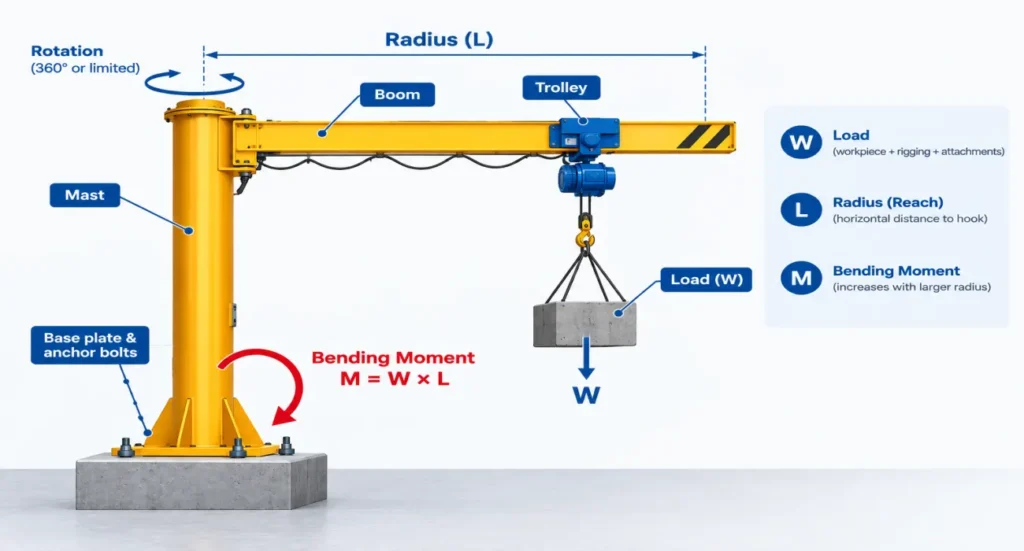
A jib is a cantilever, so the load is multiplied by its lever arm before it reaches the mast. The bending moment is simply load × radius (M = W × L). That is why a catalog rating should always be read together with the radius and rotation it refers to. For a standard trolley-type jib, this is typically the trolley at the outer end of the boom.
The trade-off shows up when the structure is fixed. A Canadian manufacturer notes that on a given design, lifting capacity often decreases as reach increases. If a quote lists "2 t" but no radius, you don't yet know what you are buying.
Many manufacturers build hoist weight and impact into the rated capacity
Many manufacturers build hoist weight and impact allowances into the rated capacity, so stacking your own margins on top can oversize the crane. Published design bases from several North American makers, including Gorbel, USA Jib Cranes e EC&MW, allow 15% of rated capacity for hoist and trolley weight and a further 25% for impact, which gives the full rated capacity as usable load. Spanco applies a higher 50% impact factor for vacuum or magnet applications. Jib Crane - Specifications, Drawings, Pricing +3
Some guides instead tell buyers to keep the working load to 80–90% of the rating, or to multiply the heaviest load by 1.25. Those conventions differ between manufacturers, and applied on top of a rating that already includes allowances they double-count the margin.
Region matters too. The 15%/25% figures come from the North American CMAA 74 / ASME B30 framework. European FEM/ISO-based designs use their own load-combination and dynamic-factor rules, so ask which design basis the quote follows. Put three questions to the supplier before adding any margin of your own:
- Does the rated capacity include the hoist and trolley?
- What impact factor is used?
- Is a magnet or vacuum lifter allowed at the full rating?
If the rating excludes the hoist, subtract its weight from the capacity you can actually use.
How to Choose Jib Crane Capacity: Four Inputs in Order
Step 1: Size from total suspended load, not workpiece weight
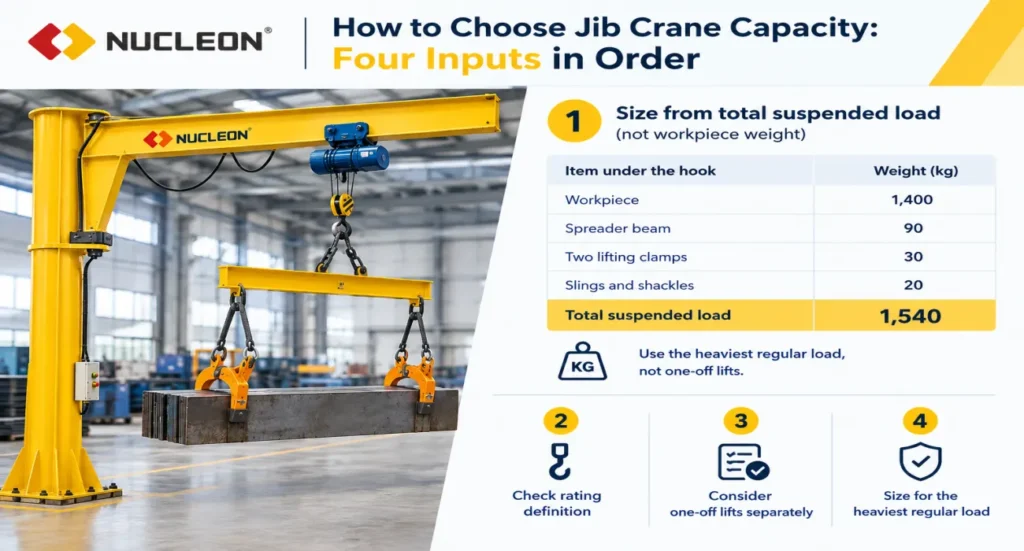
Total suspended load is everything hanging from the hook: the workpiece plus every piece of lifting gear beneath it. Here is an illustrative calculation with hypothetical figures, not a customer case:
| Item under the hook | Weight (kg) |
| Workpiece | 1,400 |
| Spreader beam | 90 |
| Two lifting clamps | 30 |
| Slings and shackles | 20 |
| Total suspended load | 1,540 |
A "1.4-ton part" therefore already exceeds a 1-ton class and points to the next standard rating up. Whether the hoist itself also counts depends on the rating definition above.
Size for the heaviest regular load and treat one-off lifts separately. One export supplier makes the same distinction: start from the heaviest single item lifted regularly, not the one-off job. If a one-off exceeds it, rigging a temporary lift is usually cheaper than sizing the permanent crane for it.
Step 2: Fix the radius before you fix the tonnage
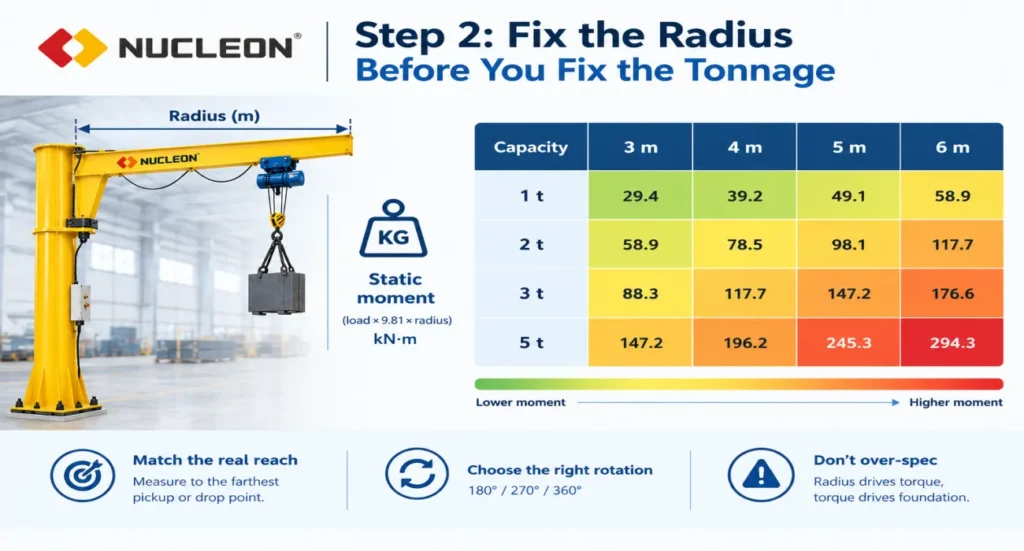
Every extra meter of reach multiplies the load's pull on the mast, so specify only the radius your farthest pickup needs. The table shows the static moment from the hook load alone (load × 9.81 × radius), in kN·m. It excludes the boom's own weight, the hoist and impact.
| Capacidade | 3 m | 4 m | 5 m | 6 m |
| 1 t | 29.4 | 39.2 | 49.1 | 58.9 |
| 2 t | 58.9 | 78.5 | 98.1 | 117.7 |
| 3 t | 88.3 | 117.7 | 147.2 | 176.6 |
| 5 t | 147.2 | 196.2 | 245.3 | 294.3 |
Read across the rows and reach and tonnage trade one-for-one. A 1 t jib at 6 m carries the same static moment as a 2 t jib at 3 m, and a 2 t jib at 6 m matches a 3 t jib at 4 m. Two 2-ton jib cranes are not the same machine: the one reaching 6 m places roughly twice the bending moment on its mast and foundation as the one reaching 3 m.
That moment lands on the mast section, base plate, anchor bolts, foundation and slewing bearing. Measure from the mast centerline to the farthest pickup or drop position, then add a small allowance for hook swing and slings. A common trap is specifying radius for the whole bay: radius drives torque, and torque drives pillar size and foundation depth. Rotation works the same way. Choose 180°, 270° or 360° to match the real working envelope, because unused swing is money spent for nothing.
Step 3: Match duty class to lifts per hour, not a flat percentage margin
Duty class, not extra tonnage, is the right way to account for frequent lifting. A jib that lifts near its rating every few minutes wears its slewing bearing, hoist gearing and structural joints far faster than one lifting occasionally. Spanco, for example, designs its wall-mounted jib cranes for CMAA 74 Class C moderate service, with loads averaging 50% of rated capacity and five to ten lifts per hour. A production cell that exceeds that pattern needs a higher class or a different crane, not simply a bigger number on the nameplate.
Give the supplier lifts per hour, hours per shift, typical and maximum load, and required lifting speed. Then ask which classification (ISO 4301-1, FEM 1.001 or a CMAA 74 class) the crane and hoist are designed to. Flat percentage rules vary from guide to guide. A stated duty class can be audited; a percentage cannot. For the hoist itself, see wire rope hoist vs chain hoist.
Step 4: Confirm the mounting and foundation can carry the moment
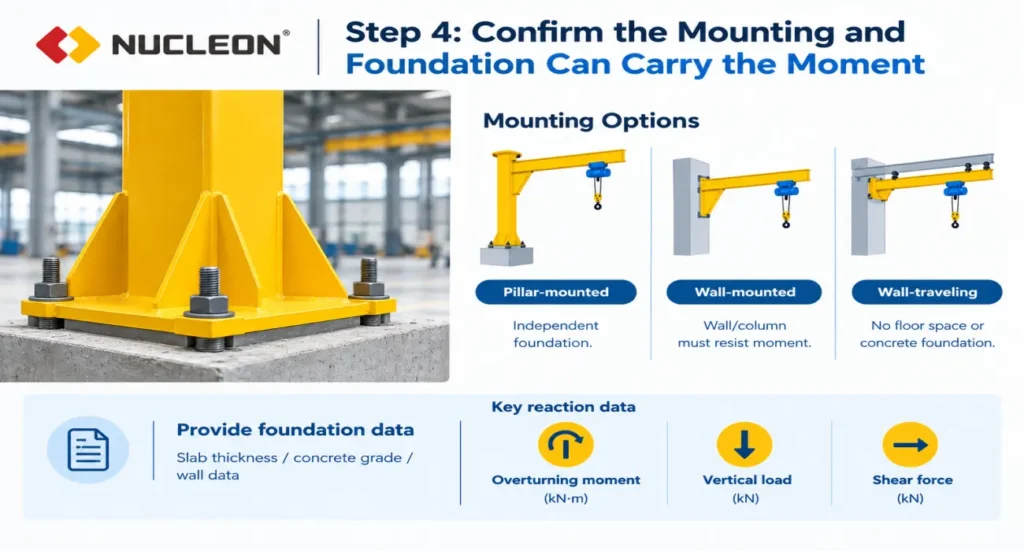
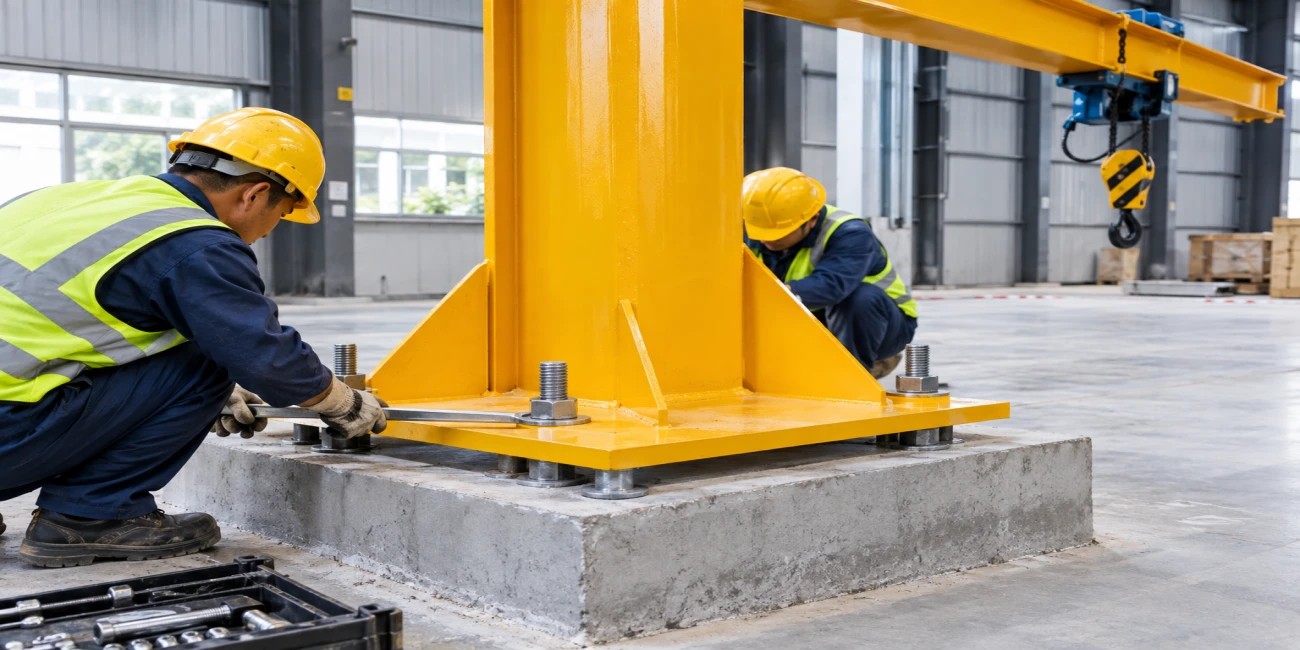
The mounting structure sets the practical capacity ceiling, because a jib crane is only as strong as the floor, wall or column holding it. The foundation is designed to the overturning moment, not to the tonnage on the nameplate, which is why the table above matters. Each mounting style loads the building differently:
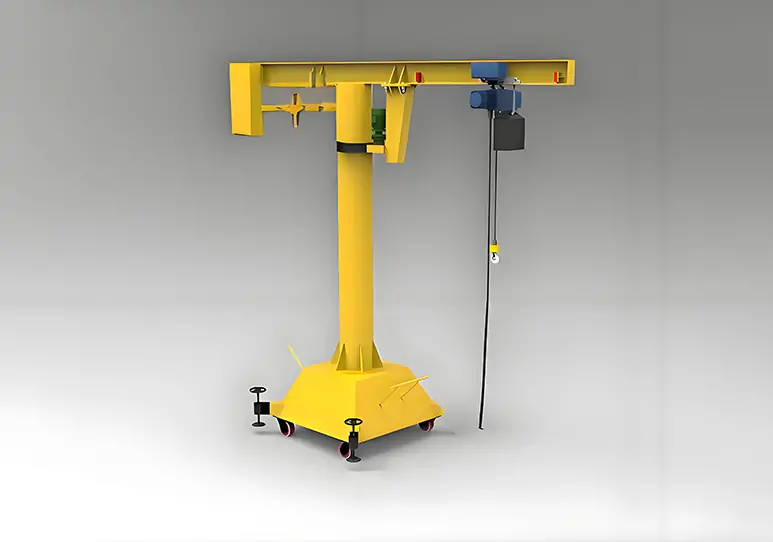
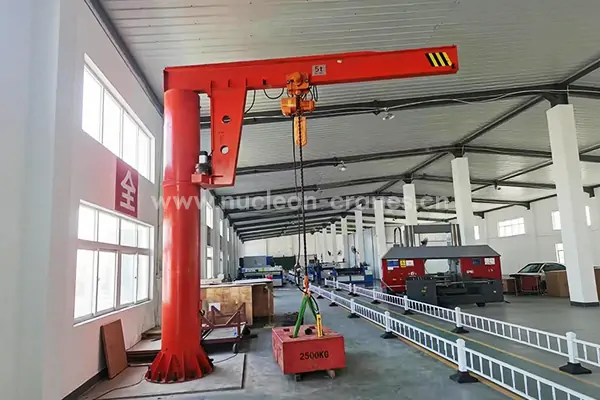
- Pillar-mounted: independent of the building but needs its own foundation. It works in almost any building.
- Wall-mounted: the wall or column must resist the reaction moment. A supplier needs a wall cross-section and column size before quoting, and brick or lightweight panel walls make pillar mounting the safe default.
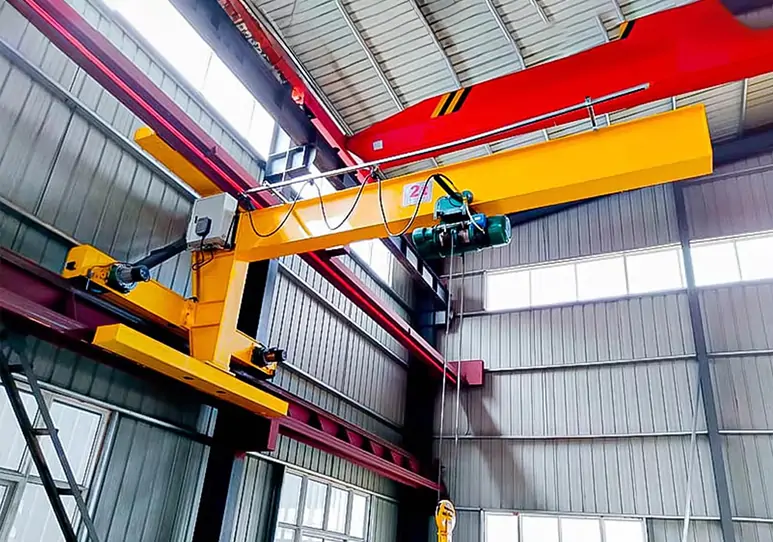
- Wall-traveling: Nucleon's wall-traveling model needs no floor space or concrete foundations and runs on an elevated rail, so the rail and its brackets then carry all the loads. Guindaste de Núcleos
Supply slab thickness, concrete grade or wall data with the enquiry, and ask the supplier for the foundation reaction data: overturning moment, vertical load and shear at the base. Capacity that looks fine on paper can fail on a slab that was never checked.
Typical Jib Crane Capacity Ranges and the Cost of Getting Them Wrong
Published capacity bands by mounting type
Freestanding pillar jibs cover the widest capacity range; wall-mounted and articulating types are generally limited to lighter loads. The bands below are typical published values and vary by manufacturer.
| Jib crane type | Commonly published capacity | Typical use |
| Pillar / freestanding | 0.125–5 t; heavy custom designs higher | Machine loading, fabrication, maintenance bays |
| Montado na parede | ~1–2 t practical (up to ~2.3 t / 5,000 lb) | Workstations where floor space is tight |
| Mast-type (floor + ceiling support) | Up to ~2.3 t (5,000 lb) | Buildings with strong overhead steel |
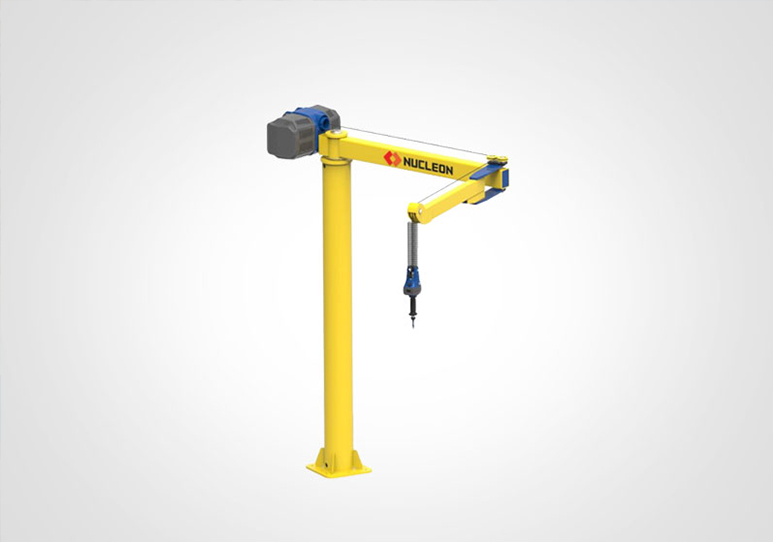
| Articular | ~70–900 kg (150–2,000 lb) | Precision workstations, obstacles in the swing |
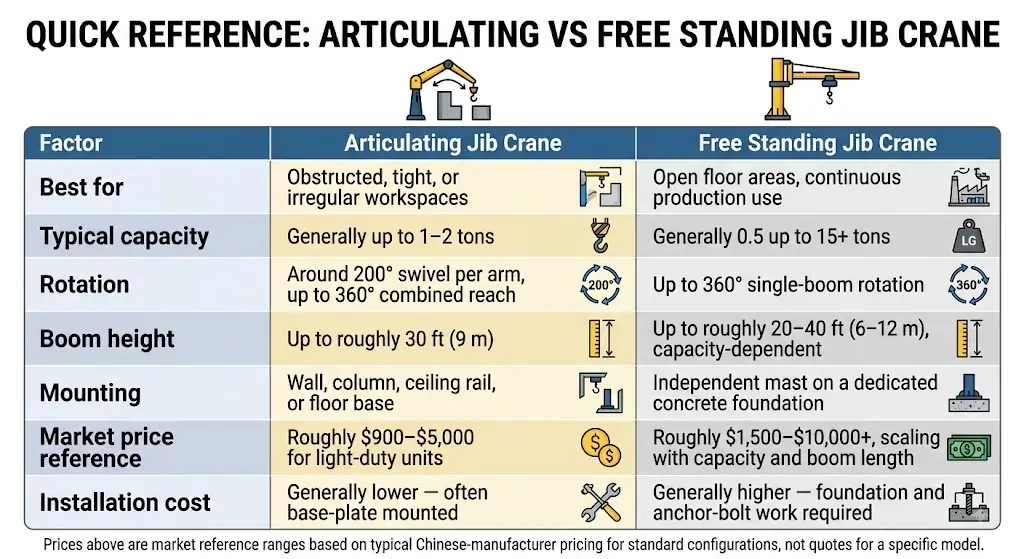
One export supplier lists 0.125–5 t for pillar mounting and about 1–2 t as practical for wall-mounted units. The Canadian manufacturer cited above lists wall-mounted and mast-type units up to 5,000 lb and articulating units from 150 to 2,000 lb. Nucleon's own pages describe cantilever jib cranes for capacities under 10 tons and wall-traveling models up to 15 tons, customized by span, rotation and capacity. The spread between suppliers is itself a warning: never treat a capacity band as a universal limit, and confirm it model by model. Explore the slewing jib crane, wall traveling jib crane e mobile portable jib crane ranges, or read our articulating vs free standing jib crane comparison.
For most workshop loads under 2 tons, a pillar or wall-mounted jib is enough. Above that, verify the foundation and compare an overhead or gantry crane.
Buying 5 tons for a 2-ton job adds cost in the mast, base plate and foundation
The reasoning "if I need 2 t, I'll just buy 5 t" feels safe, but a larger rating enlarges far more than the hoist. It usually means a bigger mast or column, base plate, anchor bolts, foundation, slewing components and trolley. Installation and civil work grow with it. In the moment table, a 5 t jib at 3 m already carries about 2.5 times the static moment of a 2 t jib at the same reach.
One export supplier puts total installed cost at roughly 20–50% above the equipment price, with foundation concrete the part buyers underestimate most. Treat that as one supplier's estimate rather than a rule.
The opposite error has its own cost: an undersized jib overloads, deflects and wears early. The fix is neither bigger nor smaller. Size to the suspended load, the radius, the duty class and the foundation you can actually provide. If a heavier job is genuinely planned, say so in the enquiry so the foundation is engineered once instead of retrofitted.
How to Specify Jib Crane Capacity to a Supplier
Send seven inputs so quotes are comparable
A quote is only comparable when every supplier prices the same load, radius, duty class and mounting. Send these seven items:
- Heaviest regular suspended load (kg) and heaviest occasional load
- Lifting attachments: hook, spreader beam, clamps, magnet or vacuum lifter
- Jib radius (m) from the mast centerline to the farthest hook position
- Rotation angle: 180°, 270° or 360°
- Lifting height and required height under boom
- Duty: lifts per hour, hours per shift, typical vs. maximum load
- Mounting type with slab, wall or column data, plus power supply and environment
Each item removes a guess. Attachments decide the impact allowance, radius and rotation decide the moment, and duty decides the hoist and bearing class. Slab or wall data decides whether the crane can be installed at all. Pair the jib with the right talha eléctrica de cabo de aço ou talha elétrica de corrente once these are settled.
Need a second opinion on sizing? Send the seven items to Nucleon's engineering team: [WhatsApp link] · [Email link] · [Get a Quote form]
Compare two quotes on the same basis before comparing price
Two quotes with different capacity definitions, radii or foundation scope are not price-comparable. Before you compare price, check that each quote states:
- whether the rated capacity includes hoist, trolley and impact
- the same radius and rotation angle
- the same hoist type, lifting speed and duty classification
- whether the foundation drawing, reaction data and anchor bolts are included, and who supplies them
- the load test certificate and applicable standards (for example CMAA 74 or ASME B30.11 where the market requires them)
A lower headline price often reflects a shorter radius, a smaller duty class or an excluded foundation, all of which cost more later.
Conclusão
The right jib crane capacity is not the largest capacity you can buy. It is the capacity that matches the actual suspended load, the required reach, the duty cycle and the structure that will carry it. Before you accept any figure, do three things:
- Add up the total suspended load, including all lifting gear.
- Confirm the radius and what the rated capacity includes.
- State the duty class and mounting data in the enquiry.
If you want the numbers checked, send your load, radius and site details to Nucleon's engineers and we will confirm the capacity and configuration.

Especialista de Equipamento
Gestor de Negócios de Gruas com vasta experiência em gestão de projetos de elevação pesada e supervisão operacional. Histórico comprovado na promoção do crescimento da receita e na garantia da conformidade com as normas de segurança.
FAQ
How much weight can a jib crane lift?
It depends on type and reach, from under 100 kg to about 15 tons on heavy models. Published ranges run from 250 lb up to 15 tons. Always confirm the rating at your required radius.
What safety factor should I apply to jib crane capacity?
There is no single universal factor, so check what the rating already includes. Many North American designs allow 15% for hoist weight and 25% for impact inside the rated capacity. Ask the supplier before adding your own margin, and state magnet or vacuum lifting explicitly because impact allowances are higher for those.
Does a longer jib reduce capacity?
A jib designed for a given span keeps its stated rating, but the bending moment on the mast and foundation rises with reach. On a fixed structure, more reach generally means less capacity. Never lengthen an existing jib without engineering review.
Is it worth buying a higher-capacity jib crane just in case?
Usually not. Extra capacity enlarges the mast, base plate, anchors, foundation and slewing parts, and installed cost rises with them. Buy the capacity your suspended load, radius and duty class require. If a heavier job is genuinely planned, say so in the enquiry so the foundation is engineered once.

 English
  العربية
  Español
  Français
  Português
  Русский