

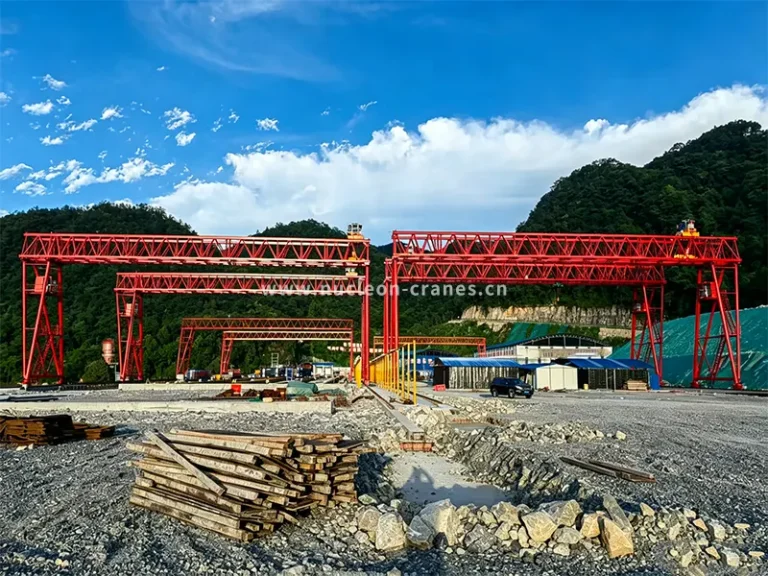
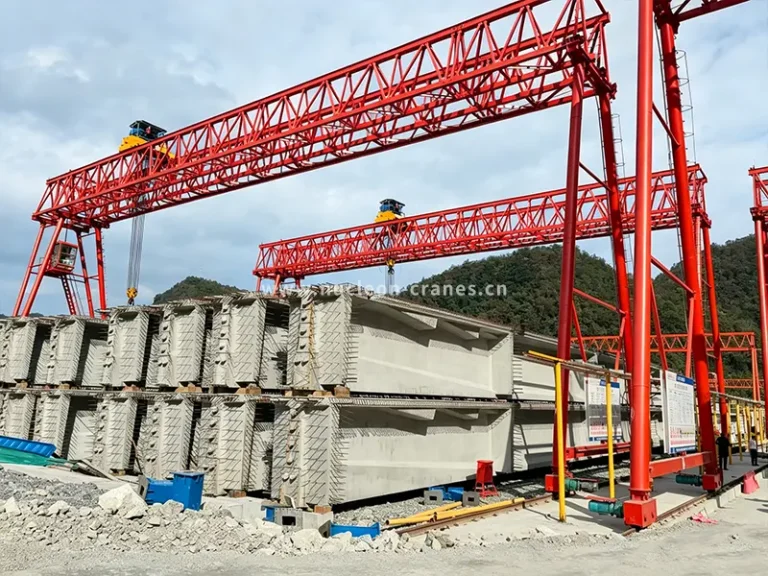
In short: Nucleão designed and manufactured 20-ton truss girder gantry cranes for a precast concrete beam yard in Chile. The steel structures were fabricated and painted at our factory, shipped by truck in sections, and assembled on site on ground rails. Several cranes of different spans now work side by side, so separate production and storage bays can operate at the same time. The truss girder design keeps structural weight low and makes long-distance transport and on-site assembly practical.
Visão geral do projeto
| Item | Details |
| Equipment | Truss girder gantry crane |
| Rated capacity | 20 tons |
| Quantity | Multiple units, different spans |
| Destination | Chile |
| Aplicação | Precast concrete beam yard |
| Estrutura | Truss main girder, braced legs, ground-rail travel |
| Entrega | Factory-built sections, trucked for export, assembled on site |
Typical Technical Specifications
| Parâmetro | Typical configuration for this crane class |
| Capacidade nominal de elevação | 20 t |
| Span | 20–35 m (varies by bay) |
| Altura de elevação | 6–10 m |
| Hoist | Electric wire rope hoist carrinho |
| Velocidade de elevação | Dual speed, approx. 0.8–5 m/min |
| Trolley travel speed | Approx. 20 m/min |
| Gantry travel speed | Approx. 20–30 m/min |
| Classe de serviço | A3–A5 (ISO 4301 / FEM) |
| Controlo | Pendant, wireless remote or cabin |
| Alimentação eléctrica | 380 V, 3-phase, 50 Hz |
| Temperatura de funcionamento | −20 °C to +40 °C |
| Structural steel | Q235B / Q355B |
| Surface treatment | Shot blasting, epoxy primer, polyurethane topcoat |
| Protective features | Overload limiter, limit switches, emergency stop, anti-collision on request |
Contexto do Projeto
A precast concrete beam yard is a high-turnover site. Reinforcement cages, formwork, and precast components move between casting, curing and storage zones many times a week. The site is open and outdoors, has no building to hang a runway from, and needs several bays working in parallel.
For this reason, the customer needed:
- Gantry cranes rather than overhead cranes, since there is no building structure to carry runway beams
- 20-ton capacity to cover components, formwork and rigging handled in the yard
- Wide spans to cover the production and storage areas with as few support legs on the ground as possible
- A design that can be shipped and assembled far from the factory
Why a Truss Girder Design
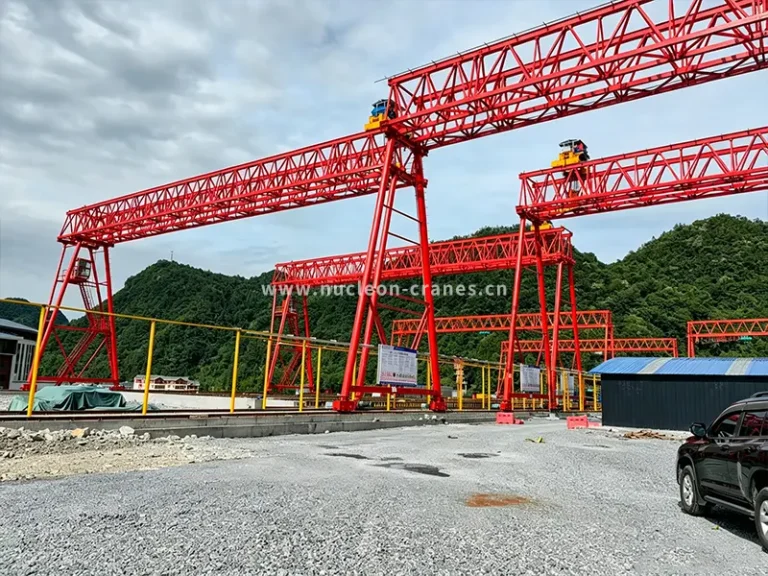
Truss girder construction is widely used for outdoor gantry cranes over long spans:
- Lower steel weight. A lattice girder uses less steel than a solid-web girder of the same span. That reduces material cost and the load transferred to rails and foundations.
- Open structure for wind. Wind passes through the lattice, so the crane presents less surface area than a solid box girder. This matters for tall cranes in exposed yards.
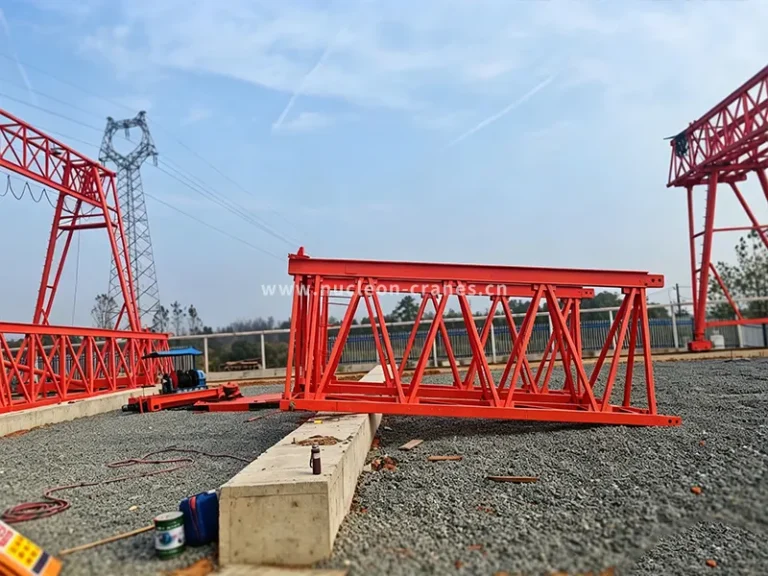
- Sectional shipping. Long girders can be built in sections that fit on standard trailers and are bolted together at the destination.
- Easier inspection. Members and joints are visible from the walkway, which helps routine checks.
For workshops, or duties that need a smoother sealed structure, a box girder gantry crane may be the better fit. Nucleon supplies both types, and the right choice depends on span, duty class, site conditions and budget.
Crane Structure and Design Features
Each crane consists of the following main parts:
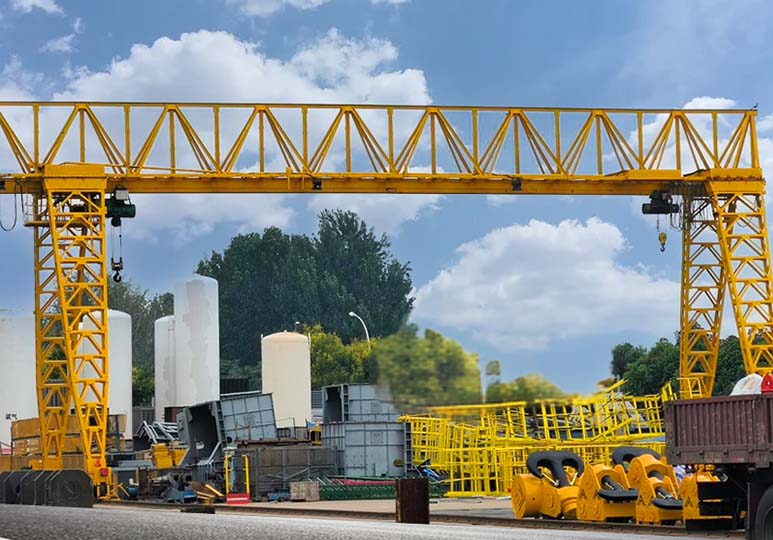
- Truss main girder. A lattice of steel chords and diagonal members, painted red for visibility and corrosion protection.
- Supporting legs with cross bracing. Braced legs carry the girder and keep the crane stable during travel and lifting.
- End carriages and travel drives. These run on ground rails and move the crane along the yard.
- Electric hoist trolley. It travels along the girder and lifts the load.
- Electrical system. Control panel, cable system, limit switches and protective devices.
- Access. Ladders and walkways for maintenance and inspection.
Since the yard is outdoors, rail sweeps, anchor devices and rain protection for electrical parts are part of the standard design considerations for this type of installation.
Manufacturing and Quality Checks
The truss girder sections, legs and end carriages were fabricated at the Nucleon factory. Typical quality steps for this crane class include:
- Material checks on incoming steel plate and sections
- Cutting, welding and dimensional checks on girder chords and diagonals
- Shot blasting followed by primer and topcoat painting
- Pre-assembly of key joints to confirm hole alignment and fit
- Trial run of hoist, trolley and travel mechanisms before dismantling
Pre-assembly at the factory reduces the risk of joint mismatch on site, where fixing errors is slow and expensive.
Export Packaging and Loading
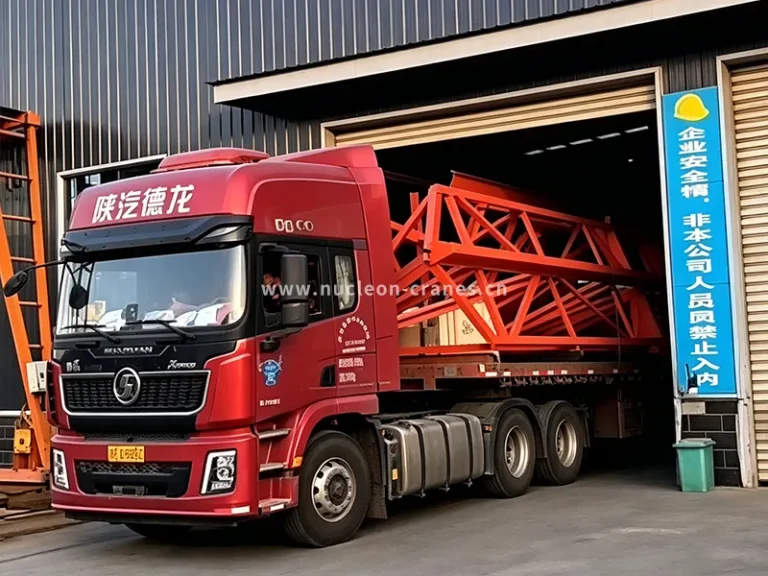
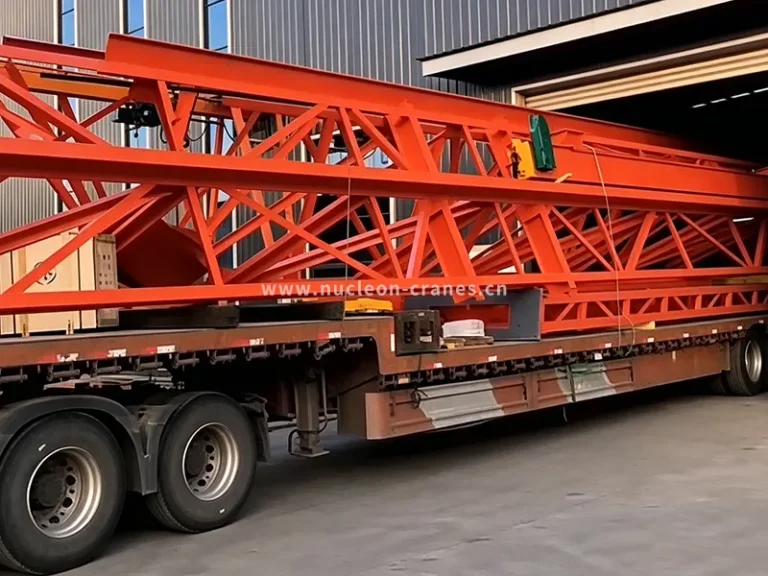
The truss girder sections were loaded onto flatbed trailers for transport to port. Each section was positioned on the trailer bed and secured for the journey. The trolley, electrical parts and smaller components were packed separately in crates.
Splitting each crane into sections keeps every load within road transport limits and reduces handling risks on arrival. Numbering the sections and matching them to the assembly drawings also helps the site team put each crane together in the right order.
On-Site Assembly in Chile
On site, the ground rails were laid on prepared foundations, and the truss girders were assembled at ground level near the rail line before being installed on the supporting legs. A typical assembly sequence is:
- Check rail alignment, gauge and foundation level
- Assemble legs and end carriages on the rails
- Assemble the girder sections at ground level and bolt the joints
- Lift the girder onto the legs and fix it
- Install the hoist trolley, cables and electrical parts
- Test each motion without load, then with rated load, before handover
Assembling the girder at ground level makes joint alignment and bolt tightening easier to check than working at height, and it limits how much heavy lifting equipment is needed on site.
Cranes in Operation
Once in service, the gantry cranes work the precast yard together. Cranes of different spans cover the casting bays and the storage area, moving concrete components between them. Because each bay has its own crane, one crane's downtime or maintenance does not stop the whole yard.
What Buyers Can Learn from This Project
- Choose girder type by site conditions. Open outdoor yards and wide spans often favor truss girders.
- Ask for sectional design if the site is remote, or transport size is limited.
- Size the crane for the total load, meaning the component plus spreader, rigging and any lifting frame, and check that total against the rated capacity.
- Match duty class to how often the crane works. A crane lifting several times an hour needs a different duty class from one used occasionally.
- Plan foundations and rails early. Rail level and foundation quality directly affect travel smoothness and wheel wear.
FAQ
What is a truss girder gantry crane?
It is a gantry crane whose main girder is built as a lattice of steel members instead of a solid box section. It is lighter for its span and widely used in outdoor yards, precast plants and construction sites.
Can a 20-ton gantry crane be used in a precast concrete beam yard?
Yes, for components within its 20-ton rated load. Check each component's weight, including spreaders and rigging, against the rated capacity before choosing a crane.
What span can a 20-ton truss gantry crane have?
Typical spans for this class run from about 20 m to 35 m. The actual span is set by the layout of your yard and the crane's duty.
How is a truss girder gantry crane shipped overseas?
Usually in sections by truck to port, then by sea, and assembled on site. The exact shipping method depends on dimensions and quantity.
Truss girder or box girder gantry crane: which should I choose?
It depends on span, duty, site conditions and budget. Send us your requirements and we will recommend a suitable structure.
Get a Gantry Crane Quotation
Tell us your load weight, span, lifting height, rail length and location, and our engineers will recommend a suitable truss or box girder gantry crane. Contact Nucleon for a quotation.

Especialista de Equipamento
Gestor de Negócios de Gruas com vasta experiência em gestão de projetos de elevação pesada e supervisão operacional. Histórico comprovado na promoção do crescimento da receita e na garantia da conformidade com as normas de segurança.
Relevant Cases
- Projeto de guindaste pórtico de viga dupla de 50 toneladas para pátio de tubos de aço em Botswana
- Guindaste pórtico monoviga tipo L de 15 toneladas exportado para Omã
- Duas pontes rolantes de treliça de 10 toneladas foram exportadas para a Bolívia.
- Instalação de guindaste elétrico europeu de 10 toneladas em armazém logístico na Itália | Estudo de caso
- Elevador marítimo de 50 toneladas instalado em marina de iates na Croácia.

 English
  العربية
  Español
  Français
  Português
  Русский