
Choosing the wrong marine travel lift is an expensive mistake. Too small, and you turn away high-value vessels. Too large, and you've overspent on equipment your dock may not even support structurally. Most marina managers get this decision wrong not because they lack information, but because they're working from the wrong starting point.
The right starting point is your boat mix—not a manufacturer's brochure. Before you look at a single spec sheet, you need a clear picture of the heaviest, widest, and longest vessels you intend to handle. Everything else—capacity, span width, wheelbase, ground bearing pressure—flows from that number.
This marine travel lift buying guide walks you through every critical decision point: how to size a travel lift for your marina, what specifications actually matter, which ground conditions can make or break your investment, and what realistic total costs look like. Whether you're building a new marina from scratch or replacing aging travel lift marina equipment, the framework here will give you a defensible decision.
By the end, you'll know exactly what tonnage travel lift you need, how to evaluate competing models, and what questions to ask any supplier before signing a purchase order.
Table of Contents
1. Start With Your Boat Mix, Not the Machine
What "Capacity" Actually Means—and What It Doesn't
The rated lifting capacity of a marina travel lift is its safe working load (SWL) under standard test conditions. What it does not account for is dynamic loading from water drainage, uneven sling distribution, or vessels with concentrated weight aft. Most equipment engineers apply a practical working rule: size your lift to handle the heaviest vessel in your fleet at no more than 80–85% of rated capacity.
For a marina regularly servicing 50-foot sailing yachts displacing around 12–15 tonnes, a 30-tonne travel lift looks adequate on paper. In practice, a 40-tonne unit gives you the safety margin and the operational flexibility to take on charter vessels and sportfishers without scheduling conflicts.
How to Build Your Vessel Profile
Pull your last three years of haul-out records and map the following for your 10 heaviest vessels: displacement (not LOA), beam at the waterline, and keel depth. If you don't have this data, contact your local boat registration authority or marine survey association—most regions maintain this by vessel class.
| Vessel Type | Typical Displacement | Typical Beam | Min. Lift Capacity |
| 40–45 ft sailing yacht | 8–12 t | 4.0–4.5 m | 25 t |
| 50–55 ft motor cruiser | 15–22 t | 4.5–5.5 m | 40 t |
| 60 ft sportfisher | 25–35 t | 5.5–6.5 m | 50 t |
| 70–80 ft superyacht | 40–80 t | 6.0–8.0 m | 100 t |
Source: vessel displacement data cross-referenced with Lloyd's Register Small Craft definitions. Capacity recommendations apply a 20% safety buffer above maximum listed displacement.
Planning for Fleet Growth
A marina travel lift has a working life of 20–25 years with proper maintenance. The vessels using your marina in year 15 will almost certainly be larger and heavier than today's fleet—average LOA trends in recreational boating have grown roughly 2–3 feet per decade across North America and Europe (ICOMIA World Recreational Boating Statistics, 2022). Build that growth assumption into your sizing decision.
2. Span Width and Wheelbase: The Two Dimensions Most Buyers Get Wrong
Travel Lift Span Width Requirements
Span width determines which vessels you can physically lift. The rule is simple: your lift's span must exceed the widest beam in your fleet by a minimum of 0.6–0.8 m on each side to allow safe sling placement and operator clearance. A vessel with a 5.5 m beam needs a lift spanning at least 6.7–7.1 m between uprights.
Where buyers go wrong is confusing span width with track gauge. Track gauge is the distance between the travel lift's rails. Span width is the clearance between structural uprights at the point of sling contact. These can differ by 0.3–0.6 m depending on frame design. Always request both dimensions from your supplier, and verify against your widest vessel.
Wheelbase and Turning Radius
Wheelbase—the distance between front and rear axles—directly controls your minimum turning radius and determines whether the machine can navigate your haul-out pit approach without risk to the vessel or the dock structure. A compact 40-tonne lift with a 4.5 m wheelbase can typically turn within a 12–14 m corridor. Longer-wheelbase machines for 100-tonne-plus lifts may require 20 m or more.
If your haul-out pit is a fixed existing structure, model the approach path on paper before purchasing. Several major manufacturers offer simulation drawings upon request.
| Lift Capacity | Typical Span Width | Typical Wheelbase | Approx. Turning Corridor |
| 25 t | 5.5–6.5 m | 3.5–4.0 m | 10–12 m |
| 40 t | 6.5–7.5 m | 4.0–5.0 m | 12–15 m |
| 75 t | 7.5–9.0 m | 5.5–7.0 m | 15–18 m |
| 150 t | 9.0–12.0 m | 7.5–10.0 m | 20–25 m |
Source: aggregated from publicly available specification sheets of Roodberg, Marine Travelift, and Cimolai Technology. Figures represent mid-range configurations; actual dimensions vary by model.
3. Ground Conditions: The Factor That Kills Projects
Marine Travel Lift Ground Conditions and Bearing Pressure
This is the issue that derails more marina equipment projects than any other, and it's almost always discovered too late. A 75-tonne travel lift with a vessel aboard can exert ground bearing pressures of 15–25 tonnes per square metre depending on configuration. Coastal soils—reclaimed land, sandy substrates, estuarine clay—frequently have bearing capacities well below this threshold.
Before finalizing your equipment selection, commission a geotechnical survey of your haul-out area. This is not optional. Ground improvement—driven piles, ground beams, reinforced concrete slabs—can add $50,000–$200,000+ USD to a project, and the right lift specification may need to be revised to match what the ground will actually support.
Some manufacturers offer wide-track configurations or extended outrigger axles that distribute load over a greater footprint and reduce peak ground pressure. Ask specifically for the wheel load data (kN per wheel) and ground contact pressure figures for any machine you're evaluating.
Ramp and Surface Gradients
Most travel lifts operate within a maximum surface gradient of 2–3%. Steeper ramps require hydraulic compensation systems or custom configurations and add cost. If your haul-out ramp exceeds this, raise it explicitly with prospective suppliers and request their engineering assessment in writing.
4. Electric vs. Hydraulic Drive: A Practical Comparison
The electric vs. hydraulic travel lift debate is less about performance and more about total cost of ownership and operational environment. Hydraulic drive systems dominate the market for larger-capacity machines and in environments where initial capital cost is the primary constraint. They are robust, well-understood by most marine equipment technicians, and easier to service in remote locations where specialist technicians are scarce.
Electric drive systems—particularly fully electric battery-powered units that have entered the market since 2020—offer meaningful advantages in operating cost and environmental compliance. Several European marinas operating under port authority environmental regulations have adopted electric travel lifts specifically to reduce hydraulic fluid spill risk and noise during sensitive haul-out periods.
One of the core differentiators in marine travel lifts is the power system—choosing electric or hydraulic will directly impact your operating costs, maintenance complexity, and environmental compliance. This choice deserves deeper examination: 👉[Electric vs. Hydraulic: Which is better for your marina?]
| Factor | Hydraulic Drive | Electric Drive |
| Initial capital cost | Lower | Higher (+15–30%) |
| Fuel/energy cost per lift | Higher | Lower (50–70% savings typical) |
| Maintenance complexity | Moderate | Lower for drivetrain |
| Hydraulic spill risk | Present | Eliminated |
| Cold-weather performance | Fluid management may be needed | Generally unaffected |
| Availability of service techs | Wide | Growing but limited |
| Typical market availability | All capacity ranges | Primarily 40–150 t |
Source: METSTRADE 2023 technical presentations and published case studies from Finnish and Dutch marina operators, 2022–2023.
5. Total Cost of Ownership: What the Purchase Price Doesn't Tell You
What a Marine Travel Lift Actually Costs
When evaluating marine travel lift for sale listings or supplier proposals, the purchase price is only the beginning. Marina operators consistently underestimate three cost categories: site preparation, commissioning, and ongoing maintenance reserves.
A mid-range 40-tonne hydraulic travel lift may carry a purchase price of $180,000–$280,000 USD depending on specification and origin. Add site preparation at $40,000–$120,000, commissioning and operator training at $8,000–$20,000, and annual maintenance at 3–5% of capital cost, and your 10-year total cost of ownership is typically 1.8–2.2x the purchase price.
| Cost Category | 25 t Unit (USD) | 40 t Unit (USD) | 75 t Unit (USD) |
| Equipment purchase | $60,000–90,000 | $90,000–140,000 | $180,000–300,000 |
| Site preparation | $15,000–40,000 | $20,000–60,000 | $40,000–100,000 |
| Annual maintenance | $3,000–5,000 | $4,000–8,000 | $8,000–14,000 |
| Estimated 10-yr TCO | $120,000–190,000 | $160,000–276,000 | $300,000–550,000 |
Source: Indicative ranges from marina development case studies and supplier cost guidance, North American and Western European markets, 2022–2024.
Useful Life and Residual Value
A well-maintained travel lift from a reputable manufacturer has a structural working life of 20–25 years. Hydraulic and electrical components will require major overhaul or replacement at the 10–15 year mark. Factor a mid-life refurbishment budget of 20–30% of original equipment cost when building your business case.
6. Supplier Selection: Questions That Separate Good Vendors from Great Ones
The marine travel lift market has a small number of established global manufacturers and a growing field of lower-cost alternatives. Price variation between equivalent-capacity machines can exceed 40–50%, reflecting differences in steel specification, hydraulic component sourcing, control system quality, and after-sales support.
Ask every prospective supplier these questions before issuing a purchase order:
- What is the steel grade specification for the main frame and uprights, and can you provide mill certificates?
- Which hydraulic component brands are used (Bosch Rexroth, Parker, Danfoss are industry-standard references)?
- What is your nearest authorized service location, and what is your guaranteed response time for breakdown callouts?
- Can you provide contact details for three marina operators currently using this model?
- What is your standard warranty period, and what does it exclude?
Reference checks are not optional. Call those marinas. Ask specifically about parts availability and response time for non-warranty breakdowns—that's where vendor quality differences become concrete.
Summary:
Your Marine Travel Lift Selection Checklist
Choosing the right marina travel lift comes down to five core decisions made in the right order:
- Define your vessel profile first—heaviest displacement, maximum beam, deepest keel in your target fleet.
- Size for margin, not minimum—operate at 80–85% of rated SWL maximum, and plan for 15-year fleet growth.
- Verify span width against your widest vessel, then check wheelbase against your actual haul-out corridor geometry.
- Commission a geotechnical survey before finalizing specification—ground conditions are non-negotiable.
- Evaluate total cost of ownership over 10 years, not purchase price alone.
If you're early in the process, the most useful next step is pulling your haul-out records and building that vessel profile. Everything else can be refined from there.

Equipment Specialist
Accomplished Crane Business Manager with extensive experience in heavy lift project management and operational oversight. Proven track record of driving revenue growth and ensuring safety compliance.
Frequently Asked Questions
What is a marine travel lift, and how does it work?
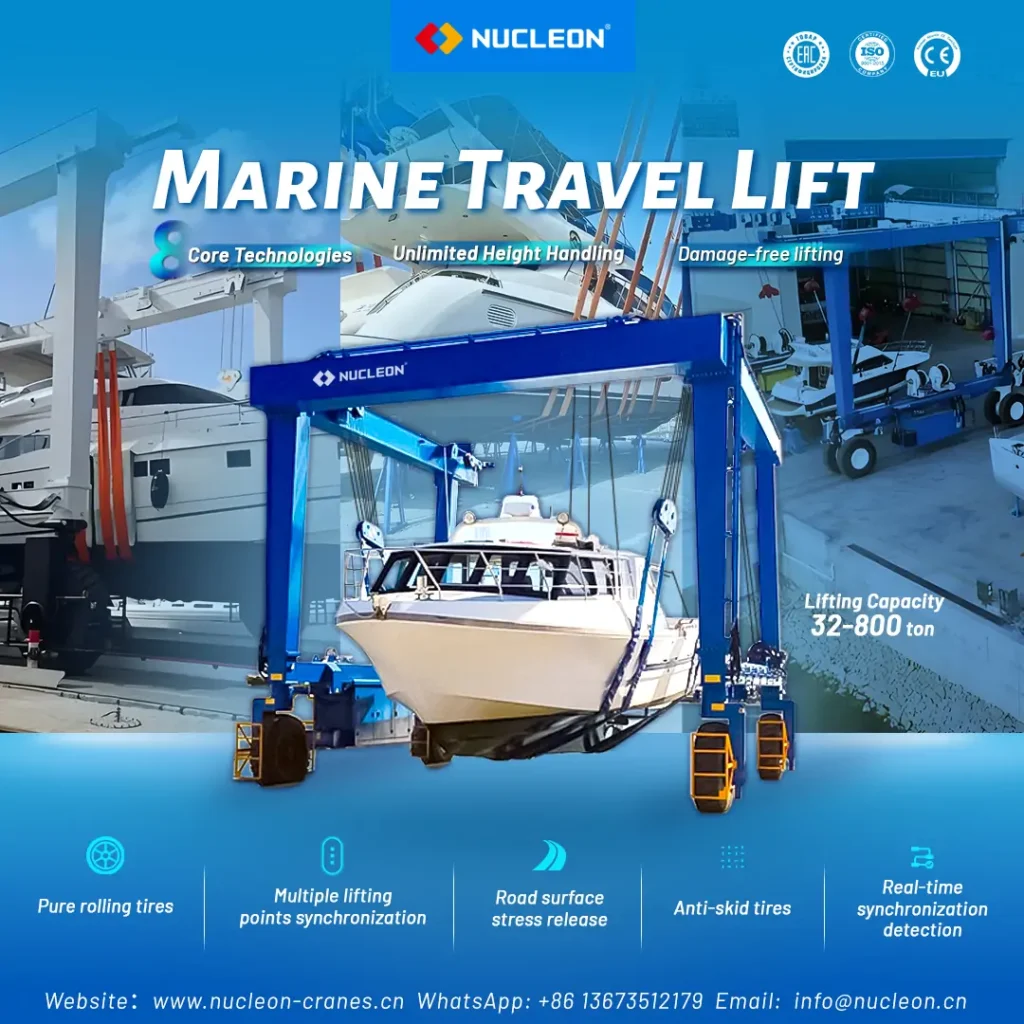
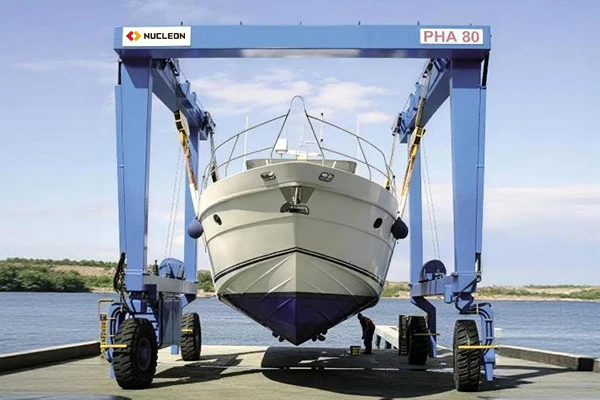
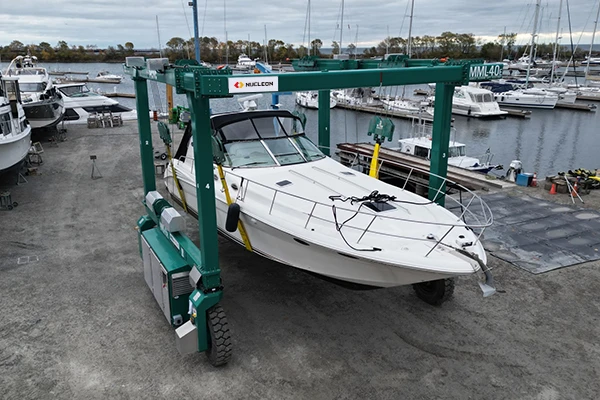
A marine travel lift (also called a boat travel lift or marina travel lift) is a self-propelled portal crane designed to move between the water and the boatyard. It straddles the vessel with two sets of fabric slings suspended from adjustable hoist beams. The operator lowers the slings, positions them at designated hull support points, raises the vessel clear of the water, then drives the lift—with the boat suspended—to the storage or service area. The machine runs on rubber tyres, allowing it to navigate paved marina surfaces without fixed rail infrastructure. Lift capacities range from roughly 15 tonnes for small recreational craft up to 1,000 tonnes for commercial and naval vessels.
What size marine travel lift do I need for my marina?
The answer depends on your heaviest and widest vessels, not your average ones. As a starting point: identify the single heaviest vessel (by displacement, not length) you expect to haul regularly, then select a lift rated at least 20% above that figure. Beam drives your span width requirement—your lift must clear the widest vessel by at least 0.6 m per side for safe sling placement. Many marina operators find a 40-tonne machine covers the recreational and light charter market up to around 55 feet; a 75-tonne unit opens up larger sportfishers and sailing yachts to approximately 70 feet.
How much does a marine travel lift cost?
Purchase price for a mid-range 40-tonne hydraulic travel lift typically falls in the $90,000–$140,000 USD range (2023–2024 market pricing). Smaller 25-tonne units can start around $60,000; larger 75-tonne machines typically run $160,000–$350,000. These figures do not include site preparation, which can add $20,000–$100,000 depending on ground conditions and infrastructure requirements. Electric-drive models carry a 15–30% premium over comparable hydraulic units but offer lower operating costs over time. Always request a total installed cost estimate from your supplier, not just equipment price.
Can a travel lift damage my boat?
A correctly operated travel lift with properly positioned slings and experienced operators poses minimal risk to the vessel. The most common causes of hull damage are incorrect sling placement (contact with through-hull fittings, rudder components, or keels), overloading beyond rated capacity, and sudden stops during travel. Marinas should establish documented haul-out procedures, require formal operator training, and maintain sling inspection protocols. Slings should be inspected before each use and replaced at any sign of wear, fraying, or contamination.
How long does a marine travel lift last, and what maintenance does it require?
A well-maintained travel lift from a reputable manufacturer has a structural working life of 20–25 years. Rubber tyres typically require replacement every 5–8 years. Hydraulic systems need fluid analysis and filter replacement annually; hydraulic cylinders and pumps typically require major service at 10–15 years. Wire rope or chain hoist systems should be inspected per EN 13157 (Europe) or ASME B30 (North America) and replaced on a schedule based on load cycles. Budget 3–5% of original equipment cost annually for planned maintenance to avoid reactive repair costs.


 English
  العربية
  Español
  Français
  Português
  Русский