

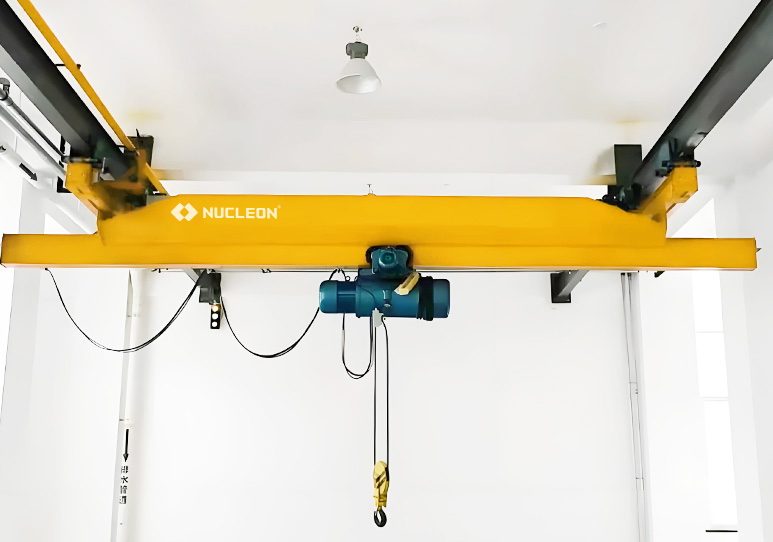
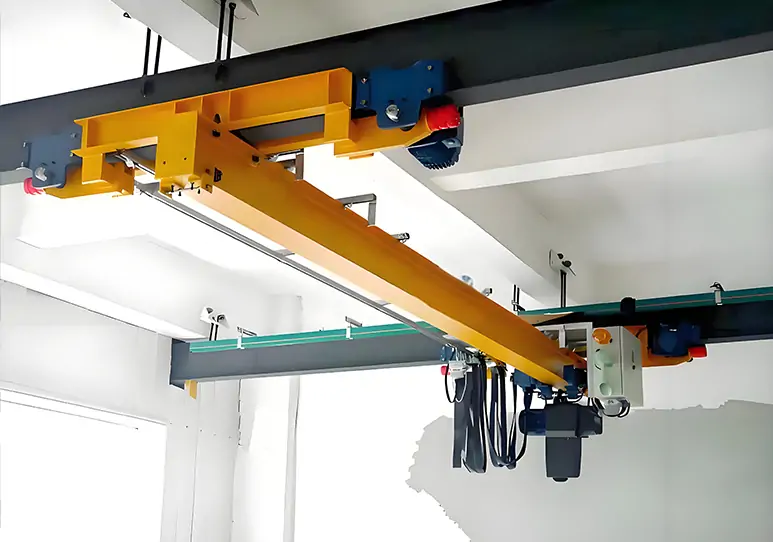
A ceiling mounted bridge crane is an overhead lifting system where the runway rails attach directly to the building's existing roof structure — no floor columns, no freestanding legs. The bridge beam spans between those rails, and a hoist trolley travels the full length of the bridge, giving rectangular coverage across the entire work area beneath. Market reference pricing from Chinese manufacturers runs from roughly $4,000 for a 1 t single girder unit at 8 m span up to $45,000+ for a 20 t double girder system at 30 m span. If your facility has adequate overhead structure, a ceiling mounted bridge crane almost always delivers more usable floor area and hook height than a freestanding alternative — but the building assessment and installation boundary conditions determine whether that promise holds in practice.
This guide gives purchasing managers and equipment engineers the full picture: configuration comparison, specification parameters, real installation boundaries, and a direct path to factory pricing.
Table of Contents
Quick-Reference: Ceiling Mounted Bridge Crane Configurations & Price Ranges
| Configuration | Capacity Range | Typical Span | Duty Class (FEM) | Market Price Reference |
| Single Girder — Light Duty | 0.5 t – 5 t | 6 m – 20 m | M3 – M4 | $4,000 – $14,000 |
| Single Girder — Medium Duty | 5 t – 10 t | 10 m – 28 m | M4 – M5 | $10,000 – $25,000 |
| Double Girder — Heavy Duty | 10 t – 20 t+ | 15 m – 35 m | M5 – M6 | $19,000 – $45,000+ |
| European-Style Low-Headroom | 1 t – 10 t | 6 m – 25 m | M4 – M5 | $7,000 – $35,000 |
One-line decision rule: Single girder covers the majority of manufacturing and warehousing applications under 10 t. Move to double girder when your span exceeds 22 m, your capacity exceeds 10 t, or your duty cycle demands M5+ classification — the structural and cost premium is substantial, but so is the service life difference.
Single Girder vs. Double Girder: The Configuration Decision That Drives Everything Else
Single Girder: Maximum Hook Height, Minimum Structural Load
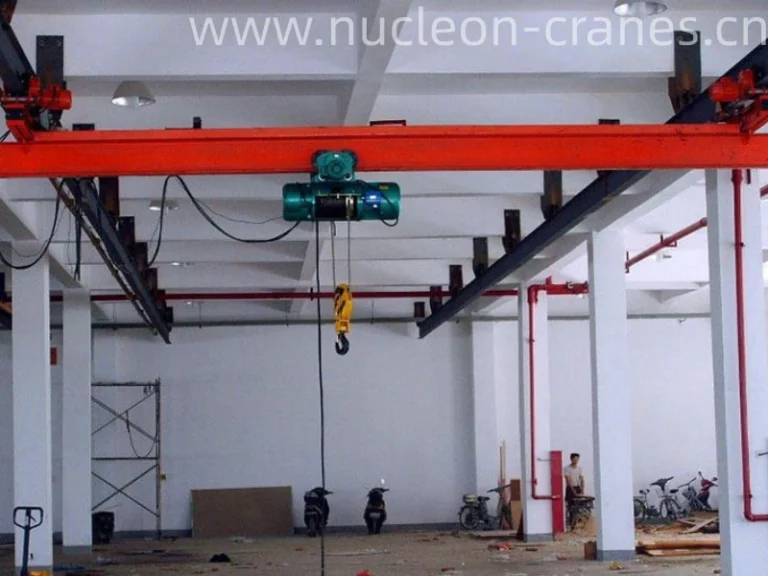
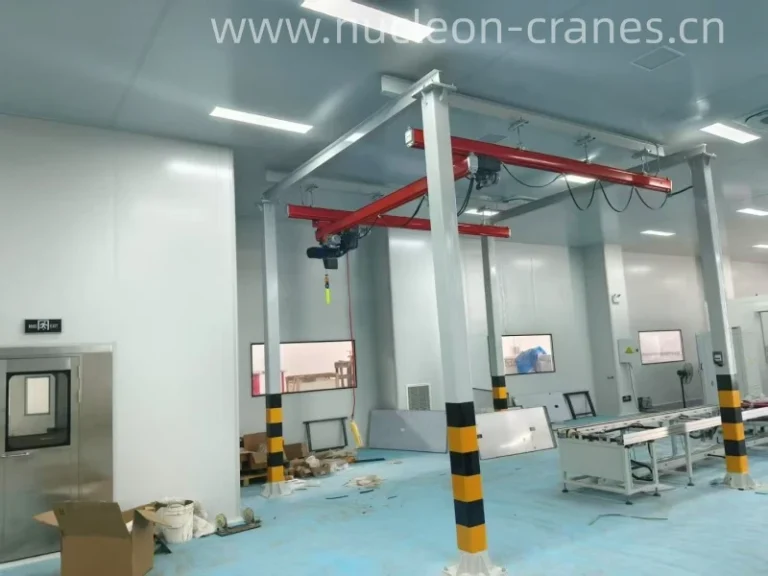
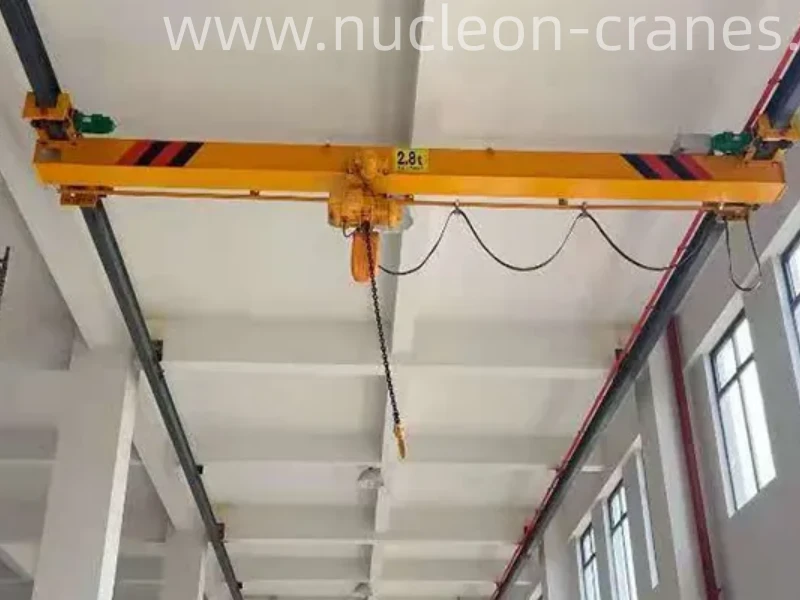
A single girder ceiling mounted bridge crane runs its hoist trolley on the bottom flange of one main beam, which keeps the structural depth shallow and the hook as high as possible relative to the runway rail elevation. For the 1–10 t range across spans up to roughly 22 m, this is almost always the right configuration.
The engineering logic is straightforward: because the beam depth required to control deflection at these spans and capacities stays relatively modest, the load transferred to the building structure at each runway bracket is manageable — typically 1.5–3× the hoist rated load when dynamic factors under EN 13001 or GB/T 3811 are applied. This makes single girder ceiling mounted cranes compatible with a wider range of existing building structures without requiring major reinforcement.
The boundary where single girder starts to compromise: spans beyond 20–22 m. At those distances, the beam must deepen significantly to stay within the deflection limit of span/700 to span/888 (per EN 13001 design criteria), which erodes the very hook height advantage that makes single girder attractive. If you're specifying a 5 t crane at 24 m span and maximum hook height is critical, a double girder configuration with a top-mounted trolley will often recover 200–400 mm of usable lift height despite adding structural depth — because the hoist sits between the two beams at rail level rather than hanging below.
Double Girder: When Span, Capacity, or Duty Class Forces the Step Up
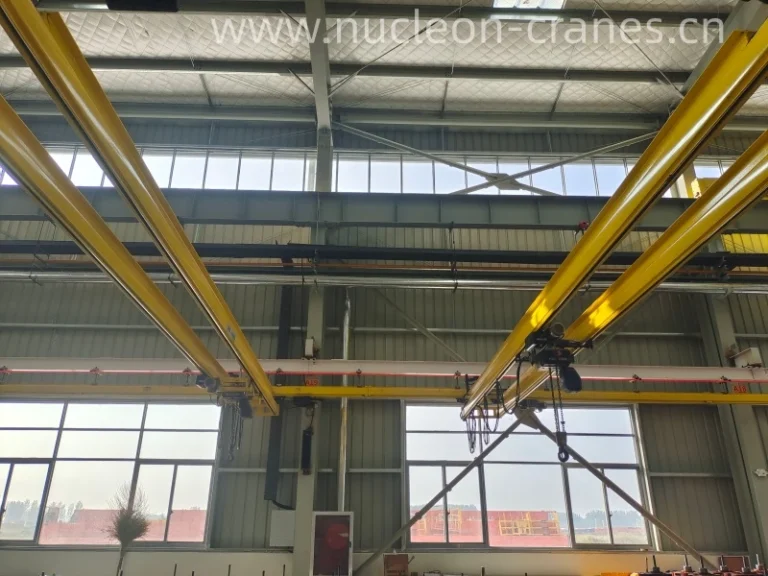
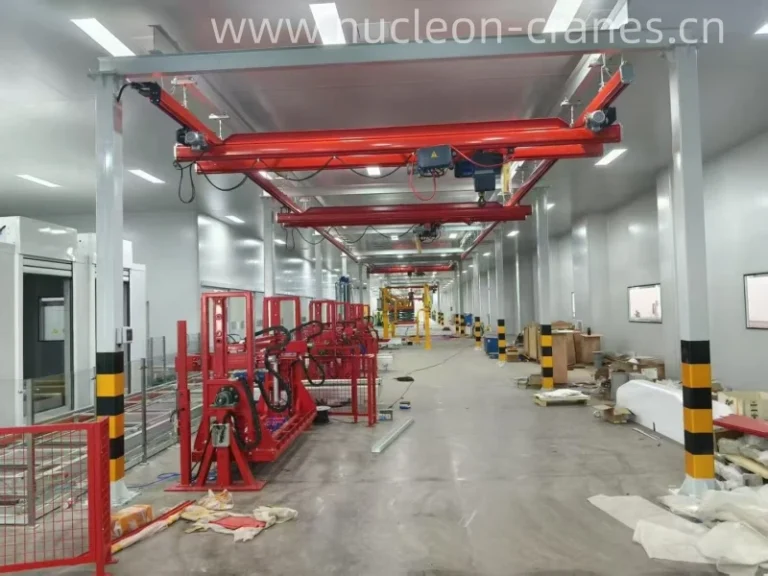
A double girder ceiling mounted bridge crane places the hoist trolley on rails running along the top flanges of two parallel beams. The hoist body sits between and below the girders, which lowers the hook position relative to the top of the bridge — maximizing usable lift in buildings where every millimeter of hook height matters.
The practical crossover points where double girder becomes the right call:
Capacity above 10 t. Single girder structures at this load level become heavy and expensive; the weight savings from double girder's optimized cross-section typically offset the added material cost by the 15 t mark.
Spans above 22 m. Two beams share the bending load, allowing a shallower combined section depth than a single beam at equivalent span and deflection limits.
Duty class M5 or above. Double girder bridge frames carry fatigue loads better under high-cycle conditions. A production line making 80–100 lifts per hour under near-rated load will exhaust a lightly built single girder structure years ahead of schedule — the structural reserve in a double girder design built to M5 typically doubles the realistic service interval between major inspections.
The cost premium is real: expect double girder configurations to run 50–90% higher than a comparable single girder unit in the same capacity range. Budget for that delta, and for the additional runway reinforcement its heavier self-weight typically demands.
Installation Boundary Conditions: What the Specification Sheet Won't Tell You
This is where ceiling mounted bridge crane projects most commonly go over budget or under-deliver — not in the equipment specification, but in the gap between what the building can actually support and what the crane needs.
Dynamic Load, Not Rated Load, Is What the Building Carries
The single most common misunderstanding in ceiling mounted bridge crane procurement is treating the crane's rated capacity as the load the building structure must support. It isn't.
Under FEM 1.001 and EN 13001, the total dynamic load transferred to the runway brackets during lifting and travel is the rated load multiplied by a dynamic load factor — typically in the range of 1.1 to 1.6× depending on hoist speed class and duty class — plus the dead weight of the crane itself (bridge beam, end trucks, hoist), plus horizontal inertia loads from bridge travel acceleration and braking. For a 5 t single girder crane traveling at 20 m/min, the peak vertical load at each runway bracket during a normal lift cycle is typically 30–60% higher than the 5 t rating alone would suggest. Older buildings not designed for crane loads routinely fail this check.
The practical consequence: a structural engineer must assess the roof steelwork before the crane is specified, not after. Reversing this sequence — ordering the crane first, then discovering the building needs reinforcement — is among the most expensive mistakes in ceiling crane fitout. Reinforcement of existing steel frames typically runs $2,000–$15,000+ depending on scope, and the timeline disruption is usually worse than the cost.
Effective Hook Height: The Number That's Rarely What You Think
The usable lift height of a ceiling mounted bridge crane is not the building eave clearance. It's what remains after subtracting, from the structural soffit, the accumulated depth of: runway bracket and connection hardware, runway beam depth, bridge beam depth (or top-flange clearance on double girder), hoist body height, and any overhead obstruction clearance required by HVAC ducts, sprinkler mains, cable trays, or lighting.
In facilities with dense ceiling-level services — common in food production, pharmaceuticals, and automotive assembly — this stack of deductions can total 1,200–2,000 mm. A building with 8 m structural clearance may yield only 6.2–6.5 m of effective hook height. This figure must be calculated from a site survey, not estimated from a building drawing. Specifying the crane before this calculation is done routinely results in either an undersized lift height or an expensive redesign of the overhead service routing.
Runway Alignment, Lateral Clearance, and Services Interference
Runway rail alignment tolerances for ceiling mounted bridge cranes follow EN 13001 or CMAA specification requirements — typically ±3 mm on span width and ±1–2 mm/m on horizontal levelness. These tolerances are tight, and achieving them in an existing building where the structural steel was not designed for crane runway attachment requires careful survey and shimming. Poor runway alignment is the leading cause of accelerated end truck wheel wear and bridge skewing in service.
Lateral clearance between the bridge end trucks and any fixed overhead obstruction must be verified on-site: standard end truck profiles require 100–250 mm clear on each side. This matters most in buildings where structural bracing members, pipe racks, or cable trays run parallel to the runway — a dimension that rarely appears accurately on building drawings and must be field-measured.
Maintenance Access: The Planning Step That Consistently Gets Deferred
Electric hoists, end truck bearings, runway rail joints, and festoon cable systems all require periodic inspection and service. At crane hook heights above 8–10 m, access to these components requires either permanent maintenance walkways alongside the runway, drop-down maintenance platforms engineered into the runway structure, or mobile elevated work platforms with adequate outreach. None of these are included in a standard crane equipment quote, and in most facilities they are treated as someone else's problem until the first service interval arrives.
Deferred maintenance access planning leads to one of two outcomes: cranes serviced incorrectly because the technician couldn't reach the component safely, or cranes not serviced at all until a failure forces a shutdown. Either path shortens service life and increases total operating cost. The correct time to design maintenance access is during runway layout — not after the crane is installed.
Get Solution QuoteSpecifying Your Ceiling Mounted Bridge Crane: The Four Parameters That Fix Your Price
Capacity and Duty Class Together — Not Capacity Alone
Rated capacity without duty class is an incomplete specification. A 5 t crane built to FEM M3 (light duty, infrequent lifts) and a 5 t crane built to FEM M5 (medium-heavy duty, high cycle) are structurally different machines with different design lives, different hoist components, and meaningfully different prices — typically 25–40% higher for M5 vs M3 at the same rated capacity.
General manufacturing and warehousing with 15–40 lifts per day under mixed loads typically fits M3–M4. Production lines cycling every few minutes under near-rated loads need M5. Steel processing, forge shops, and foundries with continuous or near-continuous duty should be evaluated against M6. Specifying M3 for an M5 application is not a cost saving — it's a maintenance liability that surfaces within 2–3 years.
Span: Measure Rail Centerline to Rail Centerline
Bridge span is the distance between the centerlines of the two runway rails, not the bay width and not the bridge beam length. End approach clearance — the distance from the runway rail centerline to the nearest wall or obstruction — typically runs 300–600 mm per side for standard end trucks. Specify span incorrectly and the crane either doesn't fit or leaves an unusable dead zone at each end of the bay.
At spans above 20 m, deflection control becomes the dominant structural design driver. Bridge beam depth increases nonlinearly beyond this point, adding both weight and cost. A 2 t increase in capacity at 25 m span may require a heavier beam section than the same 2 t increase at 12 m span — the span is doing more structural work.
Hoist Type and Speed: Where Long-Term Operating Cost Diverges
Wire rope hoists and chain hoists both serve ceiling mounted bridge crane applications, but their total cost of ownership diverges sharply above 3 t and above M4 duty class. Wire rope hoists carry higher upfront cost but better duty ratings, easier rope inspection, and longer intervals between major service. Chain hoists at light duty and low capacity are cheaper to purchase and simpler to maintain, but chain stretch and wear accelerate significantly above M4 cycle rates.
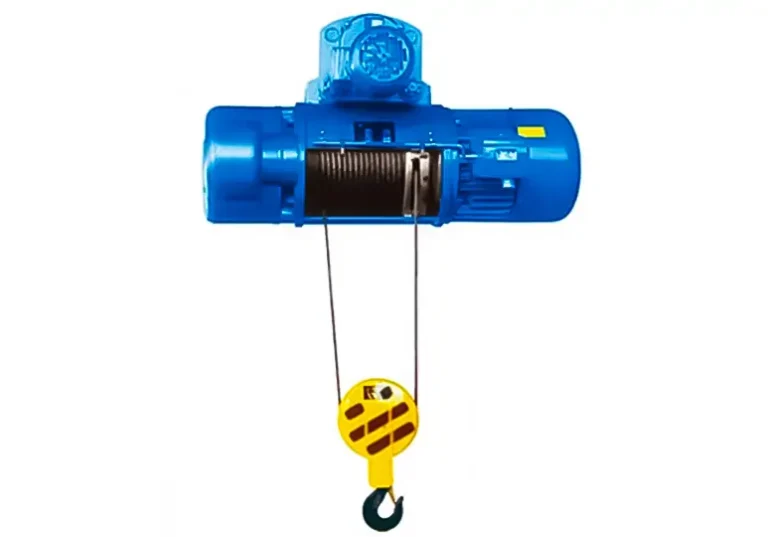
Wire Rope Hoist
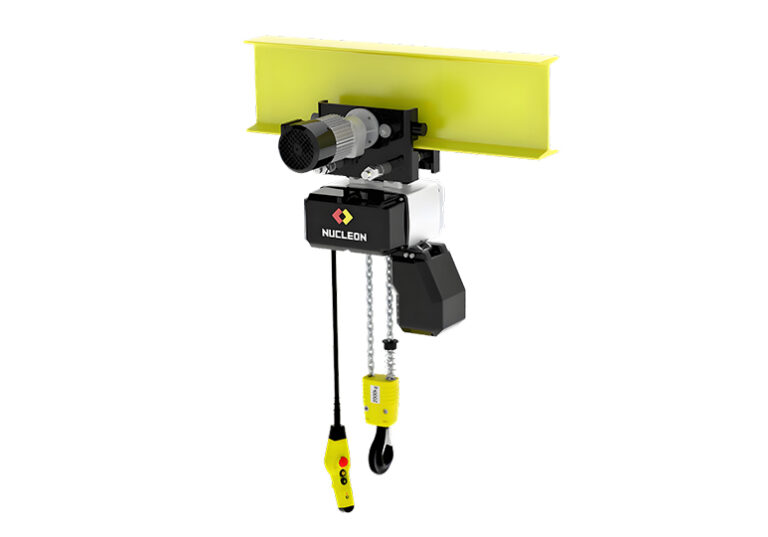
Electric Chain Hoist
For ceiling mounted bridge cranes in production environments above 3 t, specifying a wire rope hoist built to FEM M4 or above is almost always the correct long-term decision. The additional upfront cost versus a chain hoist is typically recovered within 18–30 months of heavy-cycle operation through reduced chain replacement frequency and longer hoist body service intervals.
Certifications for Import: What to Request Before You Commit
For buyers importing ceiling mounted bridge cranes into the EU, the Machinery Regulation (EU 2023/1230, replacing Directive 2006/42/EC) applies, with harmonized standard EN 13001 covering crane structural design. A compliant crane requires a Declaration of Conformity signed by the manufacturer or their authorized representative, plus a technical file covering design calculations, materials certification, and test records.
Chinese manufacturers exporting to EU and other regulated markets typically maintain CE certification issued by a recognized notified body. When evaluating suppliers, always request: the full Declaration of Conformity with the issuing notified body's name and number; the static load test report (typically 125% of WLL); the dynamic load test report (typically 110% of WLL); and the electrical compliance certificate per IEC 60204-32. Verify the notified body's status directly through the EU NANDO database — a certificate image alone is not sufficient verification.
For North American markets, ASME B30.2 and CMAA Specification 70 or 74 govern design and construction standards. Confirm which standard applies to your jurisdiction before specifying.
Conclusion
A ceiling mounted bridge crane is the right solution when your building structure can support it and your operation needs maximum floor coverage without floor columns. Before you request pricing, fix four numbers: rated capacity, FEM duty class, bridge span (rail centerline to rail centerline), and effective hook height from a verified site survey. Then commission a structural assessment of your roof steelwork — this step is not optional, and doing it after ordering the crane creates expensive problems.
Nucleon manufactures ceiling mounted bridge cranes from 1 t to 20 t+, single and double girder, to EN 13001, FEM 1.001, and GB/T 3811, with CE certification for export markets. Share your facility dimensions and lift requirements and we'll return a configuration recommendation with factory-direct pricing within 24 hours.

Equipment Specialist
Accomplished Crane Business Manager with extensive experience in heavy lift project management and operational oversight. Proven track record of driving revenue growth and ensuring safety compliance.
FAQ
Q1: What is a ceiling mounted bridge crane used for?
A ceiling mounted bridge crane handles rectangular-coverage lifting tasks in manufacturing plants, warehouses, assembly lines, and processing facilities where floor columns would obstruct operations. It's the standard solution when you need full-bay coverage, maximum hook height, and unobstructed floor access simultaneously. Capacities typically range from under 1 t for light workstation applications to 20 t+ for heavy industrial use.
Q2: How much does a ceiling mounted bridge crane cost?
Market reference pricing from Chinese manufacturers runs $8,000–$28,000 for a 1–5 t single girder unit, $20,000–$45,000 for a 5–10 t single girder, and $38,000–$85,000+ for a double girder system at 10–20 t. Runway installation, structural reinforcement, local certification, and commissioning are separate line items not included in equipment price — budget 20–40% above equipment cost for total installed cost depending on building condition.
Q3: What is the difference between single girder and double girder ceiling mounted bridge cranes?
Single girder uses one main beam with the hoist on the bottom flange — lower cost, higher hook height relative to runway rail, best for loads up to 10 t at spans under 22 m. Double girder uses two parallel beams with the hoist trolley running between them — higher cost and structural load, but necessary for capacities above 10 t, spans above 22 m, or duty class M5 and above. The hook height advantage of double girder comes from the hoist sitting at rail level rather than hanging below the beam.
Q4: What building structure is required for a ceiling mounted bridge crane?
The building's roof structure must be formally assessed by a structural engineer to verify it can carry the crane's dynamic loads — not just the rated capacity, but the total dynamic load including inertia forces, typically 30–60% higher than the rated load alone. Buildings not originally designed for crane loads often require runway beam reinforcement before installation. This assessment is a prerequisite, not an optional step.
Q5: What span can a ceiling mounted bridge crane cover?
Single girder ceiling mounted bridge cranes typically span 6–28 m, with deflection control becoming the limiting design factor above 20–22 m. Double girder configurations extend practical span to 35 m. Beyond these ranges, the beam depth required to control deflection begins to significantly erode hook height and add structural load — consult an engineer if your required span approaches or exceeds these limits.

 English
  العربية
  Español
  Français
  Português
  Русский