

An overhead crane inspection is a structured examination of a crane's structural, mechanical, and electrical systems to verify it is safe to operate — required under OSHA 29 CFR 1910.179 and detailed further in ASME B30.2. For most industrial facilities, it means three distinct programs running in parallel: a daily operator check (5–10 minutes per shift), a periodic inspection monthly to quarterly, and a full annual audit by a qualified third party.
For operations managers sourcing cranes from China or other overseas suppliers, the inspection question hits differently than it does for domestic buyers. Your equipment arrives with CE or ISO 9001 documentation, but local compliance obligations — OSHA, EN 13001, or the equivalent in your jurisdiction — are entirely your responsibility once the crane is commissioned. Getting that program wrong doesn't just create regulatory exposure; it invalidates warranties and, in heavy-cycle environments, turns small wear issues into five-figure breakdowns before the first year is out.
This guide maps inspection frequency to CMAA service class, explains what each inspection tier actually covers, gives honest cost benchmarks, and flags the two procurement mistakes that most commonly undermine even well-intentioned compliance programs.
Table des matières
Quick Reference: Overhead Crane Inspection at a Glance
| Inspection Type | Fréquence | Who Performs | Typical Cost Reference |
| Pre-shift / Daily | Every shift | Crane operator | In-house (no external cost) |
| Frequent (periodic) | Monthly for heavy use; quarterly for light use | Qualified person | Included in annual contract or ~$75/hr |
| Annual (periodic) | Yearly (severe service: quarterly) | Qualified inspector | $150–$750+ per crane unit |
| Load test | At installation + after major repair | Qualified engineer | Quoted separately |
Cost figures are market reference ranges based on North American service provider pricing. Actual cost varies by crane type, capacity, complexity, and accessibility.
Need an inspection program designed around your specific CMAA class?
Obtenir un devis de solutionWhat OSHA and ASME Actually Require — and Where Buyers Get Confused
The Two-Tier System Under OSHA 1910.179
OSHA mandates two distinct inspection tiers, not one annual visit — and conflating them is the most common compliance gap in facilities that import cranes without a local service partner to guide setup.
The first tier is frequent inspection: daily to monthly checks covering operating mechanisms, hoist chains, hooks, limit switches, and rope condition. These must be documented with date, inspector identity, and equipment identifier. The second tier is periodic inspection: a comprehensive structural and mechanical review at intervals from one month to twelve months, depending on crane service class. Under OSHA's General Duty Clause, facilities operating underhung cranes, monorails, or jib cranes — which fall under ASME B30.11, B30.16, or B30.17 rather than 1910.179 — are not exempt from equivalent requirements.
The practical implication: if you commission a 10-ton double-girder bridge crane and schedule only one annual third-party visit, you are already out of compliance from day one. OSHA's position on documentation is explicit: if it is not in writing, it did not happen. Monthly inspection records must be retained for the equipment's service life.
CMAA Service Class Determines Your Inspection Frequency
The single most useful tool for setting inspection intervals is the CMAA (Crane Manufacturers Association of America) service classification — yet it is routinely ignored by facilities that buy on capacity alone.
| CMAA Class | Application typique | Lifts per Hour | Recommended Periodic Inspection Interval |
| A | Standby / precise handling | Infrequent | Annual |
| B | Light assembly, repair shops | 2–5 | Annual |
| C | Machine shops, general warehouse | 5–10 | Annual |
| D | Heavy machine shops, steel fabrication | 10–20 | Semi-annual |
| E | Continuous production, foundries | 20+ | Trimestriel |
| F | Steel mills, 24/7 operation | Severe duty | Quarterly or more frequent |
A Class C crane doing 8 lifts per hour in a general warehouse and a Class E crane cycling every few minutes in a production line both have a 10-ton rated capacity on the nameplate — but their inspection programs look nothing alike. Specifying inspection frequency without knowing your CMAA class is like setting a maintenance budget without knowing how many hours the equipment runs.
Overhead Crane Inspection Checklist: What Each Tier Covers
Daily Pre-Shift Checks (Operator-Performed)
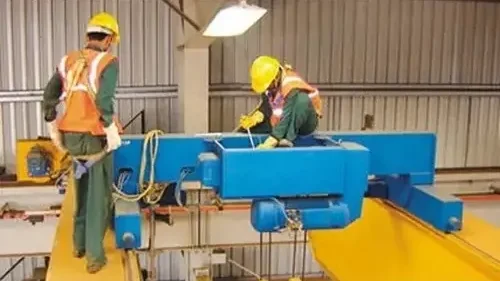
The daily check is your first line of defense and should take no more than 5–10 minutes per crane. Its purpose is to catch anything that changed overnight or developed during the previous shift — not to replace periodic inspections.
Key items include: hook condition (cracks, twist, throat opening deformation), wire rope or chain for kinks, broken wires, or corrosion, brake function during a no-load test lift, limit switch operation (upper and lower travel stops), pendant or remote control function for each motion direction, and a visual walkdown of the runway for debris or track misalignment. Any anomaly — abnormal noise, vibration, brake slip, or visible structural concern — is cause to take the crane out of service immediately.
Document every check. Even a simple logbook sign-off creates the paper trail OSHA requires and gives maintenance teams a timeline when diagnosing recurring problems.
Periodic Inspection: What a Qualified Person Actually Checks
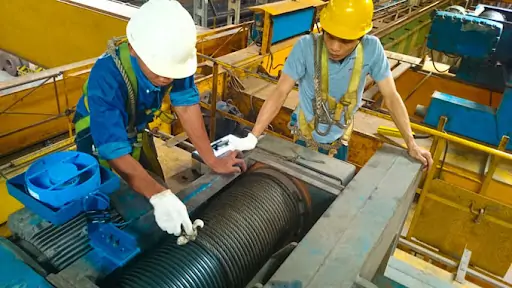
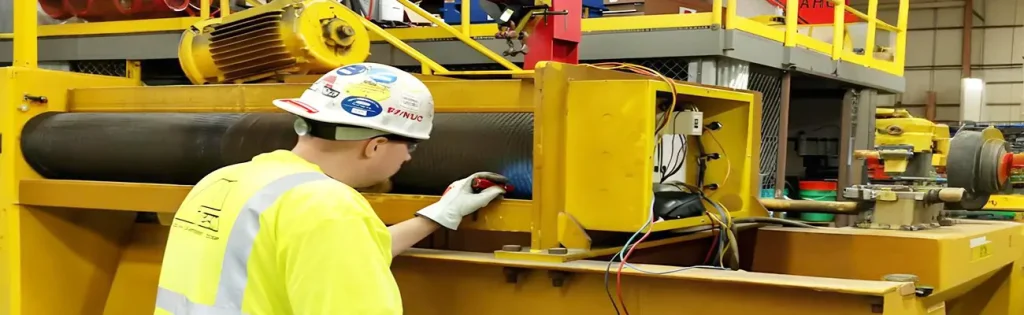
A periodic inspection goes well beyond what an operator can assess from the floor. A qualified inspector will physically access the bridge and trolley, open gearbox covers where practical, and test components under load.
Structural items include main girder camber (checking for sag or lateral deflection against original engineering tolerances), end truck condition, runway rail alignment, and weld integrity at high-stress zones — particularly around the girder-to-end-truck connection. Mechanical items cover wheel flange wear, brake lining thickness, gearbox oil condition and leak signs, drum groove condition, and rope dead-end attachment security. Electrical items include conductor bar condition, panel contactor wear, overload protection function, and grounding continuity. Hook block assemblies require a close inspection for throat opening beyond manufacturer limits (typically a 15% increase over original dimension is cause for replacement under ASME B30.10) and any visible cracks or deformation.
The output of a proper periodic inspection is a written report with pass/fail status for each item, photos of deficiencies, and a recommended repair timeline. If your provider delivers only a verbal summary, find a different provider.
Annual (Full Periodic) Inspection: The Comprehensive Audit
The annual inspection is a full-scope version of the periodic inspection, typically including a load test if the crane has undergone structural repair, modification, or has not been tested since installation. Under ASME B30.2, the load test is conducted at or near rated capacity and verifies that the hoist brake holds without drift and that structural members show no permanent deformation.
For facilities that have imported cranes, the annual inspection is also the right time to reconcile the as-built crane against its original design documentation. Component substitutions made during manufacturing — a common occurrence when original specified brands are unavailable — sometimes affect load path assumptions or electrical fault protection. A qualified inspector reviewing original drawings alongside the physical crane will catch these discrepancies; an inspector working from a generic checklist without drawings will not.
Overhead Crane Inspection Cost: What to Budget
Cost Drivers and Reference Ranges
Annual inspection cost for a single overhead crane unit typically ranges from $150 to $7500+, depending on crane type, capacity, complexity, and site accessibility. A simple 2-ton electric chain hoist on a monorail will sit at the lower end; a 50-ton double-girder top-running bridge crane with radio remote and variable-frequency drives will run significantly higher, often requiring 6–8 hours of qualified inspector time.
The market reference for qualified inspector time in North America is broadly in the range of $65–$85 per hour at time of publication, based on publicly quoted service rates. At that rate:
- A simple electric chain hoist: 30–60 minutes → roughly $38–$88
- A standard single-girder bridge crane (5–10 ton): 1.5–3 hours → roughly $100–$250
- A double-girder bridge crane (10–30 ton) with full documentation: 4–8 hours → $300–$700+
- Load testing (if required separately): quoted per event, often $250–$1,000+ depending on setup time and ballast availability
Multi-crane facilities can often negotiate a per-unit rate reduction when scheduling inspections for multiple cranes in a single visit, since travel and setup time is amortized across more units.
The Low-Bid Trap: A Documented Procurement Pitfall
Choosing an inspection provider on price alone is one of the most consistently expensive decisions a facility can make — and the logic seems sound until it goes wrong.
A low-bid inspector under time pressure will commonly conduct what the industry calls a "pencil-whip" inspection: visual checks from the floor, a completed form, no gearbox access, no structural measurements. The crane passes. Three months later, a gearbox that showed early bearing failure — visible only with the cover removed — seizes during a critical lift, taking the crane out of service for two to three weeks. Emergency diagnosis, expedited parts with overnight freight, and return labor typically run $4,000–$13,000 or more for a mid-range crane, against an inspection fee difference of perhaps $150–$300.
The safest procurement test: ask the provider how long they plan to spend on your specific crane model and what documentation they will open or disassemble. A qualified inspector doing a proper 10-ton bridge crane audit should need at minimum 1.5–2 hours on-site. If the quote implies significantly less, the inspection is not what OSHA and ASME require.
Planning your inspection program for newly imported cranes? Our team can advise on documentation requirements, CMAA classification, and connect you with qualified service partners. Send us your crane specs →
Choosing an Inspection Provider: What to Verify
Qualifications and Credentials
Outside of California, there are no formal licensing requirements in the U.S. that define what makes a crane inspector "qualified" — which means the burden of verification falls entirely on the buyer. At minimum, verify that the inspector holds a current OSHA 30-Hour general industry card, a CCCO (Certified Crane and Rigging Inspector) credential from the National Commission for the Certification of Crane Operators, or equivalent third-party certification. For facilities subject to ASME B30.2 requirements, the inspector should demonstrate familiarity with that standard specifically, not just general rigging knowledge.
Ask for references from facilities with similar crane types and duty cycles. An inspector who excels at light-duty jib cranes in maintenance shops may lack the structural assessment background needed for a high-cycle production line crane.
Documentation and Reporting Standards
A compliant inspection report must include the inspection date, the name and signature of the qualified person, the crane's equipment identifier, the specific items inspected, a pass/fail or condition rating for each item, photographs of any deficiencies, and a recommended corrective action timeline. OSHA's position on record retention is that inspection records should be maintained for the equipment's service life — not just one or two years.
For facilities importing from China or other suppliers: request your original factory test records, load test certificates, and as-built drawings at the time of purchase. These become baseline documents for every inspection that follows. Missing baseline documentation means your first annual inspection starts without reference data, making it harder to identify drift from original specifications.
Conclusion
A well-structured overhead crane inspection program protects people, extends equipment life, and keeps facilities on the right side of OSHA and ASME requirements. The practical priorities are these: match your inspection frequency to your CMAA service class (not just to the annual minimum), document every check — daily through annual — in writing, and vet inspection providers on qualifications and methodology, not on price alone.
If you are commissioning newly imported overhead cranes and need to establish a compliant inspection program from the ground up, start by confirming your CMAA class, establishing a daily operator log, and scheduling your first qualified periodic inspection within 30 days of commissioning. Annual third-party audits are the floor, not the ceiling.
Ready to plan your overhead crane inspection program or source compliant lifting equipment with full documentation? Our team works directly with factory engineers and certified inspection partners across major markets.

Spécialiste en équipement
Chef d'entreprise expérimenté dans le domaine des grues, avec une vaste expérience en gestion de projets de levage lourd et en supervision opérationnelle. Antécédents avérés en matière de croissance du chiffre d'affaires et de respect des normes de sécurité.
FAQ
What is the OSHA requirement for overhead crane inspection frequency?
OSHA 29 CFR 1910.179 requires two inspection tiers: frequent inspections (daily to monthly) performed by the crane operator or a qualified person, and periodic inspections (one to twelve months) by a qualified inspector. For cranes under severe service — CMAA Class E or F — periodic inspections are typically required quarterly, not annually. Facilities that schedule only one annual visit are generally non-compliant for anything above light-duty service.
Who is qualified to perform an overhead crane inspection?
OSHA requires inspections be performed by a "qualified person" — defined as someone with recognized training, knowledge, and experience for the task. In practice, this means someone holding credentials such as CCCO certification or ASME B30.2 familiarity, with documented experience on the specific crane type being inspected. Daily operator checks can be performed by trained crane operators; periodic and annual inspections should be performed by or under the direct supervision of a third-party qualified inspector.
How much does an overhead crane inspection cost?
Annual inspection cost for a single overhead crane unit typically runs $150–$750+, depending on crane complexity and capacity. Inspector time is broadly priced at $65–$85 per hour in the North American market. A simple chain hoist may require under one hour; a full double-girder bridge crane audit can take 6–8 hours. Multi-crane facilities can often negotiate reduced per-unit rates by scheduling inspections for all cranes in a single visit.
What happens if an overhead crane fails inspection?
A crane that fails inspection must be taken out of service immediately until deficiencies are corrected and the crane is re-inspected and accepted. Operating a crane with known deficiencies exposes the facility to OSHA citations, civil liability, and equipment warranty voiding. Critical failures — brake slip, hook deformation beyond tolerance, structural cracks — require immediate remediation regardless of production schedule.
Do imported cranes from China need to be re-inspected after delivery?
Yes. CE or ISO 9001 factory documentation covers the manufacturing standard, not local operational compliance. Once commissioned at your facility, the crane falls under the inspection requirements of your jurisdiction — OSHA 29 CFR 1910.179 in the U.S., EN 13001/EN 13157 in the EU, or the applicable national standard elsewhere. A pre-commissioning inspection by a qualified local inspector, combined with a load test, is strongly recommended before putting any imported crane into production service.
Articles connexes
- Qu’est-ce que l’inspection d’un pont roulant ? Types, fréquence et points clés de la liste de contrôle
- Composants d'une grue aérienne : Noms, fonctions et guide de sélection pour les acheteurs industriels
- Pont roulant industriel : types, fonctionnement et questions à poser avant l'achat
- How to Use an Overhead Crane: A Complete Operating Guide for Safe and Efficient Material Handling
- Quand effectuer la maintenance des ponts roulants ?
- Overhead Crane Inspection Services: Pricing, What’s Included & How to Order
- Inspection des ponts roulants : normes officielles, ressources et liens rapides


 English
  العربية
  Español
  Français
  Português
  Русский