

Why Choosing the Right Indoor Gantry Crane Matters
When your facility depends on overhead material handling, an indoor gantry crane is not just a piece of equipment — it is the backbone of your production efficiency. Yet many procurement managers find themselves overwhelmed by the sheer number of configurations, certifications, and supplier claims in the market. How do you know which gantry crane manufacturer truly delivers? What separates a CE-certified, heavy duty indoor gantry crane from a generic alternative that could compromise safety and output?
This guide gives you a clear, practical framework for evaluating indoor gantry cranes — from understanding key structural types to reading technical specifications, verifying certifications, and avoiding the most common procurement pitfalls. Whether you are sourcing a single girder gantry crane for a light assembly line or a double girder gantry crane for a steel processing plant, the decision criteria remain consistent: capacity, span, duty class, certification compliance, and total cost of ownership.
Bottom line up front: A well-specified, CE-certified indoor gantry crane from a reputable manufacturer pays for itself within 18–36 months through improved throughput, reduced manual handling injuries, and lower maintenance costs. Read on to learn exactly how to make that choice.
1. Understanding Indoor Gantry Crane Types: Which Configuration Fits Your Facility?
One of the most consequential decisions in gantry crane selection is choosing the right structural configuration. Each type of indoor gantry crane addresses specific operational constraints. Using the wrong type for your environment leads to underperformance, premature wear, or unnecessary capital expenditure.
1.1 Single Girder Gantry Crane
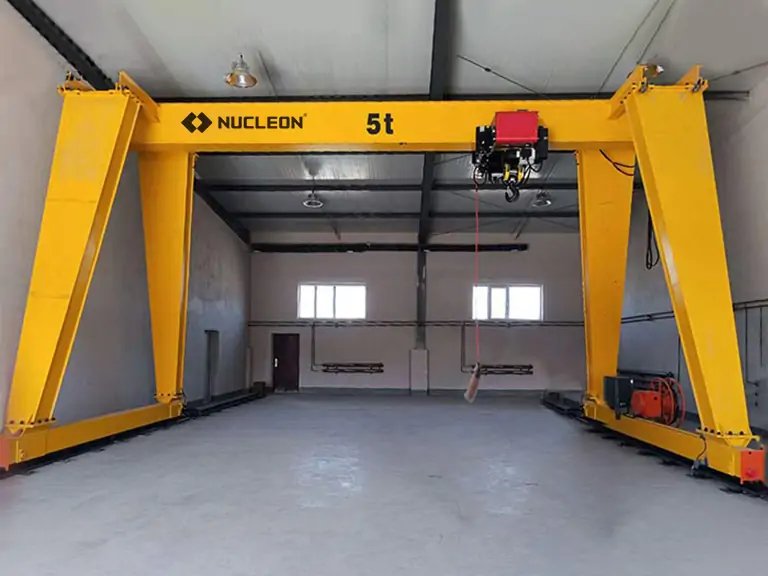
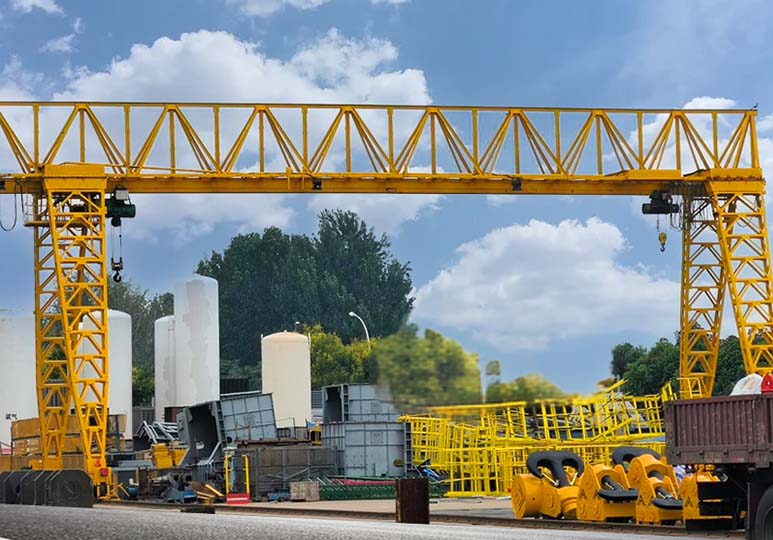
Full Gantry Crane
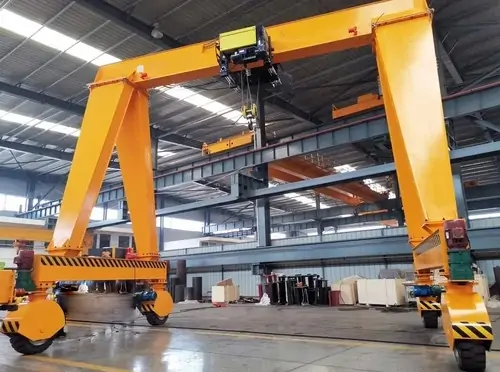
The single girder gantry crane uses one overhead beam supported by two end trucks running on floor-level rails. This design is lighter, more economical, and easier to install than its double-girder counterpart. It is well-suited for indoor facilities requiring lifts up to 20 tonnes across spans of 5 to 30 metres. Because the hoist travels along the lower flange of the single beam, hook height is slightly reduced — a trade-off worth considering in buildings with lower ceiling clearance.
Typical applications include automotive component assembly, warehousing, light fabrication, and machinery maintenance bays. If your lifting cycles are moderate (Duty Class A3–A4 per ISO 4301) and your load profile falls below 20 t, a single girder indoor gantry crane is almost always the more cost-effective choice.
1.2 Double Girder Gantry Crane
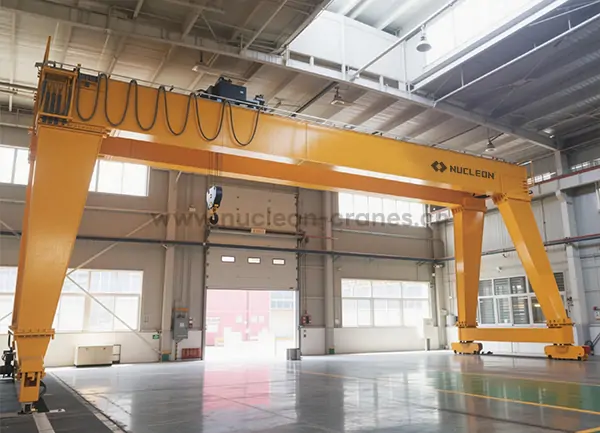
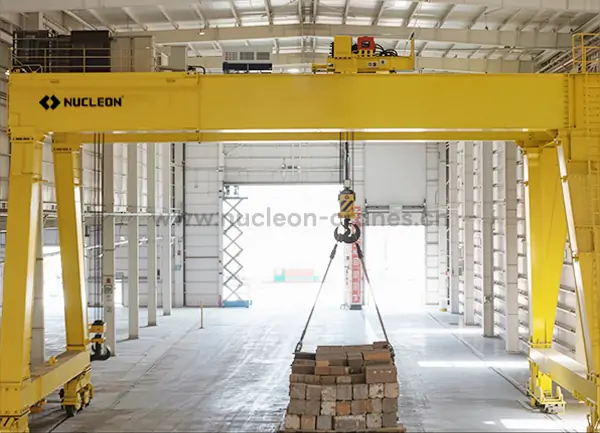
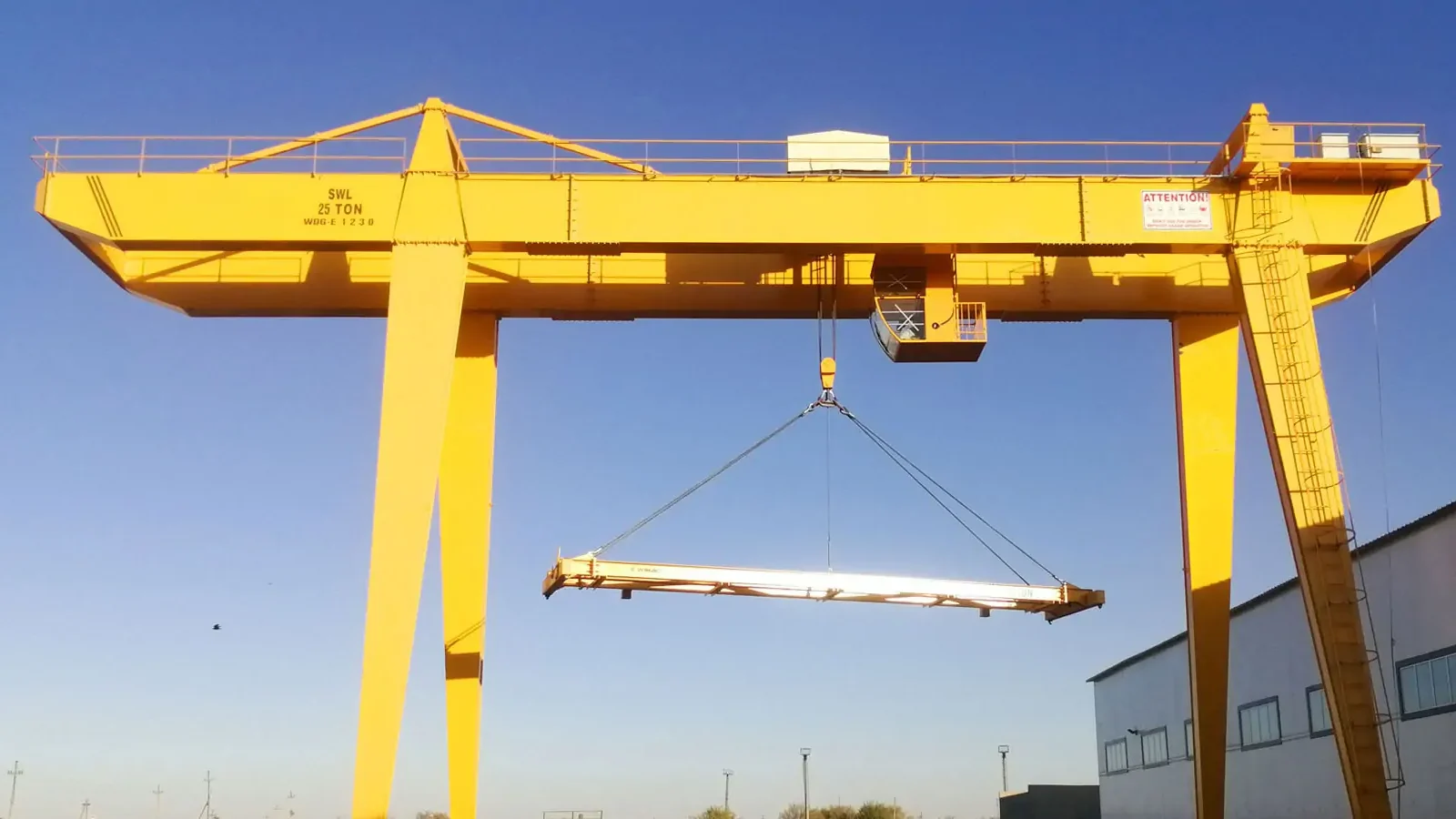
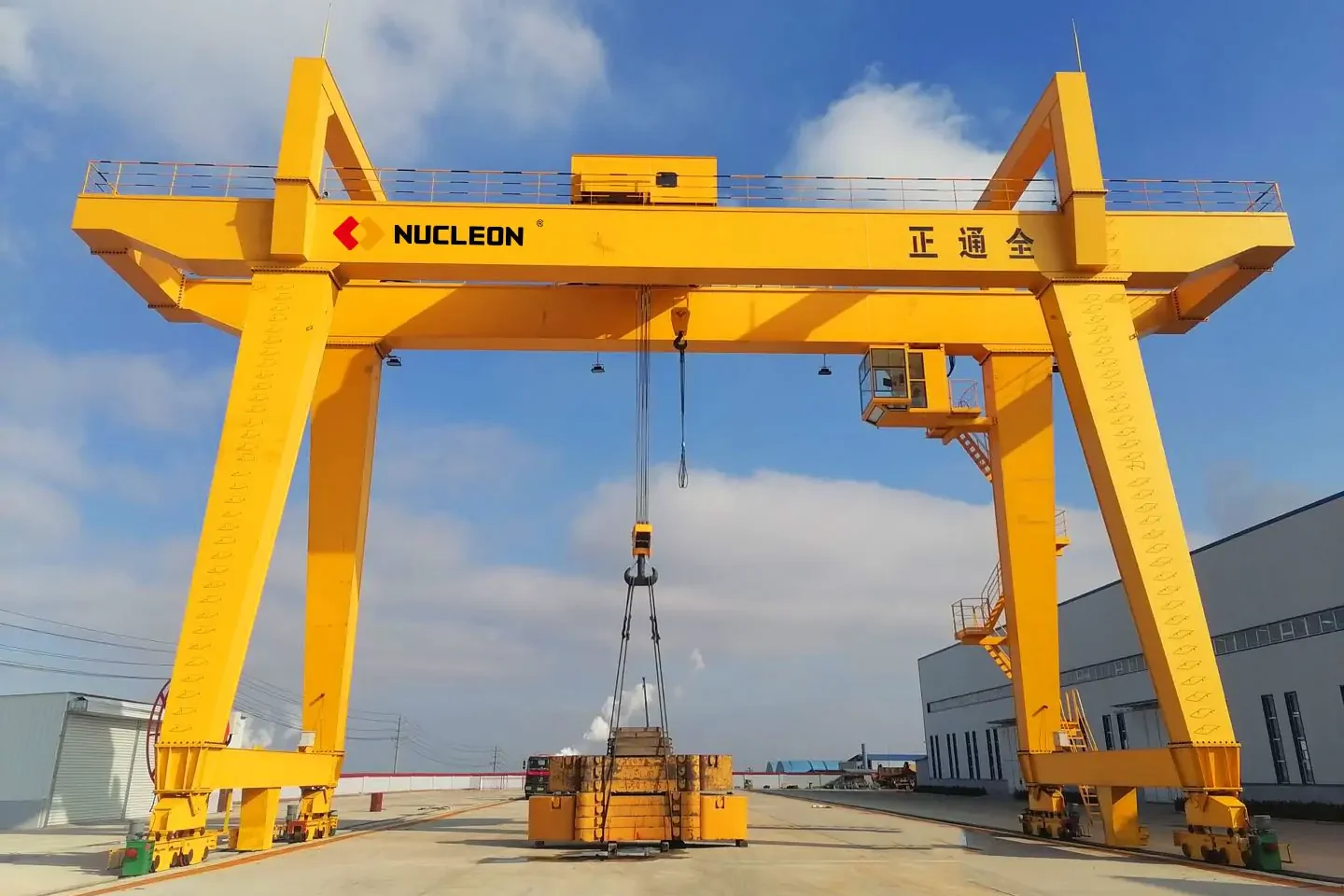
Where loads exceed 20 tonnes, or where precise hook positioning and maximum hook height are critical, a double girder gantry crane is the standard solution. Two parallel girders support a crab trolley that travels across the top of the beams, maximising hook height and allowing auxiliary hoisting functions. Spans can reach 35 metres, and lifting capacities commonly extend to 80 tonnes in standard indoor configurations.
Steel mills, heavy fabrication shops, shipbuilding facilities, and precast concrete plants rely on double girder cranes for their robustness and duty-class ratings (A5–A6 in many industrial settings). The higher upfront cost is typically justified by longer service life and the ability to handle complex, high-cycle lifting operations.
1.3 Semi Gantry Crane
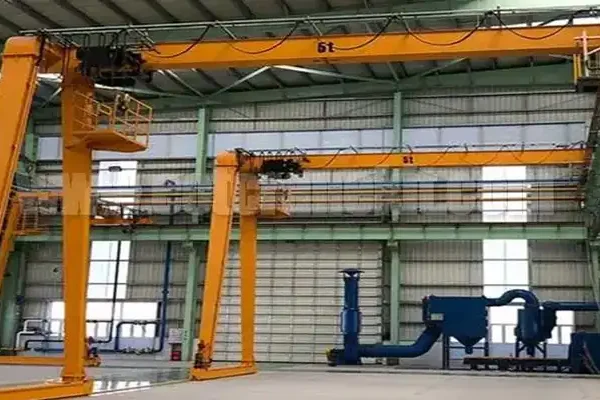
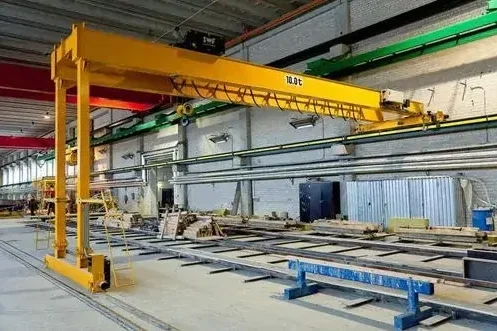
A semi gantry crane is a hybrid design: one end truck runs on a floor-level rail while the other travels on an elevated runway beam attached to a building column or wall. This configuration is ideal when floor space is constrained on one side of the facility, or when an existing structural wall can serve as a crane support without the need to install a full second floor rail. Semi gantry cranes are widely used in machinery workshops, repair facilities, and warehouses with asymmetric layouts.
1.4 Portable Gantry Crane
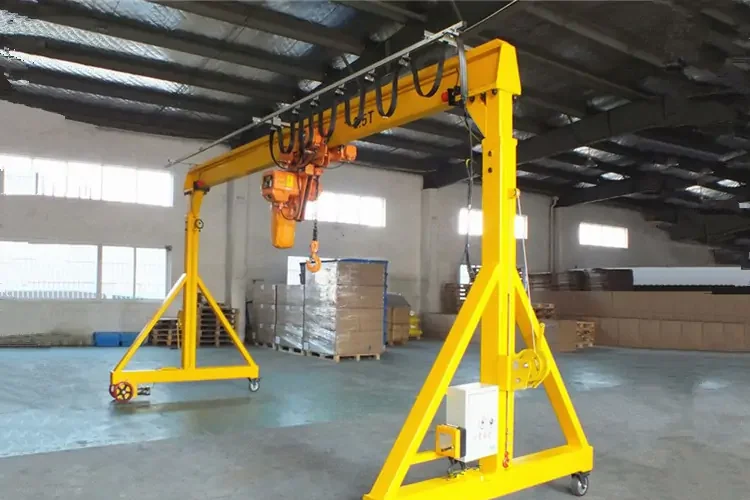
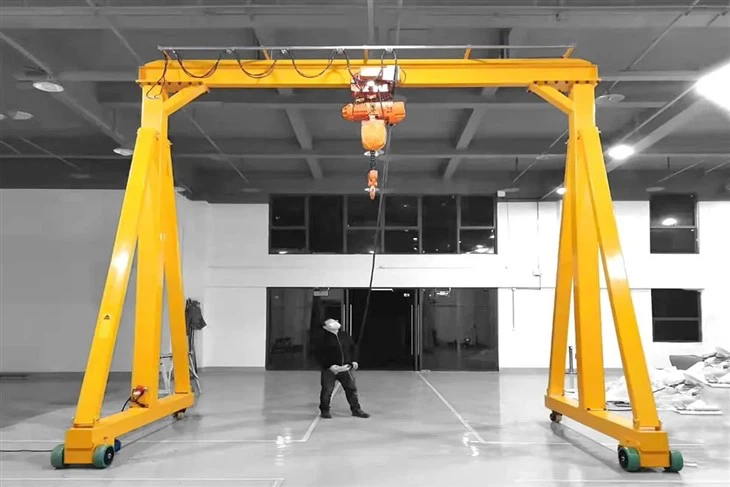
رافعة جسرية قابلة للتعديل
For facilities that require flexible, relocatable lifting solutions, a portable gantry crane offers unmatched versatility. Lightweight steel or aluminium frames, adjustable height columns, and castored wheels allow these cranes to be repositioned across different workstations without permanent installation. Capacities typically range from 0.5 to 5 tonnes, making them practical for maintenance departments, tool and die shops, and small assembly areas. While not designed for high-cycle heavy lifting, a well-built portable gantry crane can dramatically reduce manual handling risks in environments where a fixed overhead crane is not feasible.
Table 1: Indoor Gantry Crane Type Comparison
| يكتب | نطاق التغطية | سعة | Height Limit | الأفضل لـ |
| حمالة أحادية | 5-30 متر | 1-20 طن | Standard | Light to medium loads, cost-sensitive |
| عارضة مزدوجة | 10–35 m | 5–80 t | Maximized | Heavy loads, high-precision lifting |
| الرافعة شبه الجسرية | 5–25 m | 1–32 t | One rail elevated | Facilities with one structural wall rail |
| رافعة بوابة محمولة | 1.5–7 m | 0.5–5 t | Adjustable | Maintenance bays, workshops, flexibility |
مصدر: فيم 1.001 (4th Ed., 2020), ISO 4301-1:2016, manufacturer technical catalogues (2023–2024).
2. Key Technical Specifications: What the Numbers Actually Mean
Crane specifications are only useful when you know how to read them. Procurement teams sometimes over-specify (paying for capacity they never use) or under-specify (causing premature failure or safety incidents). Here is a breakdown of the parameters that matter most for indoor gantry crane selection.
2.1 Lifting Capacity and Duty Class
Lifting capacity is the rated maximum load, but duty class tells you how intensively the crane will work. ISO 4301 defines duty classes from A1 (infrequent, light use) to A8 (continuous heavy use). For most indoor manufacturing environments, A3 to A5 is the relevant range. A crane specified for A3 duty but operated under A5 conditions will experience accelerated fatigue failure — one of the most common and costly errors in crane procurement.
Always calculate your annual equivalent loading spectrum before specifying duty class. Your gantry crane manufacturer should provide this analysis as part of the application engineering process. If they do not ask about your duty cycle, consider it a red flag.
2.2 Span, Lifting Height, and Headroom
Span determines the distance the crane can cover laterally. For indoor gantry cranes, span must account for aisle width, workstation layout, and any obstructions along the travel path. Lifting height — the distance from the floor to the maximum hook position — must include sufficient clearance above the tallest load you handle, plus rigging allowance (typically 300–500 mm). Headroom, the distance from the hook at its highest point to the beam bottom, is particularly tight with single girder designs and should be verified against your building's clear height.
2.3 Speed Settings and Control Systems
Modern indoor gantry cranes typically feature variable frequency drives (VFDs) for smooth acceleration and precise load positioning. Lifting speeds of 0.5 to 20 m/min and travel speeds of 5 to 40 m/min are standard ranges. For sensitive loads or precision assembly, micro-speed settings (as low as 0.1 m/min) may be specified. Control options range from wired pendants and wireless remotes to full cabin control for large-capacity cranes. Ensure your gantry crane manufacturer complies with EN 60204-32 for electrical equipment on lifting machinery.
Table 2: Indoor Gantry Crane Key Technical Parameters
| المعلمة | Standard Range | CE / ISO Reference |
| قدرة الرفع | 0.5 t – 80 t | ISO 4301, FEM 1.001 |
| فترة | 3 m – 35 m | ISO 22986 |
| سرعة الرفع | 0.5 – 20 m/min | EN 14492-2:2021 |
| فئة الواجب | A3 – A6 (ISO) / M3–M6 | ISO 4301-1:2016 |
| CE Certification | Mandatory (EU market) | توجيه الآلات 2006/42/EC |
| Working Temperature | -20°C to +50°C | EN 13135:2013+A1:2018 |
| Control Mode | Pendant / Remote / Cabin | EN 60204-32:2023 |
Source: ISO 4301-1:2016, EN 14492-2:2021, EN 13135:2013+A1:2018, FEM 1.001 (4th Edition, 2020). Data reflects industry-standard ranges as of 2023–2024.
3. CE Certification and Safety Standards: Non-Negotiable for Industrial Procurement
For any gantry crane deployed within the European Union — or exported to CE-required markets — compliance with the EU Machinery Directive 2006/42/EC is mandatory, not optional. A CE mark on an indoor gantry crane signals that the manufacturer has completed a conformity assessment, prepared a technical file, and issued a Declaration of Conformity. However, CE marking alone is insufficient for procurement due diligence.
3.1 What CE Certification Actually Covers
CE compliance for gantry cranes under the Machinery Directive requires conformity with harmonised standards including EN 13001 (Crane Safety — General Design), EN 14492-2 (Power-driven hoists), and EN 13135 (Equipment for cranes — design requirements for mechanical systems). These standards govern structural calculations, fatigue analysis, load testing (typically 125% static and 110% dynamic load tests), and safety device requirements such as overload protection and emergency stop functions.
When evaluating a gantry crane manufacturer, request the full technical file index, the harmonised standards applied, and third-party test reports from an accredited body (e.g., TÜV, Bureau Veritas, SGS). A CE declaration without supporting documentation is insufficient for risk management and, in many jurisdictions, legally non-compliant.
3.2 Additional Quality and Safety Frameworks
Beyond CE, credible indoor gantry crane manufacturers typically hold ISO 9001 quality management certification and may additionally comply with FEM (European Materials Handling Federation) design standards, ASME B30.2 (for North American markets), or AS 1418 (Australia). For facilities operating under stringent HSE requirements, look for manufacturers who provide FMEA (Failure Mode and Effects Analysis) documentation, third-party structural weld inspection records, and NDT (Non-Destructive Testing) reports for primary structural welds.
3.3 Real-World Compliance Verification: An Automotive Supplier Example
A tier-1 automotive component supplier in Germany required three double girder indoor gantry cranes (25 t capacity, 22 m span each) for a new stamping line. During pre-qualification, two of four shortlisted gantry crane manufacturers could not produce third-party fatigue analysis reports aligned with EN 13001-3-1. The supplier disqualified both and awarded the contract to a manufacturer who provided full conformity documentation, including independent weld procedure qualification records (WPQR) and a load test certificate issued by a notified body. This case illustrates why CE marking verification goes beyond the label. (Reference: publicly documented procurement process, EU machinery sector, 2022.)
4. How to Evaluate a Gantry Crane Manufacturer: Six Practical Criteria
The global market offers hundreds of gantry crane suppliers, ranging from engineering-led manufacturers to pure trading intermediaries. Distinguishing between them requires a structured evaluation approach. The following six criteria provide a reliable framework for procurement decisions.
4.1 In-House Engineering Capability
A credible gantry crane manufacturer conducts structural calculations, finite element analysis (FEA), and application engineering in-house. Ask directly: does your team perform original design calculations, or do you adapt standard designs? Manufacturers who can adjust span, duty class, or structural configuration based on your specific facility data — floor bearing capacity, column spacing, process requirements — offer fundamentally better outcomes than those selling off-the-shelf configurations only.
4.2 Manufacturing Quality Controls
Visit the factory or request a third-party audit report. Key quality indicators include: automated welding for primary structural members, post-weld NDT on load-bearing joints, CNC machining for wheel assemblies and end trucks, and a documented in-process quality control system aligned with ISO 9001. A manufacturer who welcomes factory audits and can demonstrate traceability of structural steel certifications (EN 10025 or equivalent) is operating at a fundamentally different standard than one who does not.
4.3 Project References and Application Experience
Request references specifically relevant to your industry and crane type. A manufacturer with documented installations of single girder gantry cranes in food processing facilities, for example, will understand the hygiene-grade surface treatment and stainless steel hardware requirements that a general-purpose crane supplier may overlook. Ask for installation addresses or client contacts that can be independently verified.
4.4 After-Sales Support and Spare Parts Availability
An indoor gantry crane has a design life typically ranging from 15 to 25 years depending on duty class. Evaluate whether the manufacturer maintains a spare parts inventory, offers on-site commissioning and operator training, provides preventive maintenance documentation, and has service engineers deployable to your location within an acceptable response time. Total cost of ownership, not just purchase price, should drive this evaluation.
4.5 Lead Time and Project Management
For greenfield or expansion projects, crane delivery schedule is often on the critical path. Clarify manufacturing lead time, shipping timeline, and installation resource requirements early in the procurement process. A manufacturer who provides a project Gantt chart and a dedicated project manager reduces schedule risk significantly compared to informal delivery commitments.
4.6 Gantry Crane for Sale: Understanding Pricing Structure
When evaluating gantry cranes for sale, ensure you are comparing equivalent specifications. A lower quoted price may reflect a lower duty class, reduced testing scope, or the omission of installation and commissioning costs. Request itemised quotations that separately identify: structural steel and fabrication, hoisting equipment, electrical system, runway system (rails, end stops, festoon), installation, commissioning, load testing, and documentation package. This enables meaningful comparison across suppliers.
Table 3: Indoor Gantry Crane Approximate Price Ranges (2023–2024, Ex-Works)
| نوع الرافعة | Approx. Unit Price (USD) | Lead Time | Installation Complexity |
| رافعة بوابة محمولة | $800 – $5,000 | 1–2 weeks | Low (tool-free assembly) |
| Single Girder Gantry | $3,500 – $28,000 | 3–6 weeks | متوسط |
| الرافعة شبه الجسرية | $7,000 – $45,000 | 4–8 weeks | متوسط-عالي |
| Double Girder Gantry | $18,000 – $130,000+ | 6–14 weeks | عالية |
Note: Prices are indicative ranges based on industry market data (2023–2024). Final pricing depends on specifications, customisation, origin, and project scope. Source: industry procurement benchmarks, manufacturer published ranges.
5. Common Procurement Mistakes and How to Avoid Them
Even experienced procurement teams make avoidable errors when specifying and sourcing indoor gantry cranes. Understanding the most frequent mistakes helps you build a more robust procurement process from the outset.
- Over-specifying capacity without analysing actual load profiles: Specifying a 20 t crane for a facility where maximum actual loads are 8 t increases capital and operating costs without safety benefit. Conduct a realistic load analysis first.
- Ignoring floor bearing capacity: Indoor gantry cranes exert significant point loads through the rail and end truck assemblies. Failure to verify floor slab thickness, reinforcement, and load-bearing capacity before finalising crane specifications can require costly structural retrofits.
- Accepting CE declarations without supporting documentation: As detailed in Section 3, a CE label without a verifiable technical file and third-party test reports is legally and technically insufficient.
- Selecting the lowest-price gantry crane for sale without lifecycle cost analysis: Purchase price typically represents 30–40% of total lifecycle cost for an industrial gantry crane. Maintenance, spare parts, energy consumption, and downtime costs must be factored into the evaluation.
- Neglecting operator training and handover documentation: A well-engineered indoor gantry crane operated incorrectly is a liability. Ensure operator training, maintenance manuals, and inspection records are contractually required deliverables.
Conclusion: A Structured Approach to Indoor Gantry Crane Procurement
Selecting an indoor gantry crane is a decision that will shape your facility's material handling capability for the next 15 to 25 years. The key variables — crane type, structural configuration, duty class, span, lifting height, and certification compliance — are all interdependent. A credible gantry crane manufacturer will guide you through this specification process rather than simply quoting from a catalogue.
Prioritise manufacturers who demonstrate in-house engineering capability, full CE certification with supporting documentation, relevant industry references, and a transparent total-cost-of-ownership approach. Whether you are sourcing a portable gantry crane for a maintenance workshop or a heavy duty double girder gantry crane for a primary production line, the framework described here applies consistently.
If you are currently in the early stages of a crane procurement project, start with a load and duty cycle analysis, verify your building's structural constraints, and develop a detailed technical specification before approaching the market. This investment of time at the front end will yield significantly better commercial outcomes and reduce lifecycle risk.

أخصائي معدات
مدير أعمال الرافعة الناجح الذي يتمتع بخبرة واسعة في إدارة مشاريع الرفع الثقيل والإشراف التشغيلي. سجل حافل في قيادة نمو الإيرادات وضمان الامتثال لقواعد السلامة.
الأسئلة المتداولة (FAQ)
Q1: What is the difference between a single girder and double girder indoor gantry crane, and how do I choose?
A single girder gantry crane uses one main beam and is cost-effective for capacities up to 20 tonnes and spans up to 30 metres. The hoist travels on the lower flange, which slightly reduces hook height. A double girder gantry crane uses two parallel beams with a top-running trolley, maximising hook height and handling capacities up to 80 tonnes or more across spans up to 35 metres. The choice depends on your maximum load weight, required hook height, lifting frequency (duty class), and budget. For most light-to-medium indoor applications, a single girder design offers the best value. For heavy industrial lifting, a double girder configuration is the standard. Consult your gantry crane manufacturer for a site-specific duty cycle analysis.
Q2: Is CE certification mandatory for indoor gantry cranes, and what documents should I request?
CE certification is legally mandatory for gantry cranes placed on the EU market under the Machinery Directive 2006/42/EC. Beyond the CE Declaration of Conformity, you should request: the list of harmonised standards applied (e.g., EN 13001, EN 14492-2), the technical file index, static and dynamic load test certificates from an accredited body, and structural weld inspection (NDT) reports. A CE label without these supporting documents does not constitute adequate compliance verification. For non-EU markets, equivalent national standards (ASME B30.2 for North America, AS 1418 for Australia) apply and similar documentation standards are recommended.
Q3: What factors should I check before specifying an indoor gantry crane for an existing building?
Before specifying any indoor gantry crane, verify the following building constraints: floor bearing capacity at rail contact points (typically 15–50 kN/m² depending on crane weight and wheel configuration), clear height from floor to lowest obstruction, available aisle width for crane rail installation, column spacing if using building structure as rail support, and proximity of utilities (power supply, lighting, sprinkler systems) that may conflict with crane travel. Overlooking any of these factors can result in costly retrofits or design revisions late in the project. A competent gantry crane manufacturer will conduct a site survey or review engineering drawings before submitting a technical proposal.
Q4: How long does an indoor gantry crane typically last, and what maintenance is required?
A well-maintained indoor gantry crane has a design life of 15 to 25 years, depending on duty class and operational environment. ISO 4301 duty class A3 cranes in light industrial use commonly achieve 20+ years with standard maintenance, while A5–A6 class cranes in heavy production may require major structural inspections and component replacement at 10–15 year intervals. Regular maintenance includes: daily pre-use visual inspections, monthly lubrication of all moving parts, quarterly electrical system checks, annual load testing (at 100% rated capacity), and periodic NDT of primary structural welds at intervals defined by the manufacturer. Maintain a detailed inspection log from day one — this is also a regulatory requirement in most jurisdictions.
Q5: What should I look for when evaluating a semi gantry crane or portable gantry crane option?
For a semi gantry crane, the critical additional consideration is the structural capacity of the building column or wall that supports the elevated runway rail. Confirm with a structural engineer that the existing building structure can carry the imposed loads without modification. Also verify that the height difference between the floor rail and elevated rail is compatible with your available clear height. For a portable gantry crane, evaluate wheel load capacity versus your floor type (concrete, epoxy, tile), maximum height in extended configuration versus your minimum work height requirement, and whether the frame design allows height adjustment without full disassembly. Quality portable gantry crane frames should comply with relevant national standards (e.g., EN 1991 for load calculations) even at small capacities.

 English
  العربية
  Español
  Français
  Português
  Русский