


One Decision That Shapes a Decade of Operating Costs
Choosing the wrong power supply system for your rubber tyred gantry crane can cost millions over a 10-year operational lifespan. That is not an exaggeration. The power system you select governs fuel expenditure, maintenance cycles, emission compliance costs, and operational flexibility from day one.
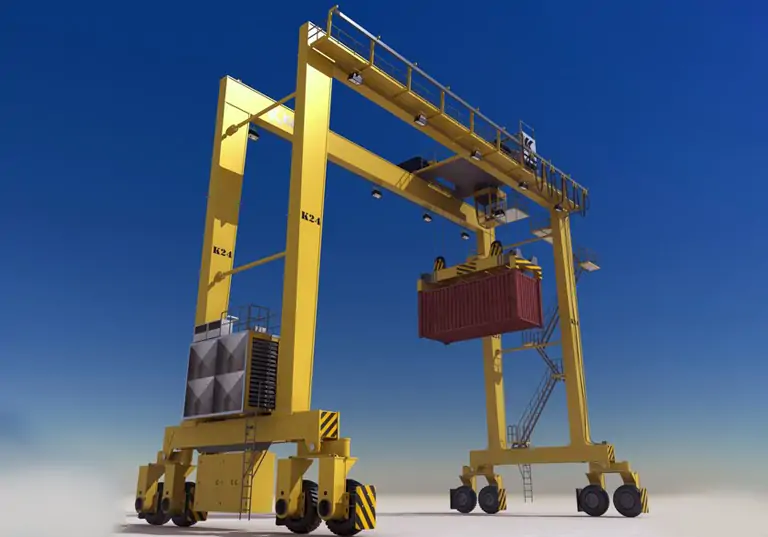
Gruas RTG are the backbone of container terminal yard operations. Today, three primary power configurations dominate the market: the Electric RTG crane, the Diesel RTG crane, and the Hybrid RTG crane. Each has a distinct application profile, cost structure, and set of trade-offs.
This guide evaluates all three configurations across four critical dimensions — technical specifications, total cost of ownership, operational requirements, and regulatory compliance — giving terminal operators, procurement managers, and engineers a structured decision framework. By the end, you will know which RTG crane power system best fits your specific yard conditions.
The Three Main RTG Crane Power Configurations
Electric RTG Crane


The electric RTG crane draws continuous power from a shore-side grid via a cable reel system or fixed conductor bar. It eliminates the diesel engine entirely, delivering zero on-site emissions, near-silent operation, and the lowest energy cost per lift cycle among all three configurations.
Technical profile: Electric RTG cranes typically operate on 6kV or 10kV high-voltage supply systems paired with variable frequency drives (VFDs) on all motion axes. Electrical systems designed to IEC 60034 and ISO 4301 standards ensure both safety and long-term reliability.
Best suited for: Large container terminals with established port power infrastructure, or regions with strict emission mandates such as EU ports operating under the EU's Green Deal industrial framework or terminals in California subject to CARB (California Air Resources Board) regulations. When RTG travel paths within the yard are predictable and relatively fixed, the payback period on electrification infrastructure typically falls within five to eight years.
Diesel RTG Crane


The diesel RTG crane carries a fully independent diesel engine and uses hydraulic or electric transmission to drive all crane motions. It requires no external power infrastructure, making it the most globally deployed RTG configuration by installed fleet size.
Technical profile: Modern diesel RTG cranes are equipped with Stage IV or Stage V compliant engines — the equivalent of Euro IV/Euro V standards — combined with selective catalytic reduction (SCR), diesel particulate filters (DPF), and exhaust gas recirculation (EGR). Engine output on mainstream models ranges from 250 to 400 kW.
Best suited for: Emerging port markets where power infrastructure is still developing, temporary or seasonal yard operations, or terminals requiring frequent inter-yard relocations. Lower upfront capital cost and rapid deployment readiness make diesel RTG cranes the preferred choice for fast-starting operations.
Hybrid RTG Crane


The hybrid RTG crane pairs a diesel engine with a high-capacity ultracapacitor or lithium-ion battery storage system. Energy recovery during hoist lowering and travel deceleration significantly reduces fuel consumption compared to conventional diesel RTG cranes. This configuration has become one of the fastest-growing RTG power options globally over the past decade.
Technical profile: Peak-shaving technology keeps the diesel engine operating continuously within its optimal efficiency range, while the energy storage system absorbs braking energy and delivers peak power on demand. Fuel savings of 30 to 50 percent compared to a conventional diesel RTG crane of equivalent capacity are consistently reported in terminal operational data.
Best suited for: Terminals transitioning toward electrification but not yet able to commit to full grid infrastructure investment, or sites where electricity tariffs are high relative to diesel prices. The hybrid RTG crane also functions effectively as a transitional step toward full electric RTG crane adoption.
Side-by-Side Comparison: Key Parameters
The following table compares all three RTG crane power configurations across critical decision dimensions. Data is based on typical terminal operating conditions — approximately 150,000 TEU annual throughput with 16 operating hours per day.
| Parâmetro | Electric RTG Crane | Diesel RTG Crane | Hybrid RTG Crane |
| Initial CAPEX | High (+20–35%) | Baseline | Medium (+10–20%) |
| Annual Energy Cost | Lowest | Highest | Low-Medium |
| CO₂ Emissions (ops) | Zero | Elevado | Medium (−30–50%) |
| Infrastructure Need | High (grid required) | Baixo | Low to Medium |
| Maintenance Complexity | Baixo | Médio-Alto | Médio |
| Operational Flexibility | Medium (cable limit) | Elevado | Elevado |
| Emission Compliance | Strictest zones | Stage IV/V compliant | Stage IV/V compliant |
| Payback Period | 5–8 years | Immediate | 3–6 years |
Selection Framework: Four Critical Evaluation Dimensions
Dimension 1: Infrastructure Readiness
Infrastructure status is the first filter in any RTG crane power selection process. If your terminal already operates a stable high-voltage power network, both electric and hybrid RTG crane configurations are viable. If port grid capacity is insufficient or large-scale infrastructure investment is not feasible in the near term, diesel RTG or hybrid RTG cranes offer a more practical path.
Key infrastructure indicators to assess include: available grid capacity (a single electric RTG crane draws 500–800 kW at peak demand), substation proximity and expansion headroom, and whether yard layout accommodates cable reel routing.
Dimension 2: Total Cost of Ownership Over the Asset Lifecycle
Purchase price alone is a misleading metric. RTG cranes carry a design lifespan of 15 to 20 years. Total cost of ownership (TCO) — not acquisition cost — should drive the decision. In most terminal operating scenarios, energy and fuel costs represent over 40 percent of TCO across the crane's working life.
A complete TCO model should include:
- Initial procurement cost (equipment and associated infrastructure)
- Annual fuel or electricity costs (modeled against realistic throughput projections)
- Planned maintenance costs (including consumable replacement cycles)
- Unplanned downtime loss (calculated against terminal daily throughput value)
- Future compliance retrofit costs (forecasting regulatory trends 5–10 years out)
Dimension 3: Emission Regulatory Compliance
Emission regulations at major global port locations are tightening steadily. EU ports have enforced strict NOx and PM limits aligned with the European Green Deal. CARB regulations in California mandate a phased transition to zero-emission port equipment. China's major coastal port cities have also introduced operational emission controls on port machinery.
Selecting a power system means not only meeting current compliance requirements but anticipating regulatory direction five to ten years ahead. Electric and hybrid RTG cranes provide meaningful regulatory headroom, reducing the risk of premature asset write-offs driven by compliance cost.
Dimension 4: Operational Pattern and Flexibility Requirements
Yard operational patterns directly influence power system suitability. If RTG travel paths within the yard are fixed and predictable, cable reel power delivery is operationally acceptable. If cranes need to transfer frequently between yard blocks, or if yard layouts are subject to reconfiguration, diesel RTG or hybrid RTG cranes offer decisive mobility advantages.
Peak operational intensity also matters. Under high-intensity continuous operation, the uninterrupted power supply of an electric RTG crane delivers clear advantages. Under intermittent or variable-intensity duty cycles, the energy storage system of a hybrid RTG crane enables more efficient energy utilization.
Conclusion and Action Recommendations
There is no universally correct Grua RTG power selection. The right choice depends on your specific terminal conditions, investment horizon, and regulatory environment. Based on the framework presented in this guide:
- If your terminal has established power infrastructure and operates in a strict emission control region, the electric RTG crane delivers the lowest long-term cost profile.
- If rapid deployment and low initial capital outlay are the priorities, and local emission regulations do not yet mandate zero-emission equipment, a modern Stage V diesel RTG crane remains a dependable choice.
- If your terminal is mid-transition toward electrification, or you need to reduce fuel costs without committing to full infrastructure overhaul, the hybrid RTG crane offers the most balanced value proposition.
We recommend a site-specific operational assessment and detailed TCO modeling before finalizing any RTG crane procurement decision. Contact our technical team for a customized power system selection report tailored to your terminal's specific conditions and throughput profile.

Especialista de Equipamento
Gestor de Negócios de Gruas com vasta experiência em gestão de projetos de elevação pesada e supervisão operacional. Histórico comprovado na promoção do crescimento da receita e na garantia da conformidade com as normas de segurança.
Perguntas frequentes (FAQ)
Q1: How significant is the annual operating cost difference between electric and diesel RTG cranes?
For a terminal handling approximately 150,000 TEU annually, electric RTG crane energy costs typically run 40 to 60 percent of the equivalent diesel RTG crane fuel expenditure, depending on local electricity tariffs and diesel prices. The additional upfront infrastructure investment is generally recovered within five to eight years of operation.
Q2: What is the service life of ultracapacitors in hybrid RTG cranes?
Ultracapacitor modules used in leading hybrid RTG crane models are rated for over one million charge-discharge cycles under design conditions. In normal yard operation, this translates to an actual service life of eight to twelve years — broadly aligned with major overhaul intervals — without requiring intermediate module replacement.
Q3: Does the cable reel system on an electric RTG crane limit yard productivity?
This is a common concern. Modern cable reel systems retract and extend at speeds matched to RTG crane travel velocity, introducing no meaningful operational delay. However, for operations requiring cranes to cross multiple yard block rows, cable routing must be comprehensively addressed during yard planning to avoid layout constraints.
Q4: Does a hybrid RTG crane require external charging infrastructure?
No. Hybrid RTG crane energy storage systems — whether ultracapacitor-based or lithium-ion battery-based — recharge automatically through regenerative braking energy recovery during hoist lowering and travel deceleration. No charging stations or dedicated power connections are required. This is one of the key operational advantages of hybrid RTG cranes over fully electric configurations.
Q5: How do Stage V diesel RTG cranes achieve compliance with current emission standards?
Stage V compliant diesel RTG cranes integrate SCR (selective catalytic reduction), DPF (diesel particulate filter), and EGR (exhaust gas recirculation) systems. NOx emissions are reduced by approximately 80 percent compared to Stage III levels, while particulate matter (PM) emissions are reduced by approximately 97 percent — meeting the most stringent current non-road mobile machinery standards.


 English
  العربية
  Español
  Français
  Português
  Русский