A grab bucket is the attachment that turns a standard overhead or gantry crane into a bulk-material handling system, closing around loose or irregular material — coal, ore, scrap steel, grain, or waste — without a operator manually slinging each load. For overhead and gantry crane applications, grab buckets typically run from 1–30 m³ in volume and 5–50 tons in crane-matched capacity, with clamshell designs suited to loose granular material and orange peel designs suited to scrap and irregular loads.
If you're specifying a grab bucket for a port terminal, steel mill, scrap yard, or waste transfer station, the two questions that actually determine cost and fit aren't "what size" — they're what material density you're handling e what your crane's rated capacity already accounts for. Get either wrong and you end up either underloading an expensive crane or overloading a cheap one.
This guide walks through how grab buckets are classified, how to size one against your crane's actual rated capacity (not just its label), what realistic 2026 price ranges look like, and the procurement details that most spec sheets leave out.
Índice
Quick reference — grab bucket types at a glance
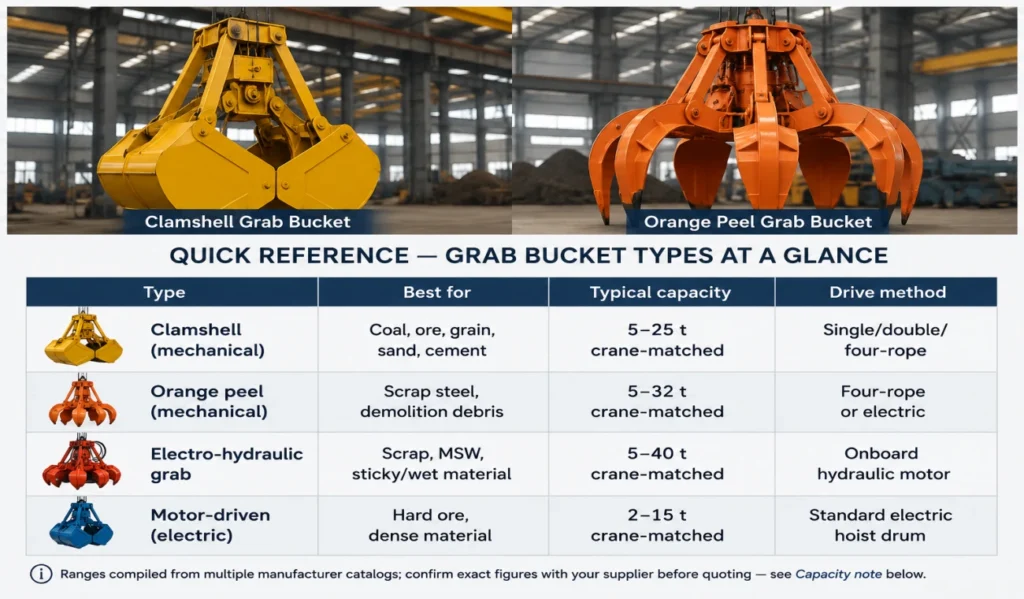
| Tipo | Best for | Capacidade típica | Drive method |
| Clamshell (mechanical) | Coal, ore, grain, sand, cement | 5–25 t crane-matched | Single/double/four-rope |
| Orange peel (mechanical) | Scrap steel, demolition debris | 5–32 t crane-matched | Four-rope or electric |
| Electro-hydraulic grab | Scrap, MSW, sticky/wet material | 5–40 t crane-matched | Onboard hydraulic motor |
| Motor-driven (electric) | Hard ore, dense material | 2–15 t crane-matched | Standard electric hoist drum |
Ranges compiled from multiple manufacturer catalogs; confirm exact figures with your supplier before quoting — see Capacity note below.
Grab Bucket Types: How They're Classified
There isn't one industry-wide classification system. Manufacturers group grab buckets by shape, by the material's bulk density, or by how the bucket is driven — and mixing these up is the most common source of confused quotes.
Classification by Shape: Clamshell, Orange Peel, and Cactus
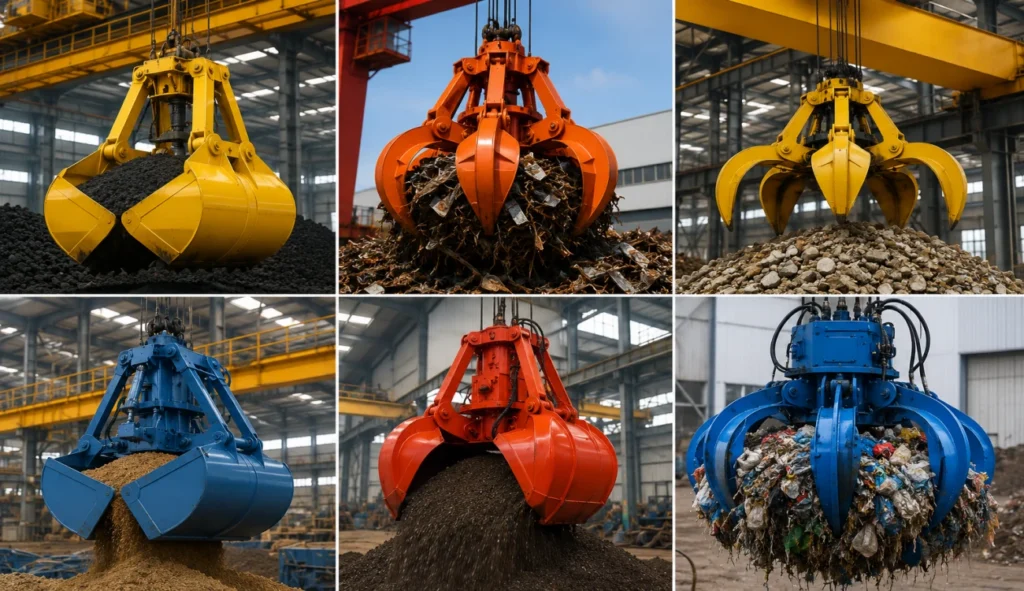
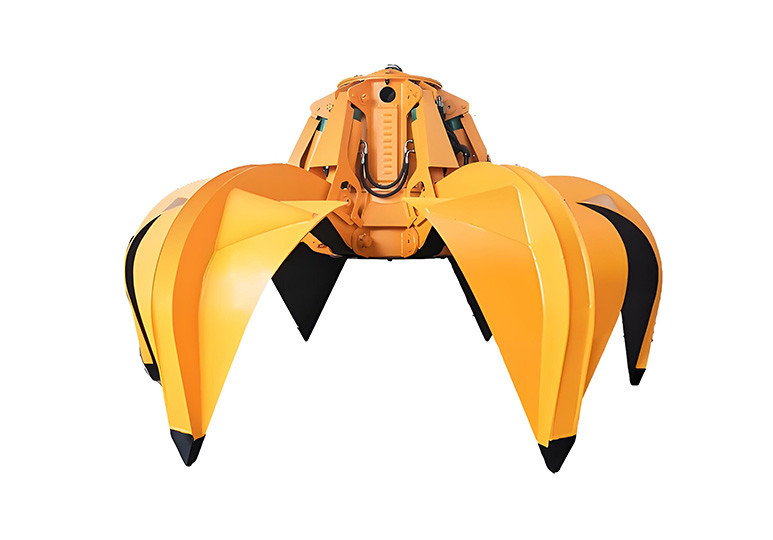
Clamshell grabs use two symmetrical bucket halves and suit loose, flowable material; orange peel grabs use 3–8 articulated tines and suit irregular, bulky material.
The clamshell closes with a sweeping motion that forms a near-sealed chamber — this is why it's the default choice for coal, grain, sand, and cement, where spillage during hoisting matters. Orange peel grabs close with penetrating force instead, so they can bite into scrap steel, pig iron, or demolition debris that a clamshell would simply push aside rather than capture. A third, less common type — the cactus grab, with 3–4 jaws — sits between the two, used where an operation regularly switches between coarse and fine material and can't justify two separate attachments.
The tradeoff: orange peel grabs typically only reach 50–70% volumetric fill on irregular material versus 75–90% for a clamshell on granular material, so a like-for-like volume comparison between the two types overstates the orange peel's actual per-cycle payload.
Classification by Bulk Density: Light, Medium, Heavy, Extra-Heavy
Grab buckets are also grouped by the density of material they're built to handle, not just by shape — this determines wall thickness and closing force, independent of volume.
| Classe de serviço | Bulk density | Typical materials |
| Luz | < 1.2 t/m³ | Dry grain, fly ash, lime, dry slag |
| Médio | 1.2–2.0 t/m³ | Gypsum, gravel, cement, pebbles |
| Pesado | 2.0–2.6 t/m³ | Hard rock, small/medium ore, scrap |
| Extra-heavy | > 2.6 t/m³ | Heavy ore, dense scrap steel |
This matters because two grabs with identical geometric volume are not interchangeable across duty classes: a light-duty clamshell built for fly ash will flex or crack under repeated extra-heavy ore loading, even if the ore's volume never exceeds the bucket's rated size. Match the duty class to your densest regularly-handled material, not your average one.
Classification by Drive Method: Rope, Motor-Driven, and Electro-Hydraulic
Drive method is decided by what your crane can supply — a single-drum crane cannot run a mechanical four-rope grab without modification.
- Rope (mechanical) grabs — single-rope, double-rope, or four-rope — are opened and closed using the crane's own hoisting ropes and require either a single-drum or dual-drum winch, depending on rope count. Four-rope grabs give finer control and a tighter closed seal (gaps as small as 0.3 mm on some designs) but need a crane built for that rope configuration.
- Motor-driven (electric) grabs run on a standard electric hoist drum with a self-contained switching mechanism, making them retrofit-friendly on cranes that already have one hoist reel.
- Electro-hydraulic grabs carry their own hydraulic pump and motor in the grab body, powered through a trailing cable, so they work on a standard single-hook overhead or gantry crane without a second drum. This is the reason electro-hydraulic grabs dominate scrap yards and waste-to-energy plants retrofitting older single-hook cranes.
Sizing a Grab Bucket to Your Crane's Actual Capacity
<a id="capacity-note"></a>
This is the step most buyers skip, and it's where the majority of costly mismatches originate.
Rated Crane Capacity Usually Already Includes the Grab's Own Weight
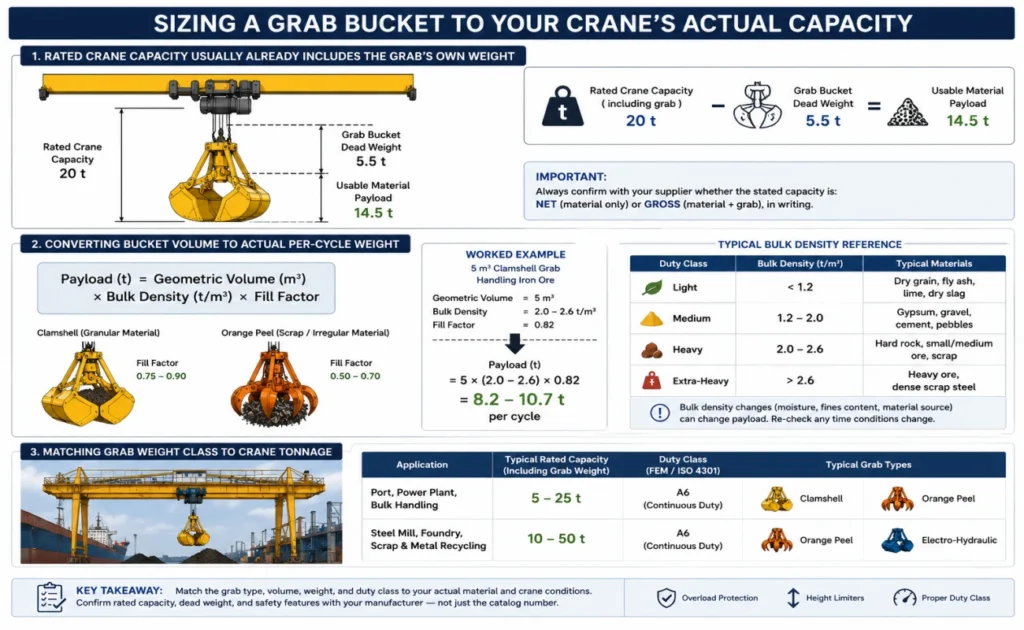
A crane rated for 20 tons with a grab bucket attached does not give you 20 tons of usable material payload — the grab's dead weight comes out of that number first.
Grab bucket dead weight is not negligible: mechanical orange peel grabs alone commonly weigh 5.5–20 tons depending on capacity, and motor-driven grabs in the 0.3–6 m³ range weigh roughly 0.95–5.6 tons. If a crane's published rated capacity already accounts for a specific grab weight (as is standard practice for purpose-built grab cranes), then:
Usable material payload = Rated crane capacity − Grab bucket dead weight
The pattern that causes real procurement trouble: a buyer compares two supplier quotes side by side, one quoting "net load capacity" and another quoting "gross rated capacity including grab," treats the two numbers as equivalent, and specs the crane's main girder around the wrong figure. The fix is procedural, not technical — ask every supplier explicitly whether their stated tonnage is net (material only) or gross (material plus grab), in writing, before comparing quotes.
Converting Bucket Volume to Actual Per-Cycle Weight
Geometric volume on a spec sheet tells you almost nothing until you multiply it by your material's real bulk density and a realistic fill factor.
Payload (t) = Geometric Volume (m³) × Bulk Density (t/m³) × Fill Factor
Fill factor is typically 0.75–0.90 for a clamshell on granular material and 0.50–0.70 for an orange peel on scrap or irregular material — the orange peel's tines simply can't achieve full volumetric closure on odd-shaped pieces.
Worked example: a 5 m³ clamshell grab handling iron ore (roughly 2.0–2.6 t/m³, per the heavy-duty density band above) at a fill factor of 0.82 yields approximately 8.2–10.7 tons of material per cycle — not 5 tons, and not a fixed number, because it moves with bulk density. A recurring, easy-to-miss cost driver here: if the same grab later switches from dry ore to wet or fines-heavy ore, bulk density rises and per-cycle payload can climb past the crane's rated load even though the bucket's geometric volume hasn't changed — this is worth re-checking any time the material source or moisture content changes, not just at initial specification.
Matching Grab Weight Class to Crane Tonnage
Manufacturer capacity bands for grab-equipped cranes vary enough that quoting one figure as an industry standard would be misleading. As a general orientation: mid-size grab-crane packages commonly fall in the 5–25 ton range (rated capacity including grab weight, duty class A6 per FEM/ISO classification is typical for continuous port and plant duty), while heavy scrap and metal-recycling installations for steel mills and foundries commonly run 10–50 tons. Orange peel grab dead weight and capacity ceilings differ meaningfully between manufacturers — some catalogs list clamshell grabs topping out around 25 tons and orange peel variants up to roughly 30–32 tons at the same duty class, while others differ. Treat any specific tonnage figure as a starting reference point, and confirm the exact rated capacity, duty class, and included safety features (overload protection, height limiters) against your chosen manufacturer's actual design documents — not against a competitor's catalog number.
What a Grab Bucket Costs in 2026
Pricing depends far more on drive method and duty class than on bucket volume alone. The ranges below are market-reference figures for standalone grab bucket attachments; a complete grab-equipped overhead or gantry crane package (crane structure, dual-drum or hydraulic hoist, controls, safety devices) prices separately and substantially higher.
| Grab type | Capacidade típica | Reference price (standalone unit) |
| Mechanical clamshell, standard duty | 1–6 m³ | $1,200–$2,500 |
| Mechanical clamshell, heavy duty | 6–20 m³ | $2,000–$5,000+ |
| Mechanical orange peel | 1–8 m³ | $1,500–$4,000 |
| Electro-hydraulic clamshell/orange peel | 1–10 m³ | $3,000–$8,000+ |
| Complete grab crane package (5–25 t) | — | Priced per project; request a specification-based quote |
Cost drivers worth budgeting for beyond the base unit:
- Wear-resistant plate (AR400/AR500) on jaw liners and cutting edges — adds roughly 10–20% to unit cost but meaningfully extends service life against abrasive material like ore or slag.
- Wire rope replacement — this is a hidden cost that rarely shows up in the initial quote. Four-rope grabs demand tight rope synchronization, and in dusty or corrosive environments, rope wear cycles can run shorter than catalog service-life estimates suggest. Ask specifically whether the warranty or first-year spare parts package includes ropes, not just structural components.
- Certification and inspection — CE marking (mandatory for EU import) and third-party inspection (SGS, Bureau Veritas, DNV) typically add a few thousand dollars per unit depending on scope, and lead time for certified units runs longer than for standard domestic-spec units.
- Lead time — standard models from established Chinese manufacturers typically ship in 4–8 weeks; custom duty classes or non-standard rope configurations commonly extend that to 10–20 weeks.
For loads under roughly 15 tons in standard port or plant duty, a mechanical clamshell on a four-rope or double-rope configuration generally offers the best cost-to-durability ratio; electro-hydraulic units earn their higher price mainly where retrofitting a second hoist drum isn't feasible.
Obter Cotação de SoluçãoProcurement Checklist Before You Order
Confirm these with your engineering team and supplier before issuing a purchase order:
- Material bulk density confirmed (t/m³), including seasonal or source-related variation
- Crane's rated capacity confirmed as net (material only) or gross (including grab dead weight) — in writing
- Payload calculated using volume × density × fill factor, checked against crane SWL at the working radius
- Duty class (FEM/ISO 4301) matched to actual cycles-per-hour and continuous vs intermittent use
- Drive method matched to available drum configuration on the crane
- Wear-plate specification (standard vs AR400/AR500) matched to material abrasiveness
- Wire rope coverage confirmed in warranty or first-year spare parts package
- Certification scope (CE, third-party inspection) confirmed against destination-market requirements
- Lead time confirmed against commissioning schedule
Conclusão
Choosing a grab bucket for an overhead or gantry crane comes down to three layered decisions: shape (clamshell vs. orange peel) matched to material behavior, duty class matched to bulk density, and drive method matched to what your crane can actually supply. The costliest mistakes happen not in picking a grab type but in comparing tonnage figures that aren't measuring the same thing — net versus gross capacity, or a fixed volume against a material whose real density varies. Confirm those numbers in writing before comparing supplier quotes, and a grab bucket for overhead and gantry cranes becomes a straightforward spec rather than a guessing game.
If you're ready to move forward, send us your crane's rated capacity, working radius, and material bulk density — that's what we need to recommend the right grab type and duty class for your operation.

Especialista de Equipamento
Gestor de Negócios de Gruas com vasta experiência em gestão de projetos de elevação pesada e supervisão operacional. Histórico comprovado na promoção do crescimento da receita e na garantia da conformidade com as normas de segurança.
FAQ
Q1: Does a grab bucket's rated capacity include the bucket's own weight?
In most purpose-built grab crane packages, yes — the crane's published rated capacity is a gross figure that already includes the grab bucket's dead weight, so usable material payload is lower than the headline tonnage. Always confirm in writing whether a quoted figure is net (material only) or gross (material plus grab), since suppliers are not consistent on this and it directly affects which crane girder size you need.
Q2: What's the difference between a clamshell and an orange peel grab bucket?
A clamshell uses two symmetrical halves that close in a sweeping motion, suited to loose, flowable material like coal, grain, and sand. An orange peel grab uses 3–8 articulated tines that close with penetrating force, suited to irregular material like scrap steel and demolition debris. Orange peel grabs typically only reach 50–70% volumetric fill versus 75–90% for a clamshell, so equal-volume comparisons overstate the orange peel's actual payload.
Q3: How much does a grab bucket for an overhead crane cost?
Standalone mechanical clamshell grabs generally run $1,200–$5,000 depending on capacity and duty class, mechanical orange peel grabs $1,500–$4,000, and electro-hydraulic units $3,000–$8,000 or more. A complete grab-equipped crane package — structure, hoist, controls, and safety systems — prices separately and substantially higher, and is best quoted against your specific tonnage and duty-class requirements rather than estimated from bucket price alone.
Q4: Can I run a grab bucket on a single-hook overhead crane?
Yes, if you choose an electro-hydraulic or motor-driven grab. These carry their own drive mechanism (a hydraulic pump or an electric switching motor) built into the grab body, so they don't require the crane to have a second hoisting drum. Mechanical four-rope or double-rope grabs, by contrast, need a crane built with the matching rope configuration.
Q5: How do I know what size grab bucket I need for my crane?
Start from your crane's rated capacity and working radius, not from a target bucket volume. Calculate expected payload as volume × material bulk density × fill factor, and make sure that figure stays within your crane's safe working load with margin. Because bulk density varies by material and even by moisture content, this calculation is worth re-checking whenever your material source changes, not just at initial purchase.

 English
  العربية
  Español
  Français
  Português
  Русский