
Introduction: Why Height Adjustability Changes Everything
Choosing the wrong lifting equipment can cost far more than the purchase price — in downtime, safety incidents, and wasted floor space. If your operation handles loads of varying heights, or if you need to move your crane between multiple locations, an adjustable height gantry crane may be the most practical investment you make this year.
This guide addresses the questions procurement managers and facility engineers ask most often: How do I compare types? What does one actually cost? Which capacity and height range fits my workflow? We answer all of that with real data, comparison tables, and documented application cases — so you can make a confident, defensible purchasing decision.
Whether you are sourcing a portable adjustable gantry crane for a maintenance bay or specifying a heavy-duty steel model for a manufacturing floor, the framework in this guide applies directly to your situation.
Índice
- Introduction: Why Height Adjustability Changes Everything
- 1. What Is an Adjustable Height Gantry Crane?
- 2. Types of Adjustable Gantry Cranes: Side-by-Side Comparison
- 3. Adjustable Gantry Crane Price: What Drives Cost?
- 4. Key Application Scenarios
- 5. How to Choose the Right Adjustable Gantry Crane: Step-by-Step
- 6. Safety Standards and Compliance
- 7. Practical Tips When You Buy an Adjustable Gantry Crane
- Conclusion: Making Your Decision
- FAQ: Adjustable Height Gantry Cranes
- Q1. What is the typical adjustable height range for a portable gantry crane?
- Q2. How much does an adjustable gantry crane cost, including delivery and setup?
- Q3. Do I need a permit or licence to operate an adjustable gantry crane?
- Q4. How often should an adjustable gantry crane be inspected?
- Q5. What is the difference between an adjustable gantry crane and a jib crane for workshop use?
1. What Is an Adjustable Height Gantry Crane?
An adjustable height gantry crane is a freestanding lifting structure whose vertical clearance between the crossbeam and the floor can be modified — either before installation or in the field — without dismantling the entire unit. This distinguishes it from fixed gantry cranes, which have a single, permanent lifting height determined at fabrication.
1.1 Core Design Principle
The height adjustment mechanism typically uses one of three approaches:
- Pin-and-hole legs: Steel or aluminum legs with multiple bolt holes allow the crossbeam height to be set in fixed increments (e.g., every 150–300 mm).
- Continuous-screw or rack systems: A threaded collar or rack-and-pinion allows stepless adjustment across the full height range.
- Telescoping tube legs: An inner tube slides inside an outer tube and locks at any point within the overlap zone.
Each approach involves trade-offs among rigidity, adjustment speed, and load rating. Pin-and-hole systems are structurally simpler and typically rated for heavier loads; screw systems allow faster repositioning; telescoping designs are most compact when collapsed for transport.
1.2 Key Components
Understanding gantry crane components helps you evaluate supplier specifications accurately. A standard adjustable gantry crane consists of:
- Main beam (girder): The horizontal load-bearing member, typically an I-beam or box section.
- Adjustable legs: Vertical supports with the height-change mechanism built in.
- End trucks / casters: Wheeled assemblies at the base of each leg for mobility (on portable models).
- Hoist trolley: Travels along the beam and carries the hoist hook block.
- Electric or manual hoist: Provides the actual lifting force.
- Tie rods / lateral bracing: On wider spans, diagonal rods resist racking forces.
A well-documented bill of materials from your adjustable gantry crane supplier should identify each component with material grade, finish specification, and applicable standard.
2. Types of Adjustable Gantry Cranes: Side-by-Side Comparison
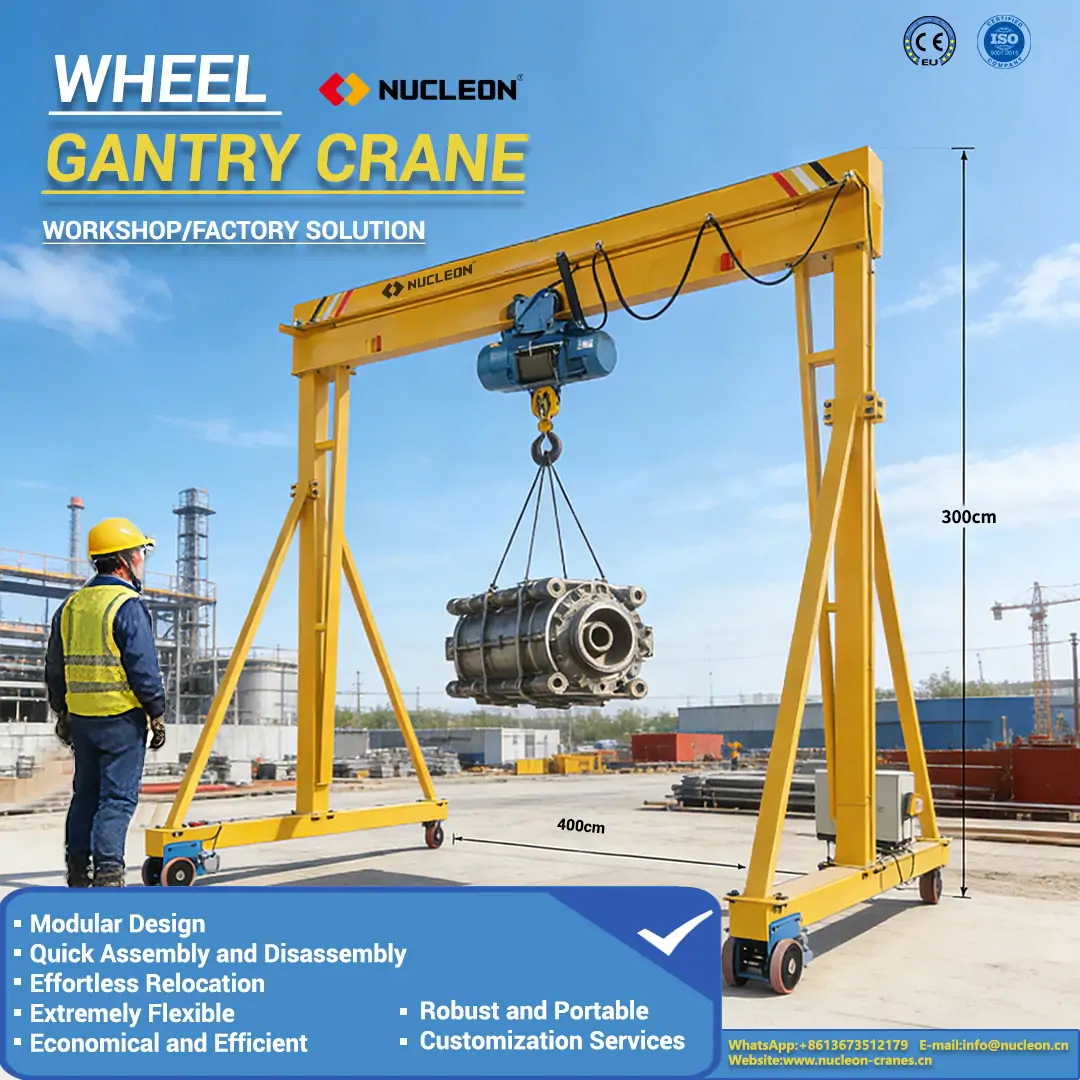
The market for adjustable gantry cranes for sale broadly divides into aluminum portable models and structural steel models. A third category — custom adjustable gantry crane configurations — covers non-standard spans, heights, or duty cycles. The table below summarizes the practical differences.
| Funcionalidade | Aluminum Portable | Steel Portable | Steel Fixed-Base | Custom / Heavy Duty |
| Capacidade Típica | 0.25 – 3 t | 1 – 10 t | 2 – 20 t | 10 – 100+ t |
| Height Range | 1.8 – 4.5 m | 2.0 – 6.0 m | 3.0 – 8.0 m | Project-specific |
| Intervalo de abrangência | 1.5 – 5 m | 2 – 8 m | 3 – 12 m | Up to 30+ m |
| Mobilidade | High (casters) | Médio | Low / fixed | Site-specific |
| Corrosion Resistance | Excellent | Good (with coating) | Good (with coating) | Per spec |
| Approx. Price (USD) | $800 – $4,000 | $2,000 – $15,000 | $5,000 – $40,000 | $30,000 – $500,000+ |
| Tempo de espera | Stock / 2–4 wk | 2–8 weeks | 4–16 weeks | 8–52 weeks |
Table 1 — Adjustable Gantry Crane Type Comparison. Capacity and price ranges are indicative based on market survey data (2023–2025). Verify specifications against manufacturer datasheets and applicable standards (ISO 4301, FEM 1.001, ASME B30.2).
2.1 Aluminum Adjustable Gantry Crane
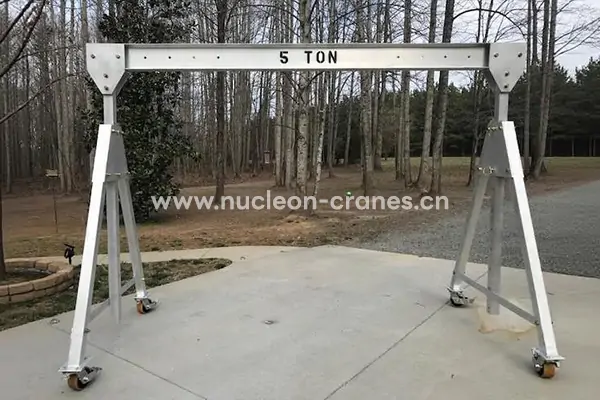
Aluminum models dominate the garage gantry crane and light-maintenance segment. Their main advantage is weight: a 1-tonne aluminum gantry crane may weigh under 100 kg complete, allowing two people to move and reassemble it without mechanical assistance. The trade-off is lower rigidity under dynamic loading. If your lift cycle involves frequent picks or shock loading, a steel model in the same capacity class will typically offer a higher fatigue life.
Aluminum is also the preferred material for food processing and pharmaceutical facilities, where steel corrosion products cannot be tolerated, and for outdoor coastal installations where salt air would degrade uncoated steel within a few seasons.
2.2 Steel Adjustable Gantry Crane
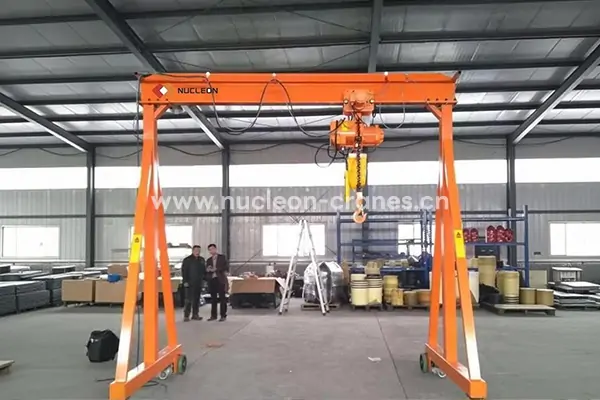
Steel portable gantry cranes and fixed-base models cover the broadest capacity range and dominate workshop gantry crane and warehouse gantry crane applications. The structural beam section — whether a standard I-beam, wide-flange (WF) section, or fabricated box beam — can be sized precisely for the required span and load, while aluminum is limited by available extrusion profiles.
One common misunderstanding is that 'adjustable' and 'portable' mean the same thing. A steel adjustable gantry crane with a 5-tonne capacity and a 6-metre span may be technically movable with forklift assistance, but it is not portable in the garage-crane sense. Clarify mobility requirements with your adjustable gantry crane manufacturer before finalizing the specification.
3. Adjustable Gantry Crane Price: What Drives Cost?
One of the most searched questions in this category is 'how much does a gantry crane cost?' The honest answer is: it depends on more variables than most buyers expect. The following breakdown gives you a framework to evaluate quotes rather than just compare headline numbers.
| Cost Driver | Low-Cost Scenario | Mid-Range Scenario | Premium Scenario |
| Capacity (SWL) | 0.5 t | 3 t | 10 t |
| Height Range | 1.8 – 3.0 m | 2.5 – 5.0 m | 3.0 – 6.5 m |
| Span | 2 m | 4 m | 8 m |
| Material | Aluminum | Steel, painted | Steel, hot-dip galv. |
| Tipo de guincho | Manual chain | Electric wire rope | Electric + VFD |
| Certification | Manufacturer cert. | CE / ASME B30.2 | CE + third-party test |
| Preço indicativo (USD) | $900 – $2,500 | $6,000 – $18,000 | $25,000 – $60,000 |
Table 2 — Adjustable Gantry Crane Price Drivers (2024–2025 market data). Prices are ex-works estimates and exclude freight, installation, and commissioning. Source: industry supplier quotation survey. Verify current pricing directly with your adjustable gantry crane supplier.
3.1 Hidden Costs Buyers Overlook
Beyond the unit price, a realistic total cost of ownership (TCO) for a gantry crane installation typically includes:
- Freight and import duties: For cranes shipped from overseas manufacturers, freight on a 3-tonne unit from Asia to a US port can add $800–$2,500 depending on Incoterms and port of entry.
- Foundation or anchor work: Fixed-base models require engineered floor anchors; costs range from $500 for simple bolt-down plates to $5,000+ for new concrete pads.
- Electrical supply: If you are adding an electric hoist, a dedicated 3-phase circuit may cost $1,000–$3,000 depending on panel proximity.
- Commissioning and load testing: Third-party load testing to verify rated capacity is required before first use under ASME B30.2 and OSHA 1910.179 for overhead hoisting equipment.
- Annual inspection: OSHA 1910.179(j) requires periodic inspection; budget $300–$800 per year for a qualified inspector.
4. Key Application Scenarios
4.1 Workshop and Maintenance Lifting
The most common use case for a portable adjustable gantry crane is engine removal and installation in vehicle maintenance workshops. A typical automotive service bay requires a crane that can straddle a vehicle (span: 2–3 m), lift a car or light-truck engine (load: 200–600 kg), and lower the assembly onto a cradle at floor level — making a height range of approximately 1.5 m to 3.5 m appropriate.
Case reference: A regional fleet maintenance operation in the UK (fleet of 80 light commercial vehicles) replaced a fixed overhead monorail with a 1-tonne aluminum adjustable gantry crane (span 2.5 m, height range 1.9–3.2 m). The crane moves between three service bays on locking casters and is repositioned by a single technician. This eliminated a scheduled monthly monorail inspection and freed up 40 cm of vertical clearance that was previously consumed by the fixed beam. (Source: Case documented in LEEA technical bulletin TB-2022-07.)
4.2 Warehouse and Distribution
Warehouse gantry crane applications typically involve unloading heavy pallets or machinery from vehicles, positioning equipment within a racking zone, or loading/unloading at a fixed dock. Adjustable height matters here because dock height, truck bed height, and shelf heights in different warehouse zones may all differ. A 3-tonne steel adjustable gantry crane with a height range of 3.0–5.5 m covers the majority of standard warehouse lifting scenarios without requiring two separate pieces of equipment.
4.3 Construction and Modular Installation
Construction gantry crane use often involves setting prefabricated panels, mechanical plant items, or structural steel components in locations where a mobile crane cannot access. Adjustable height is especially valuable in phased construction, where the floor slab level changes between project stages. Steel models in the 5–15 tonne class are most common in this segment.
4.4 Manufacturing and Assembly Lines
On a production floor, an adjustable gantry crane can serve as a supplement to a fixed overhead crane in areas where the ceiling height is insufficient for a runway-mounted system, or where a production jig or assembly fixture changes height over time. Custom adjustable gantry crane designs with variable span and integrated tooling attachment points are common in aerospace and heavy equipment manufacturing.
5. How to Choose the Right Adjustable Gantry Crane: Step-by-Step
Knowing how to choose a gantry crane comes down to systematically matching five parameters to your operation. Work through them in order; changing any one parameter late in the specification process can cascade into redesign cost.
| Step | Parâmetro | Key Questions to Answer | Common Mistake |
| 1 | Safe Working Load (SWL) | What is the maximum single-lift load? Add 25% safety margin. | Rating for average load, not maximum |
| 2 | Required Lifting Height | Floor to bottom of load at max lift + headroom for rigging. | Forgetting sling / shackle height (typically 0.3–0.6 m) |
| 3 | Span | Widest obstacle the crane must straddle + lateral clearance. | Not accounting for leg base footprint |
| 4 | Duty Cycle | Lifts per shift, average load as % of SWL, operating hours/year. | Selecting M1/M2 class for continuous industrial use |
| 5 | Site Conditions | Floor flatness, surface type, ceiling clearance, environment. | Specifying indoor casters for outdoor / uneven surfaces |
Table 3 — Gantry Crane Selection Framework. Duty cycle classification per ISO 4301-1:2011 (crane mechanisms classification). Floor flatness tolerance for caster-wheeled gantries typically requires FF25 or better (ASTM E1155).
5.1 What Size Gantry Crane Do I Need?
'What size gantry crane do I need?' is almost always really two questions: what capacity, and what span? Capacity is straightforward once you know your maximum load. Span is often underestimated. Remember that the legs of a gantry crane must stand outside the object being lifted — so if you are lifting a machine that is 2 m wide, and each leg base is 0.4 m wide, your minimum inside span is 2 m + 2 x 0.4 m + working clearance (0.2 m per side) = approximately 3.2 m minimum. Specify span as the inside clear dimension, and confirm your supplier quotes on the same basis.
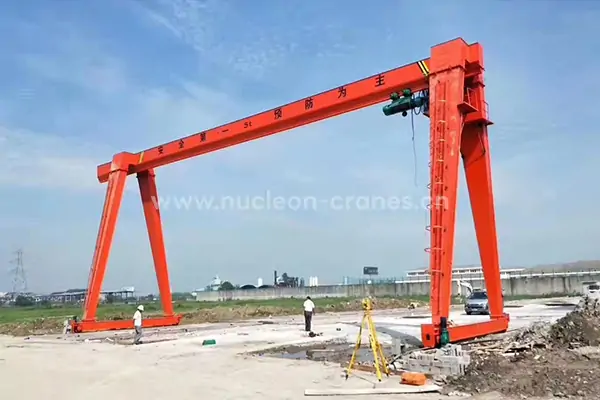
5.2 Adjustable Gantry Crane vs. Fixed Gantry Crane
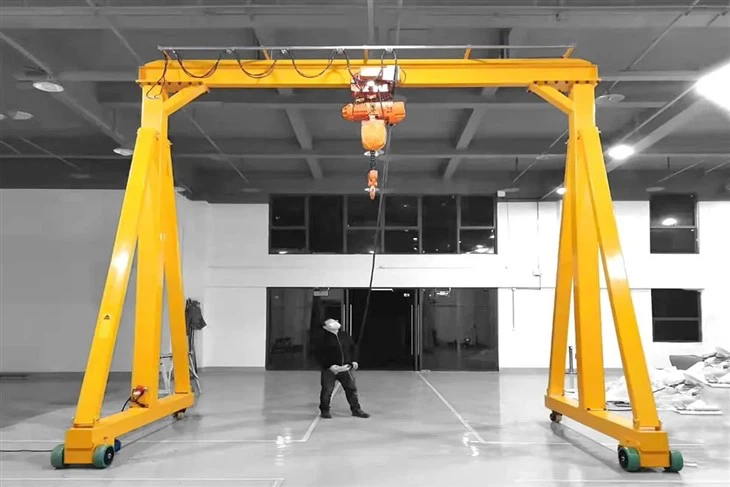
The adjustable gantry crane vs fixed gantry crane decision often comes down to one question: will the crane serve one purpose in one location for its entire service life? If yes, a fixed crane with an optimized beam section will be lighter, stiffer, and less expensive for the same capacity. If the crane must adapt to different lift heights, move between locations, or accommodate future process changes, adjustability pays for itself quickly. In our experience, operations with more than three distinct lifting scenarios per year typically justify the premium for adjustable height.
Ponte Rolante Ajustável
5.3 Portable Gantry Crane vs. Ponte rolante
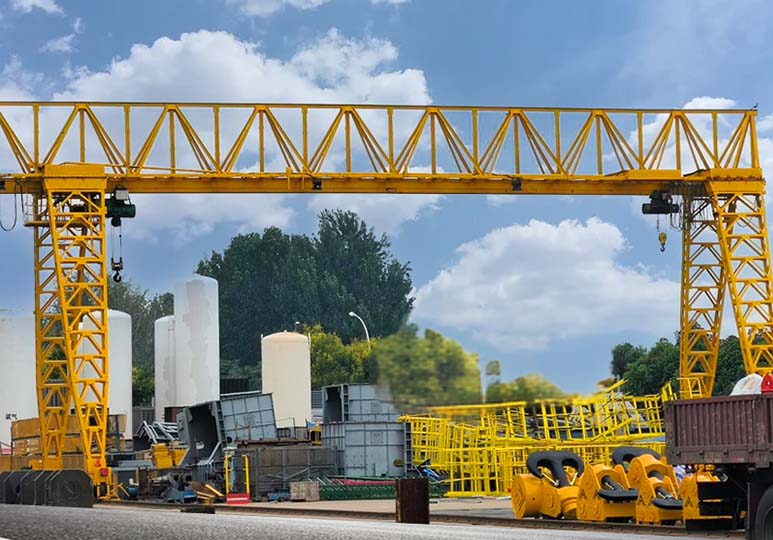
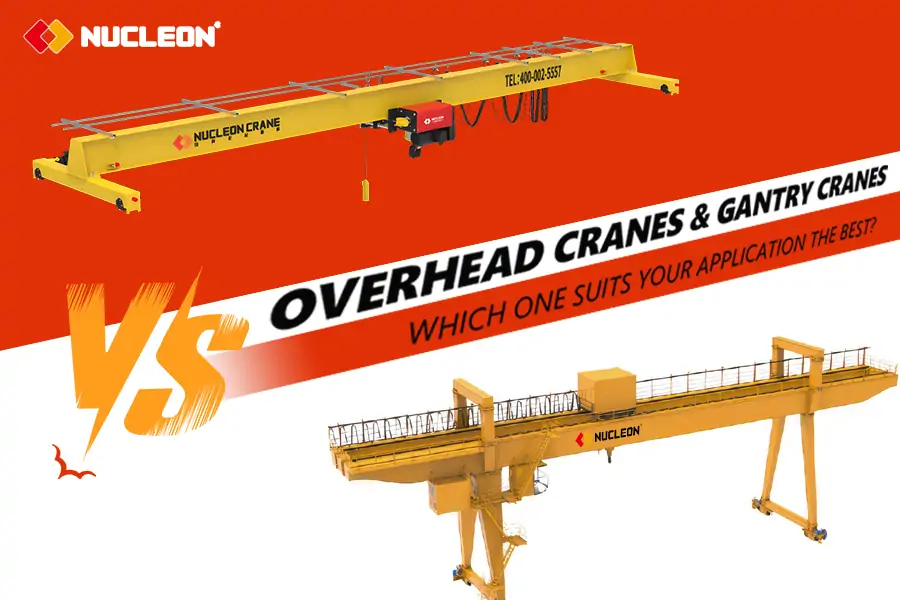
The portable gantry crane vs overhead crane comparison is most relevant when planning a new facility or retrofitting an existing space. Overhead bridge cranes require structural runway beams and typically a building with sufficient roof height and column spacing to support them — often adding $15,000–$60,000 in structural costs beyond the crane itself. A portable gantry crane requires no building modifications but is limited to the capacity and span ranges described in Table 1. For facilities with intermittent lifting needs or limited capital budgets, a portable adjustable gantry crane is frequently the more cost-effective solution.
6. Safety Standards and Compliance
Pórtico rolante safety is not optional, and the applicable standards depend on your geography and application. The key frameworks for procurement teams to understand are:
| Padrão | Region / Body | Escopo | Relevance to Buyers |
| ASME B30.2 (2022) | USA / ASME | Overhead and gantry cranes, 2-girder and single-girder | Mandatory for US workplaces under OSHA 1910.179 |
| OSHA 29 CFR 1910.179 | USA / Federal | Design, operation, inspection requirements | Legal compliance baseline for US commercial use |
| EN 13001 (2021) | EU / CEN | Crane safety, general design principles | CE marking prerequisite for EU market entry |
| ISO 4301-1 (2011) | International | Classification of mechanisms and structures | Used to specify duty cycle (M1–M8 classes) |
| AS 1418.1 (2023) | Australia / SA | Cranes, hoists, and winches — general requirements | Required for Australian and NZ installations |
Table 4 — Key Crane Safety Standards. Standards listed are current as of 2024–2025. Verify edition currency with the issuing body before specifying. OSHA 29 CFR 1910.179 is publicly available at osha.gov.
6.1 Crane Inspection Checklist Highlights
Before placing a gantry crane into service, and at the intervals required by your applicable standard, a qualified person must inspect:
- Structural members: Check for cracks, deformation, or corrosion on beam, legs, and base.
- Hoist and chain/wire rope: Inspect for wear, kinking, broken wires, and correct reeving.
- Load blocks and hooks: Verify safety latch function and check for visible defects or deformation.
- End stops and limit switches: Confirm hoisting limit switch prevents over-travel.
- Wheels and casters: Check bearing condition, tread wear, and locking mechanism function.
- Labels and markings: Confirm SWL rating plate is legible and securely attached.
Lifting safety standards consistently require that any deficiency noted during inspection results in the crane being taken out of service until repaired. Document all inspections; OSHA requires records of periodic inspections to be retained.
7. Practical Tips When You Buy an Adjustable Gantry Crane
7.1 Evaluating an Adjustable Gantry Crane Manufacturer
When assessing an adjustable gantry crane manufacturer or supplier, request the following documentation before issuing a purchase order:
- Structural calculation report or FEA summary for your specific capacity and span combination.
- Material certifications (mill certificates) for structural steel or aluminum extrusion.
- Load test certificate from an accredited third-party testing organization.
- CE Declaration of Conformity or equivalent (ASME, AS 1418) as applicable.
- Spare parts list and parts availability commitment — critical for long-term maintenance.
An adjustable gantry crane supplier who hesitates to provide these documents is worth treating with caution, regardless of price competitiveness.
7.2 Negotiating Price on an Adjustable Gantry Crane for Sale
Adjustable gantry crane price is negotiable, particularly on orders of multiple units or for long-term supply relationships. Effective levers include: committing to a full year's maintenance contract (which also protects you operationally), ordering with extended lead times that allow the manufacturer to schedule more efficiently, and requesting bundled pricing that includes the hoist, trolley, rigging hardware, and initial load test.
Avoid the temptation to buy based solely on unit price. A crane that fails a load test, requires rework, or ships without documentation will cost more in delays than the price difference between suppliers would have saved.
Conclusion: Making Your Decision
An adjustable height gantry crane offers genuine operational flexibility — but only if it is properly specified, sourced from a compliant manufacturer, and maintained to the applicable standard. The key takeaways from this guide:
- Adjustability pays off when you have multiple lifting scenarios or need to move the crane between locations.
- Material choice (aluminum vs. steel) should follow duty cycle and environment requirements, not just price.
- Total cost of ownership includes freight, electrical supply, foundation work, commissioning, and annual inspection.
- Always request structural calculations, material certs, and load test documentation from your supplier.
- Match duty cycle classification (ISO 4301 M-class) to your actual operating pattern — not the lightest category that technically applies.
If you are at the beginning of your selection process, use Table 3 as your framework. If you are evaluating supplier quotations, Table 2 will help you decompose what is driving any price differences. And if you are working through compliance requirements, Table 4 identifies the standards most likely to apply to your region and application.

Especialista de Equipamento
Gestor de Negócios de Gruas com vasta experiência em gestão de projetos de elevação pesada e supervisão operacional. Histórico comprovado na promoção do crescimento da receita e na garantia da conformidade com as normas de segurança.
FAQ: Adjustable Height Gantry Cranes
Q1. What is the typical adjustable height range for a portable gantry crane?
Most aluminum portable adjustable gantry cranes offer a height range of 1.8 m to 4.5 m, adjustable in increments of 150–300 mm via pin-and-hole legs. Steel portable models typically range from 2.0 m to 6.0 m. When comparing models, confirm whether the stated height is to the top of the beam or to the hook at its highest position — these can differ by 200–400 mm depending on hoist design. If your process requires a specific under-hook height (e.g., 3.6 m to clear a machine body), specify that dimension explicitly rather than relying on the nominal range.
Q2. How much does an adjustable gantry crane cost, including delivery and setup?
A 1-tonne aluminum portable adjustable gantry crane with manual chain hoist typically costs $1,200–$3,500 ex-works, plus $150–$600 domestic freight and $0 installation (user-assembled). A 3-tonne steel adjustable gantry crane with electric hoist runs $8,000–$18,000 ex-works, with freight of $500–$2,000 and installation/commissioning of $1,500–$4,000 depending on site complexity. Fixed-base 10-tonne models can reach $40,000–$80,000 all-in once civil work and third-party load testing are included. Always request a fully landed cost quotation — not just FOB or ex-works — to make accurate supplier comparisons.
Q3. Do I need a permit or licence to operate an adjustable gantry crane?
Requirements vary by jurisdiction and crane capacity. In the United States, OSHA does not require a federal operator licence for gantry cranes, but requires that operators be trained and evaluated as competent persons (ASME B30.2, Sec. 2-3). Several US states have additional requirements. In Australia, cranes above 3 tonne SWL require a High Risk Work (HRW) Licence under Safe Work Australia guidelines. In the EU, requirements are set at the member-state level — Germany, France, and the Netherlands each have specific operator qualification rules. Confirm requirements with your local authority before starting operator training planning.
Q4. How often should an adjustable gantry crane be inspected?
ASME B30.2 and OSHA 1910.179 distinguish between frequent inspections (before each use or daily for cranes in regular service) and periodic inspections (monthly to annually depending on service severity). At minimum: a visual check of structural members, hoist, chain/rope, and hook before each shift; a documented monthly inspection of all mechanical components; and a comprehensive annual inspection by a qualified person that includes load testing if there is any doubt about structural integrity. Document everything — inspection records are the first thing an OSHA inspector will request following an incident.
Q5. What is the difference between an adjustable gantry crane and um guindaste de braço for workshop use?
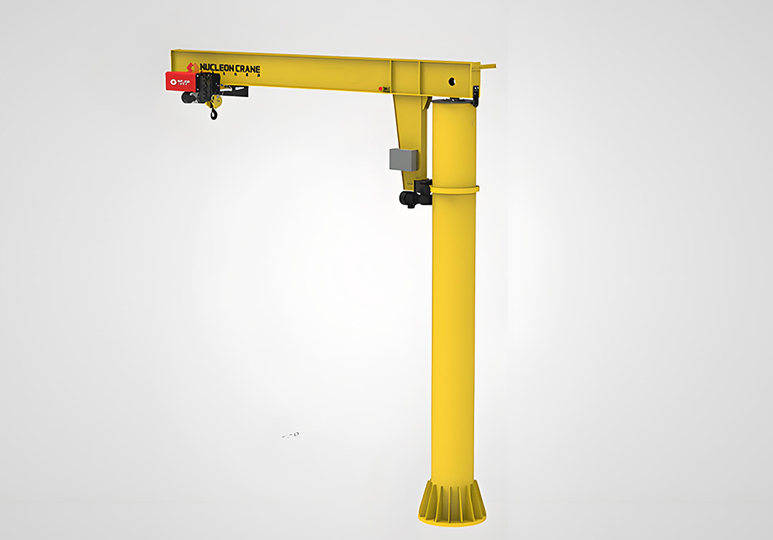
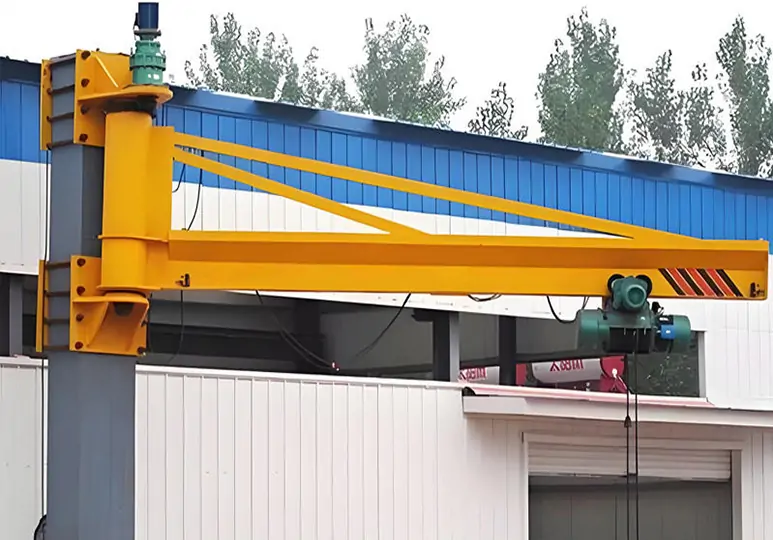
A gantry crane vs jib crane comparison comes down to coverage area and load path. A jib crane mounts to a wall or floor column and provides 180–360 degree coverage within a defined radius — typically 3–6 m — but transfers the reaction load into the building structure or a dedicated foundation. A gantry crane is self-supporting and can cover a rectangular work zone of any length, but requires clear floor space for the legs. For workshop lifting near a single machine tool, a jib crane may offer more ergonomic access. For general-purpose bay lifting or situations where building modifications are not permitted, a portable adjustable gantry crane is the more flexible choice. Many facilities use both.

 English
  العربية
  Español
  Français
  Português
  Русский