

Un palan électrique with remote control is among the most common lifting equipment in factories, warehouses, and construction sites. Driven by a motor, they automatically lift and lower heavy objects. The operator controls the entire process from a safe distance using a remote control, making it both labor-saving and highly efficient. If you are considering purchasing one, this article helps you understand the differences between the two main types, the key points to check when choosing one, and the electric hoists offered by Nucelon Cranes.
Table des matières
- How Remote-Controlled Electric Hoists Work
- Nucleon Cranes: Electric Hoists Designed for Real-World Working Conditions
- How to Make the Right Selection Decision
- Foire aux questions
- Q1: What is the control distance of the wireless remote control?
- Q2: My existing electric hoist only has a wired hand control box; can it be converted to a wireless remote control?
- Q3: What is the main difference between a chain electric hoist and a wire rope electric hoist?
- Q4: What special precautions should be taken for outdoor installation?
- Q5: Will the load fall if there is a sudden power outage during operation?
- Q6: Can standard electric hoists be used in chemical plants or fuel storage areas?
- Q7: Can Nucleon Cranes customize hoists to meet specific requirements?
How Remote-Controlled Electric Hoists Work
Electric hoists use a motor to drive a chain ou câble métallique to lift or lower heavy objects suspended on a hook. The equipment is fixed to a workshop beam, pont roulant, ou portique and is ready to use once powered on. The remote control—either a wired handheld control box or a wireless remote—allows the operator to remain in a safe position while the equipment is operating.
Remote-controlled electric hoists are widely used in manufacturing, warehousing, shipbuilding, construction, and maintenance. Wherever there is a need for regularly moving heavy objects, remote-controlled electric hoists provide a stable and reliable solution.
Wired Pendant or wireless remote control: Which is right for you?
A wired pendent connects directly to the hoist via cable, providing a stable signal and suitable for situations where the operator's position is fixed. A wireless remote control operates via wireless signal, with a standard control distance of 50 to 100 meters. The operator can move freely and maintain a constant line of sight to the load, making it more suitable for most industrial sites.
Every electric hoist manufactured by Nucleon Cranes comes standard with a CE-certified wireless remote control, featuring a built-in emergency stop button and available in 8-key and 12-key layouts to suit different operational needs.
Two Main Types: Electric Chain Hoist and Electric Wire Rope Hoist
The single most important decision when buying an electric hoist is choosing between a chain hoist and a wire rope hoist. They serve different needs, and the wrong choice for your application creates problems that are expensive to fix.
Treuil à chaîne électrique
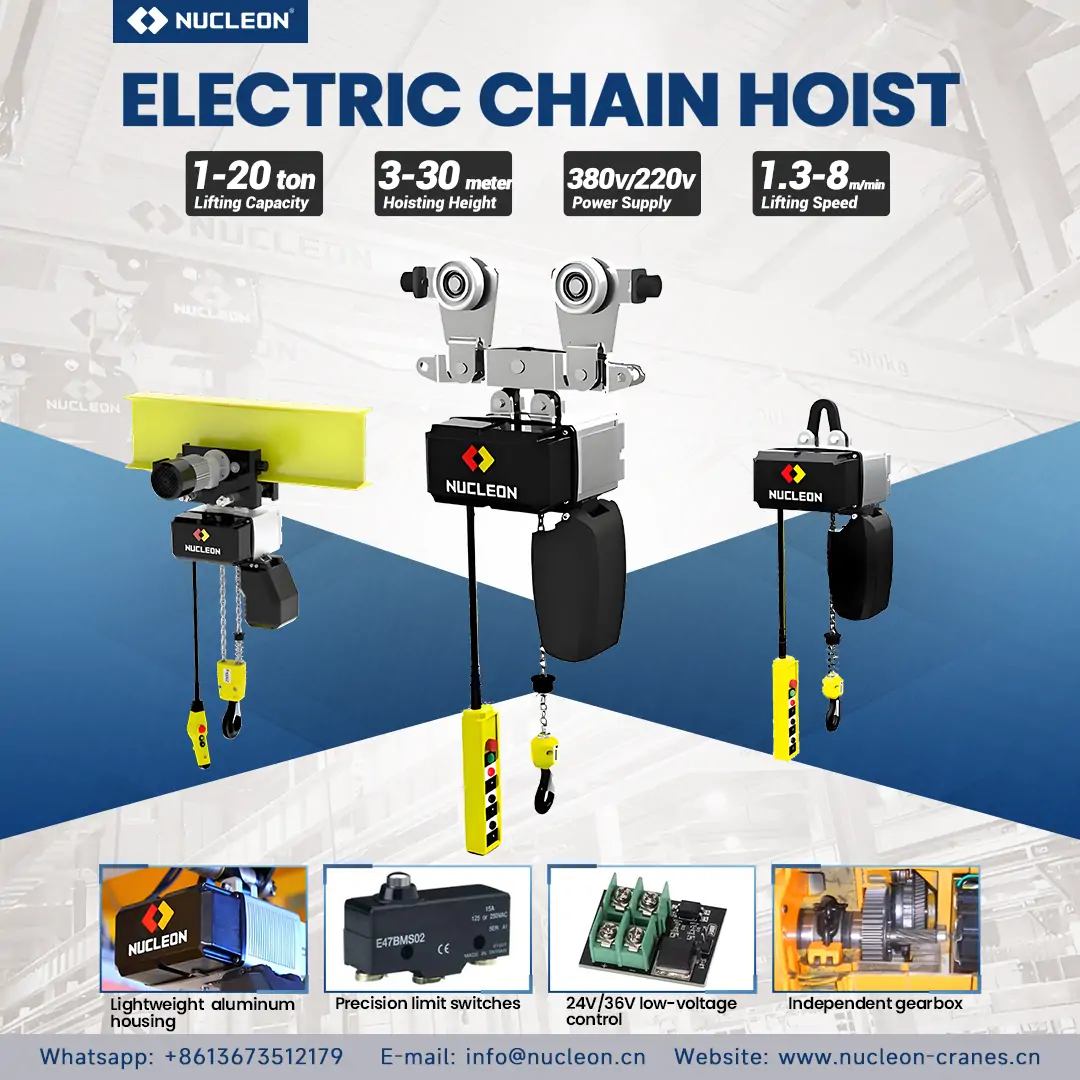
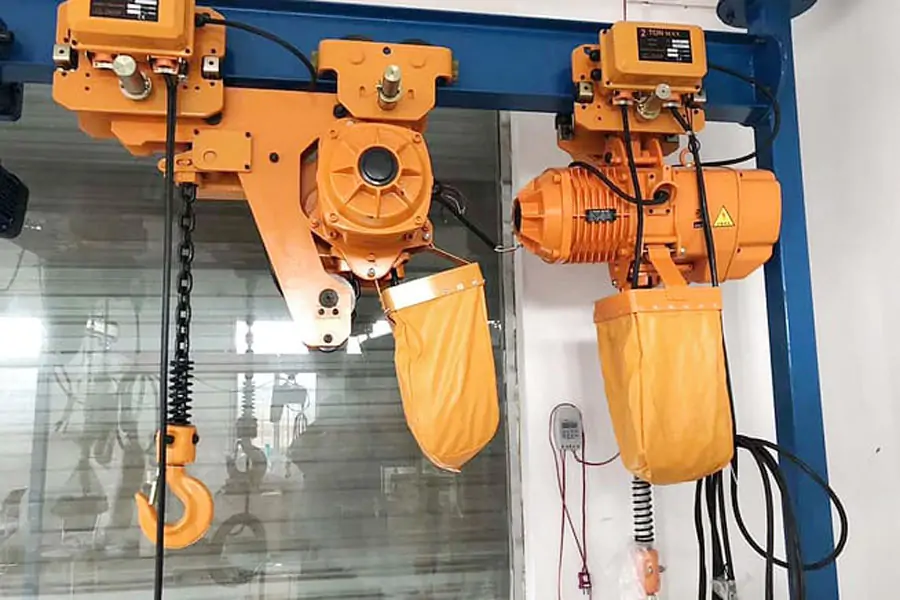
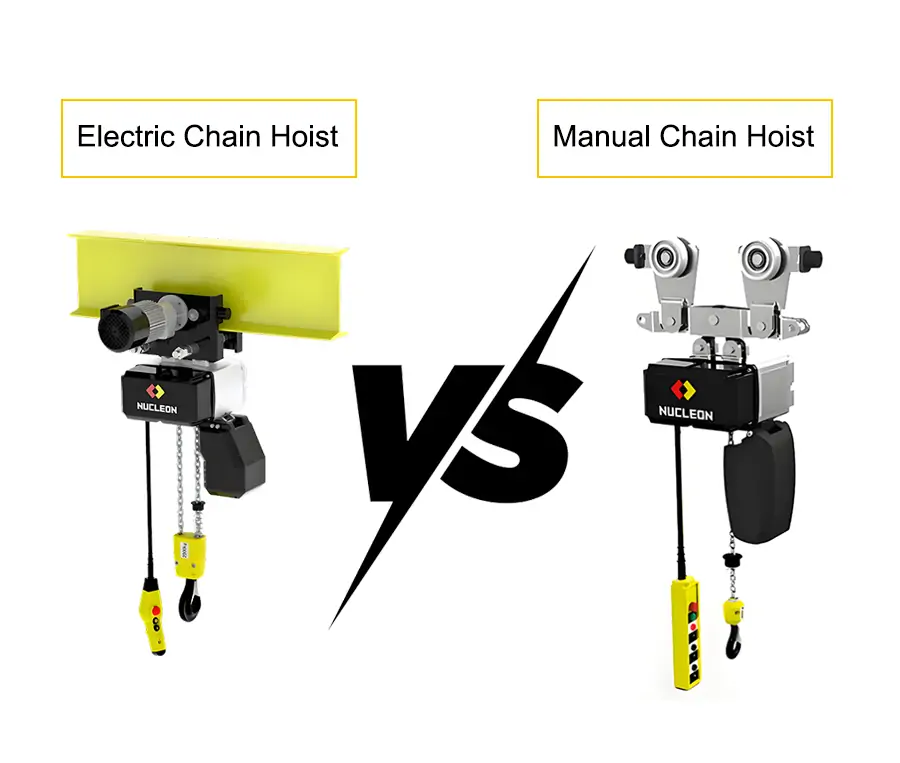
An electric chain hoist lifts loads using a high-strength steel chain. The mechanism is compact and relatively lightweight, which makes installation straightforward even in spaces with low ceilings or limited overhead room. Chain hoists handle loads from 0.5 to 20 tons and reach lift heights of up to 30 meters.
They are a natural fit for auto repair shops, small fabrication units, maintenance operations, and warehouse loading platforms. If your heaviest lift stays under 10 tons and your hoist is not running continuously all day, a chain hoist delivers solid performance at a lower cost.
Palan électrique à câble
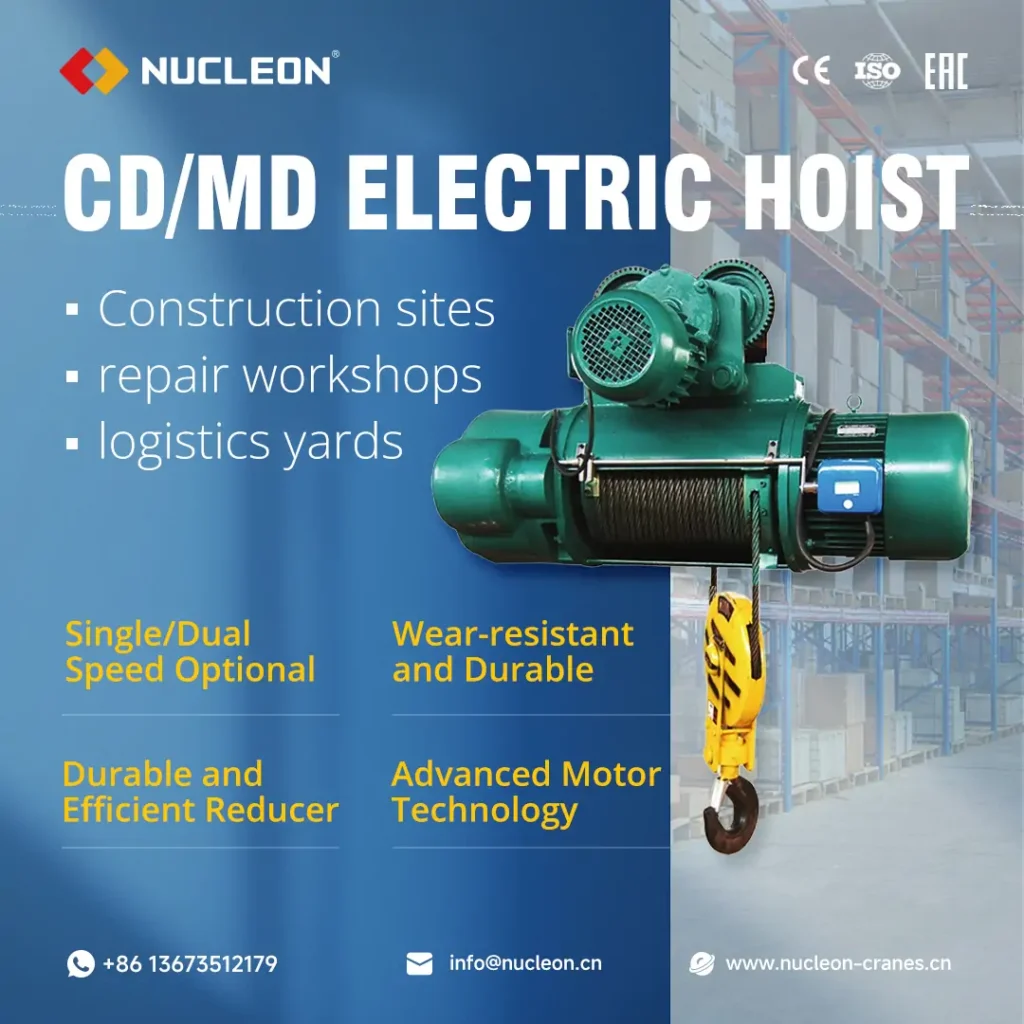
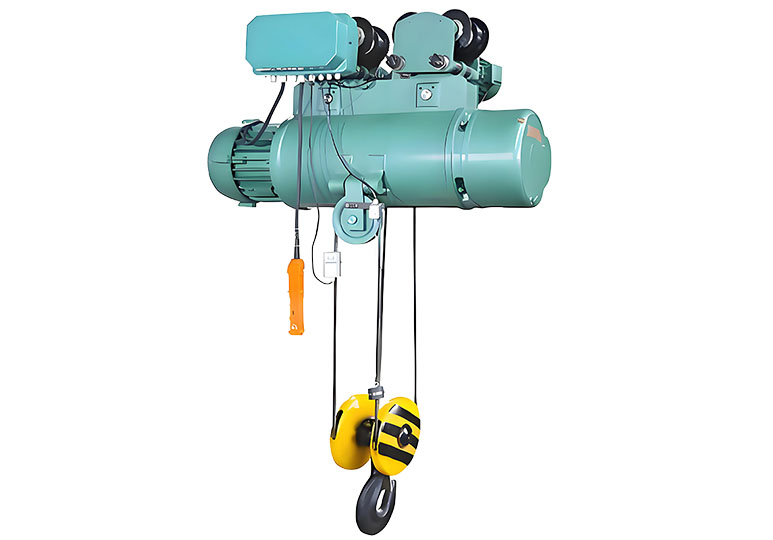
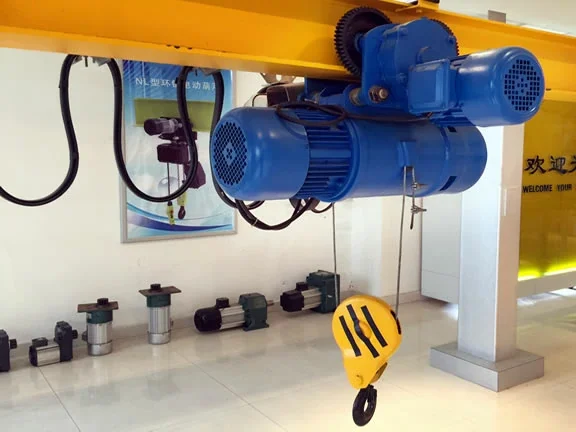
An electric wire rope hoist lifts using a multi-strand steel cable wound onto a powered drum. It is designed for heavier loads and longer daily operating hours. Capacity ranges from 1 to 32 tons, with lift heights reaching up to 45 meters. Wire rope hoists are the standard choice in steel mills, heavy manufacturing plants, ports, and large-scale construction operations.
If your loads regularly exceed 10 tons, your hoist runs for most of the working day, or it needs to integrate with a bridge or gantry crane system, a wire rope hoist is the appropriate choice.
| Treuil à chaîne électrique | Palan électrique à câble | |
| Lifting element | High-strength steel chain | Multi-strand steel wire rope |
| Capacité | 0.5 – 20 tons | 1 – 32 tons |
| Maximum lift height | Up to 30 m | Up to 45 m |
| Best application | Light to medium, intermittent use | Heavy or continuous daily operation |
| Space requirement | Low-headroom models available | Standard overhead clearance |
| Relative cost | More affordable | Higher initial investment |
Key Factors to Consider Before You Buy
Lifting Capacity: Allow for a margin
Do not choose a model whose rated lifting capacity is exactly equal to the heaviest load. Operating the equipment near its rated capacity for extended periods will significantly shorten its lifespan. A practical principle is to select the rated lifting capacity by adding 25% to 30% to the heaviest load.
Daily Usage Frequency
Electric hoists are designed with different specifications for different usage intensities. An electric hoist designed for occasional use will quickly fail if operated at high intensity forty to fifty times a day. When inquiring with suppliers, provide the number of lifting operations per day and the typical load. This is the single piece of information that has the greatest impact on the accuracy of the selection.
Installation Space and Lifting Height
Measure the height from the ground to the installation point, subtract the dimensions of the electric hoist itself and the required lifting height; the remaining amount is the usable headroom. If space is limited, be sure to inquire specifically about low headroom models, as different designs may require significantly different amounts of space above the hook.
On-site Power Supply System
Industrial electric hoists typically use three-phase electricity. The common voltage is 380V/50Hz, widely used in Asia, Europe, and Africa; 440V or 480V/60Hz is more common in North America. Confirm the on-site power supply system before placing an order, as voltage mismatch is one of the most common avoidable problems in international procurement.
Operating Environment
Standard electric hoists are suitable for general indoor factory environments. If the electric hoist is to be used outdoors, in humid, corrosive, or high-dust environments, specific instructions are required. In locations with flammable gases or dust, such as chemical plants, grain storage facilities, or fuel areas, explosion-proof electric hoists must be used; this is a safety requirement, not an option.
| Before contacting a supplier, note down four things: your maximum load, daily lift frequency, required lift height, and site power supply. Those four inputs are enough to get an accurate product recommendation. |
Nucleon Cranes: Electric Hoists Designed for Real-World Working Conditions
Nucleon Cranes specializes in the research and development and manufacturing of electric hoists and bridge cranes, serving customers in the manufacturing, construction, logistics, and heavy industry sectors. Our products cover Asia, the Middle East, Africa, and Europe. Every electric hoist undergoes actual load testing before leaving the factory, and the test certificate is included with the shipment for independent verification by the buyer upon arrival.
Customizable Remote-Controlled Electric Hoists
Standard catalog products meet most common needs. However, some site conditions exceed the standard range, which is where Nucleon's customization solutions come in. Common customization requirements include:
- Explosion-proof hoists for chemical plants, oil refineries, and grain storage facilities
- Stainless steel hooks and chains for food processing, pharmaceutical, and cleanroom environments
- Low headroom designs for facilities with limited clearance
- Variable frequency speed control requiring precise and stable positioning
- Long-range wireless remote control for large facilities or outdoor operations
- Non-standard voltage and frequency configurations for export projects
The process for requesting a customization solution is simple: send the site dimensions, load requirements, operating environment, and daily usage to Nucleon's engineering team. Specific configuration suggestions are typically received within one business day.
Included with each hoist
Nucleon's standard delivery contents for each electric hoist include: factory load test certificate, operation and maintenance manual, complete spare parts list, CE certification documents, and wireless remote control. Global after-sales technical support is available; installation, commissioning, and subsequent maintenance issues can be addressed remotely.
How to Make the Right Selection Decision
The core factors for choosing a remote-controlled electric hoist are lifting capacity, usage frequency, and site conditions. Determine the type and specifications based on these two figures, and then finalize the selection by considering installation space, power supply system, and environmental requirements. For any conditions outside the norm, inquire about customized solutions.
Nucleon offers standard products covering mainstream applications, as well as complete customized engineering solutions for special needs. Contact the Nucleon engineering team for product recommendations and customized solution quotes tailored to your site conditions.
Obtenir un devis de solution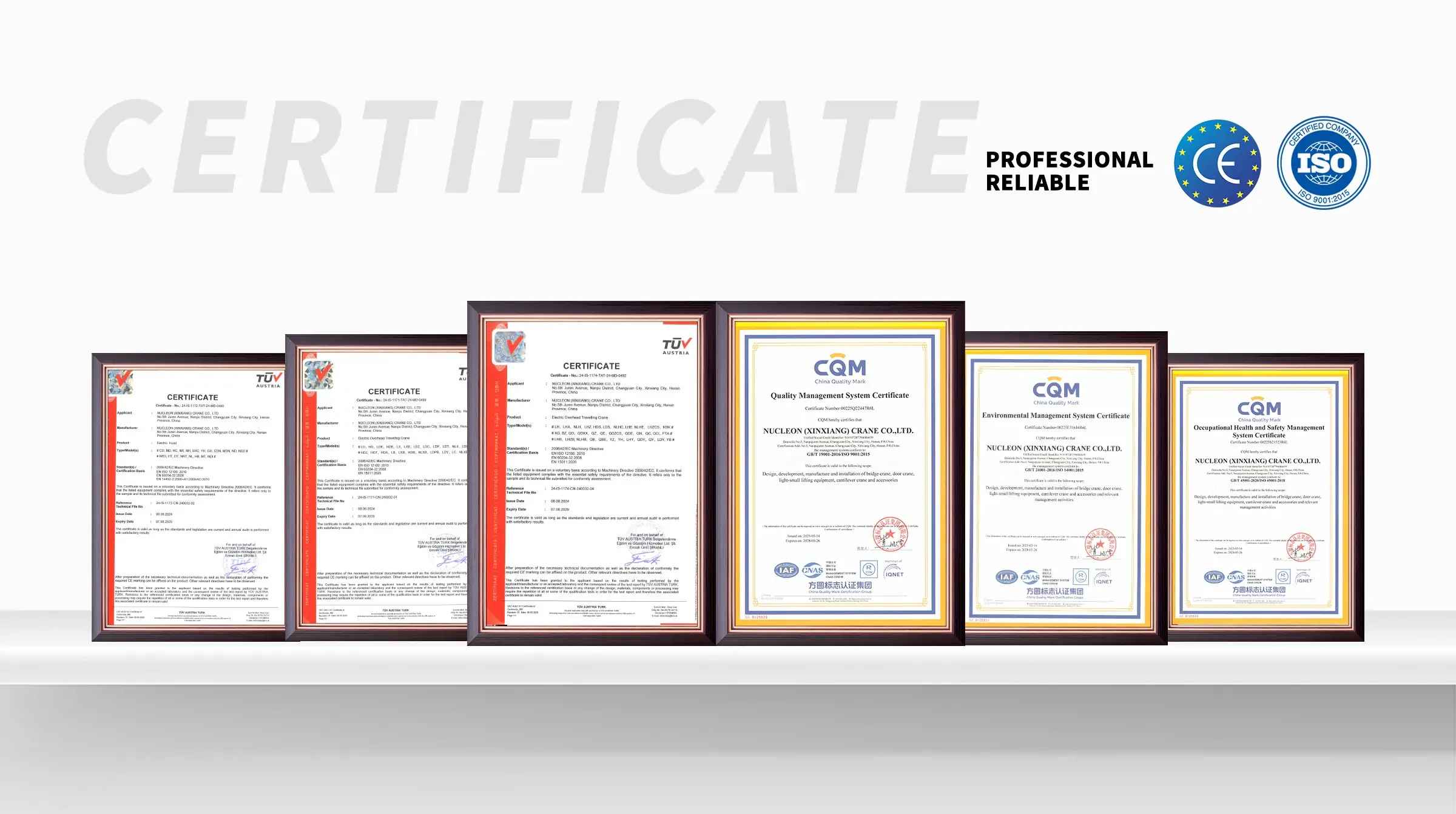
Foire aux questions
Q1: What is the control distance of the wireless remote control?
The standard wireless remote control has a control distance of 50 to 100 meters. For larger factories or outdoor applications, extended range versions are available. Nucleon Crane offers long-range wireless remote control options in customized solutions.
Q2: My existing electric hoist only has a wired hand control box; can it be converted to a wireless remote control?
In many cases, yes. Whether a conversion is possible depends on the existing hoist's control system. Send the model information to the supplier, and they can confirm compatibility.
Q3: What is the main difference between a chain electric hoist and a wire rope electric hoist?
Chain hoists use steel chains for lifting and are suitable for non-continuous use up to 20 tons. They are relatively inexpensive. Wire rope hoists use steel ropes for lifting and can reach up to 80 tons, suitable for heavy-duty continuous operations. The core differences lie in the maximum lifting capacity, intensity of use, and price.
Q4: What special precautions should be taken for outdoor installation?
Outdoor electric hoists require a higher motor protection rating (IP55 and above) and corrosion-resistant surface treatment. Nucleon Lifting supplies outdoor hoists with anti-corrosion coatings, suitable for construction sites and port environments.
Q5: Will the load fall if there is a sudden power outage during operation?
No. Electric hoists are equipped with an automatic brake function in case of power failure. The brake locks instantly upon power failure, keeping the load in place and preventing it from sliding. This is a standard safety feature of industrial-grade hoists, and every hoist from Nucleon Lifting is verified before leaving the factory.
Q6: Can standard electric hoists be used in chemical plants or fuel storage areas?
No. Areas with flammable gases or combustible dust must use certified explosion-proof hoists, with specially sealed designs for the motor and control box.
Q7: Can Nucleon Cranes customize hoists to meet specific requirements?
Yes. Nucleon Cranes accepts customized orders, covering non-standard lifting capacities, special operating environments, unconventional voltages, explosion-proof requirements, and integration with existing lifting facilities. Send your specific requirements to the team, and our engineers will provide a detailed solution.


 English
  العربية
  Español
  Français
  Português
  Русский