
Crane gearbox selection starts with the mechanism's duty, not its ratio. A gearbox that reduces motor speed correctly can still fail early if its rated torque, service factor and duty class don't match how the crane actually operates.
If you're comparing quotations from two or three gearbox or crane suppliers, this is usually where the comparison breaks down: two reducers can carry the same 25:1 ratio on paper and still not be interchangeable once you look at torque, duty and thermal rating. That gap is exactly where overhead crane and gantry crane buyers get caught out — either paying for more gearbox than the application needs, or under-specifying one that wears out years early.
This guide walks through how a crane gearbox works, which parameters actually drive selection, how to calculate ratio and output torque yourself, and what to check before you sign off on a supplier's gearbox proposal.
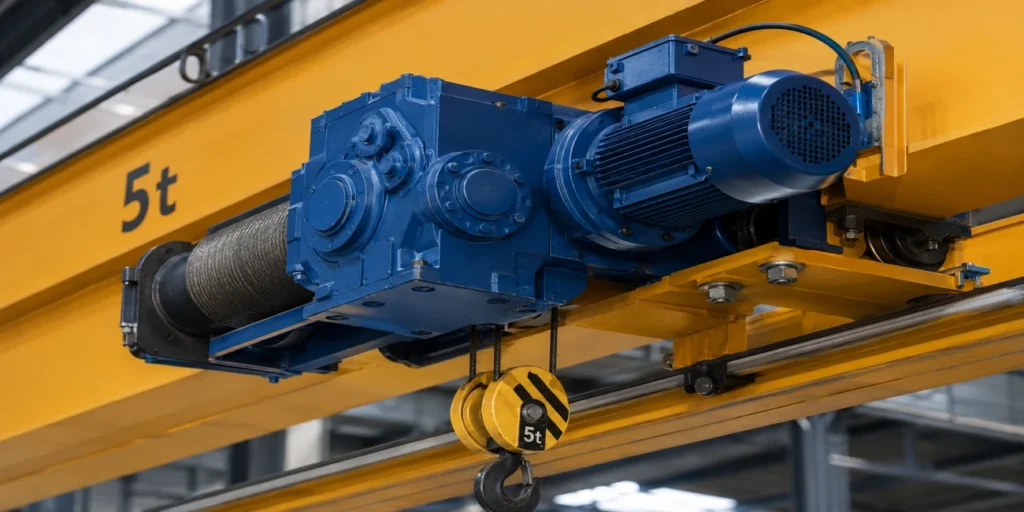
Tabla de contenidos
Crane Gearbox Types & Selection at a Glance
| Gearbox Type | Typical Ratio Range | Best Suited For | Key Trade-off |
| Helical parallel-shaft | ~10:1–500:1 (multi-stage) | Hoist and travel drives, most standard-duty cranes | Best balance of efficiency and cost; the default choice for most applications |
| Bevel-helical (right-angle) | Similar to helical, plus 90° axis change | Compact cross-travel drives where headroom is limited | Small efficiency loss per stage for the space saved |
| Planetary | High ratios in a compact housing | Large-capacity or shock-loaded hoists (50T+), steel mill and offshore duty | Higher upfront cost; highest torque density |
| Worm | High ratios, self-locking at steep ratios | Legacy replacement units | Lower efficiency than helical; modern standards don't allow relying on self-locking as the load-holding brake |
For most factory overhead and gantry crane hoist and travel drives, a helical parallel-shaft gearbox is the standard choice; the questions below determine which size and rating within that category actually fits your crane. Gearbox pricing depends heavily on torque size, duty class and mounting configuration rather than tonnage alone — request a quote with your load and duty data for an accurate market reference range.
What Is a Crane Gearbox and What Does It Do?
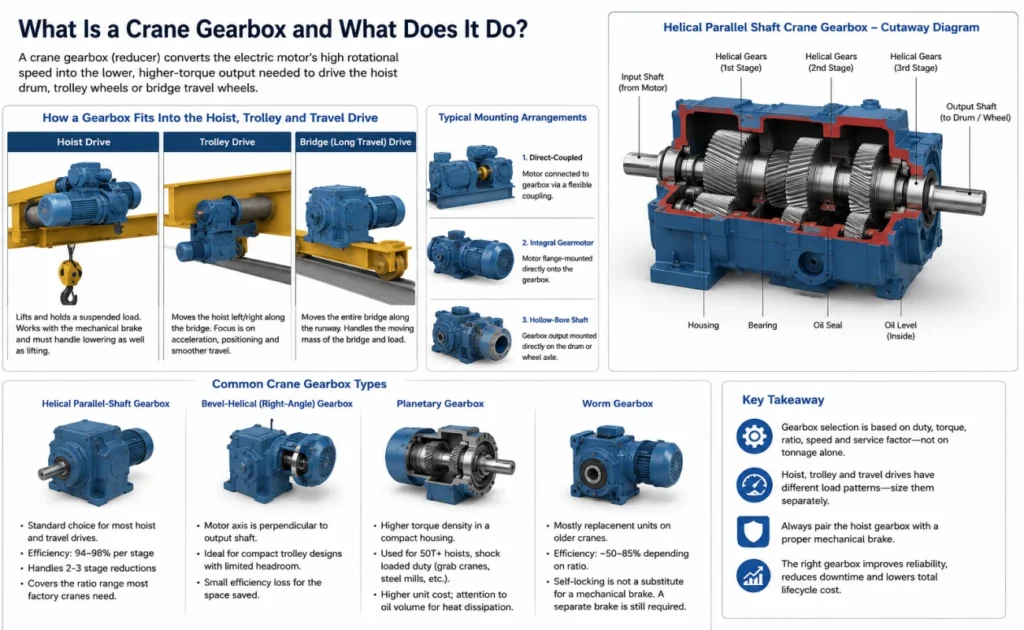
A crane gearbox (reducer) converts the electric motor's high rotational speed into the lower, higher-torque output needed to drive the hoist drum, trolley wheels or bridge travel wheels, typically under a general industrial gear-drive standard such as AGMA 6014.
How a Gearbox Fits Into the Hoist, Trolley and Travel Drive
The gearbox sits between the motor and the moving part it drives, and its correct selection depends on which of the three crane mechanisms it serves. A hoist gearbox lifts and holds a suspended load, so it works alongside the mechanical brake and must handle lowering as well as lifting. A trolley or long-travel gearbox instead accelerates a moving mass and controls positioning, with far less concern about holding a static load. Because the load pattern, shock exposure and starting frequency are different for each mechanism, the three drives are normally sized as separate selection exercises rather than specified from one shared torque figure. Mounting is also part of this decision: direct-coupled (motor to gearbox via a flexible coupling), integral gearmotor (motor flange-mounted onto the gearbox), and hollow-bore shaft (gearbox output mounted directly on the drum or wheel axle) each impose different alignment and support requirements on the crane structure.
Common Crane Gearbox Types
Helical parallel-shaft gearboxes are the standard choice for most crane hoist and travel drives, typically running at 94–98% efficiency per reduction stage. They handle two- to three-stage reductions and cover the ratio range most factory cranes need, which is why they dominate general-purpose overhead and gantry crane applications rather than the more specialized types below.
- Bevel-helical (right-angle) gearboxes are used where the motor axis has to sit perpendicular to the output shaft — commonly on compact trolley designs where headroom is tight. The right-angle stage costs a small amount of efficiency but saves the space a straight parallel-shaft unit would need.
- Planetary gearboxes pack more torque into a smaller housing than an equivalent parallel-shaft unit, which is why they show up on large-capacity hoists (roughly 50 tons and above) and on cranes that see frequent shock loading, such as grab cranes and some steel mill duty — the trade-off is a higher unit cost and more attention needed to oil volume for heat dissipation in the enclosed housing.
- Worm gearboxes are mostly seen today as replacement units on older cranes. Their efficiency (roughly 50–85% depending on ratio) is well below helical drives, and current design practice no longer treats a worm gear's self-locking behavior as a substitute for a proper mechanical hoist brake — a separate brake is still required regardless of gearbox type.
What Parameters Actually Determine Crane Gearbox Selection
Ratio and torque get the most attention, but duty class and service factor are usually what actually separates a gearbox that lasts from one that doesn't. Two suppliers offering the same reduction ratio can still be quoting mechanically different products once these other parameters are compared side by side.
| Parámetro | Why It Matters |
| Input / output speed | Sets the reduction ratio needed |
| Reduction ratio | Matches motor speed to the required drum, wheel or trolley speed |
| Rated output torque | Determines actual load-carrying capability, not just speed reduction |
| Service factor | Buffers the rating against shock, starts and duty severity |
| Duty class | Governs how the gearbox is expected to perform over its service life |
| Radial / axial load | Protects the output shaft and bearings from overload |
| Thermal rating | Prevents overheating under sustained or frequent-cycle operation |
| Mounting arrangement | Confirms installation compatibility with the crane structure |
| Lubrication | Affects service life and maintenance interval |
(Reference: technical parameters throughout this guide are typical industry ranges for crane-duty gearboxes; the exact rating for a specific crane must be confirmed against the manufacturer's model data or your own load spectrum before ordering.)
Reduction Ratio: Matching Motor Speed to Output Speed
Reduction ratio is the starting point of gearbox sizing, but it only confirms that the output speed is correct — it says nothing about whether the gearbox can actually carry the load. The basic relationship is:
i ≈ n₁ ÷ n₂
where i is the reduction ratio, n₁ is motor (input) speed, and n₂ is the required output speed at the drum, wheel or trolley. As an illustration of the range this covers in practice, one major crane-duty parallel-shaft reducer series on the market lists reduction ratios of roughly 22.4:1 to 90:1 across its standard frame sizes, with a related series extending beyond that for higher-ratio or higher-torque needs. Where your target ratio falls outside a single-stage or two-stage unit's range, the gearbox will need an additional reduction stage — which is also where efficiency drops slightly, so the required motor torque and output torque calculations below should always be rechecked against the actual number of stages, not just the target ratio.
Output Torque and Service Factor
Matching the ratio alone is the single most common procurement mistake in comparing crane gearbox quotes — two units at the same ratio can still be rated for very different actual loads. Reduction increases torque as it reduces speed, so the gearbox has to be checked against the torque it will actually see at the output shaft, not just the speed it produces. A simplified relationship for screening purposes is:
Output torque ≈ Input torque × Gear ratio × Gearbox efficiency
The gearbox's nameplate rated torque then needs to clear that calculated output torque with margin — that margin is the service factor, and it's set higher for hoisting duty (which sees repeated starts, reversals and shock from load pickup) than for a smoother, less shock-loaded travel drive. In practice, this is exactly the gap that shows up when comparing two supplier quotes with an identical reduction ratio: without the rated output torque, service factor, input speed and duty basis stated side by side, "same ratio" tells you almost nothing about whether the two gearboxes are actually equivalent for your crane.
Duty Class and Starts per Hour
Rated capacity in tons tells a gearbox supplier the maximum load — it does not tell them how hard the gearbox actually works, which is what duty class is for. Duty classification under a framework such as ISO 4301 or FEM 1.001 groups cranes by how frequently and how severely they're cycled, and that classification — not tonnage — is what should drive the gearbox's service factor and expected service life.
This is where tonnage-based assumptions cause real procurement errors: a 10-ton crane running continuous production cycles can require a heavier-duty gearbox than a 30-ton crane used only occasionally for maintenance lifts. The maintenance crane sees low starts-per-hour and long idle periods between lifts, so a lighter duty class and lower service factor are usually adequate even at higher tonnage. The production crane, by contrast, is accelerating, reversing and stopping the mechanism many times an hour, generating far more thermal and mechanical fatigue loading on the same gear teeth and bearings — even though its rated load is a third of the maintenance crane's. A supplier who sizes both gearboxes from tonnage alone, without asking about starts per hour, load spectrum and operating hours per shift, is very likely to under-spec the high-cycle unit.
Talk to our engineering team about your duty cycle →
Obtener cotización de soluciónHow to Calculate Crane Gearbox Ratio and Torque
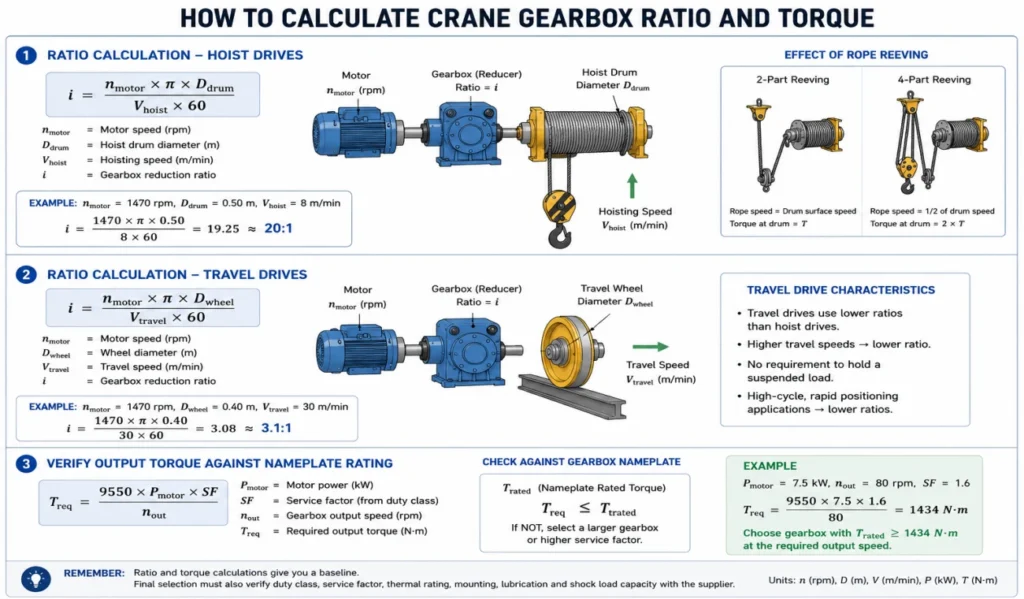
Working through the ratio and torque calculation yourself before a quote arrives gives you a number to check the supplier's proposal against — it isn't a substitute for their full mechanical and thermal sizing.
Ratio Calculation for Hoist Drives
For a hoist drive, the ratio needed is set by motor speed, hoisting speed and drum diameter:
i = (n_motor × π × D_drum) ÷ (V_hoist × 60)
where n_motor is motor speed in rpm, D_drum is drum diameter, and V_hoist is the target hoisting speed. Rope reeving changes the numbers that go into this calculation — a four-part reeving arrangement roughly halves the effective rope speed at the drum compared with two-part reeving, while roughly doubling the torque the drum has to produce for the same load, so reeving configuration has to be settled before the ratio calculation, not after.
Ratio Calculation for Travel Drives
For trolley or long-travel drives, the same form of calculation applies using wheel diameter and travel speed instead of drum diameter and hoist speed:
i = (n_motor × π × D_wheel) ÷ (V_travel × 60)
Travel drives generally sit at lower ratios than hoist drives for the same crane, because travel speeds are usually higher and don't require holding a suspended load — high-cycle applications needing rapid positioning also tend to use lower ratios than slower-cycling travel drives.
Verifying Output Torque Against the Nameplate Rating
Once the ratio confirms the output speed is correct, check that the gearbox's rated torque actually clears the torque your motor and load combination will produce, including the service factor for your duty class — not just the torque at steady rated load. This is the step that separates a gearbox correctly sized for your crane from one that only looks correctly sized because the ratio matches.
Choosing Gearboxes for Hoist, Trolley and Travel — and Comparing Supplier Quotes
A gearbox sized correctly for a crane's hoist mechanism is not automatically the right choice for its trolley or bridge travel — each mechanism needs its own selection, not one shared spec sheet.
Why Hoist, Cross-Travel and Long-Travel Need Different Gearbox Logic
The hoist drive holds a suspended load and must coordinate closely with the mechanical brake, so its gearbox selection weighs lowering behavior, shock from load pickup and higher service factors more heavily. Cross-travel (trolley) drives, especially on compact single-girder cranes with limited headroom, often favor a bevel-helical arrangement for the 90° axis change even though a straight helical unit would be more efficient. Long-travel (bridge) drives instead have to account for balanced drive distribution across multiple wheels and skew behavior along the runway, which a hoist-focused selection process won't catch. Treating all three as one "crane gearbox" line item on a quotation is a shortcut that tends to under-serve at least one of the three mechanisms.
The Procurement Mistake: Matching Ratio Without Matching the Rest
When two supplier quotes list the same reduction ratio, it's tempting to treat the gearbox line item as settled and move on to comparing price. In practice, ratio is the easiest number for a supplier to match on paper and the least useful one for confirming the gearboxes are actually equivalent. Before treating two ratio-matched quotes as interchangeable, request and compare:
- Rated output torque (not just input power)
- Service factor used for your duty class
- Input speed and number of reduction stages
- Radial and axial load rating at the output shaft
- Thermal rating and cooling arrangement
- Mounting orientation and lubrication basis
A supplier who can't provide this breakdown, and only quotes ratio and price, has effectively left the sizing decision to you — which shifts the risk of an undersized gearbox onto the buyer rather than the manufacturer.
Hidden Costs Behind a Cheap Gearbox Quote
The lowest-priced gearbox quote is not necessarily the lowest lifetime cost, and the gap usually shows up after the crane is already in production. A gearbox priced below the others on a bid list, without a matching duty basis, tends to surface its shortfall through oil leakage, premature bearing wear, gear tooth pitting or overheating well after the warranty conversation has closed — at which point the cost is downtime and an unplanned rebuild, not a line item you can compare on a quotation. Spare parts availability compounds this: a gearbox model chosen purely on initial price, without checking whether the manufacturer stocks replacement bearings, seals and gears locally, can turn a routine maintenance job into an extended production stoppage while parts are sourced. Weighing acquisition price against duty-matched sizing and realistic parts support is a more reliable comparison than price per ratio point.
Compare your current gearbox quotes with our engineering team →
Conclusión
Crane gearbox selection is a duty-class and torque decision first, and a ratio decision second — tonnage alone, and reduction ratio alone, both leave out the information that actually determines whether a gearbox will last. Start from your crane's real operating cycle, confirm output torque and service factor against that duty, and size hoist, trolley and travel drives separately rather than as one shared spec. Before comparing prices across suppliers, make sure every quote is answering the same technical question.
Working through a crane gearbox selection or comparing supplier quotations? Send us your load, speed and duty data for a technical review and market-reference pricing, or reach our engineering team on WhatsApp / Correo electrónico.

Especialista en Equipos
Gerente de Negocios de Grúas con experiencia y amplia trayectoria en gestión de proyectos de elevación pesada y supervisión operativa. Historial comprobado de impulso del crecimiento de los ingresos y garantía del cumplimiento de las normas de seguridad.
Preguntas frecuentes
How is a crane gearbox ratio calculated?
Ratio is calculated from motor speed, required output speed, and drum or wheel diameter (i = n_motor × π × D ÷ (V × 60)). A 4-pole motor driving a mid-sized hoist drum at a typical hoisting speed commonly lands in the low hundreds-to-one range, usually achieved as a two- or three-stage helical reduction.
Does the same reduction ratio mean two gearboxes are interchangeable?
No. Matching ratio alone only confirms output speed — it doesn't confirm rated output torque, service factor, duty class or thermal rating are equivalent. Two gearboxes at the same ratio can still be rated for very different actual loads and duty cycles.
What duty class should a crane gearbox be selected for?
Duty class should follow the crane's real operating cycle — starts per hour, load spectrum and operating hours — not its tonnage rating. A lower-tonnage, high-cycle production crane can need a heavier duty class than a higher-tonnage crane used occasionally.
What's the difference between helical, planetary and worm crane gearboxes?
Helical parallel-shaft gearboxes are the standard, efficient choice for most hoist and travel drives. Planetary gearboxes pack more torque into a smaller housing for large-capacity or shock-loaded duty. Worm gearboxes are lower-efficiency and mainly seen in legacy replacements today.
How much does a crane gearbox cost?
Crane gearbox pricing depends primarily on rated torque size, duty class and mounting configuration rather than tonnage alone, so a single price range isn't a reliable reference across applications. Provide your load, speed and duty data for a market-reference quote.
Artículos relacionados
- Crane End Truck & Wheel Maintenance Guide: Inspection, Wear, Alignment & Replacement
- Polipasto de cable de acero vs. polipasto de cadena: ¿Cuál dura más?
- Overhead Crane Main Girder: Materials & Structure
- Cable de acero para grúas: Guía de inspección y reemplazo
- Inspección de grúas puente: Normas OSHA, CE y GB: lo que compradores y exportadores realmente necesitan saber.

 English
  العربية
  Español
  Français
  Português
  Русский