

Tabla de contenidos
- Introduction: The Cost of Getting It Wrong
- Understanding Your Scrap Load Before You Spec the Crane
- Magnet System Selection — The Heart of Your Crane
- Crane Structural Rating — Matching the Machine to the Job
- Control Systems, Safety, and Automation
- Total Cost of Ownership — Looking Beyond the Purchase Price
- Conclusion: Build Your Specification Around Real Operating Data
- Preguntas frecuentes
- Q1: What magnet diameter should I specify for a scrap yard crane handling mixed shredded scrap at 200–300 tons per day?
- Q2: What is the difference between a standard industrial overhead crane and an electromagnetic crane designed for scrap handling?
- Q3: How much does an electromagnetic overhead crane cost, and what drives the price per ton of handling capacity?
- Q4: What safety standards apply to electromagnetic overhead cranes used in scrap metal operations?
- Q5: How often do lifting magnets need to be replaced or rebuilt in a high-cycle scrap yard operation?
Introduction: The Cost of Getting It Wrong
Choosing the right electromagnetic overhead crane for scrap metal handling is one of the most consequential decisions a scrap yard operator or steel processing facility can make. Get it right, and you have a system that runs reliably for 15–20 years with manageable maintenance costs. Get it wrong, and you face frequent magnet burnout, excessive downtime, and rehandling inefficiencies that eat directly into your margins.
The challenge is that scrap handling is among the most demanding applications for any overhead crane system. Unlike lifting uniform steel coils or precise machine parts, scrap yards deal with irregular loads, unpredictable material density, mixed ferrous content, and continuous high-cycle operations. A standard industrial crane with a general-purpose magnet simply won't survive this environment long-term.
This guide walks through the five most critical decision points when selecting a magnetic overhead crane for scrap metal operations: load analysis, magnet system selection, duty cycle and structural rating, control and safety systems, and total cost of ownership. By the end, you'll have a clear framework for evaluating suppliers, comparing specifications, and asking the right questions before you sign a purchase order.
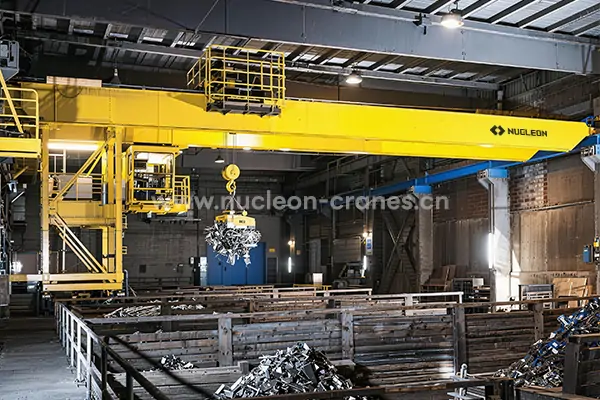
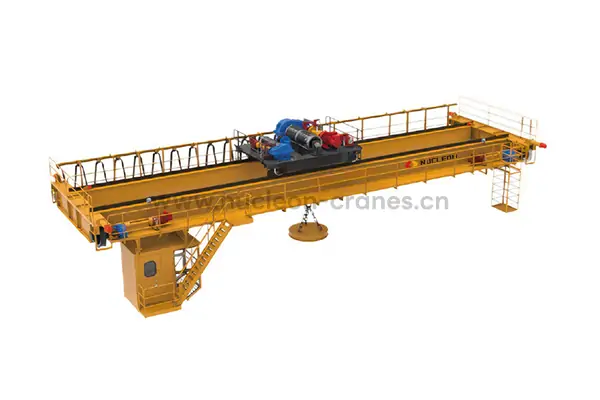
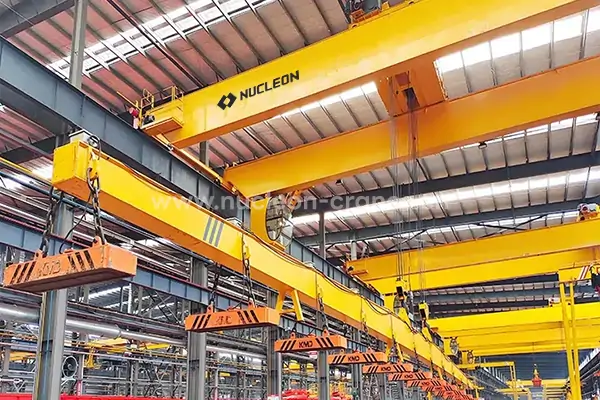
Understanding Your Scrap Load Before You Spec the Crane
Before comparing electromagnetic crane models, you need to define exactly what your crane will be lifting. This sounds obvious, but many procurement teams skip the load analysis stage and rely on rough estimates, which leads to undersized magnets or overbuilt structures that waste budget.
Material Type and Bulk Density
Scrap metal is not a uniform material. Shredded scrap, heavy melt (HMS 1&2), busheling, cast iron, and stainless content all behave differently under a lifting magnet. A magnet sized for shredded scrap with a bulk density of approximately 1.0–1.5 t/m³ will underperform significantly when handling heavy melt with bulk densities closer to 2.5–3.0 t/m³. Work with your magnet supplier to provide a representative material sample or density range before specifying magnet diameter and holding force.
Lift Cycle Volume and Operating Hours
The number of lifts per hour is the single most important factor affecting magnet and crane longevity in scrap applications. A facility processing 500 tons per day with 10-ton average lifts requires roughly 50 complete lift cycles per hour across operating shifts — a demanding duty profile by any standard. Document your target throughput in tons per day, average lift weight, and expected operating hours per shift. This data feeds directly into duty cycle classification under FEM/ISO standards, which determines the structural and mechanical rating your crane must meet.
Site Constraints and Environmental Factors
Scrap yards present specific environmental challenges: steel dust, moisture, temperature extremes, and airborne debris all shorten equipment life if not accounted for in the crane specification. Consider whether the crane will operate indoors or outdoors, the ambient temperature range, and whether the facility uses water suppression systems that could expose crane electronics to moisture. Enclosure ratings for crane electrical components should align with site conditions — typically IP54 or IP65 for outdoor or dusty indoor scrap applications.
Action Tip: Before contacting any supplier, prepare a one-page load and site summary including: material type and density range, target tons per day, lifts per hour, operating hours per day, indoor/outdoor installation, and any existing crane rail or runway data.
Magnet System Selection — The Heart of Your Crane
The lifting magnet is the component that makes or breaks a scrap handling crane's performance. Selecting the correct magnet type, size, and power supply is just as important as selecting the crane structure itself.
Round Magnets vs. Rectangular Magnets
Round lifting magnets are the most common choice for loose scrap handling. They provide uniform holding force in all directions, are mechanically simple, and are available in a wide range of diameters (typically 800mm to 2000mm for scrap applications). Rectangular or square magnets are better suited for handling bundled or baled scrap, structural steel sections, and plate material where flat contact area improves holding force.
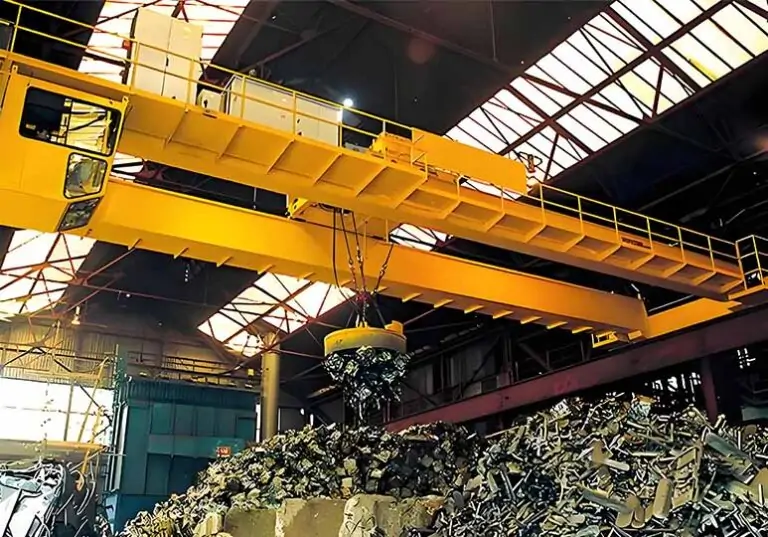
Round Magnets
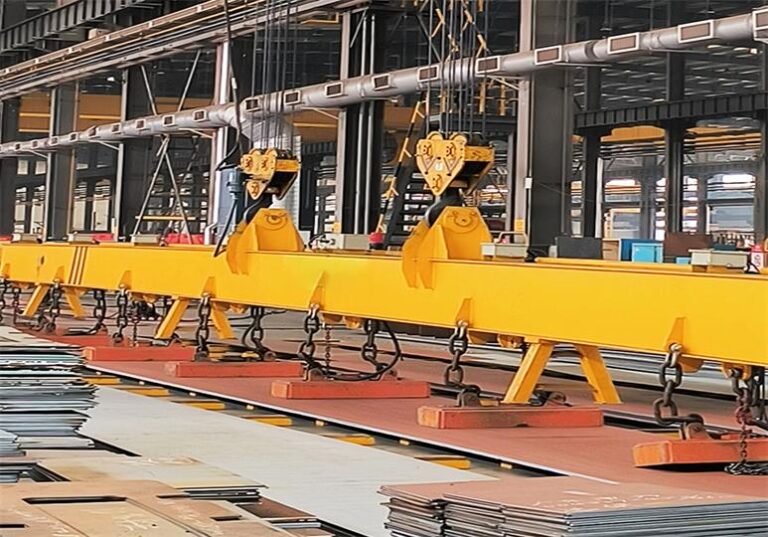
Rectangular Magnets
| Magnet Type | Best Application | Typical Diameter/Size | Relative Holding Force |
| Round (circular) | Loose/shredded scrap, mixed ferrous | 800mm – 2000mm | High (omnidirectional) |
| Rectangular | Bundles, plate, structural steel | 600×1200mm – 1000×2000mm | High (flat contact) |
| Electro-permanent | Mixed scrap, safety-critical lifts | Custom | Medio-Alto |
Reference: FEM 9.851 Lifting Magnets Standard; supplier data from major OEMs (2022–2024)
Magnet Power Supply and Duty Cycle Rating
Scrap magnets operate in continuous high-cycle mode, generating significant heat. Manufacturers rate magnet coils by their duty cycle—the percentage of time the coil remains energized within each operating cycle. For scrap handling, you should rate magnets at a minimum 60% duty cycle (ED60%), and many high-volume operations specify ED75% or ED100% continuous-rated coils. An undersized power supply or a low duty cycle rating causes most premature magnet coil failures in scrap environments.
The rectifier and control panel supplying the magnet also require careful specification. Modern systems use thyristor-controlled DC power supplies with electronic demagnetization and residual magnetism release functions, which allow faster drop cycles and cleaner material release during unloading.
Magnet Suspension and Cable Management
In high-cycle scrap operations, the mechanical suspension and power cable between the crane and magnet take significant abuse. Specify a swivel-type mechanical suspension to prevent cable twist accumulation, and use armored, flexible cable rated specifically for crane trailing applications. Cable reels or festoon systems should accommodate the full travel range without creating slack or tension hazards. A broken or damaged magnet cable mid-shift causes complete operational downtime — this is a detail worth engineering properly upfront.
Crane Structural Rating — Matching the Machine to the Job
The overhead crane structure that carries the electromagnetic lifting system must be rated appropriately for the duty intensity of scrap handling. Undersizing the crane structure is a safety and maintenance issue; oversizing it adds unnecessary capital cost.
FEM/ISO Duty Classification for Scrap Applications
European crane standards (FEM 1.001) and the equivalent ISO 4301 classify crane mechanisms into utilization groups based on operating hours and load spectrum. Scrap handling cranes typically fall into mechanism group M7 or M8 — the two highest duty classifications.
| FEM Mechanism Group | Caso de uso típico | Annual Operating Hours | Load Spectrum Factor |
| M5 | Light industrial, infrequent use | 3,200–6,300 hrs | Light-medium |
| M6 | Regular industrial production | 6,300–12,500 hrs | Mediano |
| M7 | Heavy-duty continuous production | 12,500–25,000 hrs | Heavy |
| M8 | Severe-duty, scrap/foundry | 25,000+ hrs | Very heavy |
Fuente: FEM 1.001 Rules for the Design of Hoisting Appliances, 4th Edition (2021); ISO 4301-1
Specify that all crane mechanisms — hoist, long travel, and cross travel — are rated to the mechanism group matching your actual operating profile. Requesting M7 or M8 classification for a scrap yard crane is standard industry practice and should be non-negotiable in your procurement specification.
Bridge Beam Design and Deflection Limits
For electromagnetically equipped cranes, you must design the bridge beam to accommodate the combined weight of the hoist assembly and the magnet, which adds 1,500–6,000 kg of suspended load compared to a standard hook assembly. Under full load, beam deflection should not exceed L/888 under ISO 22986 (crane beam deflection standard), and you should account for dynamic load factors associated with the irregular and variable nature of scrap lifting when designing the beam.
Control Systems, Safety, and Automation
Modern electromagnetic overhead cranes for scrap handling can integrate a range of control and automation features that improve both productivity and safety. Understanding these options helps you prioritize what matters for your operation.
Magnet Control and Anti-Drop Safety
The most critical safety requirement for any crane for scrap metal lifting is ensuring the magnet cannot lose power — and drop its load — due to a power supply failure. Specify a crane system with a battery backup or capacitor buffer on the magnet power supply, capable of maintaining holding force for a minimum of 30 seconds following a mains power interruption. This gives operators time to lower the load safely. This requirement is referenced in EN 13001-1 (Crane Safety General Principles) and should be explicitly stated in your technical specification.
Load Weighing and Cycle Counting
Integrating a load weighing system (typically ±0.5–1% accuracy via load cell in the hoist) provides real-time data on material throughput, which feeds inventory management and billing systems in scrap processing operations. Cycle counters linked to the crane PLC allow maintenance teams to schedule component inspection and replacement based on actual usage rather than time intervals, which reduces both unplanned downtime and unnecessary preventive maintenance costs.
Remote Diagnostics and Telematics
Several leading crane OEMs now offer remote monitoring packages that transmit operational data — motor temperatures, load cycles, fault codes — to a cloud platform accessible by the service team. For facilities without on-site crane maintenance expertise, this capability can significantly reduce service response times and enable predictive maintenance scheduling.
Total Cost of Ownership — Looking Beyond the Purchase Price
The purchase price of an electromagnetic crane system is typically only 40–60% of the 10-year total cost of ownership. Operating costs, maintenance expenses, energy consumption, and downtime losses account for the remainder. Evaluating suppliers purely on initial price is one of the most common procurement mistakes in this equipment category.
Key Cost Drivers Over a 10-Year Horizon
| Categoría de costo | Typical 10-Year Share | Primary Drivers |
| Initial capital cost | 40–55% | Crane class, magnet size, automation level |
| Maintenance & parts | 20–30% | Duty cycle rating, component quality, spare parts availability |
| Energy consumption | 10–15% | Magnet power supply efficiency, hoist motor class |
| Downtime and lost production | 10–20% | Structural rating, magnet duty cycle, control system reliability |
Estimated ranges based on industry operator interviews and OEM lifecycle cost models (2022–2024). Actual figures vary by facility size, operating hours, and maintenance practices.
Evaluating Custom Magnetic Overhead Crane Solutions
Not every scrap operation fits a catalog crane. High-throughput facilities, unusual bay spans, extreme conditions, or automated sorting lines may require a custom magnetic overhead crane. When evaluating custom proposals, request a load calculation report, FEM/ISO classification documents, magnet holding force test certificates, and at least two comparable reference installations. Also verify that the supplier's local after-sales service can provide spare parts and technical support—because a crane that can't be serviced is a liability, regardless of its specifications.
Conclusion: Build Your Specification Around Real Operating Data
Choosing the right electromagnetic grúa puente for scrap handling comes down to one principle: specify to your actual operating conditions, not to a generalized catalog. Define your material density, daily throughput, lift cycles, and duty environment before talking to suppliers. Insist on FEM/ISO duty classification documentation, magnet duty cycle ratings, and anti-drop safety certification. Evaluate total cost of ownership, not just purchase price.
The best electromagnetic crane for your steel scrap handling operation is the one engineered to your specific duty profile — not the cheapest option or the most expensive one, but the one matched to the job.

Especialista en Equipos
Gerente de Negocios de Grúas con experiencia y amplia trayectoria en gestión de proyectos de elevación pesada y supervisión operativa. Historial comprobado de impulso del crecimiento de los ingresos y garantía del cumplimiento de las normas de seguridad.
Preguntas frecuentes
Q1: What magnet diameter should I specify for a scrap yard crane handling mixed shredded scrap at 200–300 tons per day?
For mixed shredded scrap at that throughput, a 1400mm to 1600mm round lifting magnet is a typical starting point, assuming average lift weights in the 4–8 ton range and bulk density around 1.0–1.5 t/m³. However, the correct size depends on your crane span, hook height, and target lifts-per-hour. Request a formal magnet sizing calculation from the supplier, not just a catalog recommendation. Key inputs are material type, bulk density, target lift weight, and duty cycle requirement. Suppliers should be able to provide holding force curves showing performance across material types.
Q2: What is the difference between a standard industrial overhead crane and an electromagnetic crane designed for scrap handling?
A scrap-rated electromagnetic crane differs from a standard industrial crane in several key ways. Its structural and mechanical components meet FEM M7 or M8 duty classification, while standard cranes only reach M4–M5. The magnet power supply handles 60–100% duty cycles. The electrical system includes an anti-drop battery backup. Cables and suspension parts are built for high-cycle, abrasive environments. Using a standard crane in a scrap yard without these upgrades leads to early component failure and higher safety risks.
Q3: How much does an electromagnetic overhead crane cost, and what drives the price per ton of handling capacity?
Electromagnetic crane pricing varies widely depending on crane span, lifting capacity, magnet configuration, and automation level. As a general reference range, a complete crane system (bridge crane + hoist + magnet + controls) for scrap handling with 10–20 ton capacity and 20–30m span typically ranges from USD 80,000 to USD 250,000+, with custom or high-automation systems exceeding this range. The effective cost per ton of daily handling capacity decreases significantly at higher throughput volumes. Always evaluate total cost of ownership over 10 years, not just capital cost.
Q4: What safety standards apply to electromagnetic overhead cranes used in scrap metal operations?
Key applicable standards include: EN 13001-1/2/3 (Crane Safety — General Principles and Load Actions), ISO 4301-1 (Crane Classification), FEM 1.001 (Rules for the Design of Hoisting Appliances), IEC 60204-32 (Electrical Equipment of Cranes), and FEM 9.851 (Lifting Magnets). For EU-market cranes, compliance with the EU Machinery Directive (2006/42/EC) and CE marking is required. In North America, ASME B30.2 and CMAA Specification 70 apply. Always request full compliance documentation from the supplier before accepting delivery.
Q5: How often do lifting magnets need to be replaced or rebuilt in a high-cycle scrap yard operation?
A properly specified ED75% or ED100% rated lifting magnet in a scrap application can typically achieve 8–15 years of service life before coil replacement, provided the power supply is correctly sized and magnet temperatures are monitored. Magnets operating beyond their rated duty cycle will experience accelerated coil insulation breakdown, with coil failure possible within 2–5 years in severe cases. Key maintenance indicators include rising coil resistance readings, reduced holding force at rated power, and visible damage to the magnet shell or cable connection. Establish a quarterly inspection program and log coil resistance values at each inspection as a leading indicator of coil condition.

 English
  العربية
  Español
  Français
  Português
  Русский