

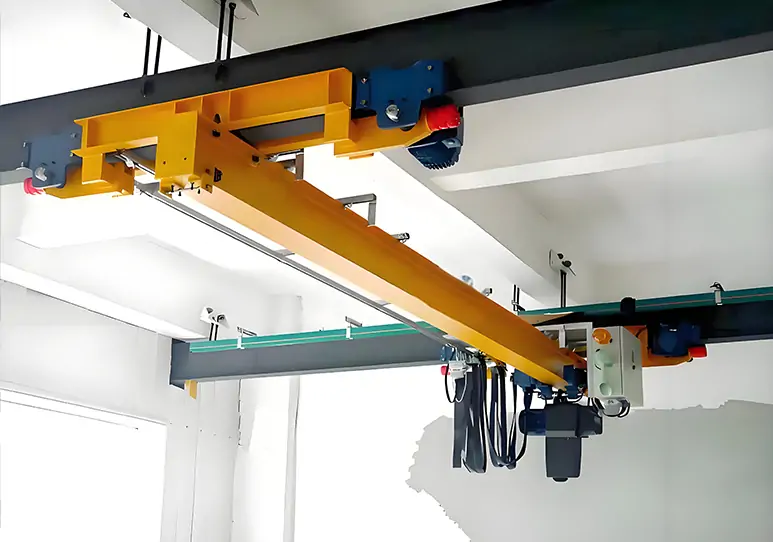
Nucleon has exported two 3 ton NLX underhung cranes to a garment factory in Cambodia, and both cranes are now installed. An underhung crane (also called a suspension crane) hangs from its runway beams and travels along their lower flange, so it needs no floor columns and keeps the work area open. The NLX European single girder underhung crane is Nucleon's lightweight model for loads up to 10 tons. This case shows what was supplied, how the cranes were packed and shipped, and how the finished installation looks under the workshop's ducts, pipes and lighting.


Project at a Glance
| Item | Details |
| Customer | Garment manufacturer in Cambodia |
| Destination | Cambodia |
| Equipment | NLX European single girder underhung crane |
| Quantity | 2 sets |
| Rated capacity | 3 t each |
| Hoist | Electric chain hoist |
| Span and lifting height | span 13 m, lifting height 8 m |
| Work duty | A3–A4 (light to medium duty) |
| Control | Pendant push-button |
| Power supply | 380 V, 50 Hz, 3-phase |
| Power to the crane | Insulated conductor bar along the runway |
| Installation support | Installation drawings, installation videos and remote guidance from Nucleon |
| Project status | Shipped and installed |
Project Background
The customer, a garment factory in Cambodia, ordered 2 sets of 3 ton NLX underhung cranes, each fitted with an electric chain hoist. Both cranes were manufactured at Nucleon's factory in Changyuan, Henan, and shipped to Cambodia.
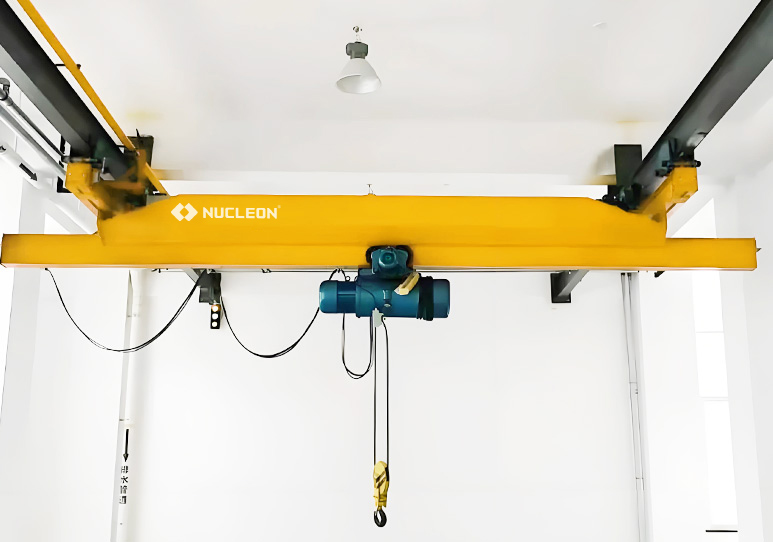
The installation photos were taken while the new factory floor was still being fitted out. Wooden crates, pallets and wire-mesh containers are still on the floor beside the cranes, and the building services are exposed overhead: air ducts, pipework and fluorescent lighting all run close to the ceiling.
Why an Underhung Crane Suits This Workshop
Garment manufacturing is one of Cambodia's main export industries, and garment workshops need open floor space for cutting tables, sewing lines, carts and storage. An underhung crane fits this kind of building for three reasons:
- No floor space used. The runway beams are fixed high up, so the crane adds no columns or supports to the work area.
- Low headroom use. The girder and hoist sit close under the runway, which helps in buildings where ducts, pipes and lights share the ceiling space.
- Lightweight and modular. The structure is light and easy to install and maintain.
Typical lifting jobs in a garment factory include moving fabric rolls, cartons of finished goods and packing materials, and handling equipment during installation or maintenance.
An underhung crane hangs from the building structure, so the roof beams or steel frame must be able to carry the crane load. This is why underhung cranes are normally limited to loads under 10 tons.
NLX underhung crane vs. top-running single girder crane

| Factor | NLX underhung crane | Top-running single girder crane |
| Where it runs | Hangs below the runway beams | Runs on top of the runway beams |
| Headroom needed | Low | Higher |
| Support structure | Runway hangs from the roof structure or a steel frame | Usually needs crane columns or a runway on the building columns |
| Best for | Light to medium loads in workshops, assembly and logistics areas | Heavier loads and longer spans |
| Typical capacity | Light to medium, up to 10 t | Wider range, including heavy duty |
If your load is heavier or your span is longer, a top-running single girder or double girder crane is usually the better choice. For a 3 ton load in a normal workshop, an underhung crane is often the simpler solution.
Equipment Configuration
| Component | Configuration |
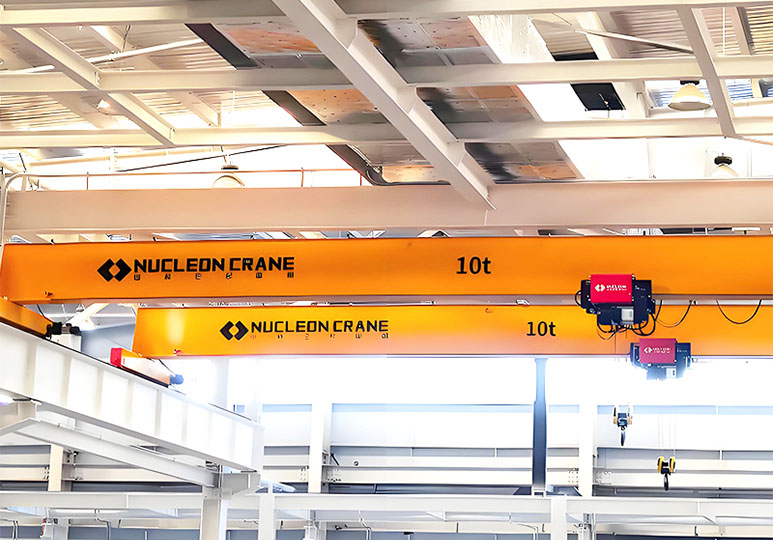
| Main girder | Yellow single girder, Nucleon brand marking on the side |
| Hoist | Electric chain hoist with hook, running along the lower flange of the girder |
| End carriages | Driven end trucks running on the lower flange of the runway beam |
| Power to the crane | Insulated conductor bar (red safety busbar) along the runway |
| Control | Pendant push-button |
| Protection | Overload limiter, limit switches, buffers, emergency stop |
| Surface | Yellow paint for visibility |
Standard features of the NLX range include:
- High-strength bolted connection between the girder and the suspension structure
- Compact geared motor drive with stepless speed control and safety disc brakes
- IP55 protection, insulation class F, 40% duty cycle
- Modular design that keeps installation and maintenance simple
What the Installation Looks Like
The photos of the finished installation show:


- The runway beams are mounted at roof level, with the yellow crane girder hanging below them.
- A red conductor bar runs along the runway to supply power, so no trailing cable is needed on the floor.
- A red emergency stop button and an electrical box are mounted on the end carriage, within reach for maintenance.
- The girder passes beneath the air ducts, pipework and lighting, and the hoist and hook still travel freely along the bay.
- The floor below is free of crane columns, so crates and equipment can be moved in and out of the bay.
Before You Order an Underhung Crane for a Similar Workshop
If your building looks like this one, check these points first and send them to us with your request:
- Roof or steel structure. Can it carry the crane weight, the rated load and the runway beams? Send the structural drawings.
- Clearance below the ceiling. Mark the lowest ducts, pipes, cable trays and lights along the runway, so the girder and hook height can be planned around them.
- Runway length and support points. Tell us where beams can be fixed and how far apart.
- Rated load and lifting height. Include the heaviest load plus any lifting frame or container.
- Power supply. Give the voltage, frequency and where the power can be connected.
Safety Protection
The NLX underhung crane is equipped with standard protective devices for overhead lifting:
- Overload limiter to stop lifting above the rated 3 t.
- Upper and lower hoist limit switches to prevent over-hoisting.
- Travel limit switches and buffers at the ends of the girder and runway.
- Emergency stop on the crane to cut power immediately.
These protections should be checked regularly together with the hook, chain, brake and runway fixings, as part of the customer's normal crane inspection routine.
Packing, Shipping and Installation
The project photos show how the cranes were prepared for export at Nucleon's factory:


- Girders were wrapped in plastic film and bubble wrap, then covered with a striped waterproof tarpaulin to protect the paint and steel from rain and dust.
- Loading was done with a lifting device in the factory, using slings and chain at the lifting points on the girder.
- On the truck, the girders were lashed down with wire rope and straps on a flatbed trailer.
- Hoists, end carriages, electrical parts and accessories were packed separately in cartons and on pallets, and secured next to the girders.
Installation of both cranes is now complete at the customer's factory in Cambodia. Nucleon provided installation drawings and installation videos, and gave remote guidance during installation and commissioning.
Project Result
Both NLX European single girder underhung cranes have been delivered to Cambodia and installed at the customer's garment factory, with Nucleon providing installation drawings, videos and remote guidance throughout. The installed cranes keep the floor clear and run beneath the workshop's ducts, pipework and lighting.
FAQ
What is an underhung crane?
An underhung crane is a lightweight overhead crane that hangs from steel structure or prefabricated roof beams, using I-beams as its running track. The NLX European single girder underhung crane is built to European standards, usually works with an electric hoist, and lifts up to 10 tons in workshops, warehouses and maintenance areas where headroom and floor space are limited.
Is an underhung crane suitable for a garment factory?
Yes. Garment factories need to keep aisles clear for people, carts and production lines. An underhung crane leaves the floor open and fits under existing ducts and pipework, and it can lift fabric rolls, cartons and equipment.
What is the difference between an underhung crane and a top-running crane?
An underhung crane hangs below its runway beams, which are fixed to the roof structure or a steel frame. A top-running crane runs on top of its runway beams and usually needs columns or building supports for the runway. Underhung cranes suit light to medium loads and low headroom; top-running cranes suit heavier loads and longer spans.
What information do you need to quote an underhung crane?
Please send the rated capacity, span, lifting height, runway length, building structure and drawings, power supply (voltage and frequency), and your country. A photo of the workshop helps.
Can the runway be fixed to an existing building?
It can, but the roof or steel structure must be checked for the extra load first. In some buildings, a separate steel frame for the runway is safer. Share your structural drawings and we will check the fixing method.
Do you support overseas installation?
Yes. For overseas projects we supply installation drawings and installation videos, and give remote guidance during installation and commissioning.
Do you ship underhung cranes to Cambodia and other countries?
Yes. This project was shipped to Cambodia. We use export packing for sea and road transport and match the electrical configuration to the local power supply.
Need an Underhung Crane for Your Workshop?
Send us your drawings and lifting requirements. We reply with a crane solution within 24 hours.

Equipment Specialist
Accomplished Crane Business Manager with extensive experience in heavy lift project management and operational oversight. Proven track record of driving revenue growth and ensuring safety compliance.
Related Cases and Products
- Product: NLX European Single Girder Underhung Crane
- Product: Electric Chain Hoist
- Product: LX Type Electric Suspension Crane
- Product: HD Type European Single Girder Bridge Crane
- Application: Overhead Crane Applications
- Blog: Single Girder vs Double Girder Overhead Cranes
- Cases: More Nucleon export cases

 English
 العربية
 Español
 Français
 Português
 Русский